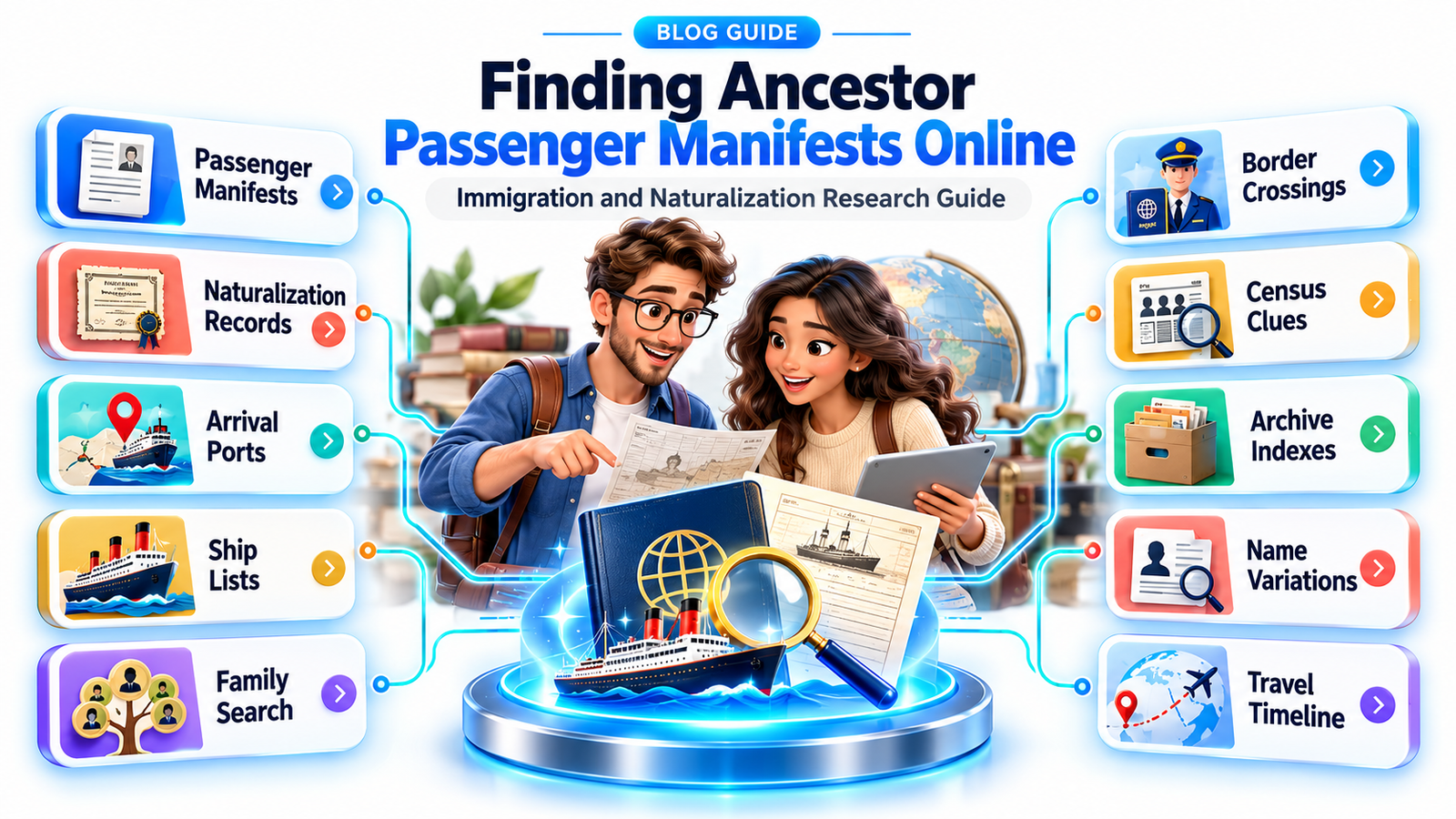
GENEALOGY RESEARCH • FAMILY HISTORY • HISTORICAL ARCHIVES
Discover immigration records, trace ancestral journeys, uncover original ship passenger lists, and build a documented family history using trusted genealogy research resources.
Research Guide
12–15 minute read
Updated October 2026


9
Imagine discovering a century-old document containing your great-grandmother’s name, the ship she traveled on, the country she left behind, and the relative waiting for her in a new country.
What once seemed like a forgotten family story suddenly becomes a documented journey.
For family historians, ancestor passenger manifests are among the most valuable historical records available. These documents can reveal where relatives originated, when they crossed international borders, who accompanied them, and where they intended to settle.
But finding the correct record is not always simple. Names were misspelled, geographical boundaries changed, families traveled through unexpected ports, and historical documents were indexed imperfectly.
The good news is that modern digital archives, immigration research guides, and specialized genealogy platforms have made these records significantly easier to locate.
Whether you are investigating Ellis Island arrivals, European emigration, American naturalization records, or a family migration route spanning several countries, this guide will help you develop a reliable research process.
More importantly, you will learn how to transform isolated historical discoveries into an organized, evidence-based account of your family’s past.
What Are Ancestor Passenger Manifests?
An ancestor passenger manifest is a historical document listing people who traveled aboard a ship or another form of transportation, usually for immigration, commercial travel, or official border-control purposes.
Passenger manifests were created by shipping operators, customs authorities, or immigration officials. The amount of information recorded varied by country, historical period, and applicable regulations.
For American family history research, the U.S. National Archives holds passenger arrival records covering approximately 1820 through December 1982, although significant gaps and access restrictions exist.
What information can you find?
Personal identity
Full name, age, sex, marital status
Place of origin
Birthplace, nationality, last residence
Travel details
Ship name, arrival date, ports
Occupation
Trade, profession, employment
Family relationships
Travel companions, relatives, contacts
Destination
Intended residence or receiving address
Fields are not universal. Earlier passenger lists often contain much less information than later immigration forms.
Consider a hypothetical passenger listed as Maria Kowalska, arriving in New York in 1911.
Her record might identify her last residence in Galicia, her father’s name, the town she departed from, and a brother living in Chicago. Those clues could connect an American census entry to European civil registration records and reveal previously unknown family members.
A passenger manifest is therefore more than proof of a journey. It is often a bridge between records on opposite sides of the world.
Why Immigration and Naturalization Records Matter
Passenger arrival records and naturalization documents serve different purposes, but they are most powerful when studied together.
Immigration records help explain how and when an individual entered a country.
Naturalization records document steps by which a foreign-born person became a citizen, where applicable.
A naturalization petition might identify a precise arrival date, ship, birthplace, spouse, or children. These details can help locate a passenger manifest that was previously difficult to find.
Conversely, an arrival record may provide identifying information that helps distinguish between several people with similar names in court naturalization files.
The U.S. National Archives notes that before September 27, 1906, American naturalization could be granted by many federal, state, municipal, and county courts. Later reforms introduced greater standardization, but earlier practices remained relevant during the transition.
The three-record method
Census or residence record
Identify an immigrant, household, birthplace, and approximate immigration year
Passenger arrival manifest
Verify travel details, family connections, and the origin of the journey
Naturalization document
Cross-check arrival claims, citizenship history, and identity details
When these sources agree, your research becomes stronger. When they disagree, the differences may reveal an inaccurate age, alternate name, different journey, or transcription error worth investigating.
Best Websites to Find Passenger Manifests Online
Not every immigration database contains the same records. Some provide searchable indexes, others display original documents, and certain collections require a subscription or archival request.
Begin with sources relevant to the ancestor’s country, arrival port, and historical period.

1. U.S. National Archives and Records Administration (NARA)
The authoritative starting point for U.S. federal passenger arrival collections, record series, port-specific finding aids, and naturalization research.
Best for: Understanding original record holdings, archival gaps, microfilm references, and official document requests.
Explore passenger arrival records

2. FamilySearch
A major free genealogy resource offering searchable immigration and naturalization collections, historical images, family trees, and research guidance.
Best for: Free searches, comparing different U.S. immigration collections, and locating related family members. Account registration or access restrictions may apply.
Browse passenger record collections

3. Statue of Liberty–Ellis Island Foundation
Its online Arrival Records Collection helps researchers explore historical passenger arrivals, including records from New York and other U.S. ports.
Best for: Searching Ellis Island-related family stories and discovering passenger records through a heritage-focused interface.

4. Ancestry
A subscription-based genealogy service offering extensive immigration databases, searchable historical records, document images, and family-history tools.
Best for: Cross-referencing passenger lists with census records, family trees, and naturalization sources.

5. The National Archives UK
An essential research resource for tracing people who entered or departed the United Kingdom.
Best for: British outgoing passenger lists, immigration history, and linking European departure records to overseas arrivals.
Read UK passenger list guidance
FamilySearch lists numerous migration and naturalization collections, while NARA identifies specific digitized collections and their host websites. The Ellis Island Foundation also offers free online searching of its Arrival Records Collection.
Practical advice: Start with the free resources before purchasing access. A paid subscription becomes more valuable when it supplies a specific missing image, searchable collection, or research feature—not merely because the first search produces no results.
How to Find an Ancestor’s Passenger Manifest: A Step-by-Step Guide
Step 1: Collect information before searching
One of the most common genealogy mistakes is beginning with only a name.
A stronger search starts with a small personal profile containing the ancestor’s approximate birth date, birthplace, spouse, parents, children, known places of residence, and possible immigration period.
Interview family members, examine old photographs and correspondence, and collect clues from marriage certificates, death records, obituaries, and census documents.
Do not assume every family story is precise. An ancestor described as arriving in 1905 might have entered in 1903, 1907, or on more than one occasion.
Step 2: Establish an approximate arrival window
Census records, marriage dates, children’s birthplaces, and naturalization petitions can help narrow the timeline.
For example, if a person appears in an overseas census in 1900 and in an American census in 1910, those dates establish a possible migration window.
If a child was born in the United States in 1906, that provides an additional clue, although it does not prove the immigrant parent was continuously present.
Start with a reasonably broad range and tighten it as evidence accumulates.
Step 3: Search names using multiple spelling variations
Immigrant names may appear in their original language, in an anglicized form, as a phonetic rendering, or with spelling mistakes introduced during transcription.
A researcher investigating an ancestor named Jan Kowalski might test variations such as Johann Kowalski, John Kowalsky, or an abbreviated given name.
Search engines and databases may support wildcards, but syntax differs between platforms.
Sample search variations
Kowalski Copy
Kowalsky Copy
Kowal* Copy
The asterisk is an illustrative wildcard pattern. Confirm the supported operators on your chosen database.
When name searches fail, search by age, approximate arrival year, birthplace, or travel companion.
Step 4: Search beyond Ellis Island
Ellis Island is famous, but it was never the only point of entry into the United States.
Immigrants arrived through Boston, Baltimore, Philadelphia, New Orleans, Galveston, San Francisco, Seattle, and many other locations.
Some entered overland from Canada or Mexico. Others traveled through one country before reaching their eventual destination.
NARA provides port-specific research listings, and FamilySearch maintains border-crossing collections that may help researchers find arrivals missing from conventional ship searches.
Step 5: Open the original document
A database result is not the same as an original passenger manifest.
Whenever possible, open the scanned source image and examine every column, including the second page or continuation sheet.
Look for handwritten corrections, crossing-out marks, passenger list numbers, destination addresses, and annotations.
A transcription might omit a relative’s name or misinterpret an unfamiliar village.
The original image provides the best opportunity to inspect what the clerk actually recorded.
Step 6: Compare the record with independent evidence
Finding a matching name is only the beginning.
Before accepting a record, compare several identifying details: age, occupation, family relationships, place of origin, destination, and date.
A matching name combined with a known sibling’s name and the correct destination is generally more persuasive than a matching name alone.
Record contradictions rather than hiding them. An incorrect date may be a transcription problem, an inaccurate original statement, or evidence that you found a different individual.
Step 7: Save the source, not just the discovery
Download or preserve the record image where permitted, and capture the collection title, record creator, repository, page or image number, date, and permanent URL if available.
Store your interpretation separately from the transcription so future researchers can distinguish what the document says from what you inferred.
This approach helps prevent the same weakly supported family-tree claims from being copied repeatedly.
How to Research Naturalization Records After Finding a Passenger Manifest
A passenger manifest establishes a potential arrival. Naturalization documents can help reconstruct the person’s later legal and residential history.
For U.S. immigration research, useful naturalization sources include declarations of intention, petitions for naturalization, court orders, certificates of naturalization, and historical immigration case files.
Understanding naturalization documents
| Record type | What it may reveal |
|---|---|
| Declaration of Intention | Birthplace, nationality, residence, and intention to seek citizenship |
| Petition for Naturalization | Family members, residence, arrival information, occupation, and witnesses |
| Certificate of Arrival | Verification of entry information in certain naturalization proceedings |
| Certificate File (C-File) | Federal copies of naturalization and related citizenship documents |
| Alien File (A-File) | Individual immigration case documents, depending on the period and file |
| Court Naturalization Index | References for locating original petitions or declarations |
These records should be interpreted according to the laws and procedures in effect at the time. Not every immigrant applied for citizenship, and not every surviving naturalization file includes all these details.
The National Archives provides guidance on historical U.S. naturalization requirements and the different courts where relevant documents may be held.
Locating historical naturalization case files
If your research involves U.S. naturalizations after 1906, investigate records maintained by the U.S. Citizenship and Immigration Services (USCIS).
Its historical genealogy resources include the Certificate File period from September 27, 1906, through March 31, 1956, along with other categories of historical immigration documentation. Researchers may need an index search or a specific identifying file number before requesting a record. Availability, fees, and access requirements should be checked directly with USCIS.
Explore the official USCIS Genealogy Program.
For earlier naturalizations, examine local court archives, state archives, historical societies, and the appropriate federal archival collections.
Tracing Immigration Beyond the United States
An effective family history project does not end at the arrival port.
The same ancestor may appear in departure registers, border-crossing records, settlement documents, census records, and church registers.
For example, someone who arrived in America from England may have been born in Ireland, worked in Liverpool, and traveled through Canada before settling in Chicago.
Each stage may require a different collection.
British passenger departures and arrivals
The UK National Archives identifies two particularly valuable record groups:
- BT 26: Incoming passenger lists, 1878–1960.
- BT 27: Outgoing passenger lists, 1890–1960.
These collections have geographical and historical limitations. In particular, they mainly concern travel between the UK and places outside Europe and the Mediterranean, rather than every possible passenger movement.
European departure records
For ancestors who departed from Germany, Poland, Italy, Scandinavia, or regions of the former Russian and Austro-Hungarian empires, research may involve:
- National and municipal archives
- Historical port departure lists
- Church and civil registration records
- Emigration permission documents
- Overseas consular records
The historical country recorded on a passenger manifest may differ from the modern country containing the person’s birthplace.
This distinction is especially important when researching migration from regions with changing political borders.
Canadian and Mexican border crossings
Researchers should also examine overland immigration records.
NARA identifies Canadian border crossing documentation beginning in the 1890s and Mexican border crossing records beginning in the early twentieth century, with collection-specific variations.
A missing ocean passenger record does not necessarily mean an ancestor never immigrated. Their recorded entry into the destination country may have occurred at a land border.
Seven Common Passenger Manifest Research Mistakes
Even experienced family historians encounter misleading search results. Understanding these problems can prevent unnecessary research expenses and incorrect family-tree connections.
Mistake 1: Assuming an exact name match proves identity.
Several immigrants may share the same name. Compare family members, ages, residences, and destinations before drawing conclusions.
Mistake 2: Searching only Ellis Island records.
The correct arrival might appear in Boston, Baltimore, Philadelphia, or another port.
Mistake 3: Ignoring the second page of a manifest.
Continuation pages may contain important details, including relatives, destinations, and additional identifying information.
Mistake 4: Treating every crossed-out name as a successful arrival.
A crossed-out passenger might not have sailed. NARA explains that marks such as “N.O.B.” can indicate “Not on Board.”
Mistake 5: Assuming an ancestor’s surname was changed at Ellis Island.
Names were subject to transcription errors, different languages, spelling conventions, and later personal changes. A name difference alone does not prove that an immigration official renamed someone.
Mistake 6: Ignoring original handwriting.
A handwritten entry can be difficult to read, and an online transcription may introduce further errors. Always inspect the original image when available.
Mistake 7: Failing to document unsuccessful searches.
If a collection was searched without success, record the search terms, date, historical coverage, and results. This prevents repeated work and helps identify gaps in the research strategy.
Build a Reliable Genealogy Research Asset Library
Finding an ancestor passenger manifest is an exciting achievement. Preserving and organizing that information is equally important.
A structured digital archive allows family historians to investigate several generations without losing the relationship between documents, people, and historical locations.
It also makes collaborating with relatives easier.
Essential genealogy research assets
Passenger manifest archive
Store original document images, searchable transcriptions, source citations, and analysis notes.
Immigration timeline spreadsheet
Track arrivals, departures, marriages, residence changes, and naturalization dates chronologically.
Family relationship tracker
Connect immigrants to spouses, children, traveling companions, relatives, and sponsors.
Source verification checklist
Evaluate record authenticity, conflicting evidence, historical context, and identification confidence.
Research journal
Document questions, unsuccessful searches, archive contacts, and the next steps in each investigation.
A practical immigration research spreadsheet
Your research tracker does not need to be complicated. Begin with a small number of fields that allow records to be searched and compared consistently.
| Field | Example |
|---|---|
| Ancestor name | Maria Kowalska |
| Approximate birth year | 1885 |
| Birthplace | Galicia |
| Arrival year | 1911 |
| Arrival port | New York |
| Ship | To be verified |
| Destination | Chicago |
| Record status | Candidate match |
| Source | Passenger database and original image |
| Next action | Confirm family relationship |
Illustrative entries only; these are not verified details for a real individual.
For larger family history projects, Excel, Google Sheets, Airtable, or a dedicated genealogy application can help manage growing collections of records.
A useful rule is to maintain a unique identifier for every ancestor and every source. That way, people with similar names are less likely to become accidentally merged.
A Practical Example: Reconstructing One Immigrant’s Journey
Consider a fictional family researcher investigating Antoni Nowak, believed to have emigrated from Central Europe around 1910.
The family remembers that Antoni eventually settled in Pennsylvania, but nobody knows where he was born or which ship transported him.
First discovery: An American census
A census provides a probable birth year of 1887 and an immigration year of 1912.
The researcher records both facts as provisional because census entries may contain reporting errors.
Second discovery: A possible passenger manifest
A search returns an Anton Nowak arriving in New York in 1913.
His age is consistent with the census, and his stated destination is Pennsylvania.
However, those two details alone do not establish identity.
Third discovery: A family connection
The scanned passenger list names an American contact whose surname corresponds to a known relative.
The researcher investigates the relationship using additional household records.
Fourth discovery: Naturalization papers
A naturalization petition supplies a birth location and a date of entry that can be compared against the candidate passenger manifest.
Agreement across several independent details strengthens the identification.
Fifth discovery: Records from the place of origin
Armed with a likely birthplace, the researcher searches local parish registers and civil records.
A possible birth entry identifies Antoni’s parents and opens a new branch of the family history.
This example demonstrates an important principle: successful immigration research depends less on finding one impressive document than on building a chain of supporting evidence.
A Seven-Day Plan to Start Your Immigration Research
A short, focused research schedule can produce better results than repeatedly searching the same databases without a clear question.
Your research checklist
0 of 7 complete
Day 1: Create an ancestor profile
Collect names, family relationships, likely birthplaces, and dates.
Day 2: Build an immigration timeline
Use census records, family papers, and vital records to narrow the arrival period.
Day 3: Search free passenger collections
Use FamilySearch, the Ellis Island Foundation, and relevant archive indexes.
Day 4: Inspect original manifests
Review image pages, annotations, associated passengers, and destinations.
Day 5: Investigate naturalization sources
Identify relevant court records and immigration case-file collections.
Day 6: Verify conflicting information
Compare alternate names, birthplaces, ages, and travel records.
Day 7: Organize discoveries and next steps
Create source citations, update the family timeline, and choose the next research question.
Copy planReset
Advanced Strategies for Difficult Immigration Cases
When ordinary passenger record searches fail, the next step should be to improve your research strategy rather than repeat the same query.
Search family groups rather than individuals
A passenger may have traveled with a spouse, child, cousin, neighbor, or future in-law.
Search the names of known relatives independently. Their manifests may contain clearer information or references to your target ancestor.
Examine historical geography
Modern place names can differ considerably from those recorded in immigration documents.
Use historical maps and gazetteers to determine which administrative district, empire, or province controlled an ancestor’s birthplace at the relevant time.
This can dramatically improve searches of European church and civil registration collections.
Investigate repeated journeys
Some immigrants returned temporarily to their country of origin, traveled for business, or sponsored later migration by relatives.
The first passenger record discovered may represent a second or third Atlantic crossing.
Compare records in both directions
An overseas arrival manifest and a corresponding European departure record may describe the same journey differently.
Where both survive, comparison can reveal additional names, dates, or locations.
Look beyond online indexes
Not every surviving historical document has been scanned or indexed.
Some records remain in physical archives, manuscript collections, microfilm holdings, local court offices, or specialized repositories.
A negative online search means only that the searched resource did not produce a match under the search conditions used. It does not prove the historical record never existed.
When Is a Paid Genealogy Research Tool Worth Buying?
Free immigration research resources are often sufficient for an initial investigation. However, paid tools may become useful when researchers need additional historical collections, stronger search capabilities, professional assistance, or structured record management.
Before buying a subscription, genealogy template, passenger manifest research workbook, or family history research guide, ask whether it will solve a specific problem.
A useful product should provide some combination of comprehensive search instructions, original-source references, reusable worksheets, evidence-tracking fields, and clear explanations of how to interpret results.
For researchers managing multiple immigrant ancestors, a genealogy research asset bundle might include a passenger manifest tracker, naturalization research checklist, historical timeline, citation organizer, and family migration map worksheet.
The value of a digital genealogy product is not the number of pages it contains, but how much uncertainty, duplicated effort, and lost information it helps eliminate.
Start with free official archives, then invest only when a tool meaningfully strengthens the research process.
Frequently Asked Questions
1. Can I find my ancestor’s passenger manifest online for free?
Yes. FamilySearch, the Statue of Liberty–Ellis Island Foundation, and the U.S. National Archives provide free access to various searchable indexes, archival descriptions, and digitized immigration records. However, individual collections may have image-access limitations, registration requirements, or gaps in coverage.
2. What if I do not know the ship’s name or arrival date?
Start with census records, naturalization petitions, family correspondence, birth and marriage certificates, and obituaries. Use this information to estimate an arrival period, then search relevant ports using name variations, age, birthplace, and family relationships. The ship’s name can sometimes be discovered through the manifest itself.
3. Why can’t I find my ancestor in Ellis Island records?
Your ancestor may have entered through another port, traveled through Canada or Mexico, arrived outside the date range of a particular collection, or appeared under a different name spelling. Also consider missing records, incomplete indexing, and historical errors.
4. Do naturalization records prove when an ancestor immigrated?
Naturalization documents can provide valuable arrival information, sometimes including a date, port, and vessel. However, recorded statements should still be checked against original passenger documents and other independent sources. A naturalization document does not automatically establish that every stated fact is accurate.
5. What is the best way to organize passenger manifests and genealogy research documents?
Create an individual folder or digital record for each ancestor, preserve the original source image, maintain full citations, and use a research spreadsheet to track discoveries, contradictions, and next actions. Separate confirmed findings from tentative matches and keep secure backups of important research files.
Turn Your Family’s Immigration History Into a Lasting Legacy
A passenger manifest might begin as a simple handwritten name on a crowded sheet of paper.
Yet that name may lead to a birthplace, an unfamiliar village, a forgotten sibling, or a family journey that shaped several generations.
With reliable immigration research guides, careful source comparison, and organized genealogy research assets, family historians can move beyond speculation and build a documented account of their ancestors’ experiences.
Choose one immigrant ancestor. Gather the facts already known about that person. Identify the most likely travel period and port of arrival. Then explore the relevant collections using a consistent research method.
Even when the first search produces no results, the investigation itself can reveal what evidence is missing and where to look next.
The goal is not simply to collect historical records. It is to preserve an accurate and meaningful family history that future generations can understand, examine, and continue.
Continue exploring: After locating a passenger manifest, investigate the ancestor’s naturalization records, historical birthplace, and family connections. Each discovery can lead to an entirely new research question.
Compliance Note: Historical Records, Privacy, Copyright, and Research Accuracy
This article is provided for general historical, educational, and genealogical research purposes. It is not legal advice, official immigration guidance, or proof of eligibility for citizenship, ancestry-based nationality claims, inheritance, or other legal benefits.
Historical immigration documents may contain inaccurate information, incomplete personal details, outdated geographical terminology, discriminatory historical classifications, or conflicting records. Researchers should verify findings against original records and independent evidence before drawing conclusions.
Access to some immigration and naturalization files may be limited by privacy laws, archival policies, retention rules, or proof-of-death requirements. Avoid publicly distributing sensitive personal information about living individuals without appropriate authorization. The U.S. National Archives notes that certain recent arrival records have restricted access.
Digitized scans, historical photographs, database transcriptions, and archival images can carry separate reproduction rights, contractual restrictions, or attribution requirements. A historical document being old does not automatically mean every modern scan, website image, or database compilation is available for unrestricted commercial reuse.
Icons used in this article are standard Lucide-style outline symbols. Lucide is distributed under the ISC license, which permits commercial use subject to its license conditions. For reuse outside this article, obtain the icons from the official Lucide license and attribution information and comply with the applicable terms.
Genealogy platforms, databases, prices, and service conditions may change. Consult official providers before ordering documents, purchasing services, or relying on a record for legal purposes.
Search-engine visibility, Google Discover inclusion, ranking improvements, reader retention, and commercial conversions cannot be guaranteed by keyword selection or article formatting alone. These depend on content usefulness, trustworthiness, technical implementation, competition, and search-platform systems.
Stay ahead with exclusive updates
Join our community. Get curated industry trends, actionable guides, and fresh resources delivered straight to your inbox.