Affiliate Marketing for Beginners: How to Earn Commissions While You Sleep
Imagine waking up, checking your email, and discovering that someone purchased a product through a recommendation you shared days ago. You weren’t online when the sale happened. You didn’t handle customer support, pack a box, or process a payment. Yet your recommendation generated a commission.
That is the appeal of affiliate marketing.
For beginners looking to build an online income stream without creating their own products, affiliate marketing offers an accessible business model. You recommend useful products or services, connect interested buyers with trusted businesses, and earn commissions when qualifying actions take place.
But here is what many exciting success stories leave out: affiliate income doesn’t become passive simply because you publish a link.
Successful affiliate marketers spend time researching products, understanding audiences, publishing helpful content, improving their websites, and building credibility. The possibility of earning commissions while you sleep comes after you’ve created something valuable that continues working when you’re offline.
The encouraging news? You don’t need to be a celebrity, a programming expert, or an experienced salesperson to begin.
You need a focused topic, a reliable affiliate program, an audience with real problems, and a willingness to provide answers people can trust.
This guide explains how affiliate marketing for beginners works, how to choose profitable opportunities responsibly, how to attract potential buyers, and how to gradually develop a sustainable passive affiliate income system.
What Is Affiliate Marketing and How Does It Work?
Affiliate marketing is a performance-based marketing model in which businesses reward independent publishers, creators, or marketers for generating qualifying sales, leads, or other agreed actions.
Instead of manufacturing products or managing inventory, you introduce customers to products that may solve their problems.
When someone takes an eligible action through your tracked affiliate link, the business pays you a commission according to its program rules.
Understanding the Affiliate Marketing Process
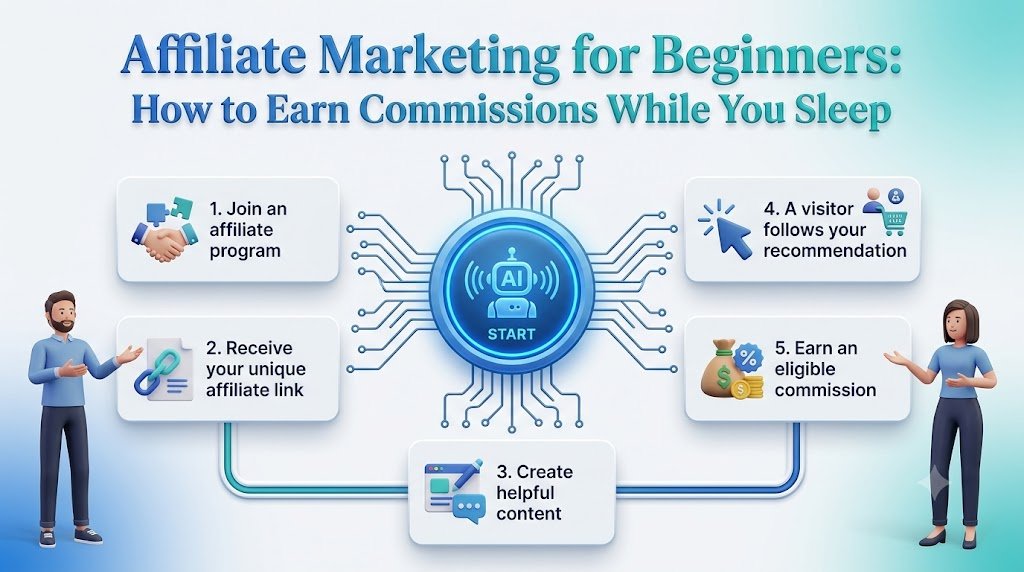
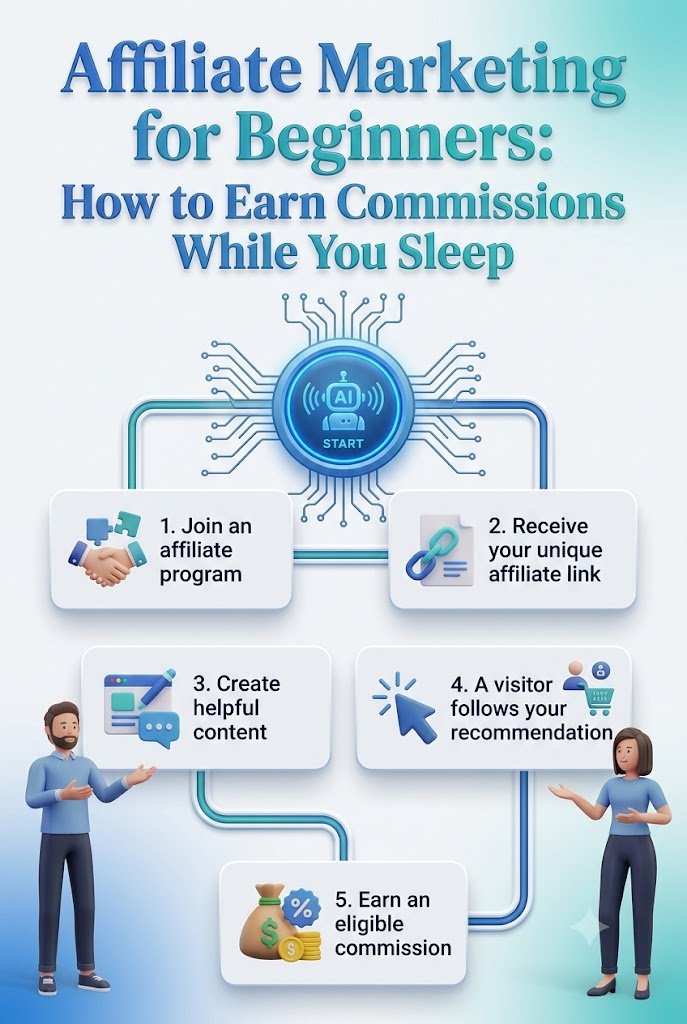
The process generally involves five stages.
Step 1: Join an affiliate program.
Register with a company or affiliate network offering products relevant to your audience.
Step 2: Receive your unique affiliate link.
After approval, the program provides a tracking link that helps attribute eligible customer actions to your account.
Step 3: Create helpful content.
Publish tutorials, comparisons, buying guides, videos, newsletters, or other resources that naturally introduce the product.
Step 4: A visitor follows your recommendation.
A reader clicks your affiliate link and visits the merchant’s website.
Step 5: Earn an eligible commission.
If the visitor completes a qualifying purchase or another eligible action under the program’s terms, you may earn a commission.
Tracking windows, cookie rules, attribution methods, exclusions, reversals, and payment schedules differ between programs.
A Simple Affiliate Commission Example
Suppose you operate a website about productivity software.
You publish an article explaining how freelancers can organize their projects more efficiently.
Inside the article, you recommend a project management tool with a hypothetical $100 subscription and a 20% commission on eligible purchases.
If a reader purchases through your affiliate link, your commission would be $20.
If ten eligible customers purchased under the same terms, that would generate $200 in gross affiliate commissions.
These figures are illustrative rather than an earnings prediction. Real commissions can change because of refunds, fees, tracking limitations, program terms, and other factors.
The important lesson is that one genuinely useful article can potentially introduce multiple customers to a product over time.
Can You Really Earn Affiliate Commissions While You Sleep?
Yes, an affiliate link can generate a qualifying sale while you’re offline.
However, generating occasional commissions and building dependable passive income are very different achievements.
Affiliate income usually begins as active work. You research audience questions, create content, earn visibility, and learn which recommendations readers find valuable.
Over time, some of your existing content may continue attracting visitors without requiring constant attention.
Consider a practical example.
You publish a detailed article titled “Best Budget Microphones for Beginners Starting a Podcast.”
The article explains microphone types, common recording problems, connection options, budget considerations, and which features matter most.
A visitor discovers your guide through a search engine at midnight, compares your recommendations, and purchases a microphone through your affiliate link.
You might earn a commission without being online at the time of purchase.
The sale was automated, but the research, content creation, and trust-building came first.
The goal is not to eliminate work. It is to create valuable resources whose usefulness can extend beyond the hours you spend producing them.
Why Affiliate Marketing Is Attractive to Beginners
Affiliate marketing provides several advantages compared with traditional product-based businesses.
1. No Need to Create Your Own Products
You can promote products already developed by established businesses.
This reduces the need to invest in manufacturing, packaging, inventory, or product development.
2. Relatively Low Startup Costs
Beginners can start publishing on certain free platforms, although a self-hosted website, domain name, email service, and research tools may involve ongoing expenses.
An expensive website or premium software subscription is not necessary to test your first content idea.
3. Flexible Working Hours
You can research and publish affiliate content around other responsibilities.
Your articles, videos, and approved promotional materials can remain accessible when you’re offline.
4. Opportunities Across Multiple Industries
Affiliate programs exist in technology, education, home improvement, travel, lifestyle, professional services, and numerous other industries.
You can focus on a topic that matches your expertise or genuine interests.
5. Potential for Long-Term Growth
Useful evergreen content can continue bringing visitors over time, particularly when it remains accurate and relevant.
However, search rankings, referral traffic, and commissions are never guaranteed.
How to Start Affiliate Marketing for Beginners: A Practical Step-by-Step Guide
Step 1: Choose a Niche With Real Customer Demand
A niche is a focused subject that attracts people with shared interests, challenges, or purchasing needs.
Choosing the right niche helps you create relevant content and identify suitable products.
Rather than building a general website promoting unrelated items, focus on an audience you can understand and serve.
For example, “technology” is a broad niche.
“Affordable productivity tools for freelance designers” is more specific.
A focused niche makes it easier to understand the questions people ask before purchasing.
Beginner-Friendly Affiliate Marketing Niches
| Niche | Example Products | Useful Content |
|---|---|---|
| Productivity | Project tools, planners | Software comparisons |
| Home office | Desks, chairs, monitors | Workspace buying guides |
| Photography | Cameras, editing software | Equipment tutorials |
| Education | Courses, learning platforms | Study resource comparisons |
| Blogging | Hosting, themes, software | Website setup tutorials |
| Travel | Accessories, booking tools | Practical travel guides |
| Digital creativity | Design tools, templates | Workflow demonstrations |
| Gardening | Tools, planters, equipment | Beginner gardening guides |
A niche should not be selected solely because someone claims its commissions are high.
Evaluate demand, product quality, competition, your ability to offer useful insights, and whether people regularly need purchasing advice.
Practical exercise: Write down five problems your ideal reader encounters. Then identify products or services that might help solve those problems.
If you can generate twenty genuinely helpful content ideas around those questions, you may have a workable niche.
Step 2: Find Trustworthy Affiliate Programs
Once your niche is clear, identify merchants with relevant products and reputable affiliate programs.
Well-known places to investigate include:
- Amazon Associates: A product-focused affiliate program for eligible publishers recommending qualifying merchandise.
- Awin: An affiliate marketing network connecting publishers with participating advertisers.
- CJ Affiliate: A network providing access to participating brands and performance-based partnerships.
- Impact: A partnership platform used by companies to manage various affiliate relationships.
- PartnerStack: A partnership platform commonly associated with software and B2B products.
- Direct company programs: Some businesses operate affiliate programs independently.
Availability, regional eligibility, approval criteria, commission structures, and permitted promotional methods vary. Applying does not guarantee acceptance.
Before joining any program, review its official terms carefully.
Look for a legitimate business, relevant products, clear commission rules, reliable reporting, reasonable payment conditions, and responsive support.
Avoid opportunities requiring you to purchase expensive training merely to unlock the possibility of earning commissions. Be especially cautious of arrangements focused primarily on recruiting new participants instead of selling genuine products or services.
Step 3: Understand Affiliate Commission Structures
Not every affiliate program rewards the same action.
| Commission Model | How It Works | Typical Application |
|---|---|---|
| Pay per sale | Commission on qualifying purchases | Products and subscriptions |
| Pay per lead | Payment for eligible lead actions | Selected service campaigns |
| Recurring commission | Commission on qualifying subscription renewals | Some software products |
| Fixed bounty | Set payment for a defined conversion | Specific signup offers |
| Tiered commission | Rates change with qualifying performance | Selected partner programs |
Recurring commissions can appear attractive, but some programs limit the number of renewals, change terms, or discontinue payments.
A high percentage commission is also not automatically better than a lower one.
For example, a trustworthy $200 product with a hypothetical 10% commission can generate the same $20 commission as a $50 product offering 40%.
Conversion likelihood, refunds, product value, and audience suitability all matter.
Step 4: Choose Your Main Content Platform
Your content platform is where visitors encounter your recommendations.
You can begin with a blog, YouTube channel, newsletter, or suitable social media platform.
Blog or website: Particularly useful for evergreen tutorials, product comparisons, and educational articles that may attract search traffic.
YouTube: Suitable for hands-on demonstrations, screen recordings, product tutorials, and detailed explanations.
Pinterest: Can help people discover relevant visual content, tutorials, and guides, subject to platform and affiliate-program rules.
Email newsletter: Helps you maintain a direct relationship with subscribers who have opted in to receive your messages.
Social media: Useful for conversations, demonstrations, and developing familiarity with your expertise, although platform reach can fluctuate.
Beginners often spread themselves too thin by launching several channels simultaneously.
A more manageable approach is to establish one main platform and gradually support it with another channel.
For someone building an evergreen content business, a useful combination may be a niche website and an opt-in email newsletter.
Step 5: Create Content That Solves Problems Before Promoting Products
This is where affiliate marketing becomes a genuine content business.
People rarely search the internet because they want to click somebody’s affiliate link.
They search because they need information, reassurance, comparisons, solutions, or buying guidance.
Your content should meet that need before requesting a sale.
Consider the difference between two article approaches.
Weak approach: “Buy This Amazing Productivity App Today!”
Helpful approach: “How to Choose a Productivity App for a Two-Person Freelance Team.”
The second title promises a practical decision-making framework.
Inside that article, you could explain the features small teams need, common subscription costs, collaboration limitations, privacy considerations, and the types of customers for whom particular tools may be unsuitable.
This helps readers make their own informed decisions.
Five Content Formats That Work Well for Affiliate Marketing
Product reviews: Explain what a product does, who might benefit, key advantages, limitations, and relevant alternatives. Distinguish firsthand testing from research.
Comparison articles: Help readers choose between products based on budget, features, suitability, and trade-offs.
Step-by-step tutorials: Demonstrate how to solve a problem and introduce relevant tools where they genuinely help.
Buying guides: Explain essential product specifications and common purchasing mistakes.
Resource collections: Organize helpful products around a specific need, such as essential tools for beginning freelance designers.
The most durable affiliate content helps visitors even when they do not buy anything.
How to Find Affiliate Marketing Keywords That Attract Potential Buyers
Successful affiliate content connects audience needs with the language people actually use.
A beginner researching home office equipment might search for:
“Best affordable desk setup for a small apartment.”
Someone closer to purchasing may search for:
“Standing desk vs regular desk for working from home.”
Another person may look for:
“Is an adjustable standing desk worth buying?”
These searches signal different information needs.
Rather than repeating the same phrase throughout an article, create content that directly addresses the reader’s question.
Understand the Four Main Search Intent Categories
| Search Intent | Example Search | Suitable Content |
|---|---|---|
| Informational | How does affiliate marketing work? | Beginner tutorial |
| Commercial investigation | Best affiliate networks for bloggers | Comparison guide |
| Transactional | Project management software pricing | Pricing-focused guide |
| Navigational | Official product partner program | Brand information |
Commercial investigation searches are particularly relevant because readers are actively evaluating choices.
However, informational content can attract an audience earlier in the decision-making process and build credibility over time.
Where to Discover Content Ideas
Start by reviewing autocomplete suggestions, related search questions, industry forums, product documentation, customer support questions, and public discussions.
Reddit communities can reveal the language people use when describing frustrations, but they should be treated as research sources rather than places to drop unsolicited affiliate links.
Free versions of keyword research tools and Google Search Console can also help you understand existing search performance.
Look for specific questions you can answer exceptionally well, rather than concentrating only on the highest-volume keywords.
Build an Affiliate Content System That Can Work Around the Clock
A sustainable affiliate business needs more than individual articles.
It benefits from a connected collection of helpful resources.
Imagine your niche is digital tools for independent professionals.
You publish a main educational guide titled “How to Organize a Freelance Business.”
That guide naturally introduces several related resources:
- A tutorial about project management workflows.
- A comparison of invoicing tools.
- A guide to creating client proposals.
- A checklist for choosing cloud storage.
- A resource about managing recurring expenses.
Each supporting article addresses a distinct problem.
Internal links connect the resources so visitors can explore related questions without starting their research again.
This approach can improve website navigation and give readers additional reasons to return.
Build a Helpful Content Journey
A new visitor might first discover your beginner guide.
Later, they might read your comparison article, subscribe to your newsletter, and eventually make a purchasing decision.
Not every visitor follows this path, and not every reader becomes a customer.
Your responsibility is to make each interaction useful.
A well-organized website should make it easy to discover related articles, evaluate recommendations, and understand how the website earns revenue.
How to Recommend Products Without Sounding Like a Salesperson
The most effective affiliate recommendations often feel like helpful guidance rather than advertisements.
A strong recommendation explains four things:
The problem: What challenge is the reader trying to overcome?
The solution: How does the product address that challenge?
The limitation: When might the product be inappropriate, unnecessary, or less suitable?
The next step: Where can the reader verify current features, eligibility, and pricing?
For example:
“If your freelance projects regularly involve client approvals and shared deadlines, a collaborative task management tool may help keep your work organized. Before subscribing, compare its guest-access limits, automation allowances, and total monthly cost.”
A relevant affiliate link can follow that explanation, accompanied by a clear commission disclosure.
This approach respects reader judgment.
Use Calls to Action That Match the Reader’s Decision
Effective calls to action do not need exaggerated promises.
Consider these examples:
For a software review: “Explore Current Features and Pricing.”
For a product comparison: “Compare the Available Options.”
For a tutorial: “View the Tool Used in This Guide.”
For a resource page: “Check Product Details and Compatibility.”
For a newsletter: “Get the Beginner’s Weekly Affiliate Marketing Checklist.”
These prompts work best when they direct readers to something genuinely relevant to their immediate needs.
Avoid artificial countdowns, invented stock shortages, or unsupported claims about discounts and savings.
How to Increase Affiliate Conversions Without Increasing Traffic
Many beginners focus almost entirely on getting more visitors.
Traffic matters, but attracting readers who find your content irrelevant will not produce strong results.
Improving the experience for the visitors you already have may be more useful.
Make Comparisons Easier
Use clear tables that summarize pricing models, core features, requirements, and limitations.
Keep any price information current and comply with individual affiliate programs’ display rules.
Explain Who Should Not Buy
Readers appreciate recommendations that acknowledge limitations.
An article titled “Who Should Skip an Expensive Project Management Subscription?” may build more confidence than an article praising every available feature.
Place Recommendations in Context
Introduce a product after explaining the problem it solves.
An affiliate link placed inside useful information provides more context than an unrelated banner.
Improve Mobile Readability
Use descriptive headings, readable text, short paragraphs, clear links, and tables that work on small screens.
Avoid intrusive pop-ups that prevent visitors from reading.
Build Trust Across Multiple Visits
Offer a genuinely useful newsletter, downloadable checklist, or updated resource collection.
Returning visitors often appreciate consistent editorial standards, visible update dates, and content that answers new questions.
Affiliate Marketing Income: What Can Beginners Realistically Earn?
There is no dependable standard income for new affiliate marketers.
Some earn nothing, some generate occasional commissions, and others build businesses with significant revenue.
Actual results depend on audience demand, competition, content quality, referral traffic, product suitability, commission terms, attribution, and conversion rates.
You can understand the basic economics through a simple illustration.
Affiliate commissions = eligible sales × average commission per sale
Suppose a website receives 2,000 visits in a month.
If 10% of visits result in an affiliate-link click, that produces 200 outbound clicks.
If 3% of those clicks lead to qualifying purchases, that produces six sales.
At an average commission of $15 per sale, gross commission revenue would be $90.
This is an invented scenario for explaining the calculation, not an expected beginner result.
Illustrative Monthly Affiliate Income Scenarios
| Monthly Visits | Affiliate Click Rate | Purchase Rate After Click | Commission Per Sale | Gross Commissions |
|---|---|---|---|---|
| 500 | 10% | 2% | $10 | $10 |
| 2,000 | 10% | 3% | $15 | $90 |
| 5,000 | 12% | 3% | $20 | $360 |
| 10,000 | 15% | 4% | $25 | $1,500 |
These hypothetical examples assume all resulting purchases qualify and do not account for refunds, rejected commissions, operating expenses, taxes, or program changes.
The numbers demonstrate how several factors combine. They do not establish typical outcomes.
Instead of obsessing over an arbitrary monthly earnings goal, concentrate on useful measurements such as qualified visits, affiliate clicks, content engagement, conversion rates, and approved commissions.
Affiliate Marketing Mistakes That Can Cost Beginners Money
Promoting Too Many Unrelated Products
Recommending everything can make a website seem unfocused.
Develop a coherent theme and select products that genuinely serve your audience.
Choosing Offers Only for High Commissions
A large commission cannot compensate for a product that disappoints customers or does not fit their needs.
Consider reliability, customer support, refund policies, and merchant reputation.
Publishing Generic AI-Generated Reviews
AI can help organize outlines, clarify explanations, and identify topics requiring research.
However, it should not be used to invent firsthand testing, fabricate customer experiences, or generate unsupported product comparisons.
Verify specifications, features, availability, and product claims before publishing.
Ignoring Affiliate Program Rules
Some programs restrict paid advertising, email promotion, link placement, trademark bidding, or the use of their promotional materials.
Review applicable policies before sharing links.
Expecting Immediate Passive Income
An affiliate website is not an instant-income machine.
The initial effort may produce little or no revenue. Search visibility and audience development can take time, and sustained results are uncertain.
Relying Entirely on One Traffic Source
Traffic from one search engine or social platform can fluctuate.
Gradually building a newsletter or a second suitable discovery channel may reduce dependence on a single platform.
Forgetting to Update Content
Products change.
Prices, features, affiliate terms, and availability may become outdated.
Review your most important articles periodically, and clearly indicate when substantive updates occur.
A Practical 30-Day Affiliate Marketing Launch Plan
A structured first month can help you move from researching an idea to publishing a small but useful collection of content.
Week 1: Research and Positioning
Day 1: Select one audience you want to serve.
Day 2: List common problems that audience experiences.
Day 3: Research relevant product categories.
Day 4: Investigate legitimate affiliate programs.
Day 5: Review competing resources and identify information gaps.
Day 6: Choose a main publishing platform.
Day 7: Outline your first five content pieces.
Week 2: Build Your Publishing Foundation
Day 8: Set up your website or chosen publishing channel.
Day 9: Create a clear About page.
Day 10: Prepare a visible affiliate disclosure.
Day 11: Add an appropriate privacy policy and contact method.
Day 12: Research your first educational article.
Day 13: Write and edit that article.
Day 14: Publish and review the article on mobile devices.
Week 3: Develop Helpful Affiliate Content
Day 15: Research a buyer-focused question.
Day 16: Draft an original product comparison.
Day 17: Verify relevant product details and limitations.
Day 18: Publish your comparison with appropriate disclosures.
Day 19: Write a tutorial addressing another related problem.
Day 20: Add useful internal links between existing articles.
Day 21: Review all published pages for accuracy and readability.
Week 4: Improve Discovery and Audience Retention
Day 22: Configure appropriate traffic analytics.
Day 23: Review your existing titles and article descriptions.
Day 24: Create a simple opt-in resource or newsletter concept.
Day 25: Publish another evergreen article.
Day 26: Repurpose useful insights for one appropriate social platform.
Day 27: Check affiliate links and relevant program rules.
Day 28: Examine initial engagement data without expecting immediate sales.
Day 29: Identify the next questions your audience needs answered.
Day 30: Plan your next month’s articles and content updates.
Your first 30-day milestone should be a functioning content system—not a promised income figure.
Even without a sale, you can make meaningful progress by establishing a focused website, publishing useful resources, and learning how visitors respond to your work.
How to Turn First-Time Visitors Into Returning Readers
A first-time website visitor may not yet be ready to purchase anything.
They may simply be researching an unfamiliar topic.
Instead of pushing them toward an immediate sale, give them a reason to continue learning from you.
Offer a Useful Free Resource
For an affiliate marketing website, examples include:
- A beginner’s affiliate program evaluation checklist.
- A niche research worksheet.
- A product comparison template.
- A simple commission-tracking spreadsheet.
- A monthly content planning checklist.
Each resource should solve a small, concrete problem.
Create a Helpful Newsletter
A newsletter can share new tutorials, updated comparisons, practical lessons, and relevant resources.
Invite readers to subscribe voluntarily and explain what they can expect.
A suitable invitation might be:
“Building your first affiliate website? Get one practical lesson each week to help you research better products, publish more useful content, and avoid common beginner mistakes.”
This promise offers continuing value without presenting subscribers with unrealistic income expectations.
Publish Connected Learning Guides
Arrange articles in a logical learning sequence.
For example, a reader who finishes your niche selection guide could continue to a tutorial about evaluating affiliate programs.
Someone researching keyword ideas could move to your content planning worksheet.
Give readers a clear next step that makes sense for their current level.
How to Measure Affiliate Marketing Performance
Measuring results helps you identify what is useful and what needs improvement.
Key Metrics Worth Tracking
Website visits: The number of visits your content receives.
Engaged visits: Visits showing meaningful interaction with your pages.
Affiliate link clicks: How often readers follow tracked recommendations.
Click-through rate: The percentage of relevant page visits that generate an affiliate click.
Affiliate conversions: The number of attributed actions that satisfy program rules.
Approved commissions: Earnings confirmed by the merchant or network.
Revenue per qualifying click: Approved commission revenue divided by eligible outbound clicks, where the data is available.
A Simple Performance Example
Imagine two articles.
Article A receives 1,000 visits and generates 10 affiliate clicks.
Article B receives 250 visits and generates 25 affiliate clicks.
Article B has a higher affiliate click-through rate, even though it attracts fewer visitors.
That difference may suggest its readers have stronger buying intent or find its recommendations more relevant.
However, clicks alone do not establish profitability.
Examine approved commissions, reader satisfaction, and the quality of the recommended products before deciding which content deserves more attention.
Advanced Ways to Develop Passive Affiliate Income
Once you’ve built a foundation, several strategies may help make your work more efficient.
Create Evergreen Content Libraries
Prioritize problems people may continue encountering in future months or years.
Examples include beginner tutorials, terminology guides, troubleshooting articles, and educational comparisons.
Keep them updated when products or standards change.
Recommend Complementary Products
A guide to setting up a home recording studio might cover microphones, headphones, acoustic treatment, and editing tools.
Explain the importance of each item and identify which purchases are optional.
Avoid encouraging unnecessary spending just to increase the number of affiliate transactions.
Use Automation for Administrative Tasks
Appropriate tools can help schedule editorial reminders, organize research, analyze website performance, and identify links that need checking.
Automation should not replace factual verification or disclosure compliance.
Develop Firsthand Expertise
When practical, test products yourself.
Take original screenshots, document meaningful limitations, record demonstrations, or describe how a product performed in a particular workflow.
When hands-on testing is not possible, explain the research methods and sources behind your comparison.
Reinvest Carefully
Once a project generates revenue, some earnings might fund better equipment, professional editing, software, or audience research.
Evaluate the expected benefit of each expense rather than assuming more subscriptions automatically create more income.
Frequently Asked Questions About Affiliate Marketing
1. Can I start affiliate marketing with no money?
You can begin learning, researching niches, and publishing on certain free platforms without significant upfront costs.
However, some affiliate programs require an established website, eligible social presence, or other qualifying conditions. A domain, hosting, or additional tools may also become useful as your project grows.
Starting cheaply is possible, but earning money is not guaranteed.
2. How long does it take to earn the first affiliate commission?
There is no reliable universal timeline.
Some beginners may earn commissions quickly through an existing audience. Others may spend months publishing without generating a qualifying sale.
Results depend on traffic quality, audience trust, content relevance, program terms, and many other factors.
3. Do I need a website to start affiliate marketing?
Not always.
Some programs permit eligible social media accounts, video channels, or other approved publishing platforms.
A website can be useful because it provides more control over content organization and branding, but you must confirm that your chosen affiliate program accepts your promotional methods.
4. Is affiliate marketing genuinely passive income?
Affiliate marketing can produce commissions when you are not actively working, but it is usually not completely passive.
Research, content updates, audience development, technical maintenance, compliance, and program management may require continuing effort.
It is more accurate to describe affiliate marketing as a potentially scalable, partially automated income model.
5. What is the best affiliate marketing strategy for beginners?
A sensible starting strategy is to choose a narrow audience, identify genuine problems, join reputable and relevant affiliate programs, and publish helpful content that supports informed buying decisions.
Focus on credibility and useful content before attempting large-scale promotion.
Compliance Note: Affiliate Disclosures, Advertising Rules, and Responsible Promotion
Affiliate marketing is a legitimate commercial activity, but it comes with important legal, contractual, and ethical responsibilities.
Affiliate disclosures: Clearly inform readers whenever a recommendation may generate a commission. Place the disclosure prominently near relevant endorsements and links, using plain language readers can understand.
A suitable example is: “This article contains affiliate links. If you make a purchase through these links, we may earn a commission.”
Amazon Associates: Participants must follow applicable marketplace-specific agreements and disclosure requirements, including the required Associate identification statement where relevant.
Honest reviews: Do not claim to have personally used or tested a product unless you actually have. Disclose relevant brand relationships, complimentary products, or other material incentives.
Accurate representations: Verify prices, features, subscription conditions, refund terms, and promotional claims. Avoid invented testimonials, false scarcity, misleading earnings claims, and fabricated discounts.
Search engine requirements: Qualify affiliate links appropriately, including Google’s recommended rel="sponsored" attribute. Publish original, genuinely useful material rather than thin pages created only to redirect users to merchants.
Privacy and email consent: Follow applicable privacy, cookie, electronic marketing, and data protection laws. Explain data collection practices and obtain valid consent where required.
Intellectual property: Use original, licensed, or appropriately authorized images, graphics, trademarks, screenshots, and promotional materials. Don’t assume that images found on the internet are free to reuse.
Taxes and business obligations: Affiliate commissions may be taxable. Reporting obligations depend on your country, residence, business structure, and applicable laws.
Income transparency: Never guarantee that visitors will earn a particular amount by following your advice. Clearly distinguish hypothetical calculations from verified performance.
These requirements vary by region, platform, and affiliate network. Review current official policies and consult qualified professionals when necessary.
Start Small, Build Trust, and Let Useful Content Keep Working
The most appealing part of affiliate marketing is the possibility of generating commissions after the original work is complete.
But the foundation of that opportunity is not a clever affiliate link.
It is the value readers receive from your research, explanations, demonstrations, and recommendations.
A well-researched tutorial may help someone avoid an unnecessary purchase. A balanced comparison may help a business owner choose the right software. An honest buying guide may save a beginner hours of confusing research.
Those experiences create the trust that supports a sustainable affiliate business.
You do not need to launch hundreds of pages or promote dozens of products to begin.
Choose one audience. Understand one meaningful problem. Create one exceptional resource. Improve it based on real feedback, and gradually build a collection of content that deserves attention.
Your next step: Choose your first niche today and outline an article that answers a question a potential customer genuinely needs help with.
The ambition is simple: create something useful enough that people continue benefiting from it—even when your computer is switched off.
Stay ahead with exclusive updates
Join our community. Get curated industry trends, actionable guides, and fresh resources delivered straight to your inbox.