Coaches and consultants often sell something that is difficult to package: expertise.
A coaching session, strategy call, audit, workshop, or consulting engagement may produce enormous value for a client, but much of that value traditionally depends on the expert being personally present. There are only so many calls you can schedule, presentations you can deliver, and clients you can support at the same time.
Digital products can change that equation.
Instead of keeping your methods locked inside one-to-one sessions, you can transform parts of your knowledge into workbooks, coaching templates, assessments, planners, training materials, client portals, presentation kits, checklists, dashboards, and other reusable resources.
These products can support existing clients, generate additional revenue, attract potential clients, improve your professional delivery process, and help more people benefit from your expertise without requiring another hour on your calendar.
The key is not simply creating more downloadable files.
The strongest digital products for coaches and consultants solve a specific problem, move the customer toward a clear result, and package professional expertise into something people can actually use.
Here are 25 high-value ideas worth exploring.
Why Digital Products Make Sense for Coaches and Consultants
A consultant might spend years developing a framework for business planning. A career coach may have refined the same interview-preparation process across hundreds of sessions. A leadership coach may repeatedly ask similar diagnostic questions. A marketing strategist may use the same client-audit structure for every new project.
Those processes are intellectual assets.
Turning them into digital resources allows you to use the same knowledge in multiple ways.
A single framework might become a free checklist, a paid workbook, a consulting assessment, a coaching planner, a workshop presentation, and eventually a complete training program.
Digital products can therefore sit at several points inside a coaching or consulting business.
Some attract leads.
Some prepare clients before a session.
Some improve the client experience during an engagement.
Others become independent products customers can purchase without hiring you for private consulting.
The most successful products usually connect directly to a real problem your audience already wants to solve.
25 High-Value Digital Product Ideas for Coaches and Consultants
1. Client Discovery Questionnaire
A professional discovery questionnaire helps potential clients explain their situation before a consultation begins.
Instead of spending the first half of a call collecting basic information, the coach or consultant can start with a clearer understanding of the client’s goals, challenges, priorities, resources and expectations.
A business consultant’s version might ask about revenue model, team structure, current bottlenecks and growth targets. A career coach could ask about experience, career goals, skills and job-search challenges.
A polished discovery form can be sold as a standalone consultant digital product or included in a larger client onboarding bundle.
2. Coaching Goal-Setting Workbook
Goal-setting becomes much more valuable when the user is guided through a process rather than handed an empty page.
A coaching workbook could help users identify their current situation, define desired outcomes, identify obstacles, choose priorities and convert ambitions into measurable actions.
You can design specialized versions such as:
Career Goal Workbook
Business Growth Workbook
Leadership Development Workbook
Wellness Goal Planner
Productivity Goal Workbook
The narrower the desired transformation, the easier the product is usually to position.
3. Client Onboarding Kit
A client onboarding kit can make a coaching or consulting business feel organized from the first interaction.
It might combine welcome information, expectations, preparation worksheets, meeting instructions, communication guidelines, goal-setting pages and progress-tracking resources.
Professionals who purchase coaching templates are often looking for exactly this type of shortcut: a structured starting point they can customize instead of creating every document from scratch.
4. Coaching Session Planner
A structured session planner helps coaches prepare for conversations and document what happens afterward.
It might include space for client goals, previous commitments, discussion priorities, key observations, action items, follow-up tasks and topics for the next meeting.
Different editions could be created for executive coaches, life coaches, business mentors, fitness professionals, career coaches and educators.
The product becomes even more valuable when both coach and client versions are included.
5. Client Progress Tracker
Clients frequently lose motivation because progress feels invisible.
A progress tracker makes improvement measurable.
Depending on the niche, users might track milestones, behaviors, revenue goals, habits, confidence levels, completed actions, project stages or learning progress.
The product does not need to be complicated. A clear visual system showing where someone started, what has changed and what remains unfinished can become an extremely practical coaching resource.
6. Self-Assessment Scorecard
Assessment-based digital products are especially useful because they help customers identify where they are before deciding what they need next.
For example, a marketing consultant could create a Digital Marketing Readiness Scorecard.
A leadership coach might create a Leadership Skills Assessment.
A productivity coach could offer a Personal Productivity Scorecard.
Each section can include a scoring scale, interpretation guidance and recommended next actions.
The assessment itself can also become an effective lead-generation tool for higher-priced services.
7. Business Audit Workbook
Business consultants can package part of their diagnostic process into a structured audit workbook.
Sections might cover positioning, offers, pricing, marketing, customer experience, operations, finances, systems and growth opportunities.
Instead of presenting a generic business checklist, build the workbook around your own methodology.
That makes the product more distinctive and turns your consulting expertise into a reusable framework.
8. Skills Gap Assessment
Career consultants, corporate trainers, HR specialists and leadership coaches can develop assessments that help people identify missing capabilities.
A skills gap worksheet could compare current skill levels with the competencies required for a specific role, promotion or professional objective.
Once the gaps are visible, the product can guide users toward a learning plan.
This works particularly well when paired with training resources, recommended exercises or a personalized consultation offer.
9. 90-Day Action Plan
Many people know what they want but struggle to translate a large goal into manageable action.
A 90-day planner solves that problem.
It can guide users from one primary objective to monthly milestones, weekly priorities and individual tasks.
Consultants can develop specialized versions such as:
90-Day Business Growth Plan
90-Day Career Transition Plan
90-Day Leadership Development Plan
90-Day Marketing Plan
90-Day Productivity Reset
A focused timeline makes the product feel more actionable than an open-ended planner.
10. Accountability Planner
Accountability is one of the reasons people hire coaches in the first place.
A digital accountability planner can recreate part of that process through structured weekly reviews.
Users can record commitments, completed actions, obstacles, lessons, missed targets and priorities for the next week.
Adding reflection questions such as “What prevented progress?” or “What is the smallest next action?” turns a basic planner into a coaching tool.
11. Client Portal Template
A well-designed client portal creates a central location for resources, meeting notes, goals, action plans, files, deadlines and progress.
Consultants can build portal templates using platforms their audience already understands and provide setup instructions.
A useful portal template might contain sections for:
Client overview
Current goals
Upcoming sessions
Action items
Resources
Meeting notes
Project milestones
Progress reviews
This type of product is particularly attractive to other coaches and consultants who want a professional client experience without designing their own system.
12. Coaching Resource Library
Instead of selling one worksheet, combine multiple related tools into a structured resource library.
A career coaching library, for example, could contain career assessments, interview worksheets, networking planners, résumé checklists, salary-negotiation preparation and job-search trackers.
A larger collection increases perceived usefulness because customers receive resources for several stages of the same journey.
It can also serve as the foundation for a membership or recurring resource subscription.
13. Strategy Roadmap Template
Consultants often help clients answer three questions:
Where are we now?
Where are we going?
How do we get there?
A strategy roadmap template can structure that entire conversation.
It may include current-state analysis, goals, strategic priorities, projects, timelines, ownership and performance indicators.
Strategy templates can be adapted for marketing, operations, sales, branding, leadership development, product launches or organizational change.
14. Consulting Recommendation Report Template
Delivering recommendations professionally is almost as important as developing them.
A consulting report template gives users a structured way to present research, findings, priorities and recommended actions.
A strong template might contain sections for an executive summary, current situation, key findings, opportunities, risks, recommendations, action plan and measurement criteria.
For independent consultants, this type of resource can save significant preparation time while improving presentation consistency.
15. Proposal and Scope-of-Work Kit
Many new consultants struggle with the transition between a promising sales conversation and a professional proposal.
A proposal kit can provide editable frameworks for describing objectives, scope, deliverables, timeline, responsibilities, pricing and next steps.
The goal should not be to provide legal advice or universal contract language.
Instead, the product can focus on organizing commercial information clearly and professionally, while encouraging users to obtain appropriate legal guidance for contractual terms.
16. Coaching Presentation Kit
Many coaches eventually deliver workshops, webinars, corporate training sessions or group programs.
Presentation templates designed specifically for coaching can make that transition easier.
Slides might cover:
Opening questions
Learning objectives
Framework explanations
Exercises
Reflection prompts
Case examples
Action planning
Workshop summaries
Next steps
A presentation kit can be offered both as a visual template and as a content-planning framework.
17. Workshop-in-a-Box
A workshop kit goes beyond presentation slides.
It provides most of what someone needs to deliver a structured learning experience.
A complete package might include facilitator notes, participant workbook, presentation slides, exercises, worksheets, discussion prompts, timing suggestions and follow-up activities.
For consultants who train organizations, a high-quality workshop kit can become one of the most valuable products in a digital catalog.
18. Training Manual Template
Consultants who work with companies frequently help document processes or train employees.
A training manual template can help organizations turn internal knowledge into structured learning materials.
Useful sections might cover learning objectives, standard operating procedures, examples, exercises, knowledge checks and reference resources.
You can develop niche-specific editions for customer service, sales onboarding, leadership, remote teams, workplace communication or operational training.
19. SOP Creation Toolkit
Businesses often know they need standard operating procedures but do not know where to begin.
An SOP toolkit can guide them through identifying repeatable processes, documenting steps, assigning responsibility and maintaining versions.
Templates can include:
Process overview
Purpose
Owner
Required tools
Step-by-step procedure
Quality checks
Exceptions
Review schedule
For operations consultants, this digital product naturally connects to larger consulting services.
20. Decision-Making Framework Workbook
People often hire consultants because they are stuck between competing options.
A decision-making workbook can turn your problem-solving method into a self-guided resource.
Users might define the decision, establish criteria, compare alternatives, identify risks, consider consequences and determine next actions.
The framework can be adapted to business strategy, careers, leadership, entrepreneurship or project management.
21. Client Review and Reflection Pack
Regular reviews keep coaching engagements focused.
A monthly or quarterly review pack could help clients evaluate what improved, what failed, what they learned and what they need to change.
Useful reflection categories include achievements, unfinished goals, obstacles, lessons, priorities, habits, key metrics and next-period commitments.
This product can also improve retention because clients can see evidence of their progress over time.
22. Consultant Presentation and Data Storytelling Kit
Consultants regularly turn complex information into presentations for decision-makers.
A data storytelling kit can help users transform findings into a clear narrative.
Templates could cover the situation, supporting evidence, problem, business impact, options, recommendations and implementation steps.
Instead of focusing only on visual design, teach users how information should flow from evidence to action.
That combination of design and methodology increases the value of the product.
23. Coaching Question Card Deck
Coaching depends heavily on asking useful questions.
A digital question deck could contain prompts organized around goals, confidence, productivity, leadership, career development, habits, decision-making or personal reflection.
The cards could be delivered as printable PDFs, mobile-friendly cards or presentation slides.
For professional coaches, a second edition could focus on questions they can use during client sessions.
24. Mini Training Course and Workbook Bundle
Not every educational product needs to become a large online course.
A focused mini course can solve one narrow problem in several short lessons.
For example:
How to Prepare for a Career Change
How to Run Better Team Meetings
How to Create Your First Business SOP
How to Build a 90-Day Marketing Plan
How to Improve Client Onboarding
Pair the training with a workbook, checklist and action planner so the customer moves from watching to implementing.
25. Complete Coaching or Consulting Toolkit
The highest-value option may be a comprehensive toolkit built around one profession or outcome.
Instead of selling isolated files, combine your strongest resources into one organized system.
For example, a Business Coach Toolkit could include a discovery form, onboarding workbook, goal planner, session notes, progress tracker, quarterly review, client portal and presentation deck.
A Consultant Starter Kit might combine an intake questionnaire, project planner, audit template, proposal framework, report template, presentation deck and client handover checklist.
The customer is not simply buying files.
They are buying a ready-made operating system.
How to Choose the Right Digital Product to Create
One of the biggest mistakes coaches and consultants make is creating what looks impressive rather than what solves a recurring problem.
Start by examining your existing work.
What questions do clients repeatedly ask?
What documents do you create again and again?
What exercises consistently produce useful insights?
What information do you explain before every engagement?
Where do clients repeatedly become confused or stuck?
Those patterns often reveal your best digital product opportunities.
If you repeatedly send clients the same preparation instructions before strategy calls, build a preparation workbook.
If new coaches constantly ask how to organize sessions, create a session-planning system.
If business owners struggle to identify operational weaknesses, create a diagnostic audit.
Your strongest product idea may already exist inside the work you currently perform manually.
Turn Your Framework Into Intellectual Property
Generic templates are easy to replace.
A recognizable methodology is much harder to replace.
Suppose a productivity coach creates a worksheet with five columns labeled Tasks, Priority, Deadline, Status and Notes.
Useful? Yes.
Distinctive? Not particularly.
Now imagine the coach develops a five-stage productivity method based on Capture, Clarify, Prioritize, Protect and Review.
The workbook guides users through that specific system.
Now the customer is not simply purchasing another planner. They are purchasing access to a method.
This is one of the strongest ways coaches and consultants can differentiate their digital products.
Name your frameworks when appropriate.
Explain why each step exists.
Include examples.
Show users how the elements connect.
Give them a process rather than a pile of pages.
Create Products Around Outcomes, Not File Formats
Customers rarely wake up thinking:
“I need a 42-page PDF today.”
They think:
“I need to organize my business.”
“I need more clarity about my career.”
“I need a professional way to onboard clients.”
“I need to prepare my team for this workshop.”
“I need to figure out what is wrong with my marketing.”
That distinction matters.
Instead of promoting a “35-page coaching workbook,” position it around the result it helps produce.
For example:
Less effective:
Business Coaching Workbook — 35 Pages
Stronger:
90-Day Business Clarity Workbook — Turn Your Biggest Business Goal Into a Practical Weekly Action Plan
The second version explains why the product matters.
How to Increase the Value of Coaching Templates
A blank template has limited value.
A guided template can be much more useful.
Consider adding instructions, completed examples, prompts, checklists, scoring systems, implementation tips and reflection questions.
Suppose you sell a client discovery form.
You could provide only the form.
Or you could include:
A customizable discovery questionnaire
A completed sample
Guidance for selecting questions
Instructions for reviewing responses
A pre-call preparation sheet
A post-call notes template
Suddenly the same core idea becomes a more complete product.
Value often comes from reducing uncertainty, not simply increasing page count.
Build a Digital Product Ladder
Not every customer is ready to purchase consulting.
Digital products can provide several entry points into your business.
Someone might discover you through a useful article and download a free checklist.
Later, they purchase a low-cost assessment.
After seeing the quality of your approach, they buy a larger toolkit.
Eventually, they may decide they want personalized help and book a consultation or coaching program.
A simple customer pathway could look like this:
Free diagnostic resource → focused workbook → professional toolkit → mini course → group coaching → premium consulting
The products reinforce the service rather than competing with it.
This is especially powerful for experts whose premium services require trust before purchase.
Use Digital Products Inside Your Existing Services
You do not have to sell every product separately.
Digital resources can improve your premium client experience.
Imagine a six-week business coaching program.
Instead of delivering only weekly calls, clients receive a structured onboarding assessment, goal-setting workbook, session planner, progress dashboard, weekly accountability sheet and final review document.
The coaching itself may remain the same length, but the overall experience feels significantly more organized.
Templates also reduce repeated administrative work for the coach.
You create the system once and use it across multiple engagements.
Digital Product Bundles Can Increase Perceived Value
One template may solve one problem.
A carefully designed bundle can solve an entire stage of the customer journey.
Consider a Consultant Client Management Bundle containing:
Discovery Form
Client Onboarding Questionnaire
Project Brief
Meeting Notes
Strategy Roadmap
Progress Dashboard
Recommendation Report
Project Completion Review
Each resource supports the next.
That relationship is important.
A bundle should feel like a system, not a folder filled with unrelated downloads.
Consider Multiple Formats
Different customers prefer different ways of working.
Where appropriate, products can be provided in editable and printable formats.
For example, a coaching planner might include a printable PDF, fillable PDF and editable document version.
A dashboard could be delivered as a spreadsheet.
A presentation kit might include editable slides.
A client portal could be delivered through a compatible workspace platform.
The goal is not to include every possible format.
Choose the formats that make the resource genuinely easier to use.
Licensing Should Be Clear
If you sell professional coaching templates or consultant digital products, tell customers what they are allowed to do with them.
Can they customize the files?
Can they use them with their own clients?
Can they distribute completed worksheets to clients?
Can they resell the original templates?
Can they share source files with other businesses?
These are different permissions.
A clear license page can prevent misunderstanding and improve buyer confidence.
If you plan to offer commercial-use, PLR or resell rights, define those permissions precisely rather than using the terms loosely.
How to Price Digital Products for Coaches and Consultants
Pricing should reflect more than the number of pages.
Consider the problem being solved, the expertise behind the resource, the amount of customer time saved, the level of customization offered and whether the buyer can use the resource commercially.
A simple personal-use worksheet and a complete consultant operating toolkit serve very different purposes.
The second may include multiple resources, professional workflows, training material and editable systems that save the buyer many hours of setup.
That can justify a different pricing position.
Rather than trying to become the cheapest option, make the value easy to understand.
Show what is included.
Explain who it is designed for.
Demonstrate how it works.
Clarify the outcome.
Include realistic previews.
Professional positioning can be more sustainable than competing entirely on price.
SEO Opportunities for Digital Products for Coaches
Search visibility becomes stronger when individual pages answer specific customer needs.
Rather than trying to rank every product for a broad phrase such as “coaching templates,” create content around specific search intent.
A leadership coach might build content around leadership assessment templates, leadership coaching worksheets or executive development planners.
A career consultant could target career coaching worksheets, job search planners, interview preparation workbooks or career change assessments.
A business consultant might publish resources around business audit templates, consulting report templates, client onboarding systems or strategy planning workbooks.
Specificity improves relevance.
It also gives search engines and AI-assisted discovery systems clearer context about who the resource is intended for and what problem it addresses.
GEO: Make Your Content Easy for AI Search Systems to Understand
Generative search experiences increasingly summarize information from multiple sources.
That makes clear writing even more important.
Use descriptive headings.
Answer important questions directly.
Explain terminology.
Provide concrete examples.
Connect products to specific users and outcomes.
Keep claims accurate.
Avoid filling pages with repetitive keywords.
For example, a section titled “What Should a Business Coaching Workbook Include?” communicates meaning more clearly than a vague heading such as “More Information.”
Structured, specific information is easier for both humans and machines to interpret.
Write for People Before Algorithms
SEO matters, but successful content still has to satisfy the visitor.
Someone searching for digital products for coaches does not want to read the keyword 40 times.
They want ideas.
They want examples.
They want to understand which products could work for their business.
They may also want to know how those products can be packaged, positioned, priced and used with clients.
Answer those questions thoroughly and naturally.
Search optimization should improve clarity rather than make writing sound mechanical.
Make the Article Discover-Friendly
Articles with practical ideas, strong visuals, timely relevance and clear expertise have more potential to earn attention across content-discovery environments.
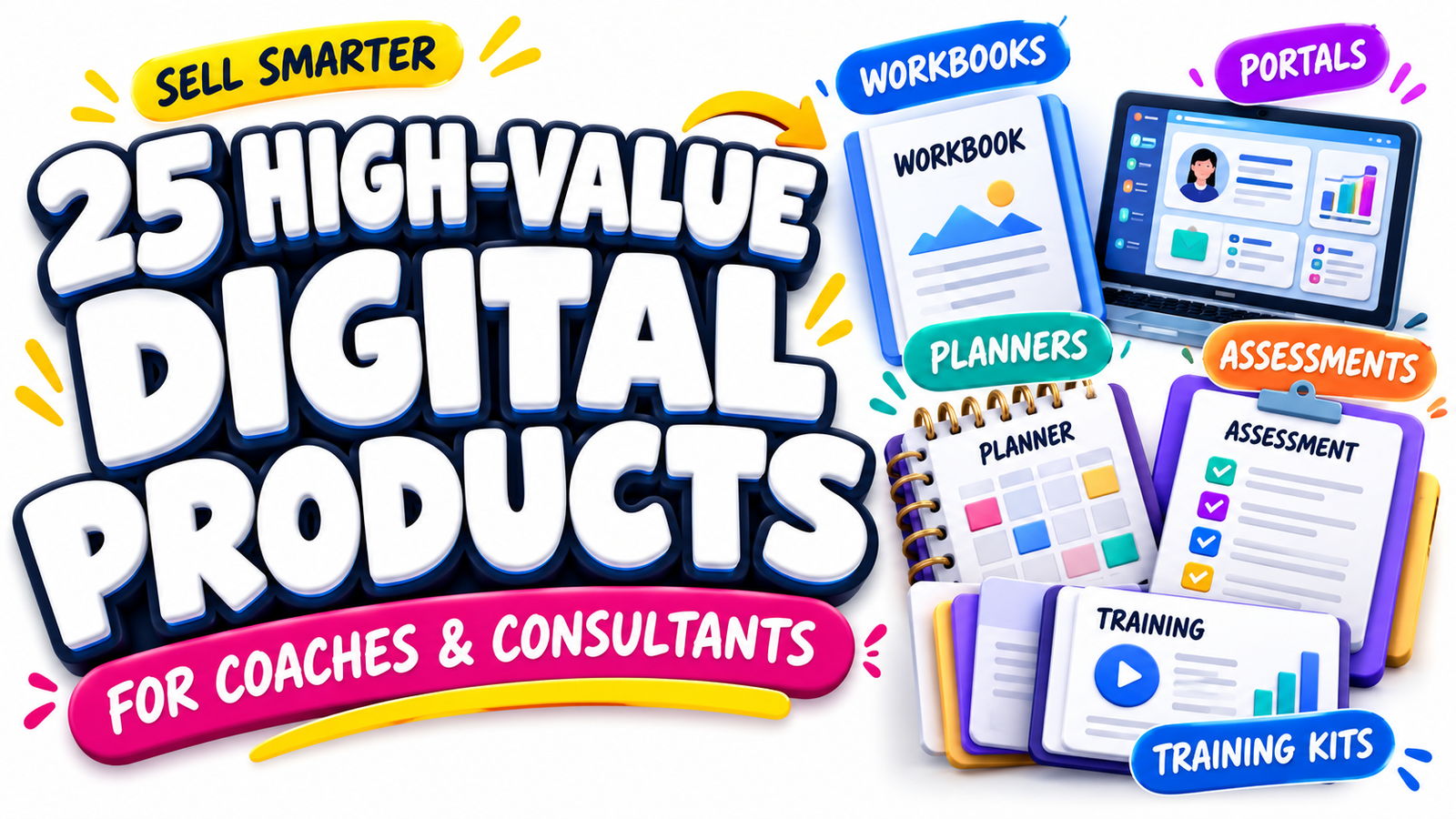
For this topic, your featured image could visually communicate the entire concept through a clean collection of coaching resources: workbook, assessment sheet, client dashboard, planner, presentation deck and strategy documents.
The headline should create curiosity without promising unrealistic results.
For example:
25 Digital Products Every Coach and Consultant Should Know About
or:
25 High-Value Digital Products Coaches Can Create From Their Expertise
The article itself should deliver exactly what the headline promises.
That alignment matters more than exaggerated clickbait.
Turn One Idea Into an Entire Product Ecosystem
You do not need to create 25 products immediately.
One strong concept can generate several offers.
Suppose you develop a Business Clarity Assessment.
That assessment could become a free lead magnet.
The next product could be a Business Clarity Workbook.
Then a 90-Day Strategy Planner.
Then a complete Business Planning Toolkit.
Then a recorded workshop.
Then a group coaching program.
Finally, customers needing deeper support may purchase private consulting.
The underlying intellectual property remains connected throughout the customer journey.
This is how digital products become more than downloads.
They become part of a business ecosystem.
Frequently Asked Questions
1. What are the best digital products for coaches to sell?
Some of the most useful options include coaching workbooks, assessments, session planners, client onboarding kits, accountability trackers, goal-setting systems, training resources and complete coaching toolkits.
The best choice depends on the problems your audience repeatedly needs help solving. A specialized resource designed around one clear outcome will usually be easier to explain and market than a very broad generic planner.
2. Can consultants sell templates they already use with clients?
Consultants can create products based on their own original frameworks, processes and materials, provided they own the necessary rights and do not expose confidential client information or material owned by another organization.
Before commercializing internal resources, remove client-specific data and review any contractual or intellectual-property obligations that may apply.
3. Should I sell one coaching template or create a bundle?
Both approaches can work.
A single product is useful when it solves a clear, narrow problem. A bundle works better when several resources naturally support different stages of the same process.
For example, a discovery form can stand alone, while a complete Client Onboarding Toolkit might combine discovery, goal setting, preparation, session planning and progress tracking.
4. What makes a coaching digital product feel high value?
High value usually comes from usefulness rather than page count.
Clear instructions, thoughtful questions, examples, editable templates, professional organization, scoring systems, implementation guidance and a proven framework can make a relatively compact product extremely useful.
The customer should understand what to do next without requiring constant explanation.
5. Do digital products replace one-to-one coaching or consulting?
They do not have to.
Digital resources can serve customers who are not ready for private services while also improving premium client programs.
They can educate prospects, prepare clients, support implementation, standardize delivery and create additional ways for customers to engage with your expertise.
For many professionals, digital products work best alongside coaching and consulting rather than replacing them.
Build Once, Serve Better and Scale Your Expertise
The greatest advantage of digital products for coaches and consultants is not simply passive income.
It is leverage.
A useful framework that once existed only inside your head can become a workbook.
A repeated client conversation can become an assessment.
A consulting process can become a toolkit.
A workshop can become training material.
A collection of templates can become an entire client-management system.
The opportunity is to identify the knowledge you repeatedly use, package it intelligently and connect it to a specific customer outcome.
Start with one recurring problem.
Create one useful solution.
Test it with real users.
Improve it.
Then look at what customers naturally need before and after that product.
That is how individual coaching templates can grow into valuable product collections—and how expertise developed through years of work can continue creating value far beyond the limits of your calendar.
Stay ahead with exclusive updates
Join our community. Get curated industry trends, actionable guides, and fresh resources delivered straight to your inbox.