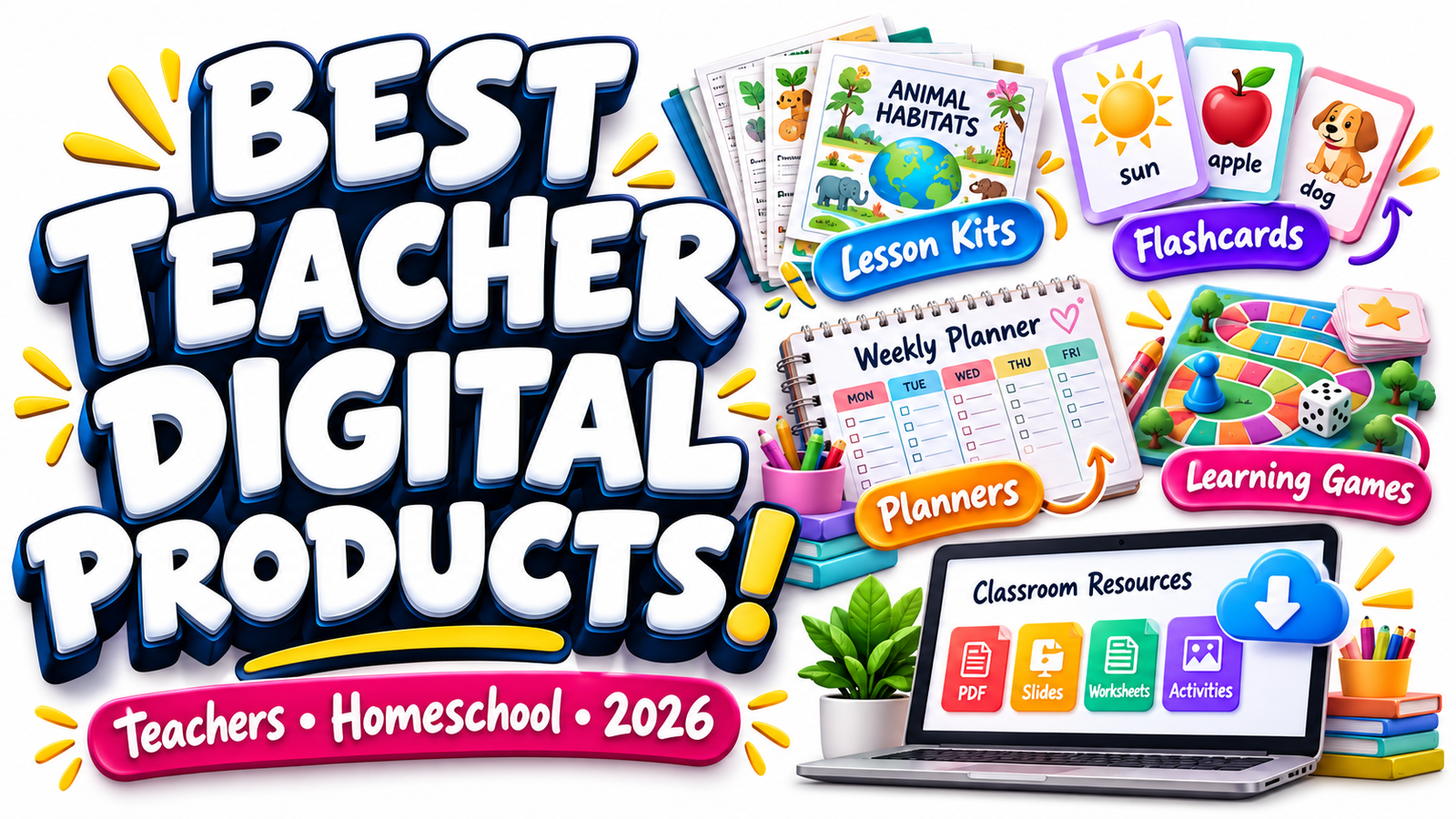
Education is becoming more digital, more flexible, and increasingly personalized—but teachers and parents still have the same fundamental problem: they need useful resources without spending hours creating everything from scratch.
That creates a strong opportunity for educators, designers, homeschool creators, curriculum specialists, and digital entrepreneurs.
In 2026, successful educational digital products are not simply attractive worksheets placed into a PDF. Buyers are looking for practical resources that save preparation time, keep learners engaged, support different ability levels, and make lessons easier to deliver.
Recent educator research reinforces this direction. In a 2026 Teachers Pay Teachers survey, educators said major reasons for purchasing resources included increasing student engagement, saving time, and discovering fresh classroom ideas. Detailed previews, pricing, and preferred formats were also important purchasing considerations.
At the same time, learning outside traditional classrooms remains significant. U.S. National Center for Education Statistics data found that 5.2% of students ages 5–17 received academic instruction at home in 2023, compared with 3.7% in 2019.
For creators, this means the market is broader than conventional teacher worksheets. There is room for teacher printables, homeschool digital products, educational games, lesson resources, activity packs, flashcards, study planners, classroom management systems, assessment materials, and interactive learning tools.
The opportunity in 2026 is to build resources around a specific learning problem and solve it exceptionally well.
Why Educational Digital Products Have Strong Potential in 2026
Digital education resources have several advantages that make them attractive to both creators and customers.
Unlike physical inventory, a digital resource can be created once and delivered repeatedly. Teachers can print it when needed, parents can reuse appropriate activities with multiple learners where the license allows, and homeschool families can organize entire units without waiting for physical materials to arrive.
More importantly, good educational products save time.
A teacher might not be searching for “a beautiful PDF.” They may be searching for:
“fractions activity for 4th grade”
“morning work printable”
“homeschool science unit study”
“reading comprehension worksheets”
“sight word flashcards”
“classroom behavior tracker”
“weekly student study planner”
That distinction matters.
The most promising digital products generally begin with a specific user, learning level, problem, and desired outcome.
Instead of creating a generic “Math Worksheet Bundle,” a creator could develop:
Fourth Grade Fraction Practice Pack for Visual Learners
The second product communicates who it is for, what it teaches, and how it may help.
That clarity improves product positioning while naturally supporting SEO, AI search visibility, marketplace discovery, and buyer confidence.
1. Lesson Resources That Reduce Teacher Preparation Time
Lesson resources remain one of the most practical categories of digital products for teachers.
Teachers frequently need materials that can fit into an existing curriculum without requiring an entire lesson to be redesigned.
A strong lesson resource can include a concise teaching guide, learning objectives, vocabulary, examples, guided practice, independent practice, extension work, assessment questions, and an answer key.
For example, rather than selling a single worksheet on the water cycle, a creator could build a compact Water Cycle Mini Lesson Kit containing an explanatory page, vocabulary cards, diagram activity, comprehension questions, experiment idea, review sheet, and answer key.
The product becomes more useful because the teacher receives an organized teaching solution rather than one isolated file.
This approach works across subjects such as mathematics, reading, writing, science, geography, history, languages, art, music, and life skills.
For homeschool audiences, lesson resources can also include parent-friendly teaching instructions because the adult delivering the lesson may not have professional teaching experience.
That additional guidance can become an important product differentiator.
2. Printable Activity Packs for Focused Learning
Teacher printables continue to be valuable because they are simple, flexible, familiar, and easy to introduce into a lesson.
Teachers can use printable activities for small-group instruction, centers, revision, independent work, homework, early finishers, substitute lessons, and assessment practice. Current TPT resource categories include formats such as worksheets, task cards, graphic organizers, games, assessments, activities, centers, and other printable classroom materials.
The mistake many creators make is producing large collections of unrelated pages.
A better strategy is to build an activity pack around one skill.
For example:
A preschool creator could develop a Fine Motor Skills Activity Pack.
A literacy creator might create a Reading Inference Practice Pack for Grades 4–5.
A homeschool science creator could produce a Backyard Nature Investigation Pack.
Each collection should move the learner toward a recognizable outcome.
Consider combining activities such as matching exercises, cut-and-sort pages, puzzles, drawing activities, short writing prompts, observation pages, mini challenges, reflection activities, and progress checks.
Variety increases engagement while still supporting the same educational objective.
3. Flashcards With More Purpose Than Simple Memorization
Flashcards are one of the most reusable forms of educational digital products.
They work particularly well for vocabulary, phonics, mathematics facts, foreign languages, science terminology, geography, historical dates, sight words, spelling, and early-learning concepts.
However, creators can go beyond the traditional word-on-one-side, definition-on-the-other format.
A mathematics flashcard set might contain an equation on one card and several visual representations on companion cards.
A language-learning product could include vocabulary, pronunciation guidance, an example sentence, and picture cards.
A science set could combine vocabulary cards with classification games and quick review challenges.
Creators can also offer multiple versions of the same resource—for example, full-color classroom cards, low-ink printable cards, and digital screen-friendly cards.
That turns one educational concept into a more complete resource without unnecessarily duplicating content.
4. Classroom Tools That Solve Everyday Teacher Problems
Some of the most useful digital products for teachers have little to do with teaching academic content directly.
Teachers also need systems for organizing classrooms, communicating with families, monitoring student work, planning lessons, tracking progress, preparing substitutes, and managing routines.
This creates opportunities for practical digital tools such as lesson planning templates, student observation forms, parent communication logs, assignment trackers, classroom job systems, attendance sheets, reading logs, assessment trackers, substitute teacher folders, small-group planning sheets, conference forms, project rubrics, classroom checklists, and intervention records.
The strongest products focus on workflow improvement.
A generic printable planner competes with thousands of alternatives.
A Small-Group Reading Intervention Planner for Elementary Teachers serves a far more specific requirement.
Niche specificity can make a relatively simple resource much more useful.
5. Homeschool Planning Systems
Homeschool families often manage several responsibilities simultaneously: curriculum selection, lesson planning, progress records, reading schedules, projects, activities, field trips, assessment, and sometimes multiple children studying at different levels.
That makes organizational products a valuable part of the homeschool digital products market.
A comprehensive homeschool planner might contain yearly planning pages, monthly goals, weekly schedules, subject planning sheets, reading records, project trackers, attendance records, learning reflections, resource lists, field-trip logs, portfolio checklists, and progress summaries.
However, creators should avoid assuming every homeschool family works in the same way.
Flexible layouts can be more useful than rigid systems.
Offering undated pages, customizable schedules, different weekly formats, and editable sections allows customers to adapt the resource to their own learning approach.
Creators can also design products for particular homeschool styles, including unit studies, project-based learning, literature-based learning, nature study, interest-led learning, or structured academic schedules.
6. Study Planners for Students
Older students need more than worksheets.
They need systems that help them organize learning.
A thoughtfully designed student study planner can address assignments, revision, projects, examinations, reading, goal setting, and time management.
Instead of creating another decorative daily planner, build the product around academic performance and manageable study habits.
For example, a student exam planner could help learners divide a large syllabus into weekly targets, identify difficult topics, schedule review sessions, record practice-test results, and track which topics require additional work.
A project planner could guide students through research, outlining, drafting, revisions, deadlines, and submission.
A reading planner could track books, chapters, vocabulary, key ideas, questions, and reflections.
These products can appeal to school students, homeschool learners, tutors, and parents.
7. Educational Games That Make Repetition More Engaging
Repetition is important for learning many skills, but repetition does not have to feel repetitive.
Educational games can turn practice into an activity students want to repeat.
Creators can build printable board games, matching games, card games, scavenger hunts, classroom competitions, bingo-style activities, escape-room-inspired challenges, sorting games, vocabulary challenges, math races, mystery activities, and learning quests.
The educational objective should always remain clear.
A visually impressive game that does not reinforce a meaningful skill may entertain students without providing much instructional value.
A stronger product begins with the skill.
For example, instead of “Space Adventure Game,” create a Space Adventure Multiplication Game for 3rd–4th Grade.
Now the theme supports the learning purpose.
Educational games also create opportunities for product collections. One successful game structure can be adapted to spelling, vocabulary, fractions, grammar, science, geography, or language learning while ensuring each version contains meaningful subject-specific content.
8. Low-Prep and No-Prep Resources
Convenience is becoming an increasingly important part of educational product value.
Teacher workload remains a significant concern. In an early-2026 TPT survey of 11,350 educators, nearly two-thirds described their work stress as high or critical. The same survey found widespread AI use, particularly for creating resources and brainstorming ideas.
This suggests a useful product-development principle:
Make the teacher’s next step obvious and easy.
A low-prep product should require little assembly.
A no-prep product should ideally be ready to print, assign, display, or distribute.
Include clear instructions. Label grade or ability levels. Provide answer keys where relevant. Explain what materials are needed. Make files easy to navigate.
Saving someone ten minutes every time they use your product can be more valuable than adding another ten decorative pages.
9. Differentiated Learning Packs
One classroom can contain students working at very different levels.
The same is true in homeschool families with siblings or children whose strengths vary by subject.
That makes differentiated educational resources especially useful.
Instead of providing one worksheet at one difficulty level, creators can develop several versions addressing the same objective.
For example, a reading comprehension pack could contain emerging, developing, and advanced versions.
A math activity could provide visual support in one version and more complex application problems in another.
Instructions can also include suggestions for independent work, guided work, extension activities, and additional support.
Differentiation makes products more flexible without changing their core purpose.
It also gives buyers more reasons to return to a resource as student needs change.
10. Learning Resources Designed for Both Print and Screen
Educational products no longer need to be exclusively printable or exclusively digital.
Many educators switch between paper and screens depending on the task.
A creator might offer a printable worksheet alongside a fillable version, presentation slides, or an interactive activity.
This hybrid approach makes resources useful for classrooms, tutoring, homework, homeschool, and remote learning.
But digital should not automatically mean complicated.
Teachers remain concerned about the effects of internet use and screen time on learning, according to TPT’s August 2026 educator survey. The same research found educators increasingly using AI for their own preparation while remaining more cautious about AI’s direct role in student learning.
That creates room for screen-light educational products: materials created digitally but designed to encourage offline writing, discussion, observation, experiments, reading, problem-solving, movement, or creative work.
A digital download can actually help families spend less time on screens.
11. AI Literacy Resources for Teachers and Older Students
AI is becoming a significant education topic in 2026, but the opportunity is broader than selling collections of prompts.
Schools and educators increasingly need resources that help people understand how AI works, evaluate AI-generated information, use tools responsibly, protect privacy, recognize limitations, and maintain independent thinking.
UNESCO’s 2026 work on smart education and teacher AI competency emphasizes integrating technology around educational purpose rather than treating technology itself as the goal.
Possible educational resources could therefore address AI literacy, fact-checking, source evaluation, responsible classroom AI use, prompt evaluation, critical thinking, research skills, digital citizenship, and comparing human and AI-generated answers.
The creator’s responsibility is especially important here.
Educational materials involving AI should be reviewed carefully for accuracy, age appropriateness, privacy considerations, and educational relevance.
12. Unit Studies for Homeschool Learners
Unit studies can be particularly well suited to homeschool education because one topic can connect several subjects.
Consider a unit study on oceans.
Reading activities might explore marine animals.
Science lessons can cover ecosystems.
Geography activities can identify oceans and coastlines.
Math problems can use ocean-related measurements.
Writing exercises can involve conservation topics.
Art activities might involve scientific illustration.
A well-designed unit therefore becomes more than a workbook. It becomes a structured learning experience.
Popular themes can include space, dinosaurs, weather, oceans, forests, ancient civilizations, inventions, countries, transportation, animals, plants, famous scientists, art history, literature, entrepreneurship, and everyday life skills.
Creators should clearly identify the approximate age or learning level, expected completion time, materials required, learning objectives, and whether adult assistance is needed.
Build Products Around Outcomes, Not File Counts
One of the easiest mistakes in the digital product market is assuming more files automatically mean more value.
A “2,000-page educational bundle” sounds large, but a teacher may still wonder:
Which pages do I actually need?
Where should I begin?
Which material matches my students?
A smaller, carefully organized resource may create more value.
Consider the difference between:
500 Printable Math Worksheets
and
30-Day Multiplication Fluency System for Grades 3–4
The second offer presents a pathway.
Day by day, the learner knows what to practice.
The teacher knows what to assign.
The parent can see progress.
That is product design based on an outcome.
Create an Educational Product Ecosystem
A successful educational resource can become the starting point for an entire product collection.
Imagine beginning with a phonics flashcard set.
You could later create phonics worksheets, matching games, reading passages, assessment cards, classroom posters, literacy centers, homeschool practice activities, and a larger phonics bundle.
The products work together because they serve the same learner and educational objective.
This approach is generally stronger than creating unrelated resources simply because a keyword appears popular.
Google’s current guidance similarly emphasizes useful, original, people-first content rather than publishing large quantities of pages primarily to capture search traffic. For AI-powered Google Search experiences, Google recommends valuable, non-commodity content with genuine usefulness rather than tactics designed only to manipulate visibility.
The same philosophy makes sense for educational products.
Build fewer resources with clearer value.
Then expand around what customers actually need.
How to Make Teacher Printables Look More Professional
Educational design does not need to be visually complex.
In fact, overly decorative pages can make learning harder.
Prioritize readable typography, consistent spacing, clear instructions, strong visual hierarchy, age-appropriate graphics, sufficient writing space, logical page order, and high-quality printing.
Also consider ink usage.
Customers printing dozens of copies may appreciate a low-ink version.
A useful product package might therefore include a color version, printer-friendly version, answer key, teacher instructions, and preview file.
Accessibility should also be considered during design.
Avoid unnecessarily tiny text, confusing layouts, poor contrast, excessive decorative fonts, and instructions that rely exclusively on color.
Good educational design makes the task easier to understand.
Show Buyers Exactly What They Are Getting
A digital educational resource is difficult to evaluate before purchase because customers cannot physically inspect it.
Your product preview therefore becomes part of the product.
TPT’s 2026 survey found detailed previews were one of the leading purchase considerations among surveyed educators.
Show representative pages.
Explain the grade or learning level.
State the file format.
Identify the number and type of activities.
Explain whether answer keys are included.
Describe printing requirements.
State whether the resource is editable.
Clarify software requirements.
Include licensing information.
And most importantly, explain how the resource is intended to be used.
Specific information reduces uncertainty and makes purchasing decisions easier.
Keywords and Search Intent for Educational Digital Products
SEO should help people find genuinely useful resources rather than dictate what you create.
Useful keyword themes can include:
educational digital products, teacher printables, homeschool digital products, printable learning activities, digital resources for teachers, homeschool worksheets, classroom printables, educational games printable, student study planner, teacher lesson resources, learning activity packs, printable flashcards, homeschool planner, classroom organization templates, digital learning resources, low-prep classroom activities, no-prep worksheets, elementary learning resources, homeschool unit studies, educational resources for kids.
Long-tail searches can be even more valuable because they reveal specific intent.
For example:
“printable multiplication games for 3rd grade”
“homeschool science activities for 8 year olds”
“reading comprehension worksheets grade 5”
“weekly homeschool planner printable”
“classroom behavior tracker for elementary teachers”
Instead of inserting these phrases repeatedly, answer the underlying questions naturally.
Google’s Search guidance specifically recommends using words people would use when searching while keeping content useful and people-first, and notes that its language systems can understand relevant pages even when every keyword variation is not explicitly repeated.
That is also a sensible approach to GEO and AI-search visibility.
Clear explanations, descriptive headings, specific examples, concise definitions, original insights, and well-organized information make content easier for both humans and search systems to understand.
What Educational Creators Should Prioritize in 2026
The strongest educational products are unlikely to succeed simply because they contain trendy graphics, AI-generated content, or hundreds of pages.
They succeed when they make teaching or learning easier.
Start with one audience.
Identify one recurring problem.
Build one useful solution.
Test whether the instructions are clear.
Review the educational accuracy.
Remove unnecessary pages.
Provide a strong preview.
Then improve the product based on real customer questions and feedback.
AI can accelerate brainstorming, formatting, variations, and administrative work, but educational expertise and human review remain especially important. In TPT’s 2026 surveys, educators reported extensive AI use while still expressing stronger trust in resources involving real educator judgment rather than purely AI-generated material.
That creates an important opportunity for educational creators.
Technology can help with production.
Trust, usefulness, and learning value are what make the finished resource worth buying.
Building a Strong Educational Digital Product Business in 2026
The educational digital product market does not require creators to produce everything for everyone.
A better business can begin with one carefully chosen niche.
You might serve kindergarten literacy teachers.
Another creator might focus on middle-school science.
Someone else may specialize in homeschool nature studies, high-school study planners, special classroom routines, foreign-language flashcards, educational games, or project-based learning.
Depth creates opportunities for related products.
One classroom resource becomes a bundle.
One bundle becomes a collection.
One collection can become a recognizable educational brand.
The goal is not simply to sell downloadable files.
It is to build resources that teachers are relieved to find, parents feel confident using, and students can genuinely learn from.
In 2026, that combination—useful educational design, clear positioning, human-reviewed quality, flexible formats, and outcome-focused learning resources—offers a more sustainable direction than chasing short-lived trends.
Frequently Asked Questions
1. What educational digital products can I create for teachers in 2026?
Useful options include lesson resources, classroom printables, activity packs, worksheets, flashcards, educational games, assessment materials, study planners, teacher organization tools, classroom management templates, small-group activities, and differentiated learning resources. Strong products usually solve a specific classroom problem rather than simply providing a large number of pages.
2. What homeschool digital products are worth creating?
Homeschool planners, unit studies, reading logs, project packs, subject worksheets, educational games, nature-study resources, learning trackers, portfolio templates, flashcards, activity packs, and parent-friendly lesson guides can all serve homeschool audiences. Products that allow flexible scheduling and different learning levels may be particularly useful because homeschool routines vary widely.
3. Are teacher printables still useful when classrooms are becoming more digital?
Yes. Printable resources remain useful for independent practice, small groups, assessment, centers, revision, homework, hands-on learning, and screen-light activities. Digital and printable formats can also complement each other rather than compete. A creator can provide print-ready materials alongside optional digital versions.
4. How can I make educational digital products stand out?
Choose a specific learner, subject, grade range, problem, and outcome. Provide clear instructions, professional layouts, realistic previews, appropriate answer keys, logical organization, useful file formats, and accurate educational content. Instead of competing on quantity alone, compete on usability, clarity, specialization, and instructional value.
5. Can AI be used to create educational digital products?
AI can help creators brainstorm ideas, organize material, generate drafts, create variations, and reduce repetitive production work. However, educational content should be reviewed by a knowledgeable human for accuracy, age appropriateness, clarity, copyright and licensing issues, bias, privacy concerns, and instructional quality. AI works best as a creation assistant rather than a substitute for educational judgment.
Stay ahead with exclusive updates
Join our community. Get curated industry trends, actionable guides, and fresh resources delivered straight to your inbox.