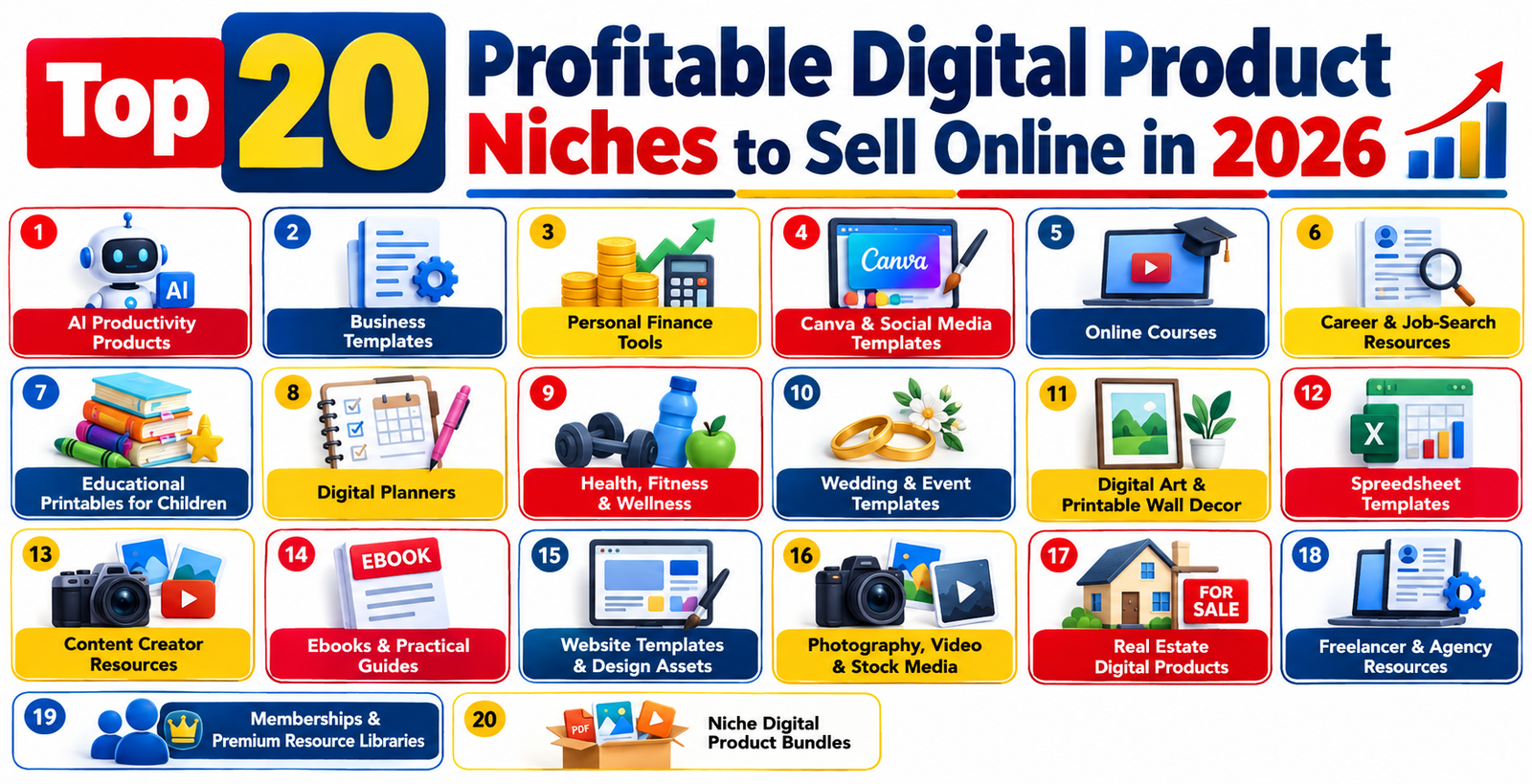
Selling digital products has become one of the most accessible ways to build an online business because there is no physical inventory to store, package, or ship. A creator can develop a useful resource once, improve it over time, and potentially sell it repeatedly to customers around the world.
The opportunity is also becoming broader. Digital products now include far more than ebooks and printable planners. Entrepreneurs sell online courses, business templates, spreadsheets, design assets, educational resources, memberships, software tools, AI workflow kits, digital art, stock media, and specialized professional resources.
Shopify identifies online courses, ebooks, printables, templates, licensed content, memberships, digital tools, stock media, and AI-enhanced products among notable digital-product categories in 2026.
But choosing a digital product simply because it is popular is rarely enough.
A stronger strategy is to choose a profitable digital product niche where three things overlap:
A specific audience + an important problem or desire + a useful digital solution
Instead of creating another generic planner, for example, you could create a client-management planner specifically for freelance photographers.
Instead of publishing another general fitness ebook, you could create a 30-day home mobility program for busy office workers.
Specificity makes the product easier to explain, easier to market, and often easier for potential buyers to recognize as relevant.
Here are 20 profitable digital product niches worth exploring in 2026, along with product ideas, customers, positioning strategies, and practical opportunities for differentiation.
What Makes a Digital Product Niche Profitable?
A profitable niche does not necessarily mean the largest market.
A smaller audience with a strong problem can sometimes be more commercially attractive than a huge audience with weak buying intent.
Before choosing your niche, look for five characteristics.
Clear customer problem
People usually purchase digital products because they want to save time, learn something, organize something, improve a result, create something faster, or avoid making mistakes.
Specific target customer
“Business owners” is broad.
“Independent wedding photographers who need a client onboarding system” is much clearer.
Repeat or related product opportunities
A strong niche should allow you to create additional products later.
For example:
Budget spreadsheet
Debt tracker
Savings planner
Investment tracker
Annual finance dashboard
One customer need can become an entire product ecosystem.
Easy digital delivery
PDFs, spreadsheets, editable templates, video lessons, downloadable files, memberships, and software tools can usually be delivered without physical fulfillment.
Searchable demand
Ideally, customers should already be searching for solutions related to the problem.
Search phrases such as:
“budget spreadsheet for small business”
“Canva templates for real estate agents”
“wedding planner printable”
“AI prompts for marketing”
“homeschool worksheets for kids”
show much stronger purchase intent than broad informational searches.
1. AI Productivity and Workflow Products
Artificial intelligence continues to create opportunities for products that help people use AI more effectively rather than simply giving them another collection of generic prompts.
Shopify identifies AI-enhanced digital products as an emerging commercial category, while its 2026 creator guidance also notes widespread business use of AI tools.
Potential products include:
AI workflow guides
Industry-specific prompt libraries
ChatGPT business systems
AI content planning templates
AI research frameworks
AI automation checklists
AI customer-service scripts
AI marketing workflow kits
AI SOP templates
The strongest products usually solve a specific business problem.
Instead of selling:
“1,000 ChatGPT Prompts”
consider:
“150 AI Prompts for Independent Real Estate Agents”
or:
“AI Content Workflow System for Etsy Sellers.”
Target customers
Freelancers, marketers, consultants, small businesses, creators, ecommerce sellers, coaches and agencies.
Opportunity
Focus on outcomes rather than prompt quantity.
Customers usually care more about completing a task faster than owning thousands of prompts.
2. Business Templates and Small-Business Systems
Business owners repeatedly need documents and systems that reduce administrative work.
That makes business templates one of the strongest evergreen digital-product categories.
Products can include:
Business plans
Invoice templates
Client onboarding documents
Proposal templates
Standard operating procedures
Project trackers
Service agreements
Meeting templates
Pricing calculators
Business dashboards
Customer intake forms
You can increase relevance by creating templates for one profession.
Examples:
Business templates for photographers
Salon management templates
Cleaning business starter kit
Virtual assistant client kit
Freelancer onboarding bundle
Wedding planner business templates
Why this niche works
Business customers often buy based on the value of time saved rather than purely on the number of pages included.
3. Personal Finance and Budgeting Tools
Managing money remains an ongoing consumer need.
Digital finance products can transform complicated financial information into simple systems people can actually use.
Possible products include:
Monthly budget spreadsheets
Savings challenges
Debt payoff calculators
Expense trackers
Net-worth dashboards
Subscription trackers
Family budget planners
Small-business cash-flow spreadsheets
Financial goal planners
Strong niche positioning
Instead of competing with generic budget planners, specialize.
Examples:
Budget planner for college students
Budget spreadsheet for couples
Freelancer income tracker
Budget system for irregular income
Vacation savings calculator
Small-business expense dashboard
For financial products, avoid making promises about investment returns or guaranteed financial outcomes. Educational tools should clearly state their intended purpose.
4. Canva and Social Media Templates
Businesses and creators constantly need visual content.
That creates continuing demand for customizable graphics that reduce design time.
Possible products include:
Instagram templates
Pinterest pin templates
YouTube thumbnail kits
Facebook ad graphics
LinkedIn carousel templates
Media kits
Brand boards
Lead magnet templates
Product launch graphics
Email newsletter graphics
Better strategy
Choose a particular customer.
For example:
“120 Instagram Templates for Fitness Coaches”
is easier to position than:
“120 Social Media Templates.”
The buyer immediately understands who the product was created for.
5. Online Courses and Micro-Courses
Educational content remains a major category for digital sellers, and Shopify continues to identify online courses as a core digital-product format.
You do not necessarily need to create a 20-hour course.
Many customers prefer focused learning experiences that solve one problem.
Examples:
60-minute Canva course
Beginner Excel dashboard course
Photography editing mini-course
Pinterest marketing course
Freelance writing starter class
AI productivity workshop
Digital-product creation course
Language pronunciation course
Strong positioning formula
Learn [specific skill] so you can achieve [specific result].
For example:
“Learn Canva in 7 Days to Create Professional Social Media Graphics.”
A focused promise usually communicates more value than “Complete Canva Masterclass.”
6. Career and Job-Search Resources
People looking for better employment often purchase resources that help them present themselves professionally.
Digital products may include:
Resume templates
CV templates
Cover-letter templates
Interview preparation guides
Job application trackers
Portfolio templates
LinkedIn profile worksheets
Career-change planners
Salary negotiation worksheets
Niche opportunities
Resume templates for nurses
CV templates for academics
Portfolio kits for designers
Interview guides for software developers
Career-change toolkit for teachers
First-job kits for graduates
The closer the resource matches the buyer’s situation, the more useful it becomes.
7. Educational Printables for Children
Parents, teachers and homeschool families regularly look for engaging educational materials.
Products can include:
Alphabet worksheets
Math worksheets
Reading exercises
Tracing activities
Flashcards
Coloring activities
Science worksheets
Puzzle books
Educational games
Preschool activity packs
Etsy’s digital marketplace continues to feature printable resources, templates and downloadable creative products.
Strong sub-niches
Preschool learning
Kindergarten activities
Homeschool resources
Montessori-inspired activities
Early mathematics
Reading comprehension
Handwriting practice
Travel activity packs
Make age suitability, learning objectives, file format and printing instructions very clear.
8. Digital Planners and Productivity Systems
Planners remain highly visible across digital-download marketplaces. Etsy’s current 2026 marketplace pages include digital planners, planner templates, journals and calendars among active categories.
Possible products include:
Daily planners
Weekly planners
Digital calendars
Goal planners
Habit trackers
Study planners
Business planners
Content planners
Meal planners
Project planners
Avoid generic competition
Combine productivity with a specific audience.
Examples:
ADHD-friendly productivity planner
Student exam planner
Content creator planner
Wedding business planner
Freelancer productivity dashboard
Teacher lesson planner
Useful functionality often matters more than decoration.
9. Health, Fitness and Wellness Resources
People consistently look for systems that help them organize healthier routines.
Digital products can include:
Workout calendars
Exercise trackers
Meal-planning templates
Hydration trackers
Mobility routines
Wellness journals
Habit trackers
Fitness challenge calendars
Recipe collections
Products in this niche should avoid unsupported medical claims.
Instead of promising:
“Cure back pain in 14 days”
use responsible positioning such as:
“14-Day Gentle Mobility Routine for Everyday Movement.”
Health-related products should clearly distinguish general educational material from professional medical advice.
10. Wedding and Event Templates
Weddings and events generate large numbers of small organizational and design tasks, which makes them well suited to digital templates.
Potential products include:
Wedding invitations
Save-the-date templates
Wedding planners
Guest-list spreadsheets
Seating charts
Budget templates
Wedding signage
Bridal shower games
Baby shower invitations
Birthday invitation templates
Why specialization works
Try themes such as:
Minimalist wedding
Rustic wedding
Luxury wedding
Beach wedding
Indian wedding planning
Micro-wedding planner
Destination wedding planner
Customization can increase perceived usefulness significantly.
11. Digital Art and Printable Wall Decor
Printable art gives customers instant access to inexpensive home decoration.
Possible products include:
Minimalist prints
Abstract art
Botanical illustrations
Nursery wall art
Typography prints
Vintage-inspired artwork
Seasonal decor
Kitchen prints
Office artwork
Etsy’s current digital-product categories continue to feature digital prints, drawings and illustrations.
Differentiation matters
Generic artwork faces considerable competition.
Consider targeting:
Nurseries
Home offices
Teachers
Coffee lovers
Pet owners
Travel enthusiasts
Specific interior styles
Sell useful size ratios and provide clear printing guidance.
12. Spreadsheet Templates and Dashboards
Spreadsheets can solve real operational problems, which can make them especially valuable digital products.
Ideas include:
Inventory trackers
Profit-and-loss templates
Cash-flow dashboards
Sales trackers
CRM spreadsheets
Content calendars
Employee schedules
Project dashboards
Pricing calculators
Ecommerce profit calculators
Valuable audiences
Small businesses
Freelancers
Etsy sellers
Amazon sellers
Landlords
Consultants
Agencies
Restaurants
Service businesses
Products that automate calculations or display information clearly can offer considerably more practical value than decorative spreadsheets.
13. Content Creator Resources
The creator economy requires constant planning, publishing, branding and performance tracking.
That creates opportunities for:
Content calendars
YouTube planning templates
Podcast planners
Sponsorship media kits
Brand collaboration trackers
Video script templates
Hook libraries
Caption frameworks
Content repurposing systems
Newsletter templates
Short-form video and social discovery continue to play an important role in ecommerce content strategy in 2026.
Strong positioning
Instead of selling “Creator Templates,” create:
“90-Day YouTube Content System for Beginner Finance Creators.”
Specific customer + specific platform + specific result.
14. Ebooks and Practical Guides
Ebooks remain one of the easiest digital products to create, especially when the author has useful knowledge or a well-researched solution.
Shopify continues to list ebooks among its major digital-product formats.
Strong topics usually answer a practical question.
Examples:
How to start freelancing
Beginner gardening guide
Home organization guide
Travel planning guide
Photography handbook
Digital-product business guide
Canva beginner guide
Home bakery startup guide
Avoid being too broad
Instead of:
“Social Media Marketing”
consider:
“How Local Restaurants Can Build a 30-Day Instagram Content Plan.”
Specific problems create clearer purchase intent.
15. Website Templates and Digital Design Assets
Businesses increasingly need a credible online presence but may not want to hire a designer for every task.
Possible products include:
WordPress templates
Shopify graphics
Landing-page templates
Website wireframes
Email templates
Icon packs
UI kits
Presentation templates
Brand kits
Logo template collections
Shopify identifies design assets, templates and website themes among commercially relevant digital-product types.
Potential buyers
Coaches
Consultants
Restaurants
Photographers
Real estate agents
Creators
Freelancers
Small ecommerce businesses
16. Photography, Video and Stock Media
Businesses need visual content continuously.
Creators can license:
Stock photos
Video footage
Background videos
Product mockups
Textures
Lightroom presets
Photo overlays
Video transitions
LUTs
Sound effects
Shopify also identifies stock photography, video and audio among established digital goods categories.
Niche strategy
Generic stock photography is difficult to differentiate.
Create specialized collections such as:
Remote-work stock photos
Small-business lifestyle images
Wellness brand photography
Food blogger photography
Travel footage
Product-display mockups
17. Real Estate Digital Products
Real estate professionals operate in a document-heavy, marketing-heavy industry.
Digital products can include:
Property listing templates
Open-house flyers
Buyer guides
Seller guides
Social media templates
Lead trackers
Client onboarding kits
Property comparison sheets
Email templates
Real estate content calendars
Audience options
Real estate agents
Property managers
Vacation rental owners
Real estate photographers
Home stagers
Property investors
This niche is particularly suitable for premium template bundles.
18. Freelancer and Agency Resources
Freelancers often start with technical skills but lack repeatable business systems.
Useful products can solve that problem.
Examples:
Client onboarding kits
Discovery call templates
Proposal templates
Scope-of-work templates
Invoice systems
Project trackers
Pricing calculators
Client questionnaires
Agency SOPs
Retainer templates
Product ecosystem example
Start with:
“Freelance Designer Client Kit”
then expand into:
Proposal template
Pricing calculator
Client portal template
Project tracker
Email scripts
Agency management bundle
One niche can produce dozens of related products.
19. Memberships and Premium Resource Libraries
Not every digital product needs to be a one-time download.
Membership products can provide recurring value through:
Monthly template drops
Premium newsletters
Resource libraries
Design asset clubs
Business communities
Educational memberships
Stock-content subscriptions
Industry research libraries
Shopify includes paid memberships and premium-content libraries among current digital-product business models.
A membership works best when customers have an ongoing need rather than a one-time problem.
For example, social media managers regularly need new templates, hooks, captions and content ideas.
That creates a natural recurring use case.
20. Niche Digital Product Bundles
Bundles can combine multiple complementary resources into one solution.
Examples:
Small Business Starter Bundle
Teacher Resource Bundle
Kids Activity Mega Bundle
Wedding Planning Bundle
Freelancer Business Kit
Social Media Marketing Bundle
Digital Planner Collection
Ecommerce Seller Toolkit
Bundles are most compelling when the products work together.
A collection of 1,000 unrelated files may look large but can create customer confusion.
A smaller, clearly organized system can often feel more useful.
For example:
Etsy Seller Launch Kit
could contain:
Keyword research worksheet
Pricing calculator
Product planner
Listing checklist
Photography guide
Order tracker
Marketing calendar
Each resource supports the same customer journey.
Which Digital Product Niches Look Especially Relevant in 2026?
Current marketplace activity suggests continued commercial interest across several broad categories, particularly:
AI-assisted productivity
Online learning
Business tools
Editable templates
Digital planners
Creator resources
Printables
Design assets
Membership content
Software and productivity tools
Shopify’s 2026 digital-product guidance highlights courses, ebooks, printables, templates, software/tools, memberships, stock media and AI-enhanced products, while Etsy’s current marketplace pages prominently surface planners, templates, social-media templates, digital prints, journals and illustrations.
That does not mean every product in these categories will sell.
Demand, competition, product quality, pricing, positioning, customer trust, platform visibility and marketing all influence results.
How to Find a Profitable Digital Product Niche
Use this simple process before spending weeks creating a product.
Step 1: Choose an audience
Ask:
Who am I helping?
Examples:
Teachers
Freelancers
Parents
Small businesses
Creators
Students
Photographers
Coaches
Step 2: Identify recurring problems
Look at questions customers repeatedly ask.
For a freelancer, problems might include:
Finding clients
Sending proposals
Pricing work
Managing projects
Getting paid
Following up with leads
Each problem can become a digital product.
Step 3: Research existing products
Study marketplaces, search engines, social platforms, forums and customer reviews.
Look at what buyers like.
More importantly, look at what they complain about.
Customer complaints often reveal product opportunities.
Step 4: Look for long-tail keywords
Instead of targeting:
“planner”
look for:
“digital planner for freelance designers.”
Instead of:
“Canva template”
consider:
“Canva Instagram templates for real estate agents.”
Specific keywords generally reveal clearer search intent.
Step 5: Create the smallest useful product
Do not start by creating 500 pages.
Create the smallest product that genuinely solves the customer’s problem.
Test it.
Collect feedback.
Improve it.
Then build related products.
How to Differentiate Your Digital Product
Competition is not necessarily a reason to avoid a niche.
Competition can indicate that customers already understand the product category.
Your job is to create a clearer reason for them to choose your solution.
Differentiate through:
Audience specificity
Better organization
Better instructions
Professional design
Customization
Useful automation
Examples
Tutorials
Bonus resources
Better product previews
Customer support
Clear licensing terms
Consider these two listings.
Generic:
Business Planner PDF
Specific:
90-Day Business Planner for Freelance Graphic Designers
The second product communicates immediately:
Who it is for
How long it covers
What problem it addresses
That clarity improves marketing.
Where Can You Sell Digital Products?
Digital products can be sold through marketplace platforms or through your own online store.
Common approaches include:
Etsy for printables, templates and creative downloads
Gumroad-style creator storefronts for downloads and resources
Shopify for a branded ecommerce store
Online learning platforms for courses
Creator platforms for memberships
Your own WordPress or ecommerce website
Shopify notes that third-party digital marketplaces can provide built-in audiences and convenient selling infrastructure, while independent stores can give sellers greater control over branding and customer relationships.
You do not necessarily have to choose only one channel.
Many digital sellers use a marketplace for discovery and develop their own website as their brand grows.
SEO Strategy for Selling Digital Products
Creating the product is only half the job.
Customers must be able to discover it.
Use keywords naturally in:
Product titles
Page titles
Meta descriptions
Headings
Product descriptions
Image alt text
FAQ sections
Blog content
Internal links
Category pages
Avoid repeating the same keyword unnaturally.
Search engines increasingly need clear context, not simply keyword density.
For example, an article targeting digital planner for small business owners could naturally discuss:
Business organization
Daily scheduling
Client management
Goal tracking
Revenue planning
Task management
Digital planning apps
Productivity systems
These related concepts help explain the subject comprehensively.
GEO Strategy for Digital Product Content
Generative Engine Optimization, or GEO, focuses on making information clear enough for AI-powered search and answer systems to understand and reference.
Use:
Clear questions and answers
Descriptive headings
Specific examples
Short factual explanations
Structured comparisons
Definitions
Practical steps
Consistent terminology
Original expertise and experience
For example:
What is a digital product niche?
A digital product niche is a defined customer segment or problem area for which a seller creates downloadable, online, or software-based products.
That direct structure helps both readers and search systems quickly understand the subject.
Google Discover Optimization
Google states that Discover content should use compelling, relevant, high-quality imagery and recommends large images of at least 1,200 pixels wide, with high resolution and suitable landscape presentation. Google also recommends enabling max-image-preview:large and identifies structured-data images or og:image as ways to indicate representative imagery.
For this article, consider a featured image such as:
Top 20 Profitable Digital Product Niches for 2026
Recommended format:
1280 × 720 px
16:9 ratio
Pure, uncluttered background
Short readable headline
Relevant digital-product icons
High contrast
Mobile-friendly composition
Avoid exaggerated promises such as:
“Make $10,000 Tomorrow!”
A descriptive headline usually creates greater trust and accurately represents the article.
No technique can guarantee placement in Google Discover because eligibility and distribution depend on Google’s systems, user interests, content quality and other signals.
How to Turn One Niche Into a Digital Product Business
Do not think about creating one isolated product.
Think about creating a customer journey.
Imagine your niche is freelancer business management.
Your first product could be:
Freelance Proposal Template
Then create:
Client questionnaire
Pricing calculator
Invoice tracker
Project dashboard
Onboarding bundle
Email script collection
Freelance business course
Eventually you could package them into:
Complete Freelancer Business System
You now have multiple price points.
Low-cost product → template
Mid-priced product → bundle
Higher-priced product → course
Recurring offer → membership
This model can increase customer lifetime value without requiring you to constantly enter unrelated markets.
A Simple Digital Product Formula
A strong product can often be described with this formula:
Specific Customer + Specific Problem + Easy-to-Use Solution
For example:
Teacher + needs weekly lesson organization + editable lesson planner
becomes:
“Editable Weekly Lesson Planner for Elementary Teachers.”
Or:
Etsy seller + struggles with pricing + spreadsheet calculator
becomes:
“Etsy Profit and Pricing Calculator.”
Clarity sells better than complexity.
Five Frequently Asked Questions
1. What is the most profitable digital product niche?
There is no single niche that is automatically the most profitable. Profitability depends on customer demand, competition, pricing, product quality, marketing and operating costs. Business templates, online education, productivity tools, design assets, AI-assisted resources, digital planners and specialized professional resources are active categories worth researching in 2026.
2. What digital products are easiest for beginners to create?
Simple PDFs, checklists, worksheets, ebooks, spreadsheets, planners and editable templates can be beginner-friendly because they usually require less technical development than software or complex online platforms. Start with one clearly defined customer problem rather than building a huge bundle immediately.
3. Can I sell digital products without a large social media audience?
Yes. Sellers can generate discovery through search engines, marketplaces, Pinterest, blogs, email marketing, YouTube and other channels. Marketplace search can be especially useful for beginners because customers are already visiting those platforms looking for products. Building an owned website and email list can provide additional long-term control.
4. How much should I charge for a digital product?
Price should reflect the value of the problem solved, complexity of the product, target customer, competition, licensing terms, support included and product positioning. A simple printable may justify a relatively low price, while a specialized business system, premium template collection or professional course may support a much higher price. Test pricing rather than assuming the cheapest option will generate the most sales.
5. Should I sell one product or create a large digital-product bundle?
Begin with a focused product that solves one problem well. Once customers respond positively, expand with related products and bundles. A carefully organized bundle containing complementary products can be valuable, but a huge collection of unrelated files can overwhelm customers and make the offer difficult to understand.
Start With a Problem, Not a Product
The biggest opportunity in digital products is not simply creating more files.
It is creating something useful enough that a specific group of people actively wants it.
Choose an audience.
Study what they struggle with.
Identify an expensive, frustrating, repetitive or time-consuming problem.
Create a simple digital solution.
Validate the idea.
Improve it with customer feedback.
Then build additional products around the same audience.
Whether you choose AI productivity tools, business templates, spreadsheets, educational printables, digital planners, online courses, creator resources or niche bundles, your strongest competitive advantage will usually come from understanding the customer better than sellers who simply follow trends.
Ready to begin?
Choose one of the 20 niches above and write down:
Who is the customer?
What problem are they trying to solve?
What digital product could make that task easier, faster or clearer?
That simple exercise can turn a broad product idea into the foundation of a focused digital business.
Stay ahead with exclusive updates
Join our community. Get curated industry trends, actionable guides, and fresh resources delivered straight to your inbox.