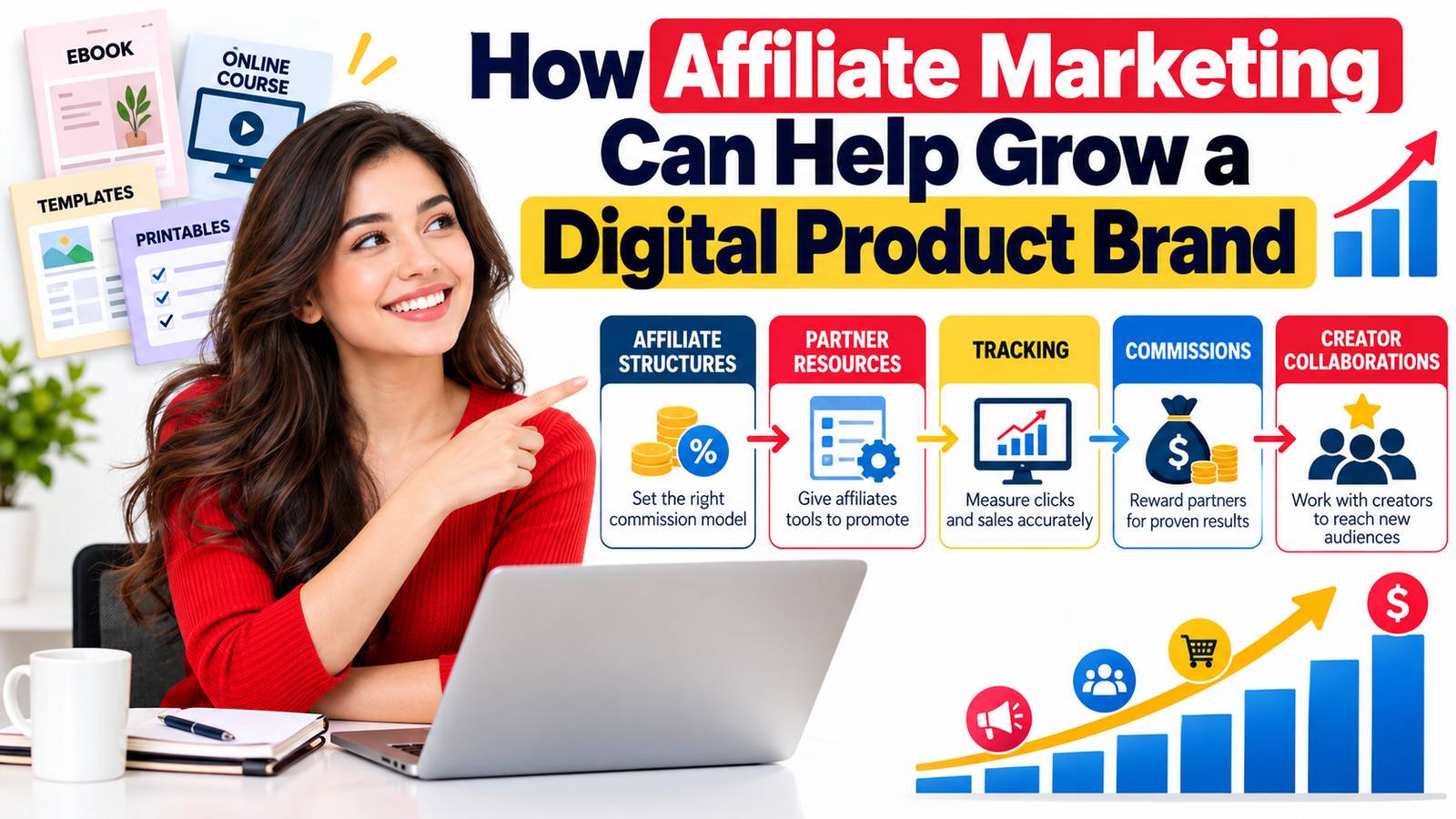
Selling a great digital product is only part of building a successful online brand. The other challenge is getting that product in front of people who actually need it.
Paid advertising can help, social media can create awareness, SEO can bring long-term traffic, and email marketing can nurture potential customers. But there is another growth channel that can expand your reach without requiring you to pay for every impression or click upfront: affiliate marketing.
Digital product affiliate marketing turns customers, creators, educators, bloggers, influencers, niche experts and other trusted partners into an extended marketing network for your brand. Instead of trying to reach every potential buyer yourself, you give selected partners a reason to introduce your products to audiences they have already built relationships with.
When someone purchases through an affiliate’s tracked link or promotional code, the affiliate earns a commission.
It sounds simple, but a strong affiliate program is much more than handing out links.
The most effective programs combine the right commission structure, accurate tracking, useful partner resources, clear rules, thoughtful creator collaborations and a product that affiliates genuinely feel comfortable recommending.
Done well, an affiliate program for digital products can become a scalable customer-acquisition channel while also strengthening your brand’s relationships across the creator economy.
What Is Digital Product Affiliate Marketing?
Digital product affiliate marketing is a performance-based marketing model in which another person or business promotes your downloadable or online product and earns compensation when their promotion produces an agreed result.
That result is usually a sale.
For example, imagine you sell a $40 content-planning template bundle.
A marketing creator joins your affiliate program. You provide that creator with a unique tracking link.
They publish a tutorial showing how they organize a month of social media content and recommend your template inside the tutorial.
A reader clicks the affiliate link and buys the $40 bundle.
If your program pays a 30% commission, the affiliate earns $12 and your business receives the remainder before processing costs, taxes and other applicable expenses.
The customer discovered a useful resource. The creator earned revenue for making the introduction. Your business gained a customer.
That alignment is one of the reasons affiliate marketing can work particularly well for digital products.
Why Affiliate Marketing Fits Digital Product Businesses
Digital products are naturally suited to partner-driven marketing because many products can be demonstrated, explained and recommended through content.
Templates can be shown in tutorials.
Online courses can be discussed in educational videos.
Printables can appear in organization demonstrations.
Business toolkits can be featured in workflow articles.
Presets can be demonstrated through before-and-after examples.
eBooks can be recommended inside resource guides.
Prompt packs can be demonstrated in practical AI tutorials.
Spreadsheets can appear inside business-management walkthroughs.
Instead of telling people repeatedly that a product exists, affiliates can show potential customers why the product is useful and where it fits into a real workflow.
That context can make the recommendation far more meaningful.
Affiliate marketing also changes part of the financial model of customer acquisition. With many affiliate arrangements, you pay the partner after an attributed conversion rather than paying simply to display an advertisement.
That does not make affiliate marketing free. Your commission is still a marketing expense. There may also be affiliate-platform fees, software costs, management time, refunds, payment-processing expenses and partner bonuses.
The advantage is that compensation is closely connected to measurable results.
Affiliates Can Extend Your Brand Beyond Your Own Audience
One of the biggest limitations facing a digital product seller is audience size.
You may create an excellent planner, workbook, template system or educational product, but your email list, search traffic and social following represent only a small portion of your potential market.
Partners can introduce the product to communities you may never reach directly.
A productivity template seller might partner with productivity YouTubers.
A wedding-planning shop could collaborate with wedding bloggers and event-planning creators.
A photography resource business could recruit photographers who teach other photographers.
A small-business template store could work with bookkeeping educators, virtual assistants, business coaches and ecommerce creators.
Each affiliate becomes another possible distribution path.
Instead of building every audience from zero, your brand gains access to audiences that already exist.
The key word, however, is relevance.
Ten highly relevant partners can be more valuable than hundreds of affiliates whose audiences have little connection with your product.
Choose an Affiliate Structure That Matches Your Business
There is no single commission structure that works for every digital product business.
Your structure should reflect your pricing, margins, customer acquisition economics, product type and partner strategy.
Percentage-Based Commission
This is one of the most common structures.
An affiliate receives a percentage of the eligible purchase.
For example:
A $60 product with a 25% commission produces a $15 affiliate payment.
Percentage commissions work especially well when your store contains products at different price points because compensation automatically increases with the transaction value.
Fixed Commission
You can also pay a fixed amount for each qualifying transaction.
A $50 product might pay $10 for every successful referral.
Fixed commissions are easy for affiliates to understand and can simplify promotional messaging internally.
Recurring Commission
Subscription products, memberships and software products may use recurring commissions.
An affiliate might receive a percentage of the customer’s subscription payment for several months or for another defined period.
Recurring commissions can be attractive to partners because one successful referral can produce more than one payment.
The business, however, needs to model customer retention carefully before making long-term commission commitments.
Tiered Commission
A tiered model rewards stronger performance.
For example, a partner could begin at one commission rate and qualify for a higher rate after reaching an agreed level of monthly or quarterly sales.
This can motivate successful affiliates without requiring the business to offer its highest commission rate to every new partner immediately.
Launch Bonuses
Temporary bonuses can work well when introducing a major new digital product.
You might offer an additional reward when an affiliate achieves a certain number of qualifying sales during the launch period.
Bonuses should complement a healthy commission structure rather than create pressure for affiliates to make exaggerated claims.
How Much Commission Should a Digital Product Affiliate Program Pay?
There is no universal percentage that automatically makes an affiliate program competitive or profitable.
Start with your economics rather than copying another brand.
Suppose a product sells for $50.
Before setting a commission, consider your payment-processing costs, platform fees, applicable taxes, customer-support costs, refund rate, product-development expenses, other promotional costs and the profit you need the transaction to produce.
Then ask another important question:
What is this partner contributing?
An affiliate publishing detailed tutorials, maintaining a niche newsletter and repeatedly educating potential customers may contribute considerably more value than someone simply placing a link on a generic coupon page.
Some brands therefore create different partnership arrangements for different types of affiliates.
The goal is not to offer the largest commission possible.
The goal is to create a rate that is attractive enough for quality partners while remaining financially sustainable for the business.
Create a Creator Affiliate Program, Not Just an Affiliate Link
A common mistake is thinking that affiliate recruitment ends when someone receives a tracking URL.
Good creators need material that helps them communicate.
Build a simple partner resource center containing product descriptions, target-customer information, approved product screenshots, demonstration ideas, brand guidelines, FAQs, sample talking points, promotional dates, landing-page links, disclosure guidance and information about what affiliates should not claim.
Avoid forcing every creator to copy the same promotional script.
Their audience follows them because of their individual voice.
Give partners accurate information and useful assets, then allow enough creative freedom for the recommendation to feel natural.
This can transform a basic affiliate arrangement into a genuine creator affiliate program.
Give Affiliates Something Worth Talking About
Affiliate software cannot compensate for an uninteresting offer.
Partners are more likely to promote a product when they can quickly answer three questions:
Who is this for?
What problem does it solve?
Why would my audience care?
Consider a generic offer such as:
“Download our business planner.”
Now compare it with a clearer positioning statement:
“A customizable planning system for solo business owners who want to organize weekly priorities, content, launches and revenue goals in one place.”
The second version gives the affiliate a story.
Strong positioning improves affiliate marketing because creators are no longer trying to invent a reason for people to buy.
The usefulness of the product already provides that reason.
Tracking Is the Infrastructure Behind the Program
Affiliate relationships depend heavily on trust, and reliable tracking is part of that trust.
Your affiliate platform should be able to connect referrals with eligible conversions according to the rules you establish.
Common tracking mechanisms include unique affiliate links, referral parameters, cookies, promotional codes and attribution records.
You should also define how attribution works.
For example, decide what happens if someone clicks Partner A’s link, later clicks Partner B’s link and then purchases.
Does the first affiliate receive credit?
Does the most recent affiliate receive credit?
What happens if the customer uses a creator’s coupon code?
How long does the referral attribution period remain active?
There is no universal answer. What matters is that your policy is consistent and understandable.
Track More Than Affiliate Sales
Sales matter, but they do not tell the entire story.
A useful affiliate dashboard should help you understand the path from partner activity to customer acquisition.
For every meaningful partner, consider the relationship between clicks, conversions, revenue, refunds, average order value, conversion rate and commission cost.
You may discover that one creator sends large amounts of traffic but few purchases.
Another creator might send relatively little traffic while producing a high conversion rate.
The second partnership may deserve far more attention.
You should also look beyond immediate revenue when appropriate.
Some affiliates may consistently introduce high-quality customers who later purchase additional products.
That information can influence how you structure future collaborations.
Create Dedicated Landing Pages for Important Partners
Sending every affiliate visitor to your homepage is often unnecessary.
If a creator is teaching a specific workflow, send their audience to the product that supports that workflow.
A photography educator demonstrating a client onboarding system should link to a relevant photography business toolkit rather than a general marketplace containing hundreds of unrelated downloads.
A focused landing page can reinforce the creator’s message.
It can explain the use case, show useful screenshots, answer objections, clarify what the buyer receives and present the purchase CTA clearly.
The closer the landing page matches the reason someone clicked, the easier it is for the visitor to understand the offer.
Use Affiliates for Product Education, Not Only Promotion
The strongest affiliates often act as educators.
A creator can show how to customize your Canva template.
A business educator can demonstrate your financial spreadsheet.
A YouTuber can explain how your content calendar fits into a publishing workflow.
A teacher can demonstrate ways to use an educational printable.
A designer can walk viewers through your creative assets.
Educational affiliate content has two advantages.
First, it attracts customers who are actively learning about a problem.
Second, it gives potential buyers a clearer picture of how the product works before purchasing.
That can produce more informed customers and potentially reduce misunderstandings after purchase.
Turn Creator Collaborations Into Better Content
Do not restrict partnerships to short promotional mentions.
Consider collaborative formats such as tutorials, product walkthroughs, workshops, comparison guides, newsletter features, case studies, resource collections, live demonstrations, interviews and limited launch collaborations.
A creator might publish:
“How I Plan 30 Days of Content in One Afternoon”
Your product appears naturally inside the workflow.
That is usually more useful than a post that simply says:
“Buy this content planner.”
People frequently respond to solutions demonstrated in context.
That makes creator collaboration both a distribution strategy and a content strategy.
Recruit the Right Affiliates
Affiliate recruitment should begin with audience alignment.
Look for people whose followers resemble the customers you actually want.
A small creator with 8,000 highly engaged followers in your niche may be more valuable than an entertainment account with hundreds of thousands of unrelated followers.
Pay attention to content quality, audience relevance, communication style, reputation and whether the creator already discusses problems your products solve.
Existing customers can also become excellent affiliates.
They already understand the product and may be able to explain naturally how they use it.
Their experience can produce authentic educational content that feels very different from a generic advertisement.
Build an Affiliate Recruitment Page
If affiliate marketing is going to become a meaningful growth channel, make the program easy to discover.
Create a dedicated page explaining who the program is for, what types of products affiliates can promote, how commissions work, when payments are issued, basic eligibility requirements, promotional rules, disclosure expectations and how someone can apply.
Optimize the page around relevant phrases such as affiliate program digital products, digital product affiliate program, creator affiliate program, affiliate marketing for creators, digital download affiliate program and other terms that accurately match your offer.
Avoid stuffing every variation into the copy.
A useful page written around genuine partner search intent is stronger than a page written mainly to repeat keywords.
Protect Your Brand With Clear Affiliate Rules
Affiliate marketing introduces other people into your marketing process, so brand protection matters.
Your terms should make clear whether affiliates may use paid search advertising, bid on your brand name, use your trademarks in domains, distribute unauthorized coupons, run paid social ads, make earnings claims, modify product images, impersonate your company or publish misleading product claims.
You should also explain refund-related commissions, prohibited traffic sources, payment timing and what happens when program terms are violated.
Clarity protects both parties.
A professional program should make it easy for good affiliates to understand what is permitted without burying the important conditions.
Affiliate Disclosure and Transparency Matter
Affiliate relationships should be transparent.
For businesses serving or marketing to U.S. consumers, Federal Trade Commission guidance says material relationships between endorsers and marketers should be disclosed clearly and conspicuously. The FTC also advises advertisers to have reasonable processes for training and monitoring influencers they pay or direct.
Disclosure is not something to hide in an obscure legal page.
If a creator may receive compensation because someone purchases through a recommendation, consumers should be able to understand that relationship.
Other countries and platforms may have their own advertising, consumer-protection and disclosure requirements, so brands operating internationally should review the rules relevant to the markets they serve.
Transparency is not merely a compliance exercise.
It helps create a healthier long-term relationship between the creator, customer and brand.
Keep the Affiliate Experience Simple
A complicated program creates friction.
Partners should be able to join, understand the rules, locate their tracking links, access resources, review performance and understand upcoming payments without repeatedly contacting your support team.
Simple systems become increasingly important as the program grows.
What feels manageable with five affiliates can quickly become difficult with 100.
Build the operational foundation before aggressively recruiting partners.
Communicate With Affiliates Regularly
Your partners should know when something worth promoting happens.
Share meaningful updates such as new product releases, major product improvements, seasonal campaigns, new demonstration assets, refreshed landing pages and upcoming promotional opportunities.
Do not overwhelm affiliates with constant requests to promote.
The objective is to become a useful partner rather than another company filling their inbox.
A concise monthly affiliate update can often be enough to keep active partners informed.
Reward Your Strongest Relationships
Affiliate dashboards contain numbers, but successful partner programs are built around people.
When you discover a creator who consistently attracts the right customers, look beyond the default commission link.
There may be opportunities for custom landing pages, exclusive bundles, higher commission tiers, co-created tutorials, product previews, newsletter collaborations or longer-term partnerships.
Your best affiliates can also become a valuable source of customer insight.
They hear questions from their audience.
They know which product features create interest.
They see objections before a purchase.
They may reveal new product opportunities that your internal analytics cannot easily show.
Avoid the Most Common Affiliate Marketing Mistakes
Affiliate programs frequently struggle when businesses recruit everyone, choose commissions without understanding profitability, provide no promotional resources, rely on unreliable tracking, make payment rules confusing, ignore disclosure requirements or judge every affiliate solely by follower count.
Another mistake is launching an affiliate program before proving that people actually want the product.
Affiliates can amplify demand.
They cannot reliably manufacture lasting demand for a weak offer.
Strengthen the product, positioning, customer experience and landing page before expecting partners to solve the growth problem.
A Simple Example of Affiliate-Led Growth
Imagine a digital product brand selling an $80 freelance business toolkit.
The brand recruits a group of freelancers, business educators, newsletter publishers and YouTube creators.
One creator publishes a detailed tutorial called:
“How I Organize New Freelance Clients From Inquiry to Final Payment.”
Inside the tutorial, the creator demonstrates the toolkit rather than simply advertising it.
The viewer sees the system working.
They follow the affiliate link to a landing page built specifically around freelance client management.
The page explains the templates, shows realistic examples, answers common questions and provides a clear purchase option.
The customer buys.
The creator receives the agreed commission.
The brand gains revenue and a new customer.
If that customer later discovers other useful products from the same brand, the lifetime value of the original affiliate relationship may extend beyond the first transaction.
That is where affiliate marketing begins to become more than a short-term promotional technique.
It becomes part of the brand’s distribution system.
Combine Affiliate Marketing With SEO, Email and Social Content
Affiliate marketing works especially well when it supports other marketing channels instead of operating separately.
An affiliate tutorial may rank in search.
A creator video may generate social discovery.
A partner newsletter can create immediate traffic.
Your landing page can capture subscribers who are not ready to purchase.
Your email sequence can continue educating them.
Retargeting campaigns may reconnect with visitors later.
Your own content can answer additional questions about the product.
Each channel strengthens the others.
That creates a healthier marketing ecosystem than depending entirely on one source of traffic.
How to Make Affiliate Content More Search and Discover Friendly
Search visibility should begin with usefulness rather than keyword repetition.
Google’s current guidance says its ranking systems seek to prioritize helpful, reliable, people-first content rather than pages created primarily to manipulate rankings. Google also states that Discover eligibility does not guarantee appearance in Discover.
For Discover, Google recommends headlines that accurately capture the content, timely or insightful material, a strong page experience and relevant high-quality imagery. Its documentation recommends large images that are at least 1200 pixels wide and explains the use of max-image-preview:large; representative images can also be specified through schema.org markup or og:image.
For an article like this one, the practical lesson is straightforward:
Create the best answer for someone genuinely trying to build an affiliate program.
Use a descriptive title.
Include real examples.
Answer the questions potential program owners are actually asking.
Show clear expertise.
Keep the page fast and mobile friendly.
Use original, relevant imagery.
Add accurate author information.
Update the content when the subject meaningfully changes rather than simply changing the publication date.
That approach supports SEO, GEO and Discover visibility without sacrificing the reader experience.
GEO: Make Your Expertise Easy to Understand and Reference
Generative search experiences often need clear, self-contained explanations.
Instead of burying the core answer inside promotional language, state important concepts directly.
For example:
What is a creator affiliate program?
A creator affiliate program is a partnership system that allows creators to recommend a company’s products using trackable links or codes and receive compensation for qualifying conversions.
Clear answers like this improve usability for human readers while also making the content easier for search and answer systems to interpret.
Useful definitions, examples, descriptive headings, consistent terminology and concise FAQ answers can all strengthen the information structure of a page.
The Long-Term Opportunity
The real strength of digital product affiliate marketing is not the ability to create thousands of referral links.
It is the ability to create a network of people who understand what your brand offers and can introduce those products to the right audiences.
Start small.
Recruit partners whose audiences genuinely match your customers.
Offer financially sustainable commissions.
Give affiliates resources that make useful content easier to create.
Track performance accurately.
Communicate clearly.
Protect your brand.
Reward strong partnerships.
Most importantly, give partners products they can recommend with confidence.
An affiliate program becomes increasingly valuable when customers, creators and the brand all benefit from the relationship.
Ready to Build Your Digital Product Affiliate Program?
If your digital product already solves a clear problem and converts customers consistently, an affiliate program may be the next distribution channel worth testing.
Start by choosing one strong product, defining
Stay ahead with exclusive updates
Join our community. Get curated industry trends, actionable guides, and fresh resources delivered straight to your inbox.