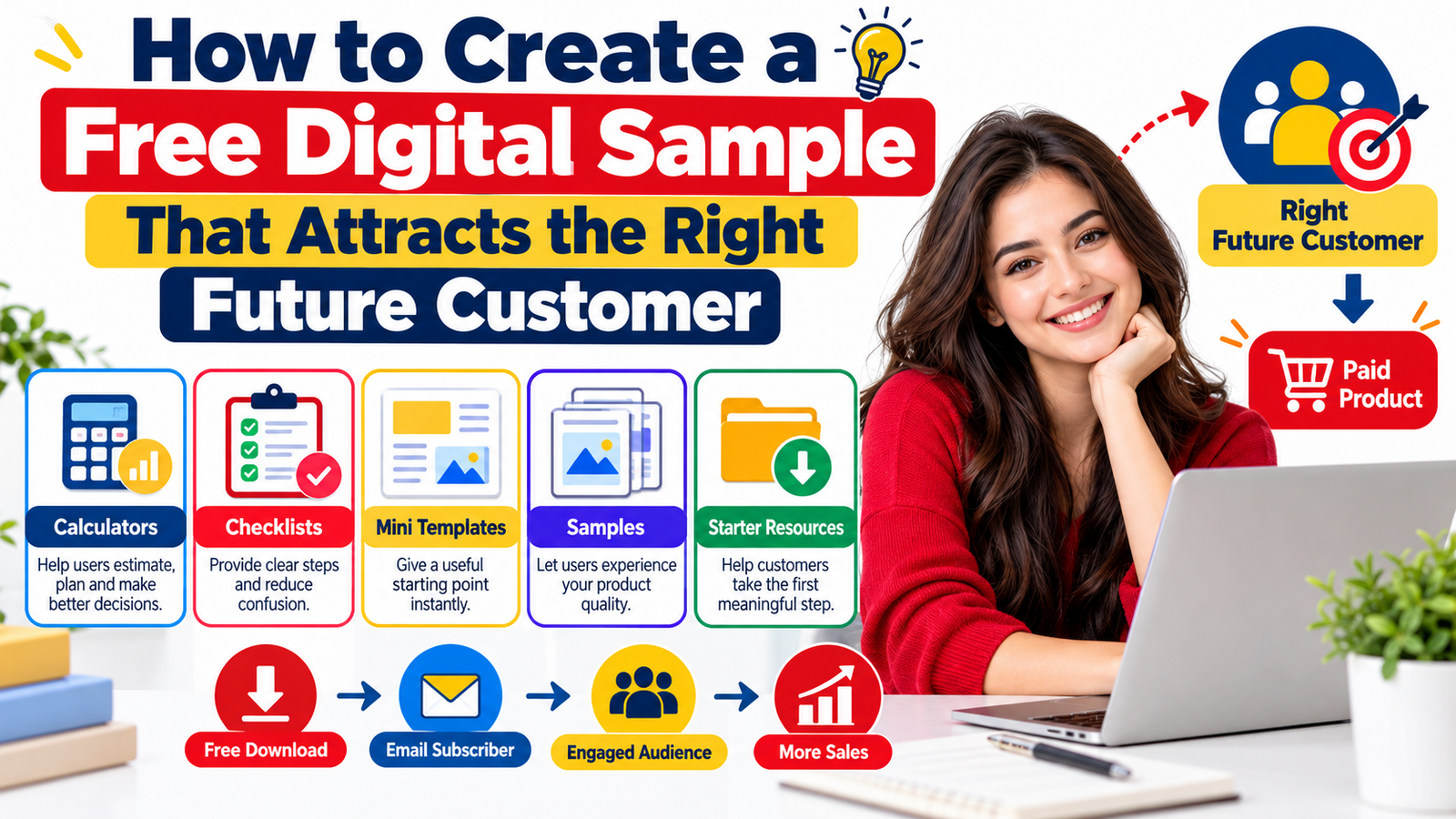
A free digital product can bring hundreds or thousands of people into your audience. But traffic and email signups alone do not make a freebie successful.
The real question is: Are you attracting people who may eventually want what you sell?
That difference matters.
A generic free download may collect email addresses from people who love free resources but have little interest in buying your paid products. A strategically designed digital product freebie, on the other hand, gives the right person a small but meaningful result while naturally introducing them to the larger problem your paid product solves.
That is why calculators, checklists, mini templates, starter kits, samples, worksheets and quick-reference tools can be powerful forms of free digital download marketing.
The best free sample is not simply something valuable you can give away. It is a carefully chosen first step into your paid product ecosystem.
When the free resource, customer problem and paid offer are closely connected, your lead magnet becomes more than an email-list incentive. It becomes a customer qualification tool, trust builder, product demonstration and sales pathway working at the same time.
What Is a Digital Product Freebie?
A digital product freebie is a downloadable or interactive resource offered at no cost, usually in exchange for an email address or another small action.
Common examples include calculators, planners, checklists, worksheets, mini guides, spreadsheet tools, Canva templates, printable samples, prompt packs, resource lists, assessment tools and limited versions of larger paid products.
However, effective lead magnet ideas are not simply smaller products.
A strong freebie answers three questions.
Who is it for?
What immediate problem does it solve?
What logical problem will the person want to solve next?
That third question is where many creators miss an important opportunity.
Suppose you sell a comprehensive freelance business management spreadsheet.
A generic free PDF called 50 Ways to Make Money Online might attract plenty of subscribers, but many of them may never need a freelance management system.
A better freebie might be a Freelance Income Goal Calculator.
Someone using that calculator is already thinking about freelance income, pricing and business planning. That person is therefore much closer to the target customer for your paid spreadsheet.
The audience may be smaller, but the commercial relevance is much stronger.
The Goal Is Not Maximum Downloads
It is tempting to judge a lead magnet by one number: downloads.
But 10,000 downloads from poorly matched visitors may be less useful than 1,000 downloads from people who genuinely need your paid solution.
A useful freebie should attract the type of customer you want more of.
Instead of asking, “What can I give away that everyone will want?” ask:
“What small problem does my ideal buyer experience immediately before needing my paid product?”
That question can completely change your digital product marketing strategy.
Imagine you sell an advanced social media content planning system.
A broad free ebook about social media might attract students, casual users, marketers, business owners, influencers and people simply researching the subject.
A 30-Day Content Idea Mini Planner, however, attracts someone actively trying to organize content.
That behavior signals stronger alignment with your paid planning system.
Your free product should therefore act as a bridge, not an unrelated giveaway.
Start With the Paid Product, Not the Freebie
One of the easiest ways to create an ineffective lead magnet is to brainstorm random free content first.
Reverse the process.
Begin with your paid product.
Ask what transformation it provides, what problem it solves, who benefits most and what usually happens immediately before someone decides they need that solution.
For example, imagine your paid product is a complete small-business budgeting dashboard.
The customer’s larger goal might be to understand business finances.
Before purchasing a comprehensive dashboard, however, the customer may first wonder:
“Where is my money going?”
“How much should I save for expenses?”
“Can my business afford this purchase?”
“What revenue do I actually need every month?”
Each question could become a highly targeted free resource.
You might create a monthly expense checklist, revenue target calculator, simple profit worksheet or one-page cash-flow planner.
Each solves a small problem while exposing the larger need addressed by your paid dashboard.
That is strategic product alignment.
Give People a Quick Win
People download free resources because they want progress.
They usually do not want another 70-page ebook sitting unread inside a downloads folder.
A powerful lead magnet helps someone accomplish something quickly.
The outcome could be estimating a number, making a decision, organizing information, identifying a problem, completing a task, preparing for the next step or seeing what a better process looks like.
This is why utility-based resources often make compelling digital freebies.
Someone can use a calculator immediately.
A checklist creates clarity.
A mini template eliminates setup work.
A worksheet turns vague ideas into organized information.
A sample shows exactly what the customer may receive.
A starter resource helps someone begin instead of merely learning about beginning.
The easier your resource is to use, the faster the customer can experience its value.
Five Free Digital Sample Formats That Connect Naturally to Paid Products
1. Calculators
Calculators work especially well when customers need to make decisions involving numbers.
A creator selling pricing tools could offer a free freelance rate calculator.
A wedding-planning template store could provide a wedding budget estimator.
A digital advertising course could offer a basic return-on-ad-spend calculator.
A fitness business could provide a training schedule calculator where appropriate.
A financial template seller could create a revenue-goal calculator.
Calculators have a powerful psychological advantage: the answer is personalized.
Instead of telling a visitor what someone might need, the tool helps them understand their own situation.
That creates a natural opportunity for the paid product.
After calculating a target monthly revenue, for example, the user might see:
“Now that you know your target, use the complete Business Revenue Dashboard to track your actual revenue, expenses and monthly progress.”
The CTA feels relevant because it continues the same task.
2. Checklists
Checklists are simple, fast and highly practical.
They are ideal when the customer’s challenge involves remembering a process or avoiding mistakes.
If you sell an ebook publishing system, offer a Pre-Publishing Checklist.
If you sell wedding planning templates, offer a Wedding Vendor Booking Checklist.
If you sell ecommerce resources, create a Product Listing Optimization Checklist.
If you sell social media templates, offer a Weekly Content Publishing Checklist.
The free checklist explains what needs to happen.
Your paid product can then help customers actually manage, document or execute those steps.
That separation is important.
Give away clarity. Sell deeper implementation.
3. Mini Templates
A mini template lets customers experience your approach before purchasing a larger template system.
Suppose your paid product contains 100 business spreadsheet templates.
Rather than giving away an unrelated ebook, provide one polished spreadsheet from the collection.
The customer immediately experiences the formatting, organization, ease of use and quality of your work.
You are no longer telling them the bundle is useful.
You are letting them experience it.
For creators, template sellers and digital resource shops, this can be one of the strongest forms of free digital download marketing.
4. Product Samples
Sometimes the most effective freebie is simply a genuine sample of the paid product.
A workbook creator might provide five sample pages.
A printable seller could provide three printable sheets.
A prompt bundle seller might offer 20 prompts from a larger collection.
A digital planner creator could provide one planning section.
A course seller could release a useful introductory lesson.
The goal is not to hide all the value behind the payment page.
Give customers enough value to understand the quality while keeping the paid product meaningfully more complete.
5. Starter Resources
Starter resources are useful when the biggest obstacle is getting started.
Examples include a starter spreadsheet, quick-start guide, first-week planner, beginner dashboard, setup worksheet, client onboarding starter pack or seven-day challenge.
The word “starter” also sets appropriate expectations.
You are not promising to solve everything.
You are helping someone make the first meaningful move.
Your premium product can then support the next stage.
Match the Freebie to Customer Awareness
Not every visitor knows exactly what they need.
Some are just discovering a problem.
Others understand the problem but have not selected a solution.
Others are actively comparing products.
Your digital product freebie should reflect the stage you want to target.
A beginner-focused checklist works well for someone recognizing a problem.
A calculator can help someone quantify the problem.
A mini template helps someone explore a solution.
A sample from a premium product helps someone evaluate a possible purchase.
This means lead magnets can also function as filters.
The resource someone chooses tells you something about what they currently need.
A person downloading your “Freelance Pricing Calculator” has different intent from someone downloading “100 Online Business Ideas.”
That information can improve your email marketing, product recommendations and future content strategy.
Make the Freebie Useful Without Making the Paid Product Unnecessary
Creators sometimes worry that a valuable free resource will reduce paid sales.
Usually the bigger risk is the opposite: giving away something too weak to establish trust.
A free resource should genuinely work.
A checklist should contain useful steps.
A calculator should produce meaningful information.
A mini template should function properly.
A sample should represent the real quality of your products.
The distinction between free and paid should come from scope, depth, convenience and completeness, rather than deliberately reducing quality.
For example, your free resource might help someone calculate a monthly content target.
Your premium product could help them plan topics, organize production, track publishing, analyze performance and manage the entire workflow.
The freebie solves one step.
The product solves the system.
Use the “One Problem, One Result” Rule
Lead magnets often become less effective when creators keep adding pages, bonuses and unrelated information.
More content does not automatically mean more value.
A focused free resource can often be understood more quickly and used more easily.
Try defining your freebie with one sentence:
This resource helps [specific person] achieve [specific small result] without [specific frustration].
For example:
“This worksheet helps first-time digital product sellers calculate a realistic starting price without building a complicated financial model.”
That promise is clear.
The customer knows who the resource is for, what it does and why it is useful.
Build a Clear Connection Between Free and Paid
Your lead magnet should never leave the subscriber wondering what to do next.
Once the free resource has helped them achieve a result, identify the natural next challenge.
A free content calendar may reveal that planning is only part of the problem. The user still needs templates, workflow tracking, analytics and publishing systems.
That creates the bridge to a complete content-management product.
A free wedding budget calculator may show the estimated budget, but the customer still needs vendor tracking, payment schedules, guest management and timelines.
That creates the bridge to a wedding planning bundle.
A free business expense tracker may organize expenses, while the customer eventually needs profit-and-loss reporting, cash-flow planning and forecasting.
That creates the bridge to a larger financial dashboard.
Good upselling does not force an unrelated purchase.
It continues the customer’s progress.
Design the CTA Around the Next Step
“Buy now” is not always the strongest CTA.
Context matters.
If someone has just completed a free template, your call to action could focus on what comes next.
“Ready to organize the complete workflow? Explore the full planning system.”
“Need more than the starter template? See the complete template library.”
“Turn your calculation into a monthly plan with the full business dashboard.”
“Continue from this checklist with the complete launch toolkit.”
These CTAs work because they connect the free experience with a clear next action.
The customer understands why the product exists.
Create a Dedicated Landing Page
Do not hide your freebie inside a crowded product page.
A focused landing page makes the value easier to understand and gives search engines a clear topic to interpret.
Your page should clearly explain the problem, intended user, result, format, what is included and what happens after someone downloads it.
A headline such as:
Free Digital Product Pricing Calculator for New Sellers
communicates more search intent than:
Grab My Amazing Freebie!
Search-friendly does not need to sound robotic.
The goal is clarity.
Include natural phrases that your audience may actually search, such as digital product freebie, free digital download, digital product checklist, free business template, lead magnet ideas for digital product sellers, free digital product sample, digital product marketing resources and related long-tail queries where they genuinely fit the page.
Optimize for SEO Without Keyword Stuffing
SEO works best when the subject is unmistakably clear.
Use your main keyword in important locations where it reads naturally, including the title, introduction, one or more headings, meta description, image alt text where accurate and page URL.
Then expand the topic semantically.
For an article about creating freebies, related concepts may include lead generation, email list building, customer acquisition, downloadable resources, free templates, conversion strategy, audience building, product sampling, email funnels, customer journey, digital downloads, creator marketing and product discovery.
Do not repeat “digital product freebie” every few sentences simply because it is your primary keyword.
Google’s current guidance continues to emphasize helpful, reliable, people-first content rather than pages written primarily to manipulate rankings. Original information, useful analysis, satisfying answers and trustworthy authorship are more sustainable than mechanically targeting keyword density.
Think About GEO as Well as Traditional SEO
Search discovery increasingly happens through more than a conventional list of blue links.
People may encounter information through search-generated summaries, conversational search experiences and other AI-assisted discovery systems.
That makes clearly structured content increasingly useful.
Write sections that answer specific questions directly.
Use descriptive headings.
Define concepts before expanding them.
Provide practical examples.
Explain relationships between problems and solutions.
Use natural entities and terminology consistently.
Avoid burying the useful answer beneath several paragraphs of filler.
Google’s current guidance for its generative AI search experiences still points publishers toward familiar fundamentals: crawlable content, strong page experience, useful information and sound SEO practices rather than a completely separate optimization formula.
Make the Article and Freebie Discover-Friendly
Google Discover is interest-driven rather than purely keyword-driven, so visibility cannot be guaranteed.
However, Google’s current Discover documentation recommends useful, timely content, non-sensational headlines, compelling relevant imagery and an overall strong page experience. It recommends large images at least 1200 pixels wide, more than 300,000 total pixels, landscape-friendly presentation and enabling max-image-preview:large. Google also advises using representative imagery rather than generic or excessively text-heavy images.
Google’s February 2026 Discover update also placed additional emphasis on reducing clickbait while surfacing more original, timely, in-depth content from sources demonstrating expertise on a topic.
For this article, a strong featured-image concept could be a clean workspace showing a creator developing a calculator, checklist and mini template on a laptop, with simple visual symbols representing free download, email subscriber and premium product progression.
Use a descriptive headline rather than exaggerated language.
Good: How to Create a Free Digital Sample That Attracts the Right Future Customer
Weak: This Secret Freebie Trick Will Explode Your Sales Overnight
The first communicates the real topic.
The second creates a promise the content may not be able to support.
Use Article Structured Data
For a blog post like this, Article or BlogPosting structured data can help Google better understand information such as the headline, images, dates and author.
Google states that Article structured data can help it understand article pages and potentially represent elements such as titles, images and dates more appropriately, although markup itself does not guarantee a particular search appearance.
Make sure your visible page information and structured data agree.
Include accurate author information, publication date, modified date when appropriate and representative imagery.
Turn the Download Into a Customer Journey
Getting the email address is only the beginning.
A good lead magnet should connect to a short follow-up journey.
The first message can deliver the resource immediately and explain how to use it.
The next communication might offer one practical implementation tip.
Another could show a realistic example or use case.
Later, you can introduce the complete paid solution.
This works much better than delivering a file and immediately sending a stream of aggressive sales messages.
Think of the sequence as continuing the experience started by the freebie.
The customer initially thinks:
“I need help with this small problem.”
Your free resource demonstrates:
“This approach works.”
Your follow-up content shows:
“There is a larger system behind this.”
Your paid product answers:
“I want the complete solution.”
That is a far healthier customer journey than trying to manufacture urgency around an unrelated offer.
Measure More Than Email Signups
A freebie can generate plenty of leads while producing almost no customers.
That is why conversion quality matters.
Track how many landing-page visitors download the resource, how many subscribers open the delivery email, how many actually click through to related content or products, which paid products they eventually purchase and which free resources produce the highest-quality customers.
Over time, you may discover that a smaller, highly specific lead magnet generates more revenue than your most downloaded resource.
That is useful information.
The purpose of measurement is not simply to prove that your freebie is popular.
It is to discover whether it attracts the audience your business actually needs.
Freebie Ideas Matched With Paid Products
| Free Digital Sample | Natural Paid Product |
|---|---|
| Freelance Rate Calculator | Freelance Business Dashboard |
| Wedding Budget Calculator | Complete Wedding Planning Bundle |
| 7-Day Content Planner | 90-Day Content System |
| Business Expense Checklist | Financial Spreadsheet Bundle |
| Five Printable Activity Pages | Complete Kids Activity Pack |
| Resume Review Checklist | Career Planning Toolkit |
| Product Launch Checklist | Complete Launch Planner |
| Mini Social Media Template Pack | Full Social Media Template Library |
| Book Planning Worksheet | Author Writing & Publishing System |
| Ecommerce Listing Checklist | Ecommerce Seller Toolkit |
| Podcast Episode Planner | Complete Podcast Management Kit |
| One Client Intake Form | Client Management Template Bundle |
Notice the relationship in every example.
The freebie does not send the customer in one direction while the paid product goes in another.
The free product opens the door.
The premium product takes the customer further.
Avoid Common Freebie Mistakes
The biggest mistake is making the freebie too broad.
“Ultimate Business Guide” sounds valuable but attracts many different types of people.
“Simple Monthly Revenue Calculator for Freelance Designers” attracts a much more specific customer.
Another mistake is creating a lead magnet because competitors have one.
Your free resource should reflect your own product ecosystem.
Poor presentation can also reduce trust. Even free resources should be easy to understand, professionally formatted and tested before publication.
Do not create artificial scarcity around an evergreen download unless there is a genuine reason for the deadline.
Do not promise dramatic financial, business or personal outcomes that the resource cannot realistically deliver.
Most importantly, do not think of the free product and paid product as separate campaigns.
They should feel like different stages of the same solution.
A Simple Freebie Formula
A practical formula is:
Relevant problem + quick result + useful experience + logical next step = strong digital product freebie.
Consider a creator selling a large library of Excel business templates.
The free resource could be a simple monthly profit calculator.
The visitor enters revenue and expenses.
The calculator gives them a basic result.
The person now realizes they would benefit from deeper monthly tracking.
The CTA introduces the complete financial spreadsheet collection.
Nothing feels forced.
The paid offer is simply the next level of the work they have already started.
Why Small Free Tools Can Build Bigger Trust
Digital customers cannot hold a downloadable product before buying it.
They cannot walk through a physical store, inspect its materials and test its construction.
That makes trust especially important.
A useful free sample reduces uncertainty.
The customer sees your design quality.
They experience your instructions.
They understand your approach.
They discover whether your product style matches how they prefer to work.
That small experience can make a paid product feel less risky.
This is particularly valuable for newer digital product brands that do not yet have a large number of customer reviews, referrals or years of brand recognition.
Your free resource becomes evidence of what you can create.
Build the Freebie That Leads Naturally to the Paid Offer
The strongest free digital sample does not try to satisfy everyone.
It attracts the right person.
It solves a meaningful but contained problem.
It demonstrates quality.
It gives the customer a quick result.
And when that result creates the need for a more complete solution, your paid product is already waiting in the logical next position.
That is what separates a random free download from a strategic digital product freebie.
Instead of asking what you can afford to give away, ask what your future customer needs to experience before they are ready for the next step.
Create that resource.
Make it genuinely useful.
Keep it closely connected to your paid offer.
Then use your content, email sequence and product pages to help the customer continue the journey.
A good freebie may earn an email address.
A well-designed freebie can earn something more valuable: relevance, trust and the opportunity to become the customer’s natural next choice.
Frequently Asked Questions
1. What is the best free digital product to use as a lead magnet?
The best lead magnet is usually a small resource closely related to the paid product you eventually want the customer to consider. Calculators, checklists, mini templates, samples and starter resources work particularly well because they can deliver a fast result while demonstrating the value of a larger system.
2. Should I give away part of my paid digital product for free?
Yes, when the sample can provide genuine standalone value without replacing the complete product. A few workbook pages, one spreadsheet, several templates or a limited starter version can help potential customers experience your product quality before purchasing the complete package.
3. How large should a digital product freebie be?
There is no ideal page count or file size. It should be as long as necessary to deliver the promised result and no longer. A one-page checklist that gets used can be more effective than a 50-page ebook that subscribers never open.
4. How can a free digital download generate sales?
The free resource should solve the first part of a larger customer problem. Once the subscriber experiences that result, introduce the paid product as the natural tool for completing the next stage. Email follow-ups, examples, tutorials and relevant CTAs can help connect the two.
5. How do I know whether my lead magnet is attracting the right customers?
Look beyond total downloads. Monitor how subscribers interact with follow-up emails, related articles and paid products. A freebie that generates fewer leads but more product-page visits, qualified subscribers and eventual customers may be more valuable than a high-volume generic giveaway.
Stay ahead with exclusive updates
Join our community. Get curated industry trends, actionable guides, and fresh resources delivered straight to your inbox.