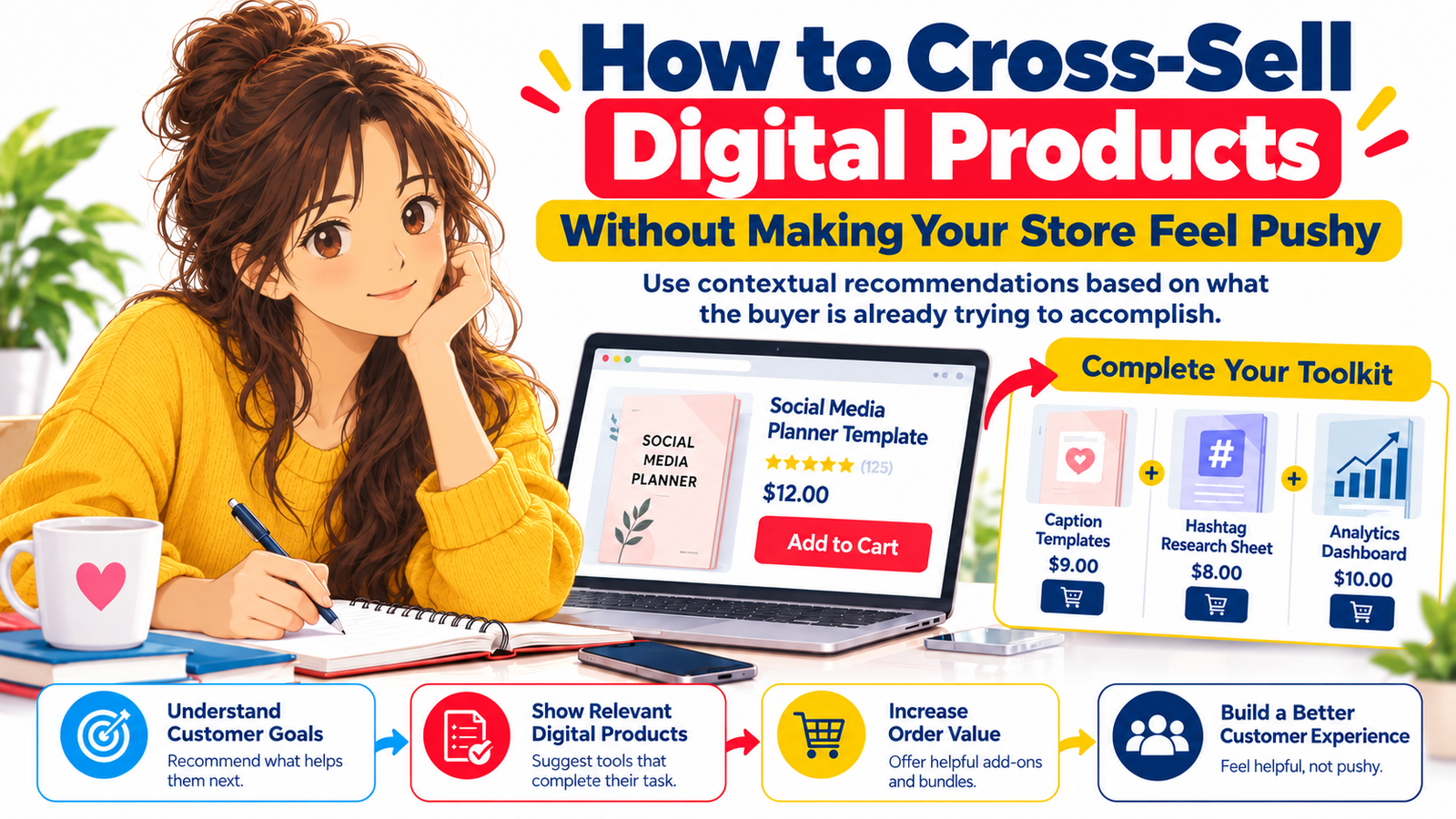
A customer arrives at your store looking for a social media planner.
They find one they like, read the description, and decide it could help organize their content.
Now you have two choices.
You can immediately surround them with pop-ups saying “Buy More!”, “Add This!”, and “Don’t Miss This Offer!”
Or you can quietly show them a caption-writing template that helps them complete the exact job they are already trying to accomplish.
Both approaches are technically cross-selling.
But only one feels genuinely helpful.
That distinction is becoming increasingly important for digital product sellers.
Effective digital product cross sell strategies are not about squeezing another purchase out of every visitor. They are about understanding what the customer is trying to accomplish and showing them another resource that makes that outcome easier, faster, or more complete.
When done well, ecommerce cross selling can improve product discovery, strengthen the customer experience, and increase average order value without making your digital store feel aggressive.
The key principle is simple:
Recommend the next useful step, not simply the next product.
What Is Digital Product Cross-Selling?
Cross-selling means recommending an additional product that complements what a customer is already viewing, buying, or using.
For example:
Someone buying a resume template might also benefit from an interview preparation workbook.
Someone purchasing an Instagram content calendar might appreciate a caption prompt pack.
Someone downloading a business budget spreadsheet might need a cash-flow tracker.
Someone buying a wedding planner could benefit from a vendor comparison worksheet.
These products are different, but they help solve connected parts of the same problem.
That is what makes them natural related digital products.
Cross-selling is different from simply showing whatever product you want to sell next. Good cross-selling begins with customer context.
Why Traditional Cross-Selling Can Feel Pushy
Customers rarely object to useful recommendations.
They object to irrelevant interruptions.
Imagine buying an ebook about freelance pricing and immediately being offered:
- a meal planner
- a children’s activity bundle
- an unrelated Canva template collection
- a random course simply because it has a high price
The problem is not the existence of the recommendation.
The problem is the lack of connection.
Research into ecommerce usability has similarly emphasized the importance of relevant recommendations, contextual labels, complementary products, and compatibility between the original purchase and recommended items.
Digital sellers can therefore use a better question than:
“What else can I sell?”
Ask:
“What else will this buyer probably need to achieve the result they came here for?”
That shift changes cross-selling from a sales tactic into customer assistance.
Start With the Customer’s Goal
Every successful cross-sell should begin with intent.
Suppose your customer is purchasing a YouTube video planner.
Their real goal probably isn’t owning a PDF.
Their goal might be:
plan videos → organize production → publish consistently → grow their channel
Once you understand that journey, useful recommendations become obvious.
You might recommend:
YouTube Video Planner → Thumbnail Planning Kit
or:
YouTube Video Planner → Sponsorship Tracker
or:
YouTube Video Planner → Content Performance Dashboard
Each additional product supports another stage of the customer’s existing objective.
This is much stronger than displaying five random bestsellers below the product description.
Think in Outcomes, Not Product Categories
Digital stores are often organized by product type:
Templates
ebooks
Spreadsheets
Checklists
Courses
Printables
Prompt packs
But customers usually think differently.
They think:
“I need to organize my business.”
“I need to find a job.”
“I need to plan my wedding.”
“I need to publish content consistently.”
“I need to manage my money.”
Your cross-selling structure should reflect those goals.
For example, a job seeker might move through this journey:
Resume Template
→ Job Application Tracker
→ Networking Planner
→ Interview Workbook
→ Salary Negotiation Checklist
Five different products.
One connected outcome.
That is contextual cross-selling.
The One-Step-Ahead Cross-Sell Method
One of the easiest ways to make recommendations feel natural is to recommend the product that helps with the buyer’s next logical step.
Consider an online seller purchasing a product research spreadsheet.
What comes next?
They may need to evaluate ideas.
Then create listings.
Then organize a launch.
Then track performance.
Your sequence could become:
Product Research Sheet → Product Validation Checklist → Listing Template → Launch Planner → Sales Dashboard
You do not necessarily need to show all five products at once.
Show the one or two that are most relevant at that moment.
This reduces decision overload while keeping recommendations meaningful.
Ask Three Questions Before Recommending Anything
Before adding a cross-sell to a product page, ask:
1. What is the buyer trying to accomplish?
Identify the result behind the purchase.
2. What might prevent them from completing that result?
Look for missing information, tools, templates, planning systems, or resources.
3. Which existing product fills that gap?
That becomes your strongest cross-sell candidate.
If you cannot clearly explain why two products belong together, the customer probably will not understand the connection either.
Complement the Purchase Instead of Duplicating It
A common cross-selling mistake is recommending something that is too similar to the main product.
Imagine someone has already selected a detailed 90-day business planner.
Recommending another 90-day planner may create confusion:
Do I need both?
Is the first one incomplete?
Which one should I use?
Instead, recommend something that expands the first product.
For example:
90-Day Business Planner + Weekly KPI Dashboard
or:
90-Day Business Planner + Marketing Campaign Tracker
or:
90-Day Business Planner + Business Finance Spreadsheet
The second product should answer:
“What becomes easier when I use these together?”
Shopify’s current recommendation guidance similarly distinguishes complementary products—add-ons that work with the main purchase—from related alternatives.
Use Clear Contextual Labels
The heading above your recommendation matters more than many sellers realize.
Generic labels such as:
You May Also Like
can work, but they provide little explanation.
More contextual headings make the relationship easier to understand.
Try:
Complete Your Toolkit
Useful when products work together as a system.
Use This With Your Planner
Excellent for worksheets, dashboards, trackers, and accessories.
Your Next Step
Ideal when the product fits naturally after the original purchase.
Helpful for This Project
Works well when customers are completing a specific task.
Add to Your Workflow
Useful for business, creator, productivity, and professional products.
Often Used Together
Good when purchase behavior genuinely supports the recommendation.
Continue With
Useful for educational products or sequential resources.
The label should explain why the recommendation exists.
That small piece of context can make the cross-sell feel like navigation rather than advertising.
Create Product Families
If your store contains many downloads, create products that naturally belong together.
Instead of producing isolated products, think in ecosystems.
For example:
Content Creator Product Family
Content Calendar
Caption Templates
Hashtag Research Sheet
Brand Partnership Tracker
Analytics Dashboard
Content Repurposing Planner
Freelancer Product Family
Client Intake Form
Proposal Template
Project Planner
Invoice Tracker
Client Offboarding Checklist
Testimonial Request Template
Author Product Family
Story Planner
Character Development Workbook
Writing Tracker
Editing Checklist
Publishing Planner
Book Marketing Calendar
Now cross-selling becomes easier because each product naturally connects to others.
This strategy also makes your catalog easier for customers to understand.
Cross-Sell According to the Stage of the Customer Journey
Not every buyer needs the same recommendation.
Someone just beginning a project may need a different resource from someone preparing to launch.
You can organize your digital products around stages.
For example:
Stage 1: Research
Idea worksheets
Research templates
Competitor trackers
Stage 2: Planning
Project planners
Calendars
Budget sheets
Stage 3: Creation
Templates
Checklists
Production systems
Stage 4: Launch
Launch planners
Marketing kits
Promotional calendars
Stage 5: Optimization
Analytics dashboards
Review worksheets
Performance trackers
If someone buys a Stage 2 product, recommending a Stage 3 resource often makes more sense than recommending another Stage 2 product.
The recommendation becomes part of the journey.
Use Small, Specific Recommendations
More products do not automatically create more sales.
A page displaying fifteen recommendations can feel like another catalog.
Instead, choose a small number of closely related options.
For example:
Buying:
Podcast Episode Planner
Helpful additions:
Guest Interview Question Pack
Podcast Sponsorship Tracker
That is enough.
The customer can understand the relationship immediately.
Strong cross-selling is selective.
Explain Why the Products Work Together
Never make the customer solve the relationship themselves.
Instead of writing:
Related Product: Social Media Caption Pack
write:
Planning your monthly content? Use the Caption Prompt Pack to turn the ideas inside your content calendar into ready-to-write posts.
The second version explains the benefit.
Another example:
Instead of:
You might also like our Expense Tracker.
Try:
Already using the Business Budget Template? The Expense Tracker helps you record day-to-day spending before transferring the totals into your monthly budget.
Now the buyer understands exactly how both files fit together.
Cross-Sell on the Product Page
The product page is one of the most natural places to introduce a complementary resource because the customer’s intent is already visible.
For example:
A visitor viewing a digital wedding budget planner could see:
Planning the Rest of Your Wedding?
Pair your budget planner with our Vendor Comparison Sheet to organize quotes, contact information, deposits, and important questions in one place.
The recommendation feels useful because it continues the same task.
Keep the primary product as the main focus.
The cross-sell should support the decision, not compete with it.
Cross-Sell Inside the Shopping Cart Carefully
The cart can work well for cross-selling, but relevance becomes especially important here.
The customer has already decided what they want.
Do not create unnecessary uncertainty.
If someone adds an Etsy Product Listing Planner, a sensible cart recommendation might be:
Keyword Research Worksheet
A less useful recommendation might be another completely different listing planner.
At this stage, supplementary resources generally make more sense than competing alternatives.
Use Post-Purchase Cross-Selling
Cross-selling does not need to happen before payment.
Sometimes the best recommendation appears after the purchase.
Suppose someone buys:
Small Business Finance Starter Spreadsheet
After checkout, you could show:
Next, organize your sales activity with the Revenue Tracking Dashboard.
This approach has an important advantage:
The original purchase has already been completed.
There is less risk of distracting the customer from checkout.
Post-purchase recommendations can also be included in:
purchase confirmation pages
download pages
customer accounts
thank-you emails
product tutorials
resource libraries
future educational emails
The objective should remain the same: help customers continue making progress.
Cross-Sell Through Product Instructions
One of the most natural opportunities occurs while customers are actually using your product.
Imagine your ebook explains:
Step 4: Track monthly revenue and expenses.
You could mention:
If you prefer a ready-made spreadsheet for this step, the Business Finance Tracker can be used alongside this guide.
This is contextual because the recommendation appears exactly when the need becomes clear.
It feels like an optional resource rather than an advertisement.
Build Bundles Around Outcomes
Bundles are another form of cross-selling.
But avoid creating bundles by simply combining unrelated inventory.
A good bundle should answer one clear customer need.
For example:
Freelancer Client Management Kit
Client Inquiry Form
Proposal Template
Project Tracker
Invoice Sheet
Client Feedback Form
Offboarding Checklist
Every product supports the same workflow.
A weak bundle might combine:
Client Proposal
Meal Planner
Instagram Quotes
Kids Worksheets
Wedding Checklist
Large numbers may sound impressive, but usefulness usually matters more than quantity.
Create a Cross-Sell Map for Your Store
You can create a simple internal map for every product.
Use a structure like this:
Main Product
What problem does it solve?
Before
What might the customer need before using it?
During
What could help while using it?
After
What will the customer probably need next?
Complement
What makes the original product more useful?
Consider a digital course planner.
Before: Course Idea Validation Worksheet
During: Lesson Planning Template
After: Course Launch Checklist
Complement: Student Progress Dashboard
You now have four contextual recommendation opportunities without inventing artificial sales tactics.
Match Cross-Sells to Search Intent
Cross-selling can also support a stronger SEO content strategy.
If someone searches:
digital planner for freelancers
their wider needs may include:
client management templates
invoice trackers
project trackers
freelance business planners
client onboarding documents
Creating useful pages around these connected subjects gives search engines and customers a clearer understanding of your store’s topical focus.
However, avoid creating dozens of thin pages simply to target keyword variations.
Google continues to recommend people-first content that leaves visitors feeling they have learned enough to accomplish their goal rather than search-engine-first pages created primarily to capture traffic.
For digital product sellers, this means your articles, product descriptions, tutorials, and related-product recommendations should genuinely answer buyer questions.
Digital Product Cross-Selling and GEO
Generative Engine Optimization, or GEO, focuses on making information understandable and useful to AI-assisted discovery systems as well as traditional search engines.
For cross-selling content, clarity matters.
Instead of vague language like:
Our products make everything easier
use specific statements:
The Content Calendar helps creators schedule publishing dates, while the Caption Workbook helps turn those planned topics into draft social posts.
Clear relationships help humans understand the offer and make your content easier for machines to interpret.
Useful GEO-friendly content often includes:
clear definitions
descriptive headings
specific use cases
question-and-answer sections
step-by-step explanations
product relationships
natural language descriptions
realistic examples
consistent terminology
The goal is not to write for machines.
The goal is to make your information unmistakably clear.
Don’t Force a Cross-Sell Where None Exists
Sometimes the best recommendation is no recommendation.
If your store does not contain something genuinely useful for the customer’s current objective, allow them to complete the purchase without interruption.
Relevance protects trust.
A customer who enjoys using one product can return later.
Trying to monetize every screen can reduce the calm, professional feeling of your store.
Measure Cross-Sell Performance
Once your system is running, monitor what customers actually choose.
Useful metrics can include:
cross-sell click-through rate
cross-sell conversion rate
average order value
products frequently purchased together
bundle conversion rate
post-purchase conversion rate
revenue per order
repeat purchase rate
Do not judge performance only by clicks.
Suppose one recommendation receives many clicks but few purchases.
The connection may look interesting but lack enough practical value.
Another recommendation might attract fewer clicks but convert significantly better because the product relationship is obvious.
Customer behavior can gradually improve your recommendation map.
Examples of Natural Digital Product Cross-Sells
Here are several practical combinations.
Resume Template → Interview Preparation Workbook
Budget Planner → Expense Tracker
Content Calendar → Caption Prompt Pack
Wedding Planner → Vendor Comparison Sheet
YouTube Planner → Thumbnail Planning Template
Podcast Planner → Guest Interview Worksheet
Novel Planner → Character Development Workbook
Ecommerce Launch Planner → Product Listing Checklist
Business Plan Template → Cash-Flow Forecast Spreadsheet
Course Planner → Lesson Planning Workbook
Photography Client Guide → Session Preparation Checklist
Social Media Kit → Analytics Dashboard
Freelancer Proposal Template → Client Onboarding Pack
Notice the pattern.
The second product helps the customer continue the first task.
That is the core of effective ecommerce cross selling.
Use the Customer’s Language in Your CTAs
Aggressive CTAs can make even a relevant recommendation feel uncomfortable.
Instead of:
BUY THIS NOW!
consider:
Add This to Your Toolkit
Continue Your Project
Complete Your Planning System
See the Companion Template
Add the Next Step
Explore the Matching Resource
Build Your Complete Workflow
The CTA should match the customer’s intention.
For educational products, you might use:
Continue Learning
For planning products:
Complete Your Planning Kit
For professional templates:
Add to Your Business Toolkit
Context makes commercial language feel more natural.
A Simple Cross-Selling Formula
You can summarize a strong digital product cross-sell in one formula:
Current Goal + Next Need + Relevant Resource + Clear Benefit
For example:
Current goal: Plan social media content.
Next need: Turn ideas into captions.
Relevant resource: Caption Prompt Workbook.
Clear benefit: Draft posts faster without starting from a blank page.
Your recommendation becomes:
Already planning your monthly content? Add the Caption Prompt Workbook to turn each idea in your calendar into a stronger starting point for your next post.
No pressure.
No exaggerated promise.
Just a logical next step.
Build a Store That Feels Helpful Before It Feels Promotional
The strongest digital product stores do not necessarily show customers the most products.
They show customers the most relevant products.
A thoughtful digital product cross sell strategy begins by understanding why someone arrived at a product page in the first place.
What are they building?
What problem are they solving?
What comes next?
Where might they get stuck?
Which resource would genuinely make the process easier?
Answer those questions and your recommendations become much more natural.
Cross-selling then stops feeling like:
“Spend more money.”
It starts feeling like:
“Since you’re already doing this, here’s something that may help with the next part.”
That is the kind of ecommerce experience capable of improving both customer usefulness and commercial value.
Frequently Asked Questions
1. What is the best way to cross-sell digital products?
Start with the customer’s current goal and recommend one or two complementary products that help complete the next stage of that goal. A content planner paired with a caption workbook is generally more contextual than pairing the planner with an unrelated product simply because both are popular.
2. How many related digital products should I recommend?
There is no universal number, but a small number of highly relevant recommendations is usually easier to understand than a long list. Prioritize relevance, usefulness, and a clear connection with the main purchase.
3. What is the difference between cross-selling and upselling digital products?
Cross-selling introduces a complementary product, while upselling generally encourages the customer toward a more advanced, expanded, premium, or higher-value version of what they are already considering.
For example:
Cross-sell: Content Calendar + Caption Workbook
Upsell: Basic Content Calendar → Complete Content Management System
Both can be useful, but they serve different buying decisions.
4. Where should I place cross-sell recommendations?
Useful locations include product pages, carts, thank-you pages, download pages, customer accounts, instructional materials, and relevant follow-up emails. Choose the location according to when the additional resource becomes useful rather than placing recommendations everywhere.
5. Can cross-selling improve average order value without offering discounts?
Yes. Discounts are not required for cross-selling. When complementary products provide obvious additional value, customers can choose them at their regular price. The objective is to increase the usefulness of the overall purchase rather than relying solely on lower prices.
Digital Product Cross Sell, Ecommerce Cross Selling, Related Digital Products, Digital Product Marketing, Digital Product Store, Cross-Selling Strategy, Ecommerce Marketing, Average Order Value, Product Recommendations, Digital Downloads, Sell Digital Products, Digital Product Business, Online Store Marketing, Customer Experience, Product Bundles, Digital Product Sales, Ecommerce Conversion, Creator Business, Digital Product Strategy, Online Business
Stay ahead with exclusive updates
Join our community. Get curated industry trends, actionable guides, and fresh resources delivered straight to your inbox.