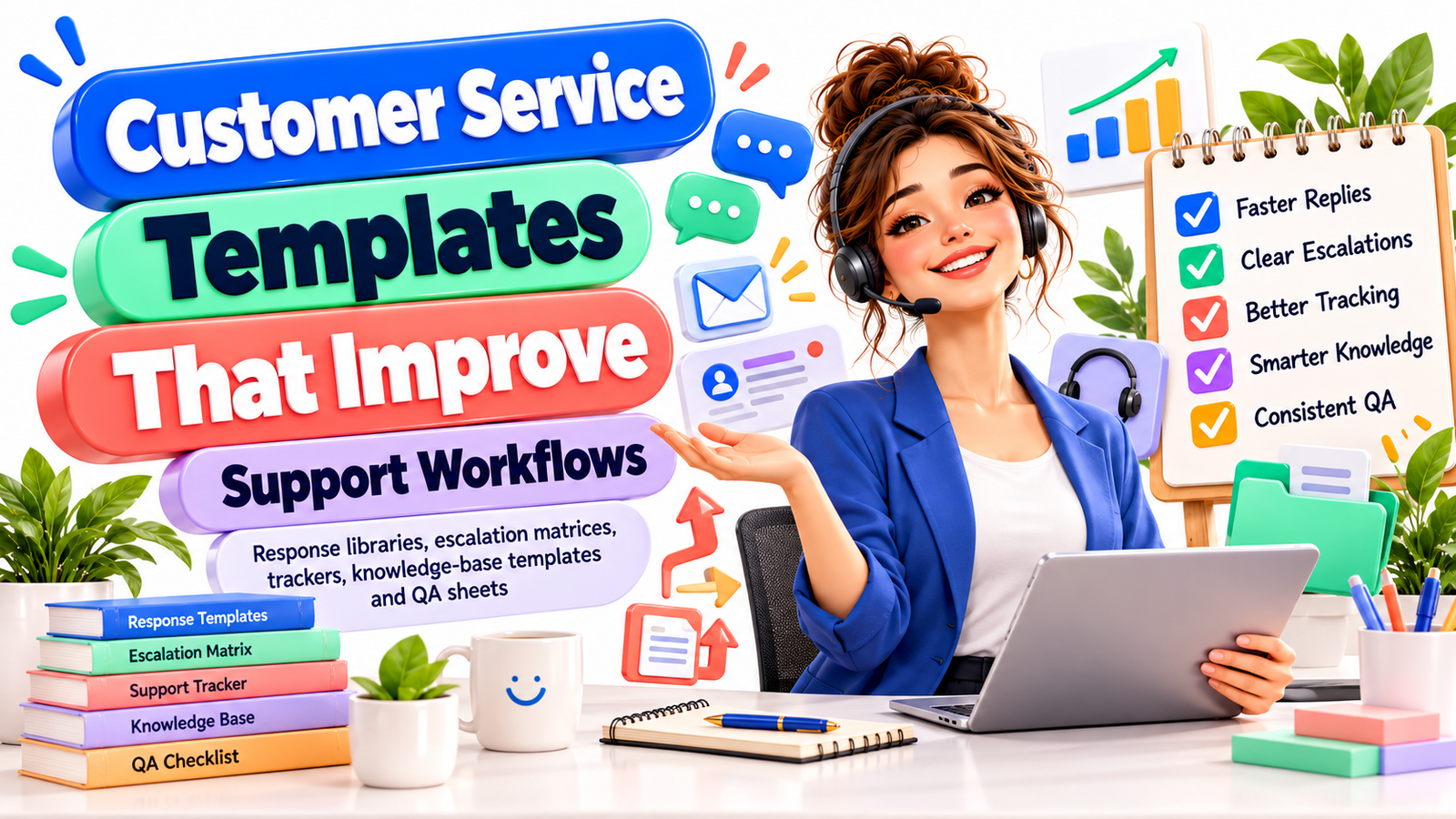
Templates That Improve Support Workflows
Customer service rarely breaks down because teams do not care about customers.
It breaks down because information is scattered, responses are inconsistent, escalation paths are unclear, managers cannot see what is happening, and agents spend valuable time rebuilding answers that should already exist.
A customer asks a familiar question, but the agent writes the reply from scratch. A billing complaint needs escalation, but nobody is certain who owns it. A new employee searches through old tickets for the correct policy. A manager wants to evaluate conversation quality, but there is no consistent QA framework.
Individually, these problems may seem small. Across hundreds or thousands of support conversations, they become expensive.
That is where digital products for customer service teams become valuable.
Well-designed customer service templates, support team templates, customer support resources, response libraries, escalation matrices, support trackers, knowledge-base templates, and quality assurance sheets can turn scattered customer service activity into a repeatable support system.
They do not replace skilled agents. They give skilled agents a stronger operating framework.
For businesses building or improving customer support operations, these resources can become some of the most practical digital tools available.
Why Customer Service Teams Need Better Systems, Not More Documents
Modern customer service teams handle far more than simple questions.
They may manage email tickets, live chat, social media messages, product problems, refunds, account questions, complaints, technical troubleshooting, cancellations, onboarding issues, subscription changes, delivery problems, customer feedback and complex escalations.
At the same time, customers expect fast answers without sacrificing accuracy or empathy.
The challenge is therefore not simply answering more tickets. The challenge is creating a support workflow that helps teams respond consistently, find information quickly, recognize high-risk situations and learn from every interaction.
This is becoming especially important as AI becomes more deeply embedded in customer service.
A 2026 Gartner survey reported that 91% of surveyed service and support leaders felt executive pressure to implement AI, while knowledge management and improving self-service remained significant priorities. Gartner also reported that 58% of service leaders planned to upskill agents into knowledge-management roles.
Salesforce similarly reported strong interest in AI agents among service leaders in 2026, while businesses continued to focus on customer satisfaction, efficiency and faster resolution.
The lesson is important: automation increases the value of structured knowledge.
An AI assistant cannot reliably use information that does not exist, is outdated, contradicts another document or lacks clear escalation rules. Human agents face exactly the same problem.
Customer service templates provide that structure.
What Are Customer Service Templates?
Customer service templates are reusable digital resources that standardize common support tasks.
They may be created in Google Docs, Microsoft Word, Google Sheets, Excel, Notion, Airtable, Canva, PDF format, CRM systems, help-desk platforms or dedicated customer service software.
Some are simple communication tools, such as prewritten email replies.
Others function as operational systems.
A complete collection might include:
- Customer response library, escalation matrix, support ticket tracker, knowledge-base article template, customer complaint form, refund and cancellation scripts, QA scorecard, coaching sheet, SLA tracker, customer feedback log, incident tracker, onboarding checklist, shift handover template, recurring-issue tracker and customer service KPI dashboard.
When these resources are designed as one connected system rather than isolated files, they can help a support operation become significantly easier to manage.
1. Customer Response Libraries: Stop Writing the Same Answer Again and Again
One of the easiest ways to improve customer service productivity is to create a structured customer response library.
Support agents repeatedly encounter similar situations.
“Where is my order?”
“How do I reset my password?”
“Can I receive a refund?”
“Why was I charged twice?”
“How do I cancel?”
“When will this feature be available?”
Without a response library, every agent may answer these questions differently.
That creates three problems: slower responses, inconsistent information and an inconsistent brand voice.
A good response library solves all three.
But reusable responses should never become robotic copy-and-paste scripts.
The strongest templates give agents a reliable structure while leaving space for personalization.
For example, instead of providing one rigid refund reply, the resource might include separate templates for refunds approved immediately, refunds requiring investigation, refunds outside the normal policy period, duplicate transactions and situations where the request cannot be approved.
Each template can contain placeholders for the customer’s name, product, order number, next step, expected timeframe and relevant help-center resource.
What Makes a Response Template Useful?
A useful template should communicate the answer quickly while preserving a natural human tone.
The opening should acknowledge the customer’s situation. The middle should explain what happened or what needs to happen next. The ending should give the customer a clear next step.
Templates should also indicate when agents are expected to customize the message.
That distinction matters.
A response library should make agents faster without making customers feel as if they are communicating with a machine.
2. Escalation Matrices: Make It Obvious Who Handles What
One of the most damaging phrases in customer support is:
“I thought somebody else was handling it.”
An escalation matrix template prevents that ambiguity.
It tells employees which issues they can resolve independently, which require supervisor approval and which must immediately be transferred to another team.
For example, a minor delivery delay may remain with frontline support, while a suspected data-security incident should follow a completely different escalation path.
An effective escalation matrix can include issue category, severity, responsible team, primary owner, backup owner, response target, escalation trigger, communication channel and documentation requirements.
This becomes particularly valuable when businesses operate across departments.
Billing problems may need finance.
Technical bugs may need engineering.
Public complaints may involve marketing or communications.
Legal threats may require management or legal review.
Security concerns may require an immediate specialist response.
Without defined escalation paths, support agents must make these decisions under pressure.
With the right template, the process becomes much clearer.
3. Customer Support Trackers: Create Visibility Across the Queue
Ticketing platforms already capture large amounts of support data, but smaller businesses and specialized teams often need a simpler operational overview.
A customer support tracker template can provide it.
A tracker might record ticket ID, customer, issue category, priority, assigned agent, channel, status, first-response date, resolution date, escalation status and follow-up requirement.
The purpose is not simply to collect data.
The purpose is to answer operational questions.
Are unresolved tickets increasing?
Which issues appear repeatedly?
Where are escalations getting stuck?
Which customers require follow-up?
Are high-priority cases receiving attention quickly enough?
Which problems could be prevented with better documentation?
Once these questions become visible, support management becomes more proactive.
Instead of finding problems through angry customer messages, managers can identify patterns earlier.
4. Knowledge-Base Templates: Turn Solved Problems Into Reusable Knowledge
A support ticket should ideally solve more than one customer’s problem.
When teams repeatedly solve the same issue, that knowledge should become reusable.
This is where knowledge-base templates become powerful customer support resources.
A knowledge-base article template might contain a clear problem statement, short answer, prerequisites, step-by-step instructions, screenshots, troubleshooting notes, related resources, escalation conditions, owner, publication date and review date.
The last two items are frequently overlooked.
A knowledge base is only helpful when customers and agents can trust it.
Product features change. Prices change. policies change. Screenshots become outdated. Procedures evolve.
A knowledge-base maintenance system therefore matters almost as much as the initial article itself.
Recent discussion around AI-assisted knowledge management also emphasizes the need to keep source information accurate and current as AI systems increasingly use knowledge bases to answer customer questions.
This creates an important opportunity for digital-product creators.
Instead of selling only a “knowledge-base article template,” a stronger product can include the article template, content inventory, update calendar, article review sheet, missing-content tracker and ownership register.
That turns a simple document into a knowledge management toolkit.
5. Customer Service QA Sheets: Measure Quality More Consistently
Speed is easy to measure.
Quality is harder.
A team may achieve fast first-response times while still giving incomplete, inaccurate or frustrating answers.
That is why customer service QA scorecards and quality-assurance sheets are valuable.
A QA sheet provides a consistent framework for reviewing customer interactions.
Typical areas can include accuracy, issue identification, communication clarity, empathy, professionalism, policy compliance, documentation quality, escalation decisions and whether the customer’s problem was actually resolved.
Current customer-service QA guidance increasingly emphasizes observable criteria rather than vague judgments. A scorecard works better when reviewers can identify specific behaviors instead of simply deciding whether an interaction “felt good.”
For example, instead of:
“Agent showed good empathy.”
A stronger criterion might ask:
“Did the agent acknowledge the customer’s concern before providing the solution?”
That is easier to review consistently.
QA Should Improve Coaching, Not Simply Produce Scores
The greatest value of a QA sheet is not the percentage at the bottom.
It is the coaching conversation the score creates.
If several agents consistently miss the same information, the problem may not be individual performance.
Perhaps the policy is unclear.
Perhaps onboarding needs improvement.
Perhaps the knowledge base is outdated.
Perhaps a response template is missing.
QA therefore becomes a feedback mechanism for the entire customer service system.
Zendesk’s 2026 guidance similarly emphasizes QA scorecards, calibration and continued measurement as parts of a broader quality-management process.
6. Customer Complaint Templates: Make Difficult Conversations Easier to Handle
Complaints require more judgment than routine questions.
A frustrated customer may be experiencing a product failure, billing error, missed delivery, poor service or repeated unresolved problem.
Agents need enough flexibility to respond naturally, but they also need guardrails.
A complaint-handling template can structure the conversation around acknowledgement, clarification, investigation, resolution, expectation setting, documentation and follow-up.
Businesses can create separate templates for low-risk complaints, repeat complaints, refund requests, service failures, public social-media complaints and situations requiring managerial escalation.
The advantage is consistency.
Customers should not receive dramatically different complaint-handling experiences depending on which employee happens to answer.
7. Support Handover Templates: Protect Context Between Agents
Customers become frustrated when they have to explain the same problem repeatedly.
Poor internal handovers are often responsible.
A customer service handover template creates a concise summary of what has already happened.
It can capture the customer’s problem, actions already taken, troubleshooting completed, promises made, important deadlines, customer sentiment, current status and next required action.
This is especially useful for 24-hour teams, outsourced support operations, shift-based teams and cases moving between departments.
A strong handover does something simple but valuable:
It allows the next employee to continue the conversation instead of restarting it.
8. SLA and Escalation Trackers: Turn Service Promises Into Measurable Work
If a business promises customers that urgent cases will receive a response within a certain timeframe, it needs a system for tracking that promise.
That is the role of an SLA tracker.
SLA templates can organize response targets by priority or customer tier.
For example, critical cases may require immediate attention, while lower-priority questions can follow a longer response window.
The template can include received time, required response time, assigned owner, status, breach risk and actual response time.
The real benefit is visibility.
Teams can identify at-risk cases before the service commitment is missed.
9. Customer Feedback Logs: Turn Conversations Into Business Intelligence
Support teams hear what customers struggle with every day.
That information is valuable far beyond the support department.
A customer feedback tracker can categorize feature requests, usability problems, complaints, recurring confusion, positive feedback and product suggestions.
Over time, these records can reveal patterns.
If dozens of customers ask how to locate the same setting, perhaps the interface is unclear.
If refund requests frequently mention one product feature, perhaps expectations are being set incorrectly during marketing or onboarding.
If agents repeatedly answer the same question, perhaps a help article, onboarding email or product tooltip is needed.
Customer service teams can therefore become an important source of product intelligence.
A well-designed digital feedback template helps turn individual conversations into structured evidence.
10. Support Team Onboarding Templates: Help New Agents Become Productive Faster
New customer service employees have a lot to learn.
They need product knowledge, company policies, software access, communication standards, escalation procedures, refund rules, troubleshooting techniques and brand tone.
Without structured onboarding, experienced employees often become the training system.
That costs time and creates inconsistencies.
A customer service onboarding template can provide a repeatable learning path.
The resource might move agents from company orientation to product knowledge, tool access, support policies, practice conversations, shadow sessions, knowledge-base training and supervised live tickets.
Managers can also include progress checks so that an agent’s readiness is based on demonstrated capability rather than simply completing a number of training days.
11. Customer Service KPI Dashboards: Turn Activity Into Decisions
Support departments collect enormous amounts of information.
The challenge is deciding what matters.
A customer service KPI dashboard can summarize metrics such as ticket volume, backlog, first-response time, average resolution time, first-contact resolution, customer satisfaction, escalation rate, reopening rate and QA performance.
Different organizations will need different combinations.
A premium business may prioritize customer satisfaction and resolution quality.
A high-volume ecommerce company may closely monitor response times, refund requests and order-related ticket volume.
A technical support operation may emphasize resolution rates, escalations and recurring incident categories.
The best support team templates therefore allow customization rather than forcing every business to measure the same metrics.
The Most Valuable Customer Service Templates Work Together
Individual templates are useful.
Connected templates are much more powerful.
Imagine a customer contacts support about a recurring technical problem.
The agent begins with a response template.
The support tracker records the case.
The knowledge base provides troubleshooting instructions.
The escalation matrix identifies when engineering should become involved.
The handover sheet preserves the case history.
The QA scorecard later reviews the interaction.
The recurring-issue tracker identifies that multiple customers have reported the same problem.
The knowledge-base update sheet then prompts the team to improve its documentation.
One customer conversation has now contributed to a larger operational system.
That is the difference between a collection of documents and a customer support workflow toolkit.
How Digital Products Can Improve Customer Support Without Making It Robotic
Templates sometimes receive a bad reputation because poorly designed templates create mechanical conversations.
But the problem is not standardization itself.
The problem is over-standardization.
Support teams should standardize things that require consistency while protecting human judgment where context matters.
Policies should be consistent.
Escalation rules should be clear.
Important information should not depend on memory.
Required documentation should be standardized.
But empathy, tone, problem solving and customer-specific explanations should leave room for human judgment.
The best customer service templates therefore function as guardrails rather than cages.
AI Makes Customer Service Templates More Valuable
It may seem that generative AI will eventually eliminate the need for templates.
The opposite is more likely in many workflows.
AI needs reliable instructions and trustworthy source information.
A structured response library can guide AI-assisted drafting.
A well-maintained knowledge base can improve automated answers.
An escalation matrix can define situations where automation should stop and a human specialist should intervene.
QA criteria can be used to evaluate AI-assisted and human interactions against the same service standards.
Customer feedback categories can help AI systems summarize patterns across large numbers of tickets.
Templates become part of the operating architecture behind AI-enabled support.
The most useful digital products for customer service teams in the AI era may therefore be those designed for both human use and AI-assisted workflows.
How to Design Customer Service Templates That Teams Will Actually Use
The biggest mistake when creating support templates is trying to capture every possible detail.
A template should reduce cognitive load, not create more of it.
Every field should have a reason for existing.
Instructions should be short.
Dropdowns, checkboxes and standardized categories can be used where appropriate.
Free-text fields should remain available when context matters.
The visual hierarchy should make important information easy to find.
Templates should also work with the tools customers already use.
A spreadsheet-based tracker might be perfect for a small business, while a larger operation may need resources that can be recreated inside Zendesk, Intercom, Salesforce, HubSpot, Freshdesk or another support platform.
Digital-product creators can increase product value by offering multiple formats or implementation guidance.
Why These Templates Can Be Strong Digital Products to Sell
Customer service templates solve practical business problems.
That gives them strong commercial potential.
A generic planner is useful because it helps people organize.
A customer support toolkit can potentially help a business reduce repeated work, improve consistency, train employees and document operations.
That makes the perceived business value different.
Potential customers include ecommerce businesses, SaaS companies, agencies, virtual assistant teams, online course businesses, subscription companies, customer-success departments, call centers, startups, service businesses and outsourced support providers.
Instead of selling one spreadsheet, creators can build a complete Customer Service Operations Bundle.
For example, a premium bundle could combine response templates, trackers, QA forms, knowledge-management resources, escalation frameworks, complaint-handling tools and onboarding documents.
The stronger the connection between the resources, the more useful the bundle becomes.
What to Look for Before Buying Customer Service Templates
Not every customer service template is equally valuable.
Buyers should ask whether the resource can actually be adapted to their business.
A beautiful spreadsheet with dozens of columns is not automatically useful.
The best templates explain how they should be used, who should maintain them, what information should be customized and how they connect with existing support processes.
Look for editable formats rather than locked files.
Check whether the language can be customized.
Review whether escalation categories suit your business.
Make sure the QA criteria measure meaningful behavior rather than subjective impressions.
Most importantly, never treat a purchased template as a substitute for creating company-specific policies.
Templates provide structure.
Your business must supply the rules.
A Practical Customer Service Template System for Small Teams
A small support team does not need twenty complicated systems on day one.
Start with the workflows that remove the most repeated effort.
Create a response library for your highest-volume questions.
Build a simple escalation matrix for situations agents should not handle independently.
Track unresolved and recurring issues.
Document your most common solutions in a searchable knowledge base.
Introduce a short QA scorecard.
Review the system regularly.
As the support operation grows, additional resources such as SLA trackers, onboarding checklists, coaching forms, incident trackers and dashboards can be added.
This staged approach makes adoption easier and prevents the team from becoming overwhelmed by administrative work.
Frequently Asked Questions
1. What are the most useful customer service templates for a small business?
Most small businesses should begin with a customer response library, ticket or issue tracker, escalation matrix, knowledge-base template and simple QA scorecard. Together, these resources cover communication, visibility, escalation, reusable knowledge and service quality without creating an unnecessarily complicated system.
2. Can customer service templates work with AI support tools?
Yes. Structured templates can complement AI-assisted customer support. Response libraries can provide approved messaging patterns, knowledge bases can supply trustworthy source information, escalation matrices can define when a human should take control, and QA scorecards can help evaluate the quality of both AI-assisted and human interactions. Businesses should still review AI-generated responses and maintain appropriate human oversight.
3. What is the difference between a response library and a knowledge base?
A response library primarily helps support agents communicate with customers. It contains reusable messages, explanations and response structures. A knowledge base stores reusable information about products, policies, troubleshooting and procedures. In a strong support operation, the two systems work together: the knowledge base provides the answer, while the response library helps communicate it clearly.
4. How often should customer support templates be updated?
Templates should be reviewed whenever products, policies, pricing, tools or procedures change. High-use resources should also receive scheduled reviews so outdated information does not remain unnoticed. Assigning an owner and review date to important templates makes maintenance significantly easier.
5. Are customer service templates only useful for large support teams?
No. Smaller businesses may benefit even more because they often have fewer dedicated operations resources. A simple template system can help a small team establish professional workflows without immediately investing in complicated enterprise software. As the business grows, those templates can later be transferred into more advanced support systems.
Better Support Starts With Better Operational Clarity
Customers experience the conversation.
Behind that conversation is an entire system.
Agents need accurate information. Managers need visibility. Teams need clear escalation rules. New employees need repeatable training. Customers need consistent answers. Businesses need a way to learn from recurring support problems.
That is why digital products for customer service teams can deliver far more value than simple prewritten replies.
A thoughtfully designed collection of customer service templates, support team templates and customer support resources can create a practical operating framework for the entire support function.
Response libraries can improve consistency.
Escalation matrices can clarify ownership.
Support trackers can reveal bottlenecks.
Knowledge-base templates can preserve organizational knowledge.
QA sheets can turn service quality into something that can be reviewed, coached and improved.
And when those tools connect, customer service becomes easier to scale without losing the human judgment customers still value.
If you manage a support team, start by identifying the tasks your employees repeat every day.
If you create digital products, look for the places where support teams repeatedly lose time, information or consistency.
Build templates around those problems.
The most valuable digital product is rarely the one with the most pages.
It is the one that removes friction every time someone uses it.
Stay ahead with exclusive updates
Join our community. Get curated industry trends, actionable guides, and fresh resources delivered straight to your inbox.