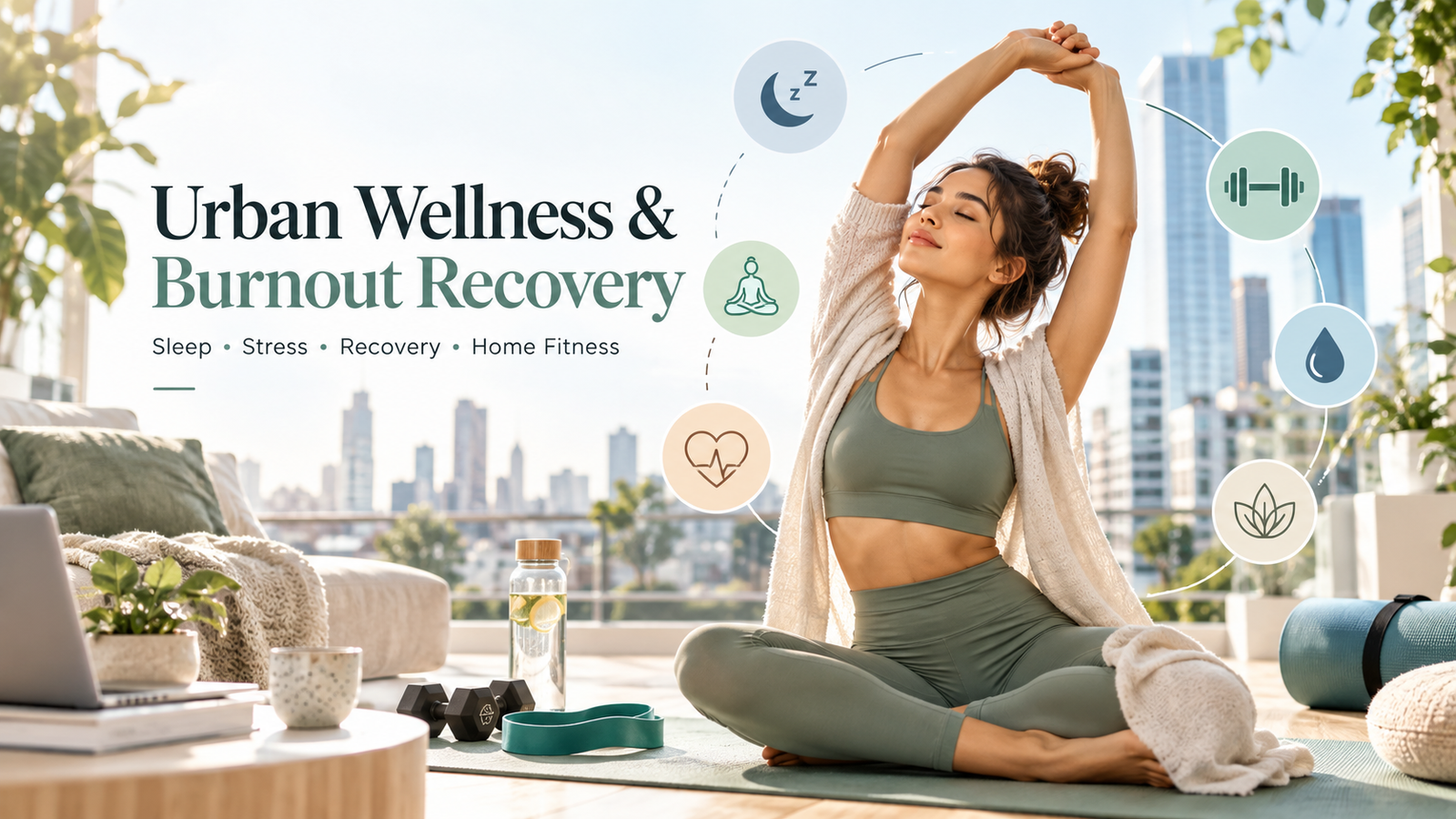
Urban Wellness, Burnout Recovery & Biohacking
In a city that rewards speed, slowing down can feel strangely rebellious.
Your morning may begin with an alarm, notifications, a crowded commute, coffee and an inbox already demanding answers. By lunchtime, you have switched between meetings, messages, deadlines and decisions dozens of times. The workday technically ends, but your nervous system may not receive the memo.
This is the reality behind the growing interest in urban wellness, burnout recovery, nervous system regulation, sleep optimization and practical biohacking.
For busy New Yorkers—and people living in fast-paced cities everywhere—the goal is no longer simply to become more productive. Increasingly, people are asking a different question:
How can I have enough energy to work, think, move, sleep and enjoy my life without constantly feeling depleted?
That question matters because wellness culture itself is changing. Nervous-system regulation and “neurowellness” have emerged as major 2026 wellness themes, alongside a growing pushback against relentless tracking and over-optimization. The emerging message is surprisingly simple: better health does not always require more devices, more data or a more complicated routine.
The most useful urban wellness strategy is often built around a few fundamentals: managing chronic stress, creating genuine recovery periods, protecting sleep, moving regularly, building strength and using technology selectively rather than compulsively.
What Is Urban Wellness?
Urban wellness is the practice of designing your daily habits, environment and recovery routines around the physical and psychological demands of city life.
It combines familiar health fundamentals with the realities of modern urban living: small apartments, long commutes, artificial light, irregular schedules, digital overload, noise, demanding careers and limited time.
That means urban wellness is not necessarily about expensive retreats or 90-minute morning routines.
It might look like:
- Ten minutes of movement before work
- A consistent wake-up time
- Walking part of your commute
- Creating short periods without notifications
- Using slow breathing after stressful meetings
- Training at home instead of losing another hour traveling to a gym
- Making your bedroom darker and quieter
- Leaving enough unscheduled time for recovery
- Tracking only health data that actually changes your behavior
The best system is not the one containing the largest number of “wellness hacks.”
It is the one you can still follow during a difficult Tuesday.
Why Burnout Feels So Common in High-Pressure City Life
People casually use the term burnout to describe many forms of exhaustion, but the World Health Organization uses it more specifically.
WHO classifies burnout as an occupational phenomenon, rather than a medical condition, associated with chronic workplace stress that has not been successfully managed. Its defining dimensions include exhaustion, greater mental distance or cynicism toward work, and reduced professional effectiveness.
That distinction is useful.
You can be tired without experiencing occupational burnout. You can also experience anxiety, depression, insomnia or another health problem that requires appropriate professional care rather than simply another wellness routine.
Still, modern city life can create the perfect conditions for inadequate recovery.
A person might leave work physically but remain mentally connected through Slack, email and notifications. A noisy commute follows an overstimulating office. Evening screen time delays the psychological transition toward sleep. The next morning begins before yesterday’s stress has fully settled.
Over time, the problem is not merely that you are busy.
The problem is that activation keeps happening while recovery keeps being postponed.
Burnout Recovery Starts With Reducing the Recovery Deficit
A common mistake is trying to recover from overload by adding more activities.
More supplements.
More routines.
More apps.
More optimization.
But if your calendar is already overloaded, turning recovery into another performance project can make wellness feel like additional work.
Instead, begin with a simpler question:
What repeatedly drains me, and what reliably helps me recover?
Consider four areas.
1. Workload
Are you attempting to solve a recovery problem while keeping an unsustainable workload unchanged?
No breathing exercise can permanently compensate for impossible expectations, chronic understaffing or a calendar with no boundaries.
Recovery sometimes requires behavioral change: saying no, renegotiating deadlines, taking breaks, using vacation time, delegating or reconsidering responsibilities.
2. Stimulation
Stress does not arrive only through major crises.
It can accumulate through hundreds of small inputs: alerts, headlines, background television, traffic, crowded spaces, open browser tabs, unanswered messages and continual task switching.
Reducing unnecessary stimulation is one of the cheapest forms of urban wellness.
3. Sleep
If you repeatedly shorten sleep to create more working hours, recovery becomes increasingly difficult.
For most adults ages 18–60, the CDC recommends seven or more hours of sleep per night, while individual sleep needs can vary.
4. Physical Recovery
The human body benefits from movement, but more exercise is not automatically better.
Someone already exhausted by poor sleep and relentless work may not need another punishing workout. They may benefit more from walking, moderate resistance training, mobility work and a sensible progression.
Nervous System Regulation Without the Hype
“Nervous system regulation” has become one of the biggest wellness phrases of 2026.
That popularity has produced both useful education and exaggerated claims.
Your nervous system is not a smartphone that can be rebooted in 30 seconds. You do not need to “reset your vagus nerve” every time you have a stressful meeting.
A healthier goal is flexibility: being able to mobilize when challenges demand energy and return toward a calmer state when the challenge has passed.
Stress itself is not automatically harmful. The body is designed to respond to challenges.
The difficulty arises when high activation becomes persistent and recovery opportunities disappear.
A Simple Regulation Practice: Longer, Slower Breathing
One accessible technique is relaxed diaphragmatic breathing.
Try this:
Sit comfortably.
Inhale gently through your nose without forcing a huge breath.
Exhale slowly.
Continue for approximately two to five minutes while allowing your breathing to become comfortable rather than dramatic.
The National Center for Complementary and Integrative Health notes that deep and slow breathing is one of several relaxation techniques designed to support the body’s relaxation response. Evidence suggests breathing exercises may help some people manage stress, although they should not be treated as replacements for appropriate medical or psychological care.
The practical advantage is obvious for urban professionals: you do not need special clothing, equipment or a wellness studio.
You can practice it after a difficult phone call, before entering your apartment, while sitting in a parked car or before beginning your evening routine.
Build a “Transition Ritual” Between Work and Home
One underrated burnout recovery strategy is creating a boundary between professional activation and personal time.
Without a transition, people often carry the office directly into their evening.
Your transition ritual might include:
- Finish your last work task and write tomorrow’s first priority.
- Silence nonessential work notifications.
- Walk for 10 minutes.
- Take several slow breaths.
- Change clothes when you arrive home.
- Avoid opening work messages during the first part of your evening.
None of these actions is revolutionary.
That is precisely why they can work.
They communicate a repeated behavioral signal: the working part of the day is ending.
Sleep Architecture Optimization: What You Can Actually Control
“Sleep optimization” is often marketed as if you can directly engineer every minute of deep and REM sleep.
Human sleep is more complicated.
During the night, sleep cycles between non-REM and REM phases. A complete cycle commonly lasts roughly 80–100 minutes, with most people moving through several cycles per night. Deep non-REM sleep tends to be more prominent earlier in the night, while REM periods generally become longer later.
You cannot simply command your brain to produce another 47 minutes of deep sleep.
What you can do is create conditions that support healthy sleep.
Protect a Consistent Wake Time
Wake time is one of the strongest anchors in a daily routine.
A reasonably consistent schedule helps keep sleep and wake patterns aligned.
Use Morning Light
Daylight helps regulate the body’s approximately 24-hour circadian system.
Getting outside after waking can therefore become a simple urban biohack that costs nothing.
Stop Treating Bedtime as an Extension of Work
Answering emails under the covers teaches your brain that the bed is another workplace.
Create a clear transition toward sleep instead.
Reduce Late-Night Bright Light and Stimulation
You do not need to fear every screen.
The more useful principle is reducing unnecessary brightness, emotionally stimulating content and work-related activity as bedtime approaches.
Watch Caffeine Timing
Caffeine can remain active long after you stop consciously feeling energized.
People sensitive to it may benefit from moving their last coffee earlier rather than depending on an arbitrary universal cutoff time.
Make the Bedroom Boring—in a Good Way
Cooler, darker and quieter sleeping environments are generally more supportive of sleep than bedrooms filled with light, noise and constant alerts.
Do Not Obsess Over a Sleep Score
Wearables can provide useful trends.
But your watch cannot perfectly reconstruct your brain’s sleep stages from the wrist.
If checking a sleep score every morning makes you anxious about sleeping, the tracker may be creating a new problem.
Use data to guide behavior—not to grade yourself as a human being.
For persistent insomnia, evidence favors cognitive behavioral therapy for insomnia (CBT-I) more strongly than relying on relaxation techniques alone.
The New Biohacking: Low Risk, High Return
Biohacking has often been associated with supplements, devices, extreme temperatures and endless metrics.
A more practical definition is much less glamorous:
Use feedback to improve the conditions that influence your energy, health and performance.
Under that definition, some of the most valuable biohacks are remarkably ordinary.
Biohack #1: Move After Long Periods of Sitting
Instead of waiting for the perfect workout, insert small amounts of movement throughout the day.
Walk while making a call.
Take stairs when practical.
Get off the subway one stop earlier occasionally.
Perform several squats while coffee brews.
Movement does not become useless merely because it lasts only a few minutes.
The CDC notes that some physical activity is better than none and that weekly activity can be divided into smaller chunks.
Biohack #2: Design Your Environment
Put resistance bands where you can see them.
Charge your phone away from the bed.
Leave walking shoes near the door.
Prepare tomorrow’s breakfast before going to sleep.
Environment design reduces the number of decisions required when motivation is low.
Biohack #3: Track One Variable at a Time
Do not begin by measuring 14 biomarkers.
Choose one useful behavior.
For example:
Week 1: consistent wake time.
Week 2: daily walking.
Week 3: two resistance-training sessions.
Week 4: evening notification cutoff.
You learn more by changing one major variable consistently than by collecting enormous amounts of data without changing anything.
Biohack #4: Treat Recovery as Training
Serious athletes schedule recovery because they understand that adaptation happens between training sessions.
Knowledge workers rarely apply the same logic.
If your brain performs difficult cognitive work for hours every day, recovery should not be considered laziness.
It is part of the performance system.
A 15-Minute Home-Gym Routine for Small Apartments
New Yorkers often face a practical fitness problem: limited time and limited space.
The solution does not have to be a $4,000 smart gym.
A resistance band, a small floor area and body weight can provide a useful foundation.
Try this simple circuit:
Minute 1–3: Warm-up
March in place, perform arm circles, gentle hip hinges and bodyweight squats.
Minute 4–12: Strength Circuit
Perform approximately 30–40 seconds of each movement, rest briefly and repeat the circuit according to your fitness level.
- Squat or chair squat
- Incline push-up against a stable surface
- Resistance-band row
- Hip hinge or glute bridge
- Dead bug or comfortable plank variation
Minute 13–15: Cool Down
Walk slowly around the room and allow your breathing to settle.
Beginners can perform fewer repetitions and longer rests. People with injuries, chronic medical conditions or concerns about exercise should obtain appropriate professional guidance.
This 15-minute routine does not magically replace every other form of physical activity.
Think of it as a consistency tool.
Current U.S. guidance recommends that adults work toward at least 150 minutes of moderate-intensity aerobic activity each week, along with muscle-strengthening activity on at least two days. The weekly total can be divided across shorter sessions.
The Minimum Viable Wellness Day
When life becomes chaotic, complicated routines tend to collapse.
That is why every urban wellness plan should contain a smaller version.
Call it the Minimum Viable Wellness Day.
On your busiest day, aim for:
Morning: Get daylight and water after waking.
Workday: Take at least one intentional movement break.
Stress: Use two minutes of slow breathing when you notice unnecessary activation.
Exercise: Complete 10–15 minutes of movement or take a brisk walk.
Evening: Create a work-notification cutoff.
Sleep: Give yourself a realistic opportunity to obtain sufficient sleep.
You can always do more.
But maintaining a small baseline prevents the all-or-nothing cycle in which people follow a perfect routine for four days and abandon wellness entirely for the next four weeks.
A Practical 7-Day Urban Burnout Recovery Reset
This is not a medical treatment plan. It is a behavioral reset for someone who wants to reduce unnecessary overload and rebuild basic recovery habits.
Day 1: Audit Your Energy
Write down three things that consistently drain you and three things that reliably help you recover.
Do not fix everything yet.
Observe first.
Day 2: Remove One Source of Digital Noise
Turn off one category of nonessential notifications.
You may be surprised by how often your attention was being interrupted.
Day 3: Stabilize Your Sleep Window
Choose a realistic bedtime range and wake-up time.
Consistency matters more than creating an elaborate sleep ritual.
Day 4: Add a 15-Minute Strength Session
Use bodyweight exercises or resistance bands.
Keep the session easy enough that you are willing to repeat it.
Day 5: Create a Work Shutdown Ritual
Write tomorrow’s first task, close your work apps and intentionally transition into personal time.
Day 6: Spend More Time Outside
Walk through your neighborhood, waterfront, park or another comfortable outdoor space.
Leave some of the walk untracked.
Not every healthy activity needs to become a dataset.
Day 7: Review, Don’t Grade Yourself
Ask:
What made me feel better?
What was difficult?
What could I realistically continue for the next month?
The goal is not a flawless seven-day transformation.
It is identifying sustainable behaviors worth repeating.
Stress Management for People Who Cannot Simply “Slow Down”
Advice to “reduce stress” can sound unrealistic when rent, deadlines, family responsibilities and professional ambitions remain very real.
Stress management does not require pretending demands do not exist.
It means changing your relationship with demands where possible.
Try dividing stressful situations into three categories.
Stressors You Can Remove
Unnecessary commitments, optional notifications, draining subscriptions, avoidable meetings.
Remove what adds little value.
Stressors You Can Modify
Workload boundaries, commute timing, meeting frequency, household responsibilities.
Negotiate what can be redesigned.
Stressors You Must Navigate
Unexpected events, difficult economic conditions, unavoidable professional pressure.
For these, recovery capacity becomes particularly important: sleep, movement, emotional support, professional help when appropriate and brief regulation practices.
This approach turns “stress management” from an abstract wellness slogan into practical decision-making.
When Biohacking Becomes Counterproductive
A device is useful when it helps you make a better decision.
It becomes less useful when the device itself becomes another source of anxiety.
Consider stepping back from a wellness tool if you are:
- Checking health metrics compulsively
- Feeling guilty because your recovery score dropped
- Avoiding enjoyable activities because an app predicts poor performance
- Buying increasingly expensive devices without changing basic habits
- Treating every normal fluctuation as evidence that something is wrong
- Replacing professional medical care with influencer advice
The 2026 “over-optimization” backlash reflects this growing tension between helpful health information and the pressure to measure wellness perfectly.
The healthiest biohacking principle may therefore be:
Measure what helps you act. Ignore what only makes you worry.
The Urban Wellness Stack: What to Prioritize First
Imagine wellness as a pyramid.
At the bottom are the fundamentals:
Sleep opportunity
Regular movement
Strength training
Nutritious food
Stress-management skills
Social connection
Reasonable work boundaries
Higher up are optional optimization tools:
Wearables
HRV tracking
Smart mattresses
Sauna routines
Specialized recovery devices
Continuous health dashboards
The order matters.
Buying the top of the pyramid while ignoring the bottom is like purchasing premium tires for a car with no fuel.
Start with behaviors that produce the greatest practical return.
Add technology only when it solves a specific problem.
Why Urban Wellness Guides Have Strong Commercial Potential
Wellness information is everywhere, yet many people still struggle because the available advice is too broad, too complicated or designed for people with unlimited time.
That creates a strong opportunity for focused digital wellness products.
A useful urban wellness manual could solve a very specific problem:
“Help me recover from a demanding workday in 20 minutes.”
“Give me apartment-friendly workouts I can actually complete.”
“Show me how to improve my sleep without buying ten devices.”
“Help me build a nervous-system-friendly work routine.”
“Give me a realistic burnout recovery plan for a high-pressure career.”
Specificity makes information more valuable.
A generic wellness eBook competes with the entire internet.
A well-designed NYC Burnout Recovery Manual for Busy Professionals, 15-Minute Apartment Fitness Guide, Urban Sleep Optimization Workbook or Nervous System Regulation Toolkit for High-Stress Careers solves a recognizable problem for a recognizable reader.
That is a much stronger commercial proposition.
Frequently Asked Questions
1. What is the fastest way to recover from burnout?
There is no legitimate instant burnout cure. If chronic workplace stress is driving exhaustion, recovery usually requires addressing the source of the stress—not merely adding relaxation techniques. Improving sleep opportunity, reducing unnecessary workload, creating stronger work boundaries, moving regularly and seeking professional support when needed can all be parts of a broader recovery strategy. WHO specifically defines occupational burnout in relation to chronic workplace stress that has not been successfully managed.
2. How can I regulate my nervous system naturally?
Useful low-cost practices can include slow breathing, relaxation exercises, regular physical activity, adequate sleep, reducing unnecessary stimulation and spending time with supportive people. Relaxation techniques can help produce a physiological relaxation response, although they should not replace appropriate medical or psychological treatment.
3. What is the best biohack for better sleep?
For most people, the highest-value “biohacks” are not exotic. Start with enough sleep opportunity, a reasonably consistent schedule, morning daylight, an appropriate sleep environment and less stimulation close to bedtime. Persistent insomnia deserves proper assessment; CBT-I has stronger evidence for chronic insomnia than relying only on relaxation hacks.
4. Can a 15-minute home workout actually improve fitness?
Short workouts can contribute meaningfully to your weekly activity, particularly when they help you exercise consistently. They do not need to replace every longer session. Adults are generally advised to accumulate at least 150 minutes of moderate aerobic activity weekly and perform muscle-strengthening activities on two or more days, and that activity can be broken into smaller portions.
5. Do I need expensive wearables for burnout recovery and wellness?
No. Wearables can help reveal patterns, but they are optional. Sleep, movement, strength training, recovery time, supportive relationships and realistic work boundaries remain valuable whether or not you track them. Consider technology when it helps you make a useful decision rather than simply giving you another score to monitor.
Build a Wellness System That Works in Your Real Life
A sustainable urban wellness routine does not ask you to leave your career, move to the mountains or spend your morning performing twelve different health rituals.
It asks something more practical.
Can you create small periods in which your body is no longer rushing?
Can you protect enough time for sleep?
Can you move even when you cannot reach the gym?
Can you recognize when work is expanding into every part of your day?
Can you use technology without allowing technology to manage your emotions?
Can you choose recovery before complete exhaustion forces you to stop?
In a culture obsessed with doing more, one of the smartest forms of modern biohacking may be learning when not to optimize.
Build strength.
Protect sleep.
Create space between stressful events.
Move often.
Reduce unnecessary stimulation.
Recover deliberately.
Then let your wellness system support your life instead of becoming another full-time job.
If your current wellness routine feels impossible to maintain, begin with three actions for the next seven days: choose a consistent wake time, complete two short strength sessions, and create one daily period without work notifications. Track how you feel—not how perfectly you perform.
Stay ahead with exclusive updates
Join our community. Get curated industry trends, actionable guides, and fresh resources delivered straight to your inbox.