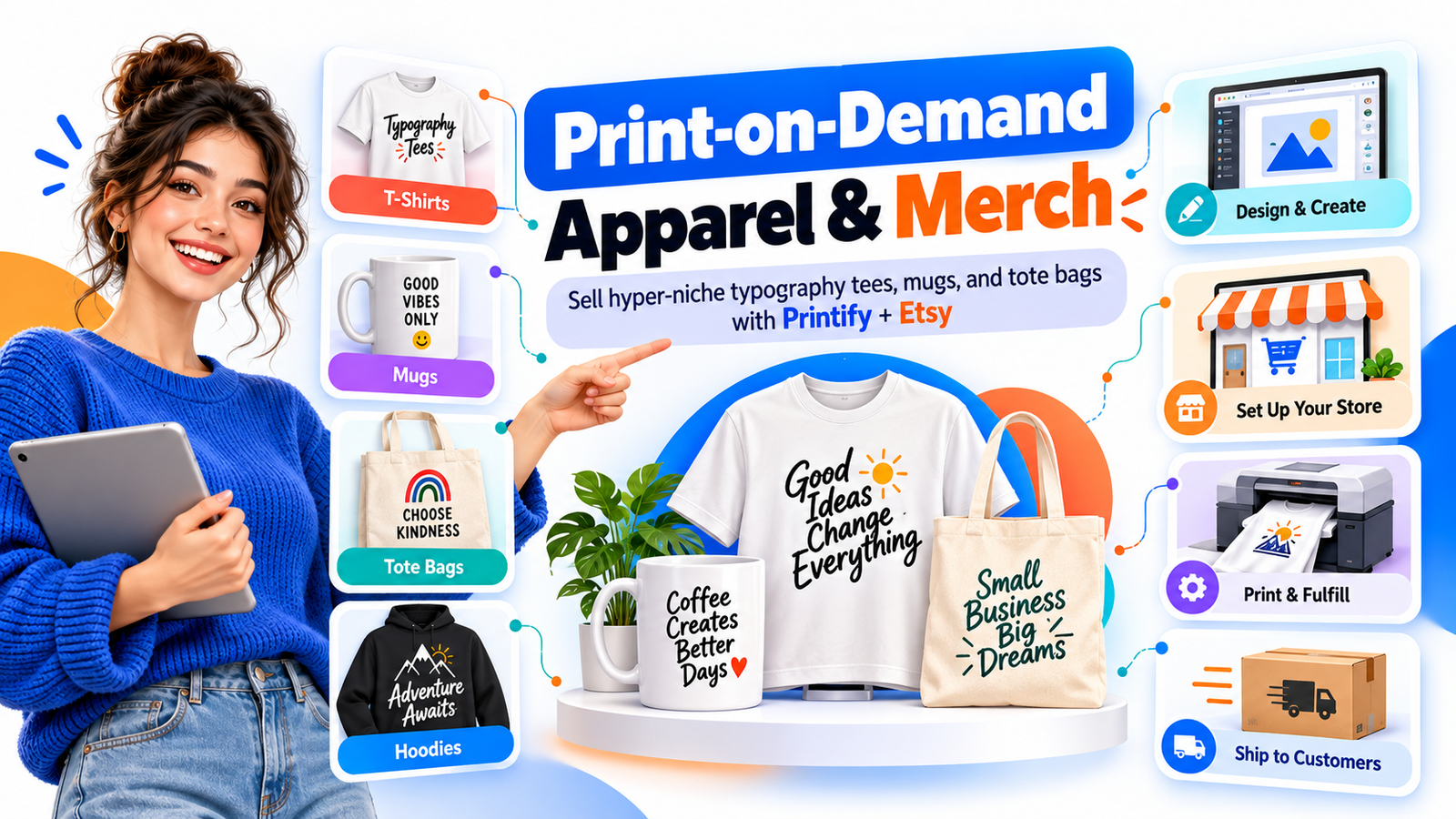
Learn how to start a hyper-niche print-on-demand apparel and merchandise business using Printify, Etsy, and Canva, from niche research and typography designs to SEO, pricing, fulfillment, and repeat sales.
Print-on-demand has changed the economics of launching a small merchandise brand.
A few years ago, selling your own T-shirts, mugs, tote bags, sweatshirts, or accessories often meant buying inventory upfront, storing boxes at home, arranging printing, packaging orders, and hoping enough products sold to recover your investment.
Print-on-demand, commonly called POD, removes much of that inventory risk.
Instead of purchasing 50 shirts before finding your first customer, you create a design, place it on a product, publish the product online, and have a print provider produce the item only after somebody orders it.
For beginners, one particularly accessible combination is Printify + Etsy + Canva.
Printify handles product production and fulfillment through its network of print providers, Etsy gives sellers access to an established marketplace, and Canva can be used to create simple typography-based graphics without advanced design software.
Printify currently offers direct Etsy integration, allowing sellers to connect their stores and route qualifying orders into the Printify fulfillment workflow.
But opening a POD store is the easy part.
Building one that customers actually notice requires something more valuable: a clear niche, distinctive ideas, original designs, useful products, strong merchandising, and disciplined testing.
This guide explains how to build a focused print-on-demand apparel and merchandise business around hyper-niche typography products such as T-shirts, mugs, tote bags, sweatshirts, and gifts.
What Is Print-on-Demand?
Print-on-demand is an ecommerce fulfillment model in which a product is printed or customized after a customer places an order.
Instead of manufacturing large quantities in advance, you create the artwork and choose the products you want to sell. A production partner then manufactures and ships individual orders according to your settings and the services available for that product.
This makes POD attractive to beginners because it can reduce several traditional ecommerce barriers.
You do not necessarily need a warehouse.
You do not have to purchase hundreds of products before validating an idea.
You can experiment with several niches.
You can discontinue weak designs without being left with boxes of unsold inventory.
You can also build a catalog gradually rather than trying to launch an enormous store on day one.
POD is therefore less like traditional wholesale retail and more like operating a design, branding, merchandising, and customer-acquisition business.
The printing is outsourced.
Your competitive advantage still has to come from you.
Why Hyper-Niche POD Can Work Better Than Generic Merchandise
One of the biggest beginner mistakes in print-on-demand is trying to sell merchandise to everyone.
A shirt saying:
“Live Your Best Life”
may technically appeal to millions of people.
Unfortunately, thousands of other sellers can create almost exactly the same concept.
Compare that with a design created specifically for:
“Night-shift veterinary technicians who love rescue cats.”
The total audience is smaller, but the message can feel much more personal.
That is the principle behind hyper-niche print-on-demand.
Instead of starting with “people who like coffee,” you could target coffee-loving accountants, night-shift nurses, bookshop owners, programmers, teachers, dog groomers, gardeners, photographers, chess players, campers, musicians, new parents, remote workers, or dozens of other communities.
Then you can narrow the concept again by combining interests, identities, professions, hobbies, situations, humor, or gift occasions.
This allows a simple typographic design to communicate:
“This was made for someone like me.”
That emotional relevance is often more powerful than creating complicated artwork.
The Three-Part Beginner POD System
A very practical beginner setup is:
Canva → Printify → Etsy
Canva becomes your design workspace.
Printify becomes your production and fulfillment platform.
Etsy becomes your marketplace storefront and discovery channel.
None of those platforms eliminates the need for research, differentiation, customer service, pricing discipline, or marketing. However, together they can dramatically reduce the technical complexity involved in testing a merchandise idea.
Your first target should not be 500 products.
Your first target should be three strong designs for one clearly defined audience.
Start With the Customer, Not the T-Shirt
Before opening Canva, answer one question:
Who exactly should want this product?
Weak POD stores often begin by creating random slogans and then attempting to discover customers afterward.
Reverse that process.
Imagine you choose gardening enthusiasts.
That is still extremely broad.
You could narrow it to:
Balcony gardeners.
Retired vegetable growers.
Indoor plant collectors.
Urban gardeners.
Organic gardening enthusiasts.
Beginner gardeners.
Garden-loving mothers.
Garden-loving grandmothers.
Then examine what makes that group interesting.
What do they proudly identify with?
What frustrations do they share?
What inside jokes would they understand?
What phrases could work as gifts?
What situations happen repeatedly in their lives?
Suppose your niche is balcony gardening.
Rather than publishing another generic “Plant Lover” shirt, you might explore ideas around limited space, tiny urban gardens, proud plant collections, apartment living, watering routines, or the humor of turning every available window into growing space.
The narrower insight creates the design opportunity.
Why Minimalist Typography Is Ideal for Testing POD Ideas
You do not need complicated illustrations to begin testing print-on-demand.
Typography can be extremely effective because the message itself becomes the design.
A minimalist typography product can use:
A short slogan.
A two-line statement.
An occupation-related phrase.
A niche joke.
A subtle identity statement.
A gift-oriented message.
A phrase combining two interests.
Good typography is not simply typing words onto a blank canvas.
Font hierarchy, spacing, alignment, contrast, readability, capitalization, word emphasis, and composition determine whether the finished product feels amateur or intentional.
The best minimalist designs usually communicate their message within seconds.
That matters because online shoppers frequently evaluate merchandise from thumbnail-sized images.
Create Your First Three Slogan Concepts
For your first experiment, choose one niche and three different psychological angles.
For example, imagine your audience is freelance writers.
Design one might communicate professional identity.
WORDS ARE MY WORKDAY
Design two might use insider humor.
ONE MORE EDIT
Design three might work as a gift or lifestyle statement.
COFFEE. DRAFT. REPEAT.
These examples illustrate the framework rather than slogans you should automatically copy. Originality matters, and you should research whether phrases, names, logos, characters, or other intellectual property are protected before commercial use.
The important principle is that your three products should not simply repeat the same idea with different fonts.
Test different reasons someone might buy.
Identity.
Humor.
Belonging.
Giftability.
Lifestyle.
Professional pride.
Emotion.
A three-design test gives you more useful information than betting everything on a single slogan.
How to Create Minimalist POD Designs in Canva
Create your document using dimensions appropriate for the print area recommended by your selected product and print provider.
Use a transparent background when the production workflow requires one.
Start with one primary phrase.
Choose one or two fonts rather than filling the design with several unrelated typefaces.
Establish visual hierarchy by making the most important word or phrase noticeably stronger.
Check letter spacing.
Check line spacing.
Keep sufficient empty space around the composition.
Zoom out and ask whether the message remains readable.
Then examine how the artwork looks on several realistic product colors.
A design that looks excellent on white may disappear on beige.
A design created for black merchandise may not work on dark navy.
Typography should be designed for the actual product, not merely for the Canva canvas.
Also confirm that the fonts, graphics, templates, and other assets you use are licensed appropriately for your intended commercial use. Platform licenses and individual assets can have conditions, so review the applicable terms before publishing merchandise.
How to Connect Printify to Etsy
Printify currently provides a direct integration process for Etsy sellers. Its documented connection flow includes signing into Printify, opening the store-management area, choosing Etsy as the sales channel, signing into Etsy, and granting the requested connection permissions.
A simple launch workflow looks like this:
- Create your Printify account and complete your Etsy seller setup. Connect Etsy from Printify’s store-management section, choose a suitable product, upload your original artwork, select product variants and print-provider options, create your mockups, prepare the title and description, disclose the relevant production partner information on Etsy, review pricing and shipping details, publish the listing, and place or review a sample order where practical before aggressively promoting the product.
Connecting the software is only the technical foundation.
The commercial work begins after that.
Etsy’s Important Rule for POD Sellers
Print-on-demand should not be treated as permission to upload arbitrary products from a fulfillment catalog and resell them unchanged.
Etsy states that sellers can use production partners, including POD services, when those partners help produce products based on the seller’s original design or eligible buyer customization. Etsy also requires sellers using production assistance to disclose the applicable production partner information.
That distinction is critical.
Your business should be built around your creative contribution, not simply republishing products somebody else created.
Transparency also improves the long-term credibility of your store.
Choosing Your First POD Products
Beginners often try to place every design on every available item.
That creates unnecessary complexity.
Instead, select products according to how your niche shops.
T-shirts are excellent for personal identity and humor.
Sweatshirts can work particularly well for communities where comfortable lifestyle apparel makes sense.
Mugs suit workplaces, hobbies, gifts, routines, and coffee-related audiences.
Tote bags can work for books, teachers, markets, hobbies, sustainability-oriented shoppers, and lifestyle niches.
Your niche should influence the product.
A phrase that works beautifully on a shirt may look awkward on a mug.
A subtle quote suitable for a tote bag might not have enough visual impact for apparel.
Think like a merchandiser rather than a file uploader.
How to Price POD Merchandise
Price should never be chosen by looking only at what competitors charge.
Your selling price needs to account for the complete economics of the order.
That can include production costs, platform fees, payment-related fees, advertising costs where applicable, refunds or replacements, promotional discounts, taxes where relevant, and the margin you want the business to generate.
An illustrative calculation might look like this:
Suppose a product ultimately costs you $13 to produce and fulfill after applicable operating expenses included in your own calculation.
If you sell it for $24, the difference is not automatically $11 of profit.
Marketplace costs, payment charges, advertising, discounts, taxes, replacements, and other expenses can reduce the remaining amount.
Build a simple spreadsheet that calculates estimated contribution margin before publishing each product.
Do not confuse revenue with profit.
Product Mockups Can Determine Whether People Click
Customers cannot physically touch your shirt, mug, or tote bag before ordering.
Your product photography and mockups therefore become part of the shopping experience.
Your primary listing image should immediately answer:
What is being sold?
What does the design say?
What does the product look like?
What style should the buyer expect?
Additional images can show different product colors, close-up design details, sizing information, lifestyle context, and relevant purchase information.
Avoid cluttering every image with excessive promotional text.
Your product should remain the hero.
Consistency also matters.
When shoppers visit your storefront, coordinated presentation makes a three-product store feel considerably more intentional than a twenty-product store filled with unrelated visual styles.
Etsy SEO Begins With Search Intent
Etsy SEO should not be reduced to stuffing as many keywords as possible into a title.
The objective is to connect a relevant search with a relevant product.
Imagine your product is intended for a book-loving kindergarten teacher.
Potential search behavior might include phrases such as:
“kindergarten teacher shirt”
“teacher reading shirt”
“book lover teacher gift”
“kindergarten teacher gift”
“reading teacher sweatshirt”
Those searches reflect commercial intent more clearly than a vague keyword such as “shirt.”
Your product title, description, tags, category, attributes, and overall listing context should communicate what the product is, who it is for, and why someone might buy it.
Write for humans first.
Then make sure search systems can understand the page.
Long-Tail Keywords Give Small Sellers More Specific Opportunities
Large generic search terms can be extremely competitive.
Long-tail searches are often more specific.
Instead of optimizing only for:
“teacher shirt”
you may discover opportunities around:
“minimalist kindergarten teacher shirt”
“reading teacher gift shirt”
“funny elementary teacher sweatshirt”
“teacher appreciation gift tote bag”
Specific search queries can reveal both the audience and the buying motivation.
That is valuable because successful niche merchandising lives at the intersection of product + person + occasion + emotion.
Use Seasonal Demand Without Becoming a Seasonal Store
Certain buying moments naturally increase merchandise demand.
Mother’s Day.
Father’s Day.
Graduation.
Teacher appreciation.
Birthdays.
Christmas.
Valentine’s Day.
Retirement.
New jobs.
Weddings.
Family reunions.
Professional milestones.
Instead of building an entirely new store for every event, adapt your established niche.
A gardening brand could create Mother’s Day garden products.
A teacher brand could create graduation gifts for education majors.
A camping brand could create Father’s Day apparel.
A nurse-focused brand could develop relevant gifting products around workplace and personal milestones.
This maintains brand consistency while expanding purchase occasions.
Protect Your Business From Intellectual Property Problems
POD sellers should take intellectual property seriously from the beginning.
A phrase being visible on social media does not automatically mean it is safe for commercial use.
A character appearing in popular culture does not make it public property.
A logo cannot simply be recreated because many people recognize it.
The same caution applies to celebrity names and likenesses, sports teams, movie franchises, song lyrics, brand names, catchphrases, artwork, and other potentially protected material.
Before selling merchandise, conduct appropriate trademark and copyright research for the markets where you intend to operate, and obtain qualified legal advice when necessary.
Building around original concepts may feel slower than copying a viral phrase.
It is a much healthier foundation for a real business.
Your First Goal Is Validation, Not Perfection
A beginner does not need hundreds of listings to learn whether an idea has potential.
Start small enough that you can understand what happens.
Three products are enough to begin collecting useful signals.
Observe impressions.
Watch clicks.
Track favorites.
Monitor conversions.
Study which keywords bring visitors.
Notice which product colors buyers prefer.
Read customer questions.
Record what shoppers repeatedly ask.
Then improve the store based on evidence.
If one design receives substantially more attention, expand the concept carefully.
Create a matching mug.
Try another apparel format.
Develop a second phrase for the same audience.
Build a small collection around the underlying theme.
Your early store is a research laboratory.
Turn One Winning Idea Into a Product Collection
Suppose a minimalist tote bag aimed at book-loving teachers begins outperforming your other products.
Do not immediately abandon the niche and chase another trend.
Investigate why the product works.
Maybe customers like the typography.
Maybe the phrase expresses professional identity.
Maybe buyers are purchasing it as gifts.
Maybe teachers want practical products rather than decorative merchandise.
You could then build a coordinated collection.
The same visual direction might be adapted to mugs, shirts, sweatshirts, notebooks, or other relevant products where your fulfillment platform and marketplace policies permit.
A cohesive collection also creates cross-selling opportunities.
Someone who purchases a shirt today may return later for a matching gift.
That is how a POD shop begins evolving from isolated listings into a brand.
How to Turn New Visitors Into Returning Visitors
Traffic alone is not enough.
A sustainable ecommerce brand needs reasons for shoppers to remember it.
Consistency is one reason.
A recognizable visual style makes your products easier to associate with your shop.
Specialization is another.
If shoppers understand exactly what your store represents, they know why they should return.
Regular product releases can also help.
Instead of uploading fifty products at once and disappearing for six months, consider releasing carefully selected new designs around recurring themes.
You can also build an owned audience outside the marketplace where appropriate.
A website, email newsletter, Pinterest account, Instagram presence, or other channel can help interested shoppers discover new collections repeatedly rather than relying entirely on marketplace search.
The goal is not simply:
Get one click.
It is:
Create enough value and identity that the person remembers your brand.
Create Content Around the Niche, Not Only the Product
One of the strongest ways to build organic visibility is to publish useful content around the audience your merchandise serves.
Imagine your store sells products for home bakers.
Instead of publishing only sales posts, you could create content about gift ideas for bakers, baking workspace organization, baking humor, beginner equipment, seasonal baking inspiration, or behind-the-scenes design stories.
That expands the number of ways people can encounter your business.
Content can attract visitors before they are ready to purchase.
Merchandise converts some of those visitors when the right buying moment appears.
Building for Google Search, Discover, GEO and AEO
If you operate your own website alongside Etsy, treat your product business as a publishing opportunity as well as a store.
Publish useful articles answering specific questions people actually search.
Use descriptive titles.
Include clear headings.
Answer important questions near the beginning of relevant sections.
Use natural language that AI search systems and traditional search engines can interpret easily.
Add internal links between related articles, collections, and products.
Include genuine author information where appropriate.
Use original images instead of recycling generic stock graphics across dozens of pages.
Google’s current Article documentation supports Article, NewsArticle, and BlogPosting structured data to help Google understand information such as the article title, author, publication dates, and representative imagery. Google recommends relevant high-resolution images and illustrates providing 16:9, 4:3, and 1:1 versions.
Google also clarified in 2026 that structured-data imagery and og:image can help identify preferred images for Search and Discover.
None of these techniques can guarantee Google rankings or Discover placement.
They can, however, make high-quality content easier for search systems to understand and present appropriately.
The Content Flywheel for a POD Brand
A strong POD operation can eventually create a simple flywheel.
Research a narrow audience.
Create useful designs for that audience.
Publish them as products.
Observe customer behavior.
Turn customer questions into content.
Use content to attract additional visitors.
Use visitor behavior to discover new product opportunities.
Launch improved products.
Repeat.
This is considerably more sustainable than repeatedly searching for the next “viral T-shirt idea.”
Using Trends Without Chasing Every Trend
Trends can create opportunities, but trend chasing can also destroy brand consistency.
The better approach is to ask:
Does this trend naturally intersect with my niche?
If a color trend becomes popular and suits your products, test it.
If a gift occasion is growing in your niche, create relevant products.
If a new hobby becomes popular among your target audience, explore it.
But avoid forcing unrelated trending keywords into products simply to capture temporary traffic.
A niche brand becomes stronger when customers can predict the type of products it creates.
Common POD Mistakes That Reduce Sales
Launching hundreds of generic designs rarely creates a meaningful competitive advantage.
Neither does copying bestselling products and changing a word.
Other frequent problems include weak mockups, unreadable typography, overly broad niches, incorrect product pricing, poor descriptions, ignoring intellectual-property risks, publishing without checking print quality, weak customer communication, and abandoning products before collecting enough useful data.
One of the most expensive mistakes is assuming that automation means passivity.
Printify can automate parts of fulfillment.
Etsy can provide marketplace infrastructure.
Canva can simplify design.
None of them automatically creates product-market fit.
The seller still has to understand the customer.
A Better 30-Day Beginner Strategy
During your first month, prioritize learning over catalog size.
In the first week, research one niche and define the buyer.
Create three minimalist typography concepts.
Prepare the artwork carefully.
Select one or two products that genuinely fit the audience.
Connect Printify and Etsy.
Create transparent, accurate listings.
During the next stage, improve your mockups, descriptions, titles, tags, pricing, and storefront presentation.
Then begin attracting traffic through relevant content, marketplace optimization, social channels, Pinterest, or another marketing channel suited to your niche.
At the end of the month, review the evidence.
Do not simply ask:
“Did I make money?”
Ask:
Which design attracted the most impressions?
Which listing received the most clicks?
Which product generated favorites?
Which search phrases attracted visitors?
Where did shoppers abandon the buying process?
Which customer questions appeared repeatedly?
Which design deserves another variation?
That information may be more valuable than rushing to upload another hundred products.
Build a Brand, Not Just a POD Catalog
Print-on-demand makes product creation accessible.
That accessibility also creates competition.
Anyone can place text on a shirt.
Far fewer sellers develop a recognizable point of view for a specific audience.
That is where the opportunity lies.
Define who you serve.
Create original merchandise that speaks naturally to that group.
Use typography intentionally.
Select products with purpose.
Present them professionally.
Study customer behavior.
Then build collections around the ideas that earn genuine attention.
The combination of Canva + Printify + Etsy can provide a relatively accessible starting infrastructure, but the long-term business value comes from your niche knowledge, creative decisions, product quality, customer experience, and marketing discipline.
Start with three designs.
Learn from what happens.
Improve the next three.
That simple cycle can teach you far more about ecommerce than spending months designing a giant catalog before a real customer ever sees it.
Frequently Asked Questions
1. Is print-on-demand good for beginners?
Yes, POD can be beginner-friendly because products are generally manufactured after orders are placed, reducing the need to purchase large quantities of inventory upfront. However, beginners still need to understand product costs, marketplace fees, customer service, design quality, intellectual-property rules, shipping expectations, and marketing. Low inventory risk does not mean guaranteed profit.
2. Can I use Printify to sell products on Etsy?
Yes. Printify currently provides direct Etsy integration. Sellers can connect eligible Etsy stores with Printify and use Printify’s fulfillment infrastructure for products they create through the platform. Etsy permits production partners such as POD services when applicable products are based on the seller’s original designs or permitted buyer customization, and sellers must follow Etsy’s production-partner disclosure requirements.
3. What are good print-on-demand products for beginners?
T-shirts, sweatshirts, mugs, and tote bags are common starting categories because buyers readily understand them and they can work across many niche audiences. The best first product, however, depends on the customer. Choose the product that naturally fits the audience rather than automatically placing every design on every available item.
4. How many designs should I launch first?
Three focused designs can be enough for an initial validation experiment. Give each design a slightly different emotional angle, such as identity, humor, giftability, or lifestyle. Study which idea attracts the strongest response before building a larger collection.
5. Can I make money with Etsy print-on-demand without paid advertising?
Organic sales are possible, but they are not guaranteed. Relevant marketplace SEO, niche selection, good product presentation, differentiated designs, useful external content, social discovery, Pinterest, repeat customers, referrals, and seasonal demand can all contribute to unpaid traffic. Paid advertising should be treated as an optional acquisition channel rather than a substitute for weak products.
#print-on-demand apparel
#print-on-demand merchandise, Etsy print-on-demand, Printify Etsy integration, Canva POD designs, POD T-shirts, print-on-demand mugs, print-on-demand tote bags, Etsy POD business, typography T-shirt designs, hyper-niche merchandise
#how to start print-on-demand on Etsy, how to connect Printify to Etsy, beginner print-on-demand business, how to make POD designs in Canva, minimalist typography T-shirt ideas, how to sell Printify products on Etsy, print-on-demand business without inventory, Etsy print-on-demand niche ideas
#Choose one audience today, create three original minimalist designs, connect your Printify and Etsy accounts, and launch a small test collection. Treat the first products as market research, measure what customers respond to, and expand only the ideas that demonstrate genuine demand.
Stay ahead with exclusive updates
Join our community. Get curated industry trends, actionable guides, and fresh resources delivered straight to your inbox.