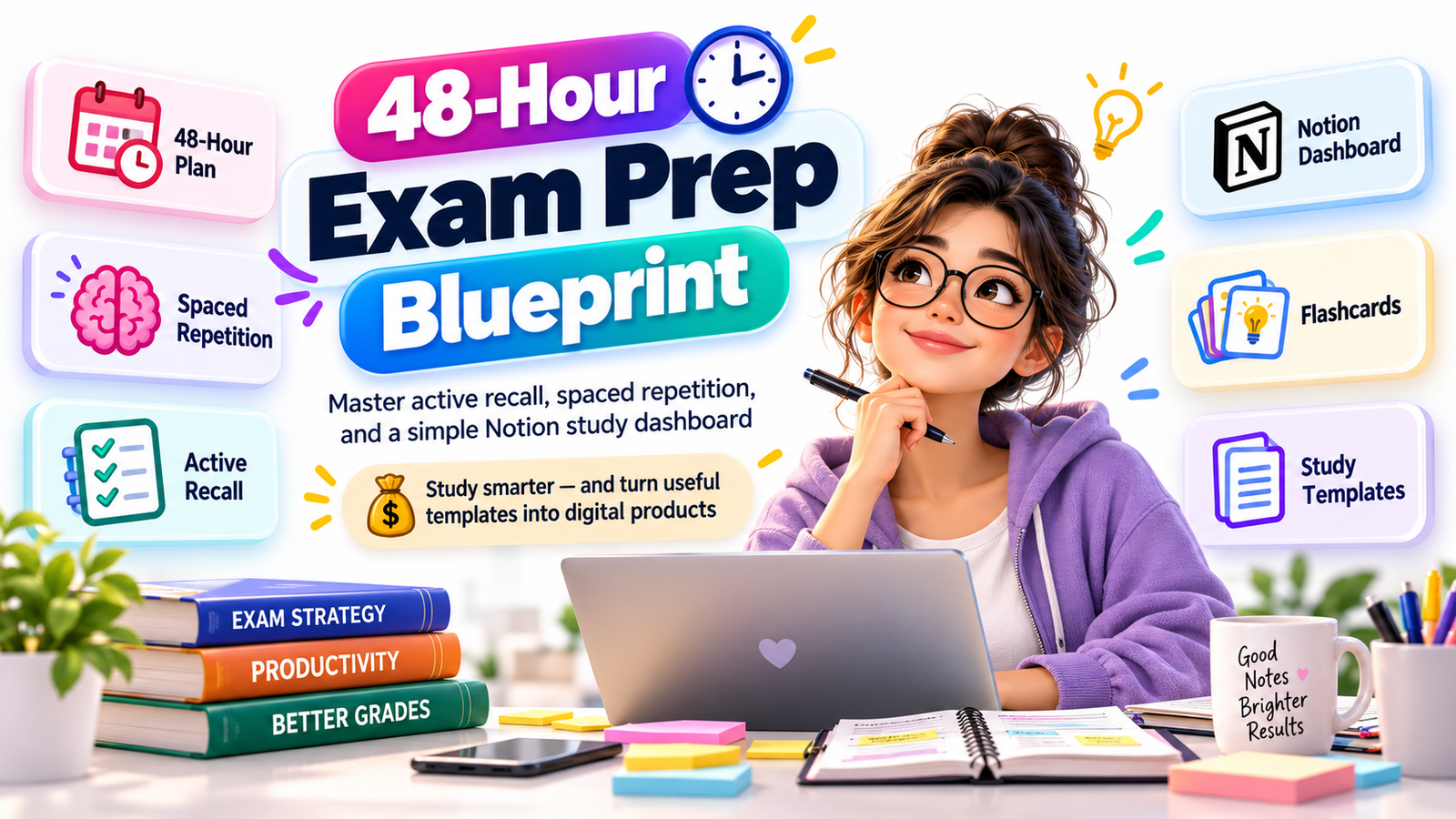
Overwhelmed Student Exam Prep: The 48-Hour Study Blueprint, Notion Dashboard and Study Template Opportunity
There is a particular kind of panic that appears when an exam is only two days away.
You open your notes. There are hundreds of pages.
Your browser has 19 tabs open.
Three chapters still feel unfamiliar.
You have saved five “ultimate study techniques” on social media but have not actually used any of them.
Then the dangerous thought appears:
“Maybe I just need to stay awake all night.”
Usually, you do not need more hours.
You need a better system for deciding what to study, how to test yourself, what to repeat and what to ignore.
A strong 48-hour exam prep strategy is not about reading everything again. It is about concentrating your limited time on the material most likely to improve recall and exam performance.
That means replacing passive rereading with active recall, retrieval practice, spaced repetition, practice questions and strategic review.
Research on retrieval practice consistently supports the value of actively bringing information back from memory instead of repeatedly exposing yourself to the same material. A major review in Annual Review of Psychology found that retrieval practice can slow forgetting and improve future access to learned information across different learners and types of material.
A systematic review examining distributed and retrieval practice also found significant benefits in many of the studies it evaluated.
So if your exam is approaching quickly, your mission is simple:
Stop trying to study everything equally. Start retrieving the right things repeatedly.
This guide shows you how.
Why Students Feel Overwhelmed Before Exams
Exam stress is often described as a time-management problem.
Frequently, it is actually a decision-management problem.
Students sit down to study but immediately face dozens of unanswered questions:
What chapter should I begin with?
Should I watch the lecture again?
Should I rewrite my notes?
Should I make flashcards?
Which formulas matter most?
Should I solve practice questions?
What if I forget yesterday’s material?
Because there is no clear system, valuable study time disappears into preparation for studying.
You organize folders.
Change productivity apps.
Highlight headings.
Search for another YouTube explanation.
Reformat your notes.
Three hours later, you feel busy but cannot confidently answer an exam question.
An effective exam preparation system removes those decisions.
Your dashboard should tell you:
What must be studied now?
What should be reviewed later?
What can already be recalled confidently?
What remains weak?
That is the foundation of the 48-hour blueprint.
The 48-Hour Exam Cram Blueprint
If you have only two days remaining, forget the fantasy of mastering every paragraph.
Think like a triage specialist.
Your goal is to identify the material producing the highest academic return for every hour invested.
Hour 0–1: Build Your Exam Map
Before memorizing anything, map the battlefield.
Take your syllabus, lecture slides, textbook chapters, previous tests, study guide and teacher instructions.
Create three categories.
Priority A: High Probability + Weak Knowledge
These topics deserve immediate attention.
Examples:
A major chapter repeatedly discussed in class
A formula you still cannot apply
A concept appearing frequently in previous tests
A teacher-emphasized definition
An important process you cannot explain without notes
Priority B: High Probability + Moderate Knowledge
You understand these topics but cannot retrieve them consistently.
These are ideal candidates for flashcards and practice questions.
Priority C: Lower Priority or Already Strong
Do not spend two hours polishing topics you already understand while major gaps remain elsewhere.
This single decision can dramatically reduce study overwhelm.
You have converted one enormous exam into a prioritized queue.
Hour 1–4: Compress the Material
Do not rewrite the textbook.
Reduce each important topic to something you can retrieve.
For example, instead of writing three pages about photosynthesis, create prompts such as:
What are the major stages of photosynthesis?
Where does each stage occur?
What enters the Calvin cycle?
What leaves it?
What happens if light intensity decreases?
Notice the difference.
Traditional notes give you information.
Retrieval prompts force your brain to produce information.
That distinction matters.
Hour 4–6: Begin Active Recall
Close your materials.
Take a blank sheet of paper.
Choose one topic.
Write everything you can remember.
Then compare your answer with your source material.
Anything missing becomes your next study target.
This technique immediately reveals the difference between:
“I recognize this information”
and
“I can actually produce this information during an exam.”
Recognition often creates false confidence.
Retrieval exposes reality.
Hour 6–8: Convert Mistakes Into Flashcards
Flashcards are most useful when they target uncertainty.
Do not create cards for information you already know perfectly.
Create them around errors.
A good flashcard asks one clear question.
Weak card:
Explain Chapter 7.
Better card:
What are the three stages of cellular respiration?
Even better:
Where does glycolysis occur and what is its main output?
Keep answers short enough that you can judge yourself quickly.
Your flashcards should become an error-correction system, not another textbook.
Hour 8–10: Practice Without Notes
Now simulate the real exam environment.
Use:
Past papers
Sample questions
Textbook exercises
Teacher-provided quizzes
Practice problems
Self-created questions
AI-generated practice questions that you verify against your course materials
Do not immediately check answers.
Struggle first.
That struggle is part of retrieval practice.
A recent review describes retrieval practice as a strongly supported learning strategy used extensively in demanding educational environments, including preparation for high-stakes examinations.
End of Day One: Build a Weakness List
Before stopping, create a list called:
Tomorrow’s High-Value Review
Only add concepts you missed.
You might end Day One with:
12 weak definitions
6 formulas
3 difficult processes
2 confusing diagrams
15 practice questions answered incorrectly
Excellent.
You now know exactly where Day Two should begin.
That is far more useful than saying:
“I still have 200 pages left.”
Why an All-Nighter Is Usually the Wrong Strategy
When time feels scarce, sleep begins to look optional.
But exam preparation is not simply about exposing your eyes to information.
You need to retrieve, discriminate, reason and apply.
Those tasks become increasingly difficult when you are exhausted.
The better strategy is to treat sleep as part of the study plan rather than something competing with it.
Instead of:
Study → study → study → collapse
Use:
Study → retrieve → review errors → sleep → retrieve again
The second sequence gives you another opportunity to test what survived overnight.
Your goal is not to brag about studying for 17 hours.
Your goal is to correctly answer tomorrow’s questions.
Day Two: Turn Weak Knowledge Into Exam-Ready Recall
Day Two should feel very different from Day One.
You are no longer exploring the syllabus.
You are strengthening weaknesses.
Morning: Recall Before Reviewing
Before opening your notes, test yesterday’s material.
Ask:
What do I remember without help?
Which formulas can I recreate?
Which processes can I explain?
Which definitions disappeared overnight?
Put each topic into three categories:
Green — confident
Yellow — partially confident
Red — weak
Spend most of your time on red and yellow.
This prevents one of the biggest mistakes in exam preparation: repeatedly reviewing comfortable material because it feels productive.
Midday: Run Short Retrieval Cycles
Instead of studying one subject continuously for five hours, create shorter review loops.
For example:
25 minutes — Topic A
5-minute break
25 minutes — Topic B
5-minute break
25 minutes — Topic C
10-minute review
Then revisit Topic A later.
That delay matters because you are forcing yourself to retrieve the material after some forgetting has begun.
That is the practical idea behind spaced repetition.
Afternoon: Use the Explain-It-Simply Test
Choose a concept.
Explain it aloud as though you were teaching a younger student.
No textbook.
No lecture.
No notes.
If you suddenly say:
“Basically…”
“It is kind of…”
“I understand it but I don’t know how to explain it…”
You have discovered a weak point.
Return to the source.
Clarify it.
Close the source.
Explain it again.
The second explanation is the actual study session.
The Minimalist Notion Study Dashboard
A study dashboard should reduce cognitive load, not become another procrastination project.
Do not spend six hours designing aesthetic widgets when your chemistry exam is tomorrow.
Your dashboard needs only a few essential sections.
Notion’s marketplace now contains thousands of student and study-planner templates, including exam planners, assignment trackers, flashcard systems and test-preparation dashboards, demonstrating how established this category has become.
Start simpler.
Section 1: Exam Command Center
Create a database with these properties:
Subject
Exam Date
Topic
Priority
Confidence
Last Reviewed
Next Review
Practice Score
Your dashboard can immediately answer:
What exam comes next?
What am I weakest at?
What should I study today?
What have I not reviewed recently?
Section 2: Topic Tracker
Give every topic one status:
Not Started
Learning
Needs Recall
Weak
Exam Ready
Do not mark something “Exam Ready” because you read it twice.
Mark it ready only after you successfully retrieve or apply it without help.
That small rule makes the system much more reliable.
Section 3: Active Recall Question Bank
For every topic, create questions instead of storing endless summaries.
Suppose you are studying economics.
Instead of:
Inflation Notes
Create prompts:
What causes demand-pull inflation?
How does cost-push inflation differ?
Why might interest rates reduce inflation?
What are two limitations of monetary tightening?
Now your dashboard actively participates in studying.
Section 4: Flashcard Database
Create fields such as:
Question
Answer
Topic
Difficulty
Confidence
Last Reviewed
Next Review
One current Notion Marketplace flashcard design uses this same general concept: questions, answers, review organization and a “Review Today” workflow.
The principle is more important than the software.
You want to open your dashboard and instantly see:
These are the cards that deserve attention today.
Section 5: Mistake Log
This might become the most valuable page in your entire system.
Every time you answer something incorrectly, record:
Question
Your answer
Correct answer
Why you were wrong
Concept involved
Review date
Students frequently spend too much time recording what they know.
High-performing study systems pay special attention to what the learner repeatedly gets wrong.
Your mistakes are not interruptions to studying.
They are directions telling you what to study next.
A Simple Spaced Repetition Schedule for Exam Week
A sophisticated algorithm is unnecessary if your exam is two days away.
Use a compressed schedule.
After learning an important concept, review it:
After roughly 20–30 minutes
Again several hours later
Again before finishing the day
Again the next morning
Again during your final exam review
The objective is not perfect timing.
The objective is repeated successful retrieval separated by meaningful intervals.
If you remember something instantly every time, reduce its priority.
If you repeatedly forget something, increase its frequency.
Your weakest material should receive the most repetitions.
Active Recall vs Rereading: A Practical Example
Imagine you need to learn ten causes of a historical event.
Passive method:
Read the ten causes six times.
Highlight them.
Read them again.
Active method:
Read them once carefully.
Close the notes.
Write all ten from memory.
You remember six.
Check the missing four.
Wait.
Try again.
Now you remember eight.
Later that evening, retrieve all ten again.
The second system feels harder.
That is precisely why it can be more informative and productive.
Difficulty during study is not automatically a sign that the method is failing.
Sometimes it means the method is forcing genuine retrieval.
How to Handle Different Types of Exams
Not every subject should be studied identically.
For Fact-Heavy Exams
Examples:
Biology
Anatomy
History
Law
Language vocabulary
Use:
Flashcards
Definition prompts
Timeline recall
Diagram labeling
Short-answer questions
For Problem-Solving Exams
Examples:
Mathematics
Physics
Accounting
Statistics
Programming
Spend less time memorizing solutions and more time solving unseen problems.
Create a mistake log showing exactly where your reasoning failed.
For Essay Exams
Practice:
Thesis statements
Argument outlines
Evidence retrieval
Counterarguments
Timed introductions
Do not simply reread model essays.
Close them and reconstruct the argument.
For Multiple-Choice Exams
Do not memorize only the correct answer.
Ask why the other options are incorrect.
This turns one question into several retrieval opportunities.
The 80/20 Rule for Overwhelmed Students
When time is extremely limited, identify the small group of concepts responsible for a large percentage of likely exam questions.
Look for:
Repeated lecture themes
Learning objectives
Previous exam patterns
Teacher emphasis
Core formulas
Foundational processes
Frequently assigned problems
Major case studies
Important terminology
Then prioritize those areas.
This does not mean ignoring the rest of the course.
It means accepting reality:
Limited time requires deliberate prioritization.
Your 48-Hour Exam Schedule
Here is a practical structure you can adapt.
Day One Morning
Audit syllabus
Identify high-priority topics
Gather study materials
Create your dashboard
Begin weakest major topic
Day One Afternoon
Active recall
Flashcards
Practice questions
Mistake logging
Second high-priority topic
Day One Evening
Short spaced reviews
Practice difficult questions again
Create Day Two weakness list
Prepare tomorrow’s materials
Sleep
Day Two Morning
Recall yesterday’s material without notes
Review weakest topics
Complete timed practice
Update mistake log
Day Two Afternoon
Mixed practice
Flashcard review
Explain difficult concepts aloud
Review high-priority formulas and definitions
Day Two Evening
Light final recall
Review mistakes
Prepare exam materials
Stop trying to learn large new chapters unless absolutely necessary
Rest
The Returning-Student Rule: Never Start From Zero Again
The best exam system is one you can reuse.
After this exam, do not delete everything.
Keep your:
Flashcard database
Mistake log
Study timetable
Topic tracker
Exam checklist
Revision workflow
Then duplicate the dashboard for your next course.
This is where overwhelmed students begin turning a crisis-management method into a repeatable academic system.
Bookmark your own dashboard.
Improve it after every exam.
Your first version does not need to be beautiful.
It needs to work.
From Study Dashboard to Digital Product
There is another interesting opportunity hiding inside this process.
If you create an effective study dashboard for yourself, you may eventually have the foundation of a digital product.
Students increasingly use digital planners, Notion templates, flashcards and exam-preparation dashboards, and Notion operates an established marketplace where both free and paid student templates are available. Current listings include paid student planners priced around $5 and $12.72, alongside large collections of free alternatives.
That does not mean uploading a generic template will automatically create income.
The opportunity is in solving a specific student problem better than a blank page does.
How College Bloggers Can Turn Study Systems Into Sellable Templates
Suppose you are a college blogger or student creator.
Instead of making another generic “Ultimate Student Planner,” choose a narrower problem.
Examples include:
48-Hour Exam Cram Dashboard
Nursing School Active Recall System
Medical Student Revision Planner
Law School Case Brief Dashboard
Engineering Formula Tracker
College Assignment Deadline Planner
ADHD-Friendly Minimal Study Dashboard
Finals Week Command Center
Language Vocabulary Review System
Research Paper Organizer
Scholarship Application Tracker
Student Budget + Study Planner
The niche itself creates your marketing message.
“Student Planner” is vague.
“48-Hour Finals Week Rescue Dashboard for College Students” immediately explains the problem.
The Four-Figure Math Without the Hype
You may see creators promoting large template-income screenshots on social platforms.
Treat those claims carefully.
Revenue varies dramatically depending on audience size, price, niche, conversion rate, platform fees, refunds, competition and marketing skill.
But understanding the mathematics is useful.
Imagine selling a specialized study template for $24.
50 sales × $24 = $1,200 gross revenue
Or:
100 sales × $12 = $1,200 gross revenue
That is how a digital product can mathematically cross four figures.
It is not a promise that yours will.
It is simply a business model.
The real question is:
Can you build something sufficiently useful that a student would rather pay for it than spend several hours creating it themselves?
What Makes a Study Template Worth Buying?
Students rarely pay because a dashboard has pretty icons.
They pay for saved time, reduced confusion and useful structure.
A strong paid template might include:
Exam countdown
Course database
Automatic progress views
Flashcard system
Active recall question bank
Mistake tracker
Study session planner
Revision calendar
Assignment tracker
Weekly review
Exam-day checklist
Quick-start instructions
Sample data
Mobile-friendly layout
Your product should solve the user’s first problem within minutes.
If buyers open the dashboard and immediately think:
“Where do I begin?”
the template is too complicated.
How TikTok Can Market a Study Template
TikTok works especially well for products that can be demonstrated visually.
Do not begin every video by saying:
“Buy my Notion template.”
Begin with the problem.
For example:
“Your exam is in two days and you still don’t know what to study first.”
Then show the dashboard solving that problem.
Another opening:
“Stop rereading 80 pages before tomorrow’s exam. Do this instead.”
Show the active-recall view.
Another:
“This one page tells me exactly what to study before finals.”
Reveal the dashboard.
The content itself becomes the product demonstration.
A Simple 15-Second Study Template Video
Second 0–3
Show the problem.
“Exam in 48 hours?”
Second 3–7
Show the dashboard.
“These are the only topics I’m reviewing.”
Second 7–11
Show the flashcard or weakness database.
“Red means weak. Green means exam-ready.”
Second 11–15
Show the finished system.
“I built the dashboard so I never waste study time deciding what comes next.”
That style of content sells the transformation rather than endlessly describing features.
Create a Free Version Before the Paid Version
A useful conversion strategy is to offer something small for free.
For example:
Free Exam Priority Calculator
Free 48-Hour Study Checklist
Free Active Recall Question Sheet
Free Five-Page Notion Study Dashboard
Free Finals Week Planner
Then offer a more complete paid system.
A student who successfully uses your free tool is much more likely to trust your larger product than someone encountering your brand for the first time.
This also gives your blog a strong reason for readers to return.
Instead of asking visitors to “subscribe for updates,” give them a concrete academic benefit.
Get the free exam-prep dashboard and use it before your next test.
That is a clearer reason to convert.
Turn Search Visitors Into Returning Readers
A student might discover your article today because they searched:
“how to study for an exam in two days”
But that reader has many future problems.
Next month they may need:
How to study for finals
How to stop procrastinating
How to make effective flashcards
How to use active recall
How to organize college assignments
How to create a Notion student dashboard
How to study difficult subjects
How to prepare for midterms
How to manage exam anxiety
How to remember information longer
Build connected articles around these recurring needs.
At the end of each guide, direct readers toward the logical next step.
For example:
Finished building your 48-hour plan? Next, learn how to create an active recall system you can use all semester.
That is how a single search visitor can become a returning reader.
Why This Study System Works Better Than Productivity Theater
Students do not necessarily need:
More highlighters
More productivity apps
More motivational videos
More complicated planners
They need a reliable feedback loop.
Study.
Retrieve.
Check.
Identify mistakes.
Review.
Retrieve again.
That cycle tells you whether learning is actually happening.
The best dashboard simply makes that cycle easier to repeat.
Frequently Asked Questions
1. Can I really prepare for an exam in 48 hours?
You can make meaningful progress in 48 hours, particularly when you already have some familiarity with the course. However, two days cannot reliably replace weeks or months of learning. Prioritize high-value topics, use retrieval practice, solve representative questions and focus on your weakest important areas rather than trying to memorize the entire syllabus.
2. What is the best study method when an exam is tomorrow?
Start with the most important concepts you cannot currently recall. Use active recall, flashcards, practice questions and a mistake log. Avoid spending most of your remaining time passively rereading notes. Test yourself repeatedly so you know what you can actually retrieve without help.
3. How do I use spaced repetition when I only have two days?
Compress the intervals. Review important material shortly after learning it, again several hours later, again near the end of the day and once more the following morning. Concepts you repeatedly forget should appear more frequently than information you consistently retrieve correctly.
4. Is Notion good for exam preparation?
It can be useful when the dashboard remains simple. A practical Notion study dashboard can combine exam dates, topic priorities, flashcards, active recall questions, mistake tracking and review schedules in one workspace. Notion’s current marketplace contains extensive categories for study planners, test preparation and student organization.
5. Can students really make money selling Notion study templates?
Yes, study templates are an established digital-product category, and both free and paid examples are available in Notion’s marketplace. However, earnings are never guaranteed. Results depend on the usefulness of the template, niche positioning, pricing, audience, content marketing, competition and conversion rate. Treat four-figure revenue as a possible business target supported by sales mathematics, not an automatic outcome.
Your Next 48 Hours
If an exam is approaching, do not waste another hour trying to create the perfect study routine.
Open your syllabus.
Identify the highest-priority material.
Test yourself.
Record what you miss.
Review those weaknesses.
Test yourself again.
Build a simple dashboard only if it helps you repeat that process faster.
And when the exam is finished, keep the system.
The study tracker that rescued you during finals could become the system you use next semester—and perhaps even the digital product another overwhelmed student eventually pays to use.
The biggest shift is simple:
Stop measuring studying by how many hours you sit at your desk. Measure it by how much important information you can successfully retrieve without help.
That gives you something far more useful than a beautiful stack of notes.
It gives you evidence that you are becoming ready.
Stay ahead with exclusive updates
Join our community. Get curated industry trends, actionable guides, and fresh resources delivered straight to your inbox.