Stop Accepting Free Merch: How Small Creators Can Negotiate Paid Brand Deals Under 5K Followers
A brand lands in your inbox.
“We love your content.”
“We think you’d be perfect for our next campaign.”
“We’d love to collaborate.”
Then you keep reading.
The compensation?
A free product worth $35.
For many small creators, this is where excitement turns into uncertainty. You may have spent months building a loyal audience, learning photography, editing videos, answering comments, testing hooks, improving your storytelling and developing a recognizable style—yet the offer makes it sound as though your work is worth little more than a sample.
That does not mean every gifted collaboration is bad.
It means gifted products and paid sponsorships are two different business arrangements, and creators need to know the difference.
You do not need 100,000 followers before you can discuss a paid brand partnership. A creator with 1,500, 3,000 or 5,000 highly relevant followers may offer something a much larger account cannot: a defined niche, credible recommendations, responsive followers, distinctive content and direct access to a specific type of customer.
The smarter question is not:
“Am I big enough to charge?”
It is:
“What business value am I providing this brand?”
That shift changes almost everything about sponsorship negotiation.
This guide will show you how to pitch paid brand deals as a small creator, respond when a company lowballs you, structure sponsorship packages, protect your content rights, build a professional creator media kit and even turn your media-kit system into a digital product you can sell to other creators.
Can You Really Get Paid Brand Deals With Under 5K Followers?
Yes. A small follower count does not automatically disqualify you from paid sponsorship opportunities.
Follower count is only one part of a creator’s commercial value.
A brand may care about your reach, but it may also care about your niche, content quality, audience location, engagement, credibility, conversion potential and ability to create reusable marketing assets.
Imagine two accounts.
Creator A has 75,000 followers but posts about fashion, travel, productivity, food, entertainment and personal updates.
Creator B has 3,800 followers and publishes almost exclusively about home espresso equipment.
Which creator would be more interesting to a company launching a specialized espresso grinder?
Possibly Creator B.
The smaller account may reach fewer people, but those people could be far more commercially relevant.
This is why nano influencer sponsorships, micro creator partnerships and niche creator marketing can be attractive to brands.
Your audience does not have to be enormous.
It has to make sense.
Stop Selling Your Follower Count
One of the biggest mistakes small creators make is opening a sponsorship conversation with:
“I only have 4,000 followers.”
The word only weakens your position before negotiations even begin.
Instead, present yourself in terms of market relevance.
A productivity creator might say:
“My audience consists primarily of freelancers and early-stage business owners interested in practical productivity systems.”
A skincare creator could say:
“My content focuses on affordable skincare routines for women with sensitive skin.”
A personal-finance creator might say:
“I create beginner-friendly money content for young professionals trying to improve budgeting and saving habits.”
Now the brand can immediately see where your audience fits into its customer acquisition strategy.
You are no longer selling 4,000 followers.
You are offering access to a clearly defined market.
The Three Things a Brand May Actually Be Buying
When a company approaches a creator, it is easy to assume it is simply paying for an Instagram post, TikTok video, YouTube mention or newsletter feature.
Usually, the real transaction is more complicated.
The Brand May Be Buying Distribution
This is the traditional sponsorship model.
You create content and publish it to your own audience.
The company is paying for exposure, attention, credibility and the possibility that members of your audience will become customers.
The Brand May Be Buying Content
Sometimes your audience matters less than your ability to produce high-quality creative assets.
A company may want your video, photography, demonstration or testimonial-style creative because it looks more authentic than conventional advertising.
This begins to overlap with user-generated-content-style creator work.
The Brand May Be Buying Rights
This is where inexperienced creators frequently leave money on the table.
A brand may want to take your sponsored content and use it on its own social accounts, website, email campaigns or paid advertising.
That is not necessarily the same product as posting to your own audience.
The more places a company can commercially exploit your content—and the longer it can use it—the more valuable those rights may become.
Your negotiation therefore needs to answer more than:
“How much for one Reel?”
You also need to know:
What are you creating, where will it appear, how long can the brand use it, and what restrictions will apply to you afterward?
Your Small-Creator Sponsorship Pitch Kit
Before sending dozens of cold emails, build a simple system.
You do not need an elaborate 25-page presentation. Brands usually need enough information to determine whether there is a commercial fit.
A practical creator pitch kit can contain:
- A concise creator media kit with your positioning, audience, selected performance metrics, content examples and contact details
- Two or three sponsorship packages instead of one vague “rate”
- Several strong examples of your best branded-style content
- A short pitch email that can be personalized quickly
- Your basic collaboration terms covering deliverables, revisions, deadlines, payment and content rights
- A system for tracking pitches, replies, offers, negotiations and completed partnerships
Think of this as your miniature creator sales department.
Once the system exists, you stop rebuilding your business every time a brand contacts you.
What Should Be in a Creator Media Kit?
A sponsorship media kit should answer the brand’s questions quickly.
Who are you?
Who follows you?
What do you create?
Why should this brand care?
What can it purchase?
What evidence suggests you can create useful content?
Start with a strong positioning statement instead of a generic biography.
Weak:
“Hi, I’m Sarah. I love beauty, lifestyle and creating content.”
Stronger:
“I create practical beauty content for budget-conscious women looking for simple skincare routines and realistic product recommendations.”
Next, include the metrics that help explain your audience and performance.
Depending on your platform, that could include average views, recent reach, engagement, audience demographics, newsletter subscribers, website traffic, saves, shares or click performance.
Do not manipulate statistics or cherry-pick extraordinary viral results without context.
Credibility is more valuable than an impressive-looking number that creates unrealistic expectations.
Then show examples.
A brand needs to imagine its own product inside your content.
Three excellent pieces of content can be more persuasive than fifteen average screenshots.
Build Packages Instead of Selling Random Posts
A sponsorship package makes you look like a business rather than someone improvising a price.
For example:
| Package | Possible Deliverables | Strategic Purpose |
|---|---|---|
| Creator Starter | 1 short-form video | Test a first collaboration |
| Campaign Package | 1 short-form video + 3 story frames | Build awareness plus follow-up exposure |
| Content + Campaign | 1 video + stories + selected brand usage rights | Give the brand distribution and reusable creative |
These are examples, not universal packages.
Your actual offer should depend on your platform, production workload, audience, performance, niche and rights involved.
A food creator producing recipe videos has different production costs from a creator filming a 20-second desk-setup clip.
A travel creator may have location expenses.
A beauty creator may need several days to test a product responsibly.
Price the work you actually perform.
A Better Way to Think About Sponsorship Pricing
There is no single rate chart that correctly prices every creator.
Instead, think about your quote as several layers.
Your creation fee covers the labor required to develop the content.
Your distribution value reflects publishing that content to your audience.
Your licensing or usage fee reflects the brand’s ability to reuse the creative elsewhere.
Your exclusivity fee compensates you if the contract prevents you from working with competing companies.
Additional charges might apply to extensive revisions, extra deliverables, raw footage, expedited turnaround, paid advertising rights or additional versions.
This prevents a dangerous situation in which a creator charges one small fee and accidentally gives the company virtually unlimited commercial rights.
Before You Quote a Price, Ask These Questions
A professional negotiation often begins with questions rather than a number.
You need to understand the scope.
Ask what deliverables the brand requires, which platforms are involved, when the content is due, whether the company wants approval rights, how many revisions are expected, whether the content will be reused and whether paid advertising is planned.
Also ask about exclusivity.
A company could theoretically request that you avoid competitors for weeks or months.
That restriction has economic value because it may prevent you from accepting another sponsorship.
Never treat exclusivity as meaningless contract language.
What to Say When a Brand Offers Only Free Product
You do not need to become confrontational.
You need to become clear.
Here is a professional response.
Hi [Name],
Thank you for thinking of me for the campaign. I appreciate the offer, and the product looks closely aligned with the type of content my audience enjoys.
For dedicated sponsored content, I currently work on a paid partnership basis rather than product-only compensation.
If there is creator budget available for this campaign, I’d be happy to send over a few package options based on your preferred deliverables.
Best,
[Name]
Notice what this script does not do.
It does not apologize.
It does not criticize the company.
It does not send an emotional paragraph explaining how hard content creation is.
It simply establishes the commercial boundary.
What to Say When a Brand Lowballs You
Suppose you quote $500 and the company replies:
“Our maximum budget is $150.”
Do not automatically reject the deal.
And do not automatically accept it.
Change the scope.
Hi [Name],
Thanks for sharing the budget.
The original rate reflects the full scope we discussed, including [briefly mention deliverables].
I wouldn’t be able to offer that complete package at $150, but I may be able to adjust the deliverables to create an option that fits your current budget.
At $150, I could offer [reduced deliverable].
If you would like the original campaign package, I can keep that available at the previously quoted rate.
Let me know which direction works best for the campaign.
Best,
[Name]
This is one of the most useful negotiation principles a creator can learn:
Reduce scope before reducing value.
If a client cannot afford the full package, remove deliverables instead of automatically discounting everything.
What to Say When the Brand Says “We Don’t Have Budget”
Sometimes that genuinely means there is no budget.
Other times it means the company does not currently have budget allocated for you.
Either way, you can preserve the relationship.
Hi [Name],
Thanks for letting me know.
I completely understand that campaign budgets can vary. I’m keeping dedicated sponsored placements reserved for paid collaborations, so I’ll pass on a product-only campaign at the moment.
Please feel free to keep me in mind for future paid creator campaigns. I’d be glad to reconnect when there is a suitable budget and brief.
Best,
[Name]
This response leaves the door open without giving away your work.
What to Say When You Actually Want the Free Product
There is nothing wrong with accepting gifted products deliberately.
The problem is accepting them because you feel obligated.
You could respond:
Thanks for the offer. I’d be happy to receive the product on a no-obligation gifting basis. I can’t guarantee dedicated coverage or a post, but if it naturally fits my upcoming content, I may consider featuring it.
This distinction matters.
Gifting is not automatically the same thing as contracted sponsored content.
Be careful about disclosure obligations too. In the United States, the FTC says creators should disclose material connections with brands, and that can include receiving free or discounted products—not only cash payments. Disclosures should be clear and difficult to miss.
Creators targeting audiences in other countries should also check the advertising and endorsement rules that apply to their location and audience.
The Usage Rights Question That Can Change the Deal
Imagine a skincare company pays you to make a sponsored video.
You publish it.
A month later, you discover the company is using that same video as an advertisement.
Those are very different commercial uses.
Organic reposting, website use, email use and paid advertising can each create additional value for the brand.
Before agreeing to a partnership, clarify:
“Is the fee for publishing on my channels only, or does the campaign require additional content usage or paid media rights?”
Then clarify duration.
Thirty days?
Three months?
Six months?
One year?
Perpetual use?
“Forever” is a long time in a creator contract.
Do not casually grant perpetual rights just because the wording appears inside a paragraph of legal text.
Whitelisting, Partnership Ads and Paid Amplification
Brands increasingly want creator content that can be amplified through advertising systems.
Depending on the platform and campaign, a brand may seek permission to run paid promotion using creator identity or creator content.
This can make the asset considerably more useful to the advertiser.
Your contract should clarify what is being authorized, for how long, through which channels and whether the authorization includes edits or derivatives.
Small creators sometimes assume they cannot negotiate these clauses because they lack a huge following.
But this part of the deal concerns commercial rights to your content and identity, not simply follower count.
Protect Yourself From Endless Revisions
One hidden profit killer in sponsored content is revision creep.
The brief changes.
Then marketing requests another version.
Then legal wants different language.
Then someone asks for a new opening.
Then the product team decides the packaging must appear earlier.
Suddenly one video has become five videos.
Define your revision policy before production begins.
For example, your package might include one reasonable revision round based on the original approved brief.
Substantial changes to the creative direction after approval can be quoted separately.
This encourages everyone to agree on the concept before you begin shooting.
Ask About Payment Terms Before Posting
Do not wait until the campaign is complete to discover how the company pays suppliers.
Ask when payment will be issued and what documentation is required.
Some businesses pay quickly. Others use longer payment cycles.
Make sure the contract or written agreement clearly states the compensation and payment terms.
Keep invoices, agreements, campaign emails and proof of delivery organized.
Treat creator income like business income because that is what it is.
Never Promise Results You Cannot Control
A creator can control the quality of the content.
You cannot completely control reach, algorithmic distribution, clicks or purchases.
Be careful about guaranteeing sales unless the arrangement genuinely supports that structure.
Instead, sell the quality of the audience, creative concept, distribution opportunity and production value.
This is also important from a broader advertising-trust perspective. The FTC states that endorsements should reflect genuine experiences and that advertising claims should be truthful rather than deceptive.
Trust is part of your commercial asset.
Protect it.
Your Pitch Email Should Be Shorter Than You Think
Brand employees receive many messages.
Your pitch should make the opportunity easy to understand.
Subject: Creator Partnership Idea for [Brand]
Hi [Name],
I’m [Name], a [niche] creator producing content for [brief audience description].
I’ve been following [Brand], and I think [specific product/campaign] would fit naturally with my audience because [specific reason].
I have a content concept around [one-sentence idea] that could work as a short-form sponsored video.
My recent content typically reaches [relevant honest metric], and my audience is primarily [useful demographic or interest information].
If you’re currently booking creators for paid partnerships, I’d be happy to send my media kit and campaign options.
Best,
[Name]
[Profile]
[Email]
The most important sentence is often the specific content idea.
It proves you are not sending the same message to 500 companies.
The Follow-Up That Does Not Sound Desperate
No response does not automatically mean rejection.
Emails get buried.
Teams change priorities.
Campaigns get delayed.
A concise follow-up is enough.
Hi [Name],
Just following up on the creator partnership idea I sent over last week.
I still think the concept around [specific idea] could be a strong fit for [Brand].
If you’re currently planning creator campaigns, I’d be happy to send additional details or adapt the concept around an upcoming launch.
Best,
[Name]
Avoid sending daily messages.
Professional persistence works better than pressure.
Build a Brand-Deal Pipeline, Not a Brand-Deal Lottery
One reason sponsorship income feels unpredictable is that creators often pitch randomly.
They contact three companies, receive no reply and conclude that sponsorships do not work.
Creators who want consistent opportunities need a pipeline.
Identify brands.
Research them.
Find relevant contacts.
Send personalized pitches.
Track follow-ups.
Record replies.
Save campaign details.
Maintain relationships after successful collaborations.
The objective is not to convince every company.
The objective is to create enough qualified conversations that a few become partnerships.
This is sales.
Calling it “creator outreach” does not change the underlying business process.
The Returning-Client Strategy Most Creators Ignore
Landing the first sponsorship can require significant effort.
The second deal with the same company may be much easier.
After a successful campaign, do not disappear.
Send the company a concise wrap-up with relevant results.
Thank the team.
Ask whether they have additional launches planned.
If the content performed particularly well, suggest a continuation.
A creator who becomes easy to work with, reliable and commercially useful can become more valuable than an unknown creator with a larger account.
Repeat partnerships also provide better social proof for future pitching.
Instead of constantly chasing strangers, build a small portfolio of relationships.
Turn Your Media Kit Into a Digital Product
Once you have built your own creator sponsorship system, another opportunity appears.
Other creators have the same problem you once had.
They need a professional media kit.
They need sponsorship email scripts.
They need a rate-card framework.
They need negotiation language.
They need a place to organize their brand outreach.
That creates the foundation for a digital product.
Instead of selling a simple Canva media-kit template, sell an outcome:
“The Small Creator Sponsorship Kit: Media Kit, Pitch Scripts, Rate Planner and Brand Deal Tracker.”
That positioning is considerably stronger than:
“Influencer Canva Template.”
The customer is not really buying editable pages.
They are buying confidence, organization and a faster route to looking professional.
What to Include in a Sponsorship Media Kit Product
Build the product around the entire sponsorship workflow.
The main template might include pages for creator introduction, audience profile, platform metrics, content examples, previous partnerships, services, collaboration packages, testimonials and contact information.
Then increase perceived usefulness with complementary assets.
Include a pitch-email template.
Include the lowball-response script.
Include a follow-up email.
Include a collaboration inquiry form.
Include a sponsorship tracker.
Include a basic campaign brief.
Include a pricing worksheet that encourages users to consider deliverables, usage rights, revisions and exclusivity rather than blindly copying somebody else’s rate.
You have now transformed a visual template into a miniature creator-business system.
Sell Transformation, Not File Count
A product listing that says:
“27 Canva Pages + 12 PDFs + 5 Bonuses”
describes inventory.
It does not communicate transformation.
Compare that with:
Turn your creator profile into a professional sponsorship pitch system—even if you are still building your first 5,000 followers.
The buyer immediately understands the purpose.
Commercially successful digital products often make the before-and-after state easy to recognize.
Before: “I don’t know what to send brands.”
After: “I have a professional pitch package ready.”
Before: “I freeze when someone asks my rate.”
After: “I have packages and negotiation scripts ready.”
Before: “My sponsorship conversations are scattered across DMs.”
After: “I have a deal tracker.”
Sell that progression.
Create Three Versions of the Product
A simple product ladder can increase average order value without creating an entirely new business.
Your entry version could include the media-kit template.
The next package could add pitch scripts, a sponsorship tracker and rate-planning tools.
A premium version could include multiple design styles, outreach templates, campaign worksheets and a creator business dashboard.
This gives buyers different entry points.
Someone who wants only a polished template can purchase the simpler version.
A creator serious about sponsorship outreach may choose the complete system.
The Template Must Be Easier Than Starting From Scratch
A digital product fails when customization feels harder than designing something independently.
Use clear placeholders.
Keep pages modular.
Make sections easy to delete.
Avoid overly decorative layouts that leave no room for real statistics.
Provide guidance for what belongs in each section.
Show customers how to replace sample information.
Consider including an example completed media kit alongside the blank template.
The product should make the buyer feel:
“I know exactly what to do next.”
That feeling drives conversions better than excessive design complexity.
Create a Product Around Search Intent
Potential customers may search for terms such as creator media kit template, influencer media kit, sponsorship template, brand pitch template, micro influencer media kit, creator rate card, influencer email pitch, sponsorship negotiation script and brand collaboration template.
Those phrases can appear naturally in your product title, description, landing page, tutorials and supporting articles.
But avoid repetitive keyword stuffing.
A page written only for algorithms usually feels unpleasant to humans.
Google’s current guidance for Discover emphasizes helpful, people-first content, titles that accurately represent the page rather than using misleading clickbait, and compelling relevant imagery. Discover eligibility does not guarantee distribution.
The long-term strategy is therefore straightforward:
Answer the question better.
Demonstrate expertise.
Give the reader something usable.
Then make the next step obvious.
Convert Article Readers Into Buyers Without Ruining the Article
A reader who finds this guide through search may not be ready to purchase immediately.
Do not attack them with five popups before they understand the topic.
Earn the conversion.
After showing readers how to structure a sponsorship pitch, introduce your template as the shortcut.
For example:
Want to build this system without creating every document from zero? Download the Creator Sponsorship Kit with an editable media kit, brand pitch scripts, deal tracker and negotiation planner.
That CTA matches the reader’s immediate problem.
Later, after the lowball-negotiation section, the CTA can be more specific:
Save the negotiation scripts and keep them beside your inbox so your next brand reply takes minutes instead of an hour.
Near the media-kit section:
Customize your sponsorship media kit before your next outreach session and start pitching with a professional package instead of sending brands scattered screenshots.
The CTA feels like the next step rather than an interruption.
Create a Reason for Readers to Return
Search traffic is useful.
A returning audience is more valuable.
Turn this article into the beginning of a creator sponsorship resource library.
Publish supporting guides about creator contracts, sponsorship pricing, brand outreach, affiliate partnerships, usage rights, sponsorship invoicing and media-kit design.
Then give readers a reason to revisit.
For example:
Bookmark this guide before sending your next brand pitch. When a company replies, return to the negotiation section and use the script that matches its offer.
You can also offer a regularly updated sponsorship checklist, template library or email resource.
The goal is to make your site somewhere creators use—not simply somewhere they visit once.
Make the Article Search and Discover Friendly Without Turning It Into Clickbait
A strong article does not need an exaggerated promise.
Google says Discover content should use headlines that reflect the essence of the content and recommends avoiding misleading or sensational preview tactics. Google also recommends relevant high-quality images, particularly large images at least 1,200 pixels wide, and supports max-image-preview:large for large previews.
For article publishers, Article or BlogPosting structured data can help Google understand information such as the headline, images, author and publication date. Google recommends representative, crawlable images and says multiple high-resolution image aspect ratios—including 16:9, 4:3 and 1:1—can be provided for best results.
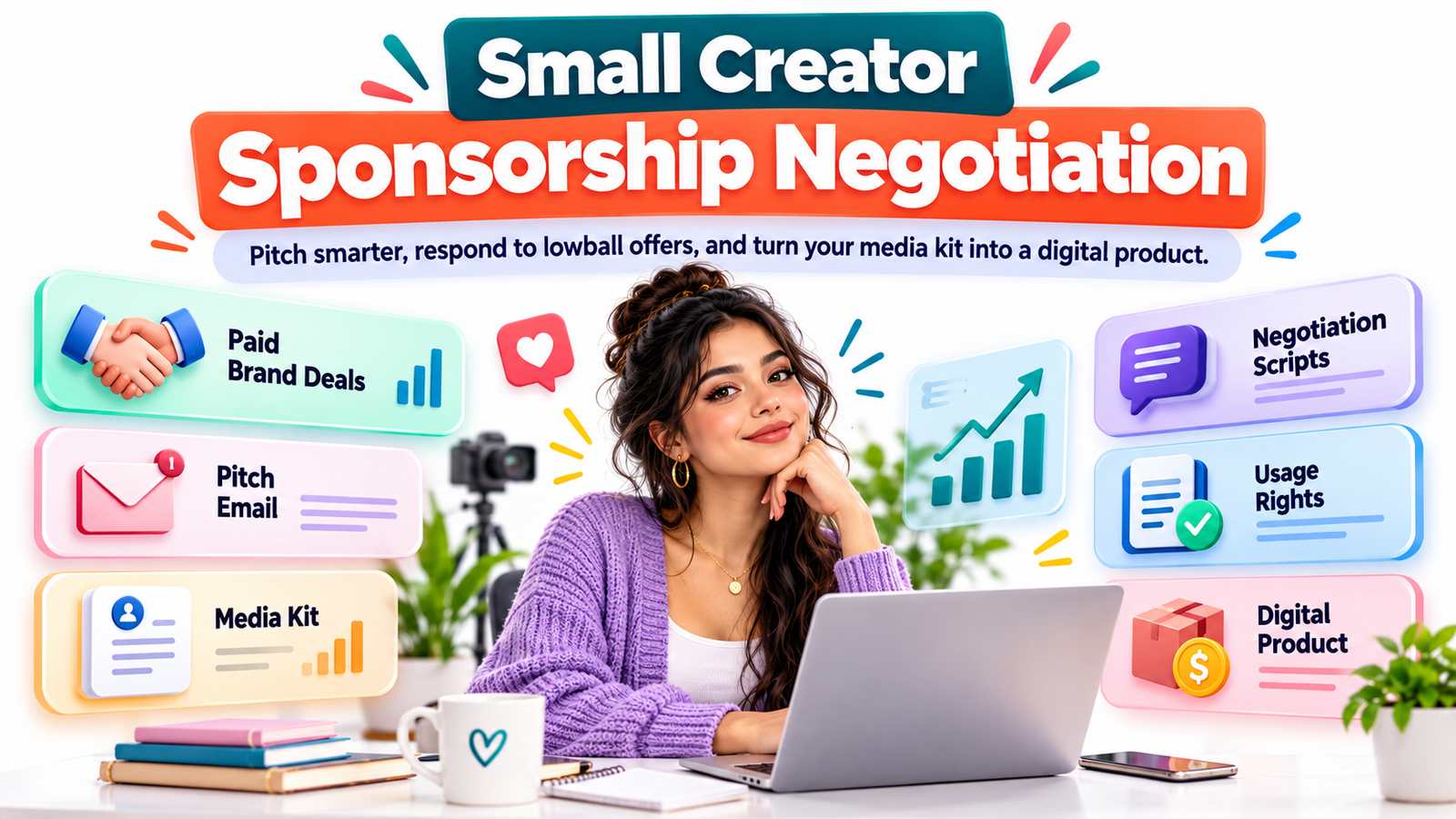
A useful featured-image concept for this article could show a small creator negotiating a sponsorship at a laptop, with visual references to a media kit, email pitch and paid brand partnership rather than an image overloaded with promotional text.
The content itself should do most of the persuasion.
Your First Paid Sponsorship Does Not Have to Be Huge
Creators sometimes reject small paid opportunities because they imagine every sponsorship must immediately become a four-figure campaign.
That can be another mistake.
There is an important difference between accepting an unfair arrangement and accepting a strategically useful smaller project.
A modest first campaign can give you experience with briefs, contracts, deadlines, approvals, invoicing and reporting.
It can also create a portfolio example.
The key is understanding what you are giving the brand in exchange.
A limited campaign at a smaller fee may make perfect sense.
Unlimited content rights, months of exclusivity, multiple videos and endless revisions for the same tiny fee probably do not.
Evaluate the complete transaction.
Small Creator Sponsorship Negotiation Is a Business Skill
You do not become professional when your follower count crosses an arbitrary number.
You become professional when you start operating professionally.
Know what you offer.
Understand your audience.
Package your services.
Ask questions before quoting.
Read your agreements.
Define your deliverables.
Clarify usage rights.
Protect your ability to work with other brands.
Disclose sponsored relationships properly.
Invoice accurately.
Follow up.
Track results.
Then improve your system after every campaign.
You may still accept free merchandise occasionally.
But now it will be a decision—not your default business model.
The next time a brand says, “We’d love to collaborate,” you will know what to ask.
The next time someone says, “We don’t have that much budget,” you will know how to adjust scope instead of immediately cutting your value.
And the next time another small creator asks how you manage sponsorships, you may discover that your own media-kit system has become a digital product worth selling.
That is how a creator starts thinking beyond posts.
You start building assets, relationships and systems.
Frequently Asked Questions
1. Can creators with fewer than 5,000 followers get paid sponsorships?
Yes. Some brands work with smaller creators because niche relevance, audience trust, content quality and creative skills can matter alongside follower count. There is no follower threshold that guarantees a paid brand deal, so creators should focus on demonstrating a clear audience fit and professional commercial offer.
2. How much should a small creator charge for a sponsorship?
There is no universally correct sponsorship rate. Consider the work required to produce the content, the deliverables, publishing requirements, your audience and performance, revision scope, usage rights, paid advertising rights, exclusivity and turnaround time. A simple post with limited rights should not automatically be priced the same as a campaign that gives the brand extensive commercial usage.
3. What should I do if a brand offers only free products?
Decide whether you genuinely want a gifting arrangement. If you want paid sponsorship work, politely explain that dedicated promotional content is offered through paid partnerships and ask whether the campaign has a creator budget. If you accept free products, remember that receiving something of value can create disclosure obligations when you endorse the product.
4. What should a creator media kit include?
A useful creator media kit normally includes your positioning, niche, audience information, relevant performance metrics, examples of your strongest content, previous partnerships when applicable, available collaboration formats and contact information. Keep it concise enough for a brand representative to understand your commercial value quickly.
5. Can I sell my creator media kit as a digital product?
Yes, provided the design and materials are yours or properly licensed for resale. The stronger opportunity is often to package the media kit with complementary tools such as brand pitch emails, negotiation scripts, sponsorship tracking sheets, campaign briefs and pricing worksheets. This transforms a simple template into a more valuable creator sponsorship system.
Build Your Creator Business Before Your Audience Becomes “Big”
Waiting until you feel famous enough to behave like a business can cost you years of experience.
Build your sponsorship system now.
Create the media kit.
Prepare the pitch.
Write the negotiation responses.
Define your packages.
Understand your rights.
Track your outreach.
Then start conversations with brands whose customers genuinely overlap with your audience.
You do not need to pretend your 3,000 followers are 300,000.
You need to show why reaching the right 3,000 people—and working with a capable creator behind that audience—can be worth paying for.
Bookmark this guide before your next sponsorship conversation. When the next brand offer arrives, come back, choose the right negotiation script and respond like a creator who understands the business behind the content.
Stay ahead with exclusive updates
Join our community. Get curated industry trends, actionable guides, and fresh resources delivered straight to your inbox.