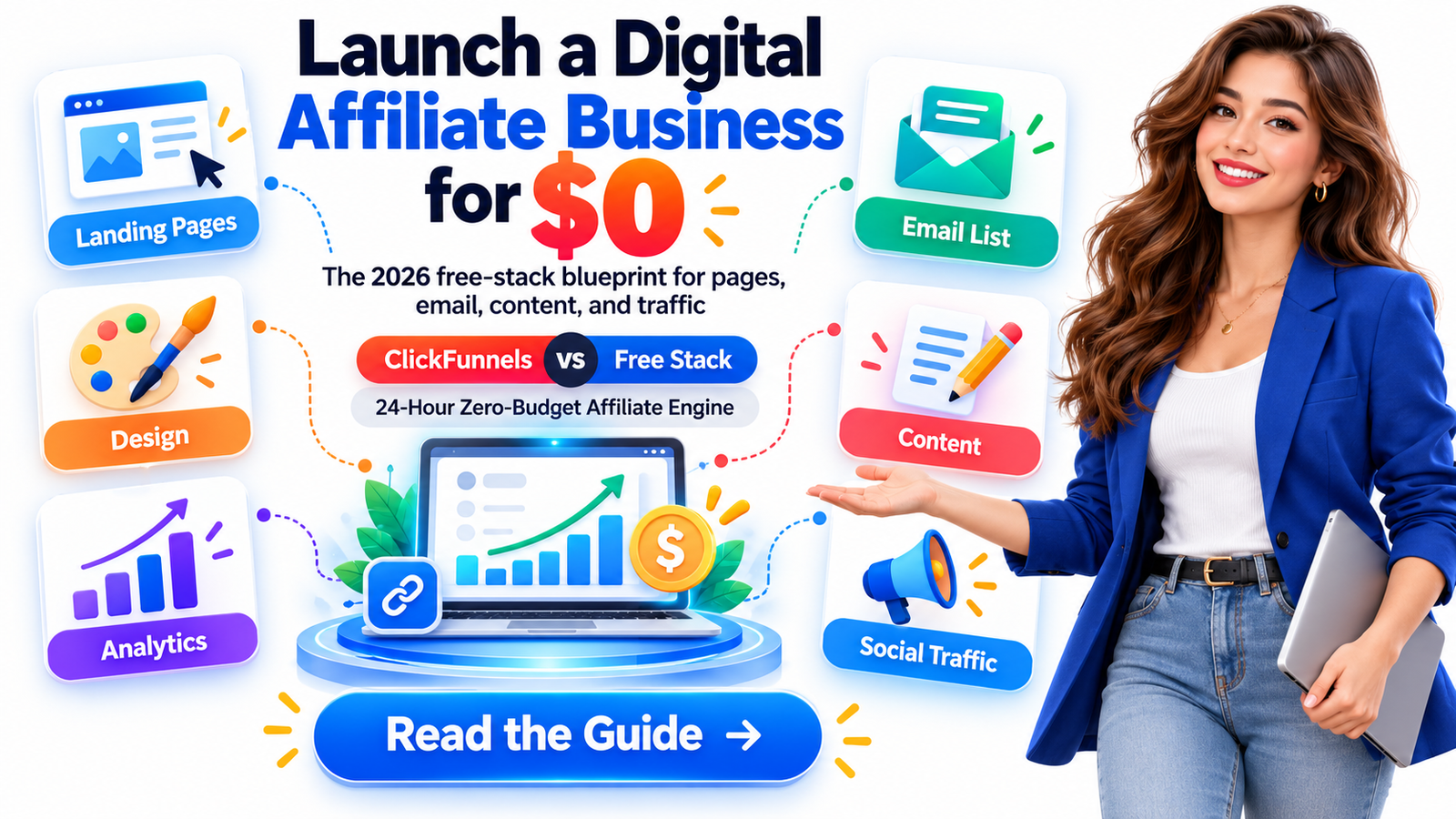
How to Launch a Full Digital Affiliate Business for $0 Upfront Cost in 2026
Starting an affiliate business used to sound cheap until you added everything together.
A website builder. Funnel software. Email marketing. Landing pages. Link tracking. Graphic design. Social scheduling. Analytics. A domain. Hosting. Automation.
Suddenly, the “low-cost online business” was carrying a monthly software bill before it had earned its first commission.
That equation has changed dramatically in 2026.
A beginner can now assemble most of the infrastructure needed for a serious digital affiliate marketing business without paying upfront for an expensive all-in-one platform. Free landing-page tools, email platforms, design software, publishing channels, analytics and social distribution tools have become capable enough that the real question is no longer:
“How much software can I afford?”
It is:
“Can I attract the right person, solve a specific problem and move that person toward a useful buying decision?”
That is the foundation of the zero-budget affiliate marketing model.
It does not mean every tool will remain free forever. It does not mean you can build a huge automated company without eventually investing money. And it certainly does not mean affiliate revenue is guaranteed.
It means you can validate the business before committing to recurring software expenses.
For beginners, creators, bloggers, freelancers and niche publishers, that distinction can save hundreds—or even thousands—of dollars during the period when the business is most uncertain.
The $0 Affiliate Business Model in One Sentence
The model is simple:
Attract a narrowly defined audience with useful content, capture interested visitors through a free landing page or email list, recommend genuinely relevant products, measure what people respond to and reinvest only after revenue appears.
You do not need fifteen tools.
You need a working path from:
Problem → useful content → trust → email/contact → recommendation → merchant page → purchase → follow-up
That is your affiliate funnel.
Everything else is optional until the numbers prove that you need it.
Why Software Costs Hurt Beginners More Than Established Marketers
A $97 monthly subscription may be insignificant to a business generating $20,000 a month.
It is completely different for someone generating $0.
This is why software should usually follow validation rather than precede it.
Imagine spending $150 per month across funnel software, design subscriptions, SEO tools and social media software.
After six months, you have spent $900.
If you still do not know whether people want your content, click your recommendations or buy the products you promote, the problem was probably never the software.
The problem was validation.
A zero-upfront-cost affiliate business reverses that sequence.
First, prove that strangers will pay attention.
Then prove that some will subscribe.
Then prove that subscribers or readers will click.
Then prove that qualified clicks can generate commissions.
Only then ask which paid tool can increase the efficiency of something that already works.
That approach is less glamorous than buying an impressive marketing stack on Day 1, but financially it is far more disciplined.
ClickFunnels vs. the Free Stack in 2026
ClickFunnels remains a powerful option for businesses that want funnels, websites, landing pages, email marketing, A/B testing, checkout functionality and other marketing capabilities inside one ecosystem.
As of October 2026, its Launch plan is listed at $97 per month when paid monthly. ClickFunnels also lists an annual equivalent of roughly $81 per month when billed annually, with the Launch tier including features such as funnels, landing pages, a website/blog, email marketing, A/B testing, up to 10,000 email contacts and 50,000 emails per month.
That is not automatically “expensive.”
If an integrated platform saves a profitable business several hours every week, $97 can be an excellent investment.
But that does not mean a first-time affiliate needs it.
At $97 per month, twelve months of monthly billing would total $1,164.
A beginner who has not validated an audience may be better served keeping that money available while assembling a temporary free affiliate marketing stack.
The free-stack philosophy is not:
“Paid software is bad.”
It is:
“Do not pay to scale a funnel you have not proved yet.”
Where ClickFunnels Wins
ClickFunnels becomes attractive when convenience has economic value.
Instead of connecting several different platforms, you can manage major parts of the customer journey within one environment.
That matters when you are running multiple funnels, testing pages frequently, sending substantial email volume, selling your own offers, managing customer journeys or working with a team.
You are paying partly for consolidation.
The less time you want to spend connecting systems, the more appealing an integrated platform becomes.
Where the Free Stack Wins
The free stack wins on financial risk.
Your fixed software cost can remain close to zero while you test:
your niche,
your content angle,
your traffic source,
your lead magnet,
your calls to action,
your affiliate offers,
your email positioning,
and your conversion assumptions.
If your idea fails, you have mostly lost time rather than months of software fees.
If it works, you have real data telling you what deserves investment.
That is a much stronger position from which to upgrade.
The 2026 Zero-Budget Affiliate Marketing Stack
You do not need to use every tool listed here. In fact, fewer tools are usually better.
Choose one tool for each essential job.
Free Landing Pages and Email Capture: Kit
An affiliate business becomes much stronger when it can turn temporary visitors into an audience you can reach again.
Kit is particularly interesting for a zero-budget launch because its current Free plan supports up to 10,000 subscribers and includes unlimited forms, landing pages and email broadcasts. It also includes tagging and segmentation, although more sophisticated visual automations require a paid plan.
That gives a beginner enough infrastructure to create a simple funnel such as:
Helpful article or social post → free checklist → landing page → email subscriber → helpful follow-up → affiliate recommendation
You do not need a complicated twelve-step funnel.
Start with one problem and one next action.
Free Visual Design: Canva
Canva continues to offer a free individual plan at ₹0 in India, with access to its drag-and-drop editor, templates and free creative assets.
For an affiliate publisher, that can cover:
featured images,
Pinterest graphics,
comparison visuals,
lead-magnet covers,
checklists,
social posts,
simple infographics,
and short-form promotional graphics.
Your objective is not to design the prettiest website in the niche.
Your objective is to make useful information easier to consume.
Free Search Intelligence: Google Search Console
Once you control a compatible website or domain property, Google Search Console gives you direct information about how your pages appear in Google Search.
Google describes Search Console as a free service that can help site owners monitor search visibility, indexing, queries and other search-performance information.
For an affiliate publisher, this data can eventually become more valuable than guessing which keyword tool score is “correct.”
Pay attention to queries where you are already receiving impressions.
If Google is showing your article for:
“best email marketing software for photographers”
but the article is currently about:
“email marketing tools”
you have discovered a more specific content opportunity directly from real search behavior.
Free Content Planning: Google Sheets or a Similar Spreadsheet
Your affiliate operating system does not need sophisticated project-management software on Day 1.
Create columns for:
Topic
Search intent
Target reader
Affiliate product
Problem being solved
Article status
Primary CTA
Clicks
Conversions
Commission
Update date
You now have a basic affiliate content database.
The important part is not the spreadsheet.
It is measuring the journey from content to revenue.
Free Social Distribution: Buffer or Native Platform Scheduling
Buffer currently offers a free plan supporting up to three connected channels, with up to ten scheduled posts per channel at a time.
You can also publish directly through social platforms.
Again, do not obsess over automation before you have something worth distributing.
One genuinely useful post placed where your target customer already spends time can outperform fifty generic scheduled posts.
The 24-Hour Zero-Budget Affiliate Engine
Could you build an affiliate business in 24 hours?
You can build the engine.
That is different from building a profitable business in one day.
Revenue depends on audience quality, demand, merchant conversion rates, commission structures, trust, traffic and many other factors.
Your 24-hour objective is simpler:
Create a complete path through which a qualified stranger can discover you, find value, join your audience and reach a relevant affiliate offer.
Hours 1–2: Choose One Painful Problem
Do not start by asking:
“What affiliate products pay the highest commission?”
Start with:
“What problem is someone already trying to solve?”
Good niches contain repeated problems with purchase intent.
Examples include:
freelancers trying to invoice clients,
small businesses choosing email marketing software,
new bloggers selecting hosting,
remote workers improving productivity,
students choosing learning platforms,
creators selecting video tools,
job seekers improving resumes,
pet owners researching training products,
online sellers comparing ecommerce tools.
The narrower the immediate problem, the easier it becomes to create useful content.
Instead of:
AI tools
try:
AI writing tools for solo real-estate agents who need listing descriptions.
Instead of:
email software
try:
email marketing platforms for coaches building their first 1,000-subscriber list.
Specificity attracts qualified visitors.
Qualified visitors convert better than random traffic.
Hours 3–4: Choose One Primary Affiliate Offer
Your first affiliate business does not need 30 programs.
Choose one strong core recommendation and perhaps one alternative.
Evaluate the product from the reader’s perspective.
Does it solve the problem?
Is the pricing appropriate?
Does the company have a credible reputation?
Is the affiliate program available in your market?
How is attribution handled?
What is the commission structure?
How long is the cookie or tracking window?
What restrictions exist on paid ads, trademarks, email marketing or coupon promotion?
Read the affiliate agreement.
Never assume every promotional strategy is permitted.
And never recommend a product solely because the commission is higher.
Trust is an asset.
A small commission from a genuinely useful product is better for a long-term publishing business than a high commission earned by pushing something your reader does not need.
Hours 5–7: Build One High-Intent Content Asset
The strongest beginner affiliate content usually connects information with a buying decision.
Think:
“Product A vs. Product B for beginners”
“Best accounting software for freelance designers”
“Is [product] worth it for a one-person business?”
“Free vs. paid email marketing software”
“How to choose a website builder when your budget is under $20”
“Best tools for creating a digital course without coding”
These queries sit closer to a commercial decision than broad informational keywords.
But do not turn the page into a pile of affiliate buttons.
Answer the question thoroughly.
Discuss limitations.
Say who should not buy the product.
Explain what alternative is better for a different type of user.
Provide original comparison, decision criteria, examples or workflow advice.
Google’s spam guidance specifically warns against “thin affiliation”—affiliate pages that add little value beyond material supplied by merchants. Google gives meaningful comparison, testing, reviews, pricing information and other original value as examples of stronger affiliate content.
Your competitive advantage is therefore not merely having an affiliate link.
It is helping someone make a better decision.
A Conversion Structure That Does Not Feel Like a Sales Pitch
A commercially useful article can follow this sequence:
The reader’s problem
Show that you understand what is frustrating them.
The cost of doing nothing
Explain the lost time, money or opportunity associated with the problem without exaggerating it.
The possible solutions
Teach before selling.
Your recommended route
Explain why one approach works for a particular reader.
Alternatives
Demonstrate objectivity.
Proof or reasoning
Use first-hand testing, screenshots, calculations, demonstrations, case studies or transparent methodology whenever available.
Low-friction CTA
Invite the next action.
A strong CTA might be:
Compare the current plans and decide whether the entry-level option fits your needs.
That feels more trustworthy than:
BUY NOW BEFORE IT’S TOO LATE!
Buyer intent does not require aggressive selling.
It requires removing uncertainty.
Build a Lead Magnet That Extends the Article
Affiliate businesses become fragile when every visitor disappears after one session.
Your lead magnet gives a first-time visitor a reason to become a returning visitor.
Suppose your article is:
ClickFunnels vs. a Free Affiliate Marketing Stack
Your lead magnet could be:
The Zero-Budget Affiliate Stack Checklist: 12 Free Tools and the Exact Job Each One Performs
Now the article answers the immediate question while the downloadable resource solves the implementation problem.
A natural CTA becomes:
Building your own zero-cost affiliate setup? Save the checklist so you can assemble the stack without reopening twenty browser tabs.
That converts because it continues the task the visitor has already started.
The Returning-Visitor Hook Most Affiliate Sites Forget
A first visit is often research.
The second or third visit may be where the buying decision happens.
Give people a reason to return.
For example:
Bookmark this guide. We update the tool limits and pricing whenever major free plans change.
That is especially appropriate for software comparisons because pricing changes.
You can also create connected resources:
Part 1: How to build the free stack
Part 2: How to create your first affiliate article
Part 3: How to get the first 100 visitors
Part 4: How to measure affiliate clicks
Part 5: When to upgrade to paid software
Now one search visitor can become a multi-session reader.
Returning visitors also give you repeated opportunities to build trust without forcing an immediate purchase.
Your First Email Sequence Can Be Simple
You do not need an elaborate automation system to begin.
The first email delivers what the subscriber requested.
The next useful message can explain a mistake beginners commonly make.
Another can provide a practical example.
Later, recommend a relevant product where it genuinely fits the problem.
For example:
Someone downloads a Beginner Affiliate Launch Checklist.
A useful sequence might discuss choosing a niche, building a simple landing page, writing comparison content, tracking clicks and then choosing software.
The affiliate recommendation becomes a logical continuation of the education rather than an interruption.
That is how effective email affiliate marketing feels different from spam.
Should You Use Free Tools Forever?
Probably not.
The purpose of the free stack is validation, not permanent software austerity.
Imagine your free workflow begins creating commissions but now takes five hours every week to manage.
A $50 tool that reduces that work to one hour may be a profitable purchase.
The useful question is not:
“Is this software expensive?”
Ask:
“Does this software produce or protect more value than it costs?”
Paid software becomes easier to justify when it helps you:
save substantial time,
capture more leads,
improve conversion rates,
send higher email volume,
conduct meaningful A/B testing,
manage multiple funnels,
centralize data,
remove manual integrations,
support a team,
or sell your own products.
At that point, an all-in-one system such as ClickFunnels may become more economical than maintaining a patchwork stack.
The free stack helps you reach that decision with evidence.
A Simple Upgrade Rule
Do not upgrade because another marketer has a better-looking dashboard.
Upgrade when you can identify a measurable constraint.
For example:
“My current email limit is preventing me from contacting active subscribers.”
“My landing-page tool cannot run the test I need.”
“Maintaining four integrations is costing six hours per month.”
“My funnel is converting consistently and I want more advanced optimization.”
“My business now generates enough gross profit that this subscription represents only a small operating expense.”
That is a business reason.
“I feel more professional with expensive software” is not.
Affiliate Compliance Is Part of the Business Model
Affiliate marketing works best when readers understand the commercial relationship.
In the United States, the FTC states that affiliate relationships should be disclosed clearly and conspicuously, with disclosures positioned close enough to recommendations for consumers to understand the connection. The FTC also warns that simply writing “affiliate link” may not always communicate clearly enough that the publisher receives compensation.
A plain-language disclosure can be straightforward:
This article contains affiliate links. If you purchase through one of these links, I may earn a commission at no additional cost to you.
Disclosure requirements can vary by jurisdiction, so publishers should check the rules that apply to their location and audience.
For Google Search, affiliate links should also be appropriately qualified. Google’s guidance recommends using rel="sponsored" for affiliate links.
Compliance should not be treated as annoying fine print.
Transparency strengthens trust.
How to Build the Article for SEO, GEO and AEO Without Stuffing Keywords
Modern search visibility is less about repeating the exact same phrase twenty times and more about answering the complete search problem.
A page about building an affiliate business for free naturally benefits from language such as:
affiliate marketing for beginners,
free affiliate marketing tools,
zero-budget affiliate marketing,
start affiliate marketing with no money,
free affiliate funnel,
affiliate landing page,
email list building,
affiliate content strategy,
buyer-intent keywords,
affiliate conversion optimization,
free marketing stack,
affiliate program selection,
organic affiliate traffic,
lead magnets,
conversion funnels,
content monetization,
and email marketing automation.
But these terms should appear because they help explain the subject.
Not because a plugin told you to reach a certain keyword density.
Google’s own guidance emphasizes helpful, reliable, people-first content and recommends using the words people use to search for information in natural, prominent places such as titles and headings.
For answer-engine and generative-search visibility, clarity becomes especially useful.
Answer direct questions directly.
Define terms.
Use specific examples.
Make comparisons explicit.
Support factual claims.
Explain who a recommendation is for.
Explain who it is not for.
Use descriptive headings.
Keep important answers understandable even when a search or AI system extracts a small section from the larger article.
That is far more sustainable than attempting to manipulate an undefined “GEO score.”
Google itself warns that third-party services cannot guarantee rankings or performance in traditional or generative search experiences.
How to Improve the Article’s Google Discover Potential
Google Discover is not something a publisher can switch on or guarantee.
Google says Discover traffic can fluctuate and is difficult to predict.
What you can control is quality and presentation.
For this topic, a strong featured image could show a visually clear contrast between an expensive software stack and a streamlined $0 beginner stack.
Google currently recommends compelling, relevant, high-quality Discover images that are at least 1200 pixels wide, contain more than 300,000 pixels in total and work well in a 16:9 landscape format. Google also recommends enabling large image previews and identifies structured-data images or og:image as ways to specify representative imagery.
A 1280×720 original featured image is therefore a sensible format for this article.
The headline should stay descriptive rather than sensational.
How to Launch a Full Digital Affiliate Business for $0 Upfront Cost in 2026
communicates the benefit clearly without making an income promise.
That matters because clickbait may win a curiosity click but lose reader trust.
The $0 Stack Is Also a Market-Research Machine
One of the hidden advantages of starting free is that every action becomes an experiment.
Suppose you publish three articles:
Article A gets 1,000 visitors and 12 affiliate clicks.
Article B gets 300 visitors and 48 clicks.
Article C gets 150 visitors and 40 clicks.
The biggest traffic source is not automatically your best commercial asset.
Article B or C may be closer to a purchase decision.
That teaches you something valuable.
You can now expand the high-intent topic into:
comparisons,
alternatives,
pricing guides,
use cases,
tutorials,
mistake articles,
industry-specific versions,
and email content.
This is how a small affiliate site begins becoming a real content business.
You follow evidence.
Your First Goal Should Not Be “Passive Income”
Calling affiliate marketing passive too early creates bad expectations.
At the beginning, it is active work.
You research.
You write.
You publish.
You distribute.
You test.
You update.
You answer questions.
You analyze search data.
You improve CTAs.
You replace weak offers.
You refresh outdated pricing.
Over time, strong evergreen pages can continue attracting visitors long after publication.
That is where leverage appears.
But the first job is building useful assets.
Passive results, when they happen, are a consequence—not the starting strategy.
When ClickFunnels Becomes the Better Decision
There is a point where the free stack can become inefficient.
Imagine you are earning consistent affiliate income, selling your own digital product, managing several landing pages, building more sophisticated automations and testing multiple campaigns.
Now your “free” stack may involve:
one landing-page platform,
another email system,
separate analytics,
separate checkout software,
multiple integrations,
manual exports,
and multiple dashboards.
At that stage, paying for consolidation may reduce complexity.
ClickFunnels is therefore not necessarily the enemy of the free stack.
It may be the next stage for a business whose economics justify it.
The decision is not:
ClickFunnels or free tools forever.
It is:
Which infrastructure makes financial sense at my current stage?
For a pre-revenue beginner, the answer may be free.
For a growing marketer, the answer may be integration.
For an established business, the cost of fragmented software and manual work may exceed the subscription price of an all-in-one system.
That is the comparison that matters.
A Better 2026 Affiliate Business Formula
The old formula was often:
Buy tools → create funnel → find products → generate traffic → hope.
A more disciplined formula is:
Find a painful problem → publish a useful solution → capture interested readers → recommend an appropriate offer → measure behavior → improve conversion → reinvest proven revenue.
That formula keeps overhead low while keeping attention on the only thing software cannot manufacture for you:
relevance.
A perfect funnel shown to the wrong audience still fails.
A simple page containing the exact answer someone needs can perform surprisingly well.
Start Today Without Buying Anything
If you have been postponing affiliate marketing because you believe you need a premium funnel builder, expensive keyword software, paid automation tools and a large advertising budget before you can begin, remove that obstacle.
Choose one audience.
Choose one meaningful problem.
Choose one legitimate affiliate offer that solves it.
Create one genuinely useful piece of high-intent content.
Create one free landing page.
Offer one relevant resource.
Start one email list.
Promote the content through one or two channels where your audience already spends time.
Measure what happens.
Your first milestone is not $10,000 a month.
It is proof.
Can you attract ten relevant visitors?
Can you get one subscriber?
Can you generate an affiliate click?
Can you identify the article that creates the most purchase intent?
Can you improve the next version?
Once the answer becomes yes, growth becomes a sequence of measurable improvements rather than an expensive guess.
Save this guide and return after your first 100 targeted visitors. At that point, review which pages generated email subscribers, which recommendations earned clicks and where visitors stopped moving forward. Those three numbers will tell you more about what to build next than another software subscription.
Frequently Asked Questions
1. Can I really start affiliate marketing with $0 in 2026?
Yes, it is possible to build the initial infrastructure with no upfront software cost by using free publishing, landing-page, email, design and analytics tools and by relying on organic distribution. However, some businesses will eventually choose to pay for a domain, hosting, advanced email capabilities, automation or funnel software. Affiliate-program approval and earnings are never guaranteed.
2. Do I need ClickFunnels to start affiliate marketing?
No. ClickFunnels can simplify funnel building, email marketing and related workflows, but beginners can validate an affiliate concept using free tools first. A paid funnel platform becomes easier to justify once you have traffic, subscribers, conversions or a workflow that is expensive to manage manually.
3. What is the best free affiliate marketing funnel for beginners?
A simple funnel is usually enough: publish useful content, send interested visitors to a free lead-magnet landing page, collect email permission, deliver the promised resource, continue helping the subscriber and recommend an appropriate product when it naturally solves the reader’s problem.
4. How long does it take to make money with affiliate marketing?
There is no reliable universal timeline. Results depend on the niche, traffic quality, audience trust, content quality, offer relevance, merchant conversion rate, competition and promotional strategy. A 24-hour launch plan can create the infrastructure quickly, but it cannot guarantee commissions within 24 hours.
5. Is a free affiliate marketing stack better than ClickFunnels?
Neither is universally better. A free stack is attractive for beginners who want to validate an idea with minimal financial risk. ClickFunnels can be more attractive when an established marketer values integrated funnels, email, testing and related features enough to justify the recurring cost. The best option is the one whose cost and capabilities match the current stage of the business.
A profitable affiliate business is not built by collecting the largest number of tools. It is built by becoming useful at the exact moment a potential buyer needs help making a decision.
Start lean enough that failure is inexpensive.
Create enough original value that readers remember you.
Track enough data that you know what actually works.
Then spend money where the evidence says spending money will create leverage.
That is how a zero-budget affiliate business can grow into a sustainable digital asset rather than another collection of monthly subscriptions.
Stay ahead with exclusive updates
Join our community. Get curated industry trends, actionable guides, and fresh resources delivered straight to your inbox.