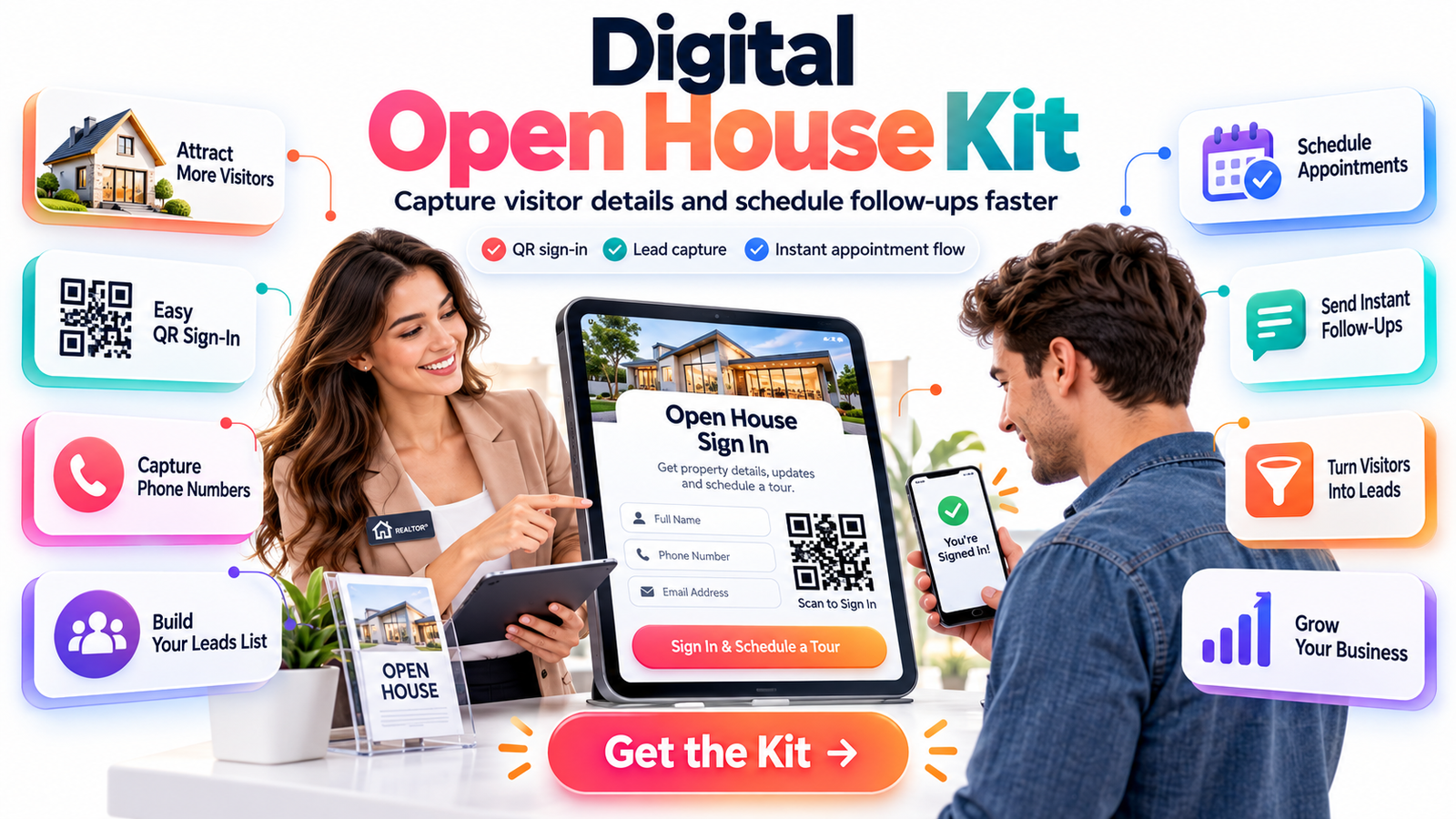
Ditch the Clipboard: How a Digital Open House Kit Triples Your Lead Capture Rate
An open house can attract twenty, thirty, or even fifty visitors and still produce almost nothing useful for the agent hosting it.
People walk through the front door, compliment the kitchen, ask about the school district, glance at the backyard, take a flyer and disappear.
At the end of the afternoon, the agent is left with a clipboard containing a few unreadable names, incomplete email addresses, fake phone numbers and several entries that simply say “just looking.”
That is not an open house lead generation system.
It is attendance tracking.
A well-designed digital open house kit changes the purpose of the event. Instead of simply counting visitors, it helps an agent identify genuine buyer intent, capture accurate contact information, understand what each visitor needs and create natural opportunities to schedule the next conversation.
The important word is natural.
People rarely want to feel as though they have entered a sales funnel the moment they step through the door. They do, however, appreciate useful information, fast answers and an easy way to receive relevant properties.
That is where modern digital open house lead capture becomes powerful.
A visitor scans a QR code or opens a mobile sign-in page. They receive useful property information. They can indicate whether they are buying, selling, researching the neighborhood or already working with an agent. A serious buyer can immediately request similar listings or schedule a private showing.
The technology is simple.
The strategy behind it is what creates appointments.
And although no digital system can guarantee a specific increase in leads, moving from passive paper sign-ins to a properly designed digital conversion flow can dramatically increase the number of usable, permission-based leads generated from the same amount of open house traffic.
Imagine 20 visitors attending an open house.
A weak clipboard system produces four usable contacts.
A stronger digital experience produces 12.
That would represent a threefold increase in usable lead capture without increasing advertising spend or visitor volume.
The opportunity is not necessarily more traffic.
It is converting more of the traffic you already have.
What Is a Digital Open House Kit?
A digital open house kit is a mobile-first collection of tools used to welcome visitors, collect contact information, provide property resources, identify buying intent and encourage appropriate follow-up actions.
Instead of asking someone to write their name and number on a sheet of paper, the agent creates a small digital journey.
The visitor might scan a QR code displayed near the entrance.
The first screen welcomes them to the property.
The second asks for essential contact details.
Another question may ask what brought them to the open house.
The visitor can then access property highlights, disclosures when appropriate, neighborhood information, financing resources, similar homes and a button for scheduling another showing or consultation.
The result is more than a digital sign-in sheet.
It becomes an open house conversion system.
Why Traditional Open House Sign-In Sheets Lose Valuable Leads
Paper worked when buyers had fewer digital expectations.
Today, almost every stage of the real estate journey begins on a screen.
Consumers search properties online, save listings on mobile devices, research neighborhoods, compare mortgage payments and contact agents electronically.
Then they arrive at an open house and are handed a pen and clipboard.
The experience feels disconnected.
There are other problems.
Handwriting may be difficult to read. Email addresses are entered incorrectly. Visitors may skip questions because the form feels intrusive. The agent has to manually transfer information into a CRM later. Valuable context about the visitor is usually missing.
Most importantly, the traditional form gives the visitor almost nothing in return.
The agent is effectively saying:
“Give me your information.”
A better digital experience communicates:
“Tell me what you need, and I’ll give you something useful.”
That small change can completely alter the psychology of open house lead capture.
The Real Goal Is Not More Sign-Ins
Many agents measure open house success using the wrong number.
They count visitors.
Or sign-ins.
Neither necessarily predicts future business.
A better measurement is the number of qualified next-step opportunities created from the event.
For example, ten people may sign in.
One asks for a second showing.
Two want homes under a specific price point.
One owns a nearby property and is considering selling.
Another wants information about down-payment options.
Three are already represented by agents.
Two are casually browsing.
Those are ten very different conversations.
A strong open house kit helps reveal those differences while the prospect’s interest is still fresh.
Start With a Frictionless Digital Check-In
The entrance experience matters.
Visitors should not feel as though they are being interrogated before they have even seen the living room.
Keep the first interaction simple.
A small tabletop sign might invite visitors to scan a QR code to access the property guide, updates and additional information.
The landing page should load quickly on a phone and immediately explain why the visitor is being asked to enter information.
For example:
“Sign in to receive property details, updates and similar homes.”
That communicates value much better than:
“Please register before entering.”
The first version feels helpful.
The second feels procedural.
The distinction matters.
Ask Only for Information You Will Actually Use
Long forms destroy conversions.
If your digital open house registration asks for name, mailing address, phone number, email address, occupation, employer, budget, mortgage balance, household income, financing status and expected purchase date before the visitor has even toured the house, expect abandonment.
Start with the minimum useful information.
Name.
Email or mobile number.
Then one or two questions that reveal intent.
For example:
“What best describes your visit today?”
A visitor could identify themselves as actively buying, casually researching, exploring the neighborhood, considering selling a property or already working with an agent.
That single question can make later follow-up significantly more relevant.
Use Progressive Lead Capture Instead of One Giant Form
One of the best conversion principles from ecommerce and SaaS marketing works equally well for real estate.
Do not ask for everything at once.
Collect information progressively.
The initial sign-in can be simple.
Later, when the visitor requests a customized property list, you can ask for preferred location, budget and bedroom count.
If they request a home-value consultation, you can ask for their property address.
If they schedule a buyer consultation, you can ask about timeline and financing status.
Every additional question appears because the visitor has requested something that makes the information relevant.
That feels much more natural than turning the front door into a qualification interview.
Give Visitors a Reason to Share Accurate Information
People protect their inboxes and phone numbers because they expect spam.
The solution is not stronger pressure.
It is stronger value.
Your digital open house kit should answer the unspoken question:
“What do I get if I sign in?”
Perhaps the visitor receives a detailed property guide.
Maybe they receive a neighborhood snapshot.
Perhaps they can request recently sold comparable homes.
They might receive similar listings within their budget.
They could request notification if the seller changes the price.
They may want a private second showing.
They may want homes nearby with larger yards, lower HOA fees or an additional bedroom.
A visitor who wants something meaningful has a reason to provide accurate contact information.
That turns lead capture from an administrative requirement into a value exchange.
Turn the Property Page Into a Conversion Page
A typical property flyer provides information.
A digital open house property page should provide information and next steps.
Include the information buyers naturally want: price, bedrooms, bathrooms, square footage, major property features, showing details and approved listing information.
Then create pathways based on intent.
Someone who likes the home should be able to request another tour.
Someone who likes the neighborhood but not the house should be able to request similar properties.
Someone concerned about affordability may want to speak with an appropriate lending professional, subject to applicable rules and disclosures.
Someone who lives nearby may want to explore their home’s potential market position.
You are no longer asking every visitor to take the same action.
You are giving each visitor the next action most relevant to them.
The Highest-Converting Question May Be “What Would You Change?”
Open house conversations often become generic.
“How do you like the house?”
“Nice.”
“What do you think of the kitchen?”
“Very nice.”
Those answers reveal almost nothing.
Try a more useful question:
“If you could change one thing about this home, what would it be?”
Suddenly you learn something.
“I need a bigger backyard.”
“We need a first-floor bedroom.”
“This is above our budget.”
“I love the house, but my commute would be difficult.”
“We need another bedroom.”
Those are not objections to fear.
They are search criteria.
If the visitor says the home is nearly perfect but needs another bedroom, your response becomes natural:
“I may know of a few four-bedroom options nearby. Would you like me to send them?”
That is a conversion conversation.
QR Codes Should Start Conversations, Not Replace Agents
Some real estate professionals over-automate the process.
Visitors scan.
Forms collect information.
Automated emails are triggered.
The agent stands quietly across the room.
That misses the real advantage of an open house.
Face-to-face interaction.
NAR has long emphasized the value of personally engaging open house visitors and learning whether they are interested in the property, interested in other homes or willing to schedule another conversation.
Technology should make those conversations easier.
It should not remove them.
Use digital tools to capture information and organize intent.
Use your human skills to create trust.
Build an Appointment Opportunity Into the Experience
One of the biggest open house mistakes happens after a promising conversation.
The visitor says:
“We’re probably going to start seriously looking next month.”
The agent replies:
“Great. I’ll follow up sometime.”
The opportunity immediately becomes vague.
Instead, create an appropriate next step while the conversation is active.
If the visitor wants to see similar properties, show available appointment options.
If they want to understand the buying process, offer a buyer consultation.
If they need a second look at the property, offer a private showing request.
If they are considering selling before buying, offer a separate seller conversation.
The goal is not to force appointments.
The goal is to eliminate unnecessary friction when someone already wants one.
Use the “Similar Homes” Conversion Hook
This may be one of the most useful elements in an open house lead capture system.
Most visitors will not buy the house they are touring.
That does not make them bad leads.
It means the current property helped reveal what they actually want.
Create a visible call to action:
“Like the area but not this exact home? Get similar listings.”
That gives the visitor permission to say no to the property without saying no to you.
They can request homes matching criteria such as location, price range, property type, number of bedrooms or another meaningful feature.
Your open house is now generating buyer opportunities even when the listing itself is not a match.
Add a Hyperlocal Neighborhood Guide
A powerful digital open house kit should sell more than square footage.
It should help people understand the location.
Visitors frequently research commute options, parks, shopping, restaurants, transportation, local services, community amenities, property taxes and other neighborhood considerations.
Create a concise neighborhood resource using accurate, neutral and verifiable information.
This can strengthen local relevance for buyers and help position the agent as a useful resource for the area.
Be careful when discussing schools, demographics, crime, religion, family composition or other topics that may implicate fair housing concerns. Use objective third-party sources where appropriate and follow brokerage guidance.
A good neighborhood guide informs.
It does not steer.
Use Micro-Commitments to Identify Serious Buyers
People often hesitate to request a consultation because it sounds like a significant commitment.
Smaller actions feel easier.
“Send me similar homes.”
“Notify me if the price changes.”
“Send the property guide.”
“Show me upcoming open houses nearby.”
“I’d like another look at this home.”
Each action reveals intent.
Several micro-commitments over time may eventually produce a conversation, showing appointment or client relationship.
This is why a digital open house funnel should not rely on one giant “Book a Consultation” button.
Different visitors are at different stages.
Give them several sensible entry points.
The Best Follow-Up Begins During the Open House
Most agents think follow-up starts after everyone leaves.
The strongest follow-up begins before the visitor leaves.
Suppose someone tells you:
“We like the location, but we really need a home office.”
Record that preference.
Your later message can say:
“Thanks for stopping by today. You mentioned needing a dedicated home office, so I pulled together a few nearby properties that may fit better.”
Compare that with:
“Hi, just following up after the open house. Let me know if you have any real estate needs.”
The first message continues a conversation.
The second starts from zero.
Personalization does not require complicated artificial intelligence.
It requires listening.
Build a Simple Open House Follow-Up Sequence
Speed matters because buyer interest cools quickly.
A visitor requesting information should receive it promptly.
The first communication can deliver exactly what was promised.
A later follow-up can provide something useful related to their stated interest.
A serious buyer might receive similar listings.
A homeowner may receive information about comparable properties.
Someone interested in the listing may receive an invitation to arrange a second showing.
The purpose is not to send more messages.
It is to send more relevant messages.
Consent requirements also matter. Do not assume that entering a phone number automatically authorizes every possible form of future marketing. Your forms and follow-up processes should use appropriate disclosure and consent language for the communication methods you intend to use.
Capture the Source of Every Lead
If you host several open houses every month, you need to know which properties, signs, advertisements and marketing channels create the strongest opportunities.
Tag leads by event.
For example, the CRM record might identify the specific property, event date, traffic source and visitor intention.
After several months, patterns emerge.
Perhaps neighborhood Facebook promotion generates traffic but few qualified buyers.
Maybe Instagram stories bring fewer visitors but more scheduled appointments.
Perhaps directional signs produce many walk-ins from nearby homeowners.
Maybe email invitations produce the highest second-showing rate.
Without source tracking, you have opinions.
With source tracking, you have data.
Measure Conversion Beyond the Sign-In Rate
A modern open house dashboard should focus on meaningful outcomes.
Imagine 30 visitors.
Twenty-four complete the digital sign-in.
Fifteen request additional property information.
Eight request similar listings.
Four engage in meaningful follow-up.
Three schedule another property showing.
One eventually becomes a client.
Those numbers tell a much more useful story than:
“Thirty people came to the open house.”
Track your visitor-to-contact rate, contact-to-conversation rate, conversation-to-appointment rate and eventual client conversion rate.
Over time, you can identify exactly where your funnel is weak.
If visitors refuse to register, improve the initial value proposition.
If people register but ignore follow-up, improve relevance.
If conversations occur but appointments do not, examine the offer or timing.
Optimization becomes possible because every stage is visible.
Do Not Force Visitors to Surrender Information Just to Walk Through the Property
There is an important distinction between encouraging registration and creating inappropriate barriers.
NAR’s current consumer guidance says a person simply attending an open house on their own does not need to enter into a written buyer agreement merely to tour the property.
Your digital system should therefore focus on useful engagement rather than making the experience feel coercive.
A visitor who chooses not to provide marketing consent may still be a valuable person to treat professionally.
Good lead generation builds trust before it tries to monetize attention.
Protect the Information You Collect
Digital lead capture introduces responsibilities that paper forms sometimes allow agents to ignore.
Names, phone numbers and email addresses are personal information.
NAR’s data privacy principles emphasize transparency in collecting personal information, appropriate data security, reasonable retention practices and responsible disclosure to third parties.
Your open house platform should therefore use reasonable security controls.
CRM access should be restricted appropriately.
Exported lead spreadsheets should not be casually shared.
Old personal data should not remain indefinitely simply because deleting it is inconvenient.
And visitors should be able to understand how their information will be used.
Trust is part of conversion optimization.
Open House Safety Still Matters
Digital sign-in does not replace a physical safety plan.
Open houses expose agents and sellers’ homes to unfamiliar visitors.
NAR continues to recommend open house safety planning, including strategies such as working with another person when possible and establishing safety procedures.
Technology should support that strategy rather than create false confidence.
Keep your phone available.
Understand the property’s exits.
Protect seller valuables and sensitive documents.
Follow brokerage safety procedures.
Avoid becoming so focused on a tablet or CRM dashboard that you stop paying attention to the room.
The Seller Can Benefit From Better Open House Data Too
A digital open house kit is not only useful for prospecting.
It can improve seller reporting.
Instead of telling the seller:
“We had a good turnout.”
You can provide more meaningful information without improperly disclosing visitor personal data.
You might report that the open house attracted strong traffic, that several visitors expressed interest in particular features, or that recurring feedback centered on a particular concern.
Structured feedback may help sellers and agents understand market reaction more clearly.
The key is to report insights responsibly rather than distributing identifiable visitor information unnecessarily.
Create a Returning-Visitor Loop
Not every reader of your website or visitor to your open house is ready to act today.
That is why strong real estate content creates a reason to return.
A buyer who discovers your digital open house guide might come back for updated neighborhood information.
Someone who requests open houses this weekend may return next weekend.
A homeowner researching property values today may contact you six months later.
Build resources worth revisiting.
Updated open house schedules.
New buyer guides.
Neighborhood market updates.
Property search tools.
Home-selling checklists.
Practical financing education from appropriate qualified sources.
Returning visitors are valuable because familiarity reduces friction.
Your goal is not simply to capture a visitor once.
It is to become useful enough that they choose to come back.
What a High-Converting Digital Open House Journey Looks Like
Picture the experience from the visitor’s perspective.
They see a tasteful QR code at the entrance offering property details and updates.
The mobile page loads immediately.
They enter a name and preferred contact method.
They select:
“Buying within 3–6 months.”
They tour the house.
The agent learns that they love the neighborhood but need one more bedroom.
Before leaving, the visitor scans another prompt:
“See similar four-bedroom homes nearby.”
They request the list.
The system records their preference.
Later, they receive the information they requested.
The agent follows up based on the actual conversation.
The visitor books another showing.
Nothing about the process needs to feel aggressive.
That is the difference between a sales trap and a well-designed customer journey.
Could a Digital Open House Kit Really Triple Lead Capture?
It can happen.
It should not be treated as a guaranteed benchmark.
Suppose an agent typically has 25 visitors and collects five usable leads.
That is a 20% usable lead capture rate.
After introducing a clearer value exchange, mobile registration, similar-property requests and immediate appointment options, the agent collects 15 usable leads from another event with similar attendance.
The number of usable contacts has tripled.
But the improvement came from the system, not simply from replacing paper with a QR code.
A bad digital form is still a bad form.
The strongest results come from combining technology with value, personalization, trust, speed and good conversations.
Make the System Mobile First
Your visitor is standing in someone else’s home.
They are not sitting at a desktop computer.
Everything needs to work comfortably on a phone.
Large buttons.
Minimal typing.
Readable text.
Fast loading.
Clear consent language.
Simple navigation.
No tiny menus.
No five-minute questionnaire.
No mandatory account creation.
Mobile friction can destroy otherwise excellent open house marketing.
Why This Strategy Also Supports Online Visibility
A digital open house strategy can become part of a broader content ecosystem.
A useful article about open house lead generation can connect to neighborhood pages, buyer resources, open house schedules, CRM templates, seller resources and local real estate content.
That creates deeper topical relevance around buyer lead generation, open house marketing and local real estate expertise.
For publishers targeting Google Search and Discover, Google currently recommends people-first, useful content with titles that accurately represent the article rather than relying on sensationalism. Google also notes that Discover eligibility does not guarantee Discover traffic.
The lesson is simple.
Do not publish a thin article promising “1,000 leads overnight.”
Publish the best explanation of the problem you can.
Answer the reader’s next question before they need another search.
That is useful for humans, traditional search engines and answer engines.
Your Open House Should Create Three Possible Wins
The visitor loves the property.
Excellent.
Help them understand the appropriate next step.
The visitor dislikes the property but wants something similar.
Excellent.
Help them find alternatives.
The visitor is not currently buying but owns a home nearby.
Potentially useful.
Offer relevant information when appropriate and when they want it.
A successful open house therefore does not depend entirely on selling the house to someone who walks through the door that afternoon.
The listing is the attraction.
The relationship is the longer-term opportunity.
The Competitive Advantage Is Relevance
Agents do not need another complicated technology stack.
They need a better connection between visitor behavior and follow-up.
Someone interested in the listing should not receive the same message as someone who hated it.
A first-time buyer should not automatically receive the same follow-up as an investor.
A nearby homeowner should not receive a generic “still looking for a home?” message.
A visitor who already has an agent should be handled appropriately and professionally.
The more accurately your system understands intent, the less your follow-up feels like prospecting.
It feels like service.
That is where conversion improves.
Stop Collecting Names and Start Capturing Intent
The clipboard itself was never the real problem.
The problem was treating every visitor as a line on a registration sheet.
Modern open house lead generation works differently.
Capture enough information to understand what the visitor wants.
Give useful value in exchange.
Create relevant next steps.
Make appointments easy to request.
Record meaningful preferences.
Follow up with context.
Protect the data you collect.
Respect consent.
Measure what converts.
Then improve the process after every event.
The open house stops being a three-hour event that ends when the door closes.
It becomes the beginning of a measurable real estate lead generation pipeline.
If your current process produces names but few conversations, start with one improvement at your next event: replace the passive clipboard with a simple mobile experience that answers one question clearly—
“What would be most useful to you next?”
That question can turn anonymous foot traffic into real opportunities far more effectively than another stack of paper flyers.
And if you already use digital sign-in, do not assume the job is finished. Review your visitor-to-contact rate, your contact-to-appointment rate and the number of visitors who actually receive something relevant after they leave. Small improvements at each stage can compound into a much stronger open house conversion system.
Frequently Asked Questions
What is the best way to capture leads at an open house?
The most effective approach combines a friendly personal welcome with a simple mobile sign-in experience that gives visitors something valuable in return. Rather than collecting only a name and email, use one or two questions to understand whether the visitor is actively buying, researching, selling, seeking similar properties or already represented. Then provide a relevant next action such as receiving similar homes or requesting another showing.
Should I use a QR code for an open house sign-in?
A QR code can make open house registration faster because visitors can use their own phones instead of sharing a clipboard or tablet. The QR code itself does not improve conversion, however. It should lead to a fast, mobile-friendly page with a clear value proposition, minimal form fields, appropriate privacy information and useful next steps.
What should be included in a digital open house kit?
A practical digital open house kit can include mobile registration, property information, approved listing resources, neighborhood information, visitor-intent questions, similar-property requests, private-showing requests, CRM integration and follow-up workflows. The exact setup should fit your brokerage policies, local requirements and marketing systems.
How do you turn open house visitors into appointments?
Start by discovering what the visitor actually needs. A person who wants another bedroom may be more interested in receiving similar homes than discussing the property they just toured. Once the need is clear, offer a logical next step such as a private showing, customized property search, buyer consultation or seller conversation. The appointment should solve a problem the visitor has already expressed.
Can a digital open house sign-in really increase lead conversion?
Yes, it can improve usable lead capture when it removes friction, provides immediate value, records buyer intent and connects visitors with relevant next actions. Results vary by property, market, traffic quality, form design, agent skill and follow-up execution, so no particular conversion increase—including a threefold increase—should be presented as guaranteed.
Compliance Note
This article is provided for general educational and marketing purposes and is not legal, tax, brokerage, privacy, telecommunications, fair housing or regulatory advice. Real estate laws, agency rules, advertising standards, MLS requirements, brokerage policies, privacy obligations, electronic marketing rules and consent requirements vary by jurisdiction and may change over time.
Agents and brokers should use brokerage-approved open house forms, disclosures, scripts, CRM systems and marketing practices. Clearly explain how visitor information will be collected and used, safeguard personal information appropriately and obtain any consent required before sending marketing emails, text messages, automated communications or other promotional outreach. Do not treat a phone number or email address entered for one purpose as unlimited permission for unrelated marketing.
Open house registration should not be used to mislead visitors about representation or contractual requirements. Current NAR consumer guidance states that a person merely attending an open house on their own does not need to sign a written buyer agreement simply to tour the property. Requirements can differ based on circumstances, brokerage policy, jurisdiction and whether an agent begins working with the buyer.
Agents should also follow applicable fair housing requirements and avoid questions, targeting practices, neighborhood descriptions or recommendations that could constitute unlawful discrimination or steering. Property information, claims, school information, neighborhood data, financing information and market statistics should be accurate, appropriately sourced and updated when necessary.
Open house safety procedures remain important even when digital registration is used. Follow brokerage safety policies, safeguard seller property and personal information, maintain awareness of visitors and use appropriate check-in and security procedures. NAR continues to maintain safety and data-privacy resources for real estate professionals.
Any examples of lead capture, appointment generation, conversion rates, income or business growth in this article are illustrative only. Actual performance depends on market conditions, listing quality, visitor volume, lead quality, technology, follow-up, agent skill, compliance practices and other factors. No specific sales, conversion, commission or income result is guaranteed.
Stay ahead with exclusive updates
Join our community. Get curated industry trends, actionable guides, and fresh resources delivered straight to your inbox.