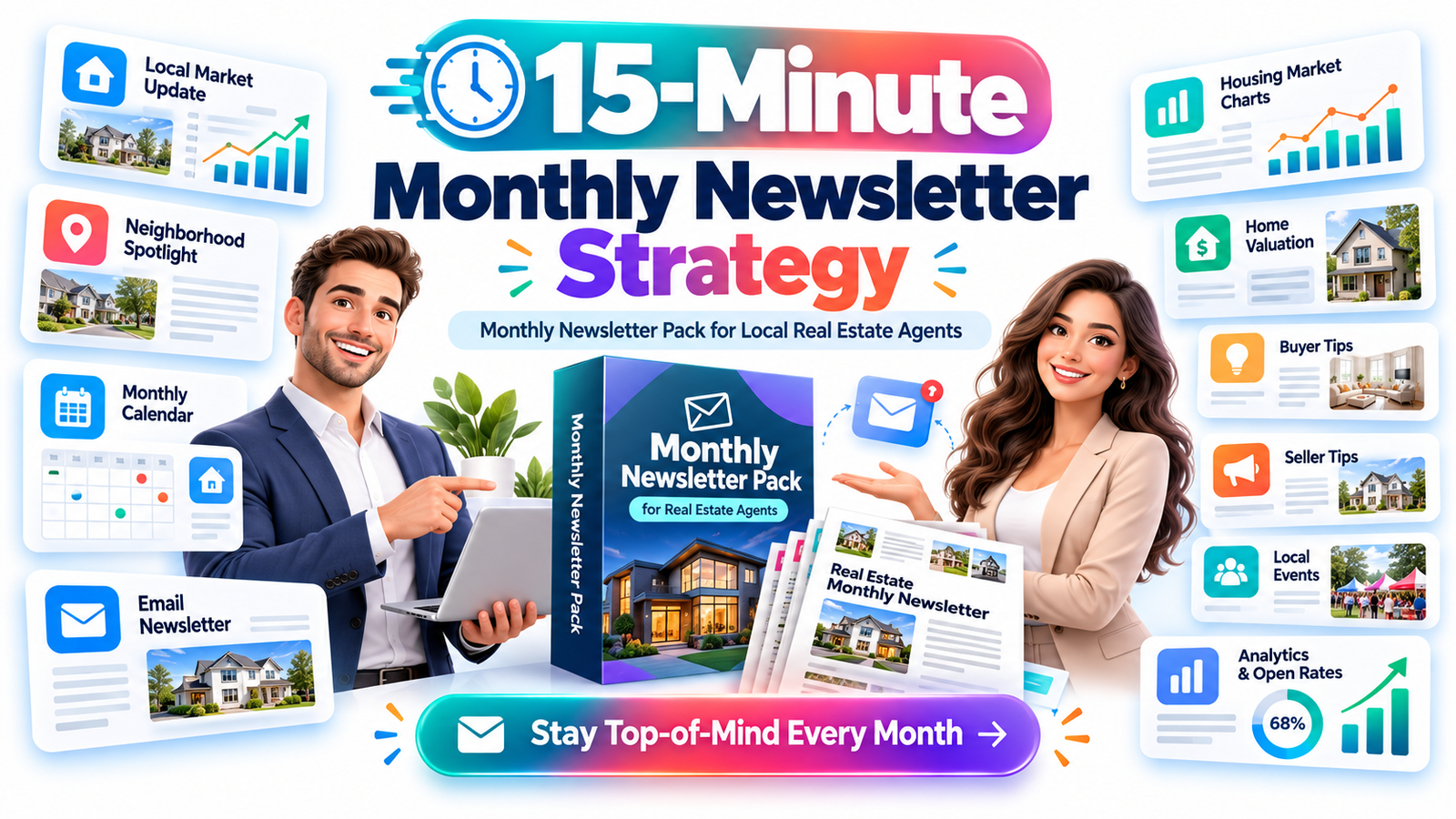
The 15-Minute Monthly Newsletter Strategy That Keeps You Top-of-Mind in Your Local Market
Most real estate agents do not have a visibility problem.
They have a consistency problem.
They post when they have a new listing. They email when they remember. They disappear during busy transaction weeks. Then, when business slows down, they suddenly try to reconnect with everyone they have met during the last three years.
That approach makes marketing feel exhausting because every message has to start from zero.
A simple monthly real estate newsletter changes the equation.
Instead of constantly asking, “What should I post this week?” you create one useful, locally relevant communication each month that reminds homeowners, buyers, past clients, prospects, referral partners and people in your sphere that you understand what is happening in their market.
And it does not have to become another full-time job.
With a reusable Monthly Newsletter Pack, a reliable content structure and a few pieces of fresh local information, an agent can assemble a valuable newsletter in roughly 15 focused minutes.
The goal is not to become the loudest real estate professional in town.
It is to become one of the people residents consistently associate with useful local real estate information.
Why Monthly Newsletters Still Matter in a Social-Media-First World
Social media is valuable, but its biggest weakness is that you do not control distribution.
A follower may never see your latest market update.
An Instagram post can disappear into a feed within hours.
A short-form video might reach thousands of strangers while missing the people in your own database who are most likely to hire or refer you.
Email gives you another channel.
When someone voluntarily joins your real estate email list, you gain permission to communicate directly with them, subject to applicable email-marketing rules and their preferences.
That creates an important marketing advantage.
You can build familiarity over months instead of depending on one social post, one open house or one cold follow-up to generate a transaction.
A homeowner who is not ready to sell today may be ready nine months from now.
A renter may become a first-time buyer next year.
A previous client may meet a coworker who needs an agent.
A homeowner may begin wondering what their property is worth after seeing three nearby homes sell.
Your monthly newsletter keeps the relationship alive during the long periods between those moments.
The Real Objective: Become the Local Market Translator
Sending more emails is not the strategy.
Sending more useful local information is.
Consumers can already search for mortgage headlines, national housing statistics and generic home-maintenance advice.
What is harder to find is context.
What does the latest inventory change mean in your specific area?
Are homes in one neighborhood sitting longer than they did three months ago?
Are buyers gaining more negotiating room?
Which price bands are moving quickly?
Are sellers still receiving multiple offers?
What new restaurant, school project, transit change, development or neighborhood event might interest residents?
This is where a good real estate newsletter becomes valuable.
You are not merely reporting numbers.
You are translating the market.
Instead of writing:
“Inventory increased 11% this month.”
Explain:
“Buyers now have slightly more choice than they did earlier in the season, particularly between $500,000 and $700,000. Well-priced homes are still moving, but sellers may need to be more strategic about condition and initial pricing.”
That second version demonstrates judgment.
Over time, those interpretations help position you as a hyper-local real estate resource rather than another agent forwarding automated market reports.
What Is a Monthly Newsletter Pack?
A Monthly Newsletter Pack is a reusable collection of prebuilt content blocks, prompts, layouts and calls to action that make creating a monthly real estate newsletter faster.
Think of it as your marketing framework rather than a completed newsletter.
A useful pack might contain interchangeable sections for:
- a short local market update
- a neighborhood spotlight
- a recently sold or market activity feature
- a homeowner tip
- a buyer tip
- a community event
- a local business spotlight
- a frequently asked real estate question
- a short personal note
- a home valuation invitation
- a buyer consultation invitation
- a referral reminder
- newsletter subject-line ideas
You do not need to use every section every month.
The pack eliminates the blank page.
Instead of inventing an email from scratch, you update a small number of fields with current information and send a polished edition.
The 15-Minute Monthly Newsletter Framework
Here is a simple structure that can work across many residential real estate markets.
Minutes 1–3: Update Three Local Market Signals
Start with three numbers or observations your audience can understand.
Depending on your available data, these might include:
- active inventory
- median or average sale price
- median days on market
- new listings
- pending sales
- closed sales
- sale-to-list-price ratio
- price reductions
- months of supply
Avoid dumping ten statistics into the email.
Choose the few indicators that tell the clearest story.
Then add one or two sentences explaining what they mean.
For example:
“Inventory increased again this month, giving buyers more options in the $400,000–$600,000 range. However, updated properties in the most popular neighborhoods are still attracting strong early attention.”
Now the reader receives analysis rather than a spreadsheet.
Minutes 4–6: Add One Hyper-Local Story
Choose something connected to the community.
It could be:
- a new restaurant opening
- a popular neighborhood event
- a park improvement
- a development proposal
- a seasonal attraction
- a new retail opening
- a community project
- a local housing trend
- a neighborhood receiving unusual buyer attention
This section is powerful because people often open local newsletters for reasons beyond real estate.
Someone who does not care about mortgage rates this month may absolutely care about a new coffee shop opening two blocks away.
That keeps your content useful even when the subscriber has no immediate transaction plans.
Minutes 7–9: Answer One Real Question
Think about something a client asked you during the past month.
For example:
“Should I renovate before selling?”
“How much earnest money do buyers usually need?”
“Can I buy before selling my current house?”
“Why are some homes selling immediately while others sit?”
“Does a price reduction make a listing look bad?”
“What does contingent actually mean?”
Turn the question into a 100- to 200-word answer.
This gives your newsletter something generic AI-generated real estate content often lacks: a connection to conversations actually happening in your market.
It can also give you future website content, social posts, short videos and FAQ pages.
One client question can become an entire micro-content campaign.
Minutes 10–11: Add One Home or Neighborhood Visual
Feature something visually relevant.
It could be a neighborhood street scene, community landmark, listing photograph you have permission to use, local event image or simple real estate market graphic.
Do not overload the email with stock photographs of people holding oversized house keys.
Subscribers are interested in their community.
Show them their community.
Minutes 12–13: Add One Contextual Call to Action
Avoid stuffing the bottom of every newsletter with five competing requests.
Choose the CTA that naturally follows the month’s content.
After a seller-market update:
“Curious what recent nearby sales may mean for your home’s value? Request a local pricing review.”
After a buyer update:
“Want to know what is currently available within your price range? Tell me your target area and budget.”
After a neighborhood spotlight:
“Thinking about moving into this area? I can send you the current homes for sale and recent comparable sales.”
After a market-shift article:
“Not sure whether buying or selling now makes sense for your situation? Schedule a short strategy conversation.”
The best conversion hooks often feel like the next logical step rather than an advertisement.
Minutes 14–15: Write the Subject Line and Send
Your subject line should give subscribers a clear reason to open.
Instead of:
“October Real Estate Newsletter”
consider:
“What Changed in the Local Housing Market This Month?”
or:
“More Homes Are Hitting the Market—Here’s What It Means Locally”
or:
“3 Things Local Homeowners Should Know This Month”
or:
“Your 5-Minute [Neighborhood] Market Update”
Specificity usually makes the value easier to understand.
A Monthly Newsletter Structure Readers Can Learn to Expect
Consistency does not mean publishing the same newsletter forever.
It means creating a familiar experience.
A practical monthly format could look like this:
Opening: One short human note about what you are seeing or hearing locally.
Market in a Minute: Two or three important market indicators with your interpretation.
Around the Neighborhood: One useful community development, event or business feature.
Question of the Month: A short answer to a real buyer or seller question.
Property or Neighborhood Spotlight: Something visual and locally relevant.
Next Step: One specific invitation based on the newsletter topic.
That is enough.
Your newsletter does not need to look like a 40-page luxury magazine to establish authority.
Useful information delivered consistently can be far more valuable.
The Local Authority Flywheel
The strongest advantage of this strategy appears after several months.
One newsletter produces more than one email.
Suppose this month’s newsletter contains an explanation of why homes in one neighborhood are taking longer to sell.
That single section can become:
a website article about the neighborhood market,
a Google Business Profile update where appropriate,
a short LinkedIn post,
a Facebook post,
an Instagram carousel,
a 45-second video,
a seller FAQ,
and a future consultation talking point.
Next month, you repeat the process.
After one year, you have created twelve evidence-rich local market updates instead of twelve generic promotional emails.
Your website also begins accumulating a library of useful local information.
That is where newsletter marketing and local real estate SEO can reinforce each other.
Turn Every Newsletter Into a Searchable Local Resource
Do not allow the useful information in your email to disappear after subscribers read it.
Repurpose your strongest sections into permanent pages or blog posts on your website.
For example:
“October Housing Market Update for [City]”
“Is [Neighborhood] Still a Seller’s Market?”
“Average Days on Market in [City]: What Buyers Should Know”
“Should You Sell Your [City] Home Before Buying Another?”
“Best Questions to Ask Before Buying a Condo in [Neighborhood]”
These pages can address the natural questions people ask traditional search engines and AI-powered answer systems.
The writing should prioritize genuine usefulness over manipulating rankings. Google’s current Search guidance specifically emphasizes people-first content that demonstrates knowledge, gives visitors a satisfying answer and exists primarily to help the intended audience.
For a real estate professional, that means adding information that only someone paying attention to the area could easily provide.
Do not simply write:
“The real estate market changes frequently.”
Tell readers what changed locally, why it matters and what questions they should consider next.
How to Build GEO and AEO Value Without Writing Robotic Content
Search behavior is becoming increasingly conversational.
People do not only type:
“homes for sale Austin.”
They ask longer questions such as:
“Is this a good time to sell a home in North Austin?”
“What neighborhoods near downtown have homes under $700,000?”
“How long are houses taking to sell in my area?”
“What should I fix before listing my house?”
Your newsletter content can answer these types of questions naturally.
Use question-based headings when appropriate.
Give a direct answer early.
Then provide explanation, limitations and local context.
For example:
Is It a Good Time to Sell in [Neighborhood]?
Instead of delaying the answer for 600 words, begin with something useful:
“It may be a favorable time for well-prepared sellers in [Neighborhood], particularly in the $X–$Y range, but conditions vary considerably by property type and price point.”
Then explain the supporting evidence.
This structure works well for human readers because they receive the answer immediately.
It also makes your content easier for search and answer systems to interpret.
Do Not Publish Generic Market Statistics Without Context
Numbers create credibility only when readers understand them.
Imagine reporting:
“Median sales price: $625,000.”
Is that good?
Bad?
Increasing?
Declining?
Typical?
Unusual?
Now compare it with:
“The median sale price reached approximately $625,000 this month. That figure alone does not mean every home appreciated, but it shows that the mix of properties closing this month skewed higher than last month. Entry-level homes remain much more competitive than the overall median suggests.”
That explanation builds trust because it acknowledges nuance.
Your audience does not need another data dashboard.
They need someone who can interpret the dashboard.
Use Neighborhood-Level Content to Build Geographic Relevance
Citywide content is useful.
Neighborhood content can be even more powerful.
Over the course of the year, rotate through the communities you actually serve.
For example:
January: Downtown condo market update
February: Northside family-home inventory
March: Waterfront property trends
April: First-time buyer opportunities
May: Historic district spotlight
June: New construction update
July: Summer events and housing activity
August: School-zone market observations
September: Investor activity
October: Fall selling conditions
November: Homeowner equity conversations
December: Annual local housing recap
You are creating a geographic content footprint around the communities your business genuinely serves.
The key word is genuinely.
Do not publish shallow pages for dozens of cities simply to capture search traffic.
Depth builds stronger authority than manufactured geographic coverage.
The Newsletter Should Sound Like an Agent, Not a Marketing Department
A frequent mistake is trying to make every newsletter sound corporate.
Your clients hired—or may hire—a person.
Let that person appear in the writing.
You can say:
“I toured several homes in this price range this month, and one thing stood out…”
“I keep hearing the same question from sellers…”
“Three buyers asked me about this recently…”
“I drove through the neighborhood last weekend and noticed…”
“Based on the listings I am watching…”
Statements like these add firsthand experience when they are true.
That is far more memorable than:
“Greetings valued clients. We are pleased to provide this month’s exciting real estate update.”
Nobody talks like that.
Build for Returning Visitors, Not Just One-Time Clicks
A successful newsletter should create anticipation.
Give readers reasons to expect another useful edition.
You might end a section with:
“Next month, I’ll compare how these numbers changed after the current wave of pending sales closes.”
Or:
“I’m tracking inventory in three nearby neighborhoods and will include the comparison in next month’s update.”
Or:
“Several readers have asked whether sellers should renovate before listing. I’ll break down the projects that may matter most in the next edition.”
This creates an information loop.
The reader has a reason to open the next email.
That is how a newsletter starts becoming a habit rather than another marketing broadcast.
Create Small Subscriber-Only Advantages
You do not need elaborate premium content.
Give subscribers useful benefits such as:
early access to your monthly neighborhood report,
a downloadable seller checklist,
a first-time buyer roadmap,
a moving timeline,
a local vendor directory,
an open-house alert list,
or a monthly homeowner maintenance calendar.
The goal is not to withhold everything from non-subscribers.
It is to reward people for maintaining the relationship.
Segment When Your Database Becomes Large Enough
Sending every message to everybody can eventually reduce relevance.
Basic segments may include:
buyers,
homeowners,
past clients,
investors,
sellers,
renters planning to buy,
and specific geographic areas.
Your core newsletter can remain the same while one section or CTA changes.
A homeowner might see:
“Want an updated estimate of your property’s likely market range?”
A buyer might see:
“Want a list of homes that match your budget?”
An investor might see:
“Want to review current inventory based on your investment criteria?”
Personalization does not require writing seven completely different newsletters.
The Monthly Newsletter Pack Can Save More Than Writing Time
The real benefit is decision reduction.
Without a system, you must decide:
what to write,
how much to write,
what sections to include,
what data to use,
which CTA to add,
what subject line to choose,
and how to format everything.
With a template, most of those decisions have already been made.
You simply update the variable information.
That makes consistency much more realistic for agents who are simultaneously handling showings, inspections, negotiations, prospecting, closings and client communication.
A Simple AI-Assisted Newsletter Workflow
AI can accelerate the editing and repurposing stage, but local facts should come from reliable sources and your own verified information.
You might provide your writing assistant with:
this month’s verified market statistics,
three observations from client conversations,
one neighborhood development,
one homeowner question,
and your preferred writing style.
Then ask it to help turn those inputs into a concise newsletter draft.
The important distinction is this:
AI should help organize your expertise, not manufacture your expertise.
Never allow an automated system to invent market statistics, transactions, testimonials, property facts, neighborhood claims, school information, legal requirements or other material facts.
Your local knowledge remains the product.
The software simply helps package it efficiently.
Make Your Website Version Search-Friendly
When turning a newsletter into a website article, use a descriptive page title and clear headings that accurately reflect the subject.
If the article discusses the October housing market in a specific city, the title should say that.
Use original images where practical.
Add an identifiable author and useful author profile.
Link naturally to relevant neighborhood, buyer, seller and property-search resources.
Keep important information easy to access on mobile.
Where technically appropriate, publishers can also implement Article or BlogPosting structured data. Google’s current documentation says Article structured data can help Google understand details such as the article title, author, dates and images, and recommends representative, crawlable imagery.
Structured data can improve machine understanding, but it is not a ranking guarantee or a substitute for useful content. Google also states that valid structured data does not guarantee a particular search appearance.
What About Google Discover?
There is no legitimate formula that guarantees placement in Google Discover.
Trying to manufacture sensational headlines simply to win clicks can damage the trust your newsletter is supposed to build.
A better approach is to publish content that is timely, useful, visually strong and genuinely relevant to the audience you serve.
For a local real estate agent, potential Discover-friendly topics may emerge naturally:
“Why More Homeowners in [City] Are Listing Before Spring”
“5 Changes Buyers Are Seeing in [City] This Month”
“Inside the Neighborhood Suddenly Getting More Buyer Attention”
“What This Month’s Inventory Shift Means for [City] Homeowners”
The headline should earn attention without promising more than the article delivers.
That balance matters.
One Newsletter Can Support the Entire Marketing Funnel
Think about the subscriber journey.
At the top of the funnel, someone searches for local housing information and discovers one of your neighborhood articles.
They read it.
They notice you publish monthly local updates.
They subscribe.
For several months, they receive useful information without pressure.
Eventually, they begin considering a move.
Because your name has appeared alongside helpful local information repeatedly, contacting you requires less psychological effort than contacting a stranger.
That is the commercial logic behind the newsletter.
The newsletter itself may not create an immediate commission.
It creates familiarity.
Familiarity can create conversations.
Conversations create opportunities.
Conversion Hooks That Do Not Feel Like Sales Pitches
The best newsletter conversions often begin with curiosity rather than pressure.
Try invitations such as:
“Want to see the five most recent sales closest to your home?”
“Wondering how much competition buyers are seeing in your price range?”
“Thinking about moving next year rather than this year? I can help you build the timeline now.”
“Not sure whether renovating before selling would pay off? Send me the project you are considering.”
“Want the complete list of homes currently available in this neighborhood?”
Each CTA continues the conversation already happening in the article.
That feels considerably more natural than inserting “CALL ME NOW!” after every paragraph.
Measure Conversations, Not Just Open Rates
Email metrics can be useful, but do not let them become the entire objective.
Track outcomes such as:
newsletter replies,
valuation requests,
buyer-search requests,
consultation bookings,
website visits,
repeat visitors,
resource downloads,
referrals,
and conversations generated.
A subscriber replying:
“We may sell next spring. Can we talk sometime?”
is more valuable than hundreds of anonymous opens.
Real estate is a relationship business.
Your measurement system should reflect that.
The Compounding Advantage of 12 Useful Emails
Imagine two agents.
Agent A sends sporadic property promotions.
Agent B sends one genuinely useful local newsletter every month.
After twelve months, Agent B has potentially delivered:
12 local market interpretations,
12 community updates,
12 educational answers,
12 useful calls to action,
and dozens of opportunities for subscribers to reply.
The difference is not simply content volume.
Agent B has created repeated evidence of competence.
That is what makes a monthly newsletter powerful.
You are building your reputation one useful communication at a time.
Your 15-Minute Newsletter Does Not Need to Be Perfect
Perfection is one of the biggest threats to consistency.
Your newsletter does not need an elaborate design.
It does not need a 2,000-word market analysis.
It does not need twelve sections.
It needs useful information, accurate local context, clear writing and a reason for the reader to care.
Start with one market observation.
Add one community story.
Answer one question.
Give the reader one sensible next step.
Then return next month.
A year from now, your audience may not remember every statistic you shared.
They may remember something more commercially important:
“When I need to know what is happening in local real estate, this is the person I hear from.”
That is the position worth building.
Frequently Asked Questions
1. How often should a real estate agent send a newsletter?
For many agents, once a month offers a practical balance between staying visible and avoiding unnecessary email volume. The more important factor is consistency. A useful newsletter sent every month is generally a stronger relationship-building system than frequent emails that disappear for long periods.
2. What should a real estate newsletter include?
A strong real estate newsletter can combine a short local market update, neighborhood or community news, one buyer or seller question, a useful homeowner insight and one contextual call to action. The best combination depends on the agent’s audience and local market.
3. How long should a monthly real estate newsletter be?
There is no universal ideal word count. It should be long enough to provide useful information and short enough that subscribers can quickly identify what matters to them. Some editions may be only a few hundred words; more detailed market editions can be longer. Clarity matters more than hitting an arbitrary word target.
4. Can AI write a real estate newsletter?
AI tools can help agents organize notes, improve clarity, create draft headlines, repurpose verified information and speed up editing. However, agents should review all generated content and independently verify market statistics, property information, legal statements and other factual claims before publishing.
5. How does a real estate newsletter generate leads?
A newsletter builds repeated exposure to your expertise. Subscribers who are not ready to transact today may remember you when they eventually need an agent, while stronger calls to action can generate home valuation requests, buyer inquiries, consultation bookings and referrals. The objective is not simply to collect opens—it is to create relevant conversations over time.
Become the Email People Actually Want From Their Agent
Real estate marketing becomes easier when you stop trying to create attention from scratch every day.
Build a repeatable system.
Collect a few verified local insights.
Translate them into plain language.
Answer the questions your clients are already asking.
Show people that you understand the communities you serve.
Then invite the right readers into a conversation.
A well-designed Monthly Newsletter Pack makes that process easier to repeat, whether you are an independent agent, team leader, new REALTOR®, experienced broker or small real estate business without a full-time marketing manager.
Your competitive advantage does not have to be sending more emails.
It can be becoming consistently useful.
And fifteen focused minutes each month can be enough to keep that relationship moving.
Compliance Note: This article is provided for general educational and marketing-information purposes and does not constitute legal, tax, financial, lending, brokerage, MLS, advertising, fair-housing or regulatory advice. Real estate laws, agency rules, advertising standards, disclosure requirements, email-marketing and privacy laws, MLS policies, brokerage policies and permissible marketing practices vary by jurisdiction and organization. Market statistics and property information should be obtained from reliable sources and verified before publication. Avoid statements or targeting practices that could violate fair-housing or anti-discrimination laws, and obtain appropriate permission before using property photographs, testimonials, client information, logos or third-party content. Email communications should comply with applicable consent, identification, privacy and unsubscribe requirements. Agents should use brokerage-approved materials and consult their managing broker, local or state REALTOR® association, MLS, qualified attorney, tax professional or other appropriate adviser when guidance is required. Examples, timelines, statistics and marketing outcomes in this article are illustrative only and do not guarantee leads, search rankings, Google Discover visibility, transactions, commissions or business results.
Stay ahead with exclusive updates
Join our community. Get curated industry trends, actionable guides, and fresh resources delivered straight to your inbox.