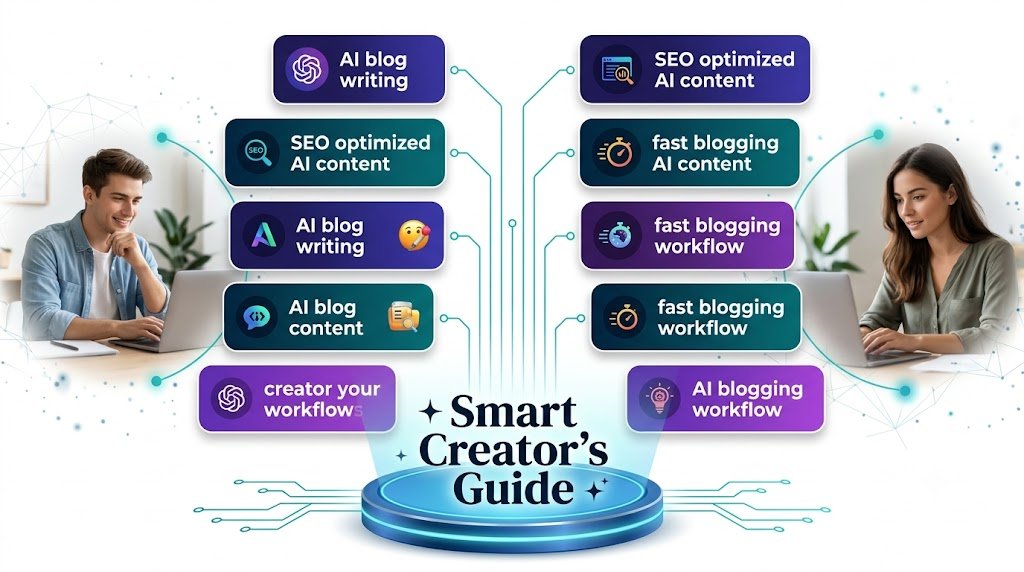
How to write high-quality blog posts faster, improve organic search visibility, attract loyal readers, and turn your content into a sustainable digital business with AI.
The internet doesn’t need another thousand generic blog posts. It needs useful answers, fresh perspectives, authentic experiences, and content that helps real people solve real problems.
Yet for bloggers, entrepreneurs, affiliate marketers, and digital creators, producing that kind of content consistently can be exhausting.
One article might require hours of keyword research, competitor analysis, outlining, writing, editing, formatting, and optimization. Multiply that workload by several articles every week, and blogging can quickly become overwhelming.
This is where AI blog writing changes the equation.
Modern AI content tools can help creators research subjects, organize information, develop outlines, write early drafts, improve readability, and prepare search-friendly content in significantly less time.
But there’s an important distinction between publishing AI-generated words and building a successful AI-assisted blogging business.
The first focuses on producing content quickly. The second focuses on producing content that people actually want to read, trust, share, and return to.
The most effective approach combines AI efficiency, human creativity, editorial judgment, and a repeatable SEO blogging workflow.
Whether you’re launching your first blog, managing multiple websites, or building a content-driven digital product business, this guide explains how to use AI strategically without sacrificing originality, quality, or credibility.
What Is AI Blog Writing, and How Does It Work?
AI blog writing is the process of using artificial intelligence tools to assist with planning, researching, drafting, editing, and optimizing blog content.
Rather than manually completing every stage of the writing process, creators use AI to accelerate repetitive tasks while retaining control over content quality.
For example, an AI writing assistant can help you:
- Discover relevant blog topics and search questions.
- Organize keyword ideas into content clusters.
- Develop structured, reader-friendly outlines.
- Draft introductions, explanations, and examples.
- Simplify complicated paragraphs.
- Generate headline and meta description alternatives.
- Identify unanswered reader questions.
- Create summaries, newsletters, and social media excerpts.
- Repurpose existing articles into additional content formats.
However, AI-generated responses are not automatically accurate, original, or optimized for search engines.
AI may invent statistics, misunderstand search intent, cite nonexistent sources, or produce repetitive explanations.
The creator remains responsible for checking facts, adding expertise, verifying originality, and ensuring that every published article delivers meaningful value.
The smartest blogging strategy isn’t replacing the writer with AI. It’s using AI to make the writer more productive.
Why AI-Assisted Blogging Is Becoming an Essential Creator Skill
Successful content creators face a difficult challenge: they need to publish consistently while maintaining quality.
Readers expect immediate answers, helpful examples, clear explanations, and trustworthy information.
Search engines increasingly emphasize content usefulness rather than simply rewarding pages containing particular keywords.
Meanwhile, creators must compete for attention across traditional search results, AI-powered search experiences, social platforms, newsletters, and recommendation feeds.
An efficient AI-assisted content system helps address these pressures.
Produce Quality Content Without Starting From Zero
One of the most frustrating parts of blogging is facing a blank document.
AI removes much of that initial friction.
You can begin with a topic, audience profile, and desired outcome, then ask an AI assistant to generate possible angles and an outline.
Instead of spending the beginning of each writing session deciding what to cover, you can concentrate on improving the substance of your article.
Maintain a More Consistent Publishing Schedule
Consistency helps creators build a recognizable content library and develop stronger relationships with returning readers.
AI can support that consistency by reducing time spent on outlining, editing, summarizing, and reformatting.
However, publishing frequency alone does not create search visibility.
A smaller collection of original, useful articles can serve readers better than hundreds of lightly edited AI drafts.
Expand Your Content Into Multiple Channels
A comprehensive blog article can become the foundation for several additional assets.
For example, one detailed guide about selling digital templates could be adapted into an email newsletter, a Pinterest infographic, a LinkedIn post, a short educational video, and a downloadable checklist.
AI helps organize these adaptations without requiring creators to rebuild every piece from scratch.
Create More Time for Revenue-Producing Activities
When drafting and editorial preparation become more efficient, creators can invest additional time in activities that support business growth.
These include developing original resources, improving website conversion rates, creating digital products, communicating with customers, and strengthening audience relationships.
The benefit is not simply writing faster.
It’s creating more value with the same available time.
The Smart Creator’s Fast Blogging Workflow: From Topic to Published Article
A practical AI blogging workflow follows a clear sequence.
Each stage has a defined purpose, and every AI output receives human review before publication.
Step 1: Find Blog Topics That Solve Real Problems
A profitable blogging strategy begins with audience needs rather than randomly generated article ideas.
Start by identifying the questions, frustrations, and desired outcomes of your ideal readers.
Suppose your blog focuses on digital products.
Your audience might ask:
- How can I create a digital product without design experience?
- What digital products can beginners sell?
- How can I improve my first product listing?
- Which tools help automate digital product delivery?
- How do I attract buyers without a large following?
These questions offer better starting points than broad subjects such as online business or passive income.
Use Google Trends, Google Search Console, search suggestions, customer conversations, and relevant online communities to validate demand.
AI can then help organize the findings.
Practical AI prompt:
Act as a content strategist for a beginner-friendly digital product website. Generate 20 useful blog article ideas based on common customer problems. For each topic, identify the target reader, likely search intent, unique content angle, and potential next action. Clearly distinguish suggested ideas from topics supported by actual search data.
This approach encourages relevant content planning without treating AI-generated assumptions as verified market research.
Step 2: Understand Search Intent Before Writing
Search intent describes what a user wants to accomplish when entering a query.
Understanding that intention is essential for creating relevant content.
Consider these searches:
“What is AI blog writing?”
The reader primarily wants information.
“How to write SEO blog posts with AI”
The reader wants practical instructions.
“Best AI blogging tools for WordPress”
The reader is comparing solutions.
“Buy an AI blogging prompt bundle”
The reader may be ready to purchase.
Each query requires a different content strategy.
An educational article should prioritize explanations and useful examples.
A comparison article should evaluate strengths, limitations, pricing, and suitability.
A purchase-focused page should clearly explain the product, its benefits, the terms of purchase, and what happens after checkout.
When content satisfies the visitor’s actual intent, the reader has a stronger reason to continue exploring your website.
Step 3: Build a Search-Friendly Content Outline
A strong outline improves both writing speed and article structure.
Before drafting, organize your topic into a logical sequence.
For a guide about AI blog writing, this might include:
- What AI blog writing means.
- Why creators use it.
- How to research topics and keywords.
- How to create an effective AI prompt.
- How to draft and humanize the article.
- How to optimize for search.
- How to publish, promote, and measure results.
The outline should reflect actual reader questions rather than mechanically repeating keywords.
Practical AI prompt:
Create a detailed outline for an article titled “How to Write SEO-Friendly Blog Posts With AI.” Target beginner bloggers and small business owners. Organize the content around practical reader questions. Include clear headings, useful examples, common mistakes, and opportunities to demonstrate first-hand experience. Avoid repetitive sections and unnecessary keyword variations.
Review the outline before proceeding.
Remove sections that do not contribute to the reader’s goal, combine overlapping explanations, and add any important points the AI missed.
Step 4: Write Better AI Prompts for Better First Drafts
Generic prompts tend to produce generic content.
For example:
“Write a blog about SEO.”
This provides little information about the audience, purpose, depth, writing style, or desired outcome.
A more effective prompt supplies that context.
Reusable AI Blog Writing Prompt
You are an experienced editorial writer specializing in educational digital business content.
Write an original, informative article about [TOPIC] for [TARGET AUDIENCE].
The reader wants to accomplish [SPECIFIC OUTCOME].
Use a natural, professional, conversational writing style with clear explanations and practical examples.
Structure the article with a helpful introduction, descriptive headings, actionable guidance, realistic examples, and an appropriate conclusion.
Address the reader’s main questions directly.
Incorporate relevant search terminology naturally without keyword stuffing.
Do not invent statistics, research findings, customer testimonials, expert quotations, or product features.
Flag factual claims requiring verification.
Avoid exaggerated promises, repetitive wording, unnecessary filler, and overly promotional language.
Include opportunities for genuine personal experience, original research, and a relevant reader action.
Produce a first draft intended for further fact-checking and human editing.
This structured prompt helps produce a more relevant starting draft.
It does not remove the need for editorial review.
Step 5: Add the Human Experience AI Cannot Supply
This is one of the most important stages of SEO optimized AI content creation.
AI can generate polished explanations, but it cannot truthfully claim to have tested a product, operated your business, interviewed your customers, or experienced your results.
Those contributions must come from actual evidence and experience.
Consider a generic statement:
“AI writing tools can help bloggers improve productivity.”
Now compare it with a specific, experience-based explanation:
“When testing an AI-assisted writing workflow, record how much time you spend on outlining, drafting, fact-checking, and editing. Compare those results with your previous process to identify where AI provides meaningful time savings.”
The second example gives the reader a method they can use.
Where possible, strengthen your articles with original screenshots, firsthand observations, product demonstrations, experiments, comparisons, and documented results.
You can also include mistakes you encountered and how you corrected them.
These details make content more distinctive and useful.
AI can help communicate your expertise, but it should never fabricate expertise on your behalf.
Step 6: Optimize the Article for Search Without Keyword Stuffing
Search-friendly writing begins with topical clarity.
Your main subject should appear naturally in the page title, introduction, relevant headings, and body content.
For example, an article about AI blog writing may naturally discuss automated content drafting, keyword research, content editing, blogging productivity, WordPress publishing, and search visibility.
These related concepts help readers understand the subject comprehensively.
But repeating “AI blog writing” in every paragraph adds little value.
A useful optimization process includes:
Page title: Explain the article’s main benefit accurately.
Introduction: Identify the reader’s problem and describe what the article will help them accomplish.
Headings: Organize sections around genuine questions and subtopics.
URL: Use a short, readable page address, such as /ai-blog-writing-guide/.
Meta description: Summarize the page accurately and give searchers a reason to visit. Google may generate a different snippet when appropriate.
Internal links: Connect relevant pages using descriptive, natural anchor text.
External references: Link to trustworthy sources when factual support is needed.
Images: Use original, relevant graphics with meaningful alternative text where appropriate.
Mobile experience: Ensure paragraphs, images, navigation, and buttons work comfortably on smaller screens.
The objective is not to achieve a perfect score from an SEO plugin.
It is to create a page that search engines can understand and visitors find genuinely helpful.
How to Make AI-Written Blog Posts Sound Natural and Human
One common weakness of unedited AI writing is predictable language.
Articles may contain repetitive transitions, broad claims, excessive enthusiasm, and paragraphs that explain obvious concepts without adding value.
Improving these drafts requires more than asking AI to “make this sound human.”
Start by removing generic statements.
Replace vague claims with useful explanations, examples, or evidence.
Vary sentence length naturally.
Use direct language when the subject allows it.
Explain difficult concepts without turning every section into a textbook definition.
Most importantly, develop a recognizable editorial perspective.
For example, rather than writing:
“AI technology is revolutionizing the world of content marketing by providing unprecedented opportunities.”
Write:
“AI can help you organize a blog post in minutes. The harder part is making sure the finished article offers something readers couldn’t get from a generic answer.”
The second version communicates a clearer idea without unnecessary exaggeration.
Natural writing emerges from clarity, specificity, and thoughtful editing—not from inserting artificial mistakes or conversational filler.
How to Make Blog Content More Useful in AI-Powered Search
Traditional search results are no longer the only way readers discover information.
AI-powered search experiences can summarize answers, surface sources, and help users explore related questions.
For content creators, this creates additional opportunities to be discovered.
Some marketers use the terms answer engine optimization and generative engine optimization to describe efforts to improve visibility in AI-driven experiences.
However, Google’s official guidance emphasizes that established SEO principles remain relevant to its AI search features. There is no separate technical requirement or special markup that guarantees inclusion in AI Overviews or AI Mode.
The strongest approach remains producing accessible, original, helpful, and well-supported content.
Answer Important Questions Early
Readers often want a direct answer before exploring details.
Consider this example:
How long does it take to write a blog post using AI?
AI can generate an initial draft quickly, but the complete process depends on research depth, factual accuracy, subject complexity, and editorial requirements. A short educational article may need relatively little revision, while technical or research-heavy content can require substantial additional work.
This format gives the reader an immediate answer and creates a natural opening for deeper explanation.
Use Clear, Descriptive Headings
Headings should explain what each section covers.
“How to Check AI-Generated Blog Content for Accuracy” is more informative than “The Secret to Better Results.”
Descriptive headings help users scan the article and make its organization easier to understand.
Explain Concepts With Context
Short answers are valuable, but they should not replace substance.
If an article discusses content optimization, explain the process, provide an example, identify limitations, and describe when the method is appropriate.
A complete explanation is more useful than a page containing disconnected definitions.
Strengthen Credibility With Evidence
Support important claims with reliable sources.
Provide attribution for statistics, studies, quotations, and third-party findings.
Where relevant, identify the author and explain their qualifications or practical experience.
For sensitive subjects such as finance, health, and legal matters, apply additional verification and appropriate expert review.
Make the Page Accessible to Search Systems
Ensure important information is present in crawlable page content.
Use understandable HTML structure, sensible navigation, and descriptive links.
Avoid hiding essential explanations entirely inside images or inaccessible interactive elements.
These practices benefit readers and support content discovery across search experiences.
The 60-Minute AI Blogging Sprint: A Practical Workflow to Test
For a familiar, low-risk topic requiring limited research, creators can experiment with a one-hour editorial sprint.
This is an illustrative target, not a guaranteed production time. Complex topics often require considerably longer.
| Time | Activity | Main objective |
|---|---|---|
| 0–10 minutes | Research the topic and reader intent | Establish what the article must answer |
| 10–20 minutes | Develop and refine the outline | Build a logical structure |
| 20–35 minutes | Generate and revise a first draft | Create a useful starting manuscript |
| 35–50 minutes | Verify facts and add original value | Improve accuracy and usefulness |
| 50–60 minutes | Review on-page optimization | Prepare the draft for editorial approval |
Publishing may require additional time for image preparation, source verification, formatting, accessibility checks, and final approval.
The purpose of the sprint is to measure efficiency, not to rush incomplete or unreliable articles onto your website.
A sensible creator tracks both time spent and the quality of the finished content.
Choosing AI Tools for a Faster Blogging System
You do not need an expensive collection of subscriptions to build a productive blogging workflow.
Different tools serve different purposes.
AI Writing and Editorial Assistance
Tools such as ChatGPT, Claude, and Gemini can help generate outlines, restructure paragraphs, develop explanations, and revise drafts.
Compare tools based on writing quality, available features, privacy controls, reliability, and pricing at the time of selection.
Keyword Research and Search Analysis
Google Search Console helps website owners analyze how their pages perform in Google Search.
Google Trends can help explore relative search interest and topic patterns.
Commercial SEO platforms such as Semrush and Ahrefs offer additional keyword research and competitive analysis capabilities.
However, estimated search volumes and difficulty scores should be treated as planning indicators rather than guarantees.
Content Management and Publishing
WordPress is a common option for creators who want flexible website publishing and extensibility.
Other platforms may be suitable depending on technical requirements, publishing goals, and subscription costs.
Choose a system that allows clean page organization, easy updates, appropriate metadata, and a comfortable mobile reading experience.
Editorial Organization
A simple spreadsheet, editorial calendar, or workspace can track article ideas, keyword targets, draft status, review dates, and performance.
The best system is one you can maintain consistently.
Adding more tools does not necessarily improve content quality.
A streamlined workflow with clear responsibilities often produces better results than a complicated collection of overlapping applications.
How to Create Blog Posts That Attract Readers Through Google Discover
Google Discover creates an additional opportunity for publishers to reach people interested in relevant subjects.
Unlike conventional search, users do not need to enter a specific query to encounter content.
However, Discover traffic can fluctuate significantly and should not be treated as predictable or guaranteed.
Creators can improve their content’s readiness for Discover by following Google’s publishing and content-quality recommendations.
Write Headlines That Inform and Attract
A strong headline should communicate a genuine benefit.
For example:
Weak: “This AI Trick Will Change Blogging Forever!”
Better: “How to Build a Faster AI-Assisted Blogging Workflow”
The second headline gives readers a clearer expectation of the content.
Avoid sensational language that exaggerates outcomes or withholds essential information merely to generate clicks.
Create Attractive, Relevant Featured Images
A strong featured image can help readers recognize the subject before opening an article.
For this guide, an effective visual might feature a modern blogging workspace with an AI writing dashboard, a content planning screen, and a clean editorial interface.
Use original or appropriately licensed imagery.
For Discover’s large-image presentation, Google’s guidance recommends compelling images at least 1,200 pixels wide and enabling large previews, such as with max-image-preview:large, where applicable.
For this article, a 16:9 image at 1600 × 900 pixels would be a practical design choice.
Keep important visual elements readable on mobile devices and avoid relying on lengthy embedded text.
Publish Content With Genuine Relevance
Emerging technologies, platform updates, creator productivity, and practical business workflows may provide timely subjects for an appropriate audience.
But chasing unrelated trends can weaken a site’s editorial focus.
A creator specializing in blogging and digital products should connect trends to problems their readers actually care about.
Google Trends can inform topic selection, but it cannot guarantee Discover visibility.
Improve the Mobile Reading Experience
Use readable text, optimized images, clear section headings, and responsive layouts.
Avoid intrusive interruptions that prevent visitors from accessing the article.
Readers who can quickly understand and navigate your content are more likely to explore related resources.
Turn First-Time Visitors Into Returning Readers
Attracting traffic is only the beginning.
A sustainable blogging business creates reasons for visitors to return.
Someone might discover your site while researching AI content tools.
They read one useful article, find an actionable template, and begin exploring related guides.
Over time, a single search visit can develop into a longer-term relationship.
Here are several ways to encourage that progression.
Build a Connected Learning Journey
Organize related blog posts into a logical sequence.
For example:
Start: The Smart Creator’s Guide to Using AI for Fast, SEO-Optimized Blog Writing
Continue: How to Create a 30-Day AI Blogging Content Calendar
Explore: How to Improve Existing Blog Posts With Search Console Data
Advance: How to Monetize a Niche Blog With Digital Products
Each article answers a distinct question while helping readers understand what to learn next.
Use contextual links rather than placing unrelated recommendations throughout the article.
Offer a Useful Free Resource
A downloadable checklist, blogging prompt collection, or editorial planning worksheet can provide extra value beyond the article.
For example:
Free AI Blog Writing Checklist
Plan your next article with a reusable checklist covering topic research, outlining, drafting, fact-checking, SEO review, and publishing.
An email signup can help readers receive the resource and future educational content.
Use clear consent language and explain what subscribers will receive.
Create an Educational Email Series
Rather than sending only promotional announcements, share practical lessons.
A five-email beginner series might teach readers how to choose a blogging niche, research content ideas, build outlines, improve drafts, and measure results.
Each email should provide standalone value.
Readers are more likely to remain subscribed when communications consistently match their interests.
Publish Useful Content Updates
A blog can develop repeat readership by revisiting important subjects.
You might publish an updated comparison of AI writing tools, a new experiment involving a blogging workflow, or a practical guide explaining a search platform change.
Make updates substantive rather than changing publication dates without meaningful revisions.
How to Turn AI Blogging Into a Revenue-Generating Business
AI-assisted blogging can support several legitimate monetization models.
The right option depends on your audience, expertise, traffic quality, and business goals.
Affiliate Marketing
Affiliate marketing allows creators to earn commissions when readers make qualifying purchases through tracked links.
For example, a detailed guide comparing writing software may include affiliate links to relevant products.
To maintain trust, explain both benefits and limitations, use accurate product information, and clearly disclose material affiliate relationships.
Do not recommend a product solely because it pays a higher commission.
Digital Product Sales
A blog that teaches practical skills can naturally introduce related digital products.
Examples include:
- AI blog writing prompt collections.
- Editorial calendar templates.
- Blog content planning workbooks.
- Keyword research trackers.
- SEO quality assurance checklists.
- Content repurposing systems.
The strongest digital products solve a specific recurring problem.
A beginner blogger might purchase a structured planning workbook because it reduces the effort required to organize an entire month of articles.
Display Advertising
Eligible websites can earn revenue from advertising networks.
Advertising income depends on factors such as visitor location, topic, advertiser demand, engagement, and traffic volume.
AI writing does not guarantee advertising approval or meaningful earnings.
Content Writing Services
Some creators use AI internally to improve the efficiency of research, outlining, and editing while providing professional content services to clients.
Human review remains essential, particularly when contracts require originality, specific sourcing methods, confidentiality, or disclosure of AI assistance.
Paid Communities and Educational Programs
A blog can establish trust with readers who want more structured assistance.
A creator might eventually offer workshops, training programs, coaching, or paid educational communities.
These opportunities work best when supported by demonstrated expertise and clear customer value.
The strongest monetization strategy connects a reader’s existing problem with a genuinely useful next step.
How to Create Conversion Opportunities Without Making Articles Feel Like Advertisements
Commercial content performs best when recommendations are relevant to the reader’s immediate needs.
Suppose someone is reading about improving AI-generated blog articles.
They may appreciate access to an editorial checklist.
They are less likely to appreciate a series of unrelated product offers interrupting the explanation.
A helpful conversion path might look like this:
Reader problem: Writing SEO-friendly blog posts takes too much time.
Educational solution: A practical article explaining an efficient AI-assisted process.
Free resource: A downloadable checklist for reviewing AI-generated content.
Optional paid product: A structured blogging workbook with planning templates and reusable prompts.
Long-term relationship: Additional lessons delivered through an opt-in newsletter.
This approach introduces commercial opportunities while preserving the educational purpose of the article.
For effective placement, consider offering a relevant resource after a useful tutorial section, linking to a related product where it solves a specific problem, and including one clear next action near the article’s conclusion.
Keep purchase terms and expectations transparent.
Do not use fake scarcity, fabricated testimonials, misleading urgency, or unsupported earnings claims.
The Biggest Mistakes Creators Make With AI Blog Writing
Publishing the First AI Draft Without Editing
AI-generated drafts may contain mistakes, repeated ideas, weak examples, or unsupported conclusions.
Every article should receive human editorial review before publication.
Producing Hundreds of Nearly Identical Pages
Mass-producing minimally differentiated content primarily to manipulate search rankings can violate Google’s scaled content abuse policy.
Build a focused library of useful articles rather than publishing large quantities of interchangeable pages.
Treating Keyword Density as the Main SEO Goal
Repeating keywords does not automatically make an article more helpful.
Focus on satisfying the reader’s search intent, covering the subject accurately, and making the content easy to navigate.
Inventing Data or Experience
Never attribute made-up results to personal experiments, customer surveys, research organizations, or industry experts.
If evidence is unavailable, remove the claim or label an example as hypothetical.
Ignoring Content Maintenance
Blog posts can become outdated.
Software features change, pricing moves, platform policies evolve, and once-accurate recommendations may stop being relevant.
Schedule reviews based on the topic’s volatility and importance.
Measuring Success Only Through Published Article Counts
Publishing more content does not necessarily mean attracting more readers or earning more revenue.
Track whether articles are actually helping your audience and supporting your website’s goals.
Measure Your Blogging Results With the Right Metrics
An effective AI blogging strategy should be evaluated using real performance data.
Google Search Console can help identify queries, search impressions, clicks, and the pages attracting organic search traffic.
Analytics tools can provide additional insight into reader behavior and on-site conversions, depending on implementation and consent requirements.
Useful measurements include:
Organic search clicks: How many visitors arrive through unpaid search results?
Search impressions: How often do your pages appear in eligible search results?
Click-through rate: How often do searchers click when a page is shown?
Engagement: Are visitors interacting with the material and exploring relevant pages?
Returning visitors: Are people coming back to consume additional content?
Email subscriptions: Are interested readers choosing to maintain a relationship?
Product conversions: Are relevant resources generating qualified sales?
Editorial efficiency: Is AI reducing production effort without lowering accuracy or usefulness?
Review these measurements over meaningful periods rather than reacting to daily fluctuations.
A blog that publishes ten strong articles and learns from the results may be building a healthier foundation than one publishing fifty articles without evaluating their performance.
A 30-Day Plan for Building Your AI-Powered Blogging System
A structured first month can help turn AI experimentation into a repeatable process.
Week 1: Build Your Editorial Foundation
Choose a clearly defined audience and identify its most important problems.
Research relevant topics, inspect existing search results, and organize related ideas into a manageable content plan.
Create a reusable article brief containing audience details, search intent, article objectives, source requirements, and quality expectations.
Week 2: Produce Your First Content Collection
Draft and carefully edit a small collection of closely related articles.
Use AI for outlining, early drafting, readability revisions, and formatting assistance.
Add original examples and supporting evidence before publication.
Ensure every article provides a distinct contribution.
Week 3: Strengthen Search Visibility and Reader Experience
Review page titles, headings, internal links, featured images, mobile layouts, and metadata.
Add relevant links between your articles.
Develop a helpful free resource that complements the published material.
Check that your website is accessible, indexable where intended, and technically functional.
Week 4: Measure, Improve, and Expand
Review available performance data.
Identify pages that deserve further explanation, clearer examples, or better navigation.
Observe which topics generate reader interest.
Then develop your next content plan around evidence rather than assumptions.
Thirty days may be enough to establish an operating routine, but search performance and commercial results often take substantially longer to develop.
Five Frequently Asked Questions About AI Blog Writing
1. Can AI-written blog posts rank on Google?
Yes. AI assistance does not automatically disqualify a page from Google Search. Google emphasizes the quality, usefulness, accuracy, and originality of content rather than simply whether AI helped create it. However, no writing method guarantees indexing, rankings, traffic, or inclusion in AI search features.
2. What is the best way to use AI for SEO blog writing?
Use AI to accelerate topic organization, outlining, drafting, editing, and content repurposing. Validate search intent with reliable information, verify important claims, add original value, and review the completed article before publishing. A combined AI-and-human workflow is generally more dependable than fully automated publishing without editorial oversight.
3. How fast can I write an SEO-optimized blog post using AI?
AI can produce a preliminary outline or draft within minutes, but the complete process depends on the complexity of the subject. Research-heavy, technical, or high-stakes content requires additional verification and review. Prioritize publishing a reliable article over meeting an arbitrary production deadline.
4. How can beginners make money from AI-assisted blogging?
Beginners can explore affiliate marketing, original digital products, advertising, content writing services, and educational resources. Income depends on audience demand, credibility, traffic, conversion performance, and the quality of the offering. Building an audience and generating sales may take considerable time, and profits are not guaranteed.
5. How do I make AI blog content more original and trustworthy?
Use AI-generated text as a starting point rather than a finished product. Incorporate verified sources, original examples, practical demonstrations, firsthand observations, and genuine editorial judgment. Review the content for factual errors, excessive similarity, misleading claims, and unsupported statements before publication.
Build a Smarter Blogging Business, Not Just a Faster Content Machine
AI has made blog content production more accessible.
Tasks that once required extensive manual preparation can now be supported by tools that help organize research, develop outlines, refine drafts, and simplify publishing workflows.
But speed alone does not create a trusted publication.
Readers return when your articles consistently solve problems, respect their time, and provide something worth learning.
Search visibility becomes more sustainable when your website develops topical depth, credible information, strong navigation, and a recognizable editorial identity.
Commercial success becomes more achievable when your products and recommendations are genuinely connected to audience needs.
The smart creator’s advantage is therefore not unlimited AI-generated content.
It is a disciplined system that combines efficient technology with original insight and consistent editorial standards.
Your next move: Choose one useful topic, validate what readers want to know, build an AI-assisted outline, and publish a carefully reviewed article that solves a specific problem.
Then measure what happens and use those insights to improve the next piece.
One valuable article can become the starting point for a growing collection of resources, a stronger reader relationship, and a more sustainable content business.
Compliance Note
This article is intended for general educational and informational purposes. AI-assisted writing, SEO methods, audience-building strategies, and blogging monetization techniques do not guarantee search rankings, Google Discover visibility, website traffic, income, or business success.
Creators and publishers remain responsible for verifying factual accuracy, evaluating originality, respecting copyrights and licensing agreements, avoiding plagiarism, protecting confidential or personal information, and reviewing AI-generated materials before publication.
Google permits appropriate use of generative AI in content production, but generating large amounts of low-value content primarily to manipulate search rankings may violate its spam policies. Publishers should prioritize accurate, reliable, original, people-first content and follow applicable Google Search Essentials and structured data guidelines.
Search optimization terminology, AI tools, pricing, eligibility requirements, platform features, and policies may change. Verify current requirements before making technical or commercial decisions.
Affiliate recommendations, sponsored material, endorsements, and promotional relationships should be disclosed clearly when required by applicable advertising and consumer-protection laws. Earnings projections and customer results must not be fabricated or presented as guaranteed outcomes.
AI-generated content should not invent professional credentials, firsthand experiences, testimonials, experimental results, or research citations. Additional expert review is advisable for medical, financial, legal, and other high-impact subjects.
Any AI-use disclosure should accurately reflect the production process where appropriate. Data collection, email marketing, tracking, and analytics activities must comply with applicable privacy laws and consent requirements.
For official guidance, consult Google Search Central’s generative AI content guidance, Google’s guide to optimizing for generative AI search, helpful content guidance, and Article structured data documentation.
This article is newly drafted for this request, but publication should still include an appropriate editorial and originality review. No specific originality-detector score, search performance, or financial outcome is guaranteed.
Stay ahead with exclusive updates
Join our community. Get curated industry trends, actionable guides, and fresh resources delivered straight to your inbox.