A practical 2026 guide to creating, formatting, publishing, and selling AI-assisted books that readers genuinely value.
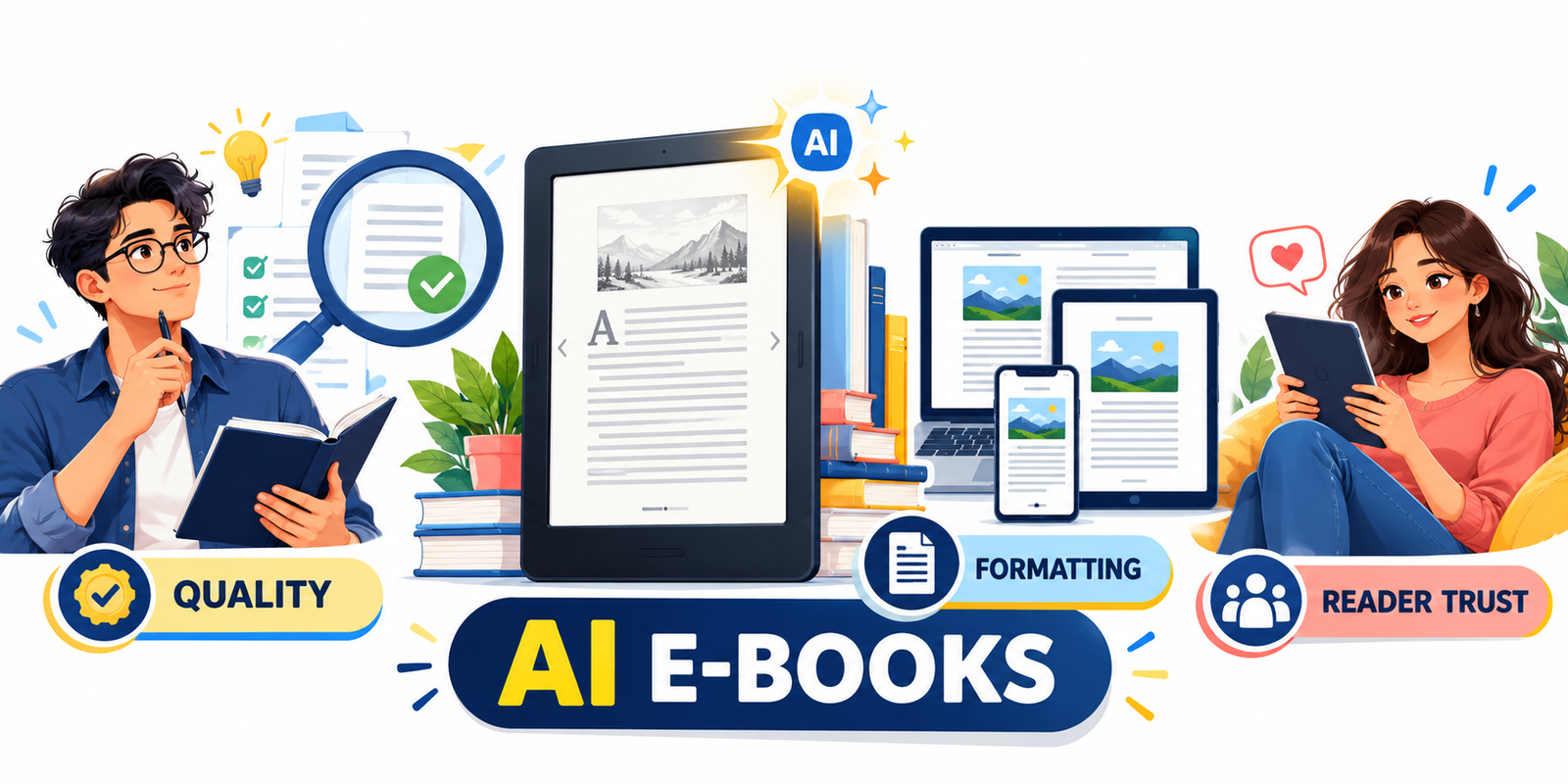
Original illustration of AI e-book quality checks, Kindle and mobile formatting, and reader trustOriginal featured illustration created for this article: AI e-book quality, cross-device formatting, and reader trust.
Imagine purchasing an e-book that promises to solve a frustrating problem. Its cover looks professional, the description is persuasive, and the chapter titles seem exactly right. But after a few pages, you encounter repetitive explanations, generic advice, inconsistent formatting, and examples that barely make sense.
Would you recommend that book to someone else?
Probably not.
Now imagine another e-book created with AI assistance. It opens with a clear promise, explains its ideas through practical examples, provides useful resources, and looks excellent on both smartphones and e-readers. Every chapter moves the reader closer to a meaningful result.
The difference is not necessarily whether artificial intelligence contributed to the writing. The difference is the quality of the finished product and the responsibility of the person publishing it.
AI has made producing digital books faster and more accessible. Entrepreneurs, educators, bloggers, and independent publishers can develop outlines, organize research, improve drafts, and prepare manuscripts with less repetitive work.
But faster production has not eliminated the need for good writing, sound judgment, proper formatting, or editorial accountability.
If you are considering selling AI books, this guide explains what makes an AI-generated e-book worth buying, how to prepare professional digital editions, what readers actually expect, and how to build a publishing business based on trust rather than volume.
What Are AI-Generated E-Books?
AI-generated e-books are digital publications in which artificial intelligence creates some or all of the content, such as text, illustrations, or translations.
AI-assisted books are different: the author creates the underlying work and uses AI to support tasks such as brainstorming, editing, proofreading, and organizing material.
These distinctions matter, particularly when publishing through platforms with specific disclosure requirements.
For example, Amazon Kindle Direct Publishing distinguishes AI-generated material from AI-assisted material and requires publishers to disclose AI-generated text, images, or translations during the publishing process.

Kindle Direct Publishing
AI can participate in multiple stages of book production, but those stages do not automatically create a commercially valuable book.
A useful way to understand modern AI publishing is to separate the workflow into three responsibilities.
AI supports production.
AI can suggest outlines, develop draft explanations, identify inconsistencies, and assist with repetitive editorial work.
The publisher provides judgment.
The publisher determines what readers need, verifies information, contributes expertise, and accepts responsibility for the content.
The reader decides the value.
The reader ultimately evaluates clarity, accuracy, originality, usefulness, presentation, and whether the book fulfills its promise.
This is why AI-generated e-books quality is a more useful business consideration than the number of titles someone can generate in a weekend.
Why Some AI-Generated E-Books Disappoint Readers
The most common problems are not always obvious grammatical mistakes. Modern AI systems can produce polished paragraphs that appear convincing at first glance.
The deeper weaknesses often involve structure, substance, and trust.
1. Repetitive content without meaningful progress
A poorly edited AI manuscript may repeat the same advice across several chapters.
For example, a book about productivity might repeatedly encourage readers to prioritize their tasks, avoid distractions, and build routines without introducing useful methods.
A stronger book advances the subject with each chapter.
One chapter might explain prioritization, another introduce a practical scheduling system, and a third provide a realistic implementation worksheet.
Every chapter should answer a different reader question.
2. Confident explanations without reliable evidence
AI tools can generate inaccurate facts, invented quotations, and references that do not exist.
This is particularly concerning in books involving finance, health, law, history, science, and technical instruction.
A polished sentence is not evidence of accuracy.
Responsible publishers should verify factual statements against trustworthy sources, inspect original references, and remove claims that cannot be substantiated.
3. Generic advice instead of practical solutions
Readers rarely purchase an educational e-book simply to encounter information they could find in a few basic search results.
They want a more organized, useful, or accessible solution.
Consider two books about starting a digital product business.
Book A: Explains that digital products can be profitable, lists popular marketplaces, and encourages readers to begin.
Book B: Helps readers identify one customer problem, choose an appropriate product, create a simple prototype, validate demand, calculate costs, and prepare a sales listing.
Book B provides a clearer path toward action.
4. Inconsistent voice and weak organization
AI-generated chapters can sometimes sound as though several different authors wrote them.
One chapter may be conversational, while the next becomes overly formal. Terminology can change, examples may contradict earlier explanations, and chapters can overlap.
A consistent editorial voice improves credibility and helps readers stay engaged.
5. Attractive packaging that overpromises
A professional cover cannot compensate for a misleading sales description.
If an e-book claims to offer an advanced marketing system but delivers only beginner-level explanations, disappointed buyers may request refunds or leave negative reviews.
The best marketing strategy begins with an accurate promise.
What Readers Actually Expect From an AI-Generated Book
Readers have different preferences about AI involvement. Some are comfortable with responsible AI assistance, while others specifically prefer human-authored work.
However, anyone purchasing a practical nonfiction e-book has reasonable expectations about its content.
| Reader expectation | What the publisher should deliver |
|---|---|
| Accurate information | Verified claims and dependable references |
| Useful explanations | Examples, exercises, tools, and clear instructions |
| Logical structure | Chapters that develop the subject without unnecessary repetition |
| Professional formatting | Consistent headings, readable text, and working navigation |
| Original value | Meaningful analysis, thoughtful synthesis, or distinctive practical resources |
| Honest marketing | A description that reflects the actual contents |
| Accessibility | Usable reading order, navigable structure, and image descriptions where appropriate |
An important principle emerges from these expectations: readers are buying a useful experience, not merely a word count.
A focused 40-page guide may offer more practical value than an unfocused 200-page publication.
The ideal length is the length required to fulfill the book’s promise.
How to Improve AI-Generated E-Book Quality Before Publishing
A practical seven-stage editorial process
Publishing quality improves when authors evaluate their manuscripts systematically rather than relying on a single AI-generated draft.
Stage 1: Define a specific reader and problem
Before generating the first chapter, establish who the book serves.
A book for freelance beginners should not assume the same knowledge as a guide for experienced agency owners.
Identify the reader’s starting point, primary difficulty, desired outcome, and likely questions.
For example:
Instead of creating a general book titled Digital Marketing Explained, consider A Beginner’s Guide to Creating a 30-Day Marketing Plan for a Small Online Store.
The narrower subject creates room for concrete examples and useful instruction.
Stage 2: Build an outcome-based outline
Organize chapters around a logical learning journey.
A practical e-book might progress through understanding the problem, selecting a solution, implementing it, evaluating progress, and troubleshooting.
Make sure each chapter has one primary purpose.
Before writing, ask whether removing a chapter would leave a genuine gap in the reader’s learning experience.
If the answer is no, the chapter may be unnecessary.
Stage 3: Use AI to create a working draft, not an automatic final manuscript
AI-generated text should be treated as material for evaluation.
Read each section critically. Identify broad generalizations, unsupported assertions, duplicated advice, and explanations that sound persuasive but lack substance.
Replace them with clearer instructions and verifiable information.
Stage 4: Add a distinctive contribution
Original value does not always require groundbreaking research.
It can come from a carefully developed framework, a worked example, a specialized checklist, a comparison of approaches, or a useful worksheet created for a particular audience.
For example, a guide to selling digital planners could include an original planning matrix connecting customer needs, product features, estimated production effort, and validation methods.
That matrix makes the book more useful than a collection of general recommendations.
Stage 5: Verify every significant factual claim
Maintain a fact-checking document that records important statements, their sources, the date of verification, and whether corrections are needed.
Pay special attention to platform fees, regulations, pricing, software capabilities, numerical claims, quotations, and citations.
Policies and product features can change, so a book built around current software should also include a publication or revision date.
Stage 6: Edit for human readability
A professional editing pass should improve transitions, remove unnecessary repetition, simplify confusing sentences, and maintain a consistent tone.
Read portions aloud.
If a paragraph sounds unnatural or says very little despite using many words, rewrite it.
Where possible, ask a qualified editor or someone familiar with the intended audience to review the manuscript.
Stage 7: Test the complete reader experience
Do not stop quality control after proofreading the text.
Check the cover, clickable table of contents, links, images, chapter headings, and final file on different screen sizes.
A technically valid file can still provide a frustrating reading experience.
E-Book Formatting Guide: How to Make Your Book Look Professional
Choose the right digital reading format
Formatting is one of the most overlooked aspects of AI-assisted publishing.
A document that looks attractive in Microsoft Word may behave differently when converted into an EPUB or opened on a Kindle device.
Professional e-book formatting requires an understanding of how digital reading systems display content.
Reflowable EPUB versus fixed-layout formats
Reflowable e-book
Text adapts to screen size and user font settings.
Best for novels and most nonfiction guides
Fixed-layout e-book
The page maintains a predefined visual arrangement.
Useful for comics and visually dependent publications
For most text-heavy e-books, a reflowable format is the better default. Readers can adjust the font size and display settings to suit their devices.
Amazon’s Kindle publishing guidance recommends reflowable formatting where possible and supports formats including EPUB, DOCX, and KPF for suitable e-books.
Kindle Direct Publishing
+1
A PDF can still be appropriate for printable workbooks, worksheets, or documents designed around an exact page layout. But a PDF should not automatically be treated as the ideal format for every digital book.
Build a reliable chapter structure
Use consistent title and heading styles rather than manually enlarging or bolding individual paragraphs.
A well-structured manuscript should include a title page, copyright information, introduction, logically organized chapters, conclusion, and relevant author information.
The table of contents should link to the appropriate sections.
Avoid adding page numbers manually in a reflowable e-book because pagination changes with screen size and font settings.
Keep typography simple
Readable e-books do not need excessive decorative fonts.
The priority is clarity, consistency, and flexibility.
Use a clear heading hierarchy, comfortable paragraph spacing, consistent text alignment, and formatting that allows readers to use their preferred text settings.
Amazon’s own Kindle Create guidance recommends keeping most body-text styling at its defaults rather than overriding reader preferences.
Kindle Direct Publishing
+1
Use images only when they improve understanding
Images should support the content rather than exist merely to make an e-book appear longer.
A well-designed diagram, labeled illustration, comparison chart, or instructional screenshot can explain a difficult topic faster than several paragraphs.
For every image, ask whether the reader would lose useful information if it were removed.
Use descriptive alternative text for informative images and preserve a logical reading order. These practices help readers who use assistive technologies.
W3C
+1
Test navigation and compatibility
Before publishing, inspect the converted book with an appropriate previewing tool.
Pay particular attention to blank pages, misplaced chapter breaks, broken tables, oversized images, inconsistent spacing, and links that do not work.
A professional book should feel effortless to navigate.
Which Tools Can Help Create and Format AI E-Books?
Different tools support different stages of production. Using one tool for everything is not always the most efficient approach.
| Tool | Practical role |
|---|---|
| ChatGPT | Brainstorming, outlining, drafting assistance, and editorial review |
| Google Docs | Collaborative manuscript editing and comments |
| Microsoft Word | Manuscript preparation and heading styles |
| Kindle Create | Preparing Kindle-ready book files |
| Calibre | E-book conversion and inspection |
| Sigil | Advanced EPUB structure editing |
| Canva | Cover design and supporting graphics |
The right combination depends on your book’s complexity, budget, technical experience, and publishing destination.
For first-time nonfiction authors, a straightforward process is to prepare and edit the manuscript in a word processor, format it in a specialized e-book tool, and preview the output before publication.
More advanced EPUB editors become valuable when a book requires customized styling or complex internal structure.
Selling AI Books: Can AI-Generated E-Books Become a Real Business?
Yes. AI-generated and AI-assisted books can be commercial products when publishers satisfy applicable platform requirements and deliver content that readers are willing to purchase.
But the ability to generate books cheaply does not guarantee sales or sustainable profit.
Success depends on the same fundamentals that influence other digital products: relevant demand, differentiation, discoverability, product quality, pricing, and customer satisfaction.
Start with a problem, not a broad topic
Instead of asking what subject AI can produce quickly, ask what problem a specific reader wants to solve.
Consider these examples.
| Broad topic | More focused e-book opportunity |
|---|---|
| Productivity | A Weekly Planning System for Freelancers Managing Multiple Clients |
| Digital marketing | A 30-Day Email Marketing Setup Guide for Small Online Stores |
| Personal finance | A Beginner-Friendly Household Budget Workbook |
| Content creation | A Practical Content Repurposing Guide for Solo Creators |
| Career development | A Job Application Tracking and Interview Preparation Toolkit |
These are potential product concepts, not verified sales opportunities. Each needs audience research and demand validation.
Focused subjects make it easier to communicate the book’s benefits and create content that addresses readers’ precise needs.
Give customers a reason to choose your book
Many broad e-book topics are already well covered by established authors, free online resources, and competing products.
Your advantage should not be that AI allowed you to create another generic book.
A stronger reason to purchase might be a specialized framework, more accessible explanations, industry-specific examples, or useful downloadable resources.
Consider a book titled How to Start an Online Business.
It faces broad competition.
A more differentiated product might be A Seven-Day Setup Guide for Freelance Designers Selling Their First Digital Template.
Its audience, promise, and deliverables are much clearer.
Build a product around the e-book
An e-book can be the foundation of a broader educational product rather than the entire offer.
For example, a digital marketing guide might include a campaign planner, a content calendar, a measurement worksheet, and a collection of example messages.
These supporting resources can increase practical value if they are genuinely useful and properly tested.
Offer materials that complement the content rather than unrelated bonuses designed merely to increase the advertised quantity.
How Much Should You Charge for an AI-Assisted E-Book?
Pricing should reflect the value of the content, audience expectations, production costs, competitive alternatives, and the commercial terms of the marketplace.
The following are illustrative price-testing bands for independent digital products, not market averages or guaranteed profitable prices.
| E-book product type | Illustrative test price |
|---|---|
| Focused beginner guide | $4.99–$9.99 |
| Specialized practical handbook | $9.99–$19.99 |
| E-book with original templates or worksheets | $14.99–$29.99 |
| Comprehensive professional toolkit | $29.99–$49.99 |
Platform-specific pricing and royalty requirements may restrict the available options.
A higher price is not automatically justified by a longer manuscript or a large collection of AI-generated bonuses.
It must be supported by a clear benefit and an appropriately matched audience.
Before setting a final price, examine comparable products and test whether potential buyers understand the book’s specific value.
How to Write an E-Book Sales Page That Converts Without Misleading Readers
Sell the outcome, not the production method
A successful product description explains what the reader will gain and why the book is relevant.
Its job is not to make exaggerated promises.
Imagine selling a beginner’s e-book about launching a digital product.
A weak description might say:
Unlock unlimited income with this revolutionary AI-powered system and achieve incredible results instantly.
This promise is vague and difficult to substantiate.
A stronger description might say:
Learn how to identify a customer problem, create a simple digital product, prepare a sales listing, and build a practical launch checklist. This beginner-friendly guide includes examples and worksheets to help you organize your first project.
The second description communicates concrete benefits without promising unrealistic results.
A useful sales-page structure
A reader-focused e-book sales page should explain the problem, identify the intended audience, describe the solution, show the main learning outcomes, and clarify what the customer receives.
A sample chapter or preview can help buyers judge whether the writing style and depth suit their needs.
Use authentic testimonials only when you have them. Never fabricate customer feedback or imply that hypothetical outcomes are verified results.
If the book is part of a larger product library, relevant links to related guides or complementary resources can make additional learning easier.
The strongest call to action is one that accurately matches the product.
For example, “Explore the sample chapter and see what you will learn” can be more credible than a time-limited sales claim that has no genuine basis.
Turning First-Time Readers Into Returning Customers
Selling one e-book is useful. Building a reputation for consistently helpful publishing is a stronger long-term objective.
Returning readers are more likely to explore a new publication when their previous experience was worthwhile.
Trust develops through repeated delivery.
Create a recognizable publishing identity
Use consistent editorial standards, subject expertise, visual design, and product descriptions across your catalog.
Customers should understand the kinds of problems your books help solve.
A publisher specializing in beginner-friendly productivity systems can build a clearer identity than one releasing unrelated generic books without a defined audience.
Connect related books through genuine learning paths
An e-book about content planning might naturally lead to a guide about email newsletters, which could lead to a resource about measuring campaign results.
These connections are helpful when each product addresses a distinct need.
Avoid repeating the same material across multiple books simply to expand your catalog.
Offer a useful free resource
A companion worksheet, planning template, or sample chapter can introduce readers to your approach.
If you invite readers to subscribe to an email newsletter, explain what they will receive and obtain appropriate consent.
A newsletter might provide periodic tutorials, revised worksheets, thoughtful publishing updates, or new learning resources.
The goal is to remain useful between purchases, not to overwhelm subscribers with promotional messages.
Improve books after publication
Reader feedback can reveal unclear instructions, missing examples, and outdated information.
Review this feedback carefully, correct problems, and update editions when material changes are necessary.
A maintained e-book can become a more trustworthy long-term product than a title that is published once and never reviewed again.
A Practical 30-Day Plan for Publishing Your First Quality AI-Assisted E-Book
This schedule is an example for a focused, relatively short nonfiction guide. Complex, research-heavy, or highly illustrated books may require substantially more time.
Days 1–5
Research and positioning
Define your reader, validate the problem, study competing resources, and write a clear promise.
Days 6–12
Outline and manuscript development
Build the chapter structure, draft with appropriate AI assistance, and add substantive original examples.
Days 13–20
Verification and editing
Check evidence, repair weak explanations, review intellectual property, and edit for clarity and consistency.
Days 21–25
Formatting and testing
Prepare the cover and e-book files, verify navigation, review accessibility, and preview across devices.
Days 26–30
Listing and launch
Prepare honest product information, review the marketplace rules, publish, and gather legitimate feedback.
This workflow prioritizes publishing one useful, properly tested book rather than rushing to release many unfinished products.
How to Evaluate Your E-Book Before Publishing
Use the following quality assessment to identify weaknesses in a finished manuscript.
E-Book Quality Checklist
Interactive pre-publication assessment
0/10
checks completeEvery chapter contributes distinct valueImportant factual claims have been verifiedThe book includes useful examples or practical resourcesThe writing is clear and consistentHeadings, links, and navigation work correctlyImages are relevant and properly licensed or authorizedThe layout has been checked on different screen sizesThe cover and description accurately represent the contentsAI disclosures and publishing requirements have been reviewedThe final manuscript has received a complete editorial review
Work through the remaining checks to strengthen the reader experience.
Reset Copy checklist
A completed checklist is a useful internal control, not a formal certification of the book’s quality. Independent editorial feedback remains valuable.
Common Questions About AI-Generated E-Books
1. Can you legally sell AI-generated e-books?
In many jurisdictions, selling AI-generated content is not automatically prohibited. However, you must have the necessary rights to the material, comply with applicable laws and marketplace policies, avoid infringing third-party intellectual property, and make required disclosures.
Copyright protection for AI-generated material can vary by jurisdiction and the degree of human authorship involved. Selling permission and copyright ownership are not the same thing.
2. Does Amazon KDP allow AI-generated books?
Yes, Amazon KDP permits AI-generated content subject to its publishing and content requirements. Publishers must disclose AI-generated text, images, or translations as defined by KDP, while qualifying AI-assisted material does not require the same disclosure. Publishers remain responsible for compliance.
Kindle Direct Publishing
3. What is the best format for selling an e-book?
For most text-based nonfiction books and novels, reflowable EPUB or a suitable Kindle publishing format is generally preferable because it supports adaptable text and device compatibility.
PDF is useful for printables and visually structured materials. The right choice depends on the content and marketplace requirements.
4. Can AI-generated e-books make passive income?
They can generate continuing sales after publication, but this income is neither guaranteed nor completely passive.
Research, writing, editing, marketing, customer support, content updates, and platform management still require effort.
A strong book with sustained reader demand may continue selling, but realistic business planning should account for ongoing expenses and uncertain revenue.
5. How can readers tell whether an AI-generated e-book is high quality?
Readers can examine the sample pages, chapter structure, author or publisher information, cited sources, practical examples, formatting, and credible customer feedback.
Look for clear explanations and genuine utility rather than impressive-sounding promises.
AI involvement alone does not establish whether a book is good or bad, and automated AI-detection tools are not reliable proof of authorship.
Compliance Note: Responsible AI Publishing, Copyright, and Reader Protection
Publishing compliance matters
AI-assisted and AI-generated publishing should follow the laws, licensing requirements, platform policies, and consumer-protection rules that apply to the specific book, seller, and market.
- AI disclosure: Follow each platform’s current requirements. Amazon KDP requires disclosure of AI-generated content, including qualifying text, images, and translations, but distinguishes it from AI-assisted content.
- Copyright and licensing: Confirm that you have permission to use text, artwork, photographs, fonts, and other incorporated material. Do not assume AI-generated or free-to-download material is automatically copyright-free or suitable for commercial distribution.
- Plagiarism and originality: Conduct appropriate originality checks and source reviews. An automated similarity score cannot guarantee the absence of copyright infringement.
- Accuracy: Verify significant factual claims, citations, statistics, and technical instructions before publication.
- Consumer protection: Avoid fabricated testimonials, false earnings claims, misleading descriptions, and unsupported claims about results.
- Privacy: Do not upload confidential client information, private records, or sensitive personal data to AI services without appropriate authorization and safeguards.
- Specialized advice: Books covering medical, financial, or legal matters should be reviewed with appropriate subject-matter expertise and should not present general education as individualized professional advice.
- Transparency: Provide accurate author, publisher, edition, and product information. Make any legally required disclosures and avoid misleading representations of authorship or expertise.
The requirements above are general guidance, not legal advice. Publishers should verify the rules applicable to their country, sales platform, and subject matter before release.
For further reference, consult the Amazon KDP Content Guidelines, the W3C EPUB Accessibility Standard, and Google’s guidance on generative AI content. Google specifically cautions that generating large amounts of content without adding value may violate its scaled-content-abuse policy.
Kindle Direct Publishing
+2
The Future of AI-Generated E-Books Belongs to Publishers Who Respect Readers
Artificial intelligence can shorten the distance between an idea and a completed manuscript. That is an important capability, especially for independent creators with limited resources.
But publishing has never been only about arranging words into chapters.
It is about helping someone understand a subject, solve a problem, experience a story, or accomplish something meaningful.
The most sustainable use of AI in e-book publishing is not to eliminate human judgment. It is to give authors and publishers more time to exercise that judgment where it matters.
Better research, stronger explanations, careful editing, accessible formatting, and honest sales descriptions are not optional details. They are central parts of a valuable digital product.
Whether you are preparing your first e-book or developing a larger digital publishing catalog, focus on creating a book that earns its place in the reader’s library.
A reader who receives genuine value has a reason to finish the book, recommend it, and explore what you publish next.
That is a stronger foundation for an e-book business than automated production alone.
Your next step: Choose one focused e-book idea, outline the result it promises, and use the quality checklist above before investing in a wider launch. Build the first book around a reader’s real need, then let feedback guide the next publication.
Stay ahead with exclusive updates
Join our community. Get curated industry trends, actionable guides, and fresh resources delivered straight to your inbox.