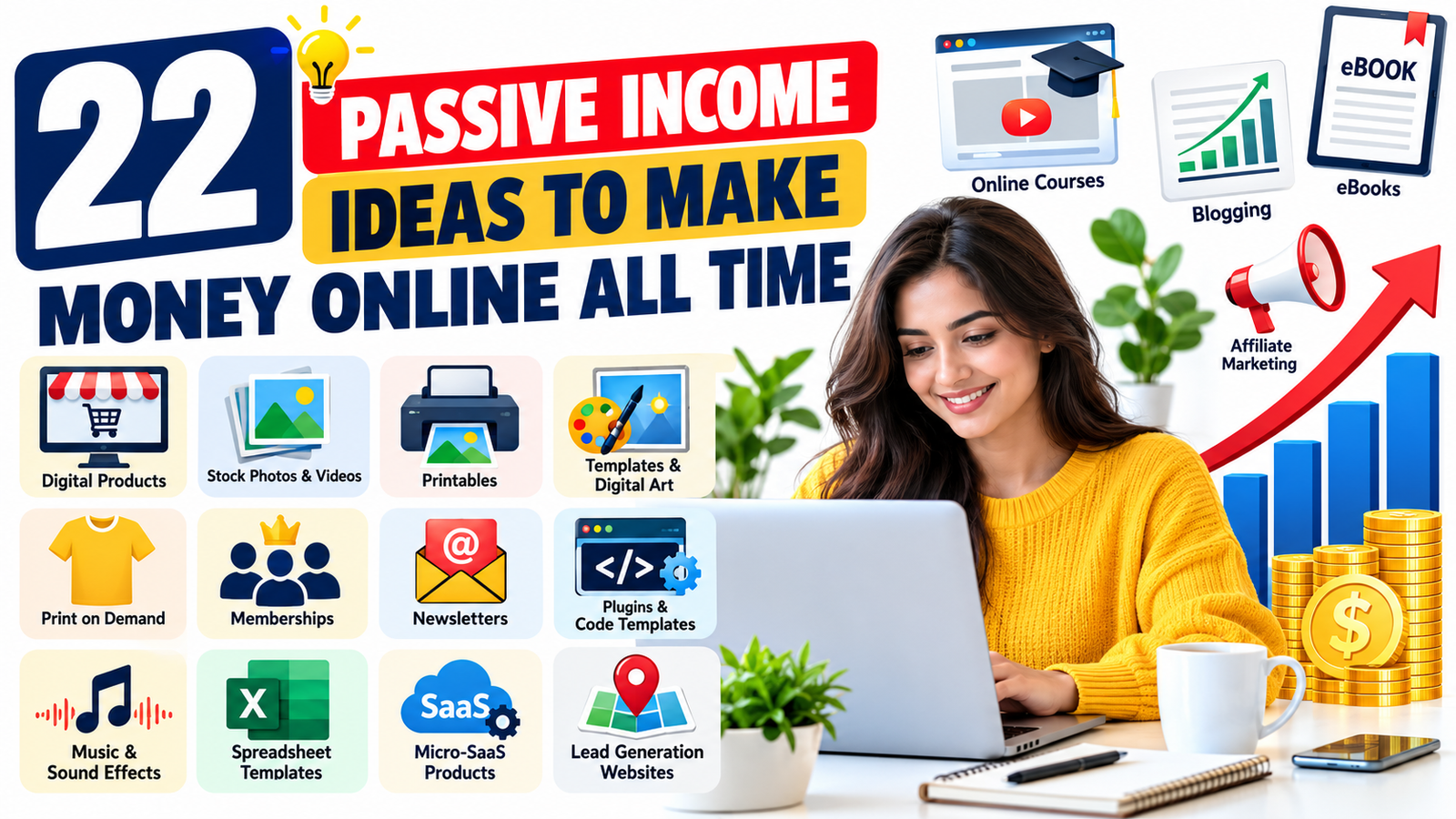
Making money while you sleep sounds like the perfect online-business promise. But genuine passive income usually works a little differently.
You normally have to invest something first: your time, knowledge, creativity, money, audience, or technology. The goal is to build an asset or system once and allow it to continue generating income with less day-to-day involvement.
That might mean publishing an eBook that sells for years, creating a digital template customers can download automatically, earning commissions from an evergreen affiliate article, licensing your photography, or building a membership that renews every month.
The internet has made these opportunities more accessible than ever.
You do not necessarily need a huge following, advanced technical skills, a large starting budget, or years of business experience. What matters more is choosing an income model you understand, solving a real problem, building something people genuinely want, and improving it over time.
If you are searching for passive income ideas to make money online, this guide covers 22 realistic options that can be started by beginners, creators, freelancers, professionals, teachers, designers, marketers, and aspiring digital entrepreneurs.
What Is Passive Income Online?
Online passive income is money generated from a digital asset, investment, system, audience, intellectual property, or automated business process that can continue producing revenue without requiring you to personally complete every transaction.
Passive does not mean effortless.
Most successful passive-income streams go through three stages:
Build: You create the asset, audience, content, product, or system.
Automate: Payments, delivery, marketing, subscriptions, or customer onboarding become partially automated.
Maintain: You periodically update, promote, improve, and support the asset.
The smartest approach is therefore not to ask:
“How can I make money without doing anything?”
A better question is:
“What can I build today that could continue creating value tomorrow?”
Here are 22 possibilities.
1. Sell Digital Products
Digital products are one of the most flexible ways to build passive income online because you can create a product once and sell unlimited copies without manufacturing or shipping physical inventory.
Examples include:
- Checklists
- Worksheets
- Business forms
- Planners
- Study guides
- Swipe files
- Marketing kits
- Printable calendars
- Budget trackers
- Social-media templates
- Resume templates
- Business workbooks
For example, instead of selling a generic planner, you could create a 30-Day Content Planner for Local Restaurants.
A focused product often solves a clearer problem and can be easier to market.
Once customers pay, a digital-commerce platform can automatically deliver the file.
How to get started
Identify a repetitive problem people already search for.
Create a useful solution.
Package it professionally.
Write a clear product description explaining exactly what buyers receive.
Upload it to your website or digital-product marketplace.
Then drive traffic through SEO, Pinterest, social media, email, YouTube, or partnerships.
Income potential: Low to high depending on product quality, demand, pricing, and traffic.
Best for: Beginners, creators, teachers, marketers, designers, and small-business specialists.
2. Publish eBooks
An eBook can continue earning money long after the writing is finished.
You can publish through platforms such as Amazon Kindle Direct Publishing or sell PDF/ePub editions directly through your own website.
The most promising eBooks often address specific needs rather than extremely broad topics.
Instead of:
“Marketing Guide”
consider something more focused such as:
“Email Marketing for First-Time Etsy Sellers”
or:
“30-Day Home Organization Plan for Busy Parents.”
Evergreen topics can continue attracting readers for years when the information remains useful.
You can also update successful titles periodically and create related books that form a series.
Ways an eBook can generate additional income
An eBook can introduce readers to your:
- Online courses
- Consulting services
- Templates
- Newsletter
- Membership
- Affiliate recommendations
- Premium guides
One relatively inexpensive book can therefore become the entry point to a much larger digital business.
3. Create and Sell Online Courses
If you know how to accomplish something other people want to learn, an online course can turn that knowledge into a scalable product.
Course topics can include:
- Excel
- Graphic design
- Writing
- Photography
- Cooking
- Language learning
- Freelancing
- Digital marketing
- AI productivity
- Business management
- Craft skills
- Career preparation
You record the lessons once, organize them into modules, provide worksheets or exercises, and allow students to enroll whenever they want.
Automatic payment processing and lesson delivery reduce ongoing work.
The strongest courses usually promise a specific transformation.
For example:
Too broad: Learn Canva
More specific: Create 30 Days of Instagram Content With Canva
Specific outcomes make it easier for potential students to understand why the course exists.
4. Build an Affiliate Marketing Website
Affiliate marketing allows you to earn commissions by recommending products or services from other businesses.
You don’t manufacture anything.
You don’t normally handle fulfillment.
Instead, you publish helpful content and include tracked affiliate links.
If a visitor uses your link and completes an eligible purchase, you may receive a commission under the affiliate program’s terms.
Popular affiliate content formats include:
- Product comparisons
- Tutorials
- Buying guides
- Reviews
- Resource pages
- Alternatives articles
- Beginner guides
- Troubleshooting articles
For example, a photography website could publish:
“Best Beginner Camera Accessories for Travel Photography.”
The article could recommend relevant equipment using affiliate links.
The long-term advantage comes from evergreen search traffic. A useful article can potentially attract visitors for months or years.
Always clearly disclose affiliate relationships and avoid recommending products solely because they pay commissions.
Trust is much more valuable than a short-term sale.
5. Start a Niche Blog
A blog can become a long-term digital asset when it consistently answers questions people search for.
Possible niches include:
- Personal finance education
- Gardening
- Home organization
- Software tutorials
- Productivity
- Parenting resources
- Travel planning
- Pets
- Cooking
- Career development
- DIY projects
- Digital business
A blog can generate multiple income streams simultaneously through:
- Display advertising
- Affiliate marketing
- Sponsored content
- Digital products
- Courses
- Memberships
- Email marketing
- Consulting
The biggest mistake is writing about everything.
Focused websites often have a clearer audience.
Instead of creating a general lifestyle blog, you might build a site dedicated to:
Small-Space Gardening for Apartment Residents.
Each article can then support the same audience.
6. Earn From Display Advertising
Once your website receives consistent traffic, advertising can provide an additional passive-income layer.
Advertisements are displayed automatically, and revenue may be generated from impressions, clicks, or other advertiser-network arrangements.
The formula is straightforward:
Useful content → search or referral traffic → page views → advertising revenue.
But chasing page views without providing real value is rarely a sustainable strategy.
Create content that keeps visitors reading because it genuinely answers their questions.
Ad revenue works particularly well when combined with other monetization methods rather than being your only source of income.
7. Create a YouTube Evergreen Content Library
YouTube is not completely passive, but evergreen videos can continue receiving views long after publication.
Examples include:
- Software tutorials
- Educational lessons
- DIY instructions
- Product guides
- Home-maintenance tutorials
- Language lessons
- Career advice
- Cooking demonstrations
- Drawing tutorials
- Business training
A video titled:
“How to Create a Monthly Budget Spreadsheet”
may continue attracting viewers much longer than a video discussing a temporary news event.
Possible revenue sources include:
- YouTube advertising
- Affiliate links
- Sponsorships
- Digital products
- Courses
- Memberships
- Consulting leads
Think of each useful video as another searchable digital asset.
8. Sell Printable Products
Printable downloads remain attractive because customers can purchase a file and print it themselves.
Possible products include:
- Kids’ activity sheets
- Coloring pages
- Wedding planners
- Meal planners
- Budget worksheets
- Habit trackers
- Educational worksheets
- Checklists
- Calendars
- Home-management forms
- Party games
- Classroom resources
Niche specificity matters.
Instead of creating another generic weekly planner, you could create:
Weekly Homework Planner for Homeschool Families
or:
Wedding Vendor Payment Tracker.
A small collection can eventually become a larger printable-product catalog.
9. Sell Canva Templates
Businesses and creators constantly need visual content but not everyone wants to design from scratch.
That creates demand for customizable templates.
You could produce template packs for:
- Instagram posts
- Pinterest pins
- Presentations
- Lead magnets
- eBooks
- Workbooks
- Restaurant menus
- Media kits
- Real-estate marketing
- Coaching businesses
- Webinar promotions
Customers buy the template, customize it, and reuse it.
Your role is to create a professional starting point that saves them time.
Be clear about what software or account type customers require and what usage rights are included.
10. Sell Spreadsheet Templates
Spreadsheet products may not look glamorous, but they solve real operational problems.
That makes them commercially useful.
Possible spreadsheet products include:
- Budget trackers
- Profit-and-loss dashboards
- Inventory trackers
- Project trackers
- Content calendars
- Client-management sheets
- Sales trackers
- Expense reports
- Pricing calculators
- Cash-flow planners
Imagine a freelancer searching for a simple way to track invoices and monthly expenses.
A professionally designed freelancer financial dashboard could save them hours.
People frequently pay for convenience, structure, organization, and saved time.
11. License Stock Photography
If you enjoy photography, your existing photos can become licensable digital assets.
Businesses, publishers, bloggers, marketers, designers, and agencies regularly need visual content.
Popular themes can include:
- Remote work
- Business
- Technology
- Food
- Nature
- Travel
- Healthcare concepts
- Family life
- Education
- Office environments
- Lifestyle scenes
One photograph may potentially be licensed multiple times depending on the platform and license arrangement.
Before uploading, carefully check ownership, model-release, property-release, trademark, and platform requirements.
12. Sell Stock Video Footage
Video demand continues growing across websites, advertisements, social media, presentations, documentaries, and promotional campaigns.
Stock footage might include:
- City scenes
- Office environments
- Nature
- Technology usage
- Travel locations
- Food preparation
- Business activities
- Timelapse footage
- Drone footage where legally permitted
- Lifestyle scenes
Good stock clips are reusable.
A short video you record today could potentially be licensed repeatedly.
Clear commercial usability is often more important than cinematic complexity.
13. Sell Digital Art and Illustrations
Illustrators can transform individual pieces of work into repeatable digital products.
Possible products include:
- Printable wall art
- Clip art
- Icons
- Digital papers
- Pattern collections
- Illustrations
- SVG graphics
- Presentation graphics
- Social-media elements
- Educational illustrations
You can also sell collections or bundles.
For example:
“100 Minimal Botanical Line Illustrations”
may provide stronger buyer value than selling every image individually.
Make licensing terms extremely clear, especially when offering commercial-use rights.
14. Create a Paid Membership
Subscription businesses can provide recurring revenue instead of requiring you to find a new buyer for every transaction.
A membership might give subscribers monthly access to:
- Templates
- Research
- Lessons
- Community discussions
- Downloadable resources
- Workshops
- Industry insights
- Exclusive newsletters
- Business tools
- Design assets
For example, you might charge a monthly fee for access to:
50 New Social Media Templates Every Month.
The key is ongoing value.
Membership income may become predictable, but subscriptions require regular delivery, customer service, and retention work.
15. Publish a Paid Newsletter
A newsletter can become an income-producing media asset if readers value your information enough to subscribe.
Strong newsletter niches usually provide one of three things:
Information: useful updates.
Interpretation: explaining what those updates mean.
Opportunity: helping readers act on the information.
Potential topics include:
- AI tools
- Marketing
- Career opportunities
- Investing education
- Local business
- Technology
- Industry news
- Freelancing
- Productivity
You might offer a free weekly newsletter and a premium tier containing deeper analysis, templates, reports, or tutorials.
16. Build a Print-on-Demand Business
Print-on-demand allows creators to sell products without maintaining large inventories.
When a customer orders, a fulfillment provider prints and ships the product.
Possible items can include:
- T-shirts
- Posters
- Mugs
- Tote bags
- Phone cases
- Notebooks
- Stickers
- Wall decor
Your focus becomes design, branding, niche research, product positioning, and marketing.
Avoid copying copyrighted characters, brand names, logos, celebrity images, or other protected material.
Original design is safer and creates a stronger long-term brand.
17. License Music or Sound Effects
Musicians and audio creators can create assets that other creators license for:
- Podcasts
- Videos
- Advertising
- Games
- Apps
- Presentations
- Short films
- Social media
You might sell:
- Background music
- Intro music
- Ambient tracks
- Sound effects
- Loops
- Beats
- Meditation audio
A growing audio library increases the number of assets capable of generating income.
Licensing terms should clearly explain where and how buyers may use the files.
18. Sell Website Themes, Plugins, or Code Templates
Developers can create digital tools once and sell licenses repeatedly.
Products could include:
- Website themes
- WordPress plugins
- Website sections
- Landing-page templates
- Scripts
- Calculators
- Automation tools
- Code components
- SaaS utilities
This model can become highly scalable because software has low duplication costs.
However, it is less passive than many people assume.
Customers expect compatibility updates, bug fixes, security maintenance, documentation, and technical support.
Strong documentation reduces support workload and improves customer satisfaction.
19. Create a Micro-SaaS Product
Micro-SaaS refers to a relatively small software service built around one focused problem.
Examples might include:
- Invoice reminder software
- Appointment tools
- Content repurposing utilities
- SEO reporting dashboards
- Review monitoring systems
- Social-caption organizers
- Proposal generators
- Simple business calculators
Instead of building a giant platform, solve one repetitive problem extremely well.
Users might pay $5, $10, $20, or more each month depending on the value provided.
One hundred subscribers paying $10 per month would produce $1,000 in monthly recurring revenue before costs, refunds, taxes, payment fees, hosting, marketing, and support.
Recurring software revenue can be powerful, but reliable maintenance is essential.
20. Create Automated Lead-Generation Websites
Some websites are designed to attract people searching for specific local or professional services.
For example:
“Emergency Plumbing Services in [City]”
The website attracts relevant visitors through search visibility or paid marketing.
Qualified enquiries can then be passed to appropriate businesses under a transparent commercial arrangement.
Revenue models could include:
- Monthly website rental
- Lead fees
- Advertising
- Referral commissions where permitted
Success depends heavily on search competition, service quality, local regulations, privacy requirements, and reliable business partners.
Never misrepresent yourself as the service provider when you are not.
21. Sell PLR or Commercial-Use Digital Resources
PLR commonly refers to private-label-rights content, although licensing rules vary considerably between sellers.
You might create original resources such as:
- Workbooks
- Templates
- Checklists
- Business documents
- Prompt collections
- Marketing materials
- Educational resources
and allow buyers to use them under clearly defined commercial terms.
For example, a digital-product seller might purchase a licensed workbook and customize it for their business if the license permits modification and resale.
The major requirement here is clarity.
Tell buyers exactly what they may and may not do.
A license might permit:
- Personal use
- Commercial use
- Editing
- Rebranding
- End-product resale
while prohibiting:
- Reselling the source files
- Transferring resale rights
- Claiming exclusive ownership
- Redistributing your original bundle unchanged
Never assume buyers understand licensing terminology.
Spell it out.
22. Build an Evergreen Digital Product Ecosystem
This is less about one product and more about connecting several passive-income ideas together.
Imagine you create a website teaching small businesses how to organize their finances.
You publish SEO articles.
Those articles attract organic traffic.
Inside the articles, you recommend relevant affiliate software.
You offer a free expense tracker in exchange for email subscriptions.
Subscribers are then introduced to a premium spreadsheet bundle.
Some customers later purchase your online course.
Others join your monthly template membership.
You now have multiple interconnected revenue streams:
Blog traffic → affiliate income
Blog traffic → email subscribers
Email subscribers → digital product sales
Digital product customers → course sales
Course customers → memberships
This model can be more resilient than relying entirely on one platform or income source.
Which Passive Income Idea Is Best for Beginners?
Beginners should usually choose ideas that are inexpensive to test and relatively easy to understand.
Examples include:
- Digital downloads
- Printables
- eBooks
- Canva templates
- Spreadsheet templates
- Affiliate content
- Niche blogging
You do not need to start five businesses simultaneously.
One useful product that sells is more valuable than twenty unfinished ideas.
Start with one audience.
Solve one problem.
Create one strong offer.
Learn how customers discover it.
Improve the offer based on real feedback.
Then expand.
How Much Money Can You Make From Passive Income?
There is no universal amount.
One creator might earn a few dollars per month from a small printable store.
Another might build a large catalog that produces substantial revenue.
Results depend on variables such as:
- Market demand
- Competition
- Product quality
- Pricing
- Search visibility
- Audience size
- Conversion rate
- Customer satisfaction
- Product catalog size
- Marketing consistency
- Platform fees
- Operating expenses
Avoid anyone promising guaranteed passive income.
Treat online income as a business process rather than a lottery ticket.
How to Choose the Right Passive Income Model
Ask yourself five questions.
What do I already know?
Existing knowledge can dramatically reduce your startup time.
If you understand accounting, spreadsheets might be logical.
If you enjoy teaching, courses could work.
If you enjoy writing, blogging or publishing may suit you.
If you’re a designer, templates or digital assets may be natural options.
What problem can I solve?
People rarely buy digital products simply because they are digital.
They buy outcomes.
They want to:
Save time.
Make something easier.
Learn something.
Avoid mistakes.
Organize information.
Create faster.
Improve a result.
Find entertainment.
Solve a frustrating problem.
Build around the outcome.
Is there evidence of demand?
Before creating a large product, research whether people are already searching, discussing, buying, or asking questions about the problem.
Explore:
- Search suggestions
- Google Trends
- Online marketplaces
- Forums
- Social platforms
- Product reviews
- Competitor websites
- Customer questions
Look for recurring problems rather than temporary hype.
Can the business become automated?
Ask whether you can automate:
- Checkout
- File delivery
- Email onboarding
- Billing
- Customer FAQs
- Appointment scheduling
- Product recommendations
Automation is what gradually transforms active work into more passive income.
Can I maintain it?
A business you dislike is difficult to maintain.
Choose a model you can imagine improving for at least the next one or two years.
A Simple Passive Income Strategy for Beginners
You don’t need a complicated business plan.
Try this process.
Step 1: Choose one niche
Example:
Freelance designers.
Step 2: Identify one painful problem
Example:
Tracking clients, invoices, project deadlines, and payments.
Step 3: Create one solution
Example:
Freelance Business Management Spreadsheet.
Step 4: Publish helpful content around the problem
Possible articles:
“How to Track Freelance Income and Expenses”
“How to Organize Client Projects”
“How to Avoid Missing Freelance Payment Deadlines”
Step 5: Offer the product naturally
Readers who need a faster solution can purchase your spreadsheet.
Step 6: Create an email list
Offer a free mini-template or checklist.
Step 7: Add complementary products
Over time, you might create:
- Invoice template
- Proposal template
- Project tracker
- Client onboarding checklist
- Freelancing course
You are gradually building a digital-product ecosystem instead of depending on one sale.
How to Make Passive Income More Reliable
Passive income becomes stronger when several principles work together.
Create evergreen assets
Prioritize resources that remain useful beyond one news cycle.
A tutorial called:
“How to Create a Household Budget”
may stay relevant much longer than a temporary trend article.
Diversify traffic sources
Do not depend entirely on one algorithm.
Your audience could arrive through:
- Google Search
- YouTube
- Social media
- Direct traffic
- Partnerships
- Referral websites
Build an email audience
Platform algorithms can change.
An email list gives you a more direct way to communicate with interested readers and customers.
Focus on repeat customers
Selling repeatedly to satisfied customers can be easier than constantly finding strangers.
Create complementary products.
If someone buys your budget spreadsheet, they may also want a debt tracker or savings planner.
Improve instead of constantly restarting
Entrepreneurs often abandon products before collecting enough useful information.
When something shows potential, improve:
- Packaging
- Product preview
- Description
- Pricing
- SEO
- Instructions
- Customer support
- Bonuses
- Landing page
Small improvements can accumulate.
Common Passive Income Mistakes to Avoid
Expecting immediate results
Most passive-income assets need time to gain visibility.
Building sustainable online income may take weeks, months, or longer.
Creating products without researching buyers
A beautiful product without demand is still difficult to sell.
Research before building.
Creating generic products
Specific products are easier to position.
Compare:
“Business Planner”
with:
“90-Day Marketing Planner for Independent Fitness Coaches.”
The second immediately tells the customer who it serves.
Depending on one platform
Marketplace policies, fees, search algorithms, and account rules can change.
Whenever practical, build assets you control, especially your website, brand, and email list.
Ignoring licensing and copyright
Only sell content you own or have valid rights to use.
Understand trademarks, copyrights, commercial licenses, software licenses, and platform policies before selling.
Calling something completely passive
Even highly automated businesses occasionally require:
- Customer support
- Updates
- Tax administration
- Marketing
- Security checks
- Platform maintenance
- Product improvements
More accurate language is low-maintenance scalable income.
SEO Strategy for a Passive Income Website
If your goal is to generate passive income through organic traffic, build content around useful search intent.
For example, a website covering digital products could create interconnected articles such as:
- How to Make Passive Income Online
- Best Digital Products to Sell
- How to Create a Digital Download
- How to Price Digital Products
- How to Sell Templates Online
- How to Sell Printables
- How Affiliate Marketing Works
- How to Build an Email List
- How to Start a Niche Blog
Link related content together naturally.
Instead of repeatedly inserting the phrase “passive income ideas,” use related language such as:
- Online income streams
- Recurring revenue
- Automated income
- Digital-product business
- Make money online
- Beginner online business
- Evergreen income
- Scalable digital products
- Work-from-home income ideas
- Online business models
This helps readers and search engines understand the topic without making the article sound artificial.
How to Improve Your Chances of Appearing in Google Discover
Discover visibility cannot be guaranteed.
The better strategy is to create content people genuinely want to read, save, share, or return to.
Use a strong but accurate headline.
Avoid misleading clickbait.
Use an original, relevant, high-quality featured image.
Make your page fast and comfortable to read on mobile devices.
Demonstrate real experience when possible through examples, screenshots, testing, comparisons, or first-hand observations.
Keep articles updated when the subject changes.
Clearly identify the author and publisher.
Use descriptive titles that match the article’s content.
Most importantly, make the article more useful than a shallow list copied from competing pages.
For this topic, a strong featured-image concept could use the headline:
22 Passive Income Ideas for Building Online Revenue
Pair it with simple visuals representing digital products, a laptop, recurring payments, an eBook, a chart, an online course, and automated sales.
Turn One Passive Income Idea Into Your First Digital Asset
You do not need to master all 22 ideas.
Choose one.
If you enjoy writing, publish an eBook.
If you like designing, build a template collection.
If you enjoy teaching, create a focused course.
If you enjoy research and content, build a niche website.
If you understand spreadsheets, create a useful business calculator or tracker.
Your first goal should not be “make millions.”
Your first goal can simply be:
Create something useful enough that one stranger willingly pays for it.
That first sale teaches you more than weeks of imagining possibilities.
Then improve the product.
Create another.
Build your audience.
Automate delivery.
Collect feedback.
Create complementary offers.
Over time, a small digital asset can become a portfolio of products capable of generating income throughout the day—even when you are not actively making each individual sale.
The opportunity is not simply to make money online.
It is to build useful digital assets that can continue working after the initial work is finished.
Frequently Asked Questions
1. What is the easiest passive income idea for beginners?
Digital downloads, printable products, simple templates, and short practical eBooks can be relatively accessible because they usually require limited startup capital and can be delivered automatically. The best option still depends on your knowledge, interests, audience, and ability to solve a specific problem.
2. Can I make passive income online without investing money?
Yes, some models can be started with very little money if you already have a computer, internet connection, and suitable free tools. Blogging, affiliate content, simple digital products, newsletters, and educational content can sometimes be started inexpensively. However, you will usually invest significant time before meaningful revenue appears.
3. How long does it take to build passive income?
There is no standard timeline. Some creators make an early sale quickly, while others need months to build traffic, products, credibility, and an audience. Search-driven businesses can take time to mature, so evaluate progress over months rather than days.
4. Can passive income replace a full-time job?
It can for some people, but there is no guarantee. A safer approach is to build and validate an income stream before depending on it for essential expenses. Monitor revenue, expenses, taxes, customer demand, and income stability before making major financial decisions.
5. What is the best way to start making passive income online today?
Choose one audience and identify one problem that audience repeatedly experiences. Create the smallest useful digital solution you can reasonably finish, publish it, explain its benefits clearly, and begin attracting relevant visitors through helpful content. Once you receive real customer feedback, improve the product before expanding into additional income streams.
Start Building Your First Income-Producing Asset
The internet offers dozens of ways to earn money, but constantly switching between opportunities can prevent you from building any of them deeply enough to succeed.
Pick one of these 22 passive income ideas.
Spend time understanding the buyer.
Create something genuinely useful.
Publish it professionally.
Promote it consistently.
Automate what makes sense.
Then give the asset enough time to prove whether the market wants it.
A single eBook may become a publishing catalog.
One template may become a digital store.
One tutorial may become a searchable YouTube library.
One article may become a niche website.
One small subscription tool may become recurring monthly revenue.
Passive income is rarely created by doing nothing.
It is usually created by doing valuable work once, building systems around it, and allowing that value to serve more people without requiring you to start from zero every day.
Choose your first idea today, create the smallest useful version, and turn your knowledge, creativity, or experience into a digital asset that has the potential to keep working long after you publish it.
Stay ahead with exclusive updates
Join our community. Get curated industry trends, actionable guides, and fresh resources delivered straight to your inbox.