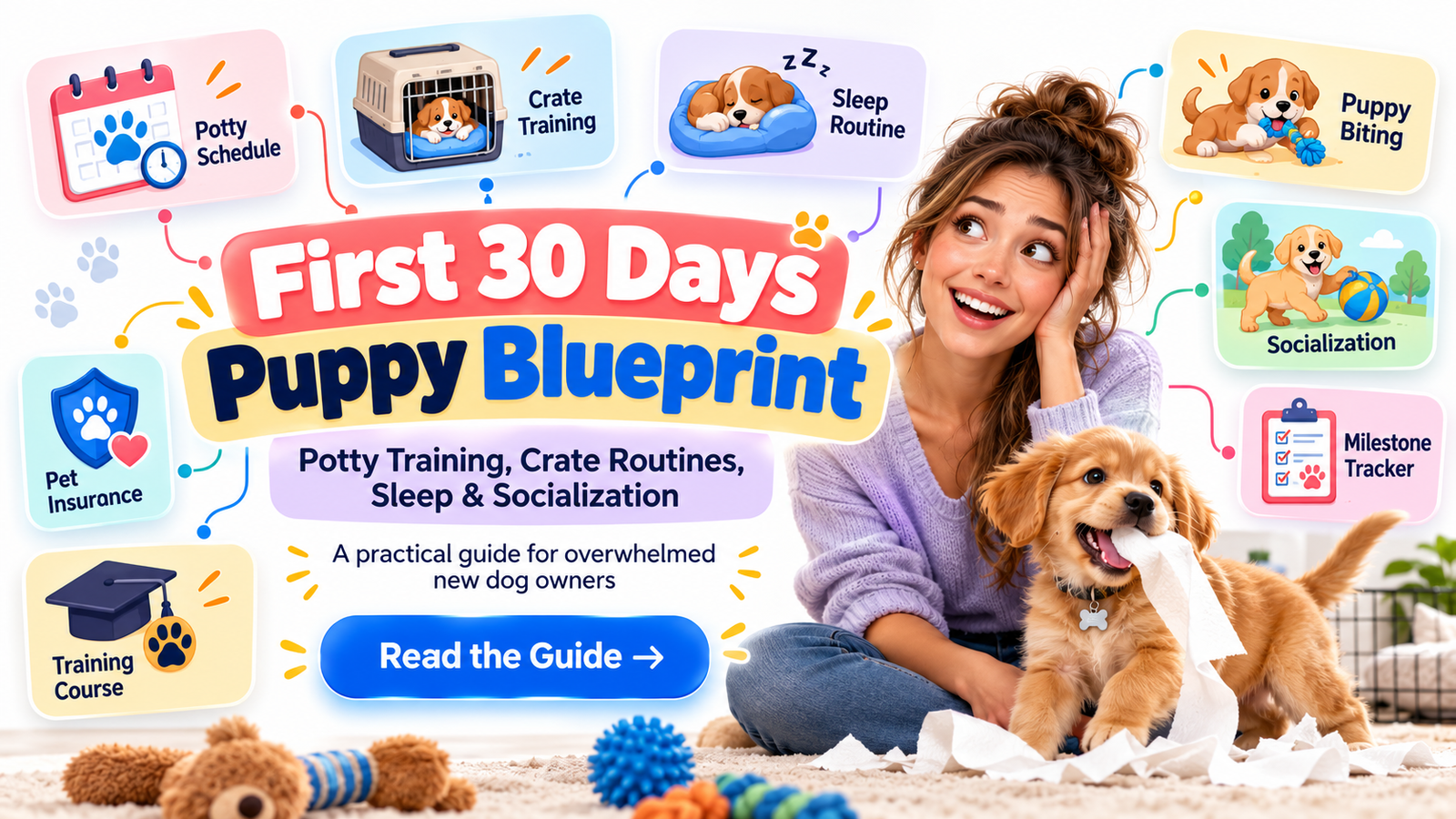
The First 30 Days Puppy Blueprint for Potty Training, Biting, Sleep and Sanity
You pictured sleepy puppy cuddles, tiny paws, happy walks, and a new best friend.
Instead, it is 3:17 a.m.
Your puppy is awake.
There was another accident on the floor. Your hands are covered in tiny scratches from puppy teeth. You cannot remember the last time you slept properly, and every article you read seems to give slightly different advice about crate training, potty breaks, feeding, socialization, biting, naps, and exercise.
Then the thought appears:
“Did I make a mistake getting a puppy?”
For thousands of new dog owners, this emotional crash is surprisingly familiar. It is often described as the “puppy blues”—the stress, exhaustion, regret, anxiety, and loss of normal routine that can arrive after bringing home a puppy.
Recent 2026 discussions in r/puppy101 show owners describing exactly these struggles: sleep deprivation, crate barking, biting, toilet-training difficulties, constant supervision, and feeling overwhelmed even after months of preparation.
That does not mean every puppy owner experiences puppy blues. It does reveal something important, however:
Most overwhelmed new dog owners do not need another 40 random puppy-training tips. They need a simple system telling them what to do next.
That is where a structured First 30 Days Puppy Blueprint becomes valuable.
Whether you are raising your first puppy or creating helpful digital products for new pet parents, the opportunity is the same: turn confusing information into an easy daily routine.
Why the First Month With a Puppy Can Feel So Difficult
A puppy changes almost every part of your normal day.
Your sleep changes.
Your morning routine changes.
Your work schedule changes.
Your social life changes.
Even walking across your living room may require checking whether a small animal is about to chew a cable, steal a sock, bite your ankle, or squat on the carpet.
This is why researching “how to train a puppy” can sometimes make overwhelmed owners feel worse instead of better.
There is simply too much information.
One trainer recommends one schedule. Another recommends something different. Social media shows perfectly behaved puppies. Friends tell you what worked for their dogs. Search results introduce another dozen techniques.
Meanwhile, your puppy needs to go outside again.
A better approach is to stop trying to solve your puppy’s entire future during the first week.
Focus on four foundations:
potty routine, sleep and crate comfort, appropriate chewing and biting management, and positive socialization.
These are the areas around which most of the first month can be organized.
Your Puppy Does Not Need a Perfect Owner. Your Puppy Needs Predictability
One of the biggest mistakes new owners make is trying to train everything simultaneously.
Sit.
Stay.
Come.
Heel.
Leave it.
Drop it.
Crate.
Potty.
No biting.
No jumping.
No barking.
Sleep through the night.
Walk perfectly.
It quickly becomes exhausting.
During the first 30 days, routine is often more valuable than complexity.
The American Kennel Club recommends establishing a predictable schedule around feeding, potty breaks, play, training, and sleep. Young puppies often need bathroom opportunities after changes in activity, while frequent short play and training sessions are generally more appropriate than trying to exhaust a puppy with one long session.
Think of your puppy’s day as a repeating rhythm:
Wake → Potty → Food or Activity → Potty → Short Play/Training → Calm Time → Nap → Repeat
Once that rhythm becomes familiar, both puppy and human gain something valuable: predictability.
The First 30 Days Puppy Blueprint
Instead of measuring success by whether your puppy behaves perfectly, divide the first month into four manageable stages.
Days 1–7: Stabilize the Household
Your goal during the first week is not advanced obedience.
It is orientation.
Your puppy is learning where they sleep, where they eat, where they eliminate, which objects they may chew, who lives in the house, and whether this strange new environment is safe.
Keep life relatively simple.
Take the puppy to the chosen potty location consistently. Introduce the crate positively instead of forcing long periods immediately. Establish regular meals. Create scheduled opportunities for naps. Puppy-proof the rooms your puppy uses instead of repeatedly correcting them for accessing tempting objects.
Most importantly, begin observing patterns.
Record when your puppy eats.
Record when they drink heavily.
Record potty successes and accidents.
Record naps.
Record periods of intense biting.
Within several days, what initially looked completely random may start forming patterns.
That information is more useful than blindly following someone else’s schedule.
Days 8–14: Build Predictable Habits
The second week is about consistency.
Continue taking your puppy outside immediately after waking, after meals, after active play, after naps, and before bedtime.
The AKC emphasizes that successful puppy potty training depends heavily on consistency, supervision, predictable opportunities to eliminate, and positive reinforcement rather than punishment.
When your puppy toilets in the correct place, reward immediately.
When an accident happens indoors, clean it thoroughly and ask a more productive question:
“What signal or timing did I miss?”
That mindset is much more useful than assuming your puppy is being stubborn.
Young puppies simply have limited bladder control.
Frequent or sudden accidents, particularly when accompanied by diarrhea, lethargy, discomfort, unusual thirst, or other concerning symptoms, deserve veterinary advice rather than more aggressive training.
Days 15–21: Develop Independence and Calmness
By the third week, many owners become focused on obedience commands.
There is another skill that deserves equal attention:
being calm without constant entertainment.
A puppy who expects interaction every waking second can make normal life extremely difficult.
Start building gentle independence.
Provide safe chew activities.
Reward calm behavior.
Use a puppy-safe area, pen, or appropriately introduced crate.
Practice very short separations before expecting long ones.
Create a predictable nap environment.
Avoid turning every waking period into intense stimulation.
Young puppies require substantial sleep. AKC guidance notes that some puppies may sleep around 16–18 hours per day, and inadequate rest can contribute to cranky or mouthy behavior.
Sometimes the puppy that appears to need more entertainment actually needs less stimulation and more rest.
Days 22–30: Expand the Puppy’s World Carefully
The fourth week is an excellent time to continue building positive exposure to everyday life.
Socialization does not mean allowing your puppy to greet every person and dog.
It means helping the puppy develop positive or neutral associations with the world.
That might include different surfaces, household sounds, grooming tools, people wearing hats, traffic heard from a safe distance, car rides, handling of paws and ears, calm dogs where appropriate, umbrellas, elevators, bicycles, vacuum cleaners, visitors, and new environments.
The American Veterinary Society of Animal Behavior describes the first three months of a puppy’s life as an especially important socialization period and supports safe socialization before puppies are fully vaccinated. The exact exposure plan should still account for vaccination status and local disease risks, so owners should discuss appropriate precautions with their veterinarian.
Socialization should not become a 30-day race to expose a puppy to everything imaginable.
The objective is positive exposure, not maximum exposure.
The Potty-Training Schedule That Makes Life Easier
One of the highest-intent searches from new puppy owners is some variation of:
“How often should I take my puppy outside to pee?”
The safest answer is not to rely exclusively on a clock.
Use both time and events.
A puppy commonly needs an opportunity to eliminate immediately after waking, shortly after eating or drinking, after active play, after a nap, after leaving the crate, before being left alone, after returning home, and immediately before bedtime.
Very young puppies may need many trips per day.
This is normal.
What matters most during early puppy potty training is preventing as many mistakes as reasonably possible while making successful outdoor elimination highly rewarding.
Consider keeping a simple potty log containing time, food, water, pee, poop, accident, nap, and notes.
After several days, you may discover something like:
“Accidents usually happen 10 minutes after breakfast.”
That is actionable.
Instead of thinking, “My puppy cannot be potty trained,” you now know:
Breakfast → outside → supervise → second potty opportunity if necessary.
This is exactly why a printable puppy potty training schedule or digital tracker can be so useful. It turns vague frustration into visible information.
Why Your Puppy Keeps Biting You
Few things surprise first-time owners more than puppy teeth.
The puppy can look adorable one moment and transform into a tiny land shark the next.
Mouthing is normal puppy behavior, but owners still need to teach appropriate interaction.
Rather than relying on intimidation or physical corrections, look for the cause.
Is the puppy overtired?
Overstimulated?
Teething?
Trying to initiate play?
Frustrated?
In need of a potty break?
Does the puppy need an appropriate chew?
Has play become too exciting?
An overtired puppy may become especially mouthy. AKC training guidance recommends building rest into the puppy’s routine and redirecting mouthing toward appropriate behaviors and outlets.
AVSAB currently recommends reward-based training methods for dog training and behavior work.
This means your puppy-biting strategy should focus less on “winning” against the puppy and more on managing the environment, preventing rehearsal of unwanted behavior, reinforcing desirable alternatives, and identifying what triggers the biting.
If biting appears unusually intense, unpredictable, fearful, painful, or concerning, contact a qualified veterinarian or credentialed behavior professional rather than diagnosing the problem through social media.
Crate Training Should Create Safety, Not Fear
Search for “puppy crate training” and you will find passionate opinions in every direction.
A crate is simply a management and training tool.
Used thoughtfully, it can support sleeping, transportation, house training, veterinary stays, and safe separation.
Used badly, it can create distress.
The goal should therefore be:
“My puppy feels comfortable entering and resting in this space.”
Not:
“How long can I make my puppy stay inside?”
Choose an appropriately sized crate, introduce it gradually, pair it with positive experiences, and avoid deliberately turning it into a punishment location. AKC guidance similarly recommends creating positive associations with the crate.
Your puppy’s crate-training tracker could measure small milestones:
Entering voluntarily.
Eating near or inside the crate.
Remaining relaxed for 30 seconds.
Settling with a chew.
Taking a supervised nap.
Remaining calm while you move briefly around the room.
Tolerating a short absence.
Sleeping for progressively longer periods when developmentally appropriate.
Suddenly the goal is no longer “crate trained or not crate trained.”
Progress becomes visible.
That matters enormously to exhausted owners who otherwise feel as though nothing is improving.
The Puppy Sleep Problem Nobody Warns You About
One recent r/puppy101 post described getting only three or four hours of sleep while trying to manage toilet training, crate training, and puppy biting. Another highly supported 2026 discussion reassured struggling owners that the sleepless early phase eventually passed.
This explains why “when will my puppy sleep through the night?” generates so much interest.
There is no universal age.
Puppies mature differently.
Instead of chasing a guaranteed date, create a repeatable nighttime routine.
Keep the final part of the evening relatively predictable. Offer an appropriate final potty opportunity. Make the sleeping environment calm. If a young puppy genuinely needs an overnight potty break, keep that trip quiet and boring rather than turning 2 a.m. into playtime.
Most importantly, distinguish between a developmental limitation and a training failure.
Your 9-week-old puppy waking at night does not automatically mean you have trained them incorrectly.
Build a Puppy Socialization Checklist Instead of Guessing
“Socialize your puppy” sounds simple until you try to do it.
A checklist makes it concrete.
Create categories such as people, sounds, surfaces, household situations, handling, transportation, environments, animals, grooming experiences, and everyday objects.
Then track the puppy’s response.
The goal is not merely to check a box.
Record:
Comfortable. Curious. Unsure. Fearful. Try again more gently.
A puppy that watches a bicycle calmly from 30 feet away may be having a far more useful socialization experience than one forced beside a bicycle while frightened.
The ASPCA similarly recommends letting dogs progress at their own pace and avoiding forcing clearly fearful dogs into interactions.
This type of practical checklist is one reason a First 30 Days Puppy Blueprint can provide more value than a standard puppy-training ebook.
It tells owners what to observe.
What Should Be Inside a First 30 Days Puppy Blueprint?
A truly useful puppy planner should solve decisions, not simply contain attractive pages.
The strongest version combines a 30-day puppy routine calendar with an age-adjustable potty tracker, feeding and water log, crate-training milestone tracker, sleep and nap record, puppy biting trigger log, socialization checklist, vaccination and veterinarian notes page, basic training progress sheet, weekly wins page, supplies checklist, questions-for-the-vet page, and an emergency-information sheet.
The important word is adjustable.
A rigid schedule saying every puppy must eat, sleep, train, and eliminate at exactly the same times will quickly become frustrating.
A better blueprint provides structure while allowing the owner to personalize it.
That is what makes the product useful rather than merely printable.
A Simple Example of a Puppy Daily Routine
Imagine a young puppy waking in the morning.
The first destination is the potty area, not your phone and not breakfast.
After successful elimination comes breakfast.
Soon afterward comes another potty opportunity.
Then you might have a brief period of interaction, gentle training, exploration, or play.
Before the puppy becomes wildly overstimulated, another potty opportunity is followed by quiet time or a nap.
When the puppy wakes, the pattern begins again.
As evening approaches, activity gradually becomes calmer, with another toilet break immediately before bedtime.
Your exact times will vary according to the puppy’s age, breed, health, household, feeding routine, vaccination status, and individual development.
The value comes from the sequence, not from copying another household’s clock.
The Real Product Opportunity: Sell Relief, Not Another PDF
Now look at this problem from the creator or digital-product seller’s perspective.
A puppy-training planner has strong commercial intent because the buyer’s problem is happening right now.
Someone searching for a generic dog quote may simply be browsing.
Someone searching:
“10-week-old puppy peeing inside every hour”
“new puppy will not sleep at night”
“puppy biting hands constantly”
“puppy crate training schedule”
“first week puppy routine”
or
“puppy blues help”
has an immediate problem.
That is powerful search intent.
Your product should therefore be positioned around the outcome:
Less guessing. More routine. A calmer first month with your puppy.
Not around file specifications such as:
“64-page printable PDF.”
People do not really want 64 pages.
They want tonight to be easier than last night.
Create a Small Free Tool Before Asking for the Sale
One effective conversion path is to offer a free One-Day Puppy Routine Sheet.
The visitor enters their email and receives a printable page containing potty tracking, naps, feeding, training, and notes.
The thank-you page then introduces the complete First 30 Days Puppy Blueprint.
This creates a natural progression:
Search problem → useful article → free quick win → complete paid system.
Instead of demanding a purchase from a first-time visitor, you demonstrate value first.
That also creates a reason for visitors to return.
Send a short follow-up after a few days:
“What changed after tracking your puppy for three days?”
Then send useful education around biting, sleep, crate progress, socialization, and common setbacks.
Your website stops being a page somebody visits once.
It becomes part of their puppy’s first month.
The Affiliate Layer: Monetize Without Destroying Trust
New puppy owners naturally purchase products.
That creates opportunities for relevant affiliate recommendations, but recommendations should appear because they solve a problem—not because they pay a commission.
A First 30 Days Puppy Blueprint could naturally connect owners with an appropriately sized crate, crate divider, washable bedding where suitable, baby gate or puppy pen, harness and leash, food-dispensing enrichment toys, appropriate chew products, enzymatic accident cleaner, treat pouch, grooming supplies, online reward-based puppy-training courses, and pet-insurance comparison options.
Pet insurance is particularly aligned with the “new puppy” stage because owners may already be considering veterinary costs and future protection.
But avoid declaring that one insurer is universally “best.”
Help readers compare waiting periods, deductibles, reimbursement percentages, annual limits, exclusions, pre-existing-condition rules, coverage options, claim processes, and geographic availability.
That builds more trust than simply displaying the company offering the highest commission.
The same rule applies to Amazon Associates recommendations.
Recommend products because they are relevant to the puppy owner’s problem, not because you need another affiliate link.
And disclose commercial relationships clearly. FTC guidance says material affiliate relationships should be disclosed clearly and conspicuously near the recommendation, while Amazon also requires Associates to identify their participation in its program.
Trust is not an obstacle to conversion.
For pet content, trust is the conversion strategy.
Add an Online Puppy-Training Course as the Next Step
Some puppy owners will eventually discover that a printable routine is not enough.
They may want demonstrations.
That creates a natural bridge to a reputable online puppy-training program.
For example, an article about biting can explain the principle and help owners track triggers.
The paid course can provide demonstrations showing timing, reinforcement, redirection, handling, and other techniques.
The two products solve different layers of the problem.
Your downloadable blueprint answers:
“What should I do and track every day?”
The training course answers:
“Show me how to teach this behavior.”
That makes the affiliate recommendation contextual instead of intrusive.
The 24-Hour Earning Mechanic
Could a puppy-planning digital product generate its first sale within 24 hours?
It is possible.
It is not guaranteed.
The fastest route is usually not waiting for Google rankings.
It is getting a highly relevant offer in front of people who are already expressing the problem.
Create one focused landing page for the First 30 Days Puppy Blueprint.
Then create one genuinely useful piece of content around an urgent search query such as:
“New Puppy Won’t Sleep? Use This First-Night Routine.”
From there, you can test a small, tightly targeted social-media advertisement aimed at appropriate new-pet-owner audiences where platform targeting allows it.
Another approach is organic community participation.
But do not join puppy groups and paste promotional links under every question.
That is spam, not marketing.
Instead, answer questions thoroughly.
Help the person solve part of the problem immediately.
Where the group’s rules permit commercial links, you can then mention that you created a structured puppy routine or provide the resource through an appropriate profile or permitted link.
The formula is simple:
Urgent problem → immediate useful answer → next-step tool.
The sale is a consequence of usefulness.
A Better Landing-Page Hook
Imagine a sleep-deprived puppy owner opening your page at midnight.
They do not need:
THE ULTIMATE SECRET DOG TRAINING REVOLUTION!
They need recognition.
A stronger opening might be:
Your puppy doesn’t need a perfect first month. You need a routine you can actually follow.
Then immediately explain what the buyer receives:
Follow your puppy’s first 30 days with simple potty schedules, sleep and crate trackers, socialization checklists, biting notes, and daily routines designed to help you stop guessing what to do next.
That is specific.
Specificity converts better than noise.
Turn Buyers Into Returning Visitors
Most sites obsess over attracting a first click.
The more valuable opportunity is earning the second, third, and tenth visit.
Puppyhood naturally creates a sequence of future questions.
Week one: “Why is my puppy crying?”
Week two: “Why is my puppy biting?”
Week three: “Why is potty training getting worse?”
Week four: “How do I socialize my puppy safely?”
Later: “When should I switch feeding schedules?”
Then leash walking, recall, adolescence, chewing, grooming, separation training, travel, enrichment, and adult-dog routines.
Build content in that order.
At the end of this article, do not merely say “read more.”
Give the reader a reason to return:
Bookmark this guide and come back at the end of each puppy week. What feels impossible on Day 3 may already look completely different by Day 14.
You could even create supporting pages called:
First Night With a Puppy
Puppy’s First Week Home
10-Week Puppy Schedule
12-Week Puppy Routine
Puppy Biting Survival Guide
Crate Training Progress Tracker
Puppy Socialization Checklist
When Will My Puppy Sleep Through the Night?
Potty-Training Regression Guide
Puppy Adolescence Survival Guide
Together, these pages build topical authority around new puppy training rather than relying on one isolated article.
Search Visibility Comes From Solving the Complete Problem
A strong article about puppy training should naturally answer the questions surrounding phrases such as new puppy schedule, first 30 days with a puppy, puppy training for beginners, puppy potty training schedule, puppy crate training, puppy biting, puppy sleep schedule, puppy socialization checklist, puppy blues, first night with a puppy, new dog owner tips, puppy routine, how to potty train a puppy, how to stop puppy biting, and how to crate train a puppy.
But those words should appear because they belong in the conversation.
Not because somebody calculated that “puppy potty training” must appear 17 times.
Search engines increasingly need to understand whether a page actually satisfies intent.
More importantly, readers know immediately.
If somebody lands here after searching “I regret getting my puppy because I am exhausted,” they need empathy and practical structure.
If they search “8-week-old puppy schedule,” they need a flexible routine.
If they search “best crate for puppy potty training,” they have commercial intent and may welcome an appropriate product comparison.
If they search “puppy insurance,” they are entering a different buyer-intent stage.
Build content around the journey.
Do Not Turn Anxiety Into a Sales Technique
There is one particularly important rule in the pet niche.
Do not scare people into buying.
Avoid claims such as:
“Buy this today or you’ll ruin your puppy forever.”
That is both unnecessary and damaging to credibility.
A better conversion hook is:
“You don’t need to solve every puppy problem today. Start by making tomorrow predictable.”
Then provide a clear action:
Download the First 30 Days Puppy Blueprint and begin with Day 1’s routine tracker.
That is persuasive without manipulating fear.
Five Common Questions New Puppy Owners Ask
1. How long does it take to potty train a puppy?
There is no single timetable that applies to every puppy. Age, development, previous living conditions, schedule consistency, supervision, health, and the training environment all matter. Begin house training as soon as the puppy arrives, provide frequent opportunities to eliminate in the correct location, reward success, and track patterns rather than expecting instant perfection. If progress unexpectedly reverses or accidents are unusually frequent, consult your veterinarian.
2. Why does my puppy bite me more in the evening?
Evening biting can be associated with excitement, teething, frustration, excess stimulation, or tiredness. Some puppies become especially mouthy when overtired. Check whether your puppy has had a potty opportunity, enough rest, appropriate chewing outlets, and a manageable level of stimulation before assuming the answer is simply more exercise.
3. Should I use a crate for puppy potty training?
A properly introduced crate can support house training and provide a safe resting area, but it should not be treated as punishment. It should be appropriately sized and introduced through positive experiences. Puppies should also receive potty breaks appropriate for their individual developmental needs.
4. When should puppy socialization start?
Important socialization begins early. AVSAB identifies the first three months as a particularly important socialization period and supports appropriately managed early socialization. Because vaccination status and infectious-disease risks vary, ask your veterinarian how to provide safe exposure in your local environment.
5. Is it normal to feel overwhelmed after getting a puppy?
Many owners report stress, exhaustion, regret, disrupted sleep, and difficulty adjusting during the early puppy period. Recent r/puppy101 discussions continue to describe these experiences under the term “puppy blues.” If distress becomes severe, persistent, or affects your ability to function or safely care for yourself or your puppy, seek appropriate professional support rather than trying to manage everything alone.
Make Tomorrow Easier Than Today
Your puppy does not know that you watched six training videos last night.
They do not know that somebody else’s puppy was apparently potty trained in four days.
They do not know how many accidents you cleaned today.
Your puppy understands patterns.
Wake up.
Go outside.
Eat.
Go outside.
Play.
Learn.
Rest.
Repeat.
That is why the first month becomes more manageable when you stop treating puppyhood as one enormous training problem and begin treating it as a sequence of small routines.
And that is the value of a First 30 Days Puppy Blueprint.
It is not supposed to create a perfectly trained dog in 30 days.
It gives an overwhelmed new owner somewhere to begin.
Track today’s potty breaks.
Record tonight’s sleep.
Notice tomorrow’s biting triggers.
Introduce one positive new experience.
Celebrate one small improvement.
Then repeat.
If you are currently living through the puppy blues, bookmark this page and return at the end of each week. Progress can be difficult to notice when you are living minute by minute, but a written record often reveals that the puppy waking five times is now waking twice, the six accidents became two, the crate door can stay closed longer, or yesterday’s terrifying vacuum cleaner barely received a glance today.
And if you want all of those routines in one place, the First 30 Days Puppy Blueprint can turn the first month’s potty schedules, crate-training milestones, socialization experiences, sleep patterns, biting triggers, and daily wins into one simple system you can follow instead of another collection of tabs you never finish reading.
For readers exploring related puppy training, new dog owner tips, puppy routines, puppy potty training, crate training, dog socialization, puppy sleep, puppy biting, pet insurance, puppy supplies, dog training courses, and first-time dog ownership, this first month is only the beginning.
The objective is not to create a flawless puppy.
It is to create enough structure that both of you can learn how to live together.
Stay ahead with exclusive updates
Join our community. Get curated industry trends, actionable guides, and fresh resources delivered straight to your inbox.