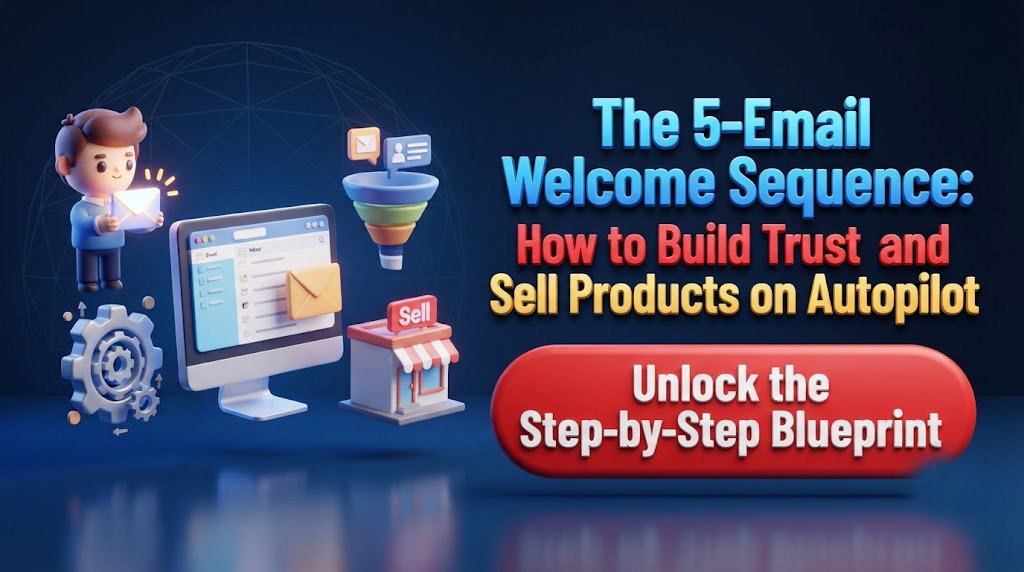
Imagine someone discovers your website, downloads your free guide, and joins your email list. They’re interested in what you offer, but they’re not ready to purchase anything yet.
What happens next?
If they receive nothing but occasional promotional emails, they may forget your brand. If your first message immediately pushes an expensive product, they might unsubscribe.
But what if the next five emails gradually transformed that initial curiosity into genuine trust, meaningful engagement, and a potential purchase?
That’s the purpose of a 5-email welcome sequence.
A well-designed automated email welcome sequence introduces your business, delivers immediate value, addresses customer concerns, demonstrates your expertise, and presents your products when subscribers have enough information to make an informed decision.
And once you build the system, it can welcome new subscribers automatically, whether you’re working, sleeping, creating new products, or taking time away from your business.
For bloggers, digital product creators, online entrepreneurs, affiliate marketers, coaches, and eCommerce store owners, this approach can turn an ordinary email list into a relationship-building and sales channel.
The important distinction is that successful email automation isn’t about sending more messages. It’s about sending the right message at the right stage of the customer journey.
In this guide, you’ll learn how to build a five-email welcome sequence, write messages people actually want to read, create an automated sales funnel, measure performance, and improve conversions without relying on aggressive sales tactics.
What Is a 5-Email Welcome Sequence?
A 5-email welcome sequence is a series of five automated emails delivered to new subscribers after they join your email list.
Instead of manually introducing your brand to every new subscriber, you create the emails once and use email marketing software to deliver them according to a predefined schedule.
Each email has a particular objective.
The five stages of an automated welcome funnel
Email 1 — Welcome
Deliver the promise and make a great first impression
Email 2 — Build Trust
Share a relatable story and demonstrate understanding
Email 3 — Provide Value
Teach a practical solution to a common problem
Email 4 — Introduce the Offer
Show how your product solves a specific need
Email 5 — Invite Action
Address hesitation and offer a clear next step
Every subscriber follows the sequence according to their individual signup date, unless your automation redirects or exits them.
The sequence creates a natural progression:
Stranger → Subscriber → Engaged Reader → Potential Customer → Buyer
Not everyone will buy after five emails, and that’s normal. Your goal is to establish a useful relationship that can continue long after the initial sequence ends.
Why an Automated Welcome Sequence Matters for Online Businesses
Many businesses invest heavily in social media, advertising, and search engine traffic but overlook what happens after someone subscribes.
Website visitors often leave without purchasing. An email list gives you a permission-based way to reconnect with interested people.
1. You create a meaningful first impression
A new subscriber has shown interest in your content or offer. A relevant welcome email acknowledges that interest and delivers whatever was promised during signup.
That first interaction helps establish whether your business feels useful, trustworthy, and professional.
2. You build trust before requesting a sale
Most people are understandably cautious about unfamiliar online businesses.
They want to know whether your advice is credible, whether your products are relevant, and whether purchasing from you is worthwhile.
A structured welcome sequence answers those questions gradually.
3. You create a consistent customer experience
Without automation, subscribers may receive different experiences depending on when they join.
An automated welcome funnel ensures every eligible new subscriber receives a consistent introduction, while personalization and segmentation keep the experience relevant.
4. You promote products without constantly selling
Your emails can introduce eBooks, digital templates, online courses, services, memberships, affiliate resources, and physical products.
Instead of repeatedly broadcasting promotional offers, the sequence helps subscribers understand the problem, evaluate possible solutions, and determine whether your product fits their needs.
5. You reduce repetitive marketing work
Email automation handles scheduled delivery, basic segmentation, and certain follow-up decisions.
You still need to monitor performance, update content, answer customer questions, and maintain the system.
However, you no longer have to manually send five introductory emails to every subscriber.
Before You Write: Understand Your Subscriber’s Real Problem
One of the biggest mistakes in automated email marketing is writing the entire sequence around the business rather than the subscriber.
Consider two opening statements.
Business-focused: “Welcome to our store. We sell premium digital products, courses, and marketing templates.”
Customer-focused: “Want to launch your first digital product without spending weeks figuring out what to create? Here’s a simple way to get started.”
The second statement addresses a recognizable problem and offers a direction.
Before creating your automated sales funnel, answer four questions:
- Who is subscribing, and why did they join?
- What specific problem are they trying to solve?
- What useful result can you help them achieve quickly?
- Which product naturally supports their next step?
For example, imagine you sell digital business templates.
Your target subscriber might be a freelancer struggling to organize client projects.
Their immediate problem is not a lack of templates. It is missed deadlines, scattered information, and unnecessary administrative work.
Your emails should therefore focus on managing projects more easily rather than repeatedly describing the number of templates in your store.
The strongest welcome emails sell the value of solving a problem before selling the product itself.
The Ideal Timing for a 5-Email Welcome Sequence
There is no universal sending schedule that works for every industry or audience. Still, the following structure is a useful starting point.
| Suggested timing | Main objective | |
|---|---|---|
| 1 | Immediately after signup | Welcome and deliver |
| 2 | Day 2 | Connect and build trust |
| 3 | Day 3 | Educate and demonstrate value |
| 4 | Day 5 | Present the relevant product |
| 5 | Day 7 | Address objections and invite action |
This seven-day model gives subscribers opportunities to read, explore, and evaluate your content without receiving a promotional message every few hours.
For urgent customer needs, a shorter sequence may work better. For expensive services or complex purchases, a longer educational period may be appropriate.
Start with a reasonable schedule, then test it using subscriber behavior, unsubscribes, complaints, clicks, and purchases.
Email 1: The Warm Welcome — Deliver Your Promise Immediately
Objective: Create a positive first impression, confirm the subscription, and deliver immediate value.
The first email should feel like the beginning of a helpful conversation.
Your subscriber may have joined through a free checklist, discount offer, tutorial, resource library, webinar registration, or downloadable guide.
Whatever encouraged them to subscribe should be delivered clearly and promptly.
What to include in the first welcome email
Begin with a friendly greeting.
Remind the subscriber why they’re receiving the message.
Deliver the promised resource, explain what they can expect from future emails, and invite one easy action.
Avoid overwhelming new subscribers with numerous products, banners, affiliate links, and unrelated promotions.
Example subject lines
- Welcome! Your Free Resource Is Ready
- You’re In! Here’s Your First Step
- Thanks for Joining — Let’s Get Started
Sample welcome email
Hi [First Name],
Welcome! I’m glad you’re here.
If you’ve been thinking about creating and selling your first digital product, you’re in the right place.
As promised, here’s your Digital Product Starter Guide:
[Download Your Free Guide]
Inside, you’ll discover how to choose a product idea, identify potential customers, and take the first steps toward launching your offer.
Over the next few days, I’ll also share practical strategies for building a digital product business without unnecessary complexity.
For now, start with one small step: choose a problem you know how to solve.
Your next step: Download the guide and identify one product idea you’d like to explore.
See you soon,
[Your Name]
[Business Name]
Why this email works
It delivers the promised resource, explains the benefit, and sets realistic expectations.
The call to action is simple: access the resource and take one small step.
You can also invite subscribers to reply with their biggest challenge. Their responses can reveal objections, product opportunities, and useful ideas for future content.
Conversion insight: A helpful first email earns attention. A premature sales pitch may spend that attention before trust develops.
Email 2: Build Trust Through a Story Your Audience Recognizes
Objective: Help subscribers understand who you are, why your business exists, and how you understand their challenges.
Trust develops when people experience consistent, useful, honest communication.
A personal story can help, but it needs to be relevant to the reader.
You don’t need a dramatic success story, extraordinary earnings, or an impressive list of achievements.
Sometimes a simple explanation of why you created a product is more persuasive.
Use the problem–discovery–solution storytelling approach
Start with a recognizable customer struggle.
Explain a discovery, lesson, or change in approach.
Then connect that lesson to something useful the subscriber can try.
For example, a creator selling productivity templates could explain how organizing tasks into a weekly system reduces the effort of deciding what to work on next.
The story should be truthful. If you don’t have an applicable personal experience, use an explicitly hypothetical scenario or a properly authorized customer example rather than inventing one.
Example subject lines
- Why I Started Creating Simple Business Tools
- The Problem That Inspired This Resource
- A Better Way to Organize Your Work
Sample trust-building email
Hi [First Name],
Have you ever opened your laptop, looked at everything you needed to finish, and wondered where to begin?
For many freelancers and creators, the hardest part of productivity isn’t doing the work. It’s keeping projects, deadlines, and priorities organized.
That’s why simple systems can be so valuable.
You don’t always need expensive software or a complicated workflow. Sometimes a clear project checklist and a weekly planning routine are enough to make your next steps easier.
Here’s one idea worth trying today:
Write down your three most important tasks for tomorrow before you finish working today.
It’s a small habit, but it gives you a clearer starting point.
I’d love to know: What’s your biggest challenge right now — planning, creating, or selling?
Just reply and tell me.
[Your Name]
[Business Name]
Why this email works
It uses a familiar problem to establish relevance.
The message gives the subscriber something useful without requiring a purchase.
It also invites a reply, turning an automated message into an opportunity for a genuine conversation.
Trust-building principle: People are more likely to consider recommendations from businesses that consistently demonstrate understanding and competence.
Email 3: Deliver a Quick Win That Demonstrates Your Expertise
Objective: Give subscribers a practical result they can experience for themselves.
The third email is where your business can distinguish itself from brands that only publish broad advice.
Instead of telling subscribers that your products are valuable, demonstrate your understanding with a small tutorial, checklist, framework, or example.
A quick win gives readers a reason to return to your emails.
The quick-win formula
Choose one problem that can reasonably be improved in a short period.
Break the solution into three understandable steps.
Explain what success looks like.
Offer an optional resource for subscribers who want to go further.
For a digital product business, this could be identifying a simple product idea.
Example subject lines
- Try This 10-Minute Digital Product Exercise
- Three Steps to Find Your First Product Idea
- A Simple Exercise You Can Use Today
Sample value email
Hi [First Name],
You don’t need 100 business ideas to start selling digital products.
You need one useful idea that solves a problem people actually experience.
Try this simple exercise:
Step 1: Write down three problems you understand well.
Step 2: Choose one that people actively look for help solving.
Step 3: Think of a small digital resource that could make the problem easier.
For example:
Problem: Freelancers struggle to track project deadlines.
Possible solution: An editable project management spreadsheet.
The next step is to validate the idea by talking with potential customers and exploring existing demand.
If you’d like a structured worksheet for this exercise, you can explore it here:
[View the Product Idea Worksheet]
Don’t worry about building a perfect product today. Focus on identifying one genuinely useful solution.
[Your Name]
[Business Name]
Why this email works
The subscriber gets a concrete task and can make progress immediately.
The resource link is relevant to the lesson instead of feeling like an unrelated advertisement.
This is an effective place to introduce a free or low-cost resource, particularly when it extends something the reader has already learned.
Practical insight: Useful education creates product awareness without requiring constant promotional language.
Email 4: Introduce Your Product as a Relevant Solution
Objective: Present a product or service that naturally continues the subscriber’s progress.
By the fourth message, subscribers have received a welcome, a relevant connection, and useful instruction.
Now you can introduce a commercial offer more directly.
The key is to connect the offer to the outcome the subscriber wants.
Rather than saying, “Buy our premium template bundle,” explain what the templates help users accomplish.
The problem–solution–benefit approach
An effective product introduction follows three stages.
Problem: Describe the difficulty your audience wants to overcome.
Solution: Explain how your product helps address that difficulty.
Benefit: Show the practical improvement the buyer may experience.
For example, a template bundle might help freelancers organize their projects, prepare client proposals, and monitor business expenses.
Avoid promising guaranteed earnings, dramatic success, or results your product cannot reliably deliver.
Example subject lines
- Ready to Organize Your Business More Easily?
- A Practical Toolkit for Your Next Step
- Here’s a Simpler Way to Manage Your Projects
Sample product introduction email
Hi [First Name],
Over the last few emails, we’ve explored how to identify useful product ideas and simplify your workflow.
But once you’re ready to put those ideas into action, creating every document and planning system from scratch can take time.
That’s where a ready-to-use toolkit may help.
Our Digital Business Starter Toolkit includes editable resources designed to help you organize your work and prepare for a product launch.
Inside, you’ll find:
- Product idea planning worksheets
- Simple project tracking templates
- Launch preparation checklists
- Basic business organization resources
The toolkit is designed for creators who want a practical starting point they can customize.
You can review what’s included, see sample pages, and decide whether it fits your needs.
Explore the Digital Business Starter Toolkit:
[View Toolkit Details]
No complicated setup. Just editable resources you can adapt to your own workflow.
[Your Name]
[Business Name]
Why this email works
The offer follows logically from the previous lessons.
The message explains specific product contents rather than relying on exaggerated marketing claims.
It also gives people permission to evaluate the product instead of pressuring them to buy immediately.
Make your product page work with the email
A strong email cannot compensate for a confusing landing page.
When readers click, the destination should explain the offer clearly.
Include accurate product images or previews, detailed features, pricing, format compatibility, license terms, support information, refund conditions, and genuine customer reviews where available.
Buyer-intent strategy: Match the product page headline to the promise made in the email. This continuity reduces confusion and helps visitors decide whether to purchase.
Email 5: Address Hesitation and Make the Next Step Easy
Objective: Answer common purchasing questions and invite a clear decision without applying artificial pressure.
Some subscribers will be interested but uncertain.
They may wonder whether the product is suitable for beginners, whether they can customize it, or whether the price represents good value.
The fifth email should reduce those uncertainties.
Rather than simply repeating the sales message, offer useful clarification.
What this email should cover
Identify two or three legitimate customer concerns.
Explain who the product is designed for.
Clarify what is included and what is not.
If you have authentic testimonials or verified reviews, you may include relevant examples with permission.
You can also offer a demonstration, preview, comparison guide, or customer support link.
Example subject lines
- Is This Toolkit Right for You?
- A Few Things to Know Before You Decide
- Your Questions About the Toolkit, Answered
Sample conversion email
Hi [First Name],
Choosing the right business resources can feel overwhelming, especially when you’re just getting started.
Before you decide whether our Digital Business Starter Toolkit fits your needs, here are a few things worth knowing.
Do I need advanced technical skills?
No. The toolkit is designed around editable resources and straightforward instructions. Check the product page for specific software requirements.
Can I customize the templates?
Yes, where the individual template format supports editing. You can adapt the provided resources to your business needs.
Will this guarantee sales?
No product toolkit can guarantee customers or revenue. These resources are intended to support planning, organization, and implementation.
If you’re looking for a practical collection of business planning tools, you can review the full contents here:
[Explore the Toolkit and Pricing]
And if you’re not ready to purchase, that’s completely fine. You’ll still receive helpful ideas and resources through this newsletter.
Thanks for being here.
[Your Name]
[Business Name]
Why this email works
It removes uncertainty through straightforward answers rather than manufactured urgency.
It also respects subscribers who aren’t ready to purchase.
A genuine limited-time promotion can be mentioned when one exists, but fake countdown timers and permanently recurring “last chance” discounts can damage credibility.
The goal of the fifth email is not to force every subscriber to buy. It is to make the next decision clearer.
How to Set Up Your Automated Email Sales Funnel
Writing five engaging messages is only part of the process. You also need a reliable system that sends the right emails to the right subscribers.
Fortunately, modern email marketing platforms make this possible without advanced programming skills.
Step 1: Choose an email automation platform
Several popular platforms support automated welcome sequences, subscriber segmentation, and campaign reporting.

Mailchimp
Suitable for businesses that want email campaigns, signup forms, audience management, and automated marketing journeys.

Kit
Designed with creators, newsletters, digital products, and subscriber relationships in mind.

MailerLite
An option for bloggers and small businesses looking for email campaigns, landing pages, and automation workflows.
Brevo
Supports customer communication and marketing automation across multiple channels.
Compare each provider’s current pricing, subscriber limits, automation features, consent-management tools, and integrations before deciding. Availability of specific features can depend on the plan.
The best platform isn’t necessarily the one with the most features. It’s the one you can use effectively and maintain consistently.
Step 2: Create a relevant signup offer
People need a reason to subscribe.
A generic invitation such as “Join our newsletter” may be less compelling than a clearly described benefit.
For example:
“Download our free 7-step checklist to plan and launch your first digital product.”
A useful lead magnet can be a checklist, spreadsheet, resource guide, mini-course, printable worksheet, or product preview.
The free resource should solve a small problem that relates naturally to the products you sell.
Step 3: Connect your signup form to the automation
Create your signup form or landing page, explain what subscribers will receive, and record marketing permission where required.
Then configure the automation trigger.
A typical workflow looks like this:
Subscriber joins → Email 1 → Wait → Email 2 → Wait → Email 3 → Wait → Email 4 → Wait → Email 5
Use subscriber-specific delays rather than sending everyone the same welcome email on a fixed calendar date.
Step 4: Add purchase-based automation rules
A new subscriber who purchases your product after Email 4 should not necessarily receive Email 5 encouraging them to buy the same product again.
Configure an exit or branching rule where your platform supports it.
For example, subscribers who purchase can leave that product’s promotional sequence and enter an appropriate onboarding flow. Subscribers who don’t purchase can continue receiving educational content or future relevant offers.
This prevents repetitive sales messages and creates a more thoughtful customer experience.
Step 5: Test the complete journey
Before activating your automation, subscribe using a test email address.
Confirm that your messages arrive in the correct order, links work, downloads are accessible, and purchase tracking functions correctly.
Also test the mobile experience, unsubscribe process, personalization fields, and customer-support contact options.
A broken download link in your first message can damage trust more quickly than an imperfect subject line.
How to Personalize Your Welcome Sequence Without Making It Complicated
Personalization is more than adding someone’s first name to a subject line.
The most useful personalization reflects what subscribers are actually interested in.
Imagine your website sells different digital products for freelancers, teachers, and small business owners.
Sending identical product promotions to all three groups may produce irrelevant recommendations.
A better approach is to ask subscribers what they need when they join.
You might offer three interests: starting a business, improving productivity, or creating digital products.
Once subscribers select an interest, your email platform can tag them and recommend relevant content.
For example, a subscriber interested in productivity could receive practical planning advice and a link to a project management template. Someone interested in launching digital products could receive product validation tips and a starter toolkit recommendation.
This creates a more helpful experience without requiring completely different automation systems for every subscriber.
Only collect information that serves a clear purpose, and explain how subscriber data will be used.
How to Write Email Subject Lines That Encourage Opens
A strong subject line sets an accurate expectation and gives readers a reason to pay attention.
For welcome sequences, clarity and relevance usually matter more than clever wordplay.
Compare these examples.
| Weak subject line | Stronger alternative |
|---|---|
| Welcome to Our Newsletter | Your Free Starter Guide Is Inside |
| Buy Our Products Now | A Toolkit for Organizing Your Next Project |
| Important Business Tips | Three Steps to Find a Useful Product Idea |
| Amazing Limited-Time Offer | See What’s Included in the Starter Toolkit |
| You Must Read This | A Simple Planning Mistake to Avoid |
Avoid using false urgency, deceptive personalization, misleading claims, and exaggerated earnings promises.
Subject lines should accurately describe the email content.
Also write preview text that complements the subject line instead of merely repeating it.
For example:
Subject: Your Free Starter Guide Is Here
Preview: Start with these three steps to find a useful product idea.
This combination tells subscribers what they can expect before opening.
How to Improve Email Engagement and Product Conversions
An effective automated sales funnel doesn’t require elaborate graphics or lengthy promotional copy.
Small improvements in clarity can make a meaningful difference.
Use one primary action per email
If your message asks subscribers to download a PDF, visit your blog, watch three videos, browse ten products, and follow four social accounts, the next step may become unclear.
Choose one primary objective for each email.
Other links can exist when necessary, including compliance and account links, but the main action should remain obvious.
Make your emails easy to scan
Many subscribers read messages on phones.
Use short paragraphs, meaningful spacing, and descriptive links.
Make sure buttons and linked text are easy to tap.
A conversational, well-structured email can be more useful than a visually complicated promotional design.
Connect educational content to your product
Your free advice and paid resources should complement each other.
For example, an email might teach subscribers how to organize a project manually, while the paid product offers an editable template that helps streamline the process.
The free content should still stand on its own.
Create an honest reason to buy
Explain the genuine value of your product.
Customers may be motivated by convenience, practical features, clearer organization, customization options, or access to specialized resources.
They don’t need a fabricated deadline or exaggerated savings claim.
Show real evidence when available
Authentic reviews, detailed product demonstrations, real customer experiences, and transparent comparisons can reduce buying uncertainty.
Never invent testimonials or present hypothetical outcomes as verified customer results.
Measuring the Success of Your 5-Email Welcome Sequence
A welcome sequence should be monitored and refined rather than treated as a permanent set-and-forget system.
Focus on the actions that reveal whether subscribers are receiving value and whether your product offer is effective.
| Metric | What it tells you |
|---|---|
| Delivery rate | Whether emails are being accepted by receiving servers |
| Click-through rate | Whether subscribers are engaging with links |
| Conversion rate | Whether recipients complete the desired action |
| Unsubscribe rate | Whether people choose to leave your list |
| Spam complaint rate | Whether recipients consider your messages unwanted |
| Revenue per subscriber | How much attributed revenue the sequence generates per subscriber |
Open rates can provide directional information, but privacy features and automated image loading can distort them. Clicks, replies, conversions, and customer outcomes often provide a more dependable view of engagement.
Example: Calculate the revenue potential of a welcome sequence
Suppose 1,000 new subscribers enter your welcome sequence during a month.
Assume 3% of them eventually purchase a $29 digital product, with purchases attributed to the sequence.
Interactive welcome funnel revenue estimatorNew subscribers
1,000Purchase conversion rate
3%Product price (USD)
$29.00
Estimated orders
30
Estimated gross revenue
$870.00
This is an illustrative calculation, not a predicted or typical conversion rate. Revenue excludes refunds, fees, taxes, advertising costs, and other expenses.
This simple model illustrates why conversion improvements can matter.
However, actual outcomes depend on audience quality, product-market fit, email relevance, offer strength, pricing, and many other factors.
A smaller engaged list may perform better than a larger list whose subscribers have little interest in your products.
A/B Testing: How to Improve Your Automated Email Sequence
Once your sequence has received sufficient traffic, begin testing individual elements.
Possible tests include subject lines, preview text, message length, CTA wording, email timing, and landing page headlines.
For example, you might compare:
Version A: “Explore Our Digital Business Toolkit”
Version B: “See the Templates Inside Your Starter Toolkit”
Both invite a similar action but emphasize different benefits.
Test one major variable at a time when possible. Use randomized groups, consistent measurement windows, and enough observations to avoid drawing conclusions from a handful of clicks.
Don’t assume that every apparent improvement is statistically meaningful.
Also avoid optimizing only for clicks. A subject line that increases curiosity but produces fewer qualified purchases may not be the better business choice.
Five Common Mistakes That Weaken Automated Welcome Emails
Mistake 1: Selling before delivering value
Someone who subscribed to receive a free resource expects that resource first.
Deliver what you promised before introducing unrelated offers.
Mistake 2: Writing lengthy, unfocused emails
A welcome email doesn’t need to explain every feature of your business.
Keep each message focused on one relevant idea and one clear next step.
Mistake 3: Promoting the same product after purchase
Without appropriate automation rules, customers may continue receiving messages encouraging them to buy something they already own.
Use purchase-based branching when reliable transaction data is available.
Mistake 4: Ignoring mobile readers
Small text, broken layouts, confusing buttons, and oversized images make emails harder to use.
Preview each message on desktop and mobile before publication.
Mistake 5: Never updating the sequence
An email can keep running for months even after a product changes, a link breaks, a discount expires, or an example becomes outdated.
Schedule periodic reviews of every message and its destination pages.
Advanced Strategy: Turn a Welcome Sequence Into a Long-Term Customer Relationship
The fifth email should not represent the end of communication.
Subscribers who haven’t purchased may still benefit from regular tutorials, product comparisons, industry insights, and practical resources.
Those who have purchased need a different experience.
A buyer onboarding sequence might explain how to access the product, use its features, troubleshoot common issues, and obtain support.
After customers have had a reasonable opportunity to experience the product, you can invite honest feedback or a review without requiring a positive rating.
Your newsletter can then continue providing educational content alongside occasional relevant product recommendations.
The long-term objective is to create a business people are comfortable hearing from.
For example, a digital product creator might publish a weekly resource explaining one practical business problem, an actionable solution, and an optional template for those who want additional support.
This creates a reason for new visitors to become subscribers and for existing subscribers to keep returning.
Returning-reader principle: Give subscribers a clear expectation of the continuing value they’ll receive, then consistently meet it.
A Simple Seven-Day Implementation Plan
You don’t need an enormous content library to launch your first automated email sequence.
A focused implementation schedule can help you move from planning to testing.
Your welcome sequence launch checklist
0 of 7 completed
0%
Day 1
Define your ideal subscriber and choose the product you want to introduce
Day 2
Create a relevant lead magnet and permission-based signup form
Day 3
Write Emails 1 and 2: welcome and trust building
Day 4
Write Email 3: an actionable lesson
Day 5
Write Emails 4 and 5: offer and objections
Day 6
Configure delays, segmentation, tracking, and purchase exits
Day 7
Test the full journey, check compliance, and activate the sequence
You can publish the sequence after these core steps are complete, but continue monitoring it as subscribers move through the workflow.
As your audience grows, build additional sequences for different interests, product categories, and customer stages.
Five Frequently Asked Questions About Automated Welcome Sequences
1. How many emails should a welcome sequence include?
A five-email welcome sequence is a practical starting point for many online businesses because it provides room to introduce your brand, deliver useful information, and present an offer.
However, five emails are not a universal requirement.
A simple newsletter may need fewer messages. A business selling expensive or complex services may benefit from a longer educational process.
Choose the number based on your audience’s needs and test performance over time.
2. Can a welcome email sequence generate sales automatically?
Yes. Automated email sequences can generate sales when subscribers receive relevant offers, purchase links work correctly, and your products meet their needs.
However, automation does not guarantee revenue.
Product quality, audience interest, pricing, trust, and website usability all influence results.
The most sustainable approach combines useful automated communication with ongoing customer support and product improvements.
3. What is the best time to send welcome emails?
Send the initial welcome email promptly after the subscriber signs up or confirms their subscription, as appropriate.
For the remaining messages, begin with a reasonable schedule over several days.
There is no single optimal hour that applies to all audiences.
Use your email platform’s reporting to evaluate engagement by timing, subscriber location, and customer segment.
4. Should I offer a discount in my five-email welcome sequence?
A discount can be useful, but it is not always necessary.
For some products, a detailed demonstration, useful sample, or clear explanation of benefits may be more persuasive.
If you use a discount, state its terms accurately, including any genuine expiration date or eligibility restrictions.
Avoid training subscribers to expect constant discounts that make your standard prices seem unreliable.
5. What happens after subscribers finish the five-email sequence?
After completing the sequence, subscribers can move into a regular newsletter, educational email series, or an interest-based follow-up campaign.
Customers who purchase should receive appropriate fulfillment and onboarding communications.
Subscribers who remain interested but haven’t purchased may continue receiving useful content and occasional relevant offers, provided you have the necessary permission or other valid legal basis.
Respect subscriber preferences and stop marketing communications when people opt out.
Compliance Note: Legal, Privacy, and Responsible Email Marketing Requirements
Automated email marketing must respect applicable laws, customer privacy, platform policies, and consumer protection standards.
Requirements vary by country, recipient location, message type, and business circumstances. The following provides general guidance rather than legal advice.
United States: CAN-SPAM Act
The US CAN-SPAM Act governs commercial email, including business-to-business marketing messages.
Businesses must use accurate sender information, nondeceptive subject lines, appropriate advertising identification, a valid physical postal address, and a functioning opt-out method.
Under the Federal Trade Commission’s guidance, commercial-email opt-out requests must be honored within 10 business days.
Federal Trade Commission
European Union: GDPR and electronic marketing rules
Personal data processing must have an appropriate lawful basis, and electronic marketing is also governed by applicable national rules implementing the ePrivacy framework.
When relying on consent, it must meet requirements such as being freely given, specific, informed, and unambiguous. Subscribers must be able to withdraw consent.
European Data Protection Board
United Kingdom: PECR and UK GDPR
UK rules generally require consent for unsolicited marketing emails to individual subscribers unless an applicable exception, such as the products-and-services soft opt-in, is satisfied.
The ICO also explains that publicly available email addresses do not automatically provide marketing permission.
Other jurisdictions
Businesses operating in India, Canada, Australia, and other markets must review applicable national privacy, electronic communications, anti-spam, consumer protection, and advertising requirements.
Do not assume that a policy compliant in one country automatically meets the requirements of another.
Email authentication and deliverability
Configure your sending domain correctly.
Google’s sender guidelines require SPF or DKIM authentication for all senders to Gmail, with additional SPF, DKIM, and DMARC requirements for bulk senders. Bulk promotional senders are also subject to one-click unsubscribe requirements and spam-rate expectations.
Google recommends keeping user-reported spam rates below 0.1% and preventing them from reaching 0.3%.
Responsible marketing practices
Apply these principles throughout your entire welcome sequence:
- Obtain and document appropriate marketing permission, or establish another lawful basis where permitted.
- Explain what subscribers are joining and what messages they can expect.
- Provide a clear unsubscribe method and honor requests promptly.
- Never use purchased or scraped contact lists without confirming that marketing to those recipients is lawful.
- Protect personal data and use reputable service providers.
- Clearly disclose material affiliate relationships and other relevant commercial connections.
- Use authentic customer reviews and accurate product descriptions.
- Avoid fabricated testimonials, false scarcity, misleading pricing, and guaranteed income claims.
- Explain significant limitations, subscription conditions, refund terms, and product licensing restrictions where relevant.
- Periodically review your marketing practices against applicable legal and platform requirements.
The example emails in this article are educational templates. Before using them commercially, include your required business identification, physical address where applicable, unsubscribe mechanism, privacy disclosures, and any other legally required information.
Build a Welcome Sequence That Keeps Working for Your Business
A well-crafted 5-email welcome sequence does more than introduce your products.
It turns the first few days of a subscriber relationship into an organized, helpful experience.
The process begins with delivering what you promised, develops through valuable education, and introduces a relevant purchase opportunity when the subscriber has more context.
That progression benefits both sides.
Subscribers receive information that helps them make better decisions. Businesses create a repeatable way to communicate, strengthen customer relationships, and generate qualified sales opportunities.
The real advantage of email automation isn’t that it eliminates marketing work. It’s that it allows your best introductory content to reach every new eligible subscriber consistently.
Start with one audience, one relevant product, and five carefully written emails.
Measure what happens. Improve what isn’t working. Keep delivering value after the welcome sequence ends.
Your next step: Choose your lead magnet today, draft your first welcome email, and create a clear path from useful free content to a product that genuinely helps your audience.
Because the most effective automated sales funnel doesn’t feel like a machine trying to sell something.
It feels like a helpful business showing up with the right information when its customers need it.
Stay ahead with exclusive updates
Join our community. Get curated industry trends, actionable guides, and fresh resources delivered straight to your inbox.