
CONTENT BUSINESS • BLOGGING • AUTOMATION • PASSIVE INCOME
Build a profitable, scalable content publishing system with freelance writers, virtual assistants, AI-supported workflows, and smart automation—without spending every day writing, editing, and managing your website.
Imagine waking up to discover that your blog published a new article overnight, your newsletter reached subscribers, your social media accounts shared fresh content, and your website continued attracting potential customers.
You didn’t write the article. You didn’t manually upload the images. You didn’t schedule the social media posts.
Instead, you built a system that handles these activities through a carefully selected team, documented processes, and automated publishing tools.
That is the idea behind a hands-off publishing business.
For bloggers, affiliate marketers, digital entrepreneurs, and independent publishers, learning how to outsource content creation can transform a time-consuming operation into a more manageable digital business.
But successful outsourcing is not simply about hiring inexpensive writers or generating hundreds of AI articles. It requires clear editorial standards, the right people, sustainable economics, and a publishing process that consistently produces content readers genuinely value.
The real objective is not to eliminate every responsibility. It is to move from doing all the work yourself to directing a reliable operation that can function without your constant involvement.
What Is a Hands-Off Publishing Business?
A hands-off publishing business is a content-driven business in which most recurring production, editing, optimization, distribution, and administrative tasks are handled by employees, freelancers, virtual assistants, software, or automation systems.
The business owner typically remains responsible for strategy, budgets, editorial standards, partnerships, and important decisions.
A well-structured publishing operation may generate revenue from display advertising, affiliate marketing, sponsored content, digital products, paid newsletters, subscriptions, or lead generation.
Unlike a traditional personal blog, where the owner may handle everything, an outsourced publishing model distributes responsibilities across a repeatable workflow.
A practical hands-off content publishing workflow
Content strategy and audience research
Content briefs and writer assignments
Writing, editing and fact-checking
SEO optimization and publishing
Distribution and revenue tracking
The owner controls strategy and quality while the team manages execution. Publishing remains subject to editorial approval and periodic review.
The distinction matters: hands-off publishing is not the same as guaranteed passive income. It is an operational model designed to reduce the owner’s daily workload while keeping the business accountable for quality and financial performance.
Why Outsourcing Content Creation Makes Business Sense
Your time has an opportunity cost
A blogger who spends six hours writing one article, another two hours editing it, and two more hours preparing graphics and publishing can easily devote an entire working day to a single piece of content.
That may be reasonable when starting out. However, it becomes difficult to scale when the website requires regular publishing, content updates, audience engagement, and revenue optimization.
Outsourcing lets the owner concentrate on activities that may offer greater long-term value, including finding underserved audience needs, building partnerships, improving conversion rates, launching digital products, and developing additional income channels.
Consistency becomes easier to maintain
Search visibility, audience trust, and returning readership benefit from useful, well-maintained content. A reliable team can help sustain an editorial schedule without relying entirely on the owner’s availability.
Consistency does not mean publishing daily at any cost. It means having a dependable process for producing appropriate content and improving existing articles when necessary.
Specialist skills improve the production process
One person rarely excels at research, writing, fact-checking, SEO, design, technical publishing, and email marketing equally.
A content business can benefit from specialists who bring different strengths.
An experienced editor may improve accuracy and readability. An SEO specialist may identify technical issues. A virtual assistant for bloggers may handle content uploading, formatting, internal links, image optimization, and scheduling.
You can expand without personally doing every task
As revenue grows, outsourcing provides an opportunity to increase capacity without automatically increasing the owner’s working hours.
However, scaling should follow profitable demand. More articles, more employees, and more software subscriptions do not automatically produce more revenue.
What Content Creation Tasks Should You Outsource First?
The smartest approach is to begin with repetitive, clearly defined activities rather than immediately handing over the entire publishing operation.
| Task | Recommended specialist | Priority |
|---|---|---|
| WordPress formatting and uploads | Virtual assistant | High |
| Image preparation and file optimization | VA or designer | High |
| Social media scheduling | Virtual assistant | High |
| Article drafting | Specialist writer | Medium |
| Editorial review and fact-checking | Editor or subject expert | High |
| Keyword research and content briefs | SEO content strategist | Medium |
| Analytics and reporting | VA or analyst | Medium |
| Affiliate link monitoring | VA with editorial oversight | Medium |
| Digital product development | Product specialist | As needed |
For a new publisher, administrative and formatting tasks are often the safest responsibilities to delegate first because they are easier to document and verify.
Experienced publishers may outsource article writing earlier, especially if they already have a proven niche, clear brand positioning, and strong editorial guidelines.
Practical tip: Track your publishing activities for seven days. Identify tasks that consume time but do not require your unique expertise. Those are promising candidates for your first outsourcing experiment.
How to Hire a Virtual Assistant for Bloggers
A skilled virtual assistant can become one of the most valuable operational contributors to a publishing business.
But hiring effectively starts with defining the job.
Identify the responsibilities
For example, a WordPress publishing assistant might handle uploading approved articles, applying headings, adding optimized images, inserting relevant internal links, creating excerpts, checking mobile formatting, scheduling posts, and recording publication URLs.
A different assistant might manage email newsletters, social media repurposing, or digital product listings.
Avoid hiring someone for an undefined role such as “manage everything related to my website.” Broad instructions often produce inconsistent results and make performance difficult to evaluate.
Where can you find suitable freelancers?
Popular places to discover freelance talent include Upwork, Fiverr, Freelancer, professional networks such as LinkedIn, specialist communities, and referrals from other publishers.
Evaluate candidates based on relevant skills, sample work, reliability, communication, and experience rather than price alone.
Use a paid test assignment
Before committing to a long-term contract, offer a small paid assignment using a realistic publishing task.
For example, provide an approved 1,200-word article and ask the candidate to format it as a WordPress draft, add properly licensed images, prepare metadata, apply internal links, and complete a publication checklist.
Evaluate the submission for accuracy, formatting, attention to detail, communication, and adherence to instructions.
A paid test reveals more about operational suitability than an impressive profile description.
Protect your business access
Give collaborators only the permissions necessary for their responsibilities. A publishing assistant usually does not need full administrator access to the website, hosting account, payment systems, or domain registrar.
Use individual accounts, strong authentication, secure password management, and a formal offboarding process when someone leaves.
The Content Team You Need to Build a Scalable Publishing Operation
You do not necessarily need a large agency or full-time workforce.
An efficient publishing system can begin with two or three contributors who cover several closely related functions.
Content writer or researcher
Produces original drafts from approved briefs, gathers reliable supporting evidence, and follows the publication’s voice and audience requirements.
Editor and quality reviewer
Evaluates accuracy, clarity, usefulness, originality, citations, and compliance before content becomes public.
Publishing virtual assistant
Handles formatting, media preparation, links, scheduling, content status updates, and routine technical checks.
SEO and growth strategist
Identifies promising topics, monitors search performance, evaluates conversions, and recommends opportunities to update or expand content.
These are responsibilities rather than mandatory separate hires. In a small operation, a capable editor might also prepare content briefs, while a trained virtual assistant handles both publishing and distribution.
As the business grows, an editorial manager can coordinate assignments and approvals so the owner receives consolidated reports instead of managing every individual task.
Step-by-Step: Build Your Content Outsourcing System
Step 1: Choose a profitable, audience-focused niche
Outsourcing works best when your publishing strategy has a clear direction.
A website covering every imaginable subject is difficult to position, maintain, and monetize coherently.
Instead, identify a specific audience with recurring questions, problems, and purchase decisions.
Potential categories include creator tools, productivity software, home organization, education resources, professional development, travel planning, and digital business operations.
Research whether the topic has sustained demand, whether you can provide distinctive expertise or useful resources, and whether monetization opportunities align with readers’ interests.
A niche should be selected for more than keyword volume. It should offer opportunities to build credibility and ongoing audience relationships.
Step 2: Create your editorial standards
Before delegating writing, document what acceptable content looks like.
Your editorial guidelines should define the target reader, brand voice, article structure, research standards, originality requirements, linking policy, prohibited claims, image licensing requirements, and approval process.
For example, a digital marketing publication might require every tutorial to contain a clear reader problem, practical steps, current interface information, screenshots where useful, identifiable limitations, and a concise recommendation.
Writers should also know what to do when they cannot verify a factual claim. They must flag uncertainty rather than invent sources or statistics.
Step 3: Develop a reusable content brief
A strong brief reduces revisions and improves consistency.
Every article assignment should specify its working title, search intent, audience, main question, supporting topics, desired length range, original-value requirement, research sources, internal linking opportunities, and intended reader action.
Consider a blog targeting freelance professionals.
Instead of assigning “Write about productivity,” provide the brief:
Working title: How Freelancers Can Save Five Hours a Week With a Simple Task Management System
Audience: Freelancers balancing multiple client projects.
Reader objective: Set up a practical system for planning, tracking, and reviewing work.
Original contribution: Include a usable weekly workflow, sample task board, and an explanation of common implementation mistakes.
Business objective: Encourage interested readers to explore a relevant project planning template.
This level of clarity helps the writer produce something more useful than generic advice.
Step 4: Build a centralized editorial calendar
A content calendar ensures assignments are visible, deadlines are clear, and articles do not get lost between contributors.
Tools such as Google Sheets, Notion, Trello, and Asana can support simple to advanced workflows.
Useful fields include article title, target audience, content owner, assigned writer, draft deadline, editor, current status, planned publication date, updated date, page URL, and performance notes.
Use standardized status labels such as Idea, Approved, Assigned, In Writing, In Review, Ready to Publish, Scheduled, and Published.
The purpose is to make progress visible without constant status meetings.
Step 5: Establish a quality control process
Every piece of outsourced content should pass a review appropriate to its topic and risk level.
The reviewer should confirm that the article answers its central question, presents accurate information, distinguishes facts from opinions, gives proper credit, avoids misleading product claims, and includes a meaningful contribution beyond information readily available elsewhere.
For health, legal, financial, and other high-stakes subjects, qualified review is especially important.
AI and plagiarism screening tools may assist with checks, but they cannot prove factual accuracy or guarantee originality. Human review remains essential.
Step 6: Automate routine publishing tasks
Once the editorial workflow operates reliably, automate repetitive activities.
For example, an approved article can trigger a task for the publishing assistant, who prepares the WordPress draft. A subsequent workflow may notify the editor that the page is ready for approval.
After publication, automation can add the live URL to the content calendar, generate a distribution task, and schedule a performance review.
Automation tools such as Zapier and Make can connect supported applications.
Start with low-risk administrative steps. Publishing without review should be reserved for narrowly defined situations where the safeguards are strong enough.
Step 7: Build a weekly reporting dashboard
The owner should receive a brief report that answers three questions: Is the team producing useful content? Is that content attracting the right audience? Is the business making financial progress?
Relevant measures include organic search clicks, returning visitors, engaged sessions, email signups, affiliate conversions, digital product sales, revenue per article, content production costs, and pages requiring updates.
Use Google Search Console for search performance and Google Analytics for relevant audience and conversion reporting.
Avoid measuring success only by the number of published articles. Production volume is an operational metric, not proof of business value.
How Much Does It Cost to Outsource Content Creation?
Outsourcing costs depend on subject complexity, geography, experience, research requirements, editing standards, and publication frequency.
Rather than assuming universal freelance rates, create a budget based on the exact deliverables your website needs.
Here is a hypothetical monthly operating model for a small English-language content publication.
| Expense | Example monthly budget |
|---|---|
| 8 researched articles at $75 each | $600 |
| Editorial review | $200 |
| Part-time virtual assistant | $200 |
| Images and content tools | $50 |
| Workflow software | $30 |
| Total | $1,080 |
These figures are illustrative planning assumptions, not verified market averages or quotes from freelance providers. Specialized subjects and rigorous research can cost significantly more.
A crucial consideration is whether these costs are supported by existing revenue or a realistic investment budget.
Calculate your publishing break-even point
Suppose the website generates the following hypothetical monthly revenue:
| Revenue stream | Monthly revenue |
|---|---|
| Display advertising | $450 |
| Affiliate commissions | $500 |
| Digital product sales | $400 |
| Total revenue | $1,350 |
Using the example production budget of $1,080, the remaining amount would be $270 per month before taxes, platform fees not included in the budget, owner compensation, and other expenses.
That modest margin demonstrates an important business reality: outsourcing is not inherently profitable. Costs may arrive immediately, while new articles may take considerable time to attract readers or generate sales.
A responsible publisher maintains a cash reserve, tests content investments in small batches, and expands only when the economics justify it.
How to Use AI Without Turning Your Website Into a Content Farm
AI tools can support article planning, outline development, research organization, editing assistance, repurposing, metadata drafting, and administrative automation.
However, AI should not be treated as a substitute for independent verification, specialist knowledge, or editorial judgment.
Google explains that using generative AI to help with research and structure can be useful, but producing large volumes of pages without adding value may violate its scaled content abuse policy.
Google for Developers
+1
A responsible AI-assisted process can combine human expertise with technological efficiency.
For example, an editor selects the reader problem and research direction. AI helps organize possible sections. A writer develops the article using checked sources, original examples, and subject knowledge. The editor then reviews and approves the result.
This approach uses AI to reduce mechanical workload without allowing automation to determine what is true or useful.
Do not publish fictional testimonials, fabricated case studies, invented research, or claims of personal product testing that never occurred.
In a market increasingly filled with generic content, genuine analysis and firsthand evidence can become meaningful competitive advantages.
Build a Revenue System Around Your Outsourced Content
Publishing is only one component of a successful digital business.
The next challenge is connecting useful content with a business model that serves readers appropriately.
Display advertising
Display advertising may work for content with substantial qualified traffic, particularly informational and evergreen subjects.
However, revenue varies by audience geography, seasonality, advertising demand, page performance, and other factors.
Affiliate marketing
Affiliate marketing connects product recommendations with commission-based revenue.
For example, a blog about remote work might publish software comparisons, setup tutorials, buying guides, and productivity resources.
Recommendations should reflect genuine usefulness rather than simply selecting the highest-paying affiliate program.
Where required, paid relationships and affiliate commissions must be disclosed clearly.
Digital products
Digital products can offer an opportunity to build revenue from resources directly related to reader needs.
Examples include content calendars, business spreadsheets, planners, checklists, educational workbooks, website templates, prompt collections, and specialized guides.
A blog article explaining editorial management could naturally introduce a downloadable publishing calendar or content workflow kit.
Conversion opportunity: Offer a free version of a useful template in exchange for an optional email signup, then introduce a more comprehensive paid version to subscribers who want additional features.
Paid newsletters and subscriptions
A specialized audience may value recurring analysis, curated resources, practical tutorials, or access to a resource library.
Subscriptions work particularly well when readers receive ongoing benefits, rather than simply being charged for information already freely available elsewhere.
Sponsored content
Established publishers may attract sponsorships from relevant businesses.
Editorial independence, transparent disclosures, realistic audience information, and clearly defined sponsorship policies help protect trust.
A diversified publishing business does not need to activate every monetization channel immediately. Begin with one or two models that align closely with the audience and expand based on demonstrated demand.
How to Create Content That Brings Readers Back
A reader who discovers one useful article may leave after solving the immediate problem. A returning reader, however, can become a newsletter subscriber, customer, advocate, or long-term community member.
The difference often comes down to what the publication offers beyond an isolated answer.
Organize articles into helpful topic collections
For example, a blog about content publishing could create a connected learning path:
A beginner starts with an article about creating a blog, continues to a guide on outsourcing content creation, explores WordPress automation, learns how to measure publishing performance, and eventually considers a content management template.
Each article should provide standalone value while helping readers find the next relevant step.
Offer a repeatable reason to subscribe
Instead of using a generic “Subscribe for updates” message, explain what subscribers will receive.
An example is a weekly publishing systems email with one practical workflow improvement, one helpful tool explanation, and one actionable content growth exercise.
Specific promises are easier for readers to evaluate than vague promotional language.
Refresh useful content regularly
Evergreen articles can become less valuable as software interfaces, business practices, prices, and platform policies change.
Assign a virtual assistant to identify articles requiring review, but have the appropriate editor or subject expert verify substantive changes.
Updating old content is often an important complement to publishing new material.
Measure audience loyalty
Review returning visitor trends, newsletter engagement, repeat purchases, content journeys, and qualitative reader feedback.
These indicators can reveal whether the site is becoming a trusted resource rather than simply collecting occasional search visits.
A Practical 30-Day Plan to Launch Your Outsourced Publishing System
Days 1–7: Audit and document
Review existing articles, publishing costs, time spent on each task, and current revenue. Choose a narrowly defined outsourcing task and write its operating procedure.
Days 8–14: Recruit and test
Find potential freelancers, conduct interviews, assign paid trials, and select contributors who demonstrate the necessary accuracy and reliability.
Days 15–21: Build the workflow
Set up the content calendar, create article briefs, assign responsibilities, configure appropriate website permissions, and begin a small content production batch.
Days 22–30: Review and improve
Publish approved work, examine workflow bottlenecks, compare actual costs with the budget, correct quality issues, and decide whether further delegation is financially justified.
At the end of the month, the objective is not to achieve total automation. It is to operate one dependable, documented content workflow that can be improved and repeated.
How to Optimize an Outsourced Publishing Website for SEO, AI Search, and Google Discover
Search engines and AI-driven discovery experiences reward relevance and usefulness in different ways. No content strategy can guarantee ranking, recommendation, or inclusion.
The strongest approach is to build high-quality, accessible content with recognizable editorial standards.
Match content to search intent
A reader searching for “how to outsource content creation” needs practical guidance about tasks, hiring, workflow design, and budgets.
Someone searching for “best virtual assistant for bloggers” may want comparisons of service options, required skills, or hiring criteria.
A visitor searching for “content creation outsourcing services pricing” may be closer to making a purchase.
Matching each article to the reader’s actual goal makes the page more helpful and creates more natural conversion opportunities.
Use related terminology naturally
A comprehensive article can discuss content outsourcing services, freelance content writers, blog management, editorial workflow automation, remote content teams, automated WordPress publishing, virtual assistant services, and scalable content operations.
These related concepts provide context without relying on repetitive keyword placement.
Make key answers easy to find
Direct definitions, descriptive headings, straightforward comparisons, transparent examples, and concise explanations help people and search systems understand the page.
For AI-powered search experiences, the priority remains clear, original, verifiable information rather than trying to engineer content around presumed AI citation formulas. Google’s current guidance emphasizes satisfying the reader rather than manufacturing separate pages for every possible search variation.
Google for Developers
Create a high-quality featured image
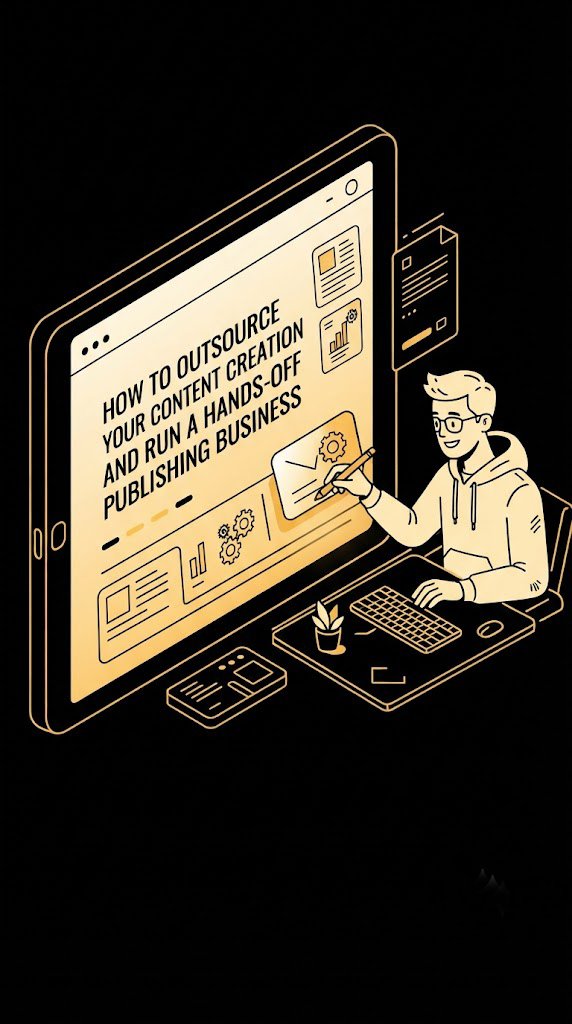
For this topic, an original landscape visual showing an organized publishing team, content workflow dashboard, and interconnected production stages would be appropriate.
Google recommends large, representative images that are at least 1,200 pixels wide for Discover, along with appropriate image preview settings. A relevant og:image or schema image reference can help identify the preferred illustration. Eligibility does not guarantee Discover traffic.
Google for Developers
Implement relevant structured data
Use accurate Article or BlogPosting structured data where appropriate, including the headline, author, publisher, publication date, modification date, and representative image.
Structured data should accurately describe the visible article. It is not a substitute for content quality and does not guarantee enhanced search appearances.
Maintain an excellent mobile reading experience
Use readable typography, short paragraphs, logical headings, responsive images, clearly visible disclosures, accessible navigation, and minimal intrusive advertising.
Readers should be able to consume the article comfortably on smaller screens and move to related resources without unnecessary friction.
Mistakes That Can Destroy an Outsourced Publishing Business
Choosing quantity over usefulness
Publishing fifty weak articles is not automatically more valuable than publishing ten carefully researched resources.
Content should be created to answer meaningful audience questions, not merely to meet a numeric quota.
Hiring exclusively on price
Very low prices may appear attractive, but inadequate research, extensive rewrites, missed deadlines, and factual errors can increase the true cost of production.
Evaluate total cost per approved, publishable article rather than the initial quoted fee alone.
Delegating without written instructions
A team cannot consistently meet expectations that have never been defined.
Document tasks, responsibilities, examples, review standards, and escalation procedures before expanding the team.
Ignoring intellectual property rights
Outsourced articles, photographs, graphics, software assets, and templates can involve different ownership and licensing arrangements.
Use written agreements addressing deliverables, originality, permitted third-party material, confidentiality, rights assignments or licenses, and applicable employment or contractor rules.
Payment alone does not necessarily transfer every intellectual property right in every jurisdiction.
Automating publication without sufficient safeguards
A workflow that publishes inaccurate articles faster is not a successful automation system.
Apply approval gates, conduct periodic audits, and maintain rollback procedures for errors.
Building a business around one traffic source
A website dependent entirely on organic search may be vulnerable to algorithm changes, competition, or changes in reader behavior.
Email subscribers, direct visits, partnerships, social communities, and customer relationships can help diversify audience acquisition.
Expecting immediate passive income
A new website may require substantial time and investment before it generates consistent revenue.
Outsourcing transfers operational work; it does not remove business risk or ensure a return.
Five Frequently Asked Questions
1. Can I run a blog without writing the articles myself?
Yes. You can hire writers, researchers, editors, and virtual assistants to create and publish articles. However, the website owner remains responsible for ensuring that published material meets editorial, legal, and platform requirements. A documented workflow and regular quality reviews are essential.
2. How much money do I need to start outsourcing blog content?
There is no universal minimum. You can begin with one paid assignment or a few hours of virtual assistant support. Your budget should reflect the complexity of the work and include editorial review and contingency costs. It is generally safer to validate the workflow before committing to substantial recurring expenses.
3. What tasks can a virtual assistant for bloggers perform?
A blogging virtual assistant can prepare WordPress drafts, format articles, optimize image files, add approved internal links, schedule social posts, organize content calendars, monitor broken links, prepare reports, and coordinate publishing tasks. More specialized activities require appropriate expertise and supervision.
4. Is hands-off publishing a genuine passive income opportunity?
It can become a relatively low-touch business, especially when established content continues attracting visitors and generating revenue. However, expenses, ongoing updates, editorial oversight, compliance responsibilities, and periodic strategic decisions remain. Income is neither automatic nor guaranteed.
5. Can AI replace freelance writers and editors completely?
AI can accelerate many parts of content production, but replacing all human review introduces substantial risks, including unsupported claims, generic content, copyright concerns, and inconsistent quality. A balanced publishing operation uses automation for efficiency while retaining human accountability for expertise, accuracy, and editorial decisions.
Build a Publishing Business That Operates Without Consuming Your Entire Day
The greatest advantage of outsourcing content creation is not simply the ability to publish more articles.
It is the opportunity to build a business that is less dependent on one person’s daily effort.
When research, writing, editing, publishing, promotion, and reporting follow documented processes, the owner can concentrate on audience needs, partnerships, brand development, and financial decisions.
Start with one repeatable task. Hire carefully. Measure the results. Improve the workflow before expanding it.
A sustainable hands-off publishing business is built through disciplined systems, trustworthy content, and realistic economics—not an endless stream of automated posts.
Your next step: Choose one publishing activity you can delegate this week, write a one-page operating procedure, and test it with a qualified freelancer or virtual assistant.
If your goal is to create a content business that is easier to manage, a single successful delegation can become the foundation for a much larger operation.
Continue Building Your Publishing System
If you found this guide useful, explore the next stage of creating a sustainable content business: choosing profitable monetization models, repurposing evergreen articles, analyzing blog revenue, building affiliate funnels, and diversifying digital assets.
Subscribe to your preferred publishing or creator-business newsletter for practical workflows, templates, and strategies that help turn content into a more organized business.
Compliance Note
The information in this article is provided for general educational and business planning purposes. It does not constitute legal, tax, financial, employment, or professional consulting advice. Revenue examples and outsourcing budgets are hypothetical illustrations, not earnings forecasts or guarantees.
Publishers are responsible for ensuring that content is original or appropriately licensed, factually accurate, and compliant with applicable copyright, advertising, privacy, accessibility, consumer protection, and contractor laws. Intellectual property ownership and worker classification requirements vary by jurisdiction.
Affiliate relationships, paid endorsements, and sponsorships should be disclosed clearly where legally required. For example, the U.S. Federal Trade Commission advises that material relationships be disclosed in a way audiences can readily notice and understand.
Federal Trade Commission
AI-assisted and outsourced content must comply with applicable platform rules and editorial policies. Avoid deceptive claims, fake testimonials, undisclosed conflicts of interest, fabricated research, plagiarism, and publishing primarily to manipulate search rankings.
Stay ahead with exclusive updates
Join our community. Get curated industry trends, actionable guides, and fresh resources delivered straight to your inbox.