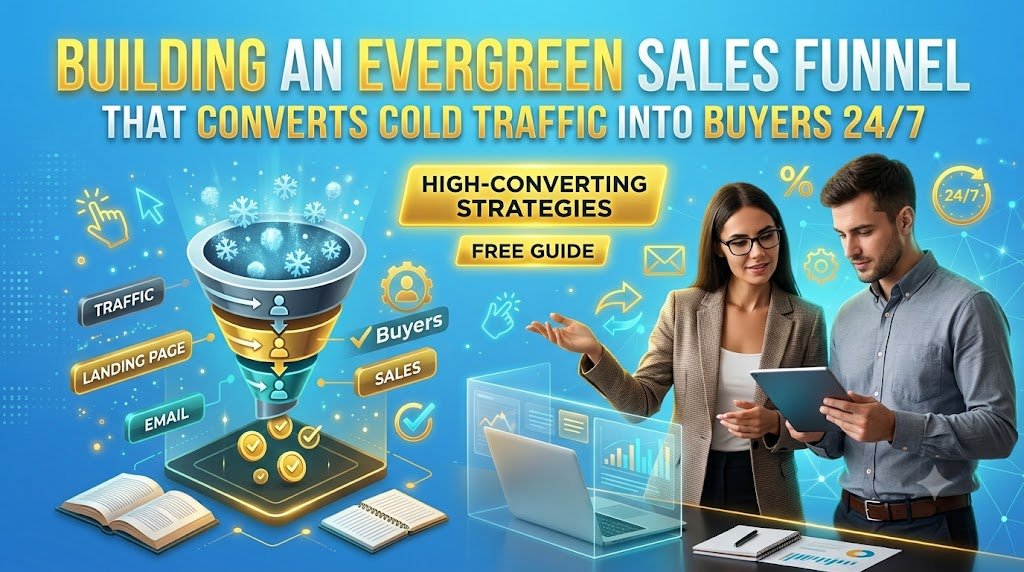
How to build an automated sales machine that attracts new visitors, earns their trust, nurtures prospects, and generates sales around the clock—even when you’re offline.
Imagine waking up in the morning, checking your business dashboard, and discovering that several customers purchased your digital products while you were sleeping.
You didn’t personally answer their questions. You didn’t send individual sales messages. You didn’t manually guide them through checkout.
Instead, a carefully designed system introduced visitors to your business, helped them understand their problems, presented a useful solution, and made purchasing simple.
That’s the potential of a well-built evergreen sales funnel.
For bloggers, affiliate marketers, digital product creators, coaches, and online entrepreneurs, creating an automated customer journey can be one of the most practical ways to make revenue less dependent on daily promotions.
But there’s something important that many online marketing tutorials overlook: automation doesn’t automatically create conversions.
A successful funnel must understand human behavior, communicate value, eliminate uncertainty, and earn trust before asking for a purchase.
This guide explains how to build an evergreen sales funnel that can convert cold traffic into paying customers, attract returning visitors, and support sustainable revenue without requiring constant manual intervention.
What Is an Evergreen Sales Funnel?
An evergreen sales funnel is an automated marketing and sales system designed to attract potential customers, nurture their interest, and guide them toward purchasing a product or service throughout the year.
Unlike a traditional product launch that depends on a fixed promotional period, an evergreen funnel remains available to new visitors whenever they discover your business.
It typically connects search-optimized content, landing pages, lead magnets, automated email sequences, sales pages, checkout systems, and customer follow-up messages.
How Does an Evergreen Sales Funnel Work?
An evergreen funnel follows a straightforward customer journey:
- Attract: A visitor discovers your content through Google, social media, Pinterest, paid advertising, or a recommendation.
- Engage: Helpful information captures their attention and addresses a real problem.
- Capture: A relevant free resource encourages them to subscribe to your email list.
- Nurture: An automated email sequence builds credibility and introduces possible solutions.
- Convert: A persuasive sales page explains the benefits of your product and provides a straightforward purchase experience.
- Retain: Follow-up emails, customer support, and relevant offers encourage repeat purchases.
The system can operate continuously, although it still requires ongoing monitoring, testing, and maintenance.
The central principle is simple: offer the right solution to the right person at the right stage of their buying journey.
Why Evergreen Sales Funnels Matter for Online Businesses
Many creators accidentally build businesses that depend entirely on their daily activity.
When they publish new content, send promotional emails, or launch campaigns, sales may increase. When they stop, customer acquisition often slows.
An evergreen funnel helps reduce that dependency by creating a repeatable system that makes existing content and marketing assets work together.
1. Your Business Can Reach Customers Across Different Time Zones
Potential buyers don’t always visit your website during your working hours.
A customer in New York might discover your product while you’re asleep in India. Another visitor could purchase a downloadable template during the weekend.
With an accessible checkout and automated digital delivery, customers can complete purchases at their convenience.
2. Content Can Generate Value Beyond Its Publication Date
An educational article answering an evergreen question can continue attracting relevant readers after publication.
For example, an article titled “How to Create Your First Monthly Budget Spreadsheet” may bring visitors interested in financial organization.
A related budget template can naturally become the next step in their journey.
This connection turns informational content into a potential customer acquisition asset.
3. Email Automation Makes Follow-Up More Consistent
Not everyone purchases during their first visit.
Some people need additional information. Others want to compare options, evaluate your credibility, or consider their budget.
Automated email sequences allow you to communicate with subscribers based on their interests and actions without manually writing every follow-up.
4. Conversion Improvements Can Benefit Multiple Traffic Sources
Improving a landing page can potentially increase conversions from organic search, email, social media, and paid campaigns.
Rather than constantly chasing more visitors, you can focus on getting more value from qualified traffic.
5. Evergreen Funnels Create Opportunities for Scalable Revenue
Once the core system is established, you can test additional content, offers, or traffic channels.
However, scaling should follow evidence of profitability, especially when paid advertising is involved.
An automated funnel is not a guarantee of passive income. It is a system that can make sales operations more efficient.
Step 1: Identify a Profitable Problem Before Building Your Funnel
One of the biggest mistakes beginners make is purchasing funnel software before deciding what customers actually want.
Technology should support your marketing strategy, not define it.
Start with a specific problem that your target audience wants to solve.
For example, consider these audiences:
- Freelancers struggling to manage inconsistent income.
- Bloggers looking for practical SEO content planning tools.
- Small businesses needing reusable social media templates.
- Job seekers who want professional resume resources.
- Online sellers who need simple inventory trackers.
Each audience has a different purchasing motivation.
A freelancer may value financial clarity, while a business owner may prioritize time savings.
Research Problems With Buyer Intent
Look beyond general interest and identify signals that suggest someone is considering a purchase.
Useful research sources include Google Search suggestions, customer reviews, online communities, competitor product pages, marketplace questions, and your own audience feedback.
Search terms such as “best content calendar template for bloggers,” “freelance invoice spreadsheet download,” or “how to automate digital product delivery” suggest more defined requirements than broad searches like “blogging tips.”
These long-tail keywords can help you create content that attracts visitors closer to making a decision.
Choose One Core Customer Problem
Your first funnel doesn’t need to solve every challenge in your niche.
Suppose your audience is beginner bloggers. Instead of selling a general collection of unrelated resources, you could create a focused offer:
Product: Blog Content Planning Toolkit
Customer problem: Difficulty planning, organizing, and publishing consistent blog content.
Core benefit: A repeatable workflow for planning and tracking articles.
Potential buyer: Bloggers, affiliate publishers, and small content teams.
This clarity makes your marketing messages significantly easier to develop.
Step 2: Create an Offer That Solves a Specific Problem
Traffic alone cannot rescue an unclear or weak offer.
Before writing a sales page, understand what your product helps customers accomplish.
A strong offer combines practical usefulness, understandable benefits, credible positioning, and a reasonable price.
Turn Product Features Into Customer Benefits
Consider a digital spreadsheet product.
A feature-focused description might say:
“Includes 12 worksheets, 40 formulas, and customizable fields.”
A benefit-focused version could say:
“Organize your monthly income, track recurring expenses, and review your budget without building a spreadsheet from scratch.”
The second statement communicates why the product matters.
Both descriptions can be useful, but benefits should establish relevance before technical details explain what is included.
Build a Value-Based Offer
An effective evergreen offer should answer these questions:
Who is it for? Define the intended customer.
What problem does it address? Explain the practical challenge.
What is included? List the actual components.
How does it work? Describe how customers access and use the product.
Why is it useful? Connect the product to a realistic benefit.
What happens after purchase? Explain delivery, support, licensing, and any relevant conditions.
You can increase perceived value by including genuinely useful supporting resources, such as instructions, examples, checklists, or tutorials.
Avoid creating large collections of low-value bonuses merely to make the offer appear bigger.
Step 3: Build a Traffic Strategy That Attracts the Right Visitors
The first stage of your evergreen sales funnel is attracting people who are genuinely interested in your subject.
Cold traffic refers to visitors who have little or no previous relationship with your brand.
These visitors may not know your expertise, products, or reputation.
Your job is to establish relevance before attempting to sell.
Organic Search: Build Long-Term Discovery Opportunities
Search engine optimization can help your funnel attract people researching problems and comparing solutions.
Create useful content around different stages of the buying journey.
Awareness-stage content
“Why Small Businesses Struggle With Content Planning”
This introduces a problem and helps readers understand its consequences.
Consideration-stage content
“Content Calendar Spreadsheet vs. Project Management Software”
This helps readers compare possible solutions.
Decision-stage content
“How to Choose the Right Content Planning Template for Your Business”
This supports visitors who are considering a practical purchase.
Each article should independently answer the reader’s question while linking naturally to relevant supporting resources.
Pinterest: Create Evergreen Discovery Paths
Pinterest may be useful for visually oriented niches such as planners, home organization, educational printables, business templates, recipes, and creative resources.
Create original pins with descriptive titles, relevant imagery, and landing pages that deliver what the pin promises.
Rather than sending every pin directly to a product page, test linking to helpful tutorials or resources that introduce your product naturally.
Social Media: Turn Short-Form Attention Into Deeper Engagement
Short videos, carousels, and educational social posts can introduce your brand to new audiences.
For example, a short video demonstrating three common spreadsheet errors might direct viewers to a more detailed blog tutorial.
The blog tutorial can then offer a free spreadsheet checklist.
This creates a logical transition from curiosity to interest.
Paid Advertising: Test Before Scaling
Paid advertising through platforms such as Google Ads or Meta can introduce a proven offer to additional audiences.
However, sending cold traffic directly to an expensive sales page may result in inefficient spending.
For a new funnel, it can be useful to test educational landing pages, free resources, or lower-commitment offers.
Track acquisition costs, conversion rates, and contribution margins before increasing advertising budgets.
A practical rule: don’t pay to scale a funnel until you understand how it performs.
Step 4: Design a Landing Page That Converts Cold Traffic
A landing page is often the visitor’s first meaningful interaction with your business.
Its primary purpose is to help someone understand an offer and take the next appropriate action.
That action might be downloading a guide, signing up for a free lesson, registering for a webinar, or purchasing a product.
Start With a Clear, Benefit-Driven Headline
A weak headline might say:
“Welcome to Our Digital Marketing Resources.”
A stronger version could say:
“Plan Your Next 30 Days of Blog Content With a Simple, Reusable Planning System.”
The second headline communicates the intended outcome.
Use the Five-Part Landing Page Structure
A relevant headline: Explain the problem being solved or the benefit provided.
A short supporting description: Clarify who the offer is designed for and what visitors will receive.
A visual preview: Show real screenshots, product previews, or a short demonstration.
Credibility and reassurance: Include truthful product details, verified customer feedback where available, and transparent policies.
A clear call to action: Tell visitors exactly what happens when they click.
Examples of effective, specific CTAs include:
“Download the Free Content Planner”
“Preview the Budget Spreadsheet”
“See What’s Included in the Toolkit”
“Get Instant Access to the Templates”
Remove Unnecessary Friction
A conversion-friendly landing page should load efficiently, display correctly on mobile devices, and avoid distractions.
Use readable typography, simple navigation, descriptive buttons, and an accessible form.
If you only need an email address to deliver a free resource, don’t request unnecessary personal information.
The easier it is to understand the offer, the easier it becomes for interested visitors to take action.
Step 5: Create a Lead Magnet That Builds Trust
A lead magnet is a useful resource visitors can receive in exchange for subscribing to your email list.
It is often the bridge between anonymous traffic and a continuing customer relationship.
Good lead magnets offer a small but meaningful solution.
Examples include:
- A printable business planning checklist.
- A free monthly budgeting worksheet.
- A seven-day content planning email course.
- A website SEO audit template.
- A product pricing calculator.
- A beginner-friendly automation guide.
Match Your Lead Magnet to Your Paid Product
If you sell an advanced content planning toolkit, a free weekly content planner is a logical lead magnet.
If you sell a budgeting system, a free expense tracker is a reasonable starting point.
The free resource should deliver genuine value while helping people understand whether the full product meets their broader needs.
Avoid attracting subscribers with unrelated giveaways that have no connection to your actual offer.
Introduce the Next Step Naturally
After someone downloads your resource, display a thank-you page that confirms delivery.
You can also introduce an optional next step:
“Your free weekly planner is on its way. If you’d like a complete monthly planning system, explore the full toolkit.”
This provides a purchasing opportunity without treating every subscriber as someone ready to buy immediately.
Step 6: Build an Automated Email Sequence That Turns Interest Into Sales
Email marketing is one of the most valuable parts of an automated sales machine because it allows you to follow up with people who have voluntarily expressed interest.
The objective is not to send constant advertisements.
It is to help subscribers make informed decisions.
Example: A Seven-Day Evergreen Email Funnel
| Day | Email focus | Primary goal |
|---|---|---|
| Day 1 | Deliver the promised free resource | Build trust |
| Day 2 | Explain a common customer problem | Establish relevance |
| Day 3 | Share a practical tutorial | Provide additional value |
| Day 4 | Introduce a suitable paid solution | Encourage consideration |
| Day 5 | Demonstrate how the product works | Reduce uncertainty |
| Day 6 | Answer common objections | Support buying decisions |
| Day 7 | Summarize the offer and next steps | Invite a purchase |
This is an illustrative sequence rather than a universally optimal schedule. Actual timing should depend on your audience, product complexity, and subscriber engagement.
Email 1: Deliver What You Promised
Subject: Your Free Content Planning Template Is Ready
Thank subscribers for joining, provide their resource, and briefly explain how to use it.
Avoid immediately overwhelming them with multiple sales pitches.
Email 2: Help Them Recognize the Problem
Subject: Why Content Planning Feels Harder Than It Should
Explain a common obstacle and offer one practical improvement.
The aim is to make subscribers feel understood.
Email 3: Demonstrate a Useful Method
Subject: A Simple Way to Plan Your Next Four Blog Posts
Provide a short walkthrough that subscribers can apply independently.
Useful education establishes credibility more effectively than unsupported claims.
Email 4: Introduce Your Product
Subject: Want a More Complete Content Planning System?
Explain how your paid resource expands on the free solution.
Include a product preview and a clear purchasing link.
Email 5: Explain the Buying Experience
Subject: What’s Actually Inside the Content Planning Toolkit?
Show the included resources, supported formats, and the steps customers follow after purchasing.
Screenshots and demonstrations can reduce unnecessary uncertainty.
Email 6: Address Genuine Concerns
Subject: Will This Toolkit Work for a Beginner?
Answer realistic questions about required skills, software compatibility, access, and support.
Avoid presenting your product as suitable for absolutely everyone.
Email 7: Offer a Clear Next Step
Subject: Ready to Organize Your Content Workflow?
Summarize the main benefit and invite subscribers to purchase if the product meets their needs.
Use authentic urgency only when a real deadline or limitation exists.
After this sequence, subscribers who remain interested but haven’t purchased can receive useful newsletters at an appropriate frequency.
Step 7: Build a Sales Page That Makes Buying Decisions Easier
Your sales page is where visitors evaluate whether the product is worth their money.
The most effective approach is to answer their questions thoroughly rather than relying on aggressive persuasion.
Explain the Customer’s Problem
Begin by describing the challenge your product is designed to address.
For a business planning toolkit, that might include scattered notes, inconsistent schedules, forgotten deadlines, or complicated tracking processes.
Show that you understand the situation without exaggerating the consequences.
Present the Product as a Practical Solution
Explain how the product addresses these challenges and demonstrate its intended use.
Use a product walkthrough, screenshots, sample pages, or a brief demonstration video.
For digital products, previews are especially useful because customers cannot physically inspect the item before buying.
Explain What’s Included
A useful product page should disclose important details, such as file formats, required software, number of included templates, licensing rights, update access, support availability, and limitations.
A customer who understands the purchase is less likely to experience disappointment afterward.
Reduce Purchase Anxiety
Buyers often hesitate because they are unsure whether a product will work for them.
Address this uncertainty with factual information.
Make pricing transparent. Explain payment security, delivery, refund conditions, and customer support.
Include genuine testimonials only when you have permission to use them and can accurately represent the customer’s experience.
Use CTAs at Natural Decision Points
You don’t need a purchase button after every paragraph.
Place calls to action where readers have enough information to make a choice.
Examples include:
“Explore the Complete Toolkit”
“View the Templates Before Buying”
“Choose Your Preferred Package”
“Get Secure Access”
Avoid overly aggressive language that pressures customers or suggests guaranteed outcomes.
Step 8: Automate Checkout, Delivery, and Customer Follow-Up
A funnel cannot function efficiently around the clock if every purchase requires manual processing.
After someone completes payment, the customer should receive clear confirmation and access to what they purchased.
Connect the Essential Systems
An evergreen funnel commonly uses:
Website or landing page software: WordPress or another suitable website platform.
Email marketing software: An email service supporting subscription forms, segmentation, and automated sequences.
Checkout and payment processing: A secure payment solution that supports your location, customers, and business model.
Digital delivery system: A method for providing access to purchased downloads, courses, memberships, or digital resources.
Analytics: Tools that help measure traffic, engagement, conversion activity, and revenue.
You don’t need the most expensive software in every category.
Choose tools based on compatibility, security, affordability, and the actual complexity of your business.
Build a Reliable Post-Purchase Experience
After payment, customers should receive an order confirmation, access instructions, and information about getting help.
For a downloadable product, test whether the file is accessible and whether the delivery email reaches the customer.
For a membership or course, test account creation, login, and access permissions.
A poor delivery experience can damage the trust you worked hard to establish during the sales process.
Step 9: Add Upsells and Cross-Sells Without Overwhelming Buyers
Once your primary funnel works reliably, you can introduce relevant additional offers.
An upsell encourages someone to choose a more comprehensive version of a product.
A cross-sell introduces a complementary product.
For example, a customer purchasing a blog content calendar might also benefit from an SEO checklist or article performance tracker.
The additional offer should make sense in the context of the original purchase.
Example: A Simple Digital Product Funnel
| Offer | Illustrative price | Purpose |
|---|---|---|
| Free weekly content planner | $0 | Build initial trust |
| Blog planning toolkit | $19 | Core paid product |
| Advanced SEO planning bundle | $39 | Optional upgrade |
| Blog performance tracker | $12 | Complementary product |
These prices are hypothetical examples, not market benchmarks or pricing recommendations.
The aim is to create a logical progression of value rather than pressure buyers into purchasing more.
Make every optional purchase clear. Avoid preselected paid extras, hidden charges, or confusing checkout choices.
Step 10: Measure the Metrics That Actually Improve Revenue
A successful evergreen funnel is not simply a collection of connected pages and email sequences.
It is a measurable customer acquisition system.
To improve results, understand how visitors move through each stage.
Important Evergreen Funnel Metrics
| Metric | What it tells you |
|---|---|
| Landing page conversion rate | Percentage of visitors who complete the desired action |
| Lead acquisition cost | Average cost of acquiring a new subscriber |
| Email click-through rate | Percentage of delivered emails generating clicks |
| Sales conversion rate | Percentage of relevant visitors or leads purchasing |
| Average order value | Average revenue per order |
| Customer acquisition cost | Average marketing and sales cost per acquired customer |
| Revenue per visitor | Revenue generated divided by relevant website visitors |
| Refund rate | Percentage of orders refunded |
| Repeat purchase rate | Percentage of customers who buy again |
Example: How a Funnel Can Generate Revenue
Imagine a funnel with the following hypothetical monthly performance:
- 5,000 landing page visitors.
- 20% become email subscribers.
- 1,000 new subscribers enter the email sequence.
- 3% of these subscribers eventually purchase the core offer.
- Average order value is $29.
That produces 30 purchases and $870 in gross revenue from that subscriber cohort, assuming the measured conversion window allows those purchases to occur.
Now suppose the lead-to-purchase conversion rate improves from 3% to 4%.
The same 1,000 subscribers would generate 40 purchases and $1,160 in gross revenue.
That’s an increase of $290 without requiring additional visitors.
These figures are illustrative, not typical conversion benchmarks or earnings forecasts. They exclude advertising expenses, refunds, payment fees, software subscriptions, taxes, and other operating costs.
The example demonstrates why improving conversion efficiency can matter as much as increasing traffic.
Step 11: Improve Your Funnel With Conversion Rate Optimization
Conversion rate optimization, often called CRO, involves systematically improving the experience visitors have before completing an important action.
Begin by looking for the largest points of friction.
If Visitors Leave Your Landing Page
Review whether the headline matches the promise made by the traffic source.
Check mobile usability, page speed, message clarity, and the relevance of your offer.
If Visitors Subscribe but Don’t Open Emails
Review your email delivery setup, sender recognition, subscriber expectations, subject lines, and email frequency.
Low engagement may indicate that the lead magnet attracted the wrong audience.
If People Click Emails but Don’t Buy
Examine your sales page, product positioning, pricing clarity, and checkout experience.
Visitors might be interested but still lack the information needed to purchase confidently.
If People Begin Checkout but Abandon It
Test the checkout process on different devices.
Look for unexpected costs, unnecessary account requirements, confusing payment steps, and technical errors.
Test One Important Change at a Time
Potential experiments include headline variations, product demonstrations, lead magnet formats, CTA wording, or pricing presentations.
When traffic volume permits, use controlled A/B tests and allow enough data to reach a reasonable conclusion.
For smaller websites, combine quantitative metrics with user feedback, support questions, and usability reviews.
Avoid declaring a winner based on only a handful of conversions.
Step 12: Turn First-Time Visitors Into Returning Visitors
Many marketers focus heavily on new traffic while overlooking the people who have already demonstrated interest.
Returning visitors are valuable because they may be more familiar with your content, products, and expertise.
However, familiarity alone does not guarantee a purchase.
The best retention strategy is to continue delivering genuine value.
Create Connected Content Journeys
If someone reads an article about starting a blog, recommend a related tutorial on selecting a niche.
From there, guide them to a resource on planning blog content.
This approach encourages continued exploration while helping readers make meaningful progress.
Publish Useful Follow-Up Content
Create tutorials, examples, customer questions, product comparisons, and actionable guides that expand on your most popular articles.
A visitor who finds a genuinely useful answer has a reason to return.
Build a Helpful Email Newsletter
A newsletter can deliver new resources, product updates, educational examples, and practical advice.
Instead of sending promotions constantly, develop a predictable editorial rhythm.
For example, a newsletter for digital product creators could share one useful selling tip, one practical tool recommendation, and one new learning resource each week.
Use Customer Feedback to Create Better Content
Customer support questions often reveal valuable content opportunities.
If several customers ask how to customize a spreadsheet, create a clear tutorial.
That article may help existing customers while also attracting future buyers researching the same problem.
Create a Recognizable Content Experience
Use consistent writing quality, clear explanations, readable design, and trustworthy recommendations.
Readers are more likely to remember a publisher who repeatedly helps them accomplish something useful.
Step 13: Optimize Your Evergreen Sales Funnel for SEO, GEO, and AEO
Search visibility is essential when your funnel relies on people discovering educational content.
A modern content strategy should consider conventional search results, AI-assisted discovery, and answer-focused search experiences.
SEO: Build Content Around Real Search Intent
Search engine optimization starts with understanding what readers expect from a particular query.
For this subject, the primary keyword is evergreen sales funnel.
Supporting terms include convert cold traffic, automated sales machine, automated marketing funnel, sales funnel automation, email marketing funnel, lead generation funnel, and evergreen digital product sales.
Natural long-tail searches include “how to build an evergreen sales funnel for beginners,” “how to turn website visitors into paying customers,” “best evergreen funnel strategy for digital products,” and “how to automate online sales without daily promotions.”
Instead of repeating keywords excessively, use them when they accurately describe the content.
Create descriptive headings, informative paragraphs, original examples, and useful internal links.
The best keyword placement should feel natural to the reader.
GEO: Make Your Content Useful for AI-Assisted Discovery
Generative Engine Optimization, commonly called GEO, refers to efforts to make content understandable and useful in AI-assisted search and answer experiences.
There is no guaranteed method for making an AI system cite or recommend a particular article.
However, several practices support content clarity and credibility:
- Provide direct, accurate explanations of important concepts.
- Describe methods step by step.
- Use meaningful examples and transparent assumptions.
- Clearly identify authorship and relevant expertise.
- Attribute important external facts to reliable sources.
- Maintain updated information and correct factual errors.
- Explain limitations rather than making unsupported promises.
Unique demonstrations, original research, first-hand product testing, and well-documented practical examples can give readers something valuable beyond generic summaries.
AEO: Answer Common Questions Clearly
Answer Engine Optimization, or AEO, focuses on making content understandable when readers ask specific questions.
For example:
What is an automated sales funnel?
An automated sales funnel is a connected marketing process that uses content, landing pages, email workflows, and checkout systems to help prospective customers move from initial discovery toward a purchase with reduced manual involvement.
Direct answers like this improve readability and make the page easier to interpret.
Follow short definitions with detailed explanations so both quick-answer seekers and readers who want depth find value.
Strengthen Technical Search Visibility
Use one descriptive primary title, a clean URL, helpful subheadings, relevant internal links, and image alternative text that describes meaningful visual content.
For this article, a suitable URL slug would be:
/evergreen-sales-funnel-cold-traffic-conversions/
A search-friendly meta description could be:
“Learn how to build an evergreen sales funnel that converts cold traffic into buyers using SEO content, lead magnets, email automation, and optimized checkout.”
For structured data, appropriate Article or BlogPosting markup can identify information such as the headline, author, publication date, modification date, and representative image.
Structured data must accurately match the visible page. Adding markup does not guarantee enhanced search appearances.
Step 14: Make Your Content More Discover-Friendly
Google Discover can introduce useful articles to people based on their interests, even when they haven’t searched for a specific keyword.
However, inclusion and traffic are not guaranteed.
To make this article a stronger candidate for broad discovery, combine evergreen usefulness with a compelling and accurate presentation.
Use a Clear, Curiosity-Driven Title
An effective title might be:
“How to Build an Evergreen Sales Funnel That Converts Visitors Into Customers”
It explains the topic and the practical benefit without suggesting guaranteed earnings.
Choose a Strong Featured Image
A high-resolution, original featured image could depict a modern marketing workflow connecting website visitors, lead capture, email automation, product checkout, and digital delivery.
Use clear graphics that visually explain the topic rather than relying on exaggerated income claims.
For Discover image eligibility, Google recommends relevant large images at least 1,200 pixels wide and the appropriate large-image-preview setting or AMP support.
A 16:9 image, such as 1600 × 900 pixels, is a practical editorial choice.
Use an accurate og:image reference and ensure that the article image represents the actual subject.
Add Genuine Information Gain
A page is more useful when it adds specific insights, rather than merely repeating advice available everywhere.
You could strengthen this topic with a sample funnel map, an original conversion experiment, a downloadable checklist, or a comparison of different customer journeys.
Refresh Important Information
Review software references, platform features, pricing examples, and compliance information when they change.
Keep the article’s publication and modification dates accurate.
An evergreen subject can stay valuable for years, but that doesn’t mean every detail remains unchanged.
Step 15: Build Your First Evergreen Funnel in 30 Days
You don’t need to build a complicated system immediately.
Start with a small funnel, confirm that its components work properly, and improve it using actual data.
Week 1: Research and Define the Offer
Identify your intended audience, research recurring problems, study relevant search queries, and choose one core offer.
Write a short positioning statement explaining who the product helps and why it exists.
By the end of the week, you should have a clear customer profile and product promise.
Week 2: Create the Core Assets
Build your landing page, lead magnet, and main sales page.
Create a helpful article targeting a relevant problem.
Prepare realistic product previews and write transparent checkout information.
Week 3: Set Up Automation
Connect your subscriber form to an email marketing platform.
Build your welcome and nurturing sequence.
Configure payment processing, digital delivery, and customer confirmation messages.
Test the system using permitted test transactions or a sandbox checkout.
Week 4: Launch, Measure, and Improve
Publish the content, begin sharing it through relevant channels, and monitor the customer journey.
Look for broken links, unclear messages, or unexpected obstacles.
Collect feedback and prioritize improvements based on observed behavior.
Thirty days can be a useful implementation framework, but it does not guarantee traffic, sales, profitability, or a fully optimized funnel.
Common Evergreen Funnel Mistakes That Reduce Conversions
Even experienced marketers can lose potential sales when different parts of their funnel are poorly connected.
Sending Every Visitor Directly to a Purchase Page
Cold visitors often need context before buying.
A helpful educational resource may be a more appropriate first step, particularly for unfamiliar brands or complex products.
Choosing the Wrong Lead Magnet
A popular freebie is not necessarily a useful sales asset.
If it attracts people with little interest in your paid offer, your list may grow without meaningful commercial results.
Overcomplicating the Customer Journey
Multiple popups, conflicting CTAs, unnecessary forms, and confusing navigation can discourage visitors.
Give people a clear next step.
Using Artificial Scarcity
False countdowns, continuously resetting deadlines, and misleading stock claims may damage trust and create legal risks.
Use authentic limitations only when they exist.
Ignoring Mobile Visitors
A sales page that looks attractive on a desktop may be difficult to navigate on a phone.
Test responsive layouts, button sizes, forms, checkout flows, and page performance.
Measuring Revenue Without Understanding Profit
Gross sales are not the same as profit.
Advertising expenses, transaction fees, refunds, taxes, software subscriptions, and other costs affect actual business performance.
Treating Automation as Permanent Neglect
An evergreen funnel still requires ongoing review.
Content becomes outdated, software changes, customer preferences evolve, and technical problems can arise.
Automation reduces repetitive work; it does not eliminate business responsibility.
A Practical Example: An Evergreen Funnel for a Digital Product Store
Consider a hypothetical digital product business selling productivity templates.
The business offers an Excel-based small business budget planner.
Its target audience includes freelancers, online sellers, and small business owners who want an organized financial tracking system.
The Traffic Entry Point
A visitor discovers an article titled:
“How to Track Small Business Expenses Without Complicated Accounting Software”
The article explains common bookkeeping challenges and provides a basic expense-tracking method.
The Lead Magnet
Inside the article, readers find an optional offer:
“Get the Free Small Business Expense Tracking Worksheet.”
Interested readers subscribe and receive the worksheet.
The Nurture Sequence
Over the next several days, subscribers receive practical advice on expense categories, cash flow planning, and maintaining accurate records.
The messages also introduce a more comprehensive budgeting template.
The Sales Page
The paid product page includes screenshots, a description of included worksheets, software requirements, pricing, licensing terms, and download instructions.
Visitors can preview the template before purchasing.
The Automated Purchase
A customer completes payment and receives their downloadable product through the delivery system.
A confirmation email explains how to access the files and where to request support.
The Retention Strategy
After purchasing, the customer receives onboarding help and occasional relevant educational material, subject to their communication preferences.
A complementary cash flow tracker might later be introduced if it addresses a genuine additional need.
The entire process connects relevant content, useful education, a focused paid solution, and continued customer support.
That is the foundation of a sustainable automated sales machine.
Frequently Asked Questions About Evergreen Sales Funnels
1. Can an evergreen sales funnel really generate sales 24/7?
Yes, an evergreen funnel can accept purchases around the clock when its website, checkout, payment processing, and product delivery systems remain operational. Automated emails can also support customer decisions without requiring constant manual involvement. However, actual sales depend on qualified traffic, product demand, pricing, credibility, and conversion performance. No funnel can guarantee continuous revenue.
2. How do you convert cold traffic into buyers without being too sales-focused?
Start by understanding what visitors need before asking them to purchase. Offer relevant educational content, a useful free resource, or an informative demonstration. Then introduce your paid product as an optional solution. Clear benefits, transparent pricing, genuine credibility signals, and a simple checkout experience help visitors make informed decisions without aggressive pressure.
3. What is the best evergreen sales funnel for beginners?
A simple content-to-email funnel is often a practical starting point. Publish a helpful article, offer a relevant free resource, deliver an automated email sequence, and introduce one focused paid product. This structure is relatively straightforward to understand, measure, and improve before adding advanced segmentation, multiple offers, or paid advertising.
4. How much does it cost to build an automated sales funnel?
The cost varies according to your website platform, email marketing service, payment processor, automation requirements, design needs, and traffic acquisition strategy. A small business using existing website infrastructure and entry-level tools may keep initial expenses relatively low. More complicated funnels may require paid subscriptions, development work, and advertising budgets. Compare both fixed monthly costs and transaction-based fees before choosing software.
5. How long does it take for an evergreen sales funnel to become profitable?
There is no universal timeline. Profitability depends on the product’s economics, qualified traffic volume, conversion rates, customer acquisition costs, refunds, and ongoing operating expenses. Some businesses may generate sales shortly after launching, while others require substantial experimentation. A realistic strategy is to establish accurate tracking, validate customer demand, and improve the funnel before committing to significant expansion.
Build a Sales System That Creates Value Before Asking for the Sale
The most effective evergreen sales funnels are not built around clever tricks or endless promotional messages.
They are built around customer understanding.
People discover a problem, search for answers, compare their options, and decide whether a solution is worth purchasing.
Your responsibility is to make that journey clearer, more useful, and more trustworthy.
Start with one audience. Solve one meaningful problem. Create one compelling offer. Connect your content, lead magnet, email sequence, and checkout process.
Then measure what happens.
Over time, improvements to your content, customer experience, and conversion strategy can help your business become more consistent and less dependent on daily manual promotion.
The real objective isn’t merely to automate selling. It’s to build a system that consistently helps people make better buying decisions.
Your first evergreen funnel doesn’t need to be perfect. It needs to be useful, reliable, measurable, and capable of improving.
Start building your funnel today: Choose your most promising customer problem, create a free resource that addresses it, and design a clear next step toward a relevant paid product.
Keep learning: Explore related guides on email marketing automation, digital product pricing, SEO content strategies, and conversion rate optimization to strengthen each stage of your customer journey.
Compliance Note: Ethical Marketing, Privacy, and Revenue Disclosures
This article provides general educational information about digital marketing, website monetization, email automation, and online sales. It does not constitute legal, tax, accounting, or financial advice.
Income and performance disclaimer: Examples, conversion calculations, sales figures, and hypothetical scenarios are provided for illustration only. They do not represent verified average results, guaranteed earnings, or promises of profitability. Business performance varies according to market demand, pricing, competition, execution, expenses, customer behavior, and other factors.
Advertising and affiliate disclosure: Clearly disclose sponsorships, commissions, affiliate relationships, and other material connections wherever legally required. Promotional statements should be accurate, substantiated, and not misleading. Never use fabricated testimonials, unsupported earnings claims, deceptive discounts, or artificial scarcity.
Email marketing compliance: Obtain and record appropriate permission for marketing communications, follow applicable consent and transparency requirements, honor opt-out requests, and provide legally required sender and unsubscribe information. Applicable rules may include the U.S. CAN-SPAM Act, the EU/UK GDPR and related electronic marketing requirements, India’s applicable data protection framework, and other regional laws, depending on where the business operates and whom it serves.
Privacy and analytics: Explain how personal information, cookies, analytics technologies, and marketing data are collected and used. Implement consent mechanisms where required, limit unnecessary data collection, use appropriate security safeguards, and respect applicable retention and deletion obligations.
Digital product transparency: Accurately describe purchased products, file compatibility, licensing permissions, delivery methods, support arrangements, refund terms, and material limitations. Make recurring charges and subscription renewals explicit where relevant.
SEO and search visibility: Search rankings, appearance in Google Discover, featured results, and citations in AI-generated answers are not guaranteed. Keyword optimization, structured data, high-resolution imagery, and technically sound website practices can support discoverability but do not ensure placement or traffic.
Professional responsibility: Review applicable platform policies, advertising standards, intellectual property requirements, consumer protection rules, and local laws before deploying an automated sales system. Where necessary, consult a qualified professional.
Stay ahead with exclusive updates
Join our community. Get curated industry trends, actionable guides, and fresh resources delivered straight to your inbox.