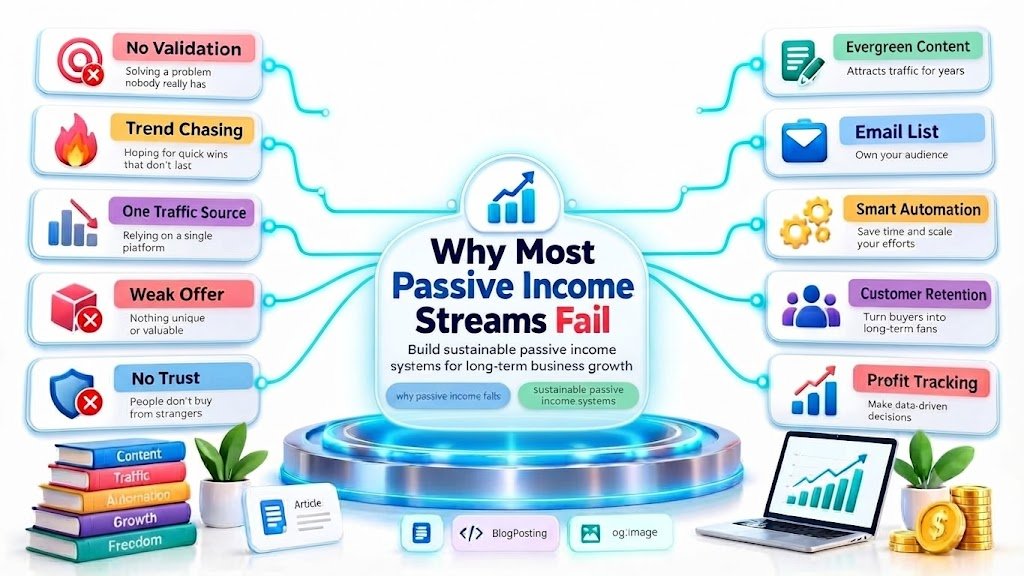
Learn why passive income fails and how to build sustainable systems with evergreen products, reliable traffic, automation, and long-term profits.
Passive Income Strategy | Sustainable Online Business | Digital Entrepreneurship | Long-Term Wealth Building
What if the biggest reason your passive income isn’t growing has nothing to do with how hard you work—but everything to do with the system you built?
Every day, thousands of aspiring entrepreneurs launch blogs, digital products, affiliate websites, online courses, automated stores, and other income-generating projects. Many start with genuine enthusiasm, invest countless hours, and imagine a future where their businesses generate revenue without requiring constant attention.
Then reality arrives.
Website traffic fluctuates. Affiliate commissions disappear. Digital products stop selling. Advertising costs increase. An automated store suddenly needs hours of customer support. A promising side hustle becomes another demanding job.
The problem is not necessarily that passive income is impossible.
The problem is that many people build income streams without building sustainable businesses around them.
Most fragile passive income projects depend on temporary attention, individual effort, or a single source of revenue. Sustainable passive income systems depend on repeatable customer value, dependable processes, financial discipline, and continuous improvement.
Understanding this distinction can change how you approach online entrepreneurship.
Whether you’re a beginner exploring your first digital product or an experienced creator trying to build a more reliable long term business, this guide explains why passive income fails, which warning signs matter, and how to create an income-generating system designed to survive changing markets.
What Is Passive Income, and Why Is It So Difficult to Sustain?
Passive income generally refers to earnings that do not require continuous, direct labor for every transaction.
Examples include:
- Selling downloadable templates, eBooks, and other digital products.
- Earning affiliate commissions from evergreen articles.
- Generating advertising revenue from established websites.
- Selling recorded courses through automated delivery systems.
- Licensing photography, illustrations, music, or software.
- Receiving recurring payments from subscription-based digital services.
However, business-related passive income is rarely completely hands-off.
A digital product requires updates. An affiliate website needs accurate information. A subscription service requires customer support, technical maintenance, and retention efforts.
Even a mature business needs monitoring.
The real objective should not be earning money without ever working again. It should be creating an asset that can generate meaningful value and revenue without requiring your constant participation in every sale.
The Difference Between Passive Income and Sustainable Passive Income
Imagine two entrepreneurs.
The first creates a trending digital product, promotes it aggressively on social media, and generates $2,000 in one month. The following month, the trend disappears, engagement declines, and sales fall sharply.
The second creates a practical digital product that solves a recurring business problem. They publish evergreen educational content, build an email list, develop a simple automated sales funnel, and regularly update the product.
Their initial earnings may be lower. However, their business has multiple mechanisms for attracting customers and maintaining relevance.
Neither outcome is guaranteed, but the second model is generally better positioned for long-term resilience.
A successful month proves that sales are possible. A sustainable system provides a way to keep earning, learning, and improving over time.
10 Reasons Most Passive Income Streams Fail
Understanding why passive income fails begins with identifying the weaknesses that undermine otherwise promising business ideas.
1. Chasing Quick Money Instead of Solving Real Problems
One of the most damaging mistakes is choosing a passive income opportunity based exclusively on its advertised earning potential.
People see headlines about profitable printables, AI-generated eBooks, affiliate websites, or automated online stores and immediately attempt to reproduce the business model.
They often overlook a fundamental question:
Who needs this product, and why would they pay for it?
Customers do not purchase digital products because the creator wants passive income. They purchase because a product saves time, solves a problem, provides useful knowledge, or delivers a desired experience.
For example, a generic productivity planner might compete with thousands of similar products.
A specialized appointment tracker designed for independent beauty professionals has a more identifiable audience and a clearer purpose.
How to avoid this mistake: Before creating a product, research the customer problem, evaluate existing alternatives, and confirm that potential buyers have a meaningful reason to choose your solution.
A small, clearly defined market with an urgent problem can be more valuable than a broad market with little buying intent.
2. Depending on Only One Traffic Source
A website that receives most of its traffic from Google may suffer when search visibility changes.
An online store relying exclusively on Instagram can lose customers when engagement declines.
An affiliate marketer dependent on a single YouTube channel may experience a significant revenue disruption if that channel stops performing.
This is known as concentration risk.
The business depends heavily on something the owner does not fully control.
A more sustainable strategy combines several relevant traffic channels.
| Traffic channel | Primary purpose |
|---|---|
| Organic search | Capture ongoing search demand |
| Email marketing | Build repeat engagement and customer relationships |
| Support discovery of useful visual and evergreen content | |
| YouTube | Demonstrate expertise and build audience trust |
| Social media | Reach new audiences and encourage interaction |
| Referral partnerships | Attract relevant customers through trusted recommendations |
Not every business needs every channel.
Start with one proven acquisition channel, then gradually develop another so the entire business does not depend on a single platform.
Practical action: Track how much traffic and revenue comes from your largest channel. If losing it would threaten your business, make diversification a priority.
3. Building Products Without Validating Demand
Creating something is easier than proving that someone wants to purchase it.
This becomes especially important with AI-assisted product development.
AI can help entrepreneurs produce eBooks, templates, worksheets, training materials, and other digital resources more efficiently. However, faster production does not automatically create customer demand.
Consider a creator who spends three weeks designing a collection of 100 digital planners without researching the intended audience.
The collection may look attractive but still struggle to generate sales.
A better approach begins with demand validation.
Search for recurring customer questions. Study product reviews to identify missing features. Analyze competitor positioning. Speak with potential buyers and, where practical, offer a small paid pilot.
Instead of producing 100 products immediately, create one focused solution and evaluate genuine purchasing behavior.
The goal is not to create the largest possible product library. It is to create products that customers find useful enough to purchase.
4. Confusing Automation With a Complete Business Model
Automation can help a business operate efficiently, but it cannot repair a weak offer.
A creator may automate content scheduling, email sequences, order processing, and product delivery while still struggling to attract paying customers.
Why?
Because automation only makes an existing process faster and more repeatable.
If a product has poor positioning, unclear benefits, or insufficient demand, automating its promotion can simply reproduce those weaknesses at scale.
Build the business process first.
Identify the audience, validate the product, establish a reliable conversion process, and understand customer objections.
Then automate the repeatable tasks.
For sustainable passive income systems, automation should reduce unnecessary work while preserving product quality and customer satisfaction.
5. Ignoring Customer Trust and Experience
Trust is one of the most valuable assets in a long term business.
Customers need confidence that a product will deliver what is promised, their payment will be handled securely, and support will be available when needed.
Unfortunately, some passive income entrepreneurs focus almost entirely on acquiring the next customer.
They overlook what happens after the purchase.
A buyer who receives a poorly organized digital product, broken download link, or misleading sales promise may never return.
Worse, negative experiences can discourage other customers.
Build trust through accurate descriptions, realistic demonstrations, clear licensing terms, transparent refund policies, timely support, and reliable delivery.
A trustworthy business can create repeat purchases and referrals that reduce dependence on constant new-customer acquisition.
6. Underestimating Ongoing Maintenance Costs
Passive income does not mean maintenance-free income.
Websites require hosting, security updates, and content reviews.
Digital courses may need revisions when tools or techniques change.
Membership businesses must continually demonstrate value.
Software products need technical support.
Creators who ignore these responsibilities often discover that their supposedly passive asset becomes less useful over time.
Build maintenance into your business plan from the beginning.
Reserve a portion of revenue and working time for product improvements, security, support, and infrastructure.
A sustainable business is not one that never requires attention. It is one whose maintenance needs remain manageable relative to the value it creates.
7. Focusing on Revenue Instead of Profit
High sales figures can create the illusion of success.
However, revenue and profit are not interchangeable.
Suppose a digital product business generates $3,000 in monthly revenue.
Illustrative monthly business performance
$3,000 Revenue
| Advertising | $900 |
| Software subscriptions | $200 |
| Contractor support | $600 |
| Payment fees and refunds | $150 |
| Other operating costs | $250 |
Operating profit before tax and owner compensation
$900
Hypothetical figures for educational purposes, not a typical or promised earnings result.
The business retains $900 before taxes and owner compensation.
That distinction becomes particularly important when evaluating advertising campaigns, affiliate programs, and digital product profitability.
Track not just sales, but also customer acquisition costs, refunds, recurring expenses, and the hours required to operate the business.
8. Building Around Short-Lived Trends
Trends can create opportunities, but they rarely provide a complete long-term strategy.
A product associated with a temporary social media craze may generate short bursts of demand without producing lasting customer interest.
An evergreen business focuses on problems that continue to exist.
Examples include time management, career development, business administration, financial organization, creative education, and professional productivity.
This does not mean avoiding emerging trends.
It means connecting new developments to durable customer needs.
For example, instead of selling a generic collection of trending AI prompts, a creator might develop an AI-assisted customer service workflow kit for small businesses.
The technology may evolve, but the underlying need to manage customer communication remains.
Build around persistent problems, then use emerging technology to deliver better solutions.
9. Failing to Build an Audience They Can Reach Again
A visitor who reads an article and leaves may never return.
A customer who purchases a product without developing any ongoing relationship with the brand may also disappear.
This creates a constant need to acquire new traffic.
An email list, subscriber community, useful resource library, or account-based customer portal can help maintain relationships beyond the initial visit.
For example, a blog article explaining how to manage freelance invoices might offer a free invoice checklist.
Readers who find the checklist valuable may voluntarily subscribe to receive practical business resources.
Later, some may become interested in an advanced invoice template bundle or business operations toolkit.
The essential principle is simple:
Do not treat every visitor as a one-time transaction. Give people a meaningful reason to return.
Always obtain appropriate marketing consent and provide an easy way to unsubscribe.
10. Quitting Before Gathering Enough Useful Data
Many entrepreneurs abandon an idea after a few weeks because sales do not immediately match expectations.
Others continue investing indefinitely in an offer that has not demonstrated meaningful demand.
Both extremes can be costly.
Sustainable growth requires measurable experiments and decision points.
Track customer behavior, evaluate results, and distinguish between problems that can be improved and ideas that should be discontinued.
Low website traffic may indicate a distribution problem.
Good traffic but few sales may indicate mismatched search intent, weak product positioning, pricing concerns, or poor landing-page clarity.
A high refund rate may point toward product quality or expectation gaps.
Treat these signals as information rather than personal judgments.
How to Build Sustainable Passive Income Systems That Last
Long-term success becomes more achievable when the business is designed as a connected system rather than a collection of disconnected activities.
A practical framework includes six essential components.
The Sustainable Passive Income System
Defined Customer ProblemStart with genuine demand
SYSTEM 1
Valuable Offer
A focused solution
SYSTEM 2
Evergreen Traffic
Consistent discovery
SYSTEM 3
Conversion System
Clear buying path
SYSTEM 4
Customer Retention
Ongoing trust
SYSTEM 5
Smart Automation
Efficient operations
SYSTEM 6
Performance Review
Continuous improvement
Repeatable, Resilient BusinessRevenue, feedback, reinvestment, and growth
System 1: Choose a Problem That Customers Consistently Need Solved
Your niche influences nearly every business decision.
A sustainable niche should combine ongoing customer demand, a problem you can solve effectively, and a realistic way to reach buyers.
Consider these examples:
| Target audience | Recurring problem | Potential digital product |
|---|---|---|
| Freelancers | Tracking invoices and deadlines | Freelance Business Dashboard |
| Small retailers | Managing inventory and orders | Inventory Spreadsheet Kit |
| Bloggers | Planning and organizing content | SEO Content Planning Toolkit |
| Job seekers | Preparing applications | Resume and Interview Workbook |
| Teachers | Organizing classroom activities | Printable Learning Resources |
| Content creators | Managing publishing schedules | Creator Workflow Templates |
Look for customers with problems that recur monthly, quarterly, or annually.
Recurring problems can support product updates, complementary offers, and repeat purchases.
System 2: Create an Evergreen Product With a Clear Outcome
A strong digital product should help the customer move from a specific problem to a desirable result.
Compare these product descriptions:
Generic offer: “500 Productivity Templates.”
Outcome-focused offer: “A Small Business Planning Kit to Organize Weekly Tasks, Client Deadlines, and Monthly Priorities.”
The second communicates a clearer audience, purpose, and expected benefit.
It is easier for visitors to evaluate whether it fits their needs.
To improve product value, include clear instructions, practical examples, accessible formatting, useful supporting materials, and realistic descriptions of what is included.
Avoid excessive complexity.
Customers frequently value a simple tool that works reliably more than a massive collection that is difficult to navigate.
System 3: Build an Evergreen Content Engine
Evergreen content addresses questions people continue asking over time.
Examples include:
- How to create a monthly business budget.
- How to start an affiliate marketing website.
- How to organize a digital product store.
- How to build an email marketing sequence.
- How to choose productivity tools for freelancers.
Each article should serve a specific search intent.
Informational visitors may want education.
Commercial investigation visitors may want comparisons.
Transaction-ready visitors may want to purchase a solution.
A sustainable publishing strategy connects these stages naturally.
For example:
Educational article: How to Organize Freelance Business Finances
Comparison article: Spreadsheet vs. Accounting Software for Freelancers
Product-focused article: What to Look for in a Freelance Invoice Tracker
Commercial destination: Freelance Finance Dashboard Product Page
This structure helps readers progress from learning about a problem to evaluating a possible solution.
Internal links should be relevant and helpful rather than inserted only to increase clicks.
System 4: Design a Conversion Funnel That Respects the Customer
A reliable sales funnel should guide visitors toward a decision without creating unnecessary pressure.
A straightforward digital product funnel might work like this:
Discovery
Visitor finds a useful article or video
Lead Magnet
Visitor chooses to download a free resource
Email Education
Helpful tips and product-relevant examples
Product Offer
Clear explanation, preview, price, and terms
Customer Experience
Reliable delivery, guidance, and support
Retention
Relevant updates and optional complementary products
An effective funnel does not require complicated software.
It requires a relevant message, a trustworthy offer, clear navigation, and a straightforward buying experience.
Conversion hooks should focus on usefulness.
For example:
Spending more time organizing client information than serving your clients? Explore a ready-to-customize workflow template that helps keep your tasks and deadlines in one place.
This communicates a specific problem and introduces an appropriate solution without promising unrealistic results.
System 5: Automate Repetitive Work, Not Human Judgment
Once you understand how a business process works, automation can make it more efficient.
Good candidates include payment confirmations, digital download delivery, email welcome sequences, basic order tracking, routine data reporting, and content scheduling.
However, avoid automating decisions that require contextual judgment without oversight.
Sensitive customer complaints, refund exceptions, complicated technical problems, and substantial product quality concerns may need personal attention.
An automated business should still feel reliable and accessible to customers.
System 6: Establish a Monthly Performance Review
Businesses become more resilient when decisions are based on meaningful information.
Monitor a focused set of indicators.
| Metric | What it reveals |
|---|---|
| Qualified website visits | Whether the right audience is arriving |
| Email opt-in rate | Whether visitors value the free resource |
| Sales conversion rate | Whether the offer matches buyer expectations |
| Average order value | Revenue generated per completed order |
| Customer acquisition cost | Cost of attracting a new paying customer |
| Refund rate | Possible dissatisfaction or expectation problems |
| Repeat purchase rate | Whether customers return to buy again |
| Operating profit | Whether the business is financially worthwhile |
| Owner hours worked | How passive the operation actually is |
Review these numbers consistently, but avoid reacting to every small fluctuation.
A meaningful trend over time is usually more useful than a single day’s performance.
Calculate Whether Your Passive Income Business Is Actually Sustainable
A valuable measure is not simply how much money your business earns.
It is how much operating profit remains relative to the time, money, and risk required to maintain it.
Consider this simplified example.
Passive Income Sustainability Calculator
Adjust the hypothetical numbers to explore your business economics.Monthly revenue
$2,000Monthly operating expenses
$650Owner hours per month
20 hours
Operating profit
$1,350
Profit per owner hour
$68
Excludes taxes, owner compensation, startup investment, depreciation, and the value of unpaid work. Profit per owner hour is an operational indicator, not an investment return.
This example can help reveal whether an apparently successful income stream is actually consuming too many resources.
If revenue increases while profit decreases, growth may be creating additional costs rather than financial stability.
If profit remains steady while required working hours decline, the business may be becoming more operationally efficient.
Both patterns deserve attention.
The Passive Income Durability Test: Seven Questions Every Entrepreneur Should Ask
A sustainable passive income system needs more than a profitable product.
It needs to withstand changing conditions.
Before investing further in an existing business, consider these seven questions:
- Would customers still need this solution two years from now?
- Can the business attract buyers without relying exclusively on one platform?
- Can the product be delivered consistently without manual intervention for every order?
- Are the operating costs reasonable relative to revenue?
- Can routine operations continue during a short absence?
- Is there a practical method for collecting customer feedback and improving the offer?
- Would the business remain viable if sales declined temporarily?
You can evaluate your business using this interactive checklist.
Business Durability Self-Assessment
0/7My product solves a recurring customer problemI have more than one viable audience acquisition channelMost product delivery tasks are repeatable or automatedI understand my operating costs and profitRoutine operations can continue during a short absenceI have a customer feedback and improvement processI have a plan for temporary declines in sales
Several important foundations need attention
Prioritize customer demand, profitability, and repeatable processes before expanding.
Copy my assessment
This is a practical self-assessment rather than a validated risk model, but it can help identify areas that deserve attention.
Three Passive Income Business Models and How to Make Them More Sustainable
Model 1: Evergreen Blogging and Affiliate Marketing
Blogging can support revenue through affiliate commissions, advertising, sponsored content, and digital products.
However, a blog that relies on a small number of affiliate links and one search traffic source is vulnerable.
A stronger model develops topic expertise, publishes helpful evergreen content, updates outdated recommendations, and builds direct audience relationships.
For example, a blog focused on freelancer productivity might publish detailed guides about client management, scheduling, invoicing, and business tools.
Relevant affiliate recommendations can help readers evaluate software while digital downloads provide an additional revenue stream.
The opportunity is not simply earning commissions.
It is building a useful information resource that people repeatedly consult.
Model 2: Digital Products and Downloadable Resources
Digital products are attractive because the same underlying file can often be sold repeatedly without manufacturing physical inventory for each order.
Still, customer demand, marketing, maintenance, and support require attention.
A sustainable digital product business might begin with one high-quality spreadsheet template, validate demand, and gradually add complementary resources.
A customer who purchases an inventory tracker may later need a purchasing log or sales reporting dashboard.
These additional offers should exist because they solve connected problems, not merely to increase the number of products available.
Clear instructions, fair licensing, and reliable file access are especially important.
Model 3: Online Courses and Digital Education
Recorded courses can reduce the need to deliver every lesson live.
However, educational content becomes less valuable when information becomes outdated or students cannot apply what they learn.
A more sustainable course business focuses on measurable learning objectives, useful exercises, accurate demonstrations, and ongoing improvements.
For example, a course teaching small business owners to use AI tools should explain durable principles such as workflow design, verification, privacy, and human oversight.
Specific interfaces and tool recommendations may need periodic updates.
The lasting product is not a collection of videos.
It is a well-designed learning experience.
How to Turn One-Time Buyers Into Returning Customers
A returning customer can be valuable because an existing relationship may reduce the effort required to explain your business and establish trust.
However, repeat purchasing cannot be forced.
It must be earned through relevance and positive experiences.
Create a Useful Customer Journey
A practical digital product customer journey could include:
Day 0 — Purchase: The customer receives the product, clear access instructions, and a receipt.
Day 2 — Getting Started: A helpful message explains how to use the product effectively.
Day 7 — Practical Application: The customer receives a relevant tip or example, where communication permissions allow.
Day 21 — Feedback Opportunity: The business invites honest feedback and offers support.
Day 30 — Relevant Follow-Up: A complementary resource is introduced only if it genuinely matches the customer’s needs and marketing consent.
These are illustrative touchpoints, not an ideal schedule for every business.
The goal is to improve product adoption and customer satisfaction before promoting additional purchases.
Give New Visitors a Reason to Return
Many first-time visitors are not ready to buy.
They may be researching, comparing options, or trying to understand their problem.
Offer a useful next step.
For a passive income education website, this might be a downloadable worksheet titled:
The Passive Income Business Health Checklist: 15 Questions to Evaluate Your Next Digital Income Idea
The resource should deliver standalone value rather than exist only as an advertisement.
A relevant newsletter can then provide updates, practical case studies, and useful guides.
Consistent value creates a reason for visitors to return voluntarily.
How to Protect Your Business From Platform Changes and Market Disruption
A sustainable business needs a contingency plan.
Search engines change how content is discovered. Social platforms evolve. Payment services revise policies. Affiliate programs can change commission structures.
Businesses cannot control every external event, but they can reduce dependence on individual providers.
Build Assets You Can Control
Where practical, invest in assets such as your own domain, original content, a permission-based subscriber list, proprietary product files, documented workflows, and a recognizable brand.
These assets are not immune to change, but they can provide more flexibility than relying exclusively on a third-party marketplace or social media account.
Keep appropriate backups and maintain exportable customer records where legally permitted.
Maintain an Emergency Operating Reserve
A business with fixed expenses can face financial pressure during periods of weak sales.
Consider maintaining funds to cover several months of essential operating expenses, based on your circumstances.
The appropriate amount depends on revenue volatility, recurring obligations, and available personal resources.
An emergency reserve does not guarantee survival, but it can provide time to investigate problems without making rushed decisions.
Review Supplier and Platform Dependence
Document which services are essential to your operations.
These may include hosting, email marketing, payment processing, cloud storage, licensing providers, and product delivery software.
Identify whether alternatives exist and how difficult switching would be.
You do not need duplicate subscriptions to every service.
You do need to understand where a single failure could interrupt your business.
How to Use AI Without Making Your Passive Income Business Fragile
Artificial intelligence can support content planning, customer service workflows, research organization, product documentation, and administrative tasks.
Used carefully, it may reduce repetitive work.
However, excessive dependence on AI-generated output can introduce new risks.
Incorrect product instructions, unverified financial information, misleading claims, copied material, and generic content can damage customer trust.
For an AI-assisted business, establish human quality-control standards.
Review factual claims, verify sources, respect copyright and licensing rights, protect confidential customer information, and test products before publishing them.
AI should support your ability to solve customer problems, not replace your responsibility for the result.
In a market where content can be generated quickly, reliable expertise, original insight, and customer experience become important ways to differentiate your business.
A Practical 90-Day Plan to Build a Long-Term Passive Income Business
Creating sustainable passive income systems requires structured execution rather than endless experimentation.
Here is a realistic framework for the first 90 days.
| Period | Primary focus | Key actions |
|---|---|---|
| Days 1–15 | Market validation | Research problems, customer needs, and competitors |
| Days 16–30 | Product development | Build a focused minimum viable offer and test usability |
| Days 31–45 | Publishing infrastructure | Create product pages, payment systems, policies, and delivery workflows |
| Days 46–60 | Audience acquisition | Publish helpful content and test one primary traffic channel |
| Days 61–75 | Conversion improvement | Analyze visitor questions, sales friction, and customer feedback |
| Days 76–90 | System refinement | Improve operations, document workflows, and evaluate sustainability |
The objective is not to guarantee a profitable business within 90 days.
It is to test a business model, gather real evidence, and establish repeatable operations.
Some products may require substantially longer validation periods.
Other ideas may reveal weak demand early and deserve reconsideration.
Both outcomes can provide useful information.
Common Passive Income Mistakes vs. Sustainable Alternatives
| Fragile approach | Sustainable alternative |
|---|---|
| Follow every trending niche | Focus on persistent customer needs |
| Publish large volumes of generic content | Create useful, differentiated resources |
| Depend on one traffic source | Develop a balanced acquisition strategy |
| Automate an untested offer | Validate before automating |
| Count gross revenue as success | Track profit, time, and cash flow |
| Ignore customers after purchase | Build support and retention processes |
| Sell products without updates | Maintain quality and relevance |
| Expand before proving demand | Improve a successful core offer first |
| Use exaggerated income promises | Communicate realistic outcomes |
| Chase fast growth without documentation | Build repeatable operating procedures |
The deeper lesson is that passive income sustainability does not come from eliminating every task.
It comes from designing a business where value creation, customer acquisition, delivery, and improvement operate together.
Five Frequently Asked Questions About Sustainable Passive Income
1. Why do most passive income streams fail?
Passive income streams often fail because they lack validated customer demand, dependable traffic, profitable operations, or ongoing maintenance. Some are built around temporary trends or depend heavily on a single platform. Building a sustainable system requires a useful offer, diversified risks, controlled expenses, and continuous improvement. There is no reliable universal failure percentage covering every type of passive income business.
2. What is the most sustainable passive income business for beginners?
There is no universally best option. Digital products, evergreen niche websites, affiliate content, and educational resources can be suitable for beginners depending on skills, available time, starting capital, and customer demand. A small, well-validated product often offers a manageable way to test a business idea before investing in a larger operation.
3. How long does it take to build sustainable passive income?
The timeline varies substantially. Some businesses generate early sales, while others need months or years to develop reliable demand and profitability. A 90-day plan can help validate assumptions and establish core processes, but it cannot guarantee sustainable revenue. The more useful milestones are repeat purchases, predictable operations, acceptable profit margins, and manageable maintenance.
4. Can AI help build a long-term passive income business?
Yes. AI can assist with research organization, content outlines, workflow documentation, support processes, and digital product development. However, AI-generated materials require factual verification, originality checks, and human oversight. Long-term success still depends on solving real customer problems and maintaining trust.
5. How can I make passive income more reliable?
Begin with a validated customer problem and a clear product offer. Track profitability, establish repeatable delivery systems, collect customer feedback, and gradually diversify traffic sources. Build direct customer relationships with appropriate consent, maintain your products, and reserve time and funds for unexpected changes. The objective is resilience rather than completely eliminating effort.
Build an Income System That Can Grow Beyond Your Daily Effort
Passive income becomes more meaningful when it is treated as a business-building discipline rather than a shortcut to easy money.
A successful digital asset should solve a real problem, attract suitable customers, deliver consistent value, and generate enough profit to justify its ongoing costs.
Automation makes this process more efficient. Evergreen content can support continuing discovery. Customer trust creates opportunities for repeat engagement. Financial monitoring helps prevent growth from becoming an expensive illusion.
But none of these elements works reliably in isolation.
The strongest long-term business is built by connecting them.
You do not need to launch dozens of products immediately, master every marketing platform, or automate every part of your business.
Start with one customer problem.
Create one useful solution.
Develop one dependable way to attract buyers.
Measure what works and improve the system.
Over time, those connected assets and processes may create a business that becomes less dependent on your daily involvement while remaining valuable to customers.
Your goal should not be to build an income stream that needs no attention. It should be to build a system that remains worth maintaining.
Your Next Step: Build Your Passive Income Foundation
Instead of launching another untested income idea, evaluate your existing business—or your next planned project—against three questions.
Does it solve a real customer problem? Can it generate revenue after accounting for expenses? Can its operations become more repeatable over time?
If any answer is unclear, begin there.
Explore a practical passive income planning toolkit with a business validation checklist, monthly profit tracker, content planning worksheet, and operating procedures template. Use it to organize your decisions before investing more money in tools, advertising, or product development.
A carefully designed system can become a more valuable asset than another collection of disconnected income ideas.
Compliance Note and Responsible Business Disclosure
Educational and financial information: This article is provided for general educational and informational purposes. It does not constitute personalized financial, investment, legal, tax, or professional business advice. Passive income ventures involve risk, and earnings, profitability, and timelines vary according to business models, customer demand, competition, costs, execution, and market conditions. No level of income or business success is guaranteed.
Income examples: Financial calculations, scenarios, schedules, and business examples presented here are hypothetical and for illustration only. They do not represent verified earnings results, industry averages, or typical customer outcomes. Readers should independently evaluate expenses, potential losses, taxes, and legal obligations before making business decisions.
Advertising and affiliate relationships: Any paid recommendations, sponsorships, or affiliate partnerships connected to a published version of this article should be disclosed clearly near the relevant promotional material. Material relationships should not be concealed. In the United States, applicable FTC endorsement and advertising guidance calls for clear and conspicuous disclosures, and earnings representations must be substantiated.
Federal Trade Commission
Digital product compliance: Sellers should verify that they have appropriate intellectual property rights, permissions, and resale licenses for digital products. Refund policies, privacy practices, customer data processing, email marketing, advertising claims, and applicable taxes must comply with relevant laws and platform policies in the jurisdictions where the business operates.
AI-generated materials: AI-assisted content and products should be reviewed for accuracy, originality, safety, privacy, and licensing compliance. AI tools may generate inaccurate or incomplete information, and responsibility for published claims remains with the publisher or business operator.
Search visibility: SEO, GEO/AEO optimization, structured data, and Google Discover best practices can improve content organization and eligibility for some search features, but they do not guarantee rankings, traffic, inclusion in AI-generated answers, or Google Discover placement. Google explicitly notes that structured data does not guarantee enhanced search appearances.
Stay ahead with exclusive updates
Join our community. Get curated industry trends, actionable guides, and fresh resources delivered straight to your inbox.