
Discover the real differences in startup costs, profitability, customer retention, scalability, and long-term earning potential—and learn how to choose the subscription business that fits your skills, budget, and audience.
Imagine waking up on the first day of a new month and knowing that hundreds of customers have already signed up to pay for your products or services.
You haven’t launched a new promotion. You haven’t spent the morning chasing individual orders. Instead, your business has an established base of customers who receive ongoing value through a subscription.
That is the attraction of recurring revenue.
But there’s an important decision to make before building a subscription business: Should you deliver a physical subscription box or create a digital membership?
Both models can produce repeat purchases, strengthen customer relationships, and create more predictable revenue. However, they operate very differently.
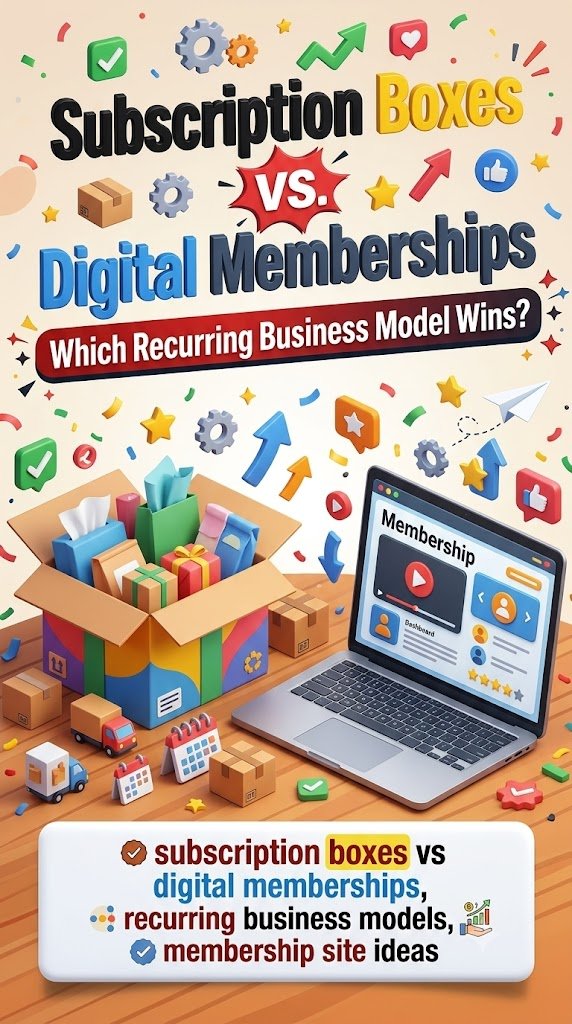
A subscription box business sends carefully selected physical products to customers at regular intervals. A digital membership provides ongoing access to exclusive content, tools, communities, resources, or services.
One creates excitement through physical discovery. The other delivers convenience and continuous access to valuable information or experiences.
And while both can become successful businesses, they don’t offer the same profit margins, financial risks, or growth opportunities.
The short answer: Digital memberships generally have an advantage for entrepreneurs seeking low startup costs, flexible operations, and scalability without physical inventory. Subscription boxes can be a stronger fit when customers value tangible products, curated discovery, or recurring essential purchases.
The real winner depends on what customers are willing to continue paying for—and whether you can deliver that value profitably.
What Is a Recurring Business Model?
A recurring business model generates revenue by charging customers at regular intervals in exchange for continuing access to products, services, or benefits.
Instead of relying entirely on one-time purchases, a subscription business encourages customers to maintain an ongoing relationship with the brand.
Common recurring revenue models include monthly subscription boxes, digital memberships, paid newsletters, software subscriptions, online learning communities, and premium resource libraries.
For example, a traditional digital product seller might earn $29 when someone purchases an eBook.
A membership creator might charge $15 per month for access to a growing collection of guides, templates, and live workshops.
The second business has an opportunity to earn revenue from the same customer repeatedly, provided the customer continues to find the membership valuable.
This distinction matters because sustainable recurring revenue is not simply about getting someone to subscribe.
It is about giving customers a compelling reason to remain subscribers.
Why recurring revenue appeals to entrepreneurs
Recurring business models offer several potential advantages:
- More predictable revenue planning as subscriptions accumulate.
- Opportunities to build long-term customer relationships.
- Potentially higher customer lifetime value.
- Easier demand forecasting when renewal patterns become established.
- Opportunities to recommend upgrades, complementary products, and premium services.
However, recurring revenue is not guaranteed revenue.
Customers can cancel subscriptions, payment methods can fail, and businesses may face increasing acquisition costs.
A profitable recurring business requires a balance between attracting new subscribers, retaining existing customers, and controlling expenses.
Subscription Boxes vs. Digital Memberships: Understanding the Difference

Subscription boxes
Physical products delivered on a recurring schedule.

Digital memberships
Online access to a continuously valuable collection of resources or experiences.
A subscription box is a recurring commerce business. Customers pay to receive physical items, often monthly, quarterly, or according to a personalized delivery schedule.
A digital membership is an access-based business. Customers pay to unlock a collection of digital benefits that continue throughout their membership.
Both depend on repeated customer satisfaction, but their operating costs and delivery requirements differ significantly.
Subscription Boxes vs. Digital Memberships: Side-by-Side Comparison
| Business factor | Subscription boxes | Digital memberships |
|---|---|---|
| Startup investment | Usually moderate to high | Usually low to moderate |
| Inventory | Physical stock often required | No physical inventory |
| Shipping | Required | Not required |
| Packaging | Recurring cost | Generally unnecessary |
| Geographic reach | Limited by delivery logistics | Potentially global |
| Delivery speed | Dependent on shipping | Usually immediate |
| Gross-margin potential | Often lower | Often higher |
| Operational complexity | Inventory, packing, fulfillment | Content, access, engagement |
| Customer experience | Tangible and sensory | Convenient and interactive |
| Scaling challenge | Logistics and working capital | Engagement and support |
| Main retention driver | Product quality and recurring usefulness | Continuing relevance and participation |
| Typical major risk | Unsold stock and fulfillment costs | Weak engagement and cancellations |
| Best suited for | Physical product brands and curators | Educators, creators, experts, communities |
Neither model guarantees profitability. A poorly planned digital membership can lose money, while a well-managed subscription box with loyal customers may become a substantial business.
The better comparison is not simply which business earns more revenue, but which produces more contribution profit, stronger retention, and sustainable growth.
1. Subscription Boxes: Turning Physical Products Into Repeat Purchases
Subscription boxes combine product curation, convenience, and anticipation.
Instead of customers choosing every product individually, a business selects items according to a particular theme or customer need.
Consider a monthly wellness subscription.
A customer pays $45 and receives a curated collection of self-care items, such as skincare samples, bath products, and relaxation accessories.
The customer benefits from discovering products without researching and purchasing each item separately.
The company benefits from recurring orders and improved visibility into future demand.
Popular subscription box business ideas

Specialty coffee subscription
Monthly deliveries of carefully selected coffee beans, tasting notes, and brewing recommendations for enthusiasts.

Beauty and skincare discovery box
Curated products for customers interested in exploring brands, skincare routines, and personal care.

Kids’ educational activity box
Age-appropriate crafts, puzzles, hands-on projects, and learning materials delivered regularly.

Stationery and journaling box
Creative writing supplies, notebooks, planner accessories, and seasonal stationery collections.
Other promising niches include pet enrichment, gardening, hobby supplies, ethical fashion accessories, and locally sourced snacks.
The strongest opportunities usually solve a specific customer need rather than offering a random assortment of products.
Advantages of subscription boxes
They create a memorable experience. Opening a thoughtfully designed package offers an emotional experience that a digital download cannot fully reproduce.
They encourage product discovery. Customers can explore new brands and products without selecting everything themselves.
They can build stronger brand recognition. Packaging, presentation, and physical product quality influence how customers remember the brand.
They support product partnerships. Suppliers may offer sampling arrangements, wholesale discounts, or collaborative campaigns, although these arrangements are not guaranteed.
They are well suited to replenishment. Consumables such as coffee, grooming products, or pet supplies can create recurring demand when delivered conveniently.
Disadvantages of subscription boxes
Physical subscriptions come with unavoidable operational responsibilities.
Businesses must consider procurement, storage, damaged products, packing materials, shipping expenses, inventory forecasting, customer service, and returns.
These issues become more challenging as subscriber numbers increase.
For instance, shipping 50 boxes per month might be manageable from a home office.
Shipping 5,000 boxes could require a warehouse, professional fulfillment systems, dedicated customer support, and substantial working capital.
A guide from Shopify explains how subscription fulfillment includes inventory management, packing, shipping, and return processing, whether handled internally or through a third-party provider.
Shopify UK
Who should start a subscription box business?
This model may be a strong choice if you already have supplier relationships, understand physical retail, enjoy product curation, or serve customers who regularly consume tangible products.
It is particularly attractive when customers can clearly understand why receiving the product repeatedly saves them effort or improves their experience.
2. Digital Memberships: Selling Continuous Access Instead of Physical Products
Digital memberships provide subscribers with ongoing access to online resources, exclusive experiences, or communities.
The offering might include courses, downloadable templates, expert guidance, educational videos, private discussion groups, or regularly updated collections.
Unlike physical goods, digital resources can usually be delivered to additional subscribers without repeated manufacturing or shipping expenses.
That creates an appealing opportunity for creators, bloggers, educators, freelancers, and entrepreneurs with specialized knowledge.
How a digital membership works
Imagine a graphic designer creating a membership for small business owners.
Subscribers pay $19 per month and receive access to:
- Editable social media templates.
- New promotional design packs.
- Brand-building tutorials.
- A searchable library of previous resources.
- Monthly design workshops.
- Community discussions and feedback.
The designer invests time in developing and maintaining the library.
As more customers join, the same resources can serve many subscribers, although hosting, support, software, and ongoing production costs may rise.
This combination of reusable content and continuing value makes digital memberships attractive as a scalable online business model.
10 Profitable Digital Membership Site Ideas to Explore
These are business concepts worth testing, not guaranteed profitable niches.
| Membership idea | Target audience | Recurring value |
|---|---|---|
| AI productivity resource library | Entrepreneurs and professionals | Updated prompts, workflows, templates |
| Social media template club | Creators and businesses | Monthly content designs and calendars |
| Freelance business community | Freelancers | Client resources, workshops, support |
| Blogging and SEO membership | Bloggers and publishers | Content frameworks, audits, training |
| Digital planner library | Students and professionals | Planners, trackers, productivity tools |
| Photography editing club | Photographers | Presets, editing tutorials, critiques |
| Language learning membership | Language learners | Lessons, exercises, conversation sessions |
| Career growth membership | Job seekers | Resume templates, interview practice |
| Small business operations club | Business owners | SOPs, calculators, operating guides |
| Creative writing community | Authors and aspiring writers | Prompts, workshops, peer feedback |
The biggest mistake is selecting a membership idea simply because it appears popular.
A profitable membership requires a particular audience that experiences a recurring problem.
For example, a general collection of downloadable business documents may attract occasional buyers.
A membership offering updated client onboarding documents, contract checklists, and workflow templates specifically for freelance designers is more focused.
That specificity can make the membership easier to explain, market, and improve.
Advantages of digital memberships
Lower physical operating costs: There are no routine packaging, inventory, or shipping requirements.
Global delivery potential: Customers can access digital services from different regions, subject to platform support, payment availability, laws, and localization.
Flexible pricing: Businesses can experiment with monthly, annual, tiered, and group membership options.
Scalable resources: The same educational content, templates, or digital tools can serve multiple subscribers.
Customer engagement opportunities: Communities, live sessions, updates, and personalized recommendations help create continuing relationships.
Automation potential: Billing, content access, onboarding, renewal communications, and some support workflows can be automated.
Disadvantages of digital memberships
Digital memberships are not automatically passive income.
A successful membership often requires regular improvements, customer communication, technical maintenance, marketing, and community management.
Members may cancel when they stop using the resources or believe they can obtain similar value elsewhere.
There is also the risk of producing too much content.
Publishing dozens of new resources every month sounds attractive, but a growing library is not valuable if customers cannot easily find or use its contents.
The strongest digital memberships focus on useful outcomes, not just content quantity.
A customer who pays $29 per month for templates that save several hours of work may perceive more value than someone paying $9 for hundreds of files they never use.
3. Which Business Model Makes More Money?
Revenue is important, but it does not tell the complete story.
A subscription business could generate $20,000 in monthly sales and still struggle financially if operating expenses are too high.
A smaller digital membership might produce less revenue but retain substantially more money after direct expenses.
To understand the difference, consider two hypothetical businesses, each with 500 paying subscribers.
Example A: Monthly subscription box
ILLUSTRATIVE MONTHLY FINANCIAL MODEL
Subscribers
500
Monthly price
$40
| Monthly revenue | $20,000 |
| Products ($14 × 500) | −$7,000 |
| Packaging ($3 × 500) | −$1,500 |
| Shipping ($7 × 500) | −$3,500 |
| Processing and fulfillment ($2 × 500) | −$1,000 |
Monthly contribution before shared overhead
$7,000
35% contribution margin
The business generates $20,000 in revenue but has $13,000 in direct fulfillment and product expenses.
The remaining $7,000 must still cover marketing, customer acquisition, administration, website expenses, salaries, returns not included above, and other overhead.
Example B: Monthly digital membership
ILLUSTRATIVE MONTHLY FINANCIAL MODEL
Subscribers
500
Monthly price
$25
| Monthly revenue | $12,500 |
| Hosting and platform allocation | −$600 |
| Payment processing | −$500 |
| Content and member service delivery | −$2,000 |
Monthly contribution before shared overhead
$9,400
75.2% contribution margin
Despite generating less revenue, this hypothetical membership retains a larger contribution after its modeled direct expenses.
These figures are illustrative assumptions, not industry averages or income forecasts. Both examples exclude taxes, founder compensation, general administration, acquisition costs, and other expenses not explicitly listed. Actual costs vary substantially.
What these numbers reveal
Higher revenue does not automatically mean higher profit.
Digital memberships may retain more revenue because there are no recurring physical product, packaging, and shipping costs.
However, that advantage decreases if the membership depends heavily on individualized coaching, live support, expensive licensed content, or paid instructors.
A digital membership charging $25 per month while delivering $40 of individual service time per customer is not a sustainable model.
The profitable approach is to design benefits that customers genuinely value while keeping fulfillment costs manageable.
4. Calculate the Earning Potential of Your Subscription Idea
Before launching either business, calculate the economics using your own numbers.
Subscription Profit Calculator
Explore different subscriber counts, pricing, and costs.
Digital membershipPhysical boxPaying subscribersMonthly price ($)Direct cost/customer ($)Fixed monthly costs ($)
Estimated monthly operating surplus
$3,000
Monthly revenue
$5,000
After direct costs
$3,800
Contribution margin
76.0%
Break-even subscribers
43
Copy my calculationEstimates assume all subscribers pay for the month. Enter your own costs, including any acquisition spending or labor you want included. This is not a net-profit forecast and does not model churn, refunds, financing, or taxes separately.
The calculator reveals something important: increasing subscribers only improves profitability when the revenue received from each customer exceeds the cost of serving them.
A business with weak unit economics may become less sustainable as it grows.
5. Customer Retention: The Real Secret Behind Recurring Revenue
Attracting customers is only half the challenge.
Keeping subscribers engaged is what creates durable recurring income.
Consider two businesses with the same starting membership count.
Business A regularly attracts new members but loses a significant percentage each month.
Business B grows more slowly but retains most existing subscribers.
Over time, Business B may become more financially resilient because it needs fewer new customers simply to replace cancellations.
This is why subscription businesses must understand customer churn.
What is customer churn?
Customer churn is the rate at which customers stop paying for a subscription over a given period.
A simple starting-period churn calculation is:
\[ \text{Churn Rate}=\frac{\text{Subscribers Lost During Period}}{\text{Subscribers at Period Start}}\times100 \]
If a business starts the month with 200 subscribers and 10 cancel, its starting-base churn rate is 5%.
Different analytics platforms may use slightly different definitions, particularly when considering subscribers who join and cancel within the same reporting period. Stripe documents one approach to tracking subscription churn through its billing analytics.
Stripe Support
How to reduce subscription box cancellations
For physical boxes, the most important retention factors often include dependable delivery, perceived value, product relevance, and customer service.
A good subscription box should reduce friction rather than introduce it.
Offer transparent delivery schedules, flexible subscription frequencies, and useful personalization. Customers may appreciate options to skip a box, pause deliveries, or change product preferences.
A recurring essentials box should arrive before the customer runs out of supplies.
A discovery box should consistently offer something worth anticipating.
How to reduce digital membership cancellations
Digital membership retention depends on whether customers continue to experience meaningful benefits.
One of the most effective approaches is to design a guided member journey.
New members should immediately understand what to do first.
For example, a membership focused on business productivity could offer a seven-day onboarding path that helps subscribers organize their workflow, select templates, and complete one practical project.
This is more useful than welcoming subscribers with a library containing 2,000 unorganized downloads.
Other practical retention methods include personalized recommendations, periodic new resources, progress tracking, live questions-and-answers, member feedback, and relevant renewal reminders.
The first 30 days matter
The opening month is an opportunity to establish customer confidence.
For both models, aim to deliver a recognizable result soon after the first payment.
A subscription box might include a welcome guide explaining how to use every item.
A membership might offer a quick-start course that creates a useful outcome within the first week.
Customers who understand the value of what they purchased have a clearer reason to continue.
6. Customer Lifetime Value vs. Acquisition Cost
Two financial metrics deserve particular attention when evaluating recurring business models.
Customer lifetime value (LTV) estimates the contribution or revenue a customer generates throughout the subscription relationship, depending on the definition being used.
Customer acquisition cost (CAC) measures how much the business spends to gain a new paying customer.
Consider a simplified digital membership example.
A customer pays $20 monthly and incurs $5 in monthly variable delivery costs. The business therefore earns $15 in monthly contribution before fixed overhead.
If the customer remains for eight months, the estimated contribution lifetime value is $120.
If acquisition costs $30, the business has $90 of modeled lifetime contribution remaining to cover overhead and profit.
Actual results will vary with cancellations, discounts, payment failures, and changes in delivery expenses.
Now consider a subscription box generating $12 in monthly contribution from each subscriber.
If acquisition costs $36, the business needs approximately three paid billing cycles to recover that acquisition expense, before fixed costs.
This is one reason retention becomes critical in physical subscriptions.
Why a low acquisition cost is not enough
A business might attract customers through free trials, steep discounts, or highly persuasive advertising.
But those subscribers are not necessarily profitable.
If customers cancel immediately after receiving an introductory offer, the subscription can lose money.
Good marketing should attract customers who genuinely want continuing access to the product or service.
A smaller group of well-matched customers is often more valuable than a large audience attracted by unrealistic promises.
7. Which Model Is Easier to Start With a Small Budget?
For most first-time entrepreneurs, digital memberships are financially easier to test.
A membership can begin with a relatively small library of resources, a payment system, a basic website, and a clearly defined offer.
It is not always necessary to develop custom software or build an extensive content platform.
You can validate demand with a founding-member offer, small paid workshop series, or limited membership pilot.
Subscription boxes require more preparation because customers expect physical deliveries.
Even a small launch might involve purchasing stock, packaging, calculating shipping fees, reviewing product safety obligations, and coordinating deliveries.
A practical comparison for a beginner
Suppose you have $500 available for a business experiment.
A digital membership creator might use that budget for website setup, a payment platform, a basic design system, and audience testing.
A physical subscription box business may need to spend much of that amount on sample products, packaging, and shipping before testing demand at scale.
This does not mean a subscription box cannot begin with limited funds. Preorders, supplier partnerships, and narrowly defined product selections can reduce upfront exposure.
However, physical fulfillment introduces risks that digital content businesses generally avoid.
For someone with specialized knowledge but limited capital, a small digital membership is often the more practical first experiment.
8. The Hybrid Membership Model: Combining Physical and Digital Value
One overlooked opportunity is to combine a subscription box with a digital membership.
Rather than choosing only physical products or digital access, a business can build a membership experience that connects the two.
Imagine a monthly art subscription.
Members receive physical drawing tools, sketching paper, or creative supplies. They also gain access to online tutorials, practice challenges, and a private community.
The physical products provide a tangible experience.
The digital content helps subscribers use those products and develop skills.
Hybrid subscription business examples
| Physical subscription | Digital membership benefit |
|---|---|
| Coffee box | Brewing lessons and tasting workshops |
| Art supplies | Guided drawing classes and challenges |
| Gardening box | Plant-care tutorials and seasonal calendars |
| Children’s activity kit | Parent guides and educational videos |
| Fitness accessories | Workout programs and progress trackers |
The hybrid approach can improve differentiation because it sells more than a collection of products.
It offers an ongoing experience built around a meaningful customer interest.
However, the business must still manage physical fulfillment and digital engagement simultaneously.
A hybrid is best introduced when customers clearly want both components, rather than adding complexity simply to appear premium.
9. How to Choose the Right Recurring Business Model
Not every entrepreneur should start the same subscription business.
The right choice depends on the audience, available resources, operational experience, and type of value being delivered.
Which Business Fits You?
0 of 5
Answer five questions to identify which model better matches your preferences.
1. What do you prefer creating?Physical productsKnowledge, tools, or digital resources
2. What startup budget feels manageable?I can fund inventory and shippingI prefer minimal upfront spending
3. How would you rather serve customers?Through delivered productsThrough online learning or resources
4. What are your strongest skills?Sourcing, merchandising, and logisticsTeaching, writing, designing, or community-building
5. What operational setup do you want?I am comfortable managing shipmentsI prefer online delivery and fewer physical processes
Your personalized recommendation appears once you’ve answered all five questions.
A useful principle is to start with the model that allows you to test real demand with the smallest manageable financial commitment.
There is little advantage in building a complicated recurring revenue system before knowing whether enough customers want the offer.
10. How to Launch a Recurring Subscription Business in 30 Days
A 30-day plan can help entrepreneurs move from an untested concept to a small pilot without prematurely investing in a large operation.
Days 1–5: Define your audience and recurring problem
Start with a specific customer group.
Instead of targeting everyone interested in business, focus on freelance designers who need client management resources, or small café owners who need updated promotional templates.
For a physical subscription, identify an audience with repeat purchasing needs or strong interest in ongoing product discovery.
Research problems, existing alternatives, price expectations, and dissatisfaction with current solutions.
Aim to identify a recurring need that people already spend money addressing.
Days 6–10: Validate willingness to pay
Create a clear description of your subscription offer.
Explain who it helps, what customers receive, how frequently benefits are delivered, and what the subscription costs.
Speak with potential customers and invite them to join a paid pilot.
Interest alone is weak evidence. A paid commitment is more meaningful, provided the offer and terms are clear.
Avoid purchasing substantial inventory or producing an extensive digital library before gathering this evidence.
Days 11–15: Build the minimum viable offer
For a subscription box, select a small product collection, confirm supply, calculate delivered costs, and prepare sample packaging.
For a digital membership, build enough material to deliver the initial promise.
This could include a small template library, a guided course, a resource database, or an initial live session.
The goal is not to look like the largest company in your category.
It is to deliver a focused benefit reliably.
Days 16–20: Create your subscription sales page
Your sales page should answer the questions customers naturally ask before subscribing.
Explain what they receive, who the offer is designed for, how the subscription works, when they are charged, how frequently it renews, and how to cancel.
Use screenshots, realistic product photography, sample resources, and relevant demonstrations.
Make pricing easy to understand.
Do not rely on artificial urgency or exaggerated earnings claims.
An effective subscription sales page reduces uncertainty and helps customers decide whether the offer fits their needs.
Days 21–25: Launch a small pilot
Invite a limited number of customers to test the complete experience.
Evaluate the buying process, payment confirmation, onboarding, delivery, and support.
Ask subscribers which benefits are genuinely useful and where the experience is confusing.
Resolve operational problems before scaling.
Days 26–30: Improve the offer and prepare for renewal
Review subscriber feedback, delivery expenses, engagement, and support requests.
For physical boxes, confirm that supplier lead times and shipping costs remain manageable.
For digital memberships, check whether members actually use the resources.
Plan the next month’s value before aggressively acquiring more subscribers.
The objective is to create a business customers want to renew, not merely a product they purchase once.
11. How to Attract Subscribers Without Depending Entirely on Paid Advertising
One of the biggest challenges in recurring revenue businesses is finding a sustainable way to acquire new customers.
Paid advertising can generate subscribers quickly, but acquisition expenses can also reduce profitability.
A more resilient approach combines useful content, targeted search traffic, referrals, and email marketing.
Create content around problems your ideal customers already search for
A digital membership focused on productivity templates might publish useful articles such as:
- How to Create a Weekly Business Planning System
- Best Client Management Templates for Freelancers
- How to Organize a Small Business Without Expensive Software
These articles can attract people who are actively looking for practical solutions.
A subscription box business selling coffee might publish brewing tutorials, bean comparison guides, and practical advice for choosing a coffee subscription.
The goal is to introduce the business through genuinely useful information rather than immediately pushing visitors toward a checkout page.
Build an email audience before asking for a subscription
Many visitors are not ready to subscribe during their first website visit.
An email newsletter provides an opportunity to develop trust through helpful content.
Offer a relevant free resource, such as a small template pack, printable guide, short lesson, or buyer’s checklist.
Then send useful follow-up content that demonstrates the value of the paid subscription.
For example, a creative writing membership might offer five free writing exercises and invite subscribers to receive a new writing prompt every week.
When readers see consistent quality, they may become more comfortable exploring the paid membership.
Make your articles worth returning to
A website that publishes only promotional content gives readers little reason to return.
Instead, develop a recognizable editorial experience.
Publish practical tutorials, original examples, product comparisons, customer questions, and updated resource guides.
Give visitors a reason to bookmark the website.
A simple recurring feature such as “Membership Business Idea of the Week” can encourage readers to revisit the site and subscribe to future updates.
Increase discoverability through useful, answer-focused content
Search visibility often improves when articles provide clear explanations of reader questions, accurate information, descriptive headings, practical examples, and credible supporting sources.
For emerging search experiences and AI-generated answers, make important definitions and comparisons easy to understand without surrounding them with unnecessary promotional language.
For example, someone asking whether a digital membership is cheaper to operate than a subscription box should find a direct answer supported by realistic costs and relevant qualifications.
Original calculators, transparent worked examples, firsthand research, and actionable frameworks provide value beyond generic summaries.
Strong featured images, accurate page titles, mobile-friendly design, descriptive image alternatives, and appropriate structured data can also improve how content is understood and presented.
Google Discover visibility and prominent search placement cannot be guaranteed. The strongest approach is to consistently publish trustworthy, useful material that serves a recognizable audience.
12. Pricing Strategies That Encourage Long-Term Membership
Pricing is not simply about choosing an amount customers can afford.
It communicates the value of the subscription and influences retention, perceived quality, and profitability.
Monthly subscriptions
Monthly billing offers customers flexibility and a relatively low initial commitment.
It is particularly suitable for new businesses because customers can test the offering without making a large upfront payment.
However, customers may evaluate whether to continue every month, making early value delivery important.
Annual subscriptions
Annual memberships can create stronger upfront cash flow and reduce monthly renewal decisions.
For example, a $20 monthly membership costs $240 over 12 months.
An annual plan priced at $199 offers customers a lower annual cost while providing the business with upfront payment.
However, annual payments may introduce refund obligations, deferred service commitments, and accounting considerations.
A business should not treat all annual subscription cash as immediately earned profit.
Tiered memberships
Some businesses benefit from offering multiple subscription levels.
For instance, a digital membership could include a basic resource library, a professional tier with monthly workshops, and a premium tier offering group guidance.
Each additional tier should have clearly differentiated benefits.
Too many choices can confuse potential customers and make subscription management unnecessarily complicated.
Start with a simple pricing structure and expand only when actual customer needs justify it.
13. Common Mistakes That Can Destroy a Recurring Business
One of the most dangerous assumptions is that recurring billing automatically creates recurring customer value.
A customer might forget to cancel for a period, but that does not make the relationship healthy or sustainable.
Long-term profitability depends on ongoing trust.
Launching without demand validation
Entrepreneurs sometimes build hundreds of resources or purchase months of inventory before making their first sale.
This approach creates avoidable financial risk.
Test a smaller offer before investing substantially.
Competing only on price
Offering the cheapest subscription may attract customers who are quick to switch when another discount appears.
Instead, focus on a particular audience, clearly differentiated benefits, reliability, and ease of use.
Ignoring customer feedback
Cancellation surveys, support conversations, and customer interviews can reveal weaknesses that sales numbers alone do not expose.
A subscriber who cancels because a box arrives late requires a different solution from someone who cancels because the products are no longer relevant.
Overpromising monthly benefits
A digital membership promising 100 new templates every month may become difficult to maintain.
A subscription box promising premium products at an unsustainably low price may struggle with supplier costs.
Set a delivery promise that the business can consistently fulfill.
Measuring subscriber growth without profitability
Subscriber counts can create the illusion of success.
A business adding 100 subscribers per month while losing 120 is shrinking.
Likewise, a business gaining subscribers at an acquisition cost greater than their expected contribution lifetime value may become financially weaker as it expands.
Track customer retention, contribution margin, acquisition cost, cash flow, and customer satisfaction together.
14. Subscription Boxes vs. Digital Memberships: Which Model Wins in Different Situations?
| Lowest physical startup requirements | Digital membership |
| Recurring consumable purchases | Subscription box |
| No packaging or shipping | Digital membership |
| Tangible gifting experience | Subscription box |
| Reuse of educational content | Digital membership |
| Physical product discovery | Subscription box |
| Potential to combine product and learning benefits | Hybrid model |
| Lower delivery costs as subscriber counts grow | Often digital membership |
The result becomes clearer when comparing business requirements instead of relying on general assumptions.
Digital memberships are often better suited to entrepreneurs selling knowledge, skills, software tools, digital resources, and ongoing professional support.
Subscription boxes are often better suited to brands selling consumables, curated products, gifts, and tactile experiences.
A hybrid can be effective when combining the two increases customer value enough to justify the additional operational costs.
15. Frequently Asked Questions
1. Are digital memberships more profitable than subscription boxes?
Digital memberships often have higher gross-margin potential because they do not require physical inventory, packaging, or shipping.
However, profitability depends on pricing, subscriber retention, marketing expenses, platform fees, and service delivery costs.
A physical subscription with efficient procurement and strong customer retention can outperform a digital membership with expensive support requirements and high churn.
2. How much money do I need to start a digital membership business?
A simple digital membership may be launched with a modest budget using existing content, hosted membership tools, and basic website infrastructure.
Costs increase if you require custom development, premium video production, paid instructors, advanced community features, or substantial advertising.
Before committing to a platform, calculate both one-time setup expenses and recurring software, payment processing, and customer support costs.
3. What are the best membership site ideas for beginners?
Promising beginner-friendly concepts include specialized template libraries, educational communities, digital planner collections, writing groups, resource memberships, and practical skill-development programs.
The most important consideration is whether customers have a recurring need and a reason to continue subscribing.
Start with a topic you understand well and an audience you can reach.
4. Can a subscription business generate passive income?
Subscription businesses can create recurring revenue, but they rarely operate without ongoing work.
Digital memberships may automate payment processing, resource delivery, and onboarding. Subscription boxes may automate billing, inventory workflows, and shipping notifications.
Both still require customer service, maintenance, financial oversight, and continuing value delivery.
The realistic goal is to build an efficient business that earns recurring income without requiring the founder to personally handle every task.
5. Should I start with a subscription box or a digital membership in 2026?
If you have limited capital, specialized knowledge, and an audience that values online resources, a digital membership may be the more practical starting point.
If you have access to reliable physical product suppliers and customers who regularly purchase or enjoy curated products, a subscription box may offer a compelling opportunity.
Test whichever model has the clearest customer demand, strongest unit economics, and most manageable operational requirements.
16. Build the Subscription Business Customers Want to Keep
The future of a recurring business is not determined by whether the offering arrives in a cardboard box or through an online dashboard.
It is determined by the usefulness of the experience customers receive month after month.
A beautiful subscription box that delivers disappointing products will struggle to retain customers.
A digital membership containing thousands of resources that nobody uses faces the same problem.
The businesses with stronger long-term potential focus on a clear audience, solve a recurring problem, deliver measurable or recognizable value, and improve based on customer feedback.
For beginners seeking a lower-cost, flexible way to test recurring revenue, a focused digital membership is often the stronger starting option.
For entrepreneurs with physical product experience and dependable fulfillment systems, a subscription box can create a differentiated business that digital products cannot fully replace.
And when tangible products genuinely complement online education or community benefits, a hybrid model may offer the most distinctive customer experience.
The important question is not which model sounds more impressive.
It is this: What valuable outcome can you deliver so consistently that customers will be happy to renew their subscription?
Start with one specific audience, one meaningful problem, and one manageable promise.
Validate the offer with paying customers, measure actual profitability, and improve the experience before scaling.
Your first subscription business does not need thousands of customers.
It needs a small group of satisfied customers who find enough value to stay.
Ready to explore your first recurring business idea? Choose one audience, write down the subscription benefit you could deliver every month, and calculate your costs using the calculator above.
For more practical business strategies, explore our related guides on building high-value membership sites, selecting profitable micro-niches, creating evergreen sales funnels, and developing sustainable recurring income systems.
Compliance Note
This article provides general educational information about recurring business models, subscription boxes, digital memberships, marketing, and financial planning. It is not legal, tax, accounting, investment, or personalized business advice.
All prices, margins, subscriber counts, operating examples, and calculator defaults are hypothetical illustrations. They are not verified industry averages, guaranteed outcomes, or representations of actual business earnings. Profitability depends on individual circumstances, execution, costs, competition, customer behavior, and market conditions.
Subscription providers should clearly disclose recurring charges, billing frequency, trial conditions, renewal dates, delivery commitments, cancellation procedures, refund policies, and other material terms before collecting payment. Obtain legally appropriate customer consent and provide accessible account and cancellation options.
Applicable laws vary by country, state, product category, and customer location. In the United States, the Federal Trade Commission’s 2024 nationwide Click-to-Cancel amendments were vacated by a federal appeals court in July 2025. Other applicable federal requirements and state automatic-renewal laws remain relevant, and further regulatory changes are possible.
Federal Register Public Inspection
Business owners should verify current requirements before launching.
Physical subscription businesses may face additional obligations involving consumer product safety, labeling, food handling, cosmetics, shipping, returns, environmental rules, and import or export requirements.
Digital memberships should review intellectual property ownership, content licensing, accessibility, privacy, data security, consumer protection, tax obligations, and payment processor requirements. Using stock resources, templates, AI-generated materials, or third-party digital products does not automatically establish the right to redistribute or resell them.
Any testimonials, earnings examples, performance statements, promotional discounts, or affiliate endorsements must be accurate, appropriately substantiated, and disclosed where legally required.
Search visibility, featured content placement, website traffic, subscriber growth, and business income are not guaranteed. Business decisions should be based on independently verified costs, customer research, financial records, and qualified professional advice when necessary.
Stay ahead with exclusive updates
Join our community. Get curated industry trends, actionable guides, and fresh resources delivered straight to your inbox.