
The internet has trained creators to chase one number above almost everything else: traffic.
More pageviews. More followers. More subscribers. More impressions.
It sounds logical. If 10,000 visitors are good, surely 100,000 must be better.
But revenue does not always follow that equation.
A website attracting 15,000 highly relevant visitors can sometimes build a stronger business than a general-interest site attracting 100,000 people who have little intention of buying anything. The difference is not simply audience size. It is audience concentration, relevance, trust, purchase intent, and the value of each visitor.
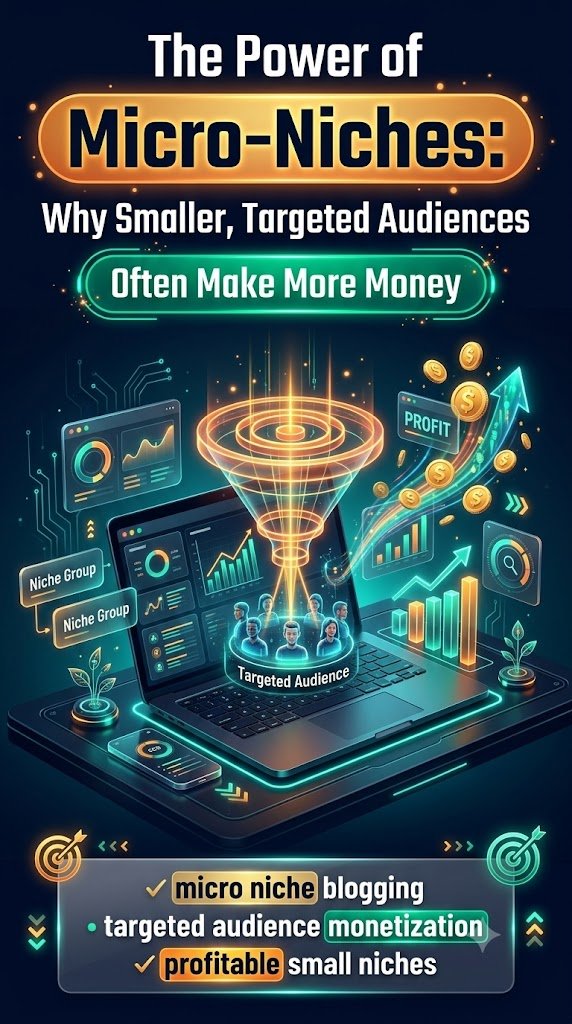
That is where micro niche blogging becomes powerful.
Instead of trying to become useful to everybody interested in a broad subject, a micro-niche business becomes extremely useful to a clearly defined type of person with a clearly defined problem.
A broad website might target:
“Fitness.”
A niche website could focus on:
“Strength training for busy professionals.”
A micro-niche could become:
“20-minute strength workouts for remote-working professionals over 40.”
The potential audience becomes smaller.
But something important happens at the same time: the message becomes significantly more relevant.
When the right visitor arrives, that person is more likely to think:
“This website is built for someone exactly like me.”
That reaction can be commercially more valuable than thousands of casual pageviews.
For bloggers, consultants, educators, affiliate marketers, digital-product creators, newsletter publishers, and small online businesses, understanding this difference can completely change how they approach audience growth.
What Is a Micro-Niche?
A micro-niche is a tightly defined segment inside a larger market.
It usually combines a broader topic with a specific audience, problem, situation, outcome, product category, location, skill level, or purchasing need.
“Personal finance” is a market.
“Budgeting” is a niche.
“Budgeting for freelancers with irregular income” is a micro-niche.
“Photography” is broad.
“Wedding photography” is narrower.
“Marketing systems for solo wedding photographers” is much more specific.
The goal is not to make the audience as tiny as possible.
The goal is to make the audience specific enough that you can understand what people need, what they search for, what frustrates them, what they already buy, and what would motivate them to return.
That distinction matters.
A micro-niche is not simply a low-volume keyword.
It is a recognizable group of people with related needs.
Why Smaller Audiences Can Produce More Revenue
The economics become easier to understand when you stop asking:
“How many visitors can I attract?”
and start asking:
“How valuable can I become to the right visitor?”
Imagine two websites.
The first receives 100,000 visitors per month. Its topic is broad, its visitors arrive with very different motivations, and only 0.5% eventually purchase a $20 product.
That would produce approximately $10,000 in illustrative gross sales.
Now imagine a highly specialized website receiving only 15,000 visitors monthly. Because its content, offers, email sequences, and recommendations are closely aligned with the audience, 4% purchase an average $40 offer.
That would produce approximately $24,000 in illustrative gross sales.
The smaller website receives 85% less traffic but generates more than twice the hypothetical sales revenue.
The example is deliberately simplified and should not be treated as an earnings forecast. Real conversion rates vary dramatically by industry, pricing, traffic quality, trust, geography, offer, competition, and many other factors.
The underlying principle, however, is important:
Relevant traffic can be more valuable than large amounts of unfocused traffic.
This is the foundation of effective targeted audience monetization.
Micro-Niches Make Your Value Proposition Easier to Understand
Broad businesses frequently struggle with vague positioning.
Consider this description:
“We help people become more productive.”
Compare it with:
“We help freelance designers manage client projects without working nights and weekends.”
The second message immediately identifies the customer, the problem, and the desired outcome.
Visitors do not have to interpret whether the product is meant for them.
That clarity can improve almost every commercial layer of a website.
Your homepage becomes easier to write.
Your lead magnet becomes easier to define.
Your email newsletter becomes easier to position.
Your affiliate recommendations become more relevant.
Your digital products become more specific.
Your calls to action become more natural because the next step can directly solve the problem the reader is already researching.
Specificity reduces friction.
And reducing friction often improves conversion.
Search Intent Becomes Much Clearer
Micro-niches can also create an important advantage in search.
Someone searching for “email marketing” could want almost anything.
They might want a definition, software recommendation, course, statistics, examples, jobs, templates, or agency.
Now consider:
“Email welcome sequence for wedding photographers.”
The search volume may be much smaller, but the intent is dramatically clearer.
A publisher serving wedding photographers can answer that query with a highly relevant article, downloadable template, email platform recommendation, course, consultation, or membership.
This is why profitable small niches should not automatically be judged by search volume alone.
Commercial opportunity depends on the relationship between demand and value.
One visitor trying to solve a $5,000 business problem may be commercially more valuable than hundreds of visitors looking for free entertainment.
Micro-Niche Blogging Can Build Topical Depth Faster
A smaller subject area also gives an independent publisher a realistic opportunity to cover a topic comprehensively.
Suppose you launch a site about “small business.”
You could potentially write about accounting, marketing, hiring, sales, taxes, productivity, ecommerce, customer service, leadership, cybersecurity, software, financing, real estate, insurance, legal issues, and hundreds of additional subjects.
Building genuine depth becomes difficult.
Now narrow the publication to:
“Email marketing for independent fitness coaches.”
Suddenly the content ecosystem becomes far more coherent.
You could publish articles about lead magnets for fitness coaches, onboarding sequences, inactive-client campaigns, referral emails, consultation follow-ups, newsletters, client-retention campaigns, seasonal promotions, email software, automation, segmentation, subject lines, landing pages, conversion measurement, and privacy considerations.
Each article supports the others.
Readers interested in one page are likely to be interested in several more.
That creates stronger internal navigation, deeper sessions, more newsletter subscriptions, more returning visitors, and more opportunities to demonstrate expertise.
Google explicitly recommends creating helpful, reliable content primarily for people and asks publishers to consider whether their site has an intended audience and a clear primary purpose or focus.
Micro-niching does not automatically produce rankings, but a focused editorial strategy can make it easier to create the kind of coherent, useful resource an identifiable audience actually wants.
Trust Develops Faster When Readers Feel Understood
Trust is difficult to manufacture through design or persuasive copy alone.
It usually grows when readers repeatedly encounter accurate information that reflects their real situation.
A generic article might tell freelancers:
“Create a budget and save money every month.”
Someone earning exactly the same amount every payday may find that sufficient.
A freelancer with fluctuating monthly income needs something more specific.
A specialized publication could discuss income smoothing, tax reserves, emergency buffers, delayed invoices, seasonal revenue, business expenses, payment schedules, and planning around unpredictable cash flow.
That reader may think:
“This person actually understands how my finances work.”
That moment is commercially significant.
Readers buy from businesses they trust to understand both the problem and the context surrounding the problem.
Micro-niches give publishers more opportunities to demonstrate that understanding.
Smaller Audiences Often Have Stronger Community Potential
There is another advantage that traffic statistics rarely capture: identity.
People do not usually identify themselves as “internet users interested in productivity.”
They may identify as:
A freelance illustrator.
A homeschooling parent.
A first-time Airbnb host.
A solo accountant.
A food photographer.
A Shopify jewelry seller.
A new puppy owner living in an apartment.
A retired traveler exploring Europe.
When content reflects someone’s identity, occupation, stage of life, or specific challenge, the website can become more than another information source.
It can become a destination.
That matters because profitable publishing increasingly depends on more than one-time search visitors.
You want people who bookmark your guides, subscribe to your newsletter, follow your updates, share your resources, purchase multiple products, recommend you to colleagues, and return when they encounter their next problem.
A micro-niche makes that relationship easier to cultivate because the next article is likely to matter to the same person who enjoyed the previous one.
The Returning Visitor Is Often More Valuable Than the First Visit
Many websites obsess over acquiring new visitors while underestimating the commercial value of the second, third, tenth, or twentieth visit.
The first visit introduces your brand.
Repeated visits build familiarity.
Familiarity can create trust.
Trust can lead to subscriptions, referrals, purchases, upgrades, or consulting inquiries.
This means your publishing strategy should answer two questions simultaneously:
“What information brought this reader here today?”
and:
“What reason will make this reader come back next week?”
That second question is where many micro-niche websites can outperform broader competitors.
A site covering everything struggles to create anticipation.
A site serving a recognizable community can develop recurring editorial formats such as monthly benchmarks, case studies, market updates, tools, templates, experiments, buyer guides, interviews, trend reports, and practical tutorials.
Every article can solve today’s problem while quietly opening the door to tomorrow’s visit.
Buyer Intent Matters More Than Raw Keyword Volume
Some keywords attract researchers.
Others attract buyers.
Consider the difference between:
“What is podcast editing?”
and:
“Best podcast editing software for two-person interview shows.”
The second searcher appears much closer to a product decision.
That does not mean every article should become a sales page.
It means content strategy should recognize different levels of commercial intent.
A healthy micro-niche publication can serve someone from the moment they recognize a problem through the moment they choose a solution.
For example, someone researching a home coffee business might move through questions about startup costs, packaging, licensing, equipment, labeling, pricing, shipping, ecommerce platforms, photography, customer retention, and marketing.
A publisher that answers those questions intelligently becomes part of the customer’s buying journey.
That creates several legitimate monetization opportunities without forcing sales messaging into every paragraph.
Micro-Niches Can Improve Affiliate Marketing
Affiliate marketing is particularly dependent on relevance.
A generic technology website may promote hundreds of unrelated products.
A specialized publication can recommend a carefully selected technology stack for a specific audience.
Consider a website devoted to productivity systems for independent architects.
Software recommendations could include project-management tools, cloud storage, invoicing software, drawing tablets, client portals, scheduling tools, backup systems, and proposal platforms.
Every recommendation exists inside a meaningful professional context.
Instead of writing:
“This is excellent project-management software.”
The publisher can explain:
“This feature is especially useful when an independent architect needs to collect client feedback without creating another email thread.”
That is significantly more useful.
Google’s spam policies distinguish useful affiliate sites from thin affiliate pages that simply reproduce merchant information. Google specifically points toward adding meaningful value through original information, reviews, testing, comparisons, or useful navigation rather than copying retailer descriptions.
In practical terms, micro niche blogging works best for affiliate monetization when specialization produces better advice, not merely more affiliate links.
Digital Products Become Easier to Design
One of the biggest advantages of a targeted audience is product clarity.
Ask a broad audience:
“What product should I create?”
You may receive dozens of unrelated answers.
Ask independent wedding photographers:
“What part of running your business repeatedly wastes your time?”
Patterns are much more likely to appear.
Perhaps they struggle with client onboarding.
That could lead to a template pack containing inquiry responses, consultation questionnaires, timelines, contracts, shot-list planners, payment reminders, and follow-up sequences.
Perhaps they struggle with social content.
That could lead to a content planning system.
Perhaps they struggle with pricing.
That could lead to a pricing calculator and workshop.
Instead of inventing products and hoping the audience wants them, you can observe recurring problems and design products around real demand.
This is one of the strongest forms of targeted audience monetization because the content business becomes a continuous research engine for future products.
Premium Pricing Becomes More Defensible
General products compete heavily on price.
Specialized products can compete on relevance.
Imagine two ebooks.
The first is called:
“How to Get More Clients.”
The second is:
“The Client Referral System for Independent Interior Designers.”
If you are an interior designer, the second product immediately appears more relevant.
The author can include examples involving renovation timelines, contractors, architects, homeowners, design consultations, project photography, referrals, and past-client follow-up.
The information may justify a higher price because the buyer does not need to translate generic advice into their profession.
Specialization can therefore increase perceived value.
That does not mean attaching “for dentists,” “for photographers,” or “for consultants” to a generic product automatically makes it premium.
The product must genuinely reflect the audience.
Specific positioning creates attention.
Specific usefulness creates value.
Membership Sites Benefit From Shared Problems
Micro-niches are also well suited to recurring-revenue models when the audience experiences ongoing challenges rather than one-time problems.
A membership for “entrepreneurs” is difficult to differentiate.
A membership for “independent bookkeeping firms trying to grow beyond referrals” has a clearer purpose.
Members may want recurring support with marketing, client acquisition, automation, pricing, hiring, software, templates, accountability, and operations.
Because members share similar circumstances, the discussions become more useful.
One person’s question may help dozens of other members.
Templates require less adaptation.
Workshops can become more practical.
Networking becomes more relevant.
Recurring revenue becomes possible when recurring value exists.
The niche alone does not create retention. The membership must continue solving problems worth paying to solve.
Email Marketing Becomes More Effective
A newsletter titled “Weekly Marketing Tips” is competing with thousands of similar publications.
A newsletter called “The Monday Growth Brief for Independent Physiotherapy Clinics” has a much clearer reason to exist.
The audience knows what it will receive.
The publisher knows what to write.
Advertisers know whom they are reaching.
Products become easier to position.
And subscribers are more likely to recognize whether the publication is relevant before joining.
This alignment can improve the quality of the email list even if subscriber growth is slower.
A smaller list of engaged people with shared interests can often be more commercially useful than a huge list collected through unrelated lead magnets.
Advertisers May Value Audience Precision
Advertising economics are not based solely on audience size.
Certain businesses will pay more attention to publications that reach difficult-to-find customer groups.
Imagine a newsletter with 8,000 commercial drone photographers.
A manufacturer selling professional drone equipment may consider that audience extremely relevant.
Now compare it with a general photography newsletter reaching 80,000 subscribers.
The second audience is larger, but many subscribers may photograph weddings, landscapes, portraits, sports, wildlife, products, or simply take pictures as a hobby.
Audience concentration can therefore become an asset.
Publishers selling sponsorships should understand not just how many people they reach but who those people are, what decisions they influence, what tools they use, and what they purchase.
The Best Micro-Niches Sit at the Intersection of Problems and Spending
Small does not automatically mean profitable.
A successful micro-niche usually needs more than audience specificity.
There should be meaningful problems to solve.
The audience should actively seek information.
Commercial solutions should exist.
People should have a reason to spend money.
There should be enough depth to support continued publishing.
And ideally, the audience should experience several connected problems rather than one isolated question.
Consider:
“Quotes about yellow notebooks.”
It may be highly specific, but the commercial ecosystem is limited.
Compare that with:
“Bookkeeping systems for Etsy sellers.”
That niche contains multiple ongoing problems involving taxes, inventory, profit tracking, fees, expenses, payment processing, software, business structures, reporting, and cash flow.
Specificity is useful only when it intersects with meaningful demand.
Start With the Customer, Not the Keyword Tool
Keyword research is useful, but it should confirm a market rather than invent one.
Before choosing a micro-niche, understand the person behind the search query.
Imagine interviewing ten potential readers.
What do they repeatedly complain about?
What mistakes cost them money?
What responsibilities consume their time?
What have they already purchased?
Which solutions disappointed them?
What questions do they repeatedly ask?
What happens if they fail to solve the problem?
What outcome would make them happily pay for help?
Those questions reveal the economic structure of the niche.
Search tools can then help identify how people express those problems online.
The best opportunities often appear where human frustration and searchable demand overlap.
Do Not Mistake Low Competition for Opportunity
One dangerous micro-niche strategy is searching for keywords with extremely low competition and assuming they represent easy money.
Sometimes competition is low because demand is weak.
Sometimes there are few advertisers because customers rarely spend.
Sometimes the keyword has volume but almost no commercial intent.
Sometimes the information can be answered completely in one sentence, giving visitors little reason to explore the site.
Competition should therefore be interpreted carefully.
You do not necessarily want a market nobody has discovered.
You usually want a market where customers already demonstrate demand but where you can serve a particular segment more intelligently than broad competitors.
A Strong Micro-Niche Can Expand Naturally
Choosing a narrow starting point does not mean staying small forever.
In fact, specialization can provide a much stronger platform for expansion.
Imagine starting with:
“Email marketing for wedding photographers.”
After building authority and an audience, you could expand into lead generation, social media, advertising, website conversion, pricing, client retention, and business automation for photographers.
Eventually, the brand might serve several categories of professional photographers.
The difference is that expansion occurs from a position of trust.
You are not starting broad and hoping someone pays attention.
You are starting focused, earning attention, and widening the circle gradually.
This approach can be summarized as:
Narrow entry. Deep value. Strategic expansion.
Micro-Niche Content Is Well Suited to Answer Engines
Search behavior continues to evolve beyond traditional lists of blue links.
People increasingly ask complete questions and expect direct, understandable answers.
That makes clarity more valuable.
A specialized publisher can answer highly specific questions with context that generic publishers may overlook.
Instead of creating a vague 5,000-word article containing every possible interpretation of a topic, answer the actual question early and then provide the reasoning, examples, limitations, and next steps.
Use descriptive headings.
Define unfamiliar terms.
Explain who advice applies to.
State exceptions.
Include examples.
Support factual claims.
Update information when circumstances materially change.
This structure helps human readers understand the page and also makes the information easier for search and answer systems to interpret.
Google currently emphasizes that SEO should support people-first content rather than replace it, and its guidance for generative AI content stresses accuracy, quality, relevance, fact-checking, and added value.
Google Discover Requires More Than Picking a Trend
Publishers sometimes assume that writing about something trending automatically improves their chances of appearing in Google Discover.
That is not a reliable strategy.
A stronger approach is to create genuinely interesting content for an established audience and present it with a compelling but accurate headline, strong original imagery, a good mobile experience, and substantial value.
Micro-niche publishers have an advantage here because they can identify developments that feel important to their community before those developments become interesting to everyone.
A broad business publication might ignore a small software update.
A publication dedicated to Etsy sellers might recognize immediately that the same update changes how thousands of sellers manage their stores.
Relevance creates the story.
Google’s documentation continues to emphasize strong page experience alongside helpful content, including mobile usability, secure delivery, sensible advertising, and avoiding intrusive interruptions.
Discover visibility, like normal organic visibility, can never be guaranteed. But improving relevance, presentation, originality, and reader experience gives content a healthier foundation.
Create Content That Naturally Leads to the Next Step
A commercial article should not feel like a trap.
The reader should receive substantial value even if they never purchase anything.
At the same time, there is nothing wrong with offering a logical next step.
Suppose someone reads:
“How to Price Photography Packages Without Guessing.”
An appropriate next step might be a photography pricing calculator.
Someone reading:
“How to Organize Client Feedback Without Endless Email Threads”
might appreciate a client portal template or software recommendation.
Someone reading:
“How to Track Quarterly Taxes as a Freelancer”
might want a tax-planning spreadsheet.
The strongest conversion paths feel like continuations of the article rather than interruptions.
The content identifies and helps solve the problem.
The offer helps the reader solve it faster, more completely, or more conveniently.
That is a much healthier conversion model than inserting unrelated promotions simply because they pay high commissions.
Build a Content Ecosystem Instead of Isolated Articles
A successful micro-niche publication should eventually resemble a connected knowledge system.
One article answers the beginner question.
Another helps the reader compare approaches.
Another provides implementation instructions.
Another reviews tools.
Another explains common mistakes.
Another presents a case study.
Another offers a downloadable resource.
Another addresses an advanced challenge.
Readers can move naturally through the ecosystem depending on their needs.
This creates internal discovery and gives new visitors multiple reasons to remain on the site.
It also creates a strong returning-visitor hook.
At the end of useful articles, instead of simply saying “subscribe to our newsletter,” explain exactly what the reader will receive next.
For example:
“Every Tuesday, we publish one practical client-acquisition experiment specifically for independent wedding photographers. Join the next edition.”
Specific promises are more compelling than generic subscription requests.
Measure Revenue Quality, Not Just Traffic Quantity
If you operate a micro-niche business, pageviews alone tell you surprisingly little.
A growing site can still be commercially weak.
A smaller site can be extremely healthy.
Pay attention to whether visitors subscribe, return, click relevant recommendations, request consultations, download resources, complete purchases, upgrade, renew, and refer other customers.
Revenue per visitor can also reveal whether audience growth is translating into business growth.
Email subscriber conversion can reveal whether visitors want a continuing relationship.
Returning visitor trends can help show whether the publication is becoming habitual.
Product conversion rates can reveal alignment between content and offers.
Customer lifetime value can show whether initial buyers continue purchasing.
The goal is not to optimize every visitor into an immediate sale.
The goal is to understand whether your content is attracting people who genuinely fit your business.
Micro-Niches Can Reduce Content Waste
Broad websites frequently publish articles that attract entirely different audiences.
One article reaches students.
Another reaches CEOs.
Another reaches hobbyists.
Another reaches enterprise software buyers.
Traffic increases, but little compounds.
A micro-niche publication has a higher chance of creating cumulative value because the same person may find many articles useful.
Your tenth article strengthens your first.
Your twentieth article supports your products.
Your fiftieth article expands the same knowledge base.
Your newsletter reinforces the website.
Your products reinforce the content.
Your community generates new questions.
Those questions generate future content.
The business begins to develop a flywheel rather than a pile of disconnected pages.
Artificially Narrow Niches Can Become a Trap
There is a point where specialization goes too far.
“Marketing for plumbers” may support a meaningful business.
“Instagram carousel templates for left-handed plumbers in towns under 5,000 residents” probably does not need its own publishing empire.
A niche should be narrow enough to create relevance but large enough to create depth.
The audience needs enough recurring problems to support ongoing content.
There should be adjacent products or services.
You should be able to imagine dozens of useful articles without repeating yourself.
The market should contain enough people, businesses, or purchasing activity to support the intended revenue model.
A micro-niche should simplify your strategy, not suffocate it.
The Most Profitable Niche May Be the One You Understand Best
Entrepreneurs often search for the “most profitable niche” as though one universal answer exists.
It does not.
Software may be enormously profitable for someone with technical expertise and almost impossible for someone who does not understand the customer.
A smaller market you understand deeply can be more valuable than a giant market you barely understand.
First-hand familiarity gives you better questions.
Better questions lead to more useful content.
More useful content builds trust.
Trust creates stronger relationships.
Stronger relationships create better monetization opportunities.
This is why experience, expertise, access, professional background, customer conversations, and genuine curiosity should influence niche selection alongside keyword data.
Five Questions About Micro-Niche Blogging
1. What is micro niche blogging?
Micro niche blogging is the practice of building content around a narrowly defined audience, problem, profession, hobby, product category, or situation rather than targeting an extremely broad market. The objective is to create highly relevant content for a recognizable group of readers. Examples include “meal planning for night-shift nurses,” “marketing for independent wedding photographers,” or “bookkeeping for Etsy sellers.”
2. Are small niches really more profitable than broad niches?
They can be, but smaller does not automatically mean more profitable. A focused audience may convert better because the content and offers are more relevant, while broad markets may offer greater overall scale. Profitability depends on customer demand, purchasing power, traffic quality, competition, products, pricing, conversion rates, operating costs, and your ability to create meaningful value.
3. How do I know whether a micro-niche has enough demand?
Look for repeated problems, active communities, commercial products, services, software, courses, professional providers, search activity, recurring questions, and evidence that people already spend money solving the problem. Talk directly with potential customers whenever possible. Keyword volume can contribute evidence, but it should not be your only measurement of demand.
4. What is the best way to monetize a targeted audience?
The strongest model depends on what the audience needs. Relevant affiliate recommendations may work when people regularly compare products. Templates, guides, courses, or software can work when the audience needs implementation help. Consulting and services can work when problems are expensive or complex. Memberships can work when the need is recurring. Sponsorships can become attractive when your audience represents a valuable customer segment.
5. Can a micro-niche website grow into a larger business?
Yes. A focused niche can become the entry point rather than the permanent boundary of the business. Once you establish trust with one audience and understand its adjacent problems, you can expand into related topics, products, customer segments, services, communities, or media channels. Expansion tends to be stronger when it follows demonstrated audience demand rather than happening simply to chase more traffic.
Build Narrow, Then Grow Deep
The biggest misconception about micro-niches is that choosing a smaller audience means choosing a smaller opportunity.
Sometimes the opposite is true.
A narrowly defined audience can make your message clearer, your content more relevant, your products more useful, your recommendations more credible, your emails more engaging, and your marketing significantly easier to understand.
You do not need everyone.
You need the right people to recognize that you understand a problem they care about.
That is the real power of micro niche blogging.
Do not ask only:
“How many people can I attract?”
Ask:
“How valuable can I become to a clearly defined group of people?”
Then build content that answers their real questions.
Create resources that save them time.
Recommend solutions that genuinely fit their situation.
Listen to the problems they continue to encounter.
Give first-time readers a reason to return.
Give returning readers a reason to trust you.
And when you have something genuinely useful to sell, make the next step easy to understand.
A massive audience can create impressive statistics.
A focused audience can create a business.
Compliance Note
This article provides general educational and informational guidance about micro-niche publishing, audience development, search visibility, and online monetization. It does not guarantee Google rankings, Google Discover placement, AI-search citations, traffic growth, advertising approval, sales, conversions, passive income, or specific financial results. Revenue examples in this article are hypothetical illustrations rather than earnings claims.
Search engines, recommendation systems, advertising platforms, affiliate programs, algorithms, consumer behavior, regulations, and platform policies can change. Publishers should verify current requirements before implementation and should prioritize accurate, original, people-first content rather than creating pages primarily to manipulate rankings. Google states that generative AI or automation can be useful, but generating large numbers of low-value pages primarily for ranking manipulation may violate its spam policies.
Any statistics, product comparisons, professional claims, financial information, or factual statements added before publication should be independently reviewed and kept current. Affiliate relationships, sponsored placements, compensated endorsements, and commercial relationships should be disclosed clearly where applicable. Publishers should also follow relevant privacy, advertising, consumer-protection, email-marketing, cookie-consent, intellectual-property, and data-protection requirements in the jurisdictions where they operate.
No SEO, GEO, AEO, content strategy, structured data implementation, headline technique, keyword strategy, or optimization method can guarantee inclusion or a particular position in Google Search, Discover, AI-generated search experiences, or other search and recommendation platforms. The strongest long-term approach remains creating useful, accurate, original content for a real audience while maintaining a trustworthy, accessible, mobile-friendly website.
Stay ahead with exclusive updates
Join our community. Get curated industry trends, actionable guides, and fresh resources delivered straight to your inbox.