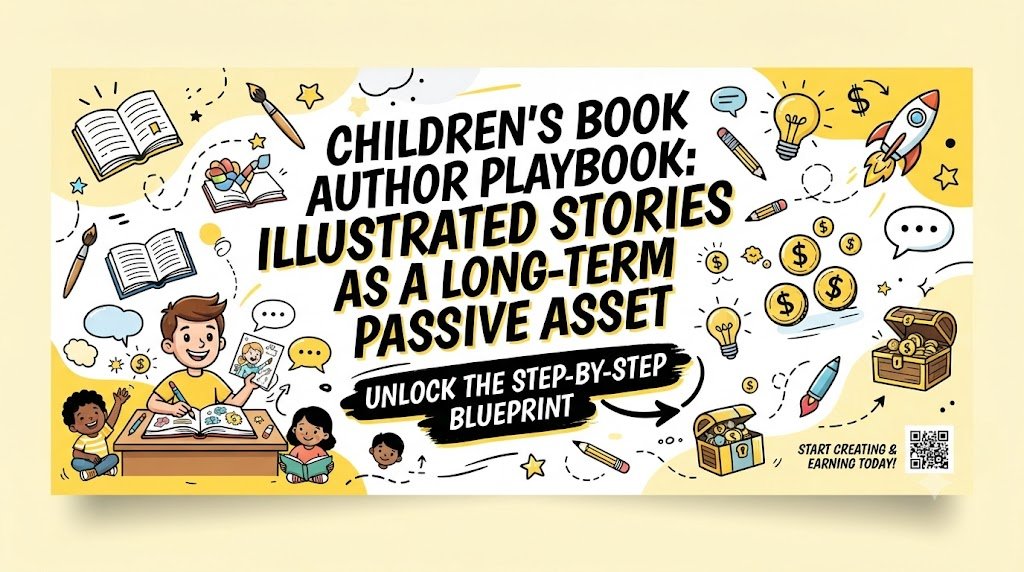
What if one children’s story you create today could continue reaching new families, inspiring young readers, and generating book sales for years?
Children’s books are more than colorful pages filled with imaginative characters. They can become lasting creative assets that connect generations, support early learning, and create opportunities for independent authors to build sustainable publishing businesses.
For aspiring writers, illustrators, educators, and digital entrepreneurs, self-publishing children’s books offers an appealing opportunity. You can develop original characters, create illustrated adventures, publish through online marketplaces, and potentially earn royalties whenever readers purchase your work.
The attraction is easy to understand. Unlike freelance projects that require you to exchange time for every payment, a well-produced book can remain available for purchase long after its initial publication.
However, creating successful illustrated children’s books requires more than uploading attractive pictures to Amazon.
You need engaging storytelling, age-appropriate writing, memorable illustrations, thoughtful positioning, professional formatting, and a marketing strategy that reaches parents, teachers, and gift buyers.
This children’s book author playbook explains how to turn your creative ideas into professionally published books, build a recognizable author brand, and develop a catalog that has the potential to generate income over time.
Why Children’s Books Can Become Valuable Long-Term Digital Assets
A children’s book has two kinds of value: the immediate experience it gives readers and the long-term commercial potential of the intellectual property behind it.
When an author creates an original story, characters, illustrations, and fictional world, those creative elements can potentially support multiple products and publishing formats.
Imagine publishing a picture book about a curious little fox learning to make friends.
That single concept might eventually expand into a series of bedtime adventures, emotional-learning stories, coloring activities, printable worksheets, and illustrated story collections.
Instead of building every product around an unrelated idea, you create a recognizable world that readers can return to.
This is one of the strongest reasons children’s publishing appeals to independent creators.
The Long-Term Advantages of Illustrated Story Publishing
Evergreen reader demand: Families continually look for stories about friendship, kindness, emotions, confidence, imagination, bedtime routines, and growing up.
Repeat purchase opportunities: Readers who enjoy one book may become interested in additional titles featuring familiar characters.
Print-on-demand fulfillment: Authors can offer physical books without purchasing large quantities of inventory in advance.
Multiple publishing formats: Depending on platform specifications, a story may be adapted for paperback, hardcover, or illustrated eBook distribution.
Original intellectual property: Authors who retain appropriate rights can potentially develop sequels, companion products, translations, and licensing opportunities.
International discoverability: Online bookstores can make eligible books accessible to readers across multiple markets.
These benefits do not make children’s publishing automatically profitable. They make it a potentially scalable creative business when authors consistently deliver books readers value.
Understanding Passive Income From Children’s Books
Passive income is often misunderstood.
Publishing one illustrated book does not guarantee monthly royalties, high search rankings, or recurring customers.
The more realistic model is front-loaded creative work followed by ongoing, potentially lower-maintenance sales.
You invest time and money in researching, writing, illustrating, editing, formatting, publishing, and promoting a title.
Once the book is available, eligible orders can produce royalties without requiring you to print or ship every copy yourself.
However, ongoing marketing, customer research, quality improvements, metadata updates, and financial monitoring may still be necessary.
Consider this illustrative scenario:
An independent author publishes a children’s picture book and earns an average royalty of $3 per copy.
| Monthly book sales | Illustrative monthly royalties |
|---|---|
| 10 copies | $30 |
| 25 copies | $75 |
| 50 copies | $150 |
| 100 copies | $300 |
| 250 copies | $750 |
These are hypothetical calculations, not earnings predictions. Actual royalties vary by format, list price, printing cost, marketplace, taxes, distribution method, and other factors. The figures also exclude production, advertising, and business expenses.
A single title might sell slowly. Other titles might perform better because they serve specific reader needs, receive positive responses, or benefit from effective promotion.
The goal is not to publish as many books as possible. It is to create books worth buying, recommending, and reading repeatedly.
Step 1: Find a Profitable Children’s Book Niche With Genuine Reader Demand
One of the biggest mistakes new children’s book authors make is choosing a subject solely because they personally like it.
Creative enthusiasm matters, but successful publishing also requires understanding the intended reader and the adult making the purchase.
Children enjoy stories. Parents and educators often search for stories that satisfy a specific need.
That distinction is important.
A parent may search for a bedtime story that helps a child manage nighttime worries. A teacher may look for a picture book about sharing. A grandparent may want a meaningful birthday gift for a five-year-old.
Your strongest publishing ideas often emerge where emotional storytelling meets a clear reader need.
Children’s Book Niches Worth Exploring
| Niche | Reader need | Potential story concept |
|---|---|---|
| Bedtime adventures | Calm, comforting reading | A sleepy bear searching for the moon |
| Social-emotional learning | Understanding feelings | A little dragon learning patience |
| Friendship stories | Empathy and kindness | Two unlikely animal friends |
| Confidence and courage | Facing new experiences | A shy rabbit’s first school day |
| Educational adventures | Learning through storytelling | A space journey exploring numbers |
| Nature and wildlife | Curiosity about the world | A young turtle discovering the ocean |
| Family relationships | Connection and belonging | A grandmother’s magical garden |
| Early independence | Everyday routines | A penguin learning to tidy up |
| Imagination and creativity | Exploration and wonder | A child who paints imaginary worlds |
| Multilingual stories | Language and cultural connection | A bilingual neighborhood adventure |
These categories represent possible opportunities, not verified bestseller rankings.
How to Validate Your Children’s Book Idea
Begin with marketplaces such as Amazon Books and other relevant online bookstores.
Search for phrases that describe the kind of book you want to create, such as:
- Bedtime story books for ages 3–5
- Children’s books about anxiety and worries
- Friendship picture books for preschoolers
- Illustrated animal adventures for ages 4–8
- First-day-of-school children’s stories
Study how existing books present their covers, descriptions, reading ages, illustrations, and benefits.
Read authentic customer reviews to understand what readers appreciate and where existing books may fall short.
Look for recurring unmet needs rather than copying successful books.
For example, parents may appreciate stories about bravery but want fewer lectures and more entertaining adventures.
That observation suggests an opportunity to create a story in which a character naturally demonstrates courage through actions.
Practical publishing insight: A commercially promising niche combines a recognizable reader problem, an emotionally satisfying story, and a concept that can stand apart from existing titles.
Step 2: Choose the Right Age Group Before Writing
Children’s literature is not one uniform category.
A story suitable for toddlers will differ significantly from a book intended for confident eight-year-old readers.
The intended reading age influences nearly every creative decision, including vocabulary, sentence structure, illustration density, page design, and narrative complexity.
Children’s Book Age Categories
| Age group | Common book style | Writing approach |
|---|---|---|
| 0–2 years | Simple picture and concept books | Very limited text, familiar objects |
| 3–5 years | Illustrated picture books | Repetition, rhythm, accessible language |
| 6–8 years | Early readers and first chapter books | Short chapters, clear storytelling |
| 9–12 years | Middle-grade books | Richer plots, developed characters |
| 13–17 years | Young adult fiction | More complex themes and relationships |
These are general developmental guidelines rather than rigid requirements.
For aspiring illustrated-story authors, ages 3–5 or 4–8 may offer a practical creative starting point, depending on the concept.
At these ages, illustrations often carry an important part of the story.
A character’s expression, a hidden visual detail, or a surprising image can communicate information beyond the written words.
A Simple Age-Appropriate Storytelling Test
Before publishing, ask yourself:
Can a child follow what is happening?
Does the story hold attention when read aloud?
Can the illustrations help explain unfamiliar situations?
Is the central conflict understandable?
Does the ending feel emotionally satisfying?
If possible, test the story with parents, teachers, librarians, or appropriately aged children with adult permission and supervision.
Real feedback is more valuable than assuming your intended audience will respond positively.
Step 3: Create Memorable Characters Readers Want to Meet Again
A successful children’s book often begins with a character readers care about.
The character does not need to be extraordinary. A small rabbit, a nervous turtle, a young inventor, or a lonely star can become memorable when given a recognizable personality and a meaningful challenge.
Consider a fictional character named Milo the Moon Fox.
Milo is curious, imaginative, and slightly afraid of unfamiliar places.
In the first story, Milo learns to sleep independently.
In another adventure, Milo makes a new friend.
Later, he discovers why asking for help can be an act of courage.
Each book tells a complete story, but the character provides continuity.
This approach offers an opportunity to develop a recognizable children’s book series.
Building a Character With Series Potential
A strong recurring character should have a recognizable appearance, a consistent personality, understandable motivations, distinctive traits, and enough flexibility to experience different adventures.
A short character profile helps preserve that identity across books.
For example:
Character: Milo the Moon Fox
Personality: Curious, gentle, occasionally nervous.
Visual identity: Silver-blue fur, large expressive ears, and a small yellow scarf.
Core theme: Learning confidence through discovery.
Possible series: Bedtime, friendship, sharing, honesty, patience, and imagination.
The strongest children’s book characters do more than support merchandise or sequels.
They give young readers someone to recognize, understand, and emotionally connect with.
Step 4: Write an Illustrated Story That Children Actually Enjoy
Beautiful artwork may attract attention, but storytelling determines whether the reading experience feels rewarding.
A strong children’s story needs movement, emotion, and a meaningful resolution.
One useful structure is a five-part storytelling framework.
The Five-Part Children’s Story Framework
1. Introduce the character
Show who the main character is and what makes their world interesting.
Example: Milo the Moon Fox loves watching the stars but dislikes sleeping alone.
2. Introduce a relatable problem
Something changes or challenges the character’s expectations.
One evening, Milo discovers that his favorite glowing star has disappeared behind the clouds.
3. Develop the adventure
The character attempts to solve the problem.
Milo searches the forest and meets animals who offer different kinds of help.
4. Create an emotional discovery
The character learns something important through experience.
Milo realizes the star has not disappeared forever, and that darkness does not always mean something is wrong.
5. Deliver a satisfying ending
Resolve the story in a way that feels hopeful and earned.
Milo returns home, settles into bed, and feels comfortable even when the night sky is cloudy.
This framework supports gentle themes without forcing a moral lecture into the story.
Write for Read-Aloud Enjoyment
Children’s picture books are frequently read aloud by adults, so the sound of the words matters.
Use natural rhythms, accessible vocabulary, varied sentence lengths, and memorable expressions.
Allow illustrations to carry some of the narrative instead of describing every visible detail.
Avoid complicated explanations that interrupt the story’s emotional flow.
Most importantly, remember that children appreciate humor, surprise, imagination, and genuine emotional experiences.
A children’s book should feel like a story, not a worksheet disguised as entertainment.
Step 5: Create Professional Illustrations Without Losing Artistic Consistency
Illustrations are central to many children’s picture books.
They establish atmosphere, communicate emotion, and help young readers understand the story.
Poor visual consistency can make even a strong manuscript feel unfinished.
A character whose appearance changes unexpectedly between pages may confuse readers and weaken the book’s visual identity.
Three Illustration Production Options
Hire a professional illustrator. This can be suitable for authors who want distinctive artwork and a collaborative production process. Agree on deliverables, revisions, payment, deadlines, and commercial rights in writing.
Create the illustrations yourself. Authors with drawing, digital painting, or design skills may prefer direct creative control. This can reduce outside production expenses, although equipment, software, and time still have costs.
Use AI-assisted creative workflows. AI tools may help with brainstorming, storyboarding, references, or certain production tasks. However, output quality, consistency, commercial-use terms, copyright questions, and platform disclosure requirements require careful attention.
AI tools do not eliminate the need for thoughtful artistic direction or quality control.
Build an Illustration Style Guide
Before designing the complete book, establish:
- Character proportions and defining visual features
- Clothing and accessory consistency
- Color palette and lighting direction
- Background and environmental style
- Facial expressions and emotional cues
- Composition and typography guidelines
A well-maintained visual reference sheet becomes particularly useful when producing a series.
It can also support collaboration with multiple illustrators over time.
Commercial publishing tip: Do not treat artwork as decoration. Every illustration should help tell the story, deepen emotion, establish setting, or reveal useful information.
Step 6: Format Your Children’s Book for Professional Publishing
A professionally illustrated manuscript can still disappoint readers when printed incorrectly.
Page layout, text placement, margins, image resolution, and trim size all affect the reading experience.
Print books require carefully prepared production files.
Important Children’s Book Formatting Considerations
Trim size: Choose dimensions supported by your intended print-on-demand platform.
Bleed: Illustrations extending to the page edge require appropriate bleed settings and safe positioning of important content.
Image resolution: Prepare artwork according to the printer’s technical specifications, commonly including high-resolution images suitable for print.
Typography: Use readable fonts with sufficient contrast against illustrated backgrounds.
Page order: Check that the text and pictures create a smooth visual and narrative sequence.
Cover design: Ensure the title remains legible in online search thumbnails.
Interior review: Examine proofs for cropping, color reproduction, readability, and spacing.
Illustrated children’s books may require different workflows for physical books and fixed-layout digital editions.
A print-ready PDF is not automatically an effective digital reading experience.
Why Proof Copies Matter
Digital previews cannot always reveal physical printing problems.
Colors may look different on paper. Small text may become difficult to read. Important artwork may appear too close to the trim.
Reviewing a physical proof can help identify these issues before customers receive the final edition.
A few thoughtful revisions during production can prevent poor customer experiences later.
Step 7: Self-Publish Kids’ Books Through Amazon KDP
Amazon Kindle Direct Publishing is one route for independent authors who want to offer books without maintaining a traditional printing inventory.
Authors can publish eligible eBooks and print-on-demand editions while retaining responsibility for production quality, metadata, rights, and marketing.
Basic Amazon KDP Publishing Workflow
- Create your original manuscript and illustrations.
- Confirm the relevant publishing and commercial-use rights.
- Prepare interior and cover files using the selected format specifications.
- Create or access your KDP account.
- Enter accurate title, author, description, and audience information.
- Select appropriate categories and discoverability keywords.
- Upload the manuscript and cover.
- Review the book using available preview tools.
- Set a price after checking projected royalties and printing costs.
- Submit the book for platform review and publication.
Platform eligibility and requirements vary across formats and marketplaces.
Amazon KDP is not the only publishing option. Depending on your business model, you may also research other book distributors, direct-to-consumer digital storefronts, and suitable print-on-demand services.
Understanding Children’s Book Royalties
Your book’s retail price is not your profit.
For KDP print books, royalty calculations account for the applicable royalty rate and printing costs.
In standard print distribution, the basic relationship is:
Royalty per copy = (Applicable royalty rate × eligible list price) − printing cost
Amazon KDP’s standard paperback royalty rate can be 50% or 60%, depending on marketplace and list price. Expanded Distribution generally uses a different rate. Production costs vary according to specifications.
As a hypothetical example, assume a book has an eligible list price of $12.99, a 60% royalty rate, and printing costs of $4.50.
The resulting royalty would be approximately $3.29 per copy before other business expenses.
This illustration is not a guaranteed rate or a quote for a specific picture book. Always calculate actual costs using the current marketplace-specific publishing tools.
Make Your Amazon Book Listing Buyer-Friendly
A good listing should help shoppers answer several questions immediately.
Who is the book for?
What is the story about?
What kind of reading experience does it offer?
What makes it worth choosing?
Instead of writing an unfocused description such as “A wonderful children’s story about animals,” present the experience more clearly.
For example:
Join Milo the Moon Fox on a gentle nighttime adventure about bravery, friendship, and discovering that the dark can hold wonderful surprises. An illustrated bedtime story for young listeners and the grown-ups who read with them.
Accurate descriptions help parents select books that match their children’s interests and reading abilities.
Step 8: Optimize Children’s Books for Amazon Search and AI-Powered Discovery
Search visibility can influence whether potential buyers discover your work.
However, discoverability is not created through keyword repetition alone.
Online stores, search engines, and answer-oriented discovery systems increasingly depend on clear, relevant, helpful information.
Your goal should be to make your book understandable to people first.
Write Titles and Subtitles That Explain the Book
A creative title establishes personality.
A useful subtitle can provide context when appropriate.
For example:
Main title: Milo and the Missing Moonlight
Descriptive subtitle: An Illustrated Bedtime Adventure About Courage and Friendship for Ages 3–5
The subtitle communicates the reading experience without overwhelming the main title.
Any title and subtitle must accurately represent the contents and follow the retailer’s metadata policies.
Build Descriptions Around Real Buying Questions
Parents and educators may ask:
What is a good bedtime book for a four-year-old?
Which children’s books teach kindness?
What picture books help children manage worries?
Is this story suitable for preschool reading?
A useful book description can naturally address these questions.
Explain the central character, the type of adventure, the intended reading audience, and the reading experience.
Use natural language rather than repeating phrases such as “best children’s book” or “top kids’ bedtime book.”
For authors who maintain websites, complementary articles can provide additional discovery opportunities.
Examples include:
How to Choose Bedtime Stories for Preschoolers
Five Gentle Reading Activities to Encourage Confidence
Picture Books About Friendship: What Makes a Story Meaningful?
These pages can answer genuine search questions while introducing relevant original books.
Clear headings, descriptive image text, accurate author information, and well-structured pages may help search engines and AI-powered systems understand the content.
No optimization technique guarantees visibility, featured answers, Google Discover placement, or sales.
Step 9: Design Children’s Book Covers That Attract the Right Buyers
Your cover is often the first interaction a potential reader has with your book.
On a crowded online marketplace, customers may initially see only a small thumbnail.
That makes clarity essential.
Elements of an Effective Children’s Book Cover
A recognizable central character: Readers should quickly understand who the story is about.
A clear emotional tone: The cover should communicate whether the book is comforting, playful, adventurous, educational, or humorous.
Readable typography: The title should remain understandable at reduced sizes.
A focused composition: Avoid crowding the cover with unnecessary objects and decorative details.
Audience-appropriate styling: A gentle bedtime story should look different from an action-packed adventure for older readers.
Original visual identity: Create distinctive artwork rather than imitating another author’s recognizable character or cover.
Compare several cover concepts at thumbnail size.
The best design is not always the most detailed one. It is often the design that communicates the story most clearly.
Step 10: Build a Children’s Book Series Instead of Relying on One Title
A standalone book can become a satisfying creative achievement.
A connected series can introduce additional commercial possibilities.
When readers already know a character, they may have less uncertainty about trying another book.
A series also allows the author to establish consistent branding, packaging, and reader expectations.
Example: A Five-Book Children’s Story Collection
| Book | Working title | Core theme |
|---|---|---|
| Book 1 | Milo and the Missing Moonlight | Confidence |
| Book 2 | Milo Makes a New Friend | Friendship |
| Book 3 | Milo Learns to Share | Generosity |
| Book 4 | Milo and the Rainy-Day Surprise | Adaptability |
| Book 5 | Milo’s Big Little Adventure | Independence |
Each story should work independently.
Readers should not need to buy every book to understand the narrative.
As the catalog grows, the author’s website, product listings, and adult-facing marketing materials can introduce readers to related titles.
Over time, a cohesive series may encourage repeat purchases and word-of-mouth recommendations.
But series growth should follow demonstrated interest and reader feedback rather than automatic mass production.
Step 11: Turn One Original Story Into Multiple Revenue Opportunities
A book can become the foundation for complementary products when the rights, production quality, platform rules, and customer demand support expansion.
This is where a long-term publishing asset can become more valuable than a single product listing.
Potential Publishing and Product Extensions
| Product format | Commercial opportunity |
|---|---|
| Illustrated paperback | Print-on-demand retail sales |
| Illustrated eBook | Digital distribution where supported |
| Hardcover edition | Premium gift-oriented positioning |
| Coloring activity book | Companion creative product |
| Printable learning activities | Educational digital downloads |
| Bedtime story collection | Bundled reading experience |
| Authorized translation | Access to another language audience |
| Licensed merchandise | Character-based products under suitable rights agreements |
A printable activity pack could feature simple character-based drawing exercises, story questions, matching games, and creative writing prompts.
A coloring companion could invite children to explore the original fictional world through hands-on play.
These expansions should offer distinct value rather than simply repackaging the same material with a different title.
Protect the Value of Your Intellectual Property
Before commissioning illustrations, clarify copyright ownership and license scope.
Paying an illustrator does not automatically mean every right in the artwork transfers to the author.
Contracts should address permitted uses, exclusivity, adaptations, merchandising, credit, and any required rights assignments.
Likewise, original book content does not grant unlimited rights to use third-party characters, trademarks, fonts, photographs, or protected artwork.
A publishing catalog becomes a stronger asset when ownership and usage rights are clear.
Step 12: Market Children’s Books Without Relying Entirely on Paid Advertising
Publishing a book makes it available.
Marketing helps the right people discover it.
Many first-time authors underestimate this difference.
You do not need an enormous advertising budget to begin testing interest, but you do need a realistic discovery strategy.
Create Helpful Content for Parents and Educators
Instead of publishing only promotional posts, develop material that supports the audience surrounding your books.
An author of bedtime stories might share articles about establishing calming reading routines, selecting age-appropriate books, or encouraging children to talk about feelings.
These articles can attract visitors seeking useful guidance.
Relevant book recommendations can then appear naturally within the content.
For example:
Looking for a gentle story to include in your evening reading routine? Explore Milo and the Missing Moonlight, an illustrated adventure about courage and finding comfort after dark.
This approach positions the book as a relevant option rather than an interruption.
Use Pinterest for Long-Term Content Discovery
Pinterest can be useful for visually attractive children’s publishing content.
Potential pin concepts include:
- Bedtime story ideas for preschoolers
- Picture books about kindness
- Children’s reading corner inspiration
- Fun family reading activities
- Illustrated book gift ideas
A pin might lead to an informative article, a book landing page, or another permitted destination.
Pinterest results can evolve over time, and consistent traffic is not guaranteed.
Focus on accurate descriptions, original images, and useful destinations instead of publishing large volumes of repetitive pins.
Build an Author Website
A simple author website can become the central destination for your catalog.
It may include an author introduction, individual book pages, age guidance, retailer links, publishing updates, and resources for adults.
You can also offer a free downloadable activity sheet to interested parents or educators.
Any email subscription system should collect information from adults with appropriate consent and transparent privacy practices.
Do not design lead-generation funnels that encourage young children to disclose personal information.
Reach Relevant Reading Communities
Explore suitable libraries, schools, independent bookstores, parenting communities, and book-focused creators.
Offer information that genuinely serves their audiences.
For example, a librarian may value a short read-aloud guide. A teacher may appreciate discussion questions. A parent-focused creator may want a physical review copy.
Avoid unsolicited bulk messages and requests for misleading or incentivized reviews.
Genuine recommendations and authentic reader experiences are more valuable than manufactured enthusiasm.
Step 13: Create a Repeat-Reader Strategy for Your Children’s Book Brand
Not every first-time buyer immediately becomes a repeat customer.
The challenge is to turn a satisfying reading experience into a recognizable author relationship.
For children’s books, that relationship is usually built through parents, teachers, librarians, and other adult decision-makers.
A family that enjoys one story may want to discover what happens next.
Use a Connected Reader Journey
A practical journey might look like this:
Discovery: A parent finds your article about bedtime reading.
Interest: The article introduces an illustrated book suited to that need.
Purchase: The parent visits a retailer and buys the book.
Experience: The family enjoys reading the story together.
Return: The parent later visits your author website to discover another adventure.
Recommendation: The family shares an authentic recommendation with friends or a reading community.
At each stage, deliver something useful.
Do not assume a sale automatically creates customer loyalty.
A satisfying story, professional presentation, reliable product quality, and consistent author identity provide stronger reasons to return.
Give Returning Visitors a Reason to Explore
Your author website might feature a page called Explore the Next Adventure.
It could introduce upcoming books, character activity pages, author updates, and additional resources.
A simple invitation might say:
Enjoyed Milo’s first adventure? Discover more stories, printable activities, and gentle reading ideas for your family’s next storytime.
This creates an inviting next step without using unrealistic promises or aggressive sales tactics.
Step 14: Calculate Children’s Book Production Costs Before Publishing
Children’s books can involve meaningful upfront expenses.
High-quality illustrations, professional editing, design, and print proofs may cost more than authors initially expect.
A realistic budget prevents creative decisions from becoming unexpected financial problems.
Example Budget for an Independent Children’s Book
| Expense category | Illustrative planning range |
|---|---|
| Manuscript editing | $50–$250 |
| Illustrations | $300–$2,000+ |
| Cover and interior layout | $50–$300 |
| Proof copies and checking | $20–$100 |
| Initial promotion | $0–$300 |
| Illustrative total | $420–$2,950+ |
These are hypothetical planning allowances, not verified industry-average quotes. Actual projects may cost substantially less or more depending on length, illustrator experience, artwork complexity, location, licensing, and production choices.
Some authors perform writing, artwork, and formatting independently. Others hire specialists for most of the production.
Neither approach is automatically superior.
The correct budget depends on available skills, quality expectations, and financial risk tolerance.
Estimate Your Break-Even Point
Suppose your total cash production cost is $900.
If you earn an average of $3 per copy before additional operating expenses, you would need approximately 300 sales to recover that initial cost.
That does not mean 300 sales are likely.
It provides a practical benchmark for evaluating your investment.
A more complete financial plan should also account for advertising, taxes, transaction charges, refunds, ongoing tools, revisions, and the value of your own labor.
Author business principle: A book is not commercially successful simply because it generates revenue. It needs to create enough value to justify the resources invested in producing and maintaining it.
Step 15: Launch Your First Children’s Book With a Practical 30-Day Plan
Publishing feels more manageable when the process is divided into clear stages.
A focused 30-day project can help you prepare a manuscript, develop a production prototype, and validate your concept.
It will not be enough for every illustrated book to reach professional publication. Illustration commissions, revisions, proof shipping, platform reviews, and rights negotiations may require a longer timeline.
Days 1–5: Research and Positioning
Choose the intended age group.
Study comparable books and identify a genuine reader need.
Develop your original story concept, character profile, and positioning.
Define what makes your project meaningfully different.
Days 6–10: Writing and Story Development
Draft the manuscript.
Read the story aloud.
Revise language, pacing, dialogue, and emotional structure.
Seek relevant feedback and identify confusing scenes.
Days 11–15: Storyboarding and Visual Development
Create a page-by-page storyboard.
Establish illustration references and character consistency.
Test important scenes through sketches or sample artwork.
Ensure the illustrations genuinely contribute to the story.
Days 16–20: Editing and Production Preparation
Revise the manuscript and artwork.
Prepare the interior layout and cover design.
Check rights documentation, reading-age suitability, and accessibility considerations.
Validate technical specifications for your chosen formats.
Days 21–25: Publishing Setup and Quality Review
Prepare accurate product descriptions, keywords, and categories.
Upload files when they are ready.
Examine previews and, where appropriate, order a physical proof.
Correct production issues before approving the final edition.
Days 26–30: Marketing Preparation
Build an author landing page.
Create helpful supporting articles and promotional assets.
Prepare adult-focused outreach to appropriate reading communities.
Establish a simple performance tracker for traffic, sales, royalties, expenses, and reader feedback.
If the book is not ready for publication, extend the schedule rather than compromising its quality.
A professionally finished story has better long-term potential than a rushed product created merely to meet a calendar deadline.
Step 16: Avoid the Mistakes That Prevent Children’s Books From Selling
Independent children’s publishing presents genuine opportunities, but it also has common failure points.
Publishing Too Many Generic Books
Quantity does not compensate for weak storytelling or inconsistent illustrations.
A smaller catalog of distinctive books can be more valuable than numerous repetitive titles that offer little original value.
Ignoring the Adult Buyer
Children may be the intended readers, but purchasing decisions are often made by adults.
Describe the story clearly enough for parents and educators to judge its suitability.
Using Misleading Categories or Keywords
Inaccurate reading ages, irrelevant search terms, exaggerated benefits, and misleading descriptions can damage buyer trust.
Choose metadata that accurately represents the book.
Neglecting Illustration Rights
Always understand the permitted commercial uses of commissioned and tool-generated material.
Rights disputes can undermine the value of an otherwise successful publishing project.
Assuming Publication Guarantees Traffic
Online bookstore visibility is competitive.
Without meaningful positioning, customer interest, and discoverability efforts, a newly published title may receive very little attention.
Using AI Without Reviewing Quality
AI-assisted production still requires scrutiny for originality, age suitability, visual errors, consistency, intellectual property, and platform disclosure requirements.
Overlooking Customer Feedback
Feedback can reveal problems with page layout, age appropriateness, language, printing quality, and reader engagement.
Look for actionable patterns rather than reacting emotionally to every individual opinion.
How to Build a Sustainable Children’s Book Publishing Business
Long-term success depends on developing more than a collection of product files.
You need a publishing process that is creative, financially responsible, and adaptable.
That process begins with understanding readers.
Choose subjects that matter to children and the adults supporting them.
Create memorable characters and original stories.
Invest in illustrations that strengthen the narrative.
Publish using accurate information and appropriate rights.
Market through useful content and authentic relationships.
Measure results before expanding the catalog.
And importantly, distinguish between activities that improve reader experience and activities that merely increase the number of published titles.
A growing backlist of quality work can potentially continue attracting new readers long after publication.
Some books may generate modest royalties. Others may never recover their production costs. A few may develop meaningful commercial momentum.
The sustainable approach is to learn from each release and reinvest responsibly.
Frequently Asked Questions About Self-Publishing Children’s Books
1. Can beginners make passive income by self-publishing children’s books?
Yes, beginners can potentially earn royalties from self-published children’s books, but there is no guaranteed income. Authors typically invest substantial effort in writing, illustrations, production, and marketing before sales occur. Print-on-demand fulfillment can reduce the need for inventory management, but maintaining sales may require ongoing work.
2. How much does it cost to publish an illustrated children’s book?
Production costs vary significantly. An author who creates the writing and illustrations independently may have relatively low direct expenses, while a project involving professional illustration, editing, design, and promotion may require hundreds or thousands of dollars. Authors should compare written quotes, evaluate rights terms, and prepare a realistic budget before committing.
3. Can I use AI illustrations in children’s books published through Amazon KDP?
Amazon KDP permits certain AI-generated content subject to its content guidelines and disclosure rules. Publishers must disclose AI-generated text, images, or translations when required, including generated cover and interior images. AI-assisted content is treated differently under KDP’s policy. Authors must also ensure they have appropriate rights and comply with all relevant content requirements.
4. What types of children’s books are suitable for long-term sales?
Books exploring enduring themes such as friendship, kindness, bedtime routines, confidence, imagination, and family relationships may have ongoing relevance. However, lasting sales also depend on storytelling quality, competition, audience fit, marketing, pricing, and reader satisfaction. No genre or subject guarantees evergreen income.
5. Is it better to publish one children’s book or create a series?
A strong standalone book is usually a sensible starting point for a new author. It offers an opportunity to test storytelling, production, and market positioning. If readers respond positively, a related series can provide additional opportunities for repeat purchases and consistent branding. Expansion should be guided by genuine demand rather than assumptions about future earnings.
Start Building Your Children’s Book Publishing Asset Today
Every memorable children’s story begins with a simple idea.
A little fox who fears the dark.
A turtle who wants to explore the ocean.
A child who discovers that kindness can change an ordinary day.
These concepts may appear small, but thoughtful storytelling can turn them into meaningful reading experiences.
For an independent author, the opportunity extends beyond one book sale.
An original character may become the foundation of a series. A popular story may inspire companion resources. A consistent publishing catalog may establish a recognizable creative brand.
But those possibilities begin with doing the fundamental work well.
Choose a reader worth serving. Write a story worth sharing. Create illustrations that support the narrative. Publish professionally and market responsibly.
Your first step: Write down three original children’s book ideas, choose one clear age group, and develop a one-page story outline.
Then turn that outline into a story that a child might ask to hear again.
Explore more: Discover children’s storytelling templates, character development worksheets, illustration planning resources, and self-publishing guides to help organize your first book project.
The most valuable long-term publishing asset is not simply a book that stays listed online. It is a story that continues to earn a place in readers’ lives.
Compliance Note
This article is intended for general educational and informational purposes and does not provide legal, financial, tax, or professional publishing advice.
Income and business claims: Publishing children’s books involves financial risk. Royalties, sales volumes, profitability, and long-term demand are not guaranteed. All financial illustrations and sample budgets are hypothetical unless explicitly identified otherwise.
Platform compliance: Authors are responsible for verifying the latest Amazon KDP and other platform requirements, including content guidelines, accepted formats, minimum page counts, reading-age metadata, pricing, royalty structures, disclosure obligations, and distribution eligibility. Platform rules can change.
Copyright and licensing: Authors must own or hold the appropriate commercial rights to text, illustrations, fonts, covers, characters, photographs, and other materials. Commissioned artwork, stock assets, and AI-generated materials may have different rights and licensing conditions.
AI-generated material: Follow the relevant publisher’s disclosure policies. Review AI-produced text and artwork for errors, inappropriate content, intellectual property concerns, and consistency. AI involvement does not remove the publisher’s responsibility for the finished book.
Child safety and privacy: Marketing should be directed appropriately toward parents, guardians, educators, or other adult purchasers. Websites, apps, newsletters, and promotional campaigns must comply with applicable privacy requirements, including the U.S. Children’s Online Privacy Protection Act (COPPA) where relevant. Avoid collecting children’s personal information without meeting applicable legal requirements.
Advertising and endorsements: Commercial claims, promotional testimonials, reviews, sponsorships, and affiliate relationships must follow applicable consumer-protection rules. Disclose material relationships clearly, avoid misleading earnings claims, and never fabricate customer reviews.
Educational and developmental claims: Stories about emotions, behavior, confidence, or learning should not be marketed as guaranteed treatments or clinically proven interventions unless supported by appropriate evidence.
SEO and sales performance: Search engine optimization, AI-answer visibility, Google Discover exposure, and marketplace ranking strategies can improve content clarity and discoverability but cannot guarantee rankings, website traffic, returning visitors, conversions, or book purchases.
Readers should verify current platform policies and consult qualified professionals when necessary before making publishing, legal, or financial decisions.
Stay ahead with exclusive updates
Join our community. Get curated industry trends, actionable guides, and fresh resources delivered straight to your inbox.