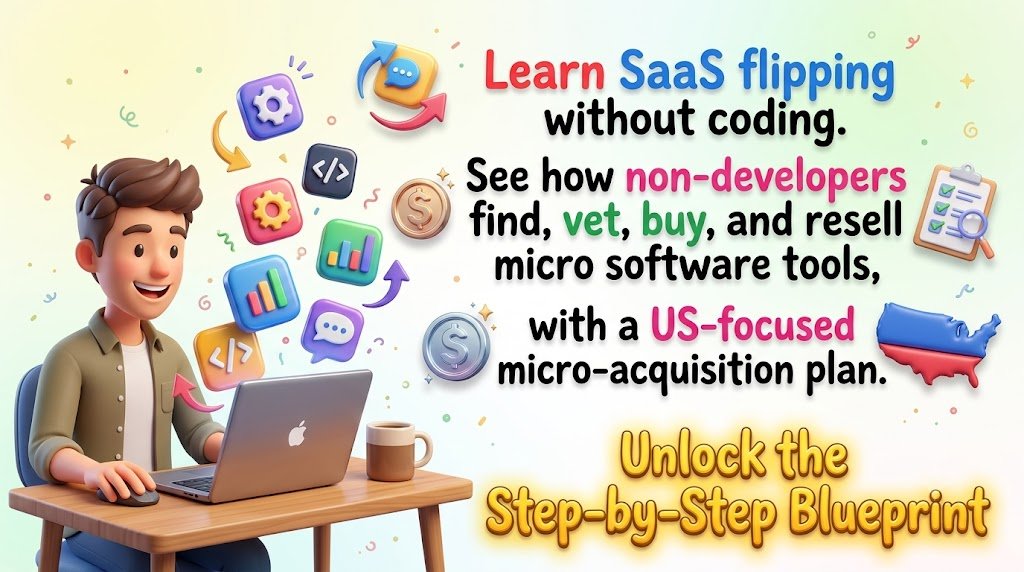
Learn SaaS flipping without coding. See how non-developers find, vet, buy, and resell micro software tools, with a US-focused micro-acquisition plan.
By Passive Income | Last updated: October 12, 2026
You want to own software income, but you can’t code and you don’t want to spend a year building something nobody uses. SaaS flipping offers another route: you buy a small, already-working software tool, improve it, and either keep it or resell it. This guide shows you how non-developers can acquire and resell micro software, step by step, with the checks that keep you out of expensive trouble.
Want the short version first? Skim the due diligence checklist later in this guide and use it on your first listing before you fall in love with any deal.
What Is SaaS Flipping, and Why Are Non-Developers Doing It?
SaaS flipping is the practice of buying an existing software-as-a-service product, improving how it’s run or marketed, and selling it, usually to a new owner who wants a cleaner, steadier business. It’s the software version of buying a tired rental property, fixing what’s fixable, and finding the next owner.
The tools involved are usually micro SaaS products: tiny, focused apps that solve one narrow problem. Think a invoice reminder tool for freelancers, a review-request widget for local shops, or a scheduling add-on for one specific platform. They’re small enough that one person can run them, which is exactly why non-developers can compete here.
Why now? Marketplaces for small online businesses are easier to browse than they used to be, freelance developers are easy to hire, and many founders of tiny tools simply want out. Some got busy. Some lost interest. Some built a good product but hate marketing. That mismatch is where flippers find opportunity.
To be clear, this is not a get-rich-quick play. Flipping is closer to small-business operations than to passive income. You’ll earn your margin through attention, judgment, and patience.
Can You Really Flip SaaS Without Knowing How to Code?
Yes, but only if you replace your missing technical skill with a process. You don’t need to write code. You need to know whether the code is safe to own, and you need someone you trust who can fix it when it breaks.
Here’s what a non-developer’s toolkit typically looks like:
- A freelance developer or small dev shop on call for a one-time technical review before you buy
- A basic understanding of how the product is hosted, billed, and supported
- Clear documentation, or a seller who will provide a written handover
- A transition period, often a few weeks, where the seller answers questions
The biggest beginner mistake is skipping the technical review because the numbers looked great. Picture a tool with steady subscriptions, built on an outdated library the original developer never updated. The revenue is real, but so is the cleanup bill. A short review before closing is cheap compared with a surprise rebuild after.
The skills you do need are business ones: reading a profit and loss statement, spotting churn, writing clear emails, and negotiating without getting emotional.
How Does a Micro-Acquisition Strategy Work in the USA?
A micro-acquisition strategy is a repeatable plan for buying small software businesses: define what you want, find listings, verify everything, close safely, then improve and exit. For US buyers, it also means handling the legal and tax basics properly from day one.
Here’s a simple framework that works for most first-time buyers.
Step 1: Define your buy box
Decide in advance what you’ll consider. Write down a price ceiling, a minimum age for the business, the customer type you understand, and the problems you refuse to take on. A narrow buy box protects you from shiny-object deals.
Step 2: Choose your entity and bank account
Most US buyers purchase through a business entity, such as an LLC, rather than personally. State rules and tax consequences differ, so speak with a business attorney and a tax professional before you form one or sign a purchase agreement.
Step 3: Find deals
You’ll find listings through marketplaces, broker-led sales, founder communities, and direct outreach. Direct outreach, such as a polite email to the owner of a small tool you admire, can surface deals that never get listed.
Step 4: Verify, negotiate, close, then improve
The next sections walk through each of these in detail. Keep this order, and don’t let excitement push you ahead of the checks.
Soft next step: If you’re still shaping your plan, compare two or three marketplaces side by side before you create accounts anywhere. A quick comparison will tell you which listing sizes and fee structures suit your budget.
Where Can You Find Micro SaaS Tools to Buy?
You can find micro SaaS tools on online marketplaces, through business brokers, in founder communities, and by contacting owners directly. Each channel has trade-offs in price, competition, and how much vetting has already been done.
| Channel | Examples | Best for |
|---|---|---|
| Online marketplaces | Acquire.com, Flippa | Beginners who want volume and variety |
| Broker-led platforms | Empire Flippers, FE International | Buyers with larger budgets who want more screening |
| Founder communities | Indie founder forums and groups | Finding motivated sellers early |
| Direct outreach | Cold emails to tool owners | Lower competition and negotiation room |
Fees, minimum deal sizes, and vetting rules change, so check each platform’s current terms before you commit.
A tip many new buyers overlook: read the seller’s reason for selling closely. Burnout, a career change, or a new project is a normal and healthy reason. Vague answers, or a sale that seems oddly urgent, deserve more questions.
What Makes a Good Micro Software Tool Worth Buying?
A good target has steady, explainable revenue, low churn, simple infrastructure, and a customer base you understand. Exciting growth charts matter less than boring stability, especially for a first deal.
Look for these signals:
- Recurring revenue that is consistent, not one big month followed by quiet ones
- Low customer churn, meaning people stay subscribed
- Diverse customers, so no single account makes up most of the income
- A clear acquisition channel, such as search traffic, an integration directory, or word of mouth
- Low support burden, so you aren’t answering tickets at midnight
- Clean ownership, meaning the seller truly owns the code, domain, and brand
Here’s a short illustrative scenario. Imagine two tools for sale at similar prices. Tool A has a flashy growth spike last quarter driven by one promotion. Tool B has modest but flat revenue, a handful of years of customers, and a simple backend. Tool A looks better in a screenshot. Tool B is usually the safer first purchase, because you can predict it.
Tools that depend entirely on a single third-party platform deserve extra caution. If the platform changes its rules or its application programming interface, your product could break overnight.
How Do You Vet a Deal Before You Buy? (Due Diligence Checklist)
Vet a deal by independently confirming revenue, customers, code ownership, traffic, and obligations before you send any money. Treat every number in a listing as a claim until you’ve verified it.
Use this checklist as a starting point:
| Area | What to confirm | How |
|---|---|---|
| Revenue | Reported income matches reality | Review payment processor records and bank deposits directly |
| Customers | Count, plan mix, churn, refund rate | Export subscriber data with the seller’s help |
| Code and hosting | Ownership, security, outdated parts | Hire a developer for a technical review |
| Traffic and leads | Where signups really come from | Check analytics access, not screenshots |
| Legal | Who owns the brand, domain, and code | Business attorney reviews the agreement |
| Obligations | Contracts, refunds, outstanding bills | Ask for a written list from the seller |
| Support | Ticket volume and common complaints | Read the inbox history and help-desk records |
Always ask for read-only access to the actual accounts where possible, rather than relying on screenshots. If a seller refuses reasonable verification, treat that as useful information.
For payment, use an escrow service or a contract reviewed by an attorney, so money and ownership move together. Never wire funds to a stranger on a promise.
How Much Does SaaS Flipping Cost, and Is It Worth It?
Costs vary widely: the purchase price is only one piece, and you should also budget for legal review, technical help, transition time, and early marketing. Whether it’s worth it depends on your capital, time, and risk tolerance.
Pricing for small software businesses is usually tied to profit or revenue and shaped by churn, growth, and risk. I won’t hand you a magic multiple, because it changes with the market and the type of business. Check recent sale data on the marketplaces themselves and ask a broker or advisor how similar tools have priced.
Here are the cost buckets to plan for:
- Purchase price
- Attorney and tax advice
- Developer review and fixes
- Escrow or marketplace fees
- A cash reserve for the first few months
- Marketing or support help
A common beginner trap is spending everything on the purchase and leaving nothing for the surprises. Keep a reserve.
Pros of SaaS flipping: you start with real customers, you skip the build phase, and small tools are often cheaper than larger online businesses. You can also learn quickly because the product already exists.
Cons: deals can fall apart, hidden technical debt is real, and you take on customer support and operational responsibility. A flip can also take longer than you expect if buyers are cautious.
Best for: patient operators who like marketing, process, and customer conversations, and who can afford to lose part of their investment.
Not for: anyone who needs guaranteed income, who can’t handle uncertainty, or who wants zero involvement after the purchase.
How Do You Add Value and Resell the Tool?
You add value by reducing risk and improving clarity: fix what’s broken, document everything, clean up the numbers, and grow what already works. Buyers pay more for tools that feel safe and easy to own.
Here are practical moves that often help, and none require coding:
- Write the operations manual. Document how billing, support, hosting, and updates work. A new buyer will love it.
- Fix the obvious friction. Slow replies, a confusing signup page, or a missing help article can quietly hurt retention.
- Clean up the bookkeeping. Keep revenue, expenses, and subscriber data organized and exportable.
- Improve one growth channel. Pick one, such as search content or an integration listing, and do it consistently.
- Reduce owner dependence. If the business only works when you personally do everything, it’s harder to sell.
When you’re ready to resell, gather three or more months of clean records, a plain-language story of how the tool works, and a documented handover plan. Then list it where serious buyers look and answer questions quickly.
A realistic scenario: you buy a small tool with messy records and a confusing help center. Over a few months you organize the financials, rewrite the help articles, and answer every support ticket within a day. Nothing dramatic changed, yet the business now looks lower risk. That kind of boring improvement is often what lets a flipper negotiate from strength. No outcome is guaranteed, of course, but clarity tends to help.
Soft next step: Start a simple tracking sheet for the tools you review, with columns for revenue, churn, technical risk, and the questions you still need answered. Reviewing ten listings on paper teaches you more than rushing into one.
What Are the Biggest Mistakes New SaaS Flippers Make?
The most common mistakes are skipping due diligence, overpaying for hype, ignoring technical risk, and underestimating support work. All of them are avoidable.
- Buying with emotion. A friendly seller and a sleek demo can cloud your judgment. Stick to your buy box.
- Trusting screenshots. Verify through direct account access.
- Skipping the lawyer. A small deal still deserves a proper agreement covering assets, warranties, and the transition.
- Ignoring platform dependence. If one integration powers everything, price in that risk.
- Forgetting the transition. Without a handover period, small questions become expensive mysteries.
- Over-promising to yourself. Expect work, setbacks, and a learning curve.
Also keep taxes and compliance in mind. Rules about collecting sales tax on software vary by state, and they can affect your margins. A US tax professional can tell you what applies to your situation.
Make Your First SaaS Flipping Move This Week
SaaS flipping rewards people who are curious, careful, and a little stubborn. You don’t need to code. You need a clear buy box, a verification habit, a technical advisor, and the patience to improve a small tool instead of chasing hype.
Here’s a simple plan for the next seven days: write your buy box, browse listings on two marketplaces, shortlist three tools, and run each one through the checklist above. Don’t buy anything yet. Just practice looking.
If you want to keep learning, join our newsletter for updates to this guide and new walkthroughs on how to acquire and resell micro software. We revisit our strategy articles as the market changes, so there will be reasons to come back.
Have you looked at a micro-acquisition, or already flipped a tool? Share what worked, what surprised you, and what you’d do differently in the comments. Honest stories help other readers more than polished ones.
Frequently Asked Questions
What is SaaS flipping?
SaaS flipping is the practice of buying a small, existing software-as-a-service product, improving how it’s run or marketed, and then selling it, usually for a higher price. The buyer doesn’t build from scratch. The profit comes from better operations, growth, cleaner paperwork, or a more attractive story for the next buyer.
Can you do SaaS flipping without coding skills?
Yes, but you need a technical safety net. Non-developers can buy products with clean documentation, stable code, and a seller willing to provide a transition period, then hire a freelance developer for fixes. Skipping a technical review is the real risk, not lacking coding skills yourself.
How much money do you need to start a micro-acquisition?
There’s no fixed number. Small tools can be listed for a few thousand dollars, while profitable ones cost far more, and pricing depends on revenue, churn, and growth. Budget for the purchase price plus a reserve for legal review, developer help, and early marketing, so one surprise doesn’t sink the deal.
Where can Americans buy micro SaaS businesses?
Common places include Acquire.com, Flippa, Empire Flippers, and FE International, plus founder communities and direct outreach. Each has different listing sizes, fees, and vetting levels, so check current terms. Whichever you use, run your own due diligence and use escrow or an attorney-reviewed purchase agreement.
Is SaaS flipping legal, and is it worth it?
Buying and selling software businesses is legal in the US when done through proper contracts and transfers. Whether it’s worth it depends on your time, capital, and risk tolerance. Returns aren’t guaranteed, and deals can fail. Talk to a business attorney and tax professional before signing anything.
Compliance Note
Disclosure: This article may mention third-party marketplaces and services for informational purposes. If affiliate links or sponsorships are ever added, they will be clearly disclosed, and they will not change our editorial opinions.
No guaranteed results: Examples and scenarios are illustrative, not testimonials or case studies. Buying and reselling software businesses carries risk, including loss of some or all of your investment. Individual outcomes vary and are not guaranteed.
Accuracy and updates: Last reviewed October 12, 2026. Marketplace terms, fees, and tax and legal rules change, so verify current details with official sources before acting.
Not professional advice: This content is educational and is not legal, tax, or financial advice. Consult a licensed US business attorney, tax professional, and financial advisor before buying or selling a business.
Stay ahead with exclusive updates
Join our community. Get curated industry trends, actionable guides, and fresh resources delivered straight to your inbox.