A practical 90-day SEO rescue workflow to revive old blog content, recover search visibility, attract qualified visitors, and turn a forgotten website into a growing digital asset.
An abandoned blog can feel like a wasted investment. Months or years of writing sit untouched, organic traffic keeps slipping, and posts that once attracted readers barely register in search results.
But a quiet blog isn’t necessarily a dead blog.
Sometimes, the opportunity is hiding inside content you’ve already published. An outdated tutorial might still attract impressions. A forgotten buying guide may have useful backlinks. A handful of articles could be one meaningful update away from serving readers better.
The challenge isn’t simply publishing again. It’s figuring out what deserves rescuing, what needs rebuilding, and what should be left behind.
With a structured 90-day turnaround organic traffic plan, you can assess your site’s real condition, resolve technical problems, improve existing articles, rebuild topical relevance, and create a sustainable system for attracting visitors.
You don’t need to publish 100 new articles or chase every trending keyword. You need a focused SEO rescue workflow built around evidence, content quality, and measurable progress.
Here’s how to approach it.
Can You Really Revive an Abandoned Blog in 90 Days?
Yes, an abandoned blog can show meaningful improvement within 90 days, particularly when it already has indexed pages, relevant backlinks, and content with remaining search demand.
However, 90 days is a practical execution window, not a guaranteed recovery deadline.
A blog that stopped publishing six months ago may respond differently from a site neglected for five years. A website affected by technical indexing problems may recover visibility after those issues are fixed, while a site with poor content quality, substantial competition, or a damaged reputation could require much longer.
The goal is to establish a working recovery process.
A successful 90-day rescue should leave you with a healthier website, a prioritized content library, clearer performance data, and an editorial system capable of supporting further growth.
THE 90-DAY RECOVERY ROADMAP
Days 1–30
Diagnose
Audit, repair and prioritize
Days 31–60
Rebuild
Refresh, consolidate and publish
Days 61–90
Grow
Distribute, convert and measure
Why Do Abandoned Blogs Lose Organic Traffic?
Before attempting to boost abandoned blog traffic, understand why the decline happened.
Not every traffic drop has the same cause, and choosing the wrong solution can waste weeks.
1. Content becomes outdated
An article written in 2021 might recommend discontinued software, reference obsolete pricing, or explain a process that has changed.
Searchers want current, accurate answers. If competing pages better satisfy their needs, your older content may become less competitive.
2. Search intent changes
A keyword doesn’t always represent the same user expectation forever.
Imagine publishing an article titled “Best Email Marketing Tools for Small Businesses.”
Originally, readers might have wanted a simple list. Today, they may expect verified pricing, automation comparisons, privacy information, screenshots, and practical recommendations based on business size.
If your article still offers only a generic list of names, it may no longer answer the query adequately.
3. Technical problems accumulate
Neglected websites can develop:
- Broken internal links and missing images.
- Incorrect redirects and canonical tags.
- Slow-loading or poorly functioning mobile pages.
- Accidental
noindexdirectives. - Plugin conflicts and server errors.
- Important articles that are difficult for search engines to discover.
Good writing cannot compensate for a page that search engines cannot properly access.
4. Competitors improve while your blog stands still
Your website doesn’t have to deteriorate for its rankings to decline.
Competitors may publish better comparisons, provide original research, answer additional questions, or build stronger topical coverage.
Standing still in a competitive search environment can feel like moving backward.
5. The blog loses its topical direction
An old blog might contain articles about personal finance, technology, travel, fitness, and digital marketing without meaningful connections.
That isn’t automatically a problem. But if there is no coherent audience, clear editorial purpose, or subject expertise, deciding what to update becomes much harder.
A successful turnaround usually starts by choosing whom the blog serves and which problems it solves.
Days 1–10: Perform a Complete SEO Audit Before Changing Anything
The first mistake many website owners make is editing content immediately.
Instead, establish a baseline.
Without knowing which pages already attract visibility, you risk deleting valuable material, changing successful URLs, or investing in pages with little realistic opportunity.
Connect Google Search Console and Google Analytics
Start with Google Search Console and Google Analytics 4.
Search Console helps you understand how your site appears in Google Search, including queries, impressions, clicks, and indexing information. Analytics helps you understand what visitors do after arriving.
Google’s documentation also explains why search clicks and Analytics sessions may differ, so avoid treating the two reports as interchangeable.
Record these baseline metrics:
| Metric | Why it matters |
|---|---|
| Organic search clicks | Measures traffic arriving from Google Search |
| Search impressions | Shows how often pages appear |
| Click-through rate | Helps identify pages with weak search-result appeal |
| Indexed pages | Indicates which pages Google has included in its index |
| Engaged sessions | Helps assess post-click engagement |
| Email signups | Measures audience development |
| Product purchases | Connects traffic improvements with revenue |
| Organic conversion rate | Shows how effectively organic visitors take action |
Compare the last 28 days with a relevant earlier period. Where possible, also examine the previous year to account for seasonality.
For a long-abandoned blog, historical Search Console data may be incomplete. Supplement it with available Analytics records, server logs, archived content inventories, and other reliable historical data.
Identify the exact pattern of decline
A site-wide traffic collapse is different from five articles gradually losing rankings.
Google recommends investigating whether declines affect the entire site or particular pages, queries, or search types. The pattern helps determine whether the problem is technical, content-related, seasonal, or connected to changes in demand.
Ask:
- Did traffic fall suddenly or gradually?
- Did mobile and desktop performance change differently?
- Are previously successful articles still indexed?
- Did impressions decline, or did only clicks fall?
- Did the decline begin after a redesign or migration?
- Are branded searches behaving differently from nonbranded searches?
An abrupt drop affecting nearly every page should trigger technical, security, manual-action, and indexing checks before a major content rewrite.
Build a content inventory
Create a spreadsheet listing every important URL.
Include its current title, topic, publication date, last meaningful update, search clicks, impressions, backlinks where known, conversion performance, and recommended action.
Classify each page into one of four groups.
Refresh
Valuable content that needs fact-checking, clearer explanations, new examples, or updated visuals.
Consolidate
Overlapping articles that could serve readers better as one comprehensive resource.
Preserve
Relevant articles that are already performing adequately and need only maintenance.
Retire
Irrelevant, unusable, or irredeemably obsolete pages, after checking their traffic, backlinks, and potential replacement value.
Do not automatically delete articles because they receive little traffic. Some may support important internal links, answer specialized questions, or attract valuable visitors despite low volume.
Days 11–20: Fix the Technical Problems Blocking Recovery
Once you understand your site’s condition, repair the infrastructure.
Technical SEO is not glamorous, but it determines whether your improved content can be discovered and interpreted correctly.
Check indexing and crawl accessibility
Use Search Console’s Page Indexing and URL Inspection reports to investigate important pages.
Look for unexpected exclusions, server errors, blocked resources, duplicate URLs, or incorrect canonicalization.
For pages intended to appear in search results, check that they return appropriate successful responses, provide accessible content, and aren’t unintentionally blocked by indexing directives.
A sitemap can help Google discover your preferred URLs, but submitting one does not guarantee indexing.
Repair broken links and redirect problems
Suppose an article about building an online store links to a tutorial that no longer exists.
You have three reasonable options: restore the missing resource, update the link to a relevant replacement, or remove the link when no useful replacement exists.
When consolidating content, apply permanent redirects where appropriate. Avoid redirecting unrelated pages to the homepage simply to eliminate errors.
Google identifies redirects and canonical annotations as signals for determining preferred URLs.
Improve the mobile experience
Review your website on actual phones, not just a desktop browser.
Check whether paragraphs are readable, images fit the screen, navigation works, advertisements obstruct content, and important buttons remain accessible.
Inspect Core Web Vitals and prioritize templates or pages affecting many visitors. Avoid spending your entire first month perfecting minor speed metrics while major content problems remain unresolved.
Restore trust and security
An abandoned blog may have neglected software, outdated themes, or inactive security monitoring.
Back up the site before making substantial changes. Update supported software, review administrator accounts, inspect for suspicious pages, and confirm that HTTPS works correctly.
Trust begins before the first paragraph.
Days 21–30: Find the Fastest Realistic SEO Opportunities
By now, the website should be in a more reliable technical condition.
Next, identify the existing content most likely to benefit from improvement.
Look for pages with impressions but disappointing clicks
Pages receiving meaningful impressions but relatively few clicks deserve investigation.
Their titles may not clearly describe the benefit, their search snippets may be unappealing, or they may rank too low to attract attention.
For example:
An article titled “Digital Products Information” might be more useful to readers as “How to Sell Digital Products: A Beginner’s Setup Guide.”
The second title communicates a clearer purpose.
However, don’t assume that rewriting a title alone will improve results. Compare search intent, ranking position, competing results, and page quality before making the change.
Identify declining pages with previous success
A page that once attracted qualified readers is often worth reviewing before investing in an entirely new keyword.
Look for:
- Articles with historical impressions and clicks.
- Buying guides that still address relevant decisions.
- Evergreen tutorials with outdated steps.
- Posts with credible backlinks.
- Resources directly related to your products or services.
These are candidates, not guaranteed quick wins.
Prioritize using a simple scoring method
Assess pages on four dimensions, each from one to five: search demand, content improvement potential, business relevance, and feasibility.
Content Rescue Priority Calculator
Use this illustrative scoring tool to compare which article to improve first. Higher scores suggest greater priority, not guaranteed traffic.
Existing search demand
4/5
Improvement potential
4/5
Business relevance
5/5
Ease of execution
3/5
16/20
Higher priority
A strong candidate for early attention.
Reset scores
This simple system discourages a common mistake: choosing articles solely because their keywords have high search volume.
A lower-volume article that attracts potential customers may be more valuable than a popular informational article with little connection to your business.
Days 31–40: Refresh Old Content Without Destroying Its Value
This is where your content turnaround becomes visible.
But refreshing doesn’t mean changing the publication date or adding a few extra paragraphs.
A meaningful update should improve the reader’s experience.
Rebuild the article around the reader’s current problem
Open the article and ask a simple question:
Would I trust this page if I discovered it for the first time today?
Check whether the introduction reflects the reader’s problem, whether the core answer appears early, and whether the examples remain accurate.
Remove unnecessary repetition. Replace unsupported claims. Explain terms that beginners may not understand.
Add information competitors overlook
Suppose you’re updating a post titled “How to Start an Affiliate Marketing Blog.”
Most similar articles may cover choosing a niche, creating a website, and joining affiliate programs.
Your refreshed version could go further by explaining how to evaluate affiliate agreements, compare recurring versus one-time commissions, identify misleading earnings claims, build honest comparison tables, and track results.
That additional decision-making value makes the page more useful.
Strengthen credibility
Where relevant, add original screenshots, tested processes, first-hand observations you can genuinely substantiate, clearly attributed examples, and citations to authoritative sources.
Show author information and make editorial and correction practices accessible.
Google’s people-first content guidance emphasizes meaningful expertise, a clear site purpose, trustworthy information, and satisfying reader experiences rather than producing material primarily to manipulate rankings.
Preserve URLs when practical
If an established URL accurately represents the refreshed article, there is usually no reason to change it simply because you’ve updated the content.
If a URL change is necessary, implement appropriate redirects, update internal links, and check canonical signals.
An improvement that creates broken navigation can undermine the very article you’re trying to rescue.
Days 41–50: Rebuild Topical Authority With Connected Content
Refreshing isolated articles is helpful, but rebuilding connected coverage can improve navigation and make the blog more useful to returning visitors.
Think of your blog as a library rather than a collection of disconnected posts.
Create a pillar-and-cluster structure
Imagine an abandoned blog focused on digital entrepreneurship.
You might establish a comprehensive guide to starting a digital product business and surround it with supporting articles.
EXAMPLE TOPICAL CONTENT STRUCTURE
Pillar: How to Start a Digital Product Business
The main resource that explains the complete journey
Choose a profitable niche
Create your first product
Build a sales page
Grow an email list
Set digital product prices
Automate product delivery
Each supporting article answers a distinct question and links naturally to related resources.
This structure helps readers move from one problem to the next.
Someone learning how to price a digital product might also need guidance on building a checkout page or writing product descriptions.
Use internal links where they are genuinely relevant, with descriptive anchor text that helps readers understand the destination.
Do not create dozens of near-identical pages simply to target keyword variations. Distinct articles should serve distinct needs.
Days 51–60: Publish Strategic New Content That Supports the Rescue
You have repaired your foundations and improved existing material.
Now consider publishing new articles where meaningful gaps remain.
Choose keywords based on problems, not volume alone
Broad keywords are often highly competitive and may not attract visitors ready to act.
A phrase like “SEO” covers an enormous range of intentions.
“How to improve organic traffic on an inactive WordPress blog” is more specific and connects directly to a practical problem.
Other examples include:
- How to audit an old blog before republishing.
- How to recover traffic after a website redesign.
- How to update outdated affiliate comparison articles.
- How to identify content cannibalization on a small blog.
- How to build an SEO rescue workflow for a content website.
These are illustrative topic candidates, not verified keyword-demand estimates. Validate their relevance and demand before assigning them to your editorial calendar.
Match the format to what the reader needs
Someone asking “What is an SEO content audit?” may want a concise explanation.
Someone searching “Best content audit tools for small websites” may expect a comparison.
Someone searching “SEO audit spreadsheet template” may want a usable download.
When you understand the intention, you can deliver the right format instead of forcing every search query into the same generic article structure.
Publish at a sustainable pace
A small blog might reasonably refresh several existing articles and publish two or three carefully researched new resources during this stage.
That is an example workload, not a ranking formula.
One thoroughly helpful article can be more valuable than ten repetitive ones.
Days 61–70: Make Your Blog Discoverable Beyond Traditional Search
A recovering blog shouldn’t depend entirely on one traffic channel.
Search is valuable, but complementary discovery channels can help new content reach relevant audiences.
Improve eligibility for Google Discover
Google Discover can surface content based on users’ interests without requiring a conventional search query.
For relevant articles, use compelling, representative images that are at least 1,200 pixels wide, preferably high-resolution, and suitable for landscape presentation. Google’s guidance also discusses max-image-preview:large and image metadata.
Use informative headlines, not sensational promises.
A title such as “We Updated 25 Old Articles: Here’s the Audit Framework We Used” can be compelling when you actually performed that work and can present reliable evidence.
A fabricated success story designed to attract clicks can damage trust.
Discover traffic is unpredictable, and following these practices does not guarantee inclusion.
Cover timely developments only when they matter
A niche blog can benefit from relevant news, industry changes, and emerging audience questions.
For example, a digital marketing blog might cover a documented change to search tools, analytics reporting, or e-commerce platform functionality.
The best timely content connects a real development to an actionable reader problem.
Avoid forcing unrelated trending topics into your editorial calendar merely to capture temporary search interest.
Repurpose content across suitable channels
A comprehensive blog guide can support an email newsletter, a LinkedIn post, a short educational video, a Pinterest graphic, or a useful community discussion.
Choose channels based on where your intended readers actually spend time.
Distribute information that has standalone value rather than repeatedly posting bare promotional links.
Days 71–80: Turn New Visitors Into Returning Readers and Buyers
Traffic recovery alone won’t build a sustainable website.
A blog receiving 10,000 monthly visits but generating no meaningful audience relationship may be less valuable than one attracting 2,000 highly relevant readers who subscribe, return, and purchase.
This is where conversion strategy becomes important.
Create a reason to subscribe
A visitor arriving from Google may read one answer and disappear.
Give that visitor a logical next step.
For a blog turnaround article, a relevant free resource might be:
The 90-Day Blog Recovery Checklist — Audit, Refresh, Publish, and Track Your Progress.
It could include a content inventory worksheet, prioritization scorecard, weekly action checklist, and results dashboard.
The offer should complement the article rather than interrupt it.
A useful invitation might read:
Ready to rescue your old content? Get a free blog recovery checklist and turn the steps in this guide into an organized weekly plan.
Only use such a promise when the resource genuinely exists and can be delivered.
Build an email welcome sequence
After readers subscribe, send relevant information that helps them continue.
A simple sequence could deliver the promised checklist, explain common SEO recovery mistakes, introduce an article prioritization method, demonstrate a workflow, and recommend an appropriate paid resource.
Provide value before repeatedly pitching products.
Add commercially relevant recommendations
Some readers need tools or products to solve their problems.
An article about restoring blog traffic can naturally discuss content auditing software, website performance tools, SEO education, technical support services, or a well-designed content tracking template.
Commercial recommendations work best when they explain who benefits, what limitations exist, and whether a free alternative may be sufficient.
Disclose material affiliate relationships clearly.
Invite readers back
Create recurring editorial features such as a monthly website improvement report, a practical SEO experiment, or an updated collection of useful tools.
Link related content near relevant points in the article.
The strongest returning-visitor hook is a credible promise of continuing usefulness—not simply asking people to bookmark a page.
Days 81–90: Measure the Turnaround and Choose Your Next Investments
By the final stage, you should have enough information to assess your progress, although some changes may still be too recent to evaluate reliably.
Don’t judge the entire project from one good or bad day.
Compare relevant date ranges, examine individual pages, and account for seasonality or changes in search demand.
Track leading and outcome indicators
Leading indicators show whether your recovery work is creating useful conditions for growth.
These include indexing improvements, updated pages returning to search results, stronger impressions, and improved coverage of audience questions.
Outcome indicators include qualified organic visits, email subscriptions, conversions, and revenue.
A blog can gain impressions before it gains meaningful clicks. It can also receive more clicks without improving sales.
You need both perspectives.
An illustrative 90-day performance example
Consider a hypothetical digital business blog with 80 published articles that has been neglected for two years.
Its owner fixes technical problems, refreshes key guides, consolidates overlapping content, and introduces a relevant email lead magnet.
The following figures illustrate how a dashboard might compare the baseline with the project’s closing measurement period. They are not actual campaign results or expected outcomes.
Illustrative organic clicks recovery
Hypothetical Google Search clicks per 28-day reporting window, not cumulative clicks or a forecast.
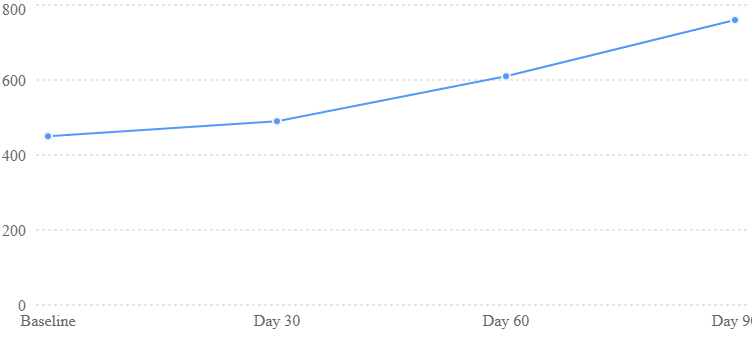
In this hypothetical scenario, clicks rose from 450 to 760 per comparable reporting window, an increase of approximately 69%.
But the figure alone doesn’t reveal whether the business improved.
The owner must also examine whether visitors are relevant, whether articles provide satisfactory answers, and whether subscriptions or sales increase.
A traffic turnaround becomes commercially meaningful when improvements support actual business goals.
Decide what deserves another 90 days
At the end of the project, identify your strongest content categories, most promising pages, conversion opportunities, and unresolved technical issues.
Double down on evidence-supported improvements.
Stop investing heavily in activities that consume effort without providing meaningful reader or business value.
And recognize when a website needs more fundamental repositioning rather than repeated minor edits.
The SEO Rescue Mistakes That Can Undermine Your Recovery
A structured turnaround becomes much easier when you avoid common shortcuts.
Updating every post at once
Mass editing makes it difficult to identify what actually improved performance.
Work in prioritized batches, record changes, and evaluate outcomes.
Changing URLs unnecessarily
URL changes can introduce redirects, broken links, or indexing complications.
Preserve established URLs unless there is a clear reason to change them.
Removing content without checking its value
A low-traffic page might have useful backlinks, a specialized audience, or important supporting links.
Investigate before deleting or merging.
Publishing large quantities of generic AI-generated material
AI can help with research organization, outlining, editing, and identifying missing questions.
But publishing unverified or repetitive content at scale is not a substitute for expertise.
Review factual claims, check primary sources, and provide meaningful original value.
Buying backlinks or manipulating engagement signals
Paid links intended to manipulate rankings, link schemes, fake engagement, and deceptive tactics can create unnecessary risk.
Build visibility through useful resources, legitimate relationships, relevant citations, and credible promotion.
Obsessing over rankings without measuring revenue
Rankings are a diagnostic signal, not your entire business model.
Measure whether organic visitors find what they need and take actions that matter.
A Practical 90-Day Blog Turnaround Schedule
Use this schedule as a manageable starting point and adjust it to your site’s size and resources.
| Days | Main activity | Intended deliverable |
|---|---|---|
| 1–10 | Audit traffic, indexing, content, and competitors | Baseline and complete content inventory |
| 11–20 | Resolve critical technical and usability issues | More reliable crawl and user experience |
| 21–30 | Prioritize pages by demand and business value | Ranked rescue backlog |
| 31–40 | Refresh the strongest existing opportunities | Updated, useful, accurate articles |
| 41–50 | Rebuild internal links and topical clusters | Better-connected content library |
| 51–60 | Publish content addressing genuine gaps | Relevant new resources |
| 61–70 | Improve distribution and discovery | Broader audience reach |
| 71–80 | Add subscriptions and appropriate offers | Better audience and conversion pathways |
| 81–90 | Compare results and review strategy | Next-quarter recovery plan |
The schedule is a planning framework. A major technical failure or severe content quality problem may require considerably more effort in earlier stages.
What Does a Successful Turnaround Actually Look Like?
Success is not necessarily a dramatic traffic spike.
Sometimes the most important signs are less exciting.
Your best tutorials appear in search again. Visitors spend time using the resources you provide. Old links lead somewhere useful. Subscribers begin returning for additional guidance. Product pages attract more relevant visitors.
Your website becomes easier to maintain because you know which articles serve its audience and why they exist.
Consider two hypothetical websites.
Blog A produces 30 new articles in a month but continues neglecting broken pages, outdated advice, and weak navigation.
Blog B publishes only three new articles while meaningfully improving 15 valuable existing resources, fixing important technical issues, and creating an email signup offer.
Blog B may achieve a stronger foundation for sustained growth, even without publishing nearly as much.
The useful question is not “How much content did we produce?”
It’s “What became demonstrably better for readers?”
How to Turn a Revived Blog Into a Long-Term Digital Asset
Once organic traffic begins recovering, establish a maintenance process so the blog doesn’t gradually fall into neglect again.
Schedule regular technical checks. Review high-value content when underlying facts or products change. Monitor search demand, broken links, conversions, and reader feedback.
Maintain clear ownership of the domain, website accounts, content rights, analytics, mailing list, and purchased assets.
If your blog supports a business, diversify revenue responsibly through relevant digital products, services, advertising, sponsorships, subscriptions, or disclosed affiliate recommendations.
Remember that advertising revenue depends on factors such as audience geography, subject matter, traffic quality, and advertiser demand. More traffic does not automatically produce proportionately more income.
Similarly, a website’s potential resale value depends on far more than monthly visits. Buyers may examine revenue quality, operating costs, historical stability, traffic concentration, compliance, and transferability.
An abandoned blog becomes a stronger business asset when its performance is understandable, its content is maintainable, and its revenue is supported by real audience demand.
Five Frequently Asked Questions About Reviving an Abandoned Blog
1. How long does it take to recover organic traffic on an abandoned blog?
Some websites may see initial improvements within weeks of correcting critical technical problems or updating strong existing pages. Others may need several months or longer, especially when the decline is driven by competition, low-quality content, or broader changes in search demand.
A 90-day plan creates a disciplined starting period but does not guarantee recovery within that timeframe.
2. Should I delete old blog posts that receive no traffic?
Not automatically. Review their relevance, backlinks, historical performance, internal linking value, and potential usefulness before taking action.
Refresh valuable pages, combine genuinely overlapping articles, and retire material that no longer serves a worthwhile purpose. When removing a page, choose the appropriate response or redirect based on whether a genuinely relevant replacement exists.
3. Is updating old content better than publishing new content?
It depends on the website.
Updating older content often makes sense when established pages already have visibility, backlinks, and relevant search demand. New content becomes important when your audience has unanswered questions or your topic coverage contains meaningful gaps.
Most sustainable strategies combine both rather than treating them as competing approaches.
4. Can AI help improve organic traffic on an abandoned blog?
Yes. AI can assist with organizing audits, developing content briefs, identifying unclear explanations, comparing drafts, and planning editorial workflows.
However, AI-generated output requires verification. Human editorial judgment, accurate information, original contribution, and a useful reader experience remain essential.
AI is most effective as a productivity tool, not as a replacement for responsible publishing.
5. How can I monetize a recovering blog without losing reader trust?
Start with offers directly related to your audience’s problems.
Examples include original templates, educational resources, consultations, relevant affiliate products, and carefully selected advertising.
Explain the benefits and limitations of recommended products, disclose material commercial relationships, and avoid aggressive pop-ups or misleading income promises.
Revenue strategies should support the reader’s experience rather than undermine it.
Your Next 90 Days Start With One Useful Decision
A forgotten blog represents more than a collection of old posts. It may contain accumulated research, relevant content, established links, and ideas that still deserve an audience.
But those assets have to be evaluated before they can be developed.
The art of the turnaround is knowing where to focus.
Fix what is broken. Improve what is useful. Consolidate what is repetitive. Publish what is missing. Measure what matters.
Start by identifying five existing articles with meaningful improvement potential. Examine their search performance, check the facts, and ask what readers need from them today.
That manageable first step can establish the habits and evidence you need for the rest of the project.
Your next breakthrough might not require a brand-new blog. It might begin with making your existing one worth visiting again.
For website owners ready to move from planning to execution, a structured content audit spreadsheet, technical SEO checklist, and weekly performance dashboard can turn this guide into a repeatable operating process.
Build the workflow around your audience, review the results regularly, and keep improving the pages that deliver real value.
Compliance Note
The strategies discussed in this article are educational and informational. Search engine rankings, Google Discover distribution, organic traffic growth, conversions, and financial outcomes are not guaranteed. Results vary according to competition, website history, technical condition, content quality, available resources, and changes in search systems.
Website owners should follow applicable Google Search policies, respect copyright and intellectual property rights, avoid deceptive or manipulative SEO practices, and verify claims before publication. Affiliate links, paid endorsements, sponsored content, and other material commercial relationships should be disclosed clearly in accordance with applicable laws, including relevant U.S. Federal Trade Commission requirements. Email collection and marketing activities should comply with applicable privacy, consent, and anti-spam requirements, including CAN-SPAM where relevant.
Protect subscriber data, obtain appropriate permissions for third-party materials, and avoid unsupported earnings claims. Content generated or assisted by AI should undergo factual review and human editorial oversight. Any example performance figures in this article are hypothetical and should not be interpreted as verified case studies, projected returns, or guarantees.
For authoritative guidance, consult Google’s people-first content guidance, Google Discover documentation, and FTC advertising and marketing guidance.

Stay ahead with exclusive updates
Join our community. Get curated industry trends, actionable guides, and fresh resources delivered straight to your inbox.