
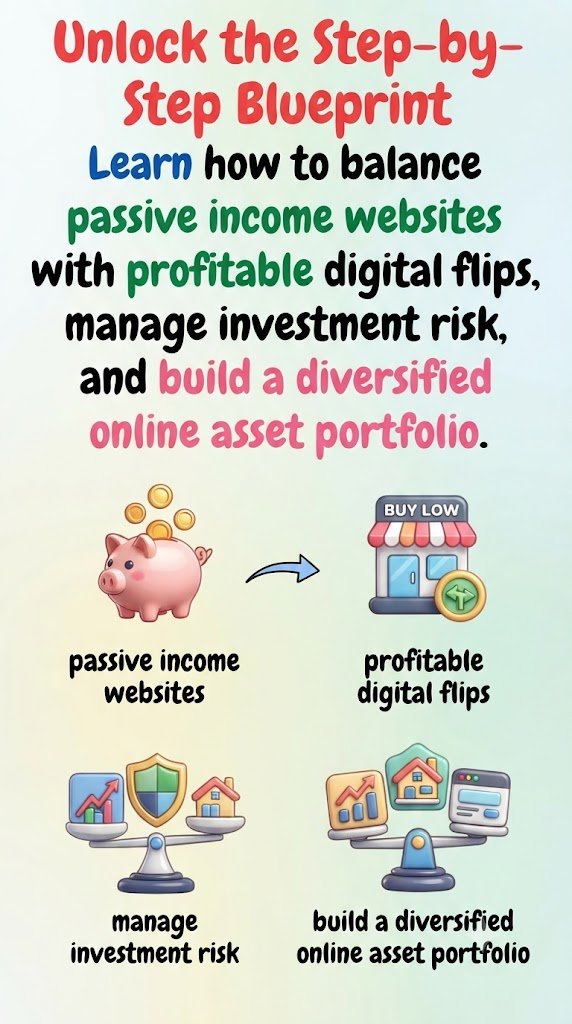
Learn how to balance passive income websites with profitable digital flips, manage investment risk, and build a diversified online asset portfolio.
Digital Portfolio Diversification: The Smart Investor’s Guide to Cash Flow and High-Yield Digital Flips
Building a digital asset that generates $1,000 a month sounds exciting—until traffic drops, affiliate commissions shrink, or an algorithm update cuts your revenue in half. Flipping websites for a substantial one-time profit sounds equally attractive, but what happens when your next buyer disappears or your acquisition takes twice as long to improve?
That is exactly why digital portfolio diversification deserves a place in every serious online investor’s strategy.
Instead of depending entirely on recurring passive income or chasing one big website sale, you can create a portfolio that combines ongoing cash flow, capital appreciation, and strategic digital asset exits.
The idea is simple: some assets pay you while you own them, while others are purchased, improved, and eventually sold.
The challenge is finding the right balance.
This guide explains how American digital entrepreneurs and investors can combine established income-producing websites, niche blogs, digital product businesses, newsletters, and high-yield website flips into a more resilient investment strategy.
You will learn how to allocate capital, evaluate opportunities, control downside risk, compare returns, and build an investor asset strategy that supports both short-term financial needs and long-term wealth-building goals.
Looking for a practical starting point? Begin by comparing the assets you already own—or plan to buy—against three factors: reliable cash flow, resale potential, and the time required to manage them. That simple exercise can reveal where your portfolio is unnecessarily exposed.
What Is Digital Portfolio Diversification, and Why Does It Matter?
Digital portfolio diversification means spreading investment capital and operational effort across different types of online businesses and digital assets rather than depending on one website, monetization method, audience, or business model.
A diversified digital portfolio may include:
- Established content websites earning advertising and affiliate income.
- Subscription-based newsletters or paid communities.
- Digital product stores selling templates, courses, or downloadable resources.
- Software-as-a-Service businesses generating recurring subscriptions.
- Undervalued websites acquired for improvement and resale.
- Small online businesses with existing customers and transferable operations.
The objective is not simply to own more websites.
It is to create assets whose financial performance is not entirely dependent on the same external factors.
For example, owning five affiliate websites that all depend on Google search traffic and the same affiliate network may look diversified on paper. In reality, all five properties share similar risks.
A search algorithm change, commission reduction, or advertiser policy update could affect the entire portfolio simultaneously.
Compare that with an investor who owns an established newsletter business, a direct-sales digital product store, and a niche website being prepared for resale.
These businesses have different revenue sources, customer relationships, and exit possibilities.
That is the difference between having multiple assets and having meaningful diversification.
Why digital assets need a different investment approach
Unlike publicly traded stocks or diversified index funds, many digital businesses are privately owned, illiquid, operationally demanding assets.
Their value can depend heavily on:
- Search rankings and website traffic.
- Platform policies and account accessibility.
- Customer retention and acquisition costs.
- Intellectual property ownership.
- Revenue quality and consistency.
- The founder’s involvement.
- Availability of qualified buyers.
- Technology, cybersecurity, and ongoing maintenance.
Digital assets can offer attractive entrepreneurial opportunities, but their market values are harder to establish and their risks can be more concentrated than those of diversified traditional investments.
Therefore, an investor should treat digital-business diversification as one component of an overall financial strategy, not as a replacement for emergency savings, retirement planning, or conventional investment diversification.
Passive Income vs Website Flips: Which Strategy Builds More Wealth?
Neither passive income nor website flipping is automatically the better investment. Their usefulness depends on your capital, business skills, liquidity needs, available time, and tolerance for uncertainty.
Passive income strategies prioritize recurring earnings from assets you continue to own.
Website flipping strategies prioritize increasing an asset’s market value and selling it for more than its total acquisition, improvement, and transaction costs.
Both can create value. Both can also lose money.
| Factor | Passive Income Assets | Website Flips |
|---|---|---|
| Primary objective | Ongoing cash flow | Profit from resale |
| Revenue timing | Recurring, but variable | Mostly at exit |
| Investment horizon | Usually longer term | Project-dependent |
| Cash accessibility | Earnings may arrive regularly | Capital often remains tied up |
| Management needs | Continuous maintenance | Intensive improvement and sale preparation |
| Main risk | Declining earnings | Failed turnaround or disappointing sale |
| Growth opportunity | Reinvested profits and audience growth | Operational improvements and higher valuation |
| Best suited for | Patient operators seeking cash flow | Skilled buyers comfortable with execution risk |
The hidden weakness of a cash-flow-only portfolio
An established website earning $800 monthly after operating expenses can appear dependable.
But imagine that 85% of its visits come from a handful of search queries.
Even if the website has produced earnings for several years, that income is vulnerable.
A major ranking change could create an immediate revenue problem.
A portfolio built entirely around similar income sites can therefore suffer significant correlated losses.
The solution is not necessarily to abandon content websites. It is to diversify their traffic sources, monetization systems, and customer acquisition methods.
The hidden weakness of a flips-only portfolio
Flipping can create a different problem: inconsistent realized income.
Suppose you purchase a neglected website for $12,000, spend $4,000 improving it, and expect to sell it for $25,000.
Your planned gross spread is $9,000 before selling fees, taxes, financing, and the value of your labor.
But what if the site never reaches the expected earnings level?
What if buyer demand declines?
What if the sale process takes nine months longer than expected?
Your capital remains exposed without producing the cash you anticipated.
This is why experienced digital asset operators evaluate both expected upside and the cost of being wrong.
How Should Investors Divide Capital Between Cash-Flow Assets and Digital Flips?
A sensible allocation starts with your financial needs rather than a universal percentage formula.
Someone building an online business alongside a full-time job may prioritize established income sources.
A professional website operator with substantial cash reserves may allocate more toward turnaround opportunities.
For illustration, consider three allocation models.
Illustrative digital asset allocation modelsThese are hypothetical planning examples, not recommended allocations or forecasts.
Conservative
80% income / 20% flips
Balanced
60% income / 40% flips
Growth-focused
35% income / 65% flips
Cash-flow assets
Flipping projects
The examples above assume the investor has already set aside appropriate personal emergency funds, business operating reserves, and money for taxes.
Conservative allocation: Prioritizing predictable operations
A hypothetical 80/20 mix dedicates 80% of digital-investment capital to established cash-flow businesses and 20% to acquisitions intended for resale.
This approach may appeal to entrepreneurs who:
- Prefer ongoing revenue.
- Have limited time for active turnaround projects.
- Need business cash flow to cover planned expenses.
- Want to develop acquisition skills without committing most of their capital.
However, the allocation does not make the overall portfolio low risk. Established websites can still experience steep declines, and even an 80% allocation to income websites may represent considerable concentration.
Balanced allocation: Combining income and growth
A hypothetical 60/40 mix offers greater exposure to resale opportunities while retaining a larger allocation to cash-flow businesses.
The key advantage is flexibility.
If acquisition opportunities become unattractive, the investor can focus on improving existing businesses rather than forcing a new purchase.
This model can work for operators who have experience maintaining digital businesses and evaluating transactions.
Growth-focused allocation: Prioritizing capital appreciation
A hypothetical 35/65 mix allocates more capital to websites and digital businesses purchased primarily for improvement and resale.
This approach requires stronger operational capabilities, greater liquidity reserves, and a willingness to accept uncertainty.
It is generally unsuitable for someone who needs stable monthly earnings or cannot absorb substantial capital losses.
The real lesson is that the correct allocation is the one you can sustain through an unsuccessful flip and a simultaneous decline in recurring income.
Which Digital Assets Offer the Best Balance of Recurring Income and Resale Potential?
The most attractive assets are not necessarily the ones with the largest advertised returns. They are the businesses with understandable economics, transferable ownership, manageable risk, and realistic opportunities for improvement.
1. Established niche content websites


9
Niche websites can generate revenue through advertising, affiliate partnerships, sponsorships, and digital products.
They are potentially suitable for a cash-flow portfolio when they have diversified traffic, original content, a defensible audience relationship, and documented operating expenses.
A site with direct visitors and an engaged email list may have a different risk profile from one depending almost entirely on search engine clicks.
Best for: Investors who understand publishing, content management, and search visibility.
Less suitable for: Buyers expecting fully hands-off earnings or guaranteed search traffic.
2. Digital product businesses
Digital products—including templates, educational materials, printable planners, and professional toolkits—can generate repeatable sales without physical inventory.
Their advantage is the ability to sell a product repeatedly after its initial creation.
Their weakness is that new sales often require continued marketing, product support, updates, and customer acquisition.
A digital store with original products, repeat customers, and its own email audience may provide both cash flow and a potential future exit.
A store relying on unverified licensing rights or a single marketplace is considerably riskier.
3. Subscription and software businesses
Subscription businesses can offer recurring billing and measurable customer behavior.
But recurring revenue is not the same as recurring profit.
Software businesses may face:
- Customer churn.
- Development and infrastructure expenses.
- Security responsibilities.
- Support costs.
- Competition from larger providers.
- Dependence on third-party services and APIs.
A profitable subscription business with low churn and transferable systems may appeal to long-term owners and acquisition buyers.
However, technical due diligence is essential.
4. Undervalued websites with operational problems
A distressed digital asset may sell for less because its traffic, customer relationships, or earnings have deteriorated.
Some businesses can be rehabilitated.
Others are structurally impaired.
For example, a website with outdated but useful articles, clean backlink history, and an engaged audience may offer a better turnaround opportunity than one with manipulated traffic or questionable intellectual property.
Best for: Operators with proven SEO, technical, editorial, and conversion optimization skills.
Less suitable for: Beginners who cannot independently evaluate the reasons for declining performance.
5. Newsletters and audience-owned businesses
Newsletters provide direct communication with subscribers instead of relying exclusively on algorithmic distribution.
Potential revenue streams include sponsorships, premium subscriptions, affiliate relationships, and owned products.
A newsletter becomes more valuable when subscriber consent is documented, engagement is genuine, and revenue is not dependent on a single sponsor.
Transferability matters here, too. A business built entirely around one individual’s personality may become difficult to sell.
How Can a $50,000 Digital Investment Portfolio Work in Practice?
Consider a hypothetical U.S. entrepreneur with $50,000 specifically allocated to digital-business investments.
The investor has separate personal savings and is comfortable with the possibility of losing part of this capital.
The proposed allocation is:
| Asset | Capital allocated | Purpose |
|---|---|---|
| Established content business | $18,000 | Recurring operating income |
| Digital product business | $12,000 | Direct customer sales |
| Website turnaround project | $10,000 | Potential resale |
| Small experimental asset | $5,000 | Testing a new business model |
| Uncommitted portfolio reserve | $5,000 | Unexpected costs and opportunities |
| Total | $50,000 |
These are illustrative allocations, not current marketplace prices.
The investor might aim to improve an acquired site’s revenue while maintaining the established assets.
But the financial plan should not assume that every project produces its intended return.
A hypothetical website flip
Suppose the investor allocates $10,000 to a turnaround:
- Purchase price: $7,000
- Content, design, and technical improvements: $2,000
- Other acquisition and operating costs: $1,000
Total project investment: $10,000.
After several months, suppose the investor finds a buyer willing to pay $15,000.
If selling fees and closing expenses total $1,200, the project produces:
Illustrative flip economics
Sale price
$15,000
Project cash invested
$10,000
Closing and selling costs
$1,200
Pre-tax cash profit
$3,800
Illustrative cash return on project capital: 38%, before taxes, financing costs, and any unpaid owner labor. Not an annualized return.
The project may appear successful, but that figure does not account for the investor’s unpaid labor.
If the investor spent 180 hours working on the acquisition and improvements, the economic attractiveness would look different once that time received a reasonable value.
A digital investment needs to justify not only the cash committed but also the attention diverted from other opportunities.
What if the project performs poorly?
Now imagine that the same website sells for only $8,000 after $800 in selling expenses.
With $10,000 invested, the project produces a $2,800 cash loss.
The portfolio’s other businesses may help the investor continue operating, but their revenue does not erase the loss.
This illustrates the central purpose of diversification: avoiding dependence on one outcome, not eliminating risk.
How Are Website Flips Valued in 2026?
Most established profit-generating websites are evaluated partly on their normalized earnings, risk characteristics, and the multiple a buyer is willing to pay.
One commonly used calculation is:
\[ \text{Indicative Business Value}=\text{Annual Net Profit}\times\text{Valuation Multiple} \]
For example, a website earning $2,000 in average monthly net profit generates approximately $24,000 in annualized net profit, assuming the earnings are sustainable.
At a hypothetical 2.5-times annual-profit multiple, the indicative price would be $60,000.
That is a calculation, not an appraisal or guaranteed offer.
A useful 2026 industry detail is that Empire Flippers announced a switch from monthly to annual valuation multiples effective September 8, 2026. A 36-times monthly-profit multiple and a 3-times annual-profit multiple describe the same price when the underlying profit is measured consistently.
Empire Flippers
This distinction matters when comparing listings, historical transactions, or brokerage reports.
What actually influences a website’s resale multiple?
Buyers may assign stronger valuations to businesses with dependable earnings, diversified customer acquisition, established systems, and low owner dependence.
They may discount businesses that have:
- Sharp recent traffic declines.
- Unverified revenue.
- Heavy reliance on one affiliate program.
- Poor-quality backlinks or questionable SEO practices.
- Unclear licensing or content ownership.
- Unrecorded expenses.
- High customer churn.
- Significant legal or cybersecurity exposure.
Some sellers overestimate value by focusing on gross revenue rather than sustainable operating profit.
Others overlook the fact that historical performance does not establish future profitability.
A practical investor asset strategy should therefore use conservative valuations and test several exit-price assumptions before purchasing.
What Should You Check Before Buying an Income Website or Flip?
A thorough due diligence process is one of the most effective ways to avoid expensive digital acquisition mistakes.
Consider this interactive checklist before pursuing a deal.
Digital Asset Acquisition ChecklistTrack the items you have independently verified.
0 of 10Reconcile bank, payment processor, and revenue recordsReview at least 12 months of traffic and earnings history where availableAnalyze traffic concentration and major ranking changesIdentify all operating expenses and required owner laborVerify domain, code, content, trademark, and license ownershipCheck customer retention, refunds, and chargebacksConfirm platform accounts and agreements can legally transferReview privacy, security, tax, and contractual obligationsModel downside, base-case, and upside exit scenariosDocument post-acquisition responsibilities and transition support
Reset Copy checklist
Completing a checklist does not guarantee a safe acquisition. Verification quality matters more than the number of boxes checked.
Verify earnings rather than trusting screenshots
Request financial evidence that can be reconciled with the seller’s actual records.
Revenue dashboard screenshots alone may not reveal refunds, advertising expenses, contractor payments, software costs, or adjustments.
Where appropriate, use transaction documentation, third-party verification, and professional accounting review.
Investigate traffic quality and concentration
A website showing impressive traffic may be dependent on a small group of pages, one keyword cluster, or temporary referral activity.
Review trends over multiple periods and distinguish organic, direct, paid, email, and referral visitors.
A site whose reported earnings depend on traffic that cannot be verified deserves significant caution.
Check whether the business can actually be transferred
Owning a website does not automatically mean every related asset can move to a new buyer.
Software licenses, merchant accounts, advertising partnerships, creator profiles, customer data, and marketplace accounts may have specific transfer restrictions.
Buyers and sellers should examine applicable terms and privacy obligations before assuming those assets are included.
How Do You Reduce Risk Without Sacrificing Every Growth Opportunity?
Start by identifying risks shared across your digital portfolio.
For instance, an investor might own three different websites but discover that all depend on organic search rankings, the same advertising provider, and the same content production process.
That creates concentration even when the business names and niches are different.
Diversify revenue sources
A content business might combine advertising, affiliate revenue, and sales of relevant digital products.
A newsletter business might balance paid subscriptions with carefully selected sponsorships.
Multiple income streams do not automatically improve a business, but they can reduce dependence on one source when the revenues are genuinely independent and operationally viable.
Diversify traffic acquisition
Traffic from Google, social platforms, direct visits, referral partners, and permission-based email marketing can behave differently.
A balanced acquisition strategy might invest in stronger email relationships and direct audience engagement while continuing to improve search visibility.
Google’s own Search Central guidance emphasizes useful, reliable, people-first content over publishing primarily to manipulate search traffic. That is an important principle when planning either long-term content growth or a website turnaround.
Maintain liquidity
Digital acquisitions are not instantly reversible.
Selling a business may involve marketing the opportunity, providing due diligence materials, negotiating contracts, and waiting for transfer or escrow procedures.
Keep adequate funds outside active acquisitions to cover operating needs, unexpected expenses, and potential delays.
Limit exposure to any single project
An attractive acquisition can still fail.
Establish a maximum project exposure based on the amount of loss your financial situation can withstand.
Remember that exposure includes committed improvement spending and future obligations, not simply the advertised purchase price.
Avoid overlapping operational dependence
If every business requires the same owner to manage publishing, customer service, product development, and technical issues, the portfolio may become impossible to operate efficiently.
Document processes, introduce sensible automation, and delegate where economics justify it.
Want to evaluate a new acquisition more confidently? Use the checklist above alongside a downside cash-flow forecast before making an offer. It is much easier to reject an expensive mistake before closing than to recover from one afterward.
How Can You Calculate Risk-Adjusted Returns on Digital Assets?
Looking at profit alone can make a risky project appear more attractive than it really is.
A practical evaluation should consider the initial investment, future cash flows, holding period, operating expenses, exit proceeds, tax consequences, and probability of a disappointing outcome.
Calculate cash-on-cash return carefully
For a completed flip, a basic pre-tax cash return can be calculated as:
\[ \text{Cash ROI}=\frac{\text{Net Cash Proceeds}-\text{Invested Cash}}{\text{Invested Cash}}\times100 \]
This metric is useful but limited.
It does not capture the time value of money, the risk taken, or the value of unpaid labor.
Evaluate an income asset using actual distributable cash flow
Consider a site with $1,500 in monthly revenue.
Its costs may include:
| Expense | Monthly amount |
|---|---|
| Hosting and software | $120 |
| Content maintenance | $250 |
| Technical support | $100 |
| Marketing | $130 |
| Total cash operating costs | $600 |
The resulting monthly operating cash surplus is $900 before taxes, debt service, owner compensation, and any unlisted costs.
A seller might advertise the site as earning $900 monthly.
However, if running it requires significant owner labor, the business’s economic profit would be lower after accounting for that work.
Never confuse revenue, operating cash surplus, and genuine passive earnings.
Stress-test your assumptions
Digital Income Stress-Test Calculator
Adjust the inputs to compare baseline cash flow with a revenue decline scenario. Illustrative only.Purchase price ($)Monthly revenue ($)Monthly operating expenses ($)Holding period
12 monthsRevenue decline scenario
30%
Baseline cash flow
$4,200
Stressed cash flow
$2,400
Cash flow is for the selected holding period, before tax, owner compensation, financing, acquisition fees, and resale proceeds. Purchase price: $12,000. This is not a valuation or profit forecast.
A profitable-looking asset may become unattractive after a moderate revenue decline.
The ability to withstand such a decline matters more than the most optimistic projection.
Should You Hold a Profitable Website or Sell It?
Sell when the risk-adjusted value of the proceeds is more attractive than the expected benefits of continuing to operate the business.
That does not automatically mean selling after a period of growth.
Consider three questions.
Is the business becoming more valuable or simply earning more today?
Temporary traffic spikes, unusually strong advertising rates, and one-time product launches may increase short-term earnings without improving the business’s underlying quality.
A buyer will want to know whether performance can continue.
Could the sale proceeds work better elsewhere?
If a business has become difficult to grow and a reasonable buyer offers an attractive price, selling might release capital for other investments.
But reinvesting in another business introduces new execution and acquisition risks.
An exit is only beneficial when the after-tax proceeds and alternative uses of capital justify it.
Is the website becoming too dependent on you?
A business that earns well but requires constant attention may be less desirable than one with slightly lower earnings and well-documented systems.
Before selling, consider whether delegating operations could improve both your lifestyle and the business’s attractiveness.
A good portfolio should give you choices.
You should not be forced to sell your strongest asset just to finance basic operating expenses.
Where Can U.S. Investors Find Digital Businesses for Acquisition?
Investors can research opportunities through specialized brokers, online business marketplaces, direct seller outreach, and professional networks.
Different channels provide different levels of screening and assistance.
| Acquisition channel | Potential advantage | Main concern |
|---|---|---|
| Empire Flippers | Brokerage process and vetted marketplace listings | Eligibility, fees, and available inventory |
| Flippa | Broad range of online business listings | Listing quality and verification vary |
| Acquire.com | Access to startup and business acquisition opportunities | Business-model complexity and transaction risk |
| Direct owner outreach | Potential access to off-market opportunities | More independent diligence and negotiation |
| Professional referrals | Relationship-based introductions | Limited selection and possible conflicts |
These are research channels, not endorsements or assurances of transaction quality. Verify each marketplace’s current requirements, fee schedules, service scope, and buyer protections.
Is paying a broker worth it?
A broker may help with buyer introductions, deal preparation, negotiation, and transfer coordination.
However, brokerage fees affect net sale proceeds, and a broker’s involvement does not replace legal, financial, or technical due diligence.
For a small asset, fees may represent a meaningful percentage of the total transaction.
For a more complex business, professional assistance may save substantial time and reduce process-related mistakes.
Compare the services delivered, the contract terms, and the cost of alternative transaction methods.
How Can You Build a Diversified Digital Asset Portfolio From Scratch?
The most practical approach is to build repeatable investment and operating processes before scaling the number of acquisitions.
Step 1: Establish your financial boundaries
Identify capital that you can afford to expose to high-risk, illiquid digital businesses.
Keep personal emergency funds and required financial commitments separate.
Set aside reasonable reserves for ongoing business operations, taxes, and uncertain acquisition costs.
Step 2: Choose a business model you understand
Start with an asset whose revenue mechanics and operational requirements you can independently evaluate.
Buying a subscription software company without understanding development, customer support, and security requirements creates avoidable uncertainty.
Likewise, purchasing a search-dependent website without understanding analytics and content quality makes the investment difficult to assess.
Step 3: Build your first cash-flow foundation
The objective is not necessarily to buy an expensive website.
It is to acquire or develop a manageable business with transparent economics and a defensible customer proposition.
Document actual income, expenses, and time invested.
Step 4: Add a controlled turnaround project
Only after establishing financial and operational discipline should you consider a higher-risk flip.
Look for a specific improvement opportunity rather than relying on vague expectations of future growth.
Examples include:
- Improving an outdated product checkout process.
- Updating inaccurate content with substantial original research.
- Improving website speed and usability.
- Reducing unnecessary operating costs.
- Introducing relevant owned products to an existing audience.
The value improvement should be measurable.
Step 5: Create a clear exit framework
Before purchasing a flip, identify the conditions under which you would sell, hold longer, invest more, or stop funding the project.
Decide how you will respond to a declining business rather than relying on emotion after problems appear.
Step 6: Review the portfolio every quarter
Assess the portfolio as a group, not only as individual businesses.
Look at cash flow, owner workload, risk exposure, maintenance requirements, and possible sale values.
A rapidly growing property can quietly become a dangerous concentration if it represents most of your portfolio’s income.
Which Metrics Matter Most When Managing a Digital Asset Portfolio?
Track a small number of decision-useful metrics consistently.
| Metric | What it tells you |
|---|---|
| Net operating cash flow | Cash produced after operating expenses |
| Revenue concentration | Dependence on particular sources |
| Traffic concentration | Exposure to specific channels or pages |
| Customer retention | Ability to maintain revenue over time |
| Owner hours | Whether income is genuinely low-maintenance |
| Acquisition cost | Total capital needed to obtain an asset |
| Estimated net exit proceeds | Potential cash after selling expenses |
| Cash reserve coverage | Ability to continue operating through setbacks |
| Realized return | Actual results from completed projects |
| Portfolio concentration | Exposure to one business or shared risk |
Do not confuse a broker’s advertised valuation with liquid cash.
An estimated sale price is not realized wealth until an actual transaction closes and associated costs and obligations are considered.
Build a portfolio dashboard
A simple spreadsheet can track monthly performance across properties.
Include asset name, business model, revenue, expenses, traffic mix, capital invested, owner hours, planned improvements, and outstanding risks.
For resale projects, maintain a separate acquisition-to-exit ledger.
This helps prevent a common accounting mistake: reporting attractive sale proceeds while overlooking months of improvement costs and unpaid effort.
What Are the Biggest Mistakes Digital Investors Make?
The most expensive mistakes often come from treating online businesses as effortless passive-income instruments.
Buying based on advertised earnings alone
A listing may emphasize its best months without adequately explaining seasonal demand, customer churn, rising costs, or recent declines.
Always inspect the underlying records.
Assuming every neglected website can be rescued
Some declining websites have recoverable operational problems.
Others have lost relevance, customer trust, or sustainable distribution.
Not every low-priced asset is undervalued.
Using optimistic resale prices to justify weak acquisitions
If a project only makes financial sense at an unusually high future valuation, its risk may be greater than the spreadsheet suggests.
Base acquisition decisions on conservative scenarios.
Ignoring taxes and transaction costs
A profitable-looking flip can produce a disappointing after-tax result.
For U.S. businesses, tax treatment depends on the transaction structure and the assets being transferred.
The IRS explains that selling a business often involves separate tax treatment for different assets rather than treating the entire sale as a single undifferentiated capital gain. Certain qualifying business asset sales may also require Form 8594.
Consult a qualified U.S. tax professional before relying on assumptions about capital gains, ordinary income, or deductions.
Growing faster than operations can support
Acquiring several websites can feel like diversification, but every additional business creates reporting, security, compliance, and maintenance responsibilities.
More assets do not automatically mean a better portfolio.
Sometimes improving two strong businesses is preferable to managing eight neglected ones.
Is Digital Portfolio Diversification Worth It for Small Investors?
It can be worthwhile when the investor has the necessary business knowledge, capital resilience, time, and willingness to manage operational risk.
But it is not the right approach for everyone.
For someone seeking effortless returns, privately owned digital businesses may be inappropriate because they require oversight and can become difficult to sell.
For an entrepreneur who enjoys improving businesses and understands the underlying economics, combining recurring-income properties with selected flips may create several paths to generating value.
The critical distinction is between investing in businesses and purchasing a promise of passive income.
A business requires maintenance, judgment, and occasional difficult decisions.
Even a well-run digital portfolio is unlikely to be completely passive.
Who may benefit most?
Digital portfolio diversification may appeal to:
- Experienced content website owners.
- Digital product entrepreneurs.
- Professionals with SEO, marketing, or software expertise.
- Small business buyers seeking operational acquisitions.
- Investors comfortable with private-business risks and illiquidity.
It may be less appropriate for:
- Anyone relying on the capital for essential expenses.
- Beginners expecting guaranteed monthly returns.
- Investors without the time or resources for due diligence.
- People unwilling to handle technology, customer service, and operational decisions.
- Anyone unable to tolerate an unsuccessful acquisition.
A Practical 90-Day Roadmap for Building Your Digital Investment Strategy
A 90-day framework can help you establish the necessary discipline before committing heavily to acquisitions.
It is a planning schedule, not a promise that a business can be purchased, improved, or sold within 90 days.
Days 1–30: Research and financial preparation
Define your investment boundaries, review your financial reserves, study business models, and analyze example listings without committing capital. Create your due diligence process and acquisition criteria.
Days 31–60: Evaluate opportunities
Conduct deeper reviews of suitable businesses. Request appropriate financial and operational documentation, compare risk scenarios, and consult qualified professionals when necessary.
Days 61–90: Make a measured decision
Complete an acquisition only if a suitable opportunity passes your requirements. Otherwise, continue monitoring the market. If you already own a business, focus on improving its cash flow, recordkeeping, and operational independence.
There is no obligation to close a deal simply because you have reached the final stage of a plan.
Sometimes the most profitable decision is preserving capital until the right opportunity appears.
Frequently Asked Questions About Digital Portfolio Diversification
1. What is the best way to diversify a digital investment portfolio?
Start by combining assets with different revenue sources, customer acquisition channels, and operational risks. For example, an established content website, a direct-sales digital product business, and a carefully selected turnaround project may provide different financial opportunities. Keep cash reserves, limit single-project exposure, and review performance regularly.
2. Is passive income better than flipping websites?
Passive income websites may provide recurring earnings, while website flips aim to generate profits when businesses are sold. Neither approach guarantees returns. Income assets suit investors seeking ongoing cash flow, whereas flipping generally requires stronger execution skills and greater tolerance for uncertain exits. Combining them can reduce dependence on either strategy.
3. How much money do I need to start investing in digital assets?
There is no universal minimum because costs differ widely across websites, digital products, and subscription businesses. Building a small original digital product may require less upfront capital than acquiring an established profitable website. Budget for expenses, taxes, maintenance, due diligence, and potential losses before purchasing anything.
4. How long does it take to flip a website profitably?
A website flip may take months or longer, depending on the initial condition, required improvements, operating performance, and buyer demand. Some projects never achieve a profitable exit. Investors should evaluate realistic holding costs, time commitments, transaction fees, and multiple sale scenarios rather than assuming a fixed turnaround schedule.
5. Are digital assets a safe investment for long-term wealth building?
Digital assets carry meaningful risks, including revenue volatility, platform dependence, cybersecurity issues, operational demands, and limited liquidity. Diversification can reduce certain concentrations but cannot eliminate losses. For long-term wealth building, digital businesses are generally better assessed alongside traditional investments, financial reserves, and personal risk tolerance rather than in isolation.
Build a Digital Portfolio That Gives You More Options, Not More Pressure
The real advantage of owning a diversified portfolio is not simply the possibility of earning more money.
It is having more than one way to create financial value.
An established digital business may generate cash while another asset is being improved. A successful website sale may release capital for new opportunities. A subscription product may build recurring customer relationships, while an owned newsletter provides a direct connection to an audience.
These elements can complement one another when they are selected carefully.
But diversification only works when you understand the underlying businesses.
Owning a larger collection of fragile websites does not create financial resilience. Buying multiple assets with the same risks can merely multiply your exposure.
Successful digital portfolio diversification begins with disciplined acquisition decisions, verified financial information, realistic valuations, sensible liquidity reserves, and a clear understanding of how each asset contributes to the overall strategy.
Start small enough that mistakes are survivable. Improve your ability to evaluate businesses before expanding your holdings. Favor durable economics over impressive revenue screenshots, and treat high-yield flips as uncertain business projects rather than guaranteed investment returns.
Your next step: Create a one-page digital portfolio scorecard covering your available capital, target assets, cash-flow needs, maximum acceptable loss, and exit criteria. Use it to compare opportunities consistently before spending money.
For continued learning, explore related guides on website acquisition due diligence, improving declining content sites, building recurring digital product revenue, and preparing an online business for sale. Subscribe to the Passive Income newsletter for future updates to these frameworks and market developments.
Already operating income websites or experimenting with digital flips? Share what has worked, what surprised you, or what you would do differently. Your experience—or a candid review of the strategies discussed here—can help other readers make better-informed decisions.
Compliance Note
Affiliate and sponsorship disclosure: This article mentions digital business marketplaces for informational purposes. No affiliate or sponsorship relationship is represented here. If monetized links or sponsored placements are added, relevant material relationships should be disclosed clearly and close to the recommendations, consistent with FTC guidance.
No guaranteed results: All financial examples, portfolio allocations, transaction scenarios, and returns are illustrative. Actual performance may differ substantially, including the possibility of losing invested capital.
Accuracy and update date: Updated October 12, 2026. Market conditions, valuation practices, platform terms, and regulatory requirements can change. Verify current information before making financial commitments.
Financial, tax, and legal disclaimer: This content is provided for general education and does not constitute personalized investment, financial, tax, or legal advice. Consult appropriately qualified U.S. professionals regarding acquisitions, business sales, transaction structures, and tax obligations.
Stay ahead with exclusive updates
Join our community. Get curated industry trends, actionable guides, and fresh resources delivered straight to your inbox.