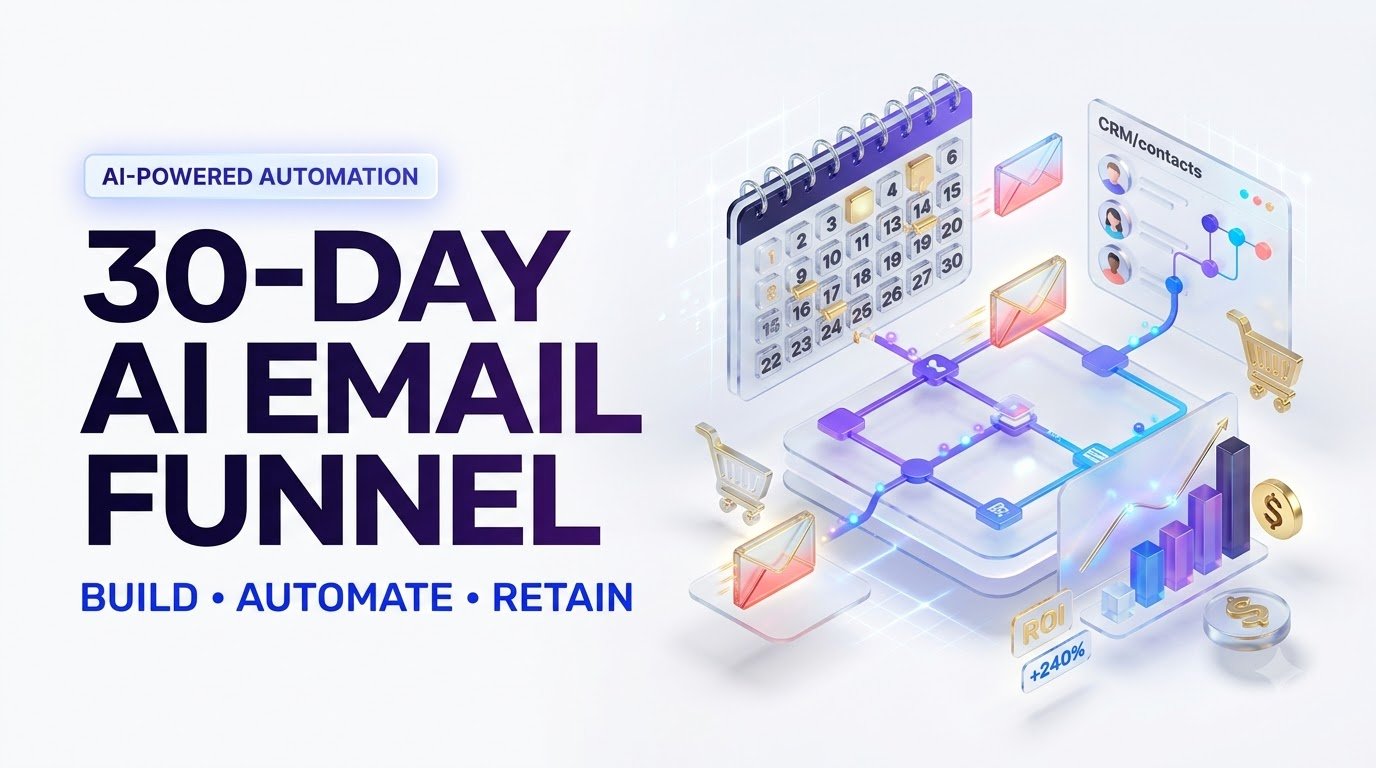
Learn to create and sell 30-day AI email marketing sequences, welcome funnels, cart recovery flows, and automated drip campaigns with practical templates.
The Evergreen Cash Engine: Selling Dynamic 30-Day AI Email Sequences Engineered for High Retention
Build an email relationship your customers want to keep—and package that system into a valuable, repeatable digital product.
30-day blueprint + ready-to-adapt promptsSomeone downloads your free guide, joins your email list, and receives a cheerful welcome message. Then nothing happens for three weeks. The next email? A discount code with no context. For a subscriber who barely remembers your brand, that message feels like an interruption rather than an invitation.
This is a common weakness in creator and e-commerce marketing. It is not necessarily a lack of products, subscribers, or clever subject lines. It is a lack of continuity. Subscribers need a reason to recognize you, trust your judgment, understand the value of your offer, and return when the timing is right.
AI email marketing sequences can help solve that problem—when AI supports a deliberate customer journey rather than producing thirty unrelated promotional messages. Better still, that carefully built journey can become a digital product: a welcome sequence template pack, an automated drip campaign prompt library, or a complete white-label automation blueprint that creators and stores can adapt to their businesses.
1. Transactional Emails vs. Relationship-Driven Email Copywriting
Transactional emails serve a specific operational purpose: they confirm purchases, deliver receipts, provide shipping updates, or help customers access their accounts. Relationship-driven marketing emails have a different job. They build familiarity, answer questions, demonstrate useful expertise, and give subscribers a relevant next step.
Both belong in a healthy customer experience, but they should not be confused. A receipt should not quietly become an excuse to enroll someone in a marketing campaign without an appropriate basis to send it.
| Dimension | Transactional email | Relationship-driven marketing email |
|---|---|---|
| Main purpose | Complete or document a service interaction | Educate, nurture, retain, or sell |
| Typical trigger | Purchase, password reset, delivery event | Opt-in, stated interest, eligible behavioral event |
| Examples | Receipt, order status, account notice | Origin story, tutorial, case example, product education |
| Success signals | Accuracy, delivery, support outcomes | Meaningful clicks, purchases, replies, repeat engagement |
| Compliance approach | Classification depends on the message’s primary purpose and applicable law | Marketing permissions, sender identification, opt-out and privacy obligations apply |
Why continuous storytelling works better than disconnected promotions
Picture a small skincare shop. A subscriber signs up to learn how to simplify a routine. An isolated discount message says, “20% off cleanser.” A connected series might first explain why too many products can make routines difficult, then show a simple morning checklist, then explain how to choose a cleanser, and only later introduce a product that fits the guidance.
The offer is not hidden. It arrives in context. The same principle applies to a creator selling a course, a consultant marketing a service, or a digital storefront offering template packs.
2. The Anatomy of a 30-Day AI Email Funnel
A 30-day funnel is a customer-journey window, not an instruction to email everyone every day. A practical version might contain 12 to 16 scheduled nurture messages over a month, with additional event-driven messages only when the recipient qualifies. Frequency should respond to expressed preferences, purchase stage, and engagement—not the seller’s desire to fill a calendar.
Stage 1: Welcome and orientation
Days 1–5. Deliver what was promised, clarify who you help, and create an easy first win.
Stage 2: Education and connection
Days 6–12. Teach a useful method, address a common mistake, and invite subscribers to identify their goals.
Stage 3: Solution discovery
Days 13–21. Introduce relevant products naturally, explain use cases, and handle reasonable objections.
Stage 4: Conversion and retention
Days 22–30. Make an appropriate offer, onboard buyers, request feedback, and offer continued value.
The five layers of a sequence that adapts
- Audience promise: What exactly did someone sign up to receive?
- Narrative arc: How do early lessons prepare the reader for deeper decisions?
- Product insertion points: Where can a purchase genuinely accelerate a desired outcome?
- Behavioral conditions: What happens when someone clicks, buys, opts out, or expresses a different interest?
- Exit and handoff rules: How do people stop getting irrelevant pitches and move into customer care?
Copywriting frameworks can help organize individual messages. A Soap Opera-style sequence uses open loops, connected stories, and a satisfying payoff across several emails. PAS—Problem, Agitation, Solution—makes one obstacle easy to understand. AIDA—Attention, Interest, Desire, Action—works for a focused product introduction. None of these formulas should justify false urgency or misleading claims.
3. The Practical 30-Day Email Marketing Calendar
Use this example as a 30-day journey map with 15 planned nurture touches. Days without scheduled messages allow time for readers to engage, while relevant triggers can add or replace communications. The example assumes the subscriber has an appropriate basis to receive marketing.
| Day | Email / journey action | Hook or subject-line example | Primary CTA |
|---|---|---|---|
| 1 | Welcome and promised resource | “Your toolkit is here. Start with this.” | Access the resource |
| 2 | Easy first win | “One small change you can make today” | Try the checklist |
| 4 | Founder or customer-problem story | “Why we built this differently” | Reply with a challenge |
| 6 | Common misconception | “The advice that sounds right—but isn’t always” | Read the explanation |
| 8 | Educational mini-lesson | “A 5-minute way to simplify the process” | Use the worksheet |
| 10 | Interest segmentation | “Which result matters most to you?” | Choose a topic |
| 12 | Proof and context | “What a realistic result actually looks like” | Explore an example |
| 14 | First contextual product introduction | “When a template saves more than time” | View the relevant product |
| 16 | Objection handling | “Do you need advanced tools to get started?” | Compare options |
| 18 | Behind-the-scenes demonstration | “See the workflow from start to finish” | Watch or read the demo |
| 21 | Offer explanation | “What’s inside—and who it’s right for” | Review the product details |
| 24 | Relevant objection and FAQ | “Three questions before you decide” | Read the buyer guide |
| 26 | Optional genuine promotion | “A limited offer, if the timing fits” | View eligible promotion |
| 28 | Post-purchase branch or continuing value | “Your next best step” | Use the product / free lesson |
| 30 | Preference check and ongoing newsletter handoff | “What would you like next month?” | Set your preferences |
Important: If the contact buys on Day 14, the sales-focused messages should be suppressed or replaced by onboarding and customer-help content. If a contact disengages, consider lowering frequency or using a properly permissioned preference check rather than increasing pressure. If an unsubscribe occurs, stop marketing sends as required.
Example: turning a bland product pitch into a mini-story
“Our new email template bundle is available. Buy today for $67.”
Stronger contextual copySubject: “The welcome email wasn’t the problem”
“A creator can spend hours polishing the first email and still lose the conversation a week later. The missing piece is often the journey between hello and the first offer. I mapped that gap into a simple sequence: welcome, teach, listen, demonstrate, invite. Here is a sample of the map so you can see whether it fits your audience.”
CTA: “Preview the 30-day email map.”
This example makes a credible observation, presents a process, and offers a low-pressure next step. It does not pretend that an actual customer said something unless permissioned, verifiable evidence supports the story.
4. Behavioral Triggers: Make the Funnel Respond to Real People
Smart automation is not about sending more emails. It is about sending the next appropriate message—or choosing not to send one.
| Observed event | Recommended action | Guardrail |
|---|---|---|
| Confirmed marketing subscription | Start welcome series and record source | Store the consent or other legal basis |
| Clicks a beginner tutorial | Add beginner-interest tag, show relevant learning content | Don’t infer sensitive personal traits |
| Views a product, where tracking is permitted | Consider a helpful product education branch | Respect tracking consent and avoid creepy personalization |
| Starts checkout but does not complete | Eligible cart recovery message after a reasonable delay | Do not assume checkout activity itself grants marketing consent |
| Completes purchase | Exit prospect pitch; send relevant service and onboarding messages | Keep operational and marketing messages appropriately distinguished |
| Requests fewer emails | Reduce cadence or apply preference selection | Honor preferences consistently |
| Unsubscribes | Immediately suppress future marketing in the system | Honor legal opt-out deadlines; do not put recipient back in the funnel |
Three add-on automation modules that can sell separately
- Soap Opera story arc: A connected 5-email introduction built around a real problem, a turning point, a lesson, evidence, and a relevant offer.
- Cart recovery: A small conditional series focused on solving friction: support questions, shipping clarity, product fit, and a final reminder where legally permitted. Suppress after purchase.
- Flash-sale sprint: An optional promotion sequence that explains a genuine offer, communicates its actual expiration, and stops when the promotion ends. Never fabricate timers or scarcity.
5. Packaging Your Product for Klaviyo, Kit, and Other Email Platforms
People who search for Klaviyo automation templates or Kit email sequences often need more than copy. They want instructions that reduce implementation effort. Give them both the words and the wiring diagram.
| Deliverable | Best audience | What the buyer receives |
|---|---|---|
| Editable swipe pack | Solo creators | Google Docs/Word-friendly drafts, subject alternatives, CTA notes, personalization placeholders |
| Platform-neutral automation map | Marketers using different ESPs | Trigger chart, wait times, branching logic, exclusions, testing checklist |
| Kit automation template | Newsletter and course creators | Sequence, tags, fields and Visual Automation configuration where supported; optional shareable template |
| Klaviyo flow build guide | E-commerce operators | Event-based flow specification, conditional splits, product-specific variables, suppression/testing instructions |
| Agency white-label system | Freelancers and agencies | Rebrandable assets, license scope, client onboarding checklist, QA workflow, reporting sheet |
How to prepare a Kit (formerly ConvertKit) version
- Create a sequence of emails with clear waits and drafts reviewed by a human.
- Define entry conditions through a sign-up form or another eligible trigger.
- Build a Visual Automation that adds subscribers to the sequence, applies interest tags, and routes buyers appropriately.
- Use supported conditions and events to move or exclude subscribers.
- Test the entire path with sample profiles before enabling sends.
- If your account supports it, create a shareable Visual Automation template and document what gets copied.
Kit distinguishes a Sequence (the actual series of emails) from a Visual Automation (the logic that enters subscribers into sequences and routes them). Features and plan availability can change; verify the buyer’s account supports the proposed setup. Official references: Kit automation guide and sharing automation templates.
How to prepare a Klaviyo version
- Document the entry event: list subscription, started checkout, purchase, or another available integration event.
- Specify flow filters, conditional splits, event data fields, send delays, and exit conditions.
- Write copy variants appropriate for the customer’s lifecycle stage.
- Verify integration mappings, eligible recipients, consent settings, dynamic fields, and purchase suppression.
- Use test profiles and preview tools to confirm that branches and merge fields render correctly.
Do not advertise a “one-click Klaviyo import” unless you have confirmed your particular export or template is supported. A platform-specific build guide is a valuable product even if some actions must be configured manually. Consult the current Klaviyo Help Center before promising exact implementation steps.
6. A Fill-in-the-Blank AI Email Prompt Engine Buyers Can Reuse
One-time swipe files are useful; reusable prompt engines help customers update emails when their offers, seasonality, or customer objections change. Provide prompts that demand context, guardrails, and a human review.
Master sequence architecture prompt
Act as a lifecycle email strategist and careful conversion copywriter.

Business: [business type]
Audience: [ideal buyer, main goal, knowledge level]
Signup promise: [reason they joined]
Offer: [name, genuine benefits, price, limitations]
Brand voice: [three descriptors]
Sending region: [locations and consent constraints]
Primary goal: [education / trial activation / first purchase / retention]
Current lifecycle stage: [new subscriber / prospect / buyer]
Known customer objections: [verified objections]

Design a 30-day journey with 12–16 nurture emails, not a daily blast.
For each email provide:
- Day, objective, subject line and preview text
- Reader problem and unique useful takeaway
- Narrative connection to prior/next email
- 120–220 word first draft and one primary CTA
- Personalization variables and safe fallback values
- Trigger, exclusion rule and post-purchase adjustment

Requirements:
- Do not invent testimonials, results, discounts, or deadlines.
- Use only supplied product facts and claims.
- Provide an alternate non-promotional path for existing buyers.
- Flag claims and legal requirements for human review.
- End with a QA checklist and test cases.
Cart recovery prompt
Write up to two permission-appropriate abandoned-checkout
emails for [product] aimed at [buyer segment].
Likely friction points: [verified objections].
Available support resources: [links].
Actual promotion details, if any: [verified terms].
For each email include: objective, delay suggestion,
subject, body, one CTA, buyer-exclusion logic,
and compliance review flags.
Do not assume a cart event gives marketing permission.
Do not create fake inventory pressure or fake coupons.
Engagement and retention prompt
Review this 30-day nurture sequence: [paste approved copy].
Identify duplicate messages, weak educational value,
conflicting CTAs, excessive promotional frequency,
and gaps for subscribers who have already purchased.
Recommend a lower-frequency path, a preference-center
message, and useful next-month topics.
Return an edit table with rationale and revised copy.
Do not infer interest solely from email opens.
7. How to Sell an AI Email Sequence Kit for $37–$297
The buyer does not necessarily want “more AI prompts.” They want less planning, faster implementation, and fewer embarrassing automation mistakes. Package around those results, while staying careful not to promise revenue or deliverability outcomes.
| Product tier | Illustrative price | Included assets | Best fit |
|---|---|---|---|
| Starter Swipe Kit | $37 | 15 adaptable email drafts, 30-day calendar, 20 subject ideas, quick-start guide | New creators |
| Growth Funnel Pack | $97 | Starter kit + prompt engines, segmentation paths, cart recovery mini-series, QA checklist | Small stores and solo marketers |
| Complete Automation Blueprint | $197 | Growth pack + Kit/Klaviyo-specific build instructions, branching maps, onboarding scripts, reporting template | Established businesses |
| Agency White-Label License | $297 | Blueprint + rebranding rights under explicit terms, client intake worksheet, delivery SOP, client license templates | Service providers and agencies |
Pricing examples, not market benchmarks These amounts are suggested product-design tiers—not verified typical sale prices or earnings guarantees. Compare comparable offers, survey potential customers, and test willingness to pay before committing to a final price.
Make the license unambiguous
- Personal or single-business use: The customer may adapt assets for one named business.
- Commercial client use: The purchaser can use adapted campaigns for specified client projects within the license.
- Agency white-label: Define whether clients may receive editable source files, whether attribution is required, and whether the agency can rebrand materials.
- Resale restriction: Explicitly state whether purchasers may redistribute or resell the underlying templates. White-label use does not automatically imply unrestricted resale rights.
- Support: Specify whether platform setup, custom rewriting, updates, or troubleshooting are included.
Where to sell—and how to promote it
A product page can live in your existing shop or a digital download platform. Use a short preview: one sample email, one flow diagram, a screenshot of the sequence planner, the deliverables list, license terms, and a clear refund policy. Affiliate recommendations for email platforms may be a useful additional income stream where programs permit them, but they should be disclosed appropriately.
Useful content marketing angles include “welcome series mistakes,” “cart recovery without fake discounts,” and “how to move buyers out of a prospect sequence.” Each article can naturally link to a relevant sample and invite visitors to subscribe for continuing lessons.
Ready to turn the blueprint into a product?
Start with the Starter Swipe Kit for adaptable copy, or choose the complete automation blueprint when you also need the logic, exclusions, and implementation documentation.
Get the Starter Kit — $37Explore the Complete Blueprint — $197
Publisher: replace these example anchors with your live checkout URLs before posting. Do not display product offers as available until they actually exist.
8. Measure Retention, Not Just Email Opens
Successful email campaigns need an explicit goal and a baseline. Open data is useful only with caveats because privacy protections and automated systems can distort open counts. Favor observed outcomes such as qualified clicks, purchases, replies, subscription retention, and customer satisfaction.
| Metric | What it reveals | Practical response |
|---|---|---|
| Click-through rate | Whether the message earned action | Improve alignment between email promise and linked page |
| Purchase conversion rate | How often eligible recipients complete a purchase | Review offer relevance, price presentation, and attribution |
| Unsubscribe and complaint rates | Audience fit and trust signals | Reduce frequency, fix targeting, improve signup expectations |
| Repeat purchase and retention | Whether relationships last beyond first purchase | Invest in onboarding, education and timely replenishment where appropriate |
| Revenue per recipient | Attributed financial impact across eligible sends | Compare against costs and an appropriate control group |
A trustworthy way to test the sequence
- Define a primary outcome, such as first purchase within 30 days, before running the test.
- Randomly assign eligible subscribers to a new sequence and a reasonable existing-cadence or alternative-sequence comparison, where practical.
- Keep offer terms, audience eligibility, and observation windows consistent.
- Review unsubscribes, complaints, buyer exclusions and revenue—not just clicks.
- Share the outcome accurately. If results are inconclusive, say so instead of inventing “before and after” wins.
Illustrative math—not a case study: Suppose 200 eligible subscribers receive a journey and 6 buy a $50 product. Gross revenue attributed to those orders is $300 and the observed conversion rate is 3%. Those figures alone do not establish that the email sequence caused the purchases; attribution rules, other marketing channels, costs, and a comparison group matter.
9. An Actionable Launch Plan for Your First Email Funnel Product
Step 1 — Pick one niche
Choose a segment with a recurring email need: digital product sellers, newsletter creators, online educators, or small e-commerce businesses.
Step 2 — Map the customer journey
Collect accurate product facts and common questions. Build one welcome path, one contextual offer, and a buyer handoff.
Step 3 — Draft and validate
Use AI for first drafts; human-edit all claims, timing, personalization, and CTA logic. Test with dummy contacts.
Step 4 — Package and demonstrate
Create editable assets, a setup video or screenshots, a license, a small free preview, and an easy-to-understand sales page.
For search visibility, create original supporting content that answers one specific buyer question per article. Add relevant internal links, descriptive headings, a strong featured image, and clear authorship. Keep updating platform instructions as product interfaces evolve. Helpful content and a distinctive point of view matter more than repeating target keywords.
10. Five Frequently Asked Questions
1. What are AI email marketing sequences?
They are planned sets of emails whose drafts, variations, or structure are assisted by AI. A strong implementation also includes audience segmentation, send timing, behavioral triggers, and rules to stop or redirect messages. AI does not replace consent checks, human editing, or campaign measurement.
2. How many emails should a 30-day welcome funnel include?
There is no universal perfect number. A starting blueprint may contain 12–16 nurture emails spread across 30 days, adjusted for subscriber expectations and business context. Some brands should send fewer. Behavioral emails should be triggered only when relevant and permissible.
3. Can I sell a welcome sequence template pack without being an email marketing expert?
You can sell templates you have the rights to distribute, but quality and accurate claims are essential. Start with one well-researched niche, document assumptions, have a qualified reviewer inspect the strategy, and avoid claiming performance results you have not measured.
4. Are Klaviyo and Kit email automations interchangeable?
No. Both support automation workflows, but their events, interfaces, data fields, conditions, and sharing methods differ. Sell platform-neutral strategy separately from product-specific setup assets, and test every supported configuration before advertising compatibility.
5. Can an AI-generated email funnel guarantee sales or retention?
No. Results depend on audience quality, permission, deliverability, product-market fit, offer strength, pricing, message quality, and execution. Present AI funnels as tools that can support a repeatable process, not as guaranteed passive-income machines.
11. Test Your Knowledge: Five Interactive Flashcards
Tap or click each card to reveal its answer and a quick explanation. These expandable cards work on mobile without custom JavaScript.
Flashcard 1 — A purchase receipt belongs to which category: transactional or relationship-driven marketing?
Answer: Transactional. Its principal purpose is confirming an order. Adding prominent promotion can change classification or compliance obligations, so evaluate the primary purpose.
Flashcard 2 — A customer buys during the prospect sequence. Keep pitching or move them to onboarding?
Answer: Move them to onboarding. Use purchase events to suppress irrelevant prospect pitches and provide a helpful next step.
Flashcard 3 — Which is better: 30 promotional emails in 30 days or a smaller series designed around a real customer journey?
Answer: The customer-journey series. Relevance, expectations, and timing matter more than maximizing message count.
Flashcard 4 — Can a copywriting template advertised as “white-label” automatically be resold without restrictions?
Answer: No. License terms define rebranding, client delivery, source-file distribution, resale, and sublicensing rights.
Flashcard 5 — What’s more persuasive evidence: “Our funnel guarantees 10x sales” or a transparent test with sample size and limitations?
Answer: A transparent test. Credible context and honest uncertainty establish more trust than unsupported earnings claims.
12. Turn a One-Time Sale into a Repeatable Customer Relationship
The best email template product does not end at the checkout page. It continues with a buyer welcome message, a simple implementation guide, troubleshooting resources, and updates when platforms change. That experience makes a customer more likely to use the product, offer useful feedback, and consider a relevant next purchase.
For a creator, the immediate benefit is a clearer path from signup to product discovery. For an e-commerce store, it is a chance to make post-signup communications more relevant. For the person selling automation kits, the opportunity is to package careful strategy, good writing, and reproducible technical instructions into an asset people can actually deploy.
Preview the Welcome Sequence KitExplore More AI Marketing Guides
Compliance Note: Email Marketing, AI Content, and Digital Product Sales
This article is educational marketing guidance, not legal, financial, tax, or professional compliance advice. Email marketing requirements depend on recipient location, business type, consent status, message content, and the services used. Review applicable rules before launching any campaign.
- Permission and unsubscribe: Maintain an appropriate legal basis for marketing. Provide clear sender identification and working opt-out mechanisms. In the United States, check the FTC CAN-SPAM business guide, including address and opt-out requirements. In the UK, review ICO electronic marketing guidance; other jurisdictions may impose additional consent rules.
- Deliverability: Configure domain authentication and comply with provider standards, including applicable bulk-sender and one-click-unsubscribe rules. See Google’s email sender guidelines. Respect spam complaints and unsubscribe requests.
- Privacy and tracking: Disclose how subscriber and behavioral data are used. Apply relevant privacy and tracking consent requirements; avoid uploading confidential customer data into AI systems without authorization and appropriate safeguards.
- Truthful claims: Do not create fabricated customer stories, endorsements, testimonials, scarcity, or performance numbers. Example pricing and revenue calculations here are illustrative only.
- Affiliate disclosure: Clearly disclose material relationships when recommending an email platform or earning a commission from a link.
- Intellectual property: Review rights to your source assets and the commercial terms of any AI services or third-party templates used. Document exactly what an agency or buyer may rebrand, sublicense, or resell.
- WordPress publishing: Add actual checkout URLs, factual product terms, an author identity, a reviewed publication date, and a real featured image before publishing. Use your SEO plugin to set metadata and structured data; avoid duplicate Article or FAQ schema.
Editorial status: Platform and regulatory guidance checked against official sources in October 2026. Product availability, pricing, ESP plans, and regulations may change. Review again before implementation.
Stay ahead with exclusive updates
Join our community. Get curated industry trends, actionable guides, and fresh resources delivered straight to your inbox.