Selling a digital product is one thing. Building a system that consistently turns interested visitors into subscribers, first-time customers, premium buyers, and repeat customers is something entirely different.
That system is your digital product sales funnel.
Instead of expecting someone to discover your website and immediately purchase your most expensive product, a well-designed funnel gives people a series of useful, low-friction steps. A visitor may first download a free checklist. A few days later, they receive a helpful email. Then they purchase an affordable template pack. After seeing the quality of that product, they become interested in a larger toolkit, course, bundle, membership, or premium resource.
The pathway looks simple:
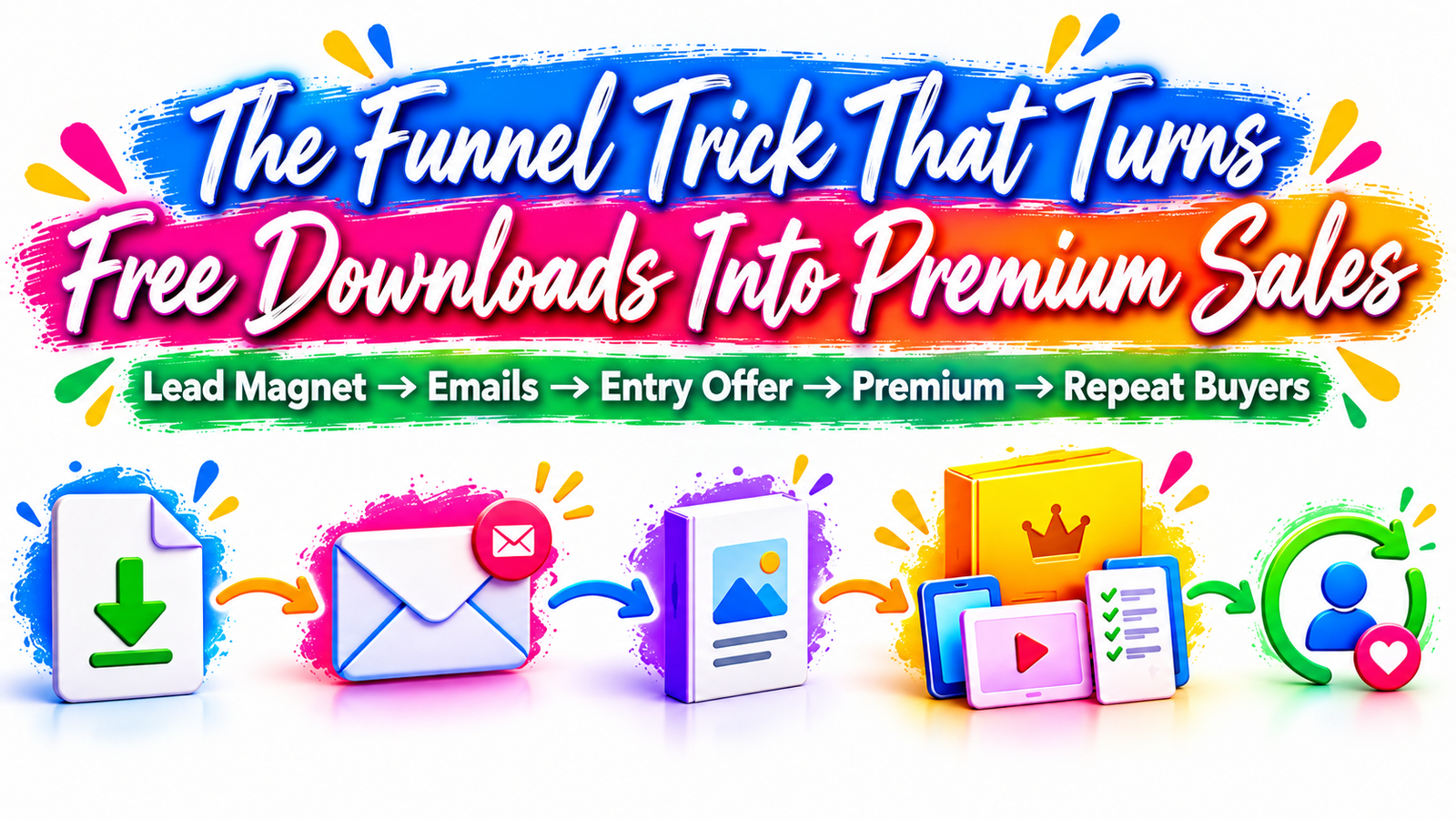
Free Download → Email Nurturing → Entry Product → Premium Resource → Repeat Buyer
But the strength of a successful digital product marketing funnel comes from what happens between those steps.
Every stage should answer one question:
What is the most natural next step for this customer?
When that question guides your funnel, selling becomes less about pushing products and more about helping customers make progress.
This guide explains how to build that system from the ground up, how to connect each offer logically, how to improve conversions, and how to make your funnel easier to discover through search engines, Google Discover, and generative AI search experiences.
What Is a Digital Product Sales Funnel?
A digital product sales funnel is a structured customer journey that moves someone from initial discovery toward increasingly valuable purchases.
The visitor rarely begins as a buyer.
They may first discover your business through Google Search, Pinterest, YouTube, Instagram, a blog article, an online marketplace, an advertisement, or a recommendation.
Your funnel then gives that visitor a reason to move closer to your business.
For example, imagine that you sell digital resources for small business owners.
Someone searches for:
“How do I organize my small business finances?”
They discover your article.
Inside the article, you offer a free Small Business Finance Checklist.
The visitor downloads it and joins your email list.
Over the following week, you send practical advice about cash flow, budgeting, expense tracking, and financial organization.
You then introduce a $9 Small Business Budget Spreadsheet.
After purchasing it, the customer receives an offer for a $39 Business Finance Toolkit.
Later, they may purchase a $99 or $149 complete business planning system.
One search visitor has now become a subscriber, customer, premium customer, and potentially a repeat buyer.
That is the power of a thoughtfully designed funnel.
Why Digital Product Sellers Need a Funnel
Many creators try to sell digital products online by publishing dozens of unrelated products and hoping visitors find something they want.
That approach can generate sales, but it often creates a fragmented customer experience.
A funnel creates continuity.
Instead of asking:
“What other product can I sell?”
you start asking:
“What does this customer need next?”
That shift changes everything.
The first product solves a small problem. The next solves a larger problem. The premium product brings several solutions together. Additional offers help customers continue making progress.
Your digital product collection becomes an ecosystem rather than a random catalog.
A good funnel can also increase the value of every visitor. You are no longer dependent on making the entire sale during a person’s first website visit.
If they are not ready to buy today, your lead magnet and email sequence keep the relationship alive.
The Five Core Stages of a Digital Product Marketing Funnel
An effective funnel can be built around five connected stages.
| Funnel Stage | Primary Goal | Example |
|---|---|---|
| Lead Magnet | Turn visitor into subscriber | Free checklist |
| Email Nurturing | Build trust and demonstrate value | Educational email sequence |
| Entry Product | Convert subscriber into customer | $7–$19 template |
| Premium Resource | Increase customer value | Toolkit, bundle, course or system |
| Repeat Buyer Pathway | Encourage future purchases | Updates, complementary products, memberships |
The important word is connected.
A free resource about Instagram content planning should not suddenly lead to a premium bookkeeping product.
Every stage should feel like the natural continuation of the previous one.
Stage 1: Create a Lead Magnet People Actually Want
Your funnel begins with a useful free resource.
A lead magnet is not simply something you give away because it is inexpensive to create. It should provide enough immediate value that a visitor is willing to exchange their email address for it.
Strong lead magnets usually solve one focused problem quickly.
Examples include a checklist, mini planner, worksheet, spreadsheet, calculator, swipe file, prompt collection, template, short guide, resource list, printable, mini-course, assessment, or starter toolkit.
Imagine your premium offer is a Complete Freelancer Business System.
A logical lead magnet could be:
Free Freelancer Client Onboarding Checklist
That lead magnet attracts people who are already experiencing a problem your paid products can solve.
Compare that with a broad offer such as:
Free Business eBook
The second option may attract more people, but those people could have dozens of unrelated interests.
Specificity usually produces better-qualified subscribers.
Use the “Small Win” Principle
A good free download should provide a small but real result.
It should not attempt to solve the customer’s entire problem.
Suppose you eventually want to sell a premium social media planning system.
Your funnel might begin with:
Free 30-Day Content Idea Sheet
The free download helps users answer:
“What should I post?”
Your entry product might then answer:
“How do I organize all those posts?”
Your premium product might answer:
“How do I build and manage my entire content marketing system?”
Each product expands the outcome.
This creates a natural progression.
Build a High-Converting Lead Magnet Page
Your landing page should be simple.
Visitors should immediately understand what they will receive, who it is for, and what problem it helps solve.
A strong headline could be:
Plan Your Next 30 Days of Content in Less Time
The supporting copy might explain that the free planner gives entrepreneurs a simple framework for organizing ideas, formats, themes, and publishing dates.
Then show a clear preview of the resource.
Avoid overwhelming visitors with multiple unrelated products, excessive menus, pop-ups, and competing calls to action.
At this stage, there is only one primary conversion:
Download the resource.
Stage 2: Use Email Nurturing to Turn Attention Into Trust
The lead magnet creates the connection.
Email nurturing develops the relationship.
One of the biggest mistakes in a digital product sales funnel is immediately sending subscribers a stream of promotional emails.
Someone downloaded your free resource because they wanted help.
Continue helping them.
A useful introductory email sequence might contain five messages:
- Deliver the promised free resource and explain how to use it.
- Help the subscriber avoid a common mistake related to the problem.
- Teach a useful framework or strategy.
- Show an example, mini case study, or before-and-after process.
- Introduce the entry product as the logical next step.
The exact number of emails is less important than the progression.
Your subscriber should gradually move from:
“This looks useful.”
to:
“This business understands my problem.”
to:
“I would consider buying their solution.”
Write Emails Around Problems, Not Promotions
Suppose you sell digital products for freelancers.
A weak nurturing email says:
Buy our Freelancer Business Bundle today.
A stronger email might discuss why freelancers lose time repeatedly creating proposals from scratch.
The email explains the problem, gives the reader a practical improvement they can use immediately, and then introduces your reusable proposal template.
The product becomes part of the solution rather than an interruption.
That is an important distinction.
Email nurturing works best when education and commerce support each other.
Stage 3: Introduce an Easy Entry Product
The entry product transforms a subscriber into a customer.
This is one of the most important moments in the funnel.
A person who has paid even a relatively small amount has crossed a psychological threshold. They have experienced your checkout process, downloaded your product, and evaluated its quality.
Your entry offer should therefore deliver an excellent experience.
Common entry products include editable templates, spreadsheets, mini toolkits, printable systems, digital planners, short guides, prompt packs, design assets, small template bundles, mini-courses, or starter packs.
The price will depend on your market and product, but the strategic purpose remains the same:
Create a low-risk first purchase.
Make the Entry Product Closely Related to the Free Download
Consider this sequence:
Free Download: Weekly Meal Planning Checklist
Entry Product: Editable 30-Day Meal Planner
Premium Resource: Complete Meal Planning and Grocery Management System
That progression makes sense.
Now consider:
Free Download: Weekly Meal Planning Checklist
Entry Product: Social Media Canva Templates
There is no logical customer journey.
Funnels perform better when every offer builds on the previous problem.
Create a Bridge Between Free and Paid
Do not simply place a product link at the bottom of an email.
Explain why the paid product exists.
For example:
Your free checklist may help users understand what steps are required.
The paid template helps them complete those steps faster.
The free resource provides information.
The paid resource provides implementation.
This distinction can dramatically improve positioning.
People will often pay not merely for information but for saved time, structure, convenience, customization, organization, and reduced decision-making.
Stage 4: Move Customers Toward a Premium Resource
Once someone purchases your entry product and receives value from it, you can introduce a more complete solution.
Premium does not necessarily mean extremely expensive.
It means the product solves a larger problem, produces a broader result, or provides significantly greater convenience.
Premium digital offers could include a complete business toolkit, advanced template library, comprehensive course, membership, professional resource vault, premium spreadsheet system, workflow bundle, digital academy, certification program, design library, or all-in-one operating system.
For example:
Free: Invoice Checklist
Entry Product: Professional Invoice Template Pack
Premium Product: Complete Freelancer Financial Management Toolkit
The premium offer expands the customer’s capability.
Position Premium Products Around Outcomes
A weak premium offer says:
Includes 185 templates, 47 worksheets, 22 trackers and 15 bonuses.
The quantity may sound impressive, but quantity alone does not communicate value.
A stronger offer might say:
Manage client onboarding, projects, invoices, payments and monthly business planning from one organized freelancer system.
The second version focuses on the transformation.
Features explain what customers receive.
Benefits explain why those features matter.
Outcomes explain what customers can accomplish.
Premium products should be positioned primarily around outcomes.
Stage 5: Build a Repeat Buyer Pathway
Many funnels stop after the premium purchase.
That is a missed opportunity.
An existing satisfied customer already knows your brand, understands your product quality, and has completed the buying process.
Instead of constantly searching for new customers, build ways for existing buyers to continue their journey.
A repeat buyer pathway might include complementary products, seasonal collections, updated versions, advanced resources, subscription libraries, memberships, expansion packs, specialized bundles, workshops, or related toolkits.
Imagine someone purchases your Small Business Marketing Planner.
Their next logical purchase could be a:
Social Media Content System
Later:
Email Marketing Toolkit
Then:
Complete Small Business Marketing Vault
These products serve related needs without simply selling the same solution repeatedly.
Turn Individual Products Into a Product Ecosystem
A strong digital product business is often easier to grow when products are designed as a family.
Suppose your audience is freelancers.
Your ecosystem might look like this:
Free Freelancer Starter Checklist
↓
$9 Client Onboarding Template
↓
$29 Freelancer Administration Kit
↓
$79 Complete Freelancer Business System
↓
Premium Template Membership
Now every new product has a strategic place.
Your marketing also becomes easier because every piece of content can point toward an appropriate stage of the funnel.
Match Your Content Strategy to the Funnel
Your blog, social posts, videos, and search content should not exist separately from your sales strategy.
They should attract people experiencing problems your funnel solves.
For example, an article titled:
How to Create a Professional Client Onboarding Process
could introduce your onboarding checklist.
Another article:
What Should Be Included in a Freelance Proposal?
could lead toward your proposal template.
Another:
How to Organize a Freelance Business
could introduce your premium business system.
This is how content marketing and a digital product marketing funnel begin working together.
Build Search Intent Into Every Funnel Stage
Search intent describes what someone is actually trying to accomplish when they enter a query.
Some searches are informational:
how to create a business budget
Some are commercial:
best small business budget template
Some are transactional:
buy small business budget spreadsheet
Your content and funnel should support these different levels of intent.
An educational article can capture informational searches.
A product comparison or detailed resource page can satisfy commercial investigation.
A clear product page can serve transactional intent.
This helps you attract people at different stages of buying readiness rather than trying to force everyone directly onto a sales page.
SEO Strategy for a Digital Product Sales Funnel
Search engine optimization should make your funnel easier to discover and understand.
Google’s current Search Essentials emphasize helpful, reliable, people-first content, the natural use of words people actually search for, crawlable internal links, and clear handling of images, videos, and structured information.
For this topic, natural keyword opportunities include:
Primary keywords: digital product sales funnel, digital product marketing funnel, sell digital products online
Secondary concepts: lead magnet for digital products, email funnel for digital products, digital download marketing, online sales funnel, digital product email marketing, digital product customer journey, recurring digital product sales
Long-tail search ideas: how to build a digital product sales funnel, how to sell digital products with email marketing, how to turn free downloads into customers, how to create a funnel for digital downloads, how to get repeat buyers for digital products
Keywords should help explain the subject.
They should never make the article sound unnatural.
Google explicitly advises creators to focus on useful people-first material instead of producing content primarily to manipulate search rankings. Its guidance also recommends demonstrating real experience, depth, clear authorship, and original value.
GEO and AI Search Visibility in 2026
Generative Engine Optimization, commonly called GEO, has become an important discussion as search increasingly includes AI-generated responses.
But there is an important distinction between legitimate optimization and supposed GEO shortcuts.
Google’s 2026 guidance says foundational SEO continues to matter for generative AI search. It emphasizes unique, useful, non-commodity content and specifically warns that special tactics such as unnecessary llms.txt files, artificial “chunking,” rewriting pages solely for AI, or chasing inauthentic mentions are not required for Google Search visibility.
For digital product businesses, practical GEO means making your expertise easy to understand.
Explain concepts clearly.
Use descriptive headings.
Give concrete examples.
Answer important follow-up questions.
Provide original frameworks.
Include comparisons where they genuinely help.
Describe your products accurately.
Show who created the content.
Keep important business and product information consistent.
Publish content that adds something beyond a generic summary.
Google’s current generative AI guidance specifically highlights unique points of view, first-hand experience, useful original material, and established SEO foundations as more valuable than supposed AI-search hacks.
In practical terms, the best GEO strategy is often simply becoming a better source.
Make Your Content Google Discover-Friendly
Google Discover is interest-driven rather than purely keyword-driven.
According to Google’s current guidance, pages that are indexed and comply with Discover policies can be eligible automatically; no special Discover schema is required, and eligibility does not guarantee placement. Google recommends accurate non-clickbait headlines, timely or uniquely insightful content, strong page experience, and compelling relevant imagery.
For publishers creating featured images, Google’s updated Discover guidance recommends large, high-quality images that are at least 1200 pixels wide, contain more than 300,000 total pixels, and work well in a 16:9 landscape format. Google also recommends enabling large image previews and specifying relevant imagery through supported metadata such as og:image or schema markup.
For an article like this, a strong Discover-style angle could be:
Why Smart Digital Product Sellers Are Building Customer Journeys Instead of One-Off Products
That angle creates curiosity without resorting to misleading clickbait.
Google also says Discover content can benefit from being timely, storytelling-driven, or offering unique insights.
Do not write about a topic solely because it appears to be trending. Google’s people-first content guidance specifically warns against publishing topics simply because they are popular when they do not genuinely serve your audience.
Use Google Trends as a research signal, not as a reason to abandon your audience strategy.
Optimize the Product Pages Inside Your Funnel
Your blog content may generate traffic, but your product pages must convert that attention.
Every important product page should clearly communicate the problem, intended customer, result, contents, format, compatibility, usage instructions, licensing terms when relevant, delivery method, frequently asked questions, and purchasing process.
Show previews whenever possible.
Digital buyers cannot physically inspect what they are purchasing.
Screenshots, workbook previews, template samples, dashboards, page mockups, video demonstrations, and before-and-after examples reduce uncertainty.
Visual search is also becoming more important. In September 2026, Google introduced additional Search Console reporting for multimodal search activity, including searches involving Lens, Circle to Search, uploaded images, and related visual search interactions.
That makes descriptive filenames, meaningful alternative text, useful screenshots, strong original visuals, and well-organized product imagery increasingly valuable parts of a digital product publishing strategy.
Use Internal Links to Connect the Funnel
Your website architecture should make the customer journey easy to follow.
An informational article can link to the lead magnet.
The lead magnet confirmation page can introduce the entry product.
The entry product page can link to a premium solution.
The customer download area can introduce complementary resources.
Related blog posts can link to one another.
Internal links serve two purposes.
They help people continue exploring your site, and they help search engines discover relationships between your pages.
A strong site architecture might resemble:
Digital Product Marketing Hub
→ Lead Generation Guides
→ Email Marketing Guides
→ Pricing Guides
→ Product Creation Guides
→ Sales Funnel Guides
→ Relevant Products
This creates thematic depth rather than isolated pages.
Add a Smart Thank-You Page
One of the most overlooked funnel assets is the page subscribers see immediately after downloading the free resource.
They have already taken action.
Their interest is high.
Instead of showing:
“Thanks. Check your inbox.”
use the page to help them continue.
Explain how to use the free resource.
Show one additional tip.
Then introduce an optional next step.
For example:
Want the complete editable version?
Your free checklist could naturally lead to a low-cost template pack.
This is sometimes called a bridge offer or tripwire offer.
It should remain relevant and optional.
The subscriber should never feel that the free resource was merely bait.
Segment Customers Based on Behavior
As your funnel grows, not every subscriber should receive identical messages.
Someone who downloaded a social media planner may have different interests from someone who downloaded a bookkeeping checklist.
Someone who purchased your beginner template should receive different messaging from someone who already owns your premium bundle.
Segmentation can be based on lead magnet downloaded, product purchased, category interest, previous purchases, email engagement, or customer stage.
This makes marketing more relevant.
Instead of sending every offer to every subscriber, you can send the right offer to the right audience.
Use Automation Without Making the Funnel Feel Robotic
Automation is one of the major advantages of selling digital products.
The lead magnet can be delivered automatically.
Email nurturing can begin automatically.
Purchase confirmation can happen automatically.
Product files can be delivered automatically.
Follow-up messages can be triggered automatically.
But the customer experience should still feel human.
Avoid writing emails that sound like software notifications.
Use natural language.
Explain why something matters.
Give useful advice.
Recognize the customer’s stage.
Automation should remove repetitive administrative work, not remove personality from the business.
Track the Metrics That Matter
Do not judge the funnel only by website traffic.
Traffic matters, but each stage has its own conversion goal.
Useful funnel measurements include visitor-to-subscriber conversion rate, email open and click behavior, entry-product conversion rate, checkout completion rate, average order value, premium upgrade rate, repeat purchase rate, refund rate, revenue per subscriber, and customer lifetime value.
Imagine 10,000 people visit your content.
If 5% join your email list, you gain 500 subscribers.
If 8% of those subscribers purchase a $10 entry product, you gain 40 customers and $400.
If 20% of those customers later purchase a $50 premium resource, another eight purchases generate $400.
If some customers purchase additional products later, the original traffic continues generating value.
This is why funnel optimization can sometimes be more valuable than simply trying to double traffic.
Improving the percentage of people moving from one stage to another compounds across the entire system.
Find the Weakest Stage Before Creating More Products
Suppose thousands of people read your articles but almost nobody downloads your lead magnet.
The problem may be the lead magnet.
If many people subscribe but nobody buys the entry product, your email sequence or offer alignment may be weak.
If the entry product sells well but premium upgrades are rare, the premium offer may be poorly positioned.
If premium customers never return, your product ecosystem may lack a useful next step.
Do not automatically solve every revenue problem by creating another product.
Sometimes the product already exists.
The connection between products is what needs improvement.
A Practical Funnel Example
Imagine a creator serving new Etsy and digital download sellers.
The funnel could begin with an article:
How to Organize Your First Digital Product Business
Inside the article is a free:
Digital Product Launch Checklist
After downloading it, subscribers receive several practical emails explaining niche selection, product planning, store organization, pricing, and launch preparation.
The entry offer becomes:
Digital Product Launch Planner — $12
After the customer completes that planner, they receive an offer for:
Digital Seller Business Toolkit — $49
The toolkit includes launch planning, keyword research worksheets, pricing calculators, content calendars, product trackers, customer service templates, and sales dashboards.
Satisfied customers later receive offers for specialized resources such as:
SEO Toolkit
Email Marketing System
Social Media Template Pack
Premium Seller Resource Vault
Every stage serves the same audience.
Every product solves the next problem.
That is what makes the funnel coherent.
The Biggest Digital Product Funnel Mistakes
The most damaging funnel mistake is trying to move too quickly from stranger to premium buyer.
Other problems usually come from the same issue.
The free download has little connection to the paid product.
Emails become constant sales pitches.
Entry products are intentionally made weak so customers will upgrade.
Premium bundles emphasize file quantity instead of customer outcomes.
Customers receive promotions for products they already own.
There is no clear next step after purchase.
The business creates too many products without understanding which existing products customers actually want.
The funnel becomes unnecessarily complicated.
A successful funnel does not need twenty stages.
A simple five-stage system can outperform a complicated marketing machine when every transition is relevant.
How to Strengthen Trust Throughout the Funnel
Trust is the thread connecting every stage.
Deliver exactly what your lead magnet promises.
Make pricing clear.
Explain file formats.
State software requirements.
Clarify licensing.
Provide accurate previews.
Avoid artificial scarcity.
Do not claim guaranteed earnings from a digital product.
Use testimonials responsibly.
Make contact and support information easy to find.
Publish useful educational content even when no immediate sale is involved.
Google’s people-first guidance likewise emphasizes trust, clear authorship, useful experience, expertise, and content that leaves readers feeling they have genuinely learned enough to move forward.
Those principles are good for search visibility because they are also good for customers.
A Simple Funnel Formula You Can Use
Start with one audience.
Identify one recurring problem.
Create one free resource that delivers a small win.
Create one affordable product that makes implementation easier.
Create one premium solution that addresses the larger outcome.
Then create useful ways for successful customers to continue.
You do not need fifty products.
You need a connected path.
A useful funnel formula is:
Problem → Quick Win → Implementation → Complete Solution → Continued Progress
Once this structure works, you can build additional funnels around related customer problems.
Build the Funnel Around the Next Best Step
The strongest digital product sales funnel does not feel like a funnel to the customer.
It feels like progress.
The visitor finds an answer.
The subscriber receives useful help.
The first-time buyer saves time.
The premium customer receives a more complete solution.
The repeat buyer discovers another resource that genuinely supports the next stage of their work.
That is how you move beyond simply trying to sell digital products online.
You begin building a customer journey.
Start small.
Choose one audience, one lead magnet, one email sequence, one entry product, and one premium offer.
Connect them carefully.
Watch how customers move through the system.
Improve the weakest transition.
Then expand.
When every product answers the customer’s next question, your marketing becomes clearer, your product catalog becomes easier to understand, and your business becomes less dependent on constantly finding brand-new buyers.
Frequently Asked Questions
1. What is the best funnel for selling digital products?
A simple funnel often works best: attract visitors with useful content, offer a relevant free lead magnet, nurture subscribers through email, introduce an affordable entry product, offer a more complete premium solution, and continue serving existing customers with related products. The specific products will vary, but the progression should remain logical.
2. Do I need a large email list before creating a digital product sales funnel?
No. A small, relevant email list can be more valuable than a large audience with little purchasing intent. Building the funnel early also allows you to learn which lead magnets, emails, products, and messages resonate before your audience becomes much larger.
3. How many emails should be included in a digital product marketing funnel?
There is no universal number. A short sequence of approximately three to seven useful emails is a practical starting point for many businesses. Focus on helping subscribers understand their problem, make progress, and recognize the natural value of the paid solution rather than sending emails simply to reach a predetermined count.
4. How can I use SEO and GEO to attract more people into my funnel?
Create original, useful content around problems your audience actively researches, use clear descriptive language, build sensible internal links, maintain strong page experience, publish helpful visuals, demonstrate real expertise, and organize product information clearly. For Google Search, current guidance indicates that traditional SEO foundations and unique people-first content remain central to visibility in generative AI experiences; special GEO hacks are not required.
5. What should I sell after someone buys my premium digital product?
Offer something that supports the customer’s next stage rather than simply another large bundle. That might be an advanced toolkit, specialized template collection, expansion pack, membership, resource library, updated edition, complementary course, or recurring service. The best repeat-buyer offer feels like continued progress rather than another promotion.
Stay ahead with exclusive updates
Join our community. Get curated industry trends, actionable guides, and fresh resources delivered straight to your inbox.