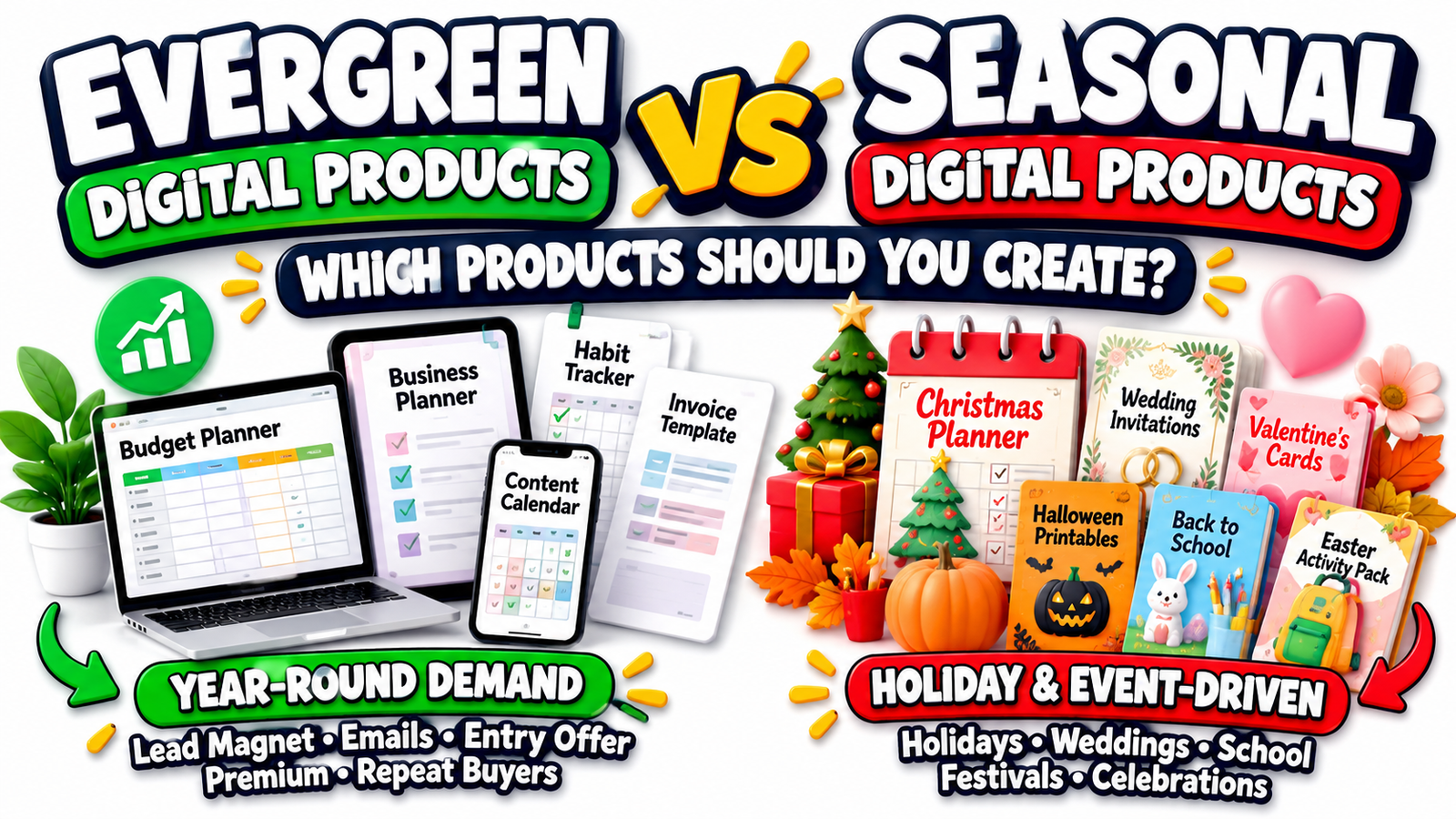
Some digital products can sell on an ordinary Tuesday in March, July, or November. Others can suddenly become highly relevant for a few weeks and then almost disappear from shoppers’ minds until the next season arrives.
That difference is at the heart of one of the most important decisions for digital-product creators: Should you create evergreen digital products or seasonal digital products?
The strongest answer is rarely “only one.”
Evergreen products can give your store stability. Seasonal products can create timely bursts of attention. Event-driven downloads can capture buyers when their need is immediate. When these product types are combined intentionally, they can form a digital product strategy that attracts customers throughout the year instead of depending on one launch, one holiday, or one bestseller.
This guide compares evergreen and seasonal digital products, explores their advantages and limitations, provides practical product ideas, and explains how to build a balanced catalog around year-round demand, holidays, weddings, school seasons, festivals, celebrations, and recurring events.
What Are Evergreen Digital Products?
Evergreen digital products are downloadable or online resources that solve needs that exist throughout most or all of the year.
Their relevance is not tied to a particular holiday, month, festival, or short-term event.
Examples include:
- Budget spreadsheets
- Business planners
- Invoice templates
- Resume templates
- Social media content calendars
- Habit trackers
- Meal planners
- Printable checklists
- Business SOP templates
- Client onboarding kits
- Canva templates
- Productivity dashboards
- Freelance proposal templates
- Wedding planning systems without a seasonal design theme
- Digital journals
- Educational worksheets
- Small-business financial trackers
- Content planning systems
- Pricing calculators
- Project management templates
A freelancer may need a proposal template in February or October. A small-business owner can search for an expense tracker at almost any point in the year. A new creator may need a social media planner regardless of the season.
That continuing problem creates continuing search potential.
What Are Seasonal Digital Products?
Seasonal digital products are designed around a specific time, holiday, celebration, festival, school period, cultural moment, or recurring annual event.
Examples include:
- Christmas planners
- Halloween invitations
- Valentine’s Day cards
- Easter activity sheets
- Diwali invitation templates
- Ramadan planners
- Eid greeting cards
- Thanksgiving meal planners
- New Year goal-setting workbooks
- Back-to-school printables
- Graduation templates
- Teacher appreciation cards
- Summer activity packs
- Wedding-season invitation collections
- Holiday social media templates
- Black Friday promotional graphics
- Mother’s Day printable gifts
- Father’s Day cards
- Year-end business planners
Demand for these products is usually concentrated around a particular buying window.
That does not necessarily make seasonal products less valuable. It simply means their sales cycle must be managed differently.
Marketplace trend reports regularly emphasize preparing seasonal inventory and listings before key occasions rather than waiting until demand has already peaked. Etsy’s 2026 trend guidance, for example, encourages sellers to update products, keywords, visuals and promotions in advance of important occasions and seasonal increases in shopper interest.
Evergreen vs Seasonal Digital Products at a Glance
Evergreen digital products
Demand pattern: Relatively consistent throughout the year
Best for: Stable traffic, long-term SEO, catalog building and recurring customer needs
Typical examples: Business templates, planners, worksheets, trackers, educational resources and productivity systems
Main advantage: One product can remain useful for a long period
Main challenge: Competition can be strong because profitable evergreen niches attract many sellers
Seasonal digital products
Demand pattern: Peaks around particular dates or events
Best for: Timely campaigns, trend-driven traffic and high-intent occasion shopping
Typical examples: Holiday printables, festival resources, school-season templates, seasonal wedding designs and event materials
Main advantage: Buyers may have a clear deadline and stronger purchase urgency
Main challenge: The selling window can be short
Neither category is automatically superior.
Their real value depends on how they fit into your broader digital product strategy.
Why Evergreen Digital Products Are So Powerful
1. They Can Generate Year-Round Search Traffic
Evergreen products are well suited to search-driven businesses because people continue looking for solutions to recurring problems.
Consider searches such as:
- small business invoice template
- weekly meal planner printable
- freelancer proposal template
- wedding budget spreadsheet
- social media content calendar
- household budget planner
- inventory tracker for small business
These needs do not disappear after one holiday ends.
An evergreen listing that performs well may continue attracting organic traffic for months or potentially years, provided it stays useful, accurate and competitive.
2. You Can Improve Them Over Time
Evergreen products provide opportunities for continuous optimization.
Instead of constantly replacing old products, you can improve:
- Product design
- Instructions
- Templates
- Mockups
- Descriptions
- FAQs
- SEO keywords
- Bonus resources
- Licensing information
- File formats
A basic expense tracker could eventually evolve into a complete financial management toolkit.
That creates leverage.
3. Evergreen Products Work Well in Product Ecosystems
One evergreen product can lead naturally to another.
For example:
Free download: Monthly budget checklist
Entry product: Budget spreadsheet
Mid-level product: Complete household finance planner
Premium product: Personal finance template bundle
This allows one customer problem to support several products at different price points.
4. They Make Content Marketing Easier
Evergreen products can support evergreen articles, videos, email campaigns and social media content.
If you sell a client onboarding kit, you could publish content around:
- How to onboard freelance clients
- What to include in a client welcome packet
- Client onboarding mistakes
- Best client questionnaire questions
- Freelance workflow templates
Those topics can repeatedly send relevant visitors toward your products.
5. Evergreen Products Can Reduce Revenue Volatility
A store built entirely around Christmas may perform strongly late in the year but struggle during other months.
A catalog containing evergreen resources has more opportunities to generate sales outside major seasonal periods.
That stability can be particularly important for creators trying to develop a long-term digital-product business.
The Limitations of Evergreen Products
Evergreen does not mean effortless.
A year-round market can also attract year-round competition.
Categories such as planners, budget templates, business templates and social media templates may contain thousands of competing options.
A generic product such as:
“Business Planner”
may struggle.
A more focused product such as:
“90-Day Business Planner for Solo Graphic Designers”
can communicate a clearer audience and outcome.
The goal is not simply to create an evergreen product.
It is to create an evergreen product for a specific buyer, problem or use case.
Why Seasonal Digital Products Can Be Extremely Valuable
1. Seasonal Products Benefit From Natural Buying Urgency
Many evergreen purchases can be postponed.
Event-based purchases often cannot.
Someone preparing a graduation party next month needs invitations soon.
A business preparing for Black Friday needs marketing graphics before the campaign starts.
Parents looking for first-day-of-school signs need them before school begins.
This deadline can create strong purchase intent.
2. Seasonal Search Demand Can Rise Rapidly
Interest in holiday, wedding, gifting and event-related products often changes throughout the year.
Marketplace data shows why these periods matter. Etsy’s Spring and Summer 2026 trend report highlighted active shopper interest around weddings, celebrations, gifting and personalized items, and reported significant growth in several wedding-related searches.
That illustrates an important principle for digital sellers:
Seasonal demand is not random. It often follows predictable customer moments.
3. Seasonal Products Give You Fresh Marketing Angles
A creator selling the same evergreen planner all year may eventually struggle to create fresh promotional campaigns.
Seasonal products naturally create new stories.
January:
New Year planning
February:
Valentine’s Day
Spring:
Weddings and Easter
Summer:
Travel, weddings and children’s activities
Late summer:
Back to school
Autumn:
Halloween and fall events
November:
Black Friday and Thanksgiving-related content
December:
Christmas, gifting and year-end planning
Your catalog becomes easier to promote because the calendar keeps creating new reasons to talk about it.
4. Seasonal Products Can Refresh Existing Designs
You do not always have to build a seasonal product from zero.
Suppose you already sell a generic social media content calendar.
You could create:
- Holiday content calendar
- Black Friday content planner
- Christmas marketing planner
- New Year campaign planner
- Valentine’s promotion calendar
- Summer sales campaign calendar
The core knowledge remains similar while the customer context changes.
5. Seasonal Products Can Attract New Customers
A buyer might discover your business while searching for a Halloween template but later purchase your evergreen business resources.
Seasonal products can therefore act as customer-acquisition products.
The seasonal item generates discovery.
The evergreen catalog creates longer-term value.
The Biggest Weakness of Seasonal Products
Timing matters enormously.
Creating a Christmas planner on December 22 leaves very little time for:
- Search engines to discover it
- Marketplace listings to gain visibility
- Social content to generate attention
- Email subscribers to respond
- Buyers to plan their purchase
Seasonal product development should therefore happen before the season becomes obvious.
Etsy’s seller guidance specifically recommends timing inventory and listing optimization in advance of relevant seasonal search increases.
For digital sellers, that can mean beginning research weeks or even months ahead of the buying period.
Five Major Types of Seasonal Digital Products
1. Holiday Digital Products
Holiday products are among the most obvious seasonal opportunities.
Potential ideas include:
- Christmas budget planners
- Holiday gift trackers
- Christmas party invitations
- Holiday meal planning sheets
- Advent activity cards
- Valentine’s Day printable cards
- Easter activity bundles
- Thanksgiving planners
- New Year goal-setting workbooks
- Holiday business promotion templates
A useful strategy is to think beyond decoration.
Instead of creating only festive graphics, ask:
What problem does this holiday create for the customer?
Christmas creates planning problems.
Valentine’s Day creates gifting and event needs.
Black Friday creates promotional needs.
New Year creates planning and goal-setting needs.
Solving the underlying problem can produce a stronger product.
2. Wedding Digital Products
Weddings represent a particularly interesting category because they combine evergreen and seasonal characteristics.
People marry throughout the year, making many wedding resources evergreen.
However, particular wedding styles, seasons and planning cycles create seasonal opportunities.
Products can include:
- Wedding invitation templates
- Save-the-date cards
- Wedding budget spreadsheets
- Seating charts
- Wedding checklists
- Bridal shower invitations
- Wedding signage
- Menu templates
- Thank-you cards
- Wedding timeline templates
- Bridesmaid planners
Wedding personalization also remains an important marketplace theme. Etsy’s 2026 trend reporting highlighted continued interest in personal, meaningful wedding details and several fast-growing wedding-related searches.
A smart seller could therefore maintain evergreen wedding planning tools while introducing seasonal visual collections such as:
- Spring garden wedding
- Summer coastal wedding
- Autumn botanical wedding
- Winter minimalist wedding
3. School and Education Products
Education creates several predictable seasonal buying moments.
Examples include:
- Back-to-school checklists
- First-day-of-school signs
- Teacher planners
- Classroom labels
- Homeschool schedules
- Student study planners
- Homework trackers
- Exam revision planners
- Graduation invitations
- Teacher appreciation printables
- Summer learning worksheets
Many education products can also become evergreen.
For example, a general multiplication worksheet may sell year-round, while a Christmas multiplication activity has seasonal appeal.
This creates an excellent opportunity to build both versions.
4. Festival and Cultural Downloads
Cultural and religious festivals can create strong targeted markets when products are developed respectfully and accurately.
Examples may include resources connected with:
- Diwali
- Holi
- Eid
- Ramadan
- Lunar New Year
- Hanukkah
- Christmas
- Easter
- regional festivals
- community celebrations
Potential digital products include:
- Invitations
- Greeting cards
- Meal planners
- Gift tags
- Event posters
- Social media graphics
- Children’s activity sheets
- Celebration checklists
- Printable décor
- Business campaign templates
Creators should avoid treating culturally meaningful occasions as generic aesthetics. Accuracy, appropriate language and genuine understanding can help produce a more trustworthy product.
5. Event-Driven Digital Products
Not every seasonal opportunity is a holiday.
Many purchases are driven by life events.
Examples include:
- Baby showers
- Birthdays
- Graduations
- Retirement parties
- Engagements
- Anniversaries
- Moving house
- Business launches
- Conferences
- Fundraisers
- Reunions
These products can be especially attractive because events occur throughout the year while individual customers experience them at different times.
They sit somewhere between pure evergreen and pure seasonal demand.
Evergreen vs Seasonal: Which Is Better for SEO?
For long-term SEO, evergreen digital products generally have an important advantage: the underlying search intent remains relevant.
An article about:
“How to Create a Freelance Invoice”
can remain useful year-round.
An article about:
“Christmas Gift Planner Printable”
may have a much shorter peak period.
However, seasonal SEO has its own advantage.
Timely content can align closely with rapidly increasing customer interest.
The strongest strategy is to use both.
Create evergreen pages that build long-term topical authority, then support them with seasonal content when relevant.
For example:
Evergreen product: Wedding planner
Evergreen article: How to Plan a Wedding Budget
Seasonal article: Spring Wedding Planning Checklist
Seasonal product: Botanical Spring Wedding Planner
You are no longer depending on one keyword.
You are building a connected content ecosystem.
Evergreen vs Seasonal Products for GEO and AI Search
Search behavior is expanding beyond traditional keyword queries.
People increasingly ask conversational questions such as:
“What digital products can I sell throughout the year?”
“What printable products sell during the Christmas season?”
“What digital downloads should I make for wedding season?”
“What products can teachers sell before back-to-school season?”
This makes clear, structured information increasingly useful.
To improve GEO—generative engine optimization—and AI-search visibility, build product pages and supporting content that clearly explain:
- Who the product is for
- What problem it solves
- What is included
- How the files work
- When the product is useful
- Whether it is editable
- Software requirements
- File formats
- Usage rights
- Common questions
- Related products
Do not write only for an algorithm.
Write information that an actual buyer—and an AI system trying to understand your page—can interpret easily.
A Better Digital Product Strategy: Use Both
For many creators, the strongest catalog can be thought of as a pyramid.
Foundation: Evergreen Products
These solve persistent problems.
Aim for roughly the majority of your core catalog to serve year-round customer needs.
Examples:
- Business templates
- Financial planners
- Productivity resources
- Educational worksheets
- Content creation tools
- Freelance systems
- Personal organization products
Growth Layer: Recurring Seasonal Products
Build products around predictable annual opportunities.
Examples:
- New Year
- Valentine’s Day
- Easter
- Graduation
- Back to school
- Halloween
- Black Friday
- Christmas
These products create recurring marketing peaks.
Opportunity Layer: Trends and Events
Reserve a smaller portion of your development time for emerging customer interests, styles and events.
These products should be tested rather than treated as permanent business foundations.
That balance gives you stability without becoming disconnected from current buyer behavior.
Turn One Evergreen Product Into Multiple Seasonal Products
One of the most efficient strategies is seasonalization.
Start with an evergreen framework.
For example:
Core product:
Kids activity bundle
Then create:
- Christmas activity bundle
- Easter activity bundle
- Summer vacation activity bundle
- Halloween activity bundle
- Back-to-school activity bundle
Another example:
Core product:
Small-business marketing planner
Seasonal versions:
- Black Friday marketing planner
- Christmas campaign planner
- New Year promotion planner
- Valentine’s Day marketing planner
- Summer sales planner
This method reduces the need to reinvent your product strategy every month.
Turn Seasonal Buyers Into Evergreen Customers
The customer relationship should not end when the holiday ends.
Imagine that someone purchases your Christmas social media template pack.
Inside the product or follow-up marketing, you could introduce:
- Annual social media planner
- Evergreen content template bundle
- Brand strategy workbook
- 365-day content calendar
- Small-business marketing toolkit
The seasonal product attracts the buyer.
The evergreen offer continues the relationship.
This is where a simple download store begins developing into a broader product ecosystem.
Build a 12-Month Digital Product Calendar
Successful seasonal selling becomes easier when product creation follows a calendar.
Your planning sheet might include:
January
Goal planners, budget resources, organization templates
February
Valentine’s resources, relationship gifts, promotional templates
March–April
Spring resources, Easter products, wedding planning
May–June
Graduation, weddings, teacher resources, summer planning
July–August
Travel templates, summer activities, back-to-school resources
September–October
Autumn products, Halloween resources, holiday preparation
November
Black Friday marketing assets, Thanksgiving products, Christmas planning
December
Christmas downloads, gift resources, year-end reviews, New Year planning
Create products ahead of these windows rather than during them.
How Far Ahead Should You Create Seasonal Products?
There is no universal deadline, but working backward from the customer’s purchase date is useful.
Ask:
When will the customer actually need this?
Then consider:
- Product creation
- Quality checking
- Listing preparation
- Product photography or mockups
- SEO indexing
- Social promotion
- Email promotion
- Marketplace discovery
For larger seasonal opportunities, planning several weeks or months in advance can give your product more time to gain visibility.
How to Choose What to Create
Before developing either an evergreen or seasonal product, evaluate five questions.
1. Is There a Clear Customer?
“Printable planner” is broad.
“Printable weekly planner for university students” is clearer.
“Wedding planning spreadsheet” is clear.
“Holiday marketing calendar for Etsy sellers” is even more specific.
Specific audiences help you design better products and write stronger marketing messages.
2. Does the Product Solve a Real Problem?
Good digital products reduce:
- Time
- Confusion
- Repetitive work
- Planning difficulty
- Design effort
- Organizational problems
- Decision fatigue
A beautiful product without a meaningful use case may struggle.
3. Is the Need Evergreen or Time-Sensitive?
If the problem exists continuously, an evergreen product may fit.
If the customer has a deadline, occasion or event, a seasonal product may be stronger.
Some ideas can support both.
4. Can You Build Related Products?
Before designing one product, imagine five related ones.
If that feels easy, you may have found a strong product ecosystem.
For example:
Wedding budget spreadsheet
→ Wedding checklist
→ Guest list tracker
→ Seating planner
→ Wedding timeline
→ Complete wedding planning bundle
That is more promising than a product with no obvious expansion path.
5. Can You Explain the Value Quickly?
A shopper should understand what the product does within seconds.
Instead of:
“Ultimate Organizer Pack”
try:
“Small Business Inventory and Expense Tracker for Handmade Sellers.”
Specificity improves understanding.
Product Ideas With Evergreen Potential
Strong evergreen opportunities include:
- Budget calculators
- Expense trackers
- Freelance client kits
- Proposal templates
- Content calendars
- Social media templates
- Resume systems
- Business planners
- Inventory spreadsheets
- Meal planners
- Fitness trackers
- Study planners
- Homeschool resources
- Printable wall art with broad themes
- Customer forms
- Pricing calculators
- Brand strategy worksheets
- Project trackers
- Notion templates
- Excel dashboards
- Canva business kits
- Digital journals
- SOP templates
- Productivity systems
- Small-business toolkits
The strongest versions usually target a particular audience rather than everyone.
Seasonal Digital Product Ideas
Potential seasonal products include:
- Christmas budget planner
- Holiday gift tracker
- Valentine’s coupon book
- Easter kids activity pack
- Halloween party invitation
- Diwali social media pack
- Ramadan planner
- Eid greeting templates
- Graduation invitation kit
- Back-to-school checklist
- Teacher appreciation printable
- Summer vacation planner
- Black Friday marketing bundle
- Mother’s Day printable gift
- Father’s Day card bundle
- New Year goal planner
- Christmas business promotion kit
- Spring wedding invitation suite
- Autumn wedding signage
- Holiday meal planner
Use trends as a source of research, not as permission to copy another creator’s work.
Avoid Building Your Entire Business Around Trends
Trends can create opportunities, but they can also disappear.
A product that performs well because of a particular aesthetic, meme, platform format or temporary craze may decline quickly.
Instead of asking:
“What is trending right now?”
also ask:
“What lasting customer need is underneath this trend?”
A trendy wedding style may disappear.
Wedding invitations will continue to be needed.
A particular planner aesthetic may fade.
Planning itself will not.
A specific social-media format may change.
Businesses will continue needing marketing content.
Build around the durable need first.
Apply the trend second.
How Google Discover Fits Into This Strategy
Content about seasonal products can work well with Discover-style publishing because timely interests and compelling visual storytelling can matter.
However, Google recommends titles that accurately represent the content rather than exaggerated clickbait. It also encourages high-quality imagery; Google guidance states that large Discover images should generally be at least 1200 pixels wide and appropriately enabled for large image previews.
For an article like this, a strong featured-image concept might communicate the contrast visually:
EVERGREEN vs SEASONAL DIGITAL PRODUCTS
with one side showing planners, business templates and trackers, and the other showing holiday, wedding, school and festival resources.
The goal should be clear visual storytelling—not misleading sensationalism.
Google also emphasizes publisher transparency, including information such as dates, bylines and publication details for content appearing in Discover environments.
A Practical 70/30 Digital Product Strategy
Creators who want a simple starting framework can consider something like:
70% evergreen products
Build the stable foundation of the store.
30% seasonal, event-driven and experimental products
Use these to capture changing buying moments.
This is not a rigid rule.
A Christmas printable shop will naturally lean seasonal.
A business-template store may be mostly evergreen.
A wedding-template brand may fall somewhere between the two.
The important principle is diversification.
Avoid depending entirely on one holiday, one trend or one product.
Track Results Instead of Guessing
After launching products, track:
- Product views
- Conversion rate
- Search impressions
- Search terms
- Revenue
- Average order value
- Email signups
- Repeat purchases
- Refund or support issues
- Seasonal sales peaks
- Bundle performance
After one year, your own data becomes extremely valuable.
You may discover that a “seasonal” item sells longer than expected or that an evergreen product has a surprising annual peak.
Those patterns should influence the next year’s product calendar.
Build for the Calendar, but Build Beyond the Calendar
Evergreen and seasonal digital products should not be treated as competitors.
They perform different jobs.
Evergreen digital products can create a dependable foundation by solving recurring problems throughout the year.
Seasonal digital products can capture attention when customers have a specific occasion, deadline or emotional reason to purchase.
Event-driven products can sit between the two, serving recurring life moments such as weddings, birthdays, graduations and business launches.
A resilient digital product strategy combines these opportunities.
Build evergreen resources around lasting problems.
Add seasonal variations around predictable moments.
Create early enough to meet demand.
Use timely trends to refresh your products rather than define your entire business.
And whenever possible, connect individual downloads into a broader product ecosystem where one purchase naturally leads to another.
The goal is not simply to create more files.
It is to create the right products for the right customer at the right moment—and still have something valuable to offer when that moment passes.
Frequently Asked Questions
1. What are the best evergreen digital products to sell?
Strong evergreen digital products usually solve recurring problems. Examples include budget spreadsheets, business templates, productivity planners, social media calendars, client onboarding kits, educational worksheets, meal planners, inventory trackers and editable Canva templates. The best opportunity depends on the audience, competition and specific problem being solved.
2. Are seasonal digital products profitable?
Seasonal digital products can be commercially attractive because shoppers often have a clear deadline or event driving the purchase. Holiday printables, wedding templates, back-to-school resources, graduation products and festival downloads can experience concentrated demand. Their main limitation is that the strongest buying window may be relatively short.
3. Should beginners create evergreen or seasonal digital products first?
For many beginners, starting with a small evergreen product foundation can make sense because the products are not dependent on a single deadline. Seasonal products can then be added around relevant occasions. Creators whose niche is inherently seasonal—such as holiday printables or wedding invitations—may structure their catalog differently.
4. How early should seasonal digital products be published?
Ideally, seasonal products should be available before buyers begin their main planning and purchasing period. Depending on the event and marketing channel, this can mean publishing several weeks or months ahead. Earlier preparation provides more time for marketplace discovery, search visibility, social promotion and email marketing.
5. Can one digital product be both evergreen and seasonal?
Yes. Many successful product ideas can exist in both forms. A generic meal planner is evergreen, while a Christmas meal planner is seasonal. A general wedding planner can sell year-round, while a spring botanical wedding planner targets a seasonal style. Creating seasonal versions of proven evergreen products can be an efficient way to expand a digital-product catalog.
Stay ahead with exclusive updates
Join our community. Get curated industry trends, actionable guides, and fresh resources delivered straight to your inbox.