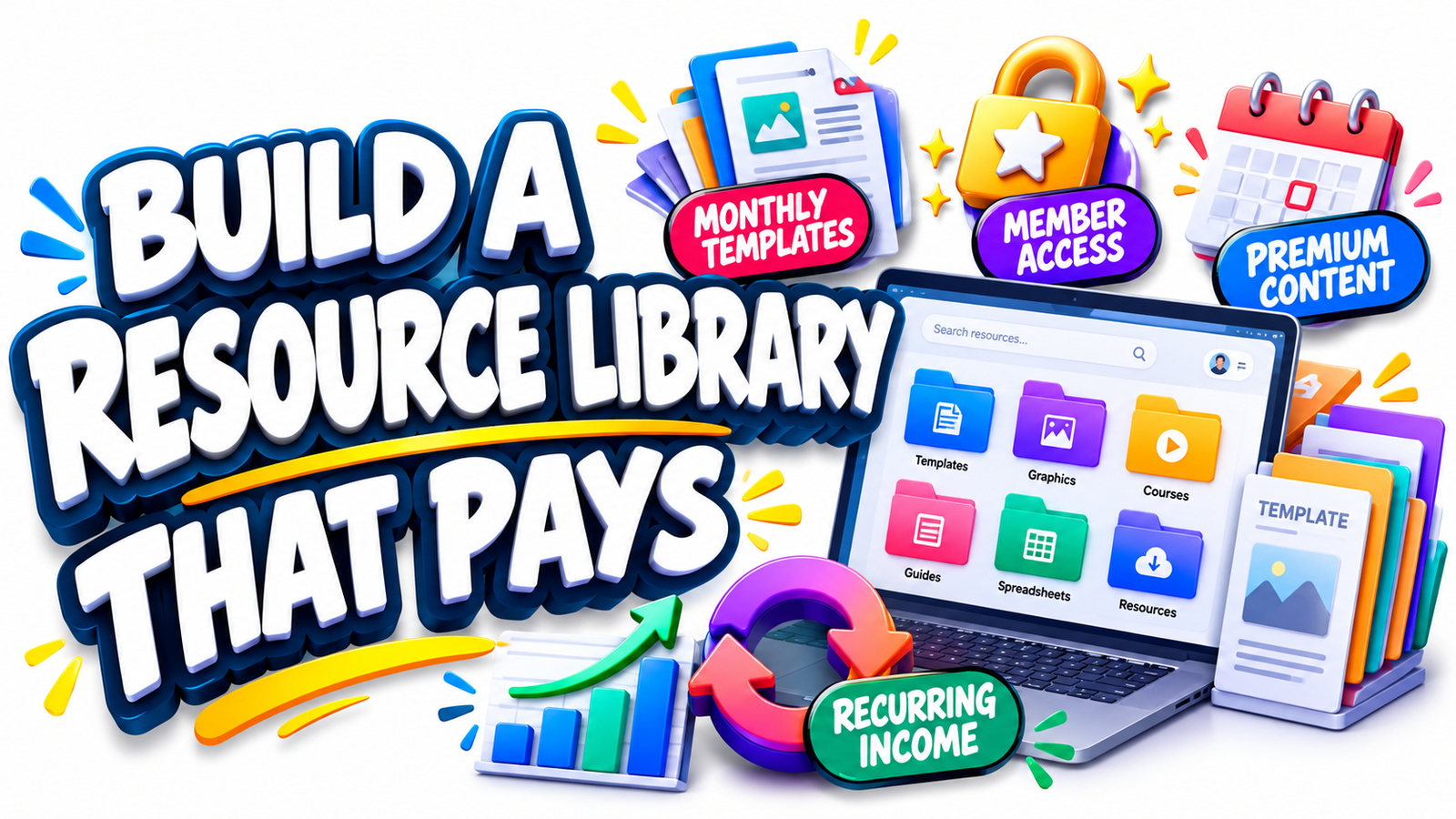
Selling one digital product can create one sale. Building a useful subscription-based digital resource library can create an ongoing relationship with customers.
That difference is one reason creators, educators, consultants, designers, marketers, freelancers, and small businesses are increasingly exploring digital product memberships, monthly template clubs, educational memberships, premium content libraries, and recurring asset collections.
Instead of asking customers to purchase a separate template, workbook, guide, course, or collection every time they need something, a subscription gives them continuing access to a growing library of resources for a recurring monthly or annual payment.
The model is already well established in the digital economy. Membership platforms in 2026 continue to support combinations of courses, communities, digital downloads, gated content, live sessions, and growing resource libraries. Subscription infrastructure also increasingly supports scheduled releases and recurring access to digital products.
But simply placing hundreds of files behind a paywall does not create a successful membership.
The strongest digital subscription businesses give members a clear reason to join, an easy way to find what they need, fresh reasons to return, and enough continuing value to justify renewing month after month.
Here is how to build one.
What Is a Subscription-Based Digital Resource Library?
A subscription-based digital resource library is an online collection of digital materials that customers can access while their membership remains active.
Depending on the business, the library might contain:
- Canva templates
- Business spreadsheets
- Printable planners
- Social-media templates
- Marketing calendars
- Worksheets
- Checklists
- Notion templates
- Presentation templates
- Email scripts
- Prompt collections
- Stock graphics
- SVG files
- Mockups
- Ebooks
- Mini-courses
- Video tutorials
- SOPs
- Business forms
- Educational materials
- Lesson plans
- Printable activities
- Content packs
- Design assets
- Research collections
- Premium articles
Members usually pay monthly or annually for continuing access.
A creator might launch with 75 resources and add 10 new resources every month. Another business might release one carefully designed toolkit each week. An educational membership could provide new lessons, worksheets, recordings, and learning materials every month.
The central promise is not simply:
“You get files.”
It is:
“You have an evolving library that helps you repeatedly solve a specific type of problem.”
That distinction matters.
Why Digital Product Memberships Are Attractive
Traditional digital products usually depend on repeated customer acquisition.
You create a product.
You launch it.
You make sales.
Eventually demand slows.
Then you create another product and repeat the process.
A membership changes the economics.
Instead of constantly starting from zero, you can build recurring relationships with customers who continue paying while the membership remains valuable to them.
Subscription and membership models are designed around recurring billing and continued access rather than a single transaction. Stripe describes subscription models as a way of monetizing an ongoing customer relationship through recurring payments.
That can create several advantages.
More Predictable Revenue
If you have 300 customers paying $15 each month, the membership begins each billing cycle with an existing revenue base rather than requiring 300 completely new sales.
Revenue is never guaranteed because members can cancel, but recurring billing can make income more predictable than relying entirely on one-time launches.
Higher Customer Lifetime Value
A $19 digital product produces $19 from a customer unless they purchase again.
A $19 monthly membership retained for six months produces $114 before transaction costs, taxes, refunds, discounts, or other expenses.
That makes retention extremely important.
Easier Cross-Selling
Members already understand your brand and resources.
You may eventually offer additional services such as:
- Premium courses
- Coaching
- Consulting
- Done-for-you services
- Certification programs
- Software
- Premium bundles
- Workshops
- Events
Your membership can become the center of a larger digital product ecosystem.
Five Subscription Library Models to Consider
Not every membership needs to look the same.
Choosing the right format depends on what your audience repeatedly needs.
1. Monthly Template Club
A monthly template club works well when customers repeatedly create similar types of materials.
For example, a marketing template membership could include:
January: social-media planning templates
February: email campaign templates
March: lead-generation templates
April: launch planning templates
May: content repurposing templates
Members receive both the existing collection and regularly released resources.
Possible niches include:
- Small-business templates
- Freelancer templates
- Teacher templates
- Wedding templates
- Real-estate marketing templates
- Social-media templates
- Financial planning templates
- Content creator templates
- Productivity templates
The biggest mistake is releasing random templates.
Every release should support the central outcome promised by the membership.
2. Premium Content Library
Instead of downloadable templates, you can sell access to continuously expanding information.
A content library could contain:
- Premium guides
- Industry reports
- Case studies
- Tutorials
- Research summaries
- Content ideas
- Checklists
- Expert interviews
- Strategy documents
This model can work especially well when information needs updating.
For example, a digital marketing membership might publish monthly guides covering changing advertising practices, content strategies, platform features, SEO developments, or marketing workflows.
The reason to remain subscribed becomes access to both the archive and continuing updates.
3. Education Membership
An education membership combines digital resources with structured learning.
Members might receive:
- Courses
- Short lessons
- Monthly workshops
- Downloadable workbooks
- Practice exercises
- Resource sheets
- Q&A sessions
- Community access
- Monthly challenges
Thinkific, for example, currently describes memberships that can combine courses, communities, digital downloads, and live events within one subscription.
An education membership can therefore become more than a course library.
It can become an ongoing learning environment.
4. Digital Asset Collection
Designers, video creators, marketers, publishers, and content creators constantly need reusable assets.
A subscription library might include:
- Icons
- Illustrations
- Backgrounds
- Mockups
- Fonts where licensing permits
- Presentation elements
- Social-media graphics
- Video overlays
- Patterns
- Stock graphics
- SVG collections
This model succeeds when members save significant production time by using the assets.
However, licensing must be extremely clear.
Members should understand whether assets may be used commercially, modified, used in client projects, incorporated into end products, or redistributed.
5. Recurring Resource Drops
You do not necessarily need a massive library.
Another model is a smaller membership based on anticipated releases.
For example:
Every Monday: 10 social-media templates
First Friday: one premium business toolkit
Monthly: one complete content pack
Quarterly: one major resource collection
Regularity creates expectation.
Members begin thinking:
“What is being released next?”
That anticipation can become a retention mechanism.
Start With One Specific Audience
One of the easiest ways to weaken a membership is trying to serve everyone.
Compare these offers:
Weak:
“Thousands of business resources.”
Stronger:
“Ready-to-use marketing templates for independent service businesses.”
Or:
Weak:
“Educational resources.”
Stronger:
“Printable classroom activities for primary-school teachers who need fresh weekly resources.”
Specificity improves marketing because visitors quickly understand whether the membership is for them.
Ask three questions:
Who is it for?
What recurring problem do they have?
What resources would help them solve that problem faster?
Your membership should sit at the intersection of those answers.
Build the Membership Around an Outcome
People rarely wake up wanting another folder containing 1,000 files.
They want an outcome.
A freelancer may want to onboard clients faster.
A teacher may want to prepare lessons faster.
A small-business owner may want better marketing.
A creator may want consistent content.
An Etsy seller may want attractive product graphics.
Design the library backward from that result.
Instead of building categories such as:
- PDFs
- Spreadsheets
- Documents
- Templates
consider organizing around customer goals:
- Find Clients
- Onboard Clients
- Manage Projects
- Create Content
- Track Finances
- Improve Productivity
- Grow Your Business
Outcome-based organization makes a large resource library feel useful rather than overwhelming.
Create a Strong Core Library Before Launch
A subscription cannot rely entirely on promises about resources that may arrive later.
Give new members enough immediate value.
For example, a small-business resource membership might launch with:
Marketing
- Social-media planner
- Campaign calendar
- Content worksheet
- Promotion checklist
Finance
- Income tracker
- Expense tracker
- Pricing calculator
- Cash-flow worksheet
Operations
- SOP templates
- Project tracker
- Meeting notes
- Inventory sheet
Customers
- Client questionnaire
- Feedback form
- Onboarding checklist
- Proposal template
Then continue expanding.
The core library creates the initial buying decision.
Future releases create reasons to stay.
Create a Predictable Release Schedule
Consistency matters more than publishing enormous quantities of mediocre material.
Consider a simple schedule.
Week 1
New template collection
Week 2
Tutorial or implementation guide
Week 3
Mini toolkit
Week 4
Member-requested resource
Members now understand that new value arrives throughout the month.
Another option is one substantial monthly release.
For example:
January: Business Planning Kit
February: Social Media Kit
March: Email Marketing Kit
April: Customer Management Kit
May: Productivity Kit
June: Finance Tracking Kit
Publish the schedule inside the member dashboard.
When people can see what is coming, the membership feels active.
Use Member Requests to Guide New Products
Your customers can become your best research team.
Ask members:
“What resource would save you the most time this month?”
Their answers can reveal opportunities that keyword tools may never identify.
Track:
- Search queries inside your library
- Most downloaded resources
- Least downloaded resources
- Support questions
- Feature requests
- Cancellation reasons
- Survey responses
Suppose dozens of customers search for “pricing calculator.”
That is valuable product-development information.
Create one.
Then create supporting resources such as:
- Pricing worksheet
- Profit-margin calculator
- Service pricing guide
- Pricing strategy checklist
One customer need can become an entire content category.
Make the Library Easy to Search
As your resource library membership grows, organization becomes increasingly important.
A 50-file library is manageable.
A 2,000-file library can become frustrating.
Use categories, tags, filters, thumbnails, clear titles, and search.
For example:
Category: Social Media
Format: Canva Template
Platform: Instagram
Goal: Lead Generation
Industry: Coaching
A user searching for Instagram lead-generation templates can quickly find what they need.
Convenience is part of the product.
Avoid the “Massive Bundle” Trap
More files do not automatically mean more value.
“10,000 templates” sounds impressive until customers discover that 8,000 are irrelevant, outdated, duplicated, difficult to edit, or poorly organized.
A subscription should favor useful depth over meaningless volume.
Twenty excellent resources solving a real problem can outperform thousands of generic downloads.
Customers are paying for access, convenience, quality, organization, and continuing relevance—not simply disk space.
Choose Your Pricing Structure
There is no universal membership price.
Pricing depends on:
- Audience
- Resource quality
- Frequency of releases
- Commercial-use rights
- Support
- Community access
- Educational content
- Production cost
- Competitive alternatives
- Business value of the resources
A simple structure might look like:
Starter
Core library access
Professional
Full library + monthly releases
Premium
Everything above + workshops, advanced resources, or commercial-use benefits
You can also offer:
Monthly plan: lower commitment
Annual plan: lower effective monthly cost in exchange for a longer commitment
Avoid creating too many tiers at launch.
Two or three choices are usually easier to understand than six complicated plans.
Create a Powerful Onboarding Experience
Getting a customer to subscribe is only the beginning.
Their first ten minutes matter.
Do not drop new members into a giant dashboard and make them figure everything out.
Show them:
Step 1: Start here
Step 2: Choose your goal
Step 3: Download your first resource
Step 4: Watch the quick tutorial
Step 5: See this month’s new release
Consider sending an onboarding sequence:
Day 0: Welcome and login information
Day 1: Best resources to start with
Day 3: How to use the library
Day 5: Popular member resources
Day 7: What is coming next
Your objective is to help members experience value quickly.
Retention Matters More Than Constant Acquisition
A subscription business with excellent acquisition but poor retention can become exhausting.
Imagine adding 100 members every month but losing 90.
You continually market simply to replace cancellations.
Instead, investigate why customers stay.
Common retention drivers include:
- Consistent new resources
- Better organization
- Personalized recommendations
- Useful tutorials
- Member requests
- Resource updates
- Exclusive releases
- Community
- Challenges
- Progress systems
- Member-only events
Your continuing question should be:
“Why should someone happily renew next month?”
If the answer is unclear, improve the membership before aggressively scaling promotion.
Track the Numbers That Matter
Do not evaluate a digital subscription business purely by total member count.
Monitor:
Monthly Recurring Revenue
The recurring revenue generated from active monthly subscriptions.
Churn Rate
The percentage of members who cancel during a period.
Retention Rate
The proportion of customers who remain subscribed.
Customer Lifetime Value
The approximate economic value created by an average customer relationship.
Activation
Whether new members complete important early actions, such as downloading resources or viewing lessons.
Resource Engagement
Which templates, downloads, lessons, and categories attract the most activity.
These metrics can tell you whether your membership is truly useful.
Protect Digital Resources Without Creating Friction
Digital memberships require reasonable access controls.
Depending on your platform and product, options may include:
- Member accounts
- Download restrictions
- Gated pages
- File-access rules
- Watermarks
- Expiring links
- Controlled permissions
Current digital-subscription tools offer combinations of recurring billing, file-access rules, scheduled content delivery, and membership access controls.
However, excessive restrictions can frustrate legitimate customers.
The goal should be sensible protection combined with a smooth user experience.
Make Licensing Extremely Clear
If your membership contains templates, graphics, prompts, stock assets, or editable commercial resources, publish a straightforward license.
Explain whether members can:
- Use resources personally
- Use resources commercially
- Modify templates
- Create end products
- Use resources for clients
- Sell finished products
- Share source files
- Resell templates
- Redistribute assets
Do not rely on vague language such as “commercial rights included.”
Explain exactly what is and is not permitted.
Clear licensing protects both the creator and customer.
Create a Free-to-Paid Funnel
Many successful subscription businesses do not immediately ask cold visitors to purchase.
They first demonstrate value.
A simple funnel could look like:
Google/Search/Social Media → Free Resource → Email List → Useful Content → Membership Offer → Member
For example, a business-template membership could give away:
Free Small Business Planning Pack
After downloading it, subscribers receive emails teaching them how to use the resources.
Then introduce the premium library:
“If this planning pack helped you, the complete membership includes marketing, finance, operations, productivity, and client-management resources, with new additions every month.”
The free resource previews the quality of the paid experience.
Turn Existing Products Into a Membership
You may already have enough material to begin.
Suppose you currently sell:
- 20 planners
- 15 worksheets
- 10 ebooks
- 30 Canva templates
- 5 business kits
- 4 mini-courses
Instead of rebuilding everything, categorize those products into one library.
Then identify gaps.
Create a monthly release schedule to fill those gaps.
This approach can turn disconnected products into a cohesive digital product membership.
Use SEO to Attract High-Intent Visitors
Do not create a membership sales page and expect search traffic to appear automatically.
Build supporting content around customer problems.
For a small-business template membership, potential articles could include:
- Best Small Business Templates for Managing Daily Operations
- How to Create a Monthly Marketing Calendar
- Business Documents Every Freelancer Should Have
- How to Build a Simple Standard Operating Procedure
- How to Create a Client Onboarding System
- Best Productivity Templates for Small Business Owners
These articles attract people searching for solutions your membership provides.
Naturally use relevant phrases such as:
digital product membership
digital subscription business
resource library membership
membership website
monthly template subscription
premium content library
digital resource subscription
online membership business
subscription-based digital products
recurring revenue digital products
Avoid repeating keywords unnaturally.
Google continues to recommend helpful, original, people-first content rather than pages created mainly to manipulate rankings.
Optimize for GEO and AI Search Visibility
GEO, or generative engine optimization, should not mean rewriting every paragraph for machines.
Google’s 2026 guidance for generative AI features emphasizes that established SEO fundamentals remain relevant while useful, original, non-commodity information becomes increasingly important.
Make your article easy to understand and extract by using:
- Clear headings
- Short definitions
- Direct answers
- Step-by-step explanations
- Examples
- Original insights
- Tables where useful
- FAQ sections
- Descriptive terminology
- Strong entity context
- Accurate author information
- Reliable sources
Instead of writing:
“Memberships are great.”
write:
“A digital product membership gives customers continuing access to a gated collection of templates, downloads, lessons, or other resources in exchange for recurring payment.”
Clear answers help both humans and search systems understand your content.
Improve Your Opportunity for Google Discover
No publisher can guarantee placement in Google Discover.
The practical goal is to make your content eligible, compelling, useful, and visually strong.
Google’s current Discover guidance recommends relevant, high-quality large images, including images at least 1200 pixels wide, and its February 2026 Discover update specifically emphasized more original, in-depth, timely content while reducing sensational clickbait.
For this article, a strong featured image could use:
1280 × 720 pixels
16:9 aspect ratio
Clear subject
Large readable headline
Professional design
Strong visual hierarchy
A headline such as:
BUILD A DIGITAL LIBRARY THAT PAYS MONTHLY
could create curiosity without promising unrealistic income.
Also use accurate:
- Publication date
- Updated date
- Author byline
- Author profile
- Article structured data
- Relevant internal links
- Descriptive images
Google’s Article structured-data guidance recommends information such as headline, author, date published, date modified, and representative images where applicable.
A Simple Subscription Library Launch Plan
You do not need 1,000 products before launching.
Start strategically.
Phase 1: Define the Customer
Choose one audience with a recurring need.
Phase 2: Define the Promise
Decide what continuing outcome your library helps members achieve.
Phase 3: Build the Core Collection
Create enough resources to make the initial subscription worthwhile.
Phase 4: Organize Everything
Add logical categories, tags, descriptions, search, and navigation.
Phase 5: Establish the Release Calendar
Tell customers exactly how often new resources will arrive.
Phase 6: Set Pricing
Choose simple monthly and, where appropriate, annual plans.
Phase 7: Build Onboarding
Guide customers toward their first useful result.
Phase 8: Launch With Founding Members
Invite a smaller initial group and observe how they use the library.
Phase 9: Improve From Behavior
Analyze searches, downloads, questions, cancellations, and requests.
Phase 10: Scale Acquisition
Once customers are staying and using the product, expand through SEO, email marketing, partnerships, social content, affiliates, and paid promotion where appropriate.
The Real Product Is Continuing Value
The greatest misconception about subscription libraries is that creators must produce endless amounts of content.
They do not.
They must produce continuing value.
Sometimes that means creating something new.
Sometimes it means improving an existing template.
Sometimes it means reorganizing the library.
Sometimes it means removing outdated resources.
Sometimes it means teaching members how to use what they already have.
A resource customers cannot find or understand has very little practical value.
A carefully organized collection of 100 excellent tools may therefore be stronger than an unstructured vault containing 10,000 files.
The objective is not to build the biggest digital library.
It is to build the library your particular audience repeatedly wants to use.
Frequently Asked Questions
1. What is a digital product membership?
A digital product membership is a subscription in which customers pay recurring fees for continuing access to digital products or premium resources. These may include templates, courses, ebooks, worksheets, graphics, videos, software resources, tutorials, or other members-only materials.
2. What can I include in a subscription-based resource library?
You can include templates, planners, spreadsheets, checklists, ebooks, mini-courses, videos, graphics, prompts, SOPs, worksheets, business tools, educational materials, stock assets, and other resources relevant to your audience. The strongest libraries usually focus on solving a specific recurring problem instead of collecting unrelated files.
3. How often should I add new resources?
There is no universal schedule. Weekly, biweekly, or monthly releases can all work. What matters most is setting a realistic schedule and consistently delivering useful resources. One excellent monthly toolkit may create more value than dozens of weak weekly downloads.
4. Is a digital subscription business better than selling individual digital products?
Neither model is automatically better. One-time products can be simpler to manage, while memberships can create recurring revenue when customers have an ongoing need. Many businesses combine both approaches by selling individual products while offering a premium membership containing a larger collection and continuing releases.
5. How do you keep members subscribed to a digital resource library?
Retention comes from continuing usefulness. Add relevant resources, update old materials, simplify navigation, respond to member requests, improve onboarding, communicate upcoming releases, and regularly remind customers of resources they may have missed. Give subscribers a clear reason to believe their membership will remain useful next month.
Build a Library People Want to Keep
A successful subscription-based digital resource library is not created by uploading hundreds of files and switching on recurring billing.
It is built by understanding one audience deeply and helping that audience solve recurring problems.
Start with a focused promise.
Create an excellent core library.
Organize it around outcomes.
Release useful resources consistently.
Listen to your members.
Improve based on actual behavior.
Make the subscription increasingly valuable as the library grows.
When done well, a resource library membership can evolve from a simple collection of digital downloads into a long-term customer ecosystem—combining useful tools, education, recurring releases, community, and premium content within one continually improving product.
That is where the real opportunity in a digital subscription business lies: not merely selling access, but creating a resource customers repeatedly return to because it continues making their work, learning, or business easier.
Stay ahead with exclusive updates
Join our community. Get curated industry trends, actionable guides, and fresh resources delivered straight to your inbox.