Finding a job is rarely just about writing a resume and clicking “Apply.”
Modern job seekers may need to organize dozens of applications, customize resumes for different roles, prepare for interviews, research companies, track networking conversations, follow up with recruiters, plan career changes, and keep important documents in one place.
That creates an opportunity for digital product creators.
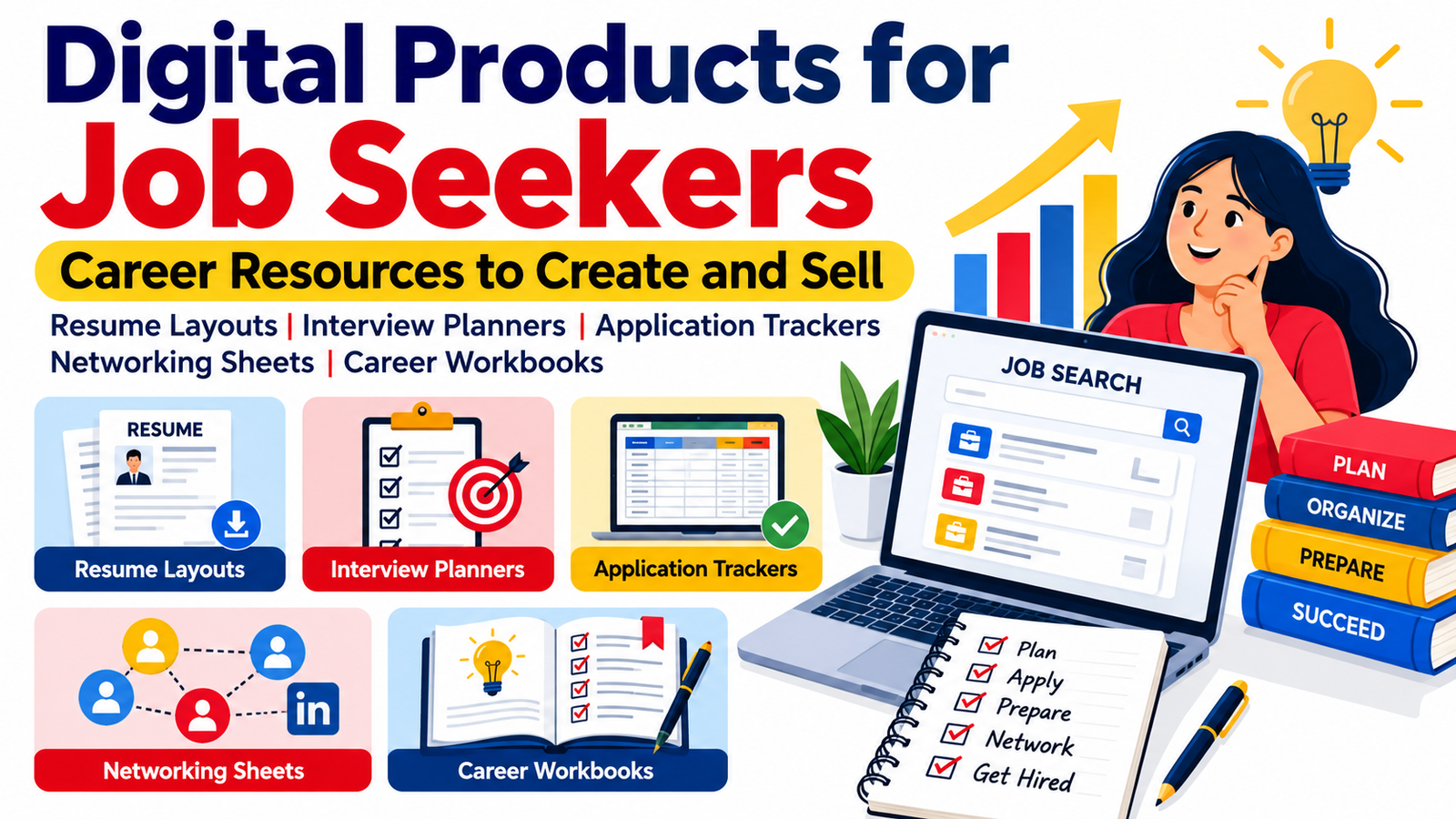
Instead of selling another generic printable, you can create job seeker digital products that solve specific problems during the employment search. Resume templates, interview planners, job application trackers, networking sheets, career workbooks, portfolio planners, and follow-up templates can turn a confusing process into a more manageable system.
These products can be useful for recent graduates, professionals changing careers, freelancers looking for full-time positions, people returning to work, remote-job applicants, and experienced professionals pursuing their next opportunity.
For creators, career resources also have an important advantage: one well-designed system can often be expanded into multiple products, bundles, editions, and niche-specific versions.
The strongest opportunity is not simply creating attractive documents. It is creating resources that help users organize information, prepare effectively, make better decisions, and take the next step with less friction.
Why Job Seeker Digital Products Have Strong Commercial Potential
Career development is an ongoing need.
People graduate. Contracts end. Companies restructure. Professionals pursue promotions. Workers change industries. Parents return to employment. Freelancers explore permanent roles. Employees relocate. Remote workers search for better opportunities.
Different job seekers may have different goals, but many experience the same practical challenges.
Where did I apply?
Which resume version did I send?
When should I follow up?
What salary range did the company mention?
Who interviewed me?
What questions should I prepare?
Which networking contacts should I reconnect with?
What accomplishments should I include in my resume?
A thoughtfully designed digital resource can answer these organizational questions without pretending to guarantee employment.
That distinction matters.
A good career product does not need to promise, “Get hired immediately.” It can offer something much more credible:
A clearer system for managing the job-search process.
That is a valuable promise because it is realistic, useful, and easy for customers to understand.
What Makes a Job Seeker Digital Product Worth Buying?
Free career advice is everywhere, so simply packaging basic information into a PDF may not be enough.
People are more likely to value a product when it saves time, reduces repetitive work, organizes complicated information, or provides a structure they would struggle to create themselves.
For example, a blank page titled “Job Applications” offers limited value.
A carefully designed job application tracker can include fields for company name, job title, application date, job-posting URL, resume version, cover-letter status, recruiter name, interview stage, salary information, follow-up date, outcome, and personal notes.
The customer is not really buying a spreadsheet.
They are buying organization.
The same principle applies across the career-resource market.
A resume template sells structure and presentation.
An interview planner sells preparation.
A networking tracker sells follow-through.
A career workbook sells clarity.
A job-search dashboard sells visibility over the entire process.
Understanding the real outcome behind each product will help you create more useful resources and write stronger product descriptions.
Resume Templates: One of the Most Practical Career Digital Products
Resume templates are an obvious starting point, but there is room to create far more than one generic layout.
Different applicants need different formats.
A recent graduate may need more space for education, internships, projects, volunteer work, certifications, and skills.
An experienced professional may need a layout focused on accomplishments, leadership, measurable results, and career progression.
A career changer may need stronger positioning around transferable skills.
A freelancer moving into employment may need a format that translates independent projects into relevant professional experience.
You can therefore create separate resume template collections for specific audiences instead of trying to make one design work for everyone.
Create Clean, Practical Resume Layouts
Visual appeal matters, but functionality should come first.
Offer layouts that are easy to edit, easy to scan, and logically organized. Consider creating both a visually polished version and a simpler version for applicants who prefer straightforward formatting.
Potential sections can include professional summary, work experience, education, core skills, certifications, projects, achievements, languages, volunteer experience, publications, and professional links.
Customers should also receive simple editing instructions.
Tell them which software is required, which fonts are used, whether fonts are included or freely available, which sections can be duplicated, and how they can export the finished document.
Removing uncertainty improves the customer experience.
Build Resume Bundles Instead of Selling One File
A resume template can become a more valuable career template bundle when paired with complementary resources.
For example, your package might contain a resume layout, matching cover-letter template, reference sheet, professional biography worksheet, accomplishment brainstormer, resume proofreading checklist, job-description keyword worksheet, and application tracker.
The customer receives a system rather than an isolated file.
That can also make your product easier to differentiate.
Job Application Trackers: Turn a Messy Search Into a Clear System
A job application tracker is one of the simplest job seeker digital products to understand because the problem it solves is immediate.
Someone applying to three positions may remember everything.
Someone applying to thirty positions probably will not.
A tracker creates a central record of activity.
Useful fields can include company, position, location, remote or on-site status, job-posting link, application deadline, date applied, contact person, resume version, cover letter submitted, salary range, interview dates, follow-up dates, status, offer details, rejection date, and notes.
You can create the tracker in several formats.
A printable PDF works for people who prefer writing by hand.
A spreadsheet works well for people who want sorting and filtering.
A digital planner version can appeal to tablet users.
A more advanced dashboard can summarize applications by stage, such as researching, preparing, applied, screening, interviewing, offer, closed, or follow-up required.
The more clearly the tracker helps someone understand their pipeline, the more useful it becomes.
Add a Weekly Job Search Review
An application tracker becomes even stronger when combined with a weekly review page.
Users can record how many applications they completed, which applications need follow-up, which interviews are coming next, which networking conversations require attention, what worked well during the week, and what they want to improve.
This transforms a passive record into an active planning tool.
Interview Planners: Help Job Seekers Prepare With Purpose
Job interviews create another major opportunity for digital product creators.
Many candidates know they should prepare, but they do not always know what to research or how to organize their notes.
An interview planner can guide them through that process.
Start with company research.
Provide spaces for the company’s products or services, target customers, important competitors, company values, recent developments, role responsibilities, and questions the applicant still needs answered.
Then include role-specific preparation.
Users can identify the requirements in the job description, connect those requirements with their own experiences, and prepare examples showing how they solved problems or achieved results.
You can also include behavioral-question preparation pages where customers outline situations, actions, and outcomes from previous experiences.
Another section can help users prepare thoughtful questions for the interviewer.
After the interview, provide space for notes, follow-up actions, important names, unanswered questions, impressions about the role, and the date a thank-you message was sent.
Suddenly, the interview planner becomes more than a worksheet.
It becomes an end-to-end interview preparation system.
Networking Sheets: A Simple Product With Long-Term Value
Networking is often treated as something informal, which is precisely why people lose track of it.
Someone meets a former colleague.
A recruiter sends a message.
A friend makes an introduction.
A professional connects with someone at an industry event.
Two weeks later, the details are forgotten.
A networking tracker can help users organize professional relationships respectfully and consistently.
Useful fields can include contact name, organization, role, where they met, date of first contact, relevant conversation notes, possible opportunities, next follow-up date, LinkedIn profile, email address, and action required.
You can expand the tracker into a networking kit containing an outreach planning worksheet, informational interview notes page, referral-request planner, follow-up schedule, professional-event contact sheet, and relationship-maintenance calendar.
The objective should not be to encourage spam.
The resource should help users remember genuine professional interactions and follow up appropriately.
Career Workbooks: Sell a Process, Not Just a Template
A career workbook can become one of the most substantial products in your catalog.
Some job seekers do not know which position they want.
Others know what they want but struggle to explain why they are qualified.
A structured workbook can help users think through these questions before they begin applying.
Start with career direction.
Ask users to define the types of roles they are considering, preferred working environment, location preferences, salary considerations, schedule requirements, skills they want to use, industries that interest them, and areas they want to avoid.
Next, guide them through a skills inventory.
Users can identify technical skills, transferable skills, communication strengths, leadership experience, software knowledge, certifications, project experience, and measurable accomplishments.
Then move into job-search positioning.
Help customers identify how their experience relates to the roles they want.
A career workbook can also contain company-research pages, application planning, interview preparation, networking planning, offer-comparison worksheets, and a 30-day job-search action plan.
The deeper the transformation, the more valuable the workbook can become.
Create a Resume Accomplishment Workbook
One of the hardest parts of writing a resume is remembering specific achievements.
Many people can describe what they were responsible for but struggle to identify what they improved, changed, solved, saved, built, delivered, increased, reduced, organized, or completed.
An accomplishment workbook can help users collect this information before writing their resume.
Prompts might encourage them to think about successful projects, difficult problems, customer improvements, process changes, leadership situations, recognition, deadlines met, costs reduced, revenue influenced, efficiency improvements, training completed, systems implemented, or teams supported.
The workbook should encourage accuracy rather than exaggeration.
Users should record real results they can explain confidently if questioned during an interview.
Develop a Job Description Analysis Worksheet
Job descriptions contain a large amount of information, but applicants often read them quickly.
A structured analysis sheet can help customers break a posting into manageable pieces.
Create areas for required skills, preferred qualifications, responsibilities, software, experience level, certifications, recurring terminology, company expectations, questions to research, and examples from the applicant’s background that relate to those requirements.
The worksheet can then connect directly to resume customization and interview preparation.
This creates an excellent cross-sell opportunity with your resume templates.
Create a Cover Letter Planning Kit
Instead of selling only a decorative cover-letter layout, create a system that helps users plan the content.
Include areas for the position being targeted, company information, most relevant experience, major qualification, reason for interest, supporting accomplishment, opening paragraph ideas, closing message, and proofreading checklist.
You can then include one or more editable cover-letter layouts where users insert the content they developed.
This combination of guidance and implementation is often more useful than a template alone.
Build a Professional Reference Kit
References are another part of the job-search process that can easily become disorganized.
A professional reference kit can contain a reference-contact organizer, permission checklist, reference-information sheet, matching reference-page template, follow-up reminder, and thank-you note planner.
The instructions should remind users to obtain permission before listing someone as a reference and to keep contact information current.
Small details like these can make a simple digital download feel thoughtful and complete.
Create a Company Research Template
Applicants may apply to many organizations without developing a structured system for comparing them.
A company research worksheet can collect information about the organization, industry, products, services, leadership, location, working model, role requirements, compensation information provided by the employer, benefits mentioned in the listing, company culture information, questions for interviews, and personal observations.
Users can complete one sheet for every serious application.
This resource works particularly well inside an interview or career-planning bundle.
Create a Salary and Job Offer Comparison Worksheet
Receiving an offer can create a different kind of decision-making challenge.
A comparison worksheet can help users organize the information available to them.
Possible categories include salary, bonus structure, benefits, commute, remote-work arrangements, schedule, paid leave, training opportunities, role responsibilities, career-development possibilities, contract conditions, and personal priorities.
Avoid presenting the worksheet as professional financial or legal advice.
Its purpose is simply to help the user compare information in one place.
Develop a 30-Day Job Search Planner
Time-based products can make broad goals easier to approach.
A 30-day job search planner could guide users through career clarification, resume preparation, profile updates, target-company research, application scheduling, networking, interview preparation, weekly reviews, and follow-up.
Instead of encouraging users to send as many applications as possible, design the planner around purposeful activity.
For example, one day could focus on improving a professional summary.
Another could focus on identifying five target employers.
Another could involve preparing accomplishment stories.
Another could be dedicated to reconnecting with relevant professional contacts.
This structure makes the product feel like a program rather than a collection of pages.
Develop Career Change Resources
Career changers represent an especially interesting niche because they face challenges that standard resume products may not solve.
Someone moving from teaching into corporate training, hospitality into sales, administration into project coordination, or traditional employment into remote work may need help identifying transferable skills.
A career-change workbook could contain a skills-transfer map, experience translation worksheet, target-role comparison, knowledge-gap planner, training roadmap, networking strategy, resume repositioning worksheet, and 60- or 90-day action plan.
Specific positioning can often make a product more compelling than trying to serve every job seeker at once.
Create Resources for Recent Graduates
Graduates have different needs from professionals with ten years of experience.
Instead of forcing them into a standard professional resume framework, create resources around the assets they actually have.
That may include education, internships, academic projects, coursework, volunteer experience, extracurricular leadership, certifications, personal projects, portfolios, and entry-level skills.
A graduate career kit could combine a resume template, first-job application tracker, internship tracker, networking worksheet, interview planner, professional-email guide, skills inventory, and career-goal workbook.
The result is a product built around a specific stage of life.
Create Remote Job Search Resources
Remote applicants can also benefit from specialized products.
A remote job search organizer might track location restrictions, time-zone requirements, equipment policies, remote-work experience, communication platforms, travel expectations, meeting schedules, and application status.
An accompanying preparation workbook could help users document examples of independent work, remote collaboration, digital communication, deadline management, and online project coordination.
Again, specialization creates relevance.
Create Printable, Editable and Spreadsheet Versions
Customers do not all work in the same way.
Some prefer printable PDFs.
Others want Word documents.
Some like Canva templates.
Others want Google Sheets or Excel trackers.
Tablet users may prefer digital planning pages.
When practical, offer several compatible formats or clearly identify which format the product supports.
Do not claim compatibility you have not tested.
A simple product information section explaining file types, required applications, editing limitations, printing recommendations, and download instructions can prevent confusion before purchase.
Bundle Individual Resources Into a Complete Job Search System
Individual products can attract customers looking for one solution.
Bundles can serve customers who want an entire workflow.
Imagine combining a resume template pack, cover-letter templates, job application tracker, company research pages, interview planner, networking organizer, achievement workbook, reference kit, weekly review sheets, and career planning workbook.
Now the product is no longer simply a collection of files.
It becomes a job search organization system.
That gives you a clearer commercial message:
Plan the search. Organize applications. Prepare for interviews. Track important conversations. Keep your career information together.
The value comes from the connected workflow.
Make Your Career Templates Easy to Use
A beautiful product can still receive poor feedback if customers cannot understand it.
Good instructions are part of the product.
Include a simple start-here guide explaining what files are included, what each resource does, which applications are needed, where users should begin, how editable files work, how to duplicate pages, and how to export or print completed materials.
Use descriptive filenames.
“Interview-Preparation-Workbook.pdf” is more helpful than “Document-07-Final.pdf.”
Keep folders organized.
If a bundle contains dozens of files, divide them logically into categories such as Resume, Applications, Networking, Interview, Career Planning, and Instructions.
Convenience is part of the product experience.
Use Clear Licensing and Usage Terms
Digital products need understandable usage terms.
Tell customers whether the purchase is for personal use, commercial use, or another license type.
If you are selling editable design resources, clarify whether buyers may modify them only for their personal career search or whether another form of usage is permitted.
If you sell PLR or MRR career products, define exactly what purchasers may edit, resell, distribute, rebrand, or bundle.
Do not rely on vague phrases such as “full rights” when important restrictions exist.
Clear licensing protects both the seller and customer.
Avoid Unrealistic Employment Claims
Career resources can help customers become more organized and prepared, but no template can guarantee a job interview, job offer, salary increase, promotion, or hiring decision.
Your product description should reflect that reality.
Instead of saying:
“Use this resume and get hired.”
Use positioning such as:
“Create a clear, organized resume with an editable layout designed to simplify the writing process.”
Instead of:
“Land your dream job in 30 days.”
Consider:
“Build a structured 30-day job-search routine covering applications, networking, preparation, and follow-up.”
Credible marketing can be persuasive without making impossible promises.
How to Position Job Seeker Digital Products for Search
Search optimization starts with understanding what the customer actually wants.
Someone searching resume templates has a different intent from someone searching job application tracker, interview preparation workbook, or career change planner.
Build pages around clear primary topics instead of forcing every career keyword into every product.
For a resume template product, related terms might naturally include editable resume template, professional CV template, resume layout, cover letter template, career template, and job seeker resource.
For an application tracker, relevant phrases might include job search tracker, employment application spreadsheet, interview tracker, job search organizer, follow-up tracker, and career planning template.
For a career workbook, semantic topics might include career planning, transferable skills, job search strategy, professional goals, career transition, skills assessment, networking, and interview preparation.
Write for the customer first.
Keywords should help search engines understand the page, not make the copy sound unnatural.
GEO Optimization: Make Your Content Easy to Understand and Reference
Search behavior increasingly includes conversational and AI-assisted discovery.
That makes clarity especially important.
Answer specific questions directly.
Use descriptive headings.
Define what each product does.
Explain who it is for.
Provide practical examples.
Organize related concepts together.
Avoid burying the main answer beneath unnecessary filler.
For example, instead of writing several paragraphs before explaining a job application tracker, answer immediately:
“A job application tracker is a worksheet or spreadsheet used to record positions, companies, application dates, interview stages, follow-ups, and outcomes.”
Then expand with examples and recommendations.
Clear, structured answers are useful to readers regardless of how they discover your content.
Create Content Around Problems, Not Only Products
If you operate a digital product store, your blog can attract customers before they are ready to purchase.
Instead of publishing endless promotional pages, answer genuine career-organization questions.
You might publish content about organizing multiple job applications, preparing materials before an interview, keeping track of professional contacts, creating an accomplishment inventory, comparing job offers, or building a weekly job-search routine.
Within those articles, relevant digital products can become natural next steps.
A reader learning how to organize applications may benefit from your application tracker.
Someone researching interview preparation may benefit from your interview workbook.
Someone planning a career transition may benefit from your career-change toolkit.
This creates a much more natural path from information to product discovery.
Turn One Career Product Into a Larger Product Line
One strong product can provide the foundation for an entire digital shop category.
Start with a job application tracker.
Then create an interview planner.
Add a resume workbook.
Develop a networking tracker.
Combine them into a job search bundle.
Next, create specialized editions for graduates, career changers, managers, remote workers, freelancers moving into employment, or professionals returning after a career break.
You can also create minimalist versions, printable versions, spreadsheet versions, premium workbooks, and complete career systems.
The key is not creating hundreds of random files.
Build a connected product ecosystem where each resource solves a recognizable problem.
Focus on Transformation Instead of Page Count
A 100-page workbook is not automatically better than a 20-page workbook.
Customers care about usefulness.
Ask what the user should be able to do after using the resource.
Can they clearly see where every application stands?
Can they prepare relevant examples before an interview?
Can they identify their transferable skills?
Can they compare several opportunities in one place?
Can they remember which professional contacts need follow-up?
If the answer is yes, the product is delivering meaningful value.
Good digital product design removes unnecessary complexity.
Make the Product Look Professional Without Overdesigning It
Career resources usually benefit from clarity.
Use readable typography, consistent spacing, clear section headings, logical page hierarchy, adequate writing space, and restrained visual elements.
Resume templates should especially prioritize readability over decorative effects.
Provide enough visual personality to make the resource attractive, but remember what the customer is trying to accomplish.
They need to enter information quickly.
They need to understand what goes where.
They need documents that feel organized.
Design should support those goals.
Add Strategic Calls to Action
Calls to action should match where the reader is in the buying journey.
A reader who has just learned about application tracking may respond well to:
Organize your search with an editable job application tracker.
A reader interested in interviews might see:
Turn scattered interview notes into a repeatable preparation system with a structured interview planner.
Someone reading about the complete career process could see:
Get the complete career toolkit with resume planning, application tracking, networking, interview preparation, and weekly review resources in one organized bundle.
The strongest CTAs continue the reader’s current task rather than abruptly switching into aggressive sales language.
A Strong Product Starts With a Specific Job Seeker
Before designing your next digital product, decide exactly who it is for.
Not simply “job seekers.”
Consider:
A university graduate applying for a first full-time role.
A professional making a career change.
A parent returning to employment.
A remote worker searching across multiple companies.
A freelancer preparing for permanent employment.
A manager targeting leadership opportunities.
An applicant managing a high volume of applications.
Once the audience becomes specific, product decisions become easier.
You know what pages to include.
You know what terminology to use.
You know what examples will make sense.
You know how to describe the value.
You also gain a more focused search topic.
Frequently Asked Questions
1. What are the best digital products to sell to job seekers?
Useful options include resume templates, cover-letter templates, job application trackers, interview planners, company research worksheets, networking trackers, reference organizers, accomplishment workbooks, career-change planners, job offer comparison sheets, and complete job-search bundles.
The best choice depends on the audience you want to serve and the specific problem you can solve well.
2. Are resume templates still good digital products?
Resume templates can remain useful because job seekers regularly need clear ways to organize professional information.
However, differentiation matters.
Instead of selling only a decorative resume design, consider adding matching cover letters, editing instructions, achievement worksheets, proofreading checklists, and multiple layout options.
Practical usability can be more valuable than visual complexity.
3. What should a job application tracker include?
A useful job application tracker can include the company, role, job-posting link, application date, resume version, cover-letter status, recruiter or contact person, interview stage, follow-up date, compensation information provided, final status, and notes.
More advanced trackers can also include dashboards or weekly review sections.
4. Can I sell job seeker templates as a bundle?
Yes, provided you own the content or have appropriate rights to everything included.
A bundle could combine resume layouts, application trackers, interview planners, networking sheets, company research templates, career worksheets, and follow-up resources.
Make the bundle easy to navigate and clearly explain what buyers receive.
5. How can I make career digital products more valuable?
Focus on solving a complete problem instead of simply increasing the number of pages.
Add clear instructions, logical workflows, editable formats when appropriate, examples, checklists, review pages, niche-specific editions, and complementary resources.
Customers should quickly understand how the product helps them take action.
Build Career Resources That Help People Move Forward
The opportunity in job seeker digital products is much larger than creating attractive resume layouts.
Job searching involves planning, organization, research, communication, preparation, reflection, and follow-up.
Every stage creates opportunities for genuinely useful digital resources.
A resume template can help someone organize experience.
An interview planner can improve preparation.
A job application tracker can prevent opportunities from disappearing into forgotten browser tabs.
A networking sheet can keep professional conversations organized.
A career workbook can help someone understand where they want to go next.
Combine these resources thoughtfully and you can build an entire career-product collection around a single promise:
Make the job-search process clearer, more organized, and easier to manage.
That is useful to customers and commercially practical for creators.
Start with one specific problem. Create the resource carefully. Test the instructions. Improve the user experience. Then expand into related products that naturally support the same customer.
A successful career-resource store does not need to promise someone’s next job.
It needs to help them approach the search with better tools.
Job Seeker Digital Products, Resume Templates, Job Application Tracker, Career Resources, Career Templates, Job Search Planner, Interview Planner, Interview Preparation, Career Workbook, Resume Layouts, Job Search Templates, Networking Tracker, Networking Worksheet, Cover Letter Template, Career Change Planner, Job Search Organizer, Employment Tracker, Professional Resume Template, Career Planning, Resume Workbook, Digital Downloads, Printable Career Planner, Job Search Bundle, Career Development Resources
Stay ahead with exclusive updates
Join our community. Get curated industry trends, actionable guides, and fresh resources delivered straight to your inbox.