Podcasting has grown far beyond recording a conversation, uploading an MP3, and hoping people listen.
Today’s podcaster may be planning episodes, researching guests, recording audio and video, coordinating sponsors, writing show notes, creating social clips, managing publishing schedules, reviewing analytics, collecting listener feedback, and trying to turn an audience into a sustainable creator business.
That complexity creates an opportunity.
Every repetitive podcasting task can potentially become a useful digital product.
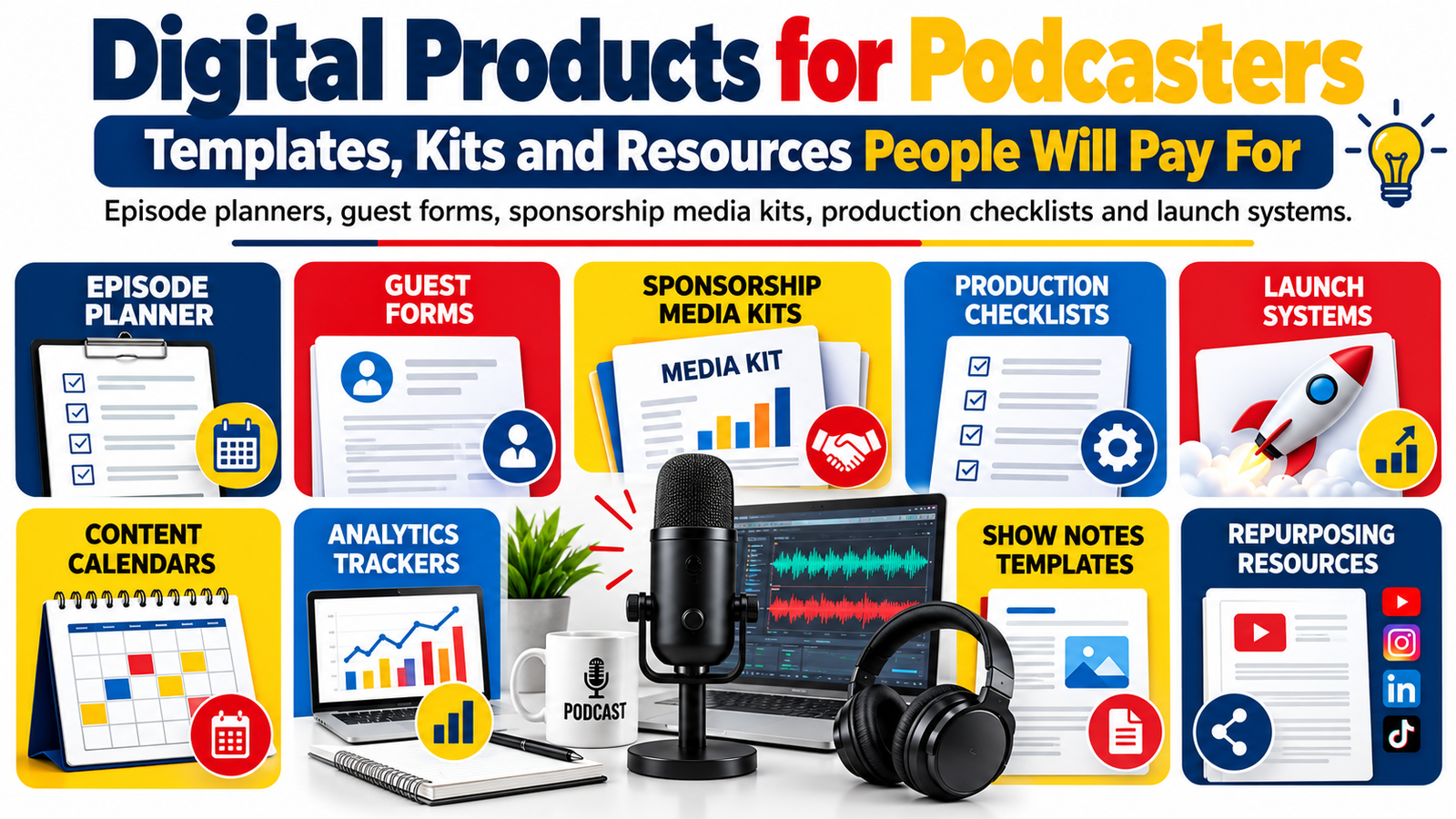
Episode planners, guest intake forms, sponsorship media kits, podcast production checklists, interview preparation sheets, launch systems, content calendars, analytics trackers, video podcast workflows, and complete podcast planning kits can help creators save time and run more organized shows.
That is what makes digital products for podcasters an attractive niche.
People generally do not pay for a PDF simply because it looks attractive. They pay because it helps them solve a problem faster, avoid mistakes, organize complicated work, or produce a better result.
If you can turn podcasting knowledge into a practical system, you can build resources that beginners, independent creators, podcast managers, agencies, coaches, businesses, and experienced hosts may genuinely find valuable.
Why Digital Products for Podcasters Have Strong Commercial Potential
Podcast creators face a recurring challenge: the creative part is only one piece of the job.
A podcaster might spend an hour recording an episode but several additional hours preparing, editing, scheduling, promoting, communicating with guests, organizing sponsorships, and reviewing performance.
That creates demand for tools that reduce friction.
The broader podcast market also continues to evolve. Edison Research’s 2026 data shows U.S. podcast consumption reaching record levels, while video has become increasingly important to the podcast experience. IAB reported that U.S. podcast advertising revenue reached approximately $2.9 billion in 2025, up 17.6% year over year.
That growth does not mean every podcaster will make significant money. It does mean that creators increasingly need professional systems for production, promotion, sponsorship management, audience development, and monetization.
Spotify’s 2026 creator updates also emphasize sponsorship management, memberships, analytics, video, and deeper fan engagement—another sign that podcasting is developing into a broader creator-business ecosystem rather than remaining purely an audio publishing format.
For digital product sellers, the opportunity is not simply to create more templates.
The better opportunity is to create podcast workflow solutions.
What Makes a Podcast Template Worth Paying For?
Free templates are everywhere.
A paid resource therefore needs to offer something beyond a blank page with a few headings.
A strong podcast template should reduce one or more of these problems:
- “I don’t know what to do next.”
- “I keep forgetting steps.”
- “My episodes feel disorganized.”
- “Guest communication takes too much time.”
- “I don’t know what information sponsors need.”
- “My podcast launch feels overwhelming.”
- “I am inconsistent with publishing.”
- “My team doesn’t follow the same process.”
- “I have data but don’t know what to track.”
- “I record content but fail to repurpose it.”
- “I need one organized place for my podcast workflow.”
The more specifically your product addresses one of these problems, the easier it becomes for a potential customer to understand its value.
A product called Podcast Worksheet is vague.
A product called 30-Minute Podcast Episode Planning System for Interview Shows immediately communicates who it is for and what it helps accomplish.
Specificity increases perceived usefulness.
1. Podcast Episode Planner
An episode planner is one of the most natural digital products for podcasters because episode preparation happens repeatedly.
A strong planner can include:
Episode working title
Main topic
Target listener
Core listener problem
Episode objective
Primary takeaway
Opening hook
Talking points
Stories or examples
Statistics or research notes
Questions to answer
Guest references
Sponsor placement
Call to action
Resources mentioned
Episode description
Show-note ideas
Social content opportunities
Recording status
Editing status
Publishing date
Instead of selling one generic page, create several episode planning formats.
For example:
Solo episode planner
Interview episode planner
Educational podcast planner
Storytelling episode planner
Business podcast planner
News or commentary episode planner
Video podcast planner
This immediately transforms a small template into a more complete podcast planning kit.
2. Podcast Guest Intake Form
Guest coordination becomes surprisingly complicated as a show grows.
Hosts repeatedly ask guests for the same information:
Name
Professional title
Biography
Headshot
Website
Social profiles
Topic expertise
Preferred talking points
Topics to avoid
Pronunciation information
Recording availability
Equipment setup
Promotional links
Product or book information
Consent information
A well-designed podcast guest form can standardize the process.
You could provide versions for Google Forms, editable documents, PDFs, Notion, Airtable or other commonly used tools.
Add a guest preparation guide explaining microphone basics, recording environment recommendations, expected episode structure, approximate interview duration, and promotional procedures.
Now the buyer receives a guest onboarding system instead of a single questionnaire.
3. Podcast Interview Question Builder
Coming up with interesting questions every week can become exhausting.
Create an interview question framework that helps hosts move beyond predictable questions such as “Tell us about yourself.”
Organize questions by purpose:
Origin questions
Expertise questions
Story questions
Problem-solving questions
Contrarian questions
Case-study questions
Failure and lesson questions
Future-looking questions
Rapid-fire questions
Closing questions
You could create niche versions for business podcasts, author interviews, health professionals, entrepreneurs, artists, educators, technology experts, coaches or creators.
A question bank becomes significantly more useful when paired with a framework explaining when and why different question styles should be used.
4. Podcast Production Checklist
A missed production step can create frustrating problems.
Wrong microphone selected.
Backup recording forgotten.
Guest link not sent.
Sponsor message omitted.
Episode artwork missing.
Show notes unfinished.
Publishing date incorrect.
A podcast production checklist can help creators develop a repeatable workflow covering the entire process.
Divide it into stages:
Pre-production
Recording day
Post-production
Quality control
Publishing
Promotion
Archiving
Include separate checklists for audio-only and video podcasts.
For teams, add responsibility fields such as host, editor, producer, social media manager and virtual assistant.
This turns the checklist into a lightweight podcast operations system.
5. Podcast Sponsorship Media Kit
As creators begin approaching advertisers, many struggle to present their show professionally.
A podcast sponsorship media kit template can solve that problem.
Useful sections might include:
Podcast overview
Host introduction
Audience profile
Show topics
Publishing frequency
Listening platforms
Selected performance metrics
Audience geography
Available sponsorship placements
Host-read opportunities
Video integrations
Newsletter or social add-ons
Past collaborations
Contact information
Advertiser next steps
Design versions for Canva, PowerPoint or Google Slides can make customization easier.
Avoid encouraging customers to inflate audience numbers or make unsupported performance claims. A professional sponsorship kit should make accurate information easier to understand—not make a small podcast appear artificially large.
Trust matters when brands are involved.
6. Podcast Sponsorship Tracker
Getting a sponsor is only part of the work.
Creators may need to track prospects, outreach, negotiations, deliverables, campaign dates, scripts, links, invoices and payments.
A sponsorship tracker could contain:
Brand name
Contact person
Contact information
Outreach date
Follow-up date
Campaign status
Proposed package
Agreed deliverables
Episode placement
Recording deadline
Publish date
Tracking link
Promo code
Invoice number
Payment status
Campaign notes
Performance reporting status
Offer spreadsheet, Notion and printable versions.
Combine the tracker with outreach templates, a sponsorship checklist and media kit to create a larger Podcast Sponsorship Toolkit.
7. Podcast Launch System
Starting a podcast involves dozens of decisions.
That makes a launch kit particularly attractive to beginners.
A comprehensive podcast launch system might guide users through:
Defining the show’s purpose
Selecting the target audience
Choosing a show name
Writing the podcast description
Developing episode categories
Creating cover artwork
Selecting recording equipment
Choosing hosting and distribution tools
Creating episode templates
Recording pilot episodes
Preparing promotional assets
Building a launch calendar
Creating a trailer
Publishing initial episodes
Requesting reviews or feedback appropriately
Building an email list
Creating launch-week social content
Tracking early results
A 30-day launch calendar could make the package even more actionable.
Instead of telling customers what a podcast is, help them move from idea to published show.
8. Podcast Content Calendar
Consistency becomes difficult when creators are managing dozens of episode ideas.
A podcast content calendar template helps connect ideas to actual publishing dates.
Include fields such as:
Episode number
Topic
Content pillar
Format
Guest
Recording date
Editing deadline
Publishing date
Sponsor
Primary CTA
YouTube version
Newsletter
Blog post
Short clips
Social posts
Status
A yearly or 90-day calendar can be especially useful for creators who batch content.
9. Podcast Show Notes Template
Writing show notes from scratch for every episode wastes time.
Create templates for:
Interview episodes
Solo episodes
Educational episodes
Roundtables
Case studies
Narrative episodes
Video podcasts
A structured show notes template can contain an opening summary, key takeaways, timestamps, guest information, resources, products mentioned, sponsor information, relevant links and calls to action.
Add a quality-control checklist covering readability, link accuracy, names, episode numbers and formatting.
10. Podcast Recording Day Kit
Recording sessions often involve small operational details that are easy to forget.
Build a recording kit containing:
Equipment checklist
Microphone check
Camera check
Lighting check
Internet check
Storage check
Recording software check
Guest confirmation
Water reminder
Phone silence reminder
Backup recording procedure
File naming convention
Sponsor script check
Intro and outro notes
Post-recording backup checklist
This can be particularly valuable for video podcasters, interview shows and small production teams.
11. Video Podcast Production Planner
One of the most relevant opportunities is a dedicated video podcast template system.
Video introduces additional tasks that an audio-only workflow may not address.
A video podcast planner could cover:
Camera positions
Lighting setup
Background setup
Frame composition
Thumbnail ideas
B-roll opportunities
On-screen graphics
Short-form clip moments
YouTube title ideas
YouTube description
Chapters
Video sponsor placements
Vertical content ideas
Shorts and Reels opportunities
Edison Research reported in 2026 that weekly podcast consumers had become almost equally likely to watch podcasts as listen, highlighting how closely podcasting and video creation are now connected.
This creates opportunities for specialized digital resources designed for creators publishing across podcast platforms, YouTube and short-form social channels.
12. Podcast Content Repurposing Kit
One podcast episode can potentially become many pieces of content.
But creators frequently fail to repurpose episodes because they lack a process.
Create a repurposing system that turns one episode into:
Blog content
Newsletter content
YouTube clips
Short videos
Quote graphics
LinkedIn posts
X posts
Instagram captions
Carousel ideas
Email subject ideas
Short educational posts
FAQ content
Future episode ideas
The product becomes more valuable when it tells the customer what to extract from an episode rather than simply listing social networks.
For example, include prompts such as:
“Identify the strongest disagreement or surprising viewpoint.”
“Extract three actionable steps.”
“Find a 30-second standalone story.”
“Turn one audience question into a short post.”
That gives users a repeatable content engine.
13. Podcast Analytics Tracker
Creators can become overwhelmed by analytics.
A useful tracker should simplify performance measurement rather than creating another complicated dashboard.
Possible metrics include:
Episode title
Publication date
Plays or downloads
Video views
Watch time where available
Audience retention
Follower growth
Email sign-ups
Website clicks
Sponsor clicks
Comments
Shares
Top-performing topic
Top-performing format
Guest performance
Conversion notes
Spotify announced expanded podcast analytics in 2026, including additional ways for creators to examine audience engagement, returning audiences and episode performance.
Digital sellers can build resources that help creators translate platform metrics into editorial decisions.
The real value is not recording more numbers.
It is answering questions such as:
Which topics consistently perform well?
Which formats produce loyal listeners?
Which guests generate stronger engagement?
Which episodes create website traffic?
What should we create more often?
14. Podcast Workflow SOP Kit
Once several people work on a podcast, verbal instructions quickly become inefficient.
An SOP—or standard operating procedure—kit can document how the show operates.
Include templates for:
Episode planning
Guest booking
Recording preparation
Audio editing
Video editing
File storage
File naming
Show notes
Thumbnail creation
Publishing
Sponsor management
Social promotion
Quality control
Archiving
Analytics reviews
This product could target podcast agencies, businesses, virtual assistants and producers as well as individual hosts.
15. Podcast File Organization System
A surprisingly practical product is a ready-made folder and naming structure.
For example:
Podcast
Season
Episode
Raw Audio
Raw Video
Guest Assets
Edited Audio
Edited Video
Thumbnails
Clips
Show Notes
Sponsors
Published Assets
Analytics
Archive
Combine the structure with file-naming conventions and version-control recommendations.
Customers are paying for the organizational thinking, not merely empty folders.
16. Podcast Idea Bank and Topic Generator
Running out of episode ideas is another recurring creator problem.
Build a topic-generation workbook containing frameworks such as:
Beginner questions
Common mistakes
Myth vs. reality
Case studies
Industry changes
Predictions
Lessons learned
Step-by-step tutorials
Behind-the-scenes topics
Audience questions
Tool comparisons
Expert interviews
Personal stories
Contrarian viewpoints
Trend reactions
Create niche-specific editions to make them more commercially relevant.
“200 Podcast Ideas” is broad.
“200 Episode Ideas for Personal Finance Podcasters” communicates a much clearer use case.
17. Podcast Monetization Planner
Podcasters often think monetization means sponsorships alone.
A planning resource can help creators evaluate several possible revenue streams, depending on their audience and business model.
These might include:
Advertising
Sponsorships
Memberships
Premium content
Courses
Consulting
Digital products
Affiliate partnerships
Events
Merchandise
Community access
Services
Newsletter sponsorships
Spotify itself has been expanding creator monetization options around advertising, video, sponsorship tools and paid fan relationships.
A useful monetization planner should not promise unrealistic income.
Instead, help creators assess audience fit, workload, required assets, pricing considerations and possible next actions.
18. Podcast Guest Outreach Kit
Finding guests is one problem.
Convincing them to appear is another.
A guest outreach package could include templates for:
Initial invitation
Warm introduction
Cold outreach
Expert invitation
Author invitation
Follow-up email
Booking confirmation
Recording reminder
Thank-you message
Episode-live notification
Promotion request
Repeat guest invitation
Add a guest pipeline tracker and the package becomes significantly stronger.
19. Podcast Brand Voice Workbook
Many podcasts struggle because every episode, email and social caption feels disconnected.
Create a workbook that helps creators define:
Audience
Brand personality
Tone
Core themes
Content pillars
Words to use
Words to avoid
Opening style
Closing style
Interview approach
Visual direction
Listener promise
Core CTA
This can be especially valuable for business podcasts and branded shows.
20. Complete Podcast Business Planner
Your premium product can combine your smaller resources into one integrated system.
A Complete Podcast Planning Kit could contain:
Episode planner
Podcast content calendar
Guest intake form
Guest outreach templates
Interview question bank
Production checklist
Recording day checklist
Video planner
Show notes templates
Content repurposing system
Sponsorship media kit
Sponsor tracker
Analytics dashboard
Launch calendar
Monetization planner
SOP templates
File organization system
Quarterly review workbook
Now you are no longer selling individual worksheets.
You are selling an operating system for a podcast.
Build Products Around Different Types of Podcasters
Not every podcaster has the same problems.
Segmentation can make a digital product dramatically more relevant.
You could build resources specifically for:
Beginner podcasters
Solo podcasters
Interview podcasters
Business podcasters
Video podcasters
YouTube podcasters
Coaches
Authors
Consultants
Educators
Nonprofits
Churches
Agencies
Podcast managers
Virtual assistants
Podcast producers
Corporate podcast teams
For example, a beginner may want a launch checklist.
A professional producer may care more about SOPs.
A creator looking for advertisers may want a sponsorship package.
A video podcaster may want production planning and clip workflows.
Specific buyers create specific product opportunities.
Sell a Result, Not a Collection of Pages
This distinction can change how customers perceive your product.
Weak positioning:
“50-page podcast workbook.”
Stronger positioning:
“Plan your next 12 podcast episodes in one organized system.”
Weak positioning:
“Podcast Canva templates.”
Stronger positioning:
“Create a professional sponsorship presentation without designing your media kit from scratch.”
Weak positioning:
“Podcast checklist bundle.”
Stronger positioning:
“Follow the same pre-production, recording, publishing and promotion workflow for every episode.”
Page count describes quantity.
Outcome describes value.
Create a Simple Product Ladder
You do not need to create a massive bundle immediately.
Start with one useful resource.
For example:
Entry product: Episode Planner
Expanded product: Episode Planning Kit
Specialized product: 90-Day Podcast Content System
Premium product: Complete Podcast Business Planner
You can use customer questions and feedback to determine which products should be created next.
If customers repeatedly ask how to manage guests, create a guest management kit.
If they ask about sponsors, build a sponsorship system.
If video workflow creates confusion, build a video podcast production pack.
Your customers can become one of your best sources of product research.
How Much Can You Charge for Podcast Templates?
There is no universal correct price.
Pricing depends on depth, design, customization, format, target market, licensing, support and how important the problem is to the buyer.
A simple printable may reasonably sit at the lower end of your catalog.
A multi-format podcast planning kit can justify more.
A complete business system containing editable templates, dashboards, SOPs, instructions and commercial-use options may support a substantially higher price.
The important principle is this:
Do not increase the price simply by adding more files. Increase value by solving more of the customer’s workflow.
Ten highly relevant templates can be more valuable than 500 random pages.
Editable Formats Increase Practical Value
Consider offering resources in several formats where appropriate.
Popular options include:
Fillable PDF
Canva
Google Docs
Google Sheets
Microsoft Word
Microsoft Excel
Notion
PowerPoint
Google Slides
Each format serves a different workflow.
A sponsorship media kit makes sense in Canva or Slides.
An analytics tracker works naturally in a spreadsheet.
A guest form may work better as an online form.
An episode worksheet can be useful as a printable and editable document.
Choose formats according to the task rather than automatically offering everything.
Make Your Podcast Digital Products Easier to Use
The customer’s experience starts after the purchase.
Do not deliver a folder containing dozens of unexplained files.
Add a START HERE guide.
Explain:
What is included
Who each template is for
Recommended order of use
Which files are editable
What software may be required
How to duplicate templates
How to customize them
What is not included
What the license allows
Where support information is located
A polished onboarding experience can make an inexpensive product feel much more professional.
Licensing Should Be Clear
If you sell editable podcast templates, clearly explain what buyers are permitted to do.
For example, clarify whether the product is intended for:
Personal use
Internal business use
Client work
Commercial use
Resale
PLR
MRR
Do not leave customers guessing.
If you are selling standard templates directly to podcast creators, you may choose to allow buyers to customize them for their own show while prohibiting redistribution of the original template.
If you offer PLR or MRR products, the license should clearly state exactly what can and cannot be modified, rebranded, resold or distributed.
Clear licensing protects both seller and customer expectations.
Where Can Podcast Digital Products Be Sold?
Your own website can provide the strongest control over branding, customer relationships and product presentation.
Digital products may also be sold through creator marketplaces, ecommerce platforms or specialized digital-download services depending on your business model.
But the platform is less important than the product-market fit.
A beautiful store will not rescue a weak product.
Start with the question:
What recurring podcasting problem am I solving?
Then create the product around the answer.
SEO Strategy for Selling Podcast Templates
Search traffic can become particularly valuable because people searching for templates often have practical intent.
Primary keywords can include:
podcast templates
digital products for podcasters
podcast planning kit
Related search terms can naturally include:
podcast episode planner
podcast guest form template
podcast production checklist
podcast sponsorship media kit
podcast launch checklist
podcast workflow template
podcast content planner
podcast interview template
podcast guest questionnaire
podcast analytics tracker
podcast planning template
podcast management system
video podcast checklist
podcast content calendar
podcast sponsorship template
Avoid repeating exact keywords unnaturally.
Instead, create comprehensive content that answers closely related questions.
That makes the page more useful to humans while also giving search systems stronger context about the subject.
GEO: Make the Content Easy for AI Search Systems to Understand
Search behavior is expanding beyond traditional blue-link search results.
People increasingly ask conversational questions such as:
“What templates do I need to launch a podcast?”
“What should be included in a podcast guest form?”
“How do I organize podcast production?”
“What should a podcast sponsorship media kit contain?”
“What digital products can I create for podcasters?”
Content designed for generative search experiences should answer these questions clearly.
Use descriptive headings.
Provide direct definitions.
Explain processes step by step.
Include concrete examples.
Answer related questions.
Use natural terminology instead of stuffing keywords.
Support time-sensitive claims with reliable sources.
Keep important information easy to extract and understand.
That combination improves usefulness for traditional readers as well as systems attempting to summarize or recommend information.
Make the Article More Suitable for Google Discover
Google states that Discover content is automatically eligible when it is indexed and complies with Discover policies; special structured data is not required, and eligibility does not guarantee traffic.
Google recommends headlines that accurately represent the content, useful or timely material, a strong page experience, and compelling high-quality images rather than misleading or sensational previews. Large Discover images should generally be at least 1200 pixels wide, and publishers can enable large previews with max-image-preview:large.
For this article, a strong featured-image concept would show a modern podcast creator workspace with a microphone surrounded by organized visual representations of an episode planner, guest form, production checklist, analytics sheet and sponsorship media kit.
Keep the image clean, highly relevant and easy to understand at mobile size.
Google also supports Article and BlogPosting structured data to help it better understand article information such as the headline, images, publication dates and author information.
Turn Podcast Knowledge Into Systems People Can Use
The strongest digital products for podcasters do not simply give creators more information.
They remove decisions.
A good episode planner removes the question, “What should I prepare?”
A production checklist removes the question, “What am I forgetting?”
A guest kit removes the question, “What information should I collect?”
A sponsorship media kit removes the question, “How do I present my show professionally?”
A launch system removes the question, “Where do I even start?”
That is the real opportunity.
Look at every repetitive task involved in running a podcast and ask:
Could I turn this process into a template, checklist, tracker, workbook or complete system?
Start with one specific problem.
Create a genuinely useful solution.
Test it with real creator workflows.
Improve it based on customer questions.
Then gradually connect your individual products into a broader podcast planning kit or creator resource shop.
The goal is not to produce the biggest bundle.
It is to become the store podcasters visit when they want their next episode, launch, guest interview, sponsorship or production workflow to feel easier and more organized.
Frequently Asked Questions
1. What digital products can I create for podcasters?
Useful digital products include episode planners, guest intake forms, interview question banks, podcast launch checklists, content calendars, sponsorship media kits, sponsor trackers, production checklists, show-note templates, analytics trackers, video podcast planners, content repurposing systems and complete podcast planning kits.
The best product usually solves a repetitive problem rather than simply providing information.
2. Do people really pay for podcast templates when free templates exist?
They can when the paid product offers more convenience, specialization, organization or depth than free alternatives.
A generic blank worksheet may have limited value. A complete interview-podcast workflow containing guest outreach, intake forms, research sheets, question frameworks, recording checklists and follow-up templates provides a much clearer reason to purchase.
3. What is the best first digital product to create for podcasters?
An episode planning kit is a practical starting point because nearly every active podcaster needs to plan episodes repeatedly.
You can begin with a simple planner and later expand it into separate templates for solo episodes, interviews, video podcasts, educational shows and sponsored episodes.
4. Can I sell podcast digital products without being a famous podcaster?
Yes. Buyers generally care more about whether the product solves their problem than whether the seller is a celebrity.
However, credibility matters. Create accurate, professionally designed resources, explain how they should be used, avoid unrealistic claims, and demonstrate the workflow with realistic examples.
Practical expertise is more valuable than manufactured authority.
5. What should be included in a complete podcast planning kit?
A comprehensive kit could include an episode planner, content calendar, guest questionnaire, interview preparation sheets, production checklists, recording-day checklist, show-note templates, podcast launch system, sponsorship media kit, sponsor tracker, analytics dashboard, repurposing planner, monetization worksheet, SOP templates and file-management system.
The exact contents should depend on the specific type of podcaster you are targeting.
Podcast Templates, Podcast Planning Kit, Podcast Episode Planner, Podcast Guest Form, Podcast Production Checklist, Podcast Sponsorship Media Kit, Podcast Launch Checklist, Podcast Content Calendar, Podcast Workflow Template, Podcast Business, Podcast Monetization, Video Podcast Templates, Podcast Creator Resources, Podcast Management System, Podcast Interview Template, Podcast Analytics Tracker, Podcast Guest Questionnaire, Digital Downloads, Creator Economy, Podcast Resources, Podcast Marketing, Content Creator Templates, Podcast Sponsorship, Podcast Launch System
Stay ahead with exclusive updates
Join our community. Get curated industry trends, actionable guides, and fresh resources delivered straight to your inbox.