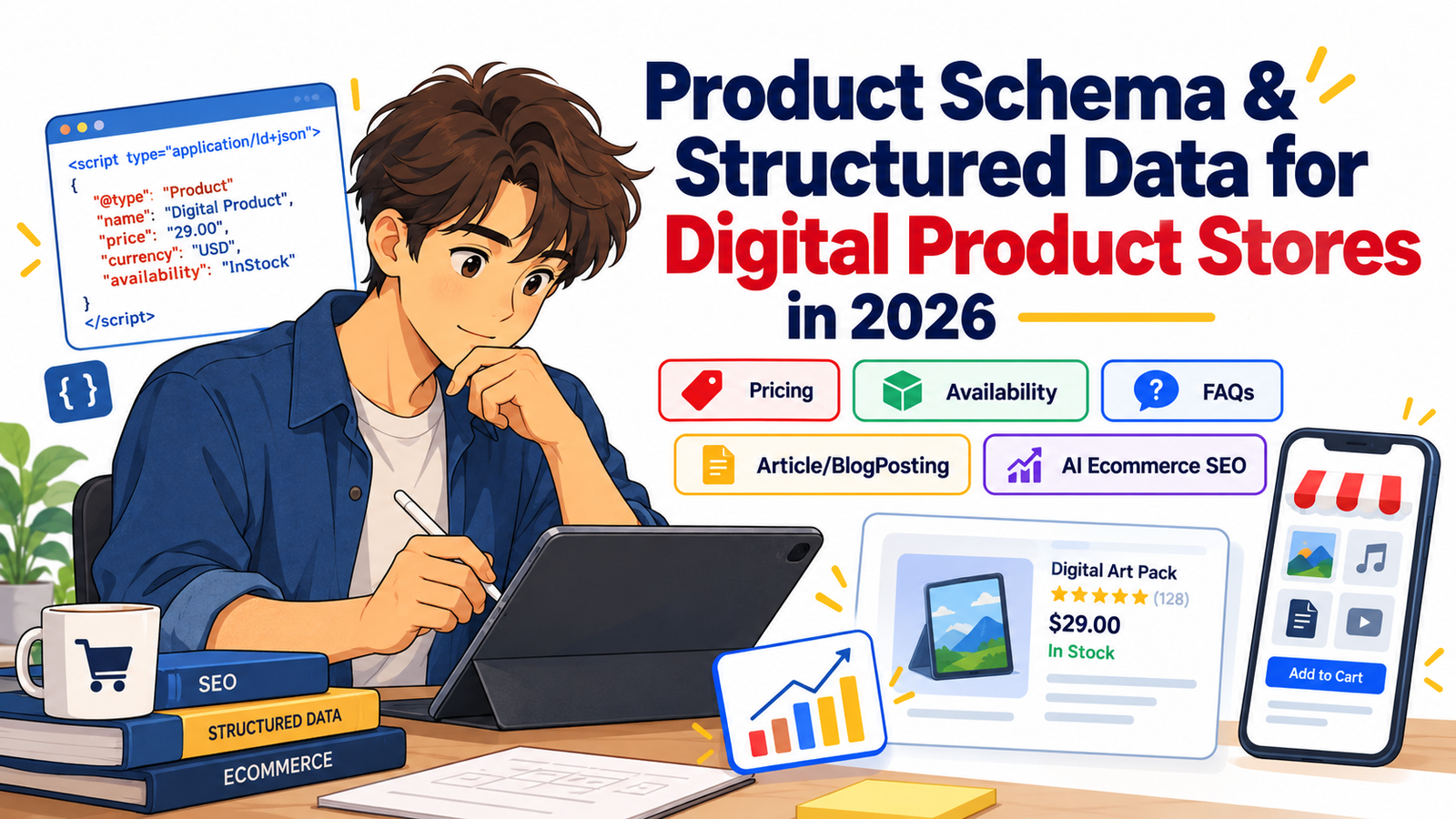
Learn how product schema, structured data SEO, pricing, availability, FAQs, product feeds, and AI ecommerce SEO can make digital product stores easier for search engines and AI systems to understand.
The Next Phase of Ecommerce SEO Is About Being Understood
A digital product store can look perfect to a human visitor and still communicate surprisingly little to a search engine.
A shopper may instantly understand that a page sells a $29 Canva template bundle, includes 150 editable templates, comes with commercial-use rights, and is available as an immediate digital download.
A machine does not always interpret those details with the same certainty.
That is where product schema ecommerce optimization and structured data SEO become important.
Structured data gives search engines and other machine systems explicit information about what a page represents. Instead of requiring a crawler to infer that “$29” is the current product price, structured data can label it as the price. It can identify the currency, product name, offer URL, availability, brand, SKU, ratings, and other relevant attributes.
Google describes structured data as a standardized way to provide information about a page and classify its content. Product markup can make eligible pages available for enhanced product experiences containing information such as price, availability, ratings, images, and other merchant details.
For digital product sellers in 2026, this has implications beyond the traditional blue search result.
Search is increasingly connected to shopping interfaces, AI-generated answers, product comparisons, visual search, merchant data and machine-assisted discovery.
Semrush describes modern ecommerce AI SEO as making product information easier for AI systems to find, understand and use. At the same time, Google’s own guidance is more measured: Google says there is no special schema or AI-specific markup required to appear in AI Overviews or AI Mode. Standard SEO fundamentals, useful content, accurate structured data and crawlable pages remain the foundation.
That distinction matters.
Schema is not a magic AI-ranking switch.
It is infrastructure that makes your ecommerce information clearer.
What Is Product Schema?
Product schema is structured data used to identify information about a product in a format machines can interpret.
The vocabulary generally comes from Schema.org, while individual search engines decide which properties they support for specific search features.
A simplified product page may communicate:
Product: Digital Business Planner Bundle
Brand: Example Studio
Price: $19.00
Currency: USD
Availability: In stock
Format: PDF, XLSX and Canva templates
License: Commercial use
Product URL: example.com/business-planner
A visitor understands this from headings, images, buttons and descriptive copy.
Product structured data places important information into clearly defined fields.
For ecommerce stores, the most important relationship is usually:
Product → Offer
The Product identifies what is being sold.
The Offer describes the commercial offer attached to that product, such as its price, currency, URL and availability.
Google’s merchant-listing documentation specifically supports Product and nested Offer structured data for pages where shoppers can purchase the product.
Why Structured Data Matters More as Ecommerce Becomes Machine-Driven
The traditional ecommerce journey was relatively simple:
Search → click → browse → compare → purchase.
That journey is becoming more fragmented.
A shopper may now discover products through:
Google Search
Google Images
AI Overviews
AI Mode
Shopping interfaces
Social platforms
Creator recommendations
Comparison articles
Conversational assistants
Marketplaces
Recommendation engines
A machine may need to determine several things before presenting your product:
What exactly is this item?
Who sells it?
What does it cost?
Is it currently available?
What file types are included?
Who is it designed for?
Is the price current?
Is there an identifiable brand?
Does the information match across the website?
Can the buyer purchase it directly?
What are the usage or licensing terms?
The cleaner your underlying product information becomes, the easier it is for machines to interpret your store consistently.
Semrush’s 2026 ecommerce AI SEO guidance similarly emphasizes detailed product information, product feeds, accurate schema and consistency between structured sources.
Product Schema Is Not a Google Ranking Shortcut
One of the most important structured data SEO principles is understanding what schema does not do.
Adding schema does not automatically move a product from position 30 to position three.
It does not guarantee rich results.
It does not guarantee inclusion in Google Discover.
It does not guarantee a recommendation from an AI assistant.
Semrush notes that schema markup’s established SEO value is primarily helping systems understand page entities and making eligible content available for rich-result experiences rather than functioning as a direct Google ranking factor.
Google also explicitly states that implementing structured data does not guarantee that a rich result will appear.
Think of schema as a clarity layer, not a ranking trick.
The Essential Product Schema Fields for a Digital Product Store
Not every digital product requires dozens of properties.
Start with accurate fundamentals.
Product Name
Your structured product name should closely match the visible product title.
For example:
Visible title: Ultimate Social Media Planner Bundle
Structured data: Ultimate Social Media Planner Bundle
Avoid creating a completely different keyword-heavy name inside the markup.
Product Image
Provide a representative product image that users can actually see on the page.
Google recommends crawlable, indexable images that accurately represent the marked-up product. For product merchant listings, Google recommends providing multiple high-resolution versions where possible, including 1:1, 4:3 and 16:9 formats.
For a digital download, useful images might include:
Template previews
Workbook mockups
Spreadsheet screenshots
Printable page previews
Course dashboard previews
Bundle overview graphics
The image should help a buyer understand the product rather than merely decorate the page.
Description
Your product description should clearly explain what the product is.
Weak:
Everything you need to succeed.
Stronger:
A downloadable business-planning bundle containing editable revenue trackers, monthly planning sheets, goal-setting worksheets and launch checklists for freelancers and small business owners.
Specific descriptions help both humans and machines establish context.
SKU
If your store maintains its own product identifiers, use a consistent SKU.
For example:
DGM-BP-2026-001
Google recognizes sku as a merchant-specific product identifier.
Do not invent GTINs or manufacturer identifiers merely because a schema generator asks for them.
Many independently created digital products legitimately do not have GTINs.
Brand
Identify the actual brand responsible for the product.
For example:
Digital Growth Market
Maintaining consistent brand naming across the website, product schema, About page and other structured data reduces ambiguity.
Price
The structured price must match the price shoppers actually see.
If the page says:
$17.00
the schema should not say:
$14.00
Google may verify product information before displaying merchant-listing information, so consistency is essential.
Price Currency
Use a valid three-letter currency code, such as:
USD
GBP
EUR
AUD
CAD
INR
If your store genuinely provides currency-specific product URLs, ensure each page communicates the correct currency and price.
Google recommends separate URLs when the same product is offered in multiple currencies.
Availability
Availability tells machines whether the offer can currently be purchased.
Common Schema.org values include concepts such as:
InStock
OutOfStock
PreOrder
For a digital product that is immediately purchasable and downloadable, InStock may appropriately describe the active offer.
The important principle is accuracy.
If a product has been removed or purchasing is disabled, do not continue declaring it available.
A Practical Product Schema Example for a Digital Download
A simple JSON-LD implementation might look like this:
<script type="application/ld+json">
{
  "@context": "https://schema.org",
  "@type": "Product",
  "name": "Digital Business Planner Bundle",
  "description": "A downloadable collection of editable business planning templates, revenue trackers, goal worksheets and launch checklists.",
  "image": [
    "https://example.com/images/business-planner-1x1.jpg",
    "https://example.com/images/business-planner-4x3.jpg",
    "https://example.com/images/business-planner-16x9.jpg"
  ],
  "sku": "DBP-2026-001",
  "brand": {
    "@type": "Brand",
    "name": "Example Studio"
  },
  "category": "Business Planning Templates",
  "offers": {
    "@type": "Offer",
    "url": "https://example.com/products/digital-business-planner",
    "price": "19.00",
    "priceCurrency": "USD",
    "availability": "https://schema.org/InStock",
    "itemCondition": "https://schema.org/NewCondition"
  },
  "additionalProperty": [
    {
      "@type": "PropertyValue",
      "name": "File Formats",
      "value": "PDF, XLSX, Canva"
    },
    {
      "@type": "PropertyValue",
      "name": "Delivery",
      "value": "Digital Download"
    }
  ]
}
</script>
The exact markup required for your store depends on the product and Google’s current supported properties.
The rule to remember is simple:
Schema should describe the page. It should never invent information that the page does not contain.
Visible Content and Schema Must Tell the Same Story
One of the biggest ecommerce structured data mistakes is treating JSON-LD as a hidden SEO keyword field.
It is not.
If your schema says:
150 templates
Commercial license
Lifetime access
$27 price
4.9-star rating
those claims should be supported by corresponding information available to visitors.
Google’s AI feature guidance specifically recommends ensuring that structured data matches visible page content.
This alignment also creates a better operational discipline.
Your product page, checkout data, product feed and schema should function as different representations of the same underlying product record.
Think Beyond Schema: Build a Product Data System
A mature 2026 digital ecommerce strategy should not treat product schema as isolated code pasted into individual pages.
Create a central product information structure.
For every product, maintain fields such as:
Product ID
Product name
Short description
Full description
Price
Currency
Availability
Category
Brand
Primary image
Additional images
Product URL
File format
Compatibility
Included resources
License type
Last updated date
Refund terms
Version
Relevant product collection
When this data is centrally managed, your website can reuse it for:
Product pages
Schema markup
Search filters
Product feeds
Email campaigns
Internal search
Comparison pages
Landing pages
AI integrations
Marketplace listings
This dramatically reduces conflicting product information.
Structured Data for the Entire Digital Product Store
Product pages are only one piece of an ecommerce schema strategy.
Different pages have different purposes.
Homepage
Consider clear Organization structured data that identifies your business.
Google says Organization markup can help it better understand and disambiguate an organization and can communicate properties such as the organization’s name and logo.
Product Pages
Prioritize:
Product
Offer
BreadcrumbList
Relevant rating or review data, when genuine and eligible
Category Pages
Category pages usually should not pretend to be individual products.
Use clear HTML navigation and breadcrumbs.
Google’s standard Product rich-result documentation focuses on pages representing a single product or variants of that product rather than broad product-list pages.
Blog Articles
Useful educational content may use:
Article
or
BlogPosting
The article should support product discovery naturally rather than turning every paragraph into an advertisement.
About or Brand Pages
Use appropriate Organization information and reinforce brand identity with consistent naming, descriptions and contact details.
Breadcrumbs
BreadcrumbList structured data can describe where a page sits within your site’s hierarchy and may help Google understand site context.
A store might use:
Home → Business Templates → Marketing Templates → Social Media Planner
That hierarchy helps both users and crawlers understand relationships between products and collections.
Product Variants Need Special Attention
Digital products can have variants too.
For example:
Personal-use license
Commercial-use license
Extended commercial license
Basic version
Professional version
Agency version
English edition
Spanish edition
When your variants genuinely represent versions of the same core product, your site architecture should make those relationships clear.
Google supports ProductGroup structured data for representing product variants, together with properties such as hasVariant, variesBy and product-group identifiers.
Do not create dozens of nearly identical pages solely to capture extra keywords.
Build variants because they represent meaningful purchasing choices.
What About FAQ Schema in 2026?
FAQs remain valuable.
FAQ rich results are a different story.
Google’s Search documentation recorded the deprecation of FAQ rich results effective May 7, 2026.
That means digital product stores should not add FAQs with the expectation that the old expandable FAQ search treatment will appear.
Still, FAQs are extremely useful for:
Resolving purchase objections
Answering licensing questions
Explaining compatibility
Clarifying downloads
Explaining file formats
Reducing customer-support requests
Providing concise answers that search systems can understand
Supporting long-tail search intent
Improving conversion confidence
So keep useful FAQs.
Just build them primarily for shoppers and content clarity rather than chasing an obsolete Google FAQ rich-result benefit.
Product Reviews and Ratings Require Accuracy
Ratings can make product information more useful, but fabricated reviews are not an SEO strategy.
If you use structured review information, it should represent genuine review content available to users and comply with Google’s review structured data requirements.
Do not:
Create fake five-star ratings
Mark up ratings that do not exist
Copy marketplace ratings and present them as your own without proper context
Insert an aggregateRating merely because a schema generator provides the field
Trust matters more than visual stars.
Digital Product Attributes Machines Should Be Able to Find
Digital products often have attributes traditional ecommerce templates overlook.
Consider making these details clearly visible in normal HTML:
File format
Number of files
Number of pages
Template dimensions
Editable or non-editable
Software required
Canva compatibility
Microsoft Excel compatibility
Google Sheets compatibility
Adobe compatibility
Language
Version
Operating-system requirements
Download method
Usage rights
Personal-use rights
Commercial-use rights
PLR or MRR rights, where applicable
Update policy
Support policy
Refund conditions
These attributes may not all correspond to Google-supported rich-result fields.
That is fine.
Machine-readable SEO does not mean forcing everything into schema.
The visible page remains crucial.
Structured Data and AI Ecommerce SEO
The rise of AI-assisted search has produced a great deal of speculation around “GEO,” “AEO” and AI SEO.
Some recommendations are useful.
Others are presented with more certainty than the evidence supports.
Google’s own 2026 guidance says websites do not need special AI schema, special AI text files or special markup to appear in Google’s generative search features. Existing SEO fundamentals continue to matter.
For ecommerce stores, focus on fundamentals that benefit both traditional and AI-mediated discovery:
Make products crawlable.
Keep important information in text.
Use logical internal links.
Maintain accurate product structured data.
Use descriptive images.
Maintain current merchant information.
Publish specific product attributes.
Keep prices and availability current.
Strengthen brand credibility.
Create useful supporting content.
Avoid contradictory product data.
That is much more sustainable than chasing an imaginary “AI schema hack.”
Server-Side Product Information Can Reduce Ambiguity
Product information hidden behind complicated JavaScript can create unnecessary crawling and extraction problems.
Google specifically recommends having Product structured data in the initial HTML for merchants optimizing for shopping experiences and warns that dynamically generated product markup can make fast-changing information such as pricing and availability less reliable to crawl.
For important ecommerce data, prioritize accessibility.
Your product title, description, price, availability and buying information should not require unusual browser interactions before they become available.
Keep Product Data Consistent Everywhere
Imagine this situation:
Product page: $29
Schema: $25
Product feed: $27
Advertisement: $19
Checkout: $29
Which price should a machine trust?
Which price should the shopper trust?
The answer is obvious: your systems need synchronization.
Maintain consistency between:
Visible website information
Structured data
Checkout database
Merchant feeds
Marketplace listings
Social shopping feeds
Advertising feeds
Promotional landing pages
Semrush’s 2026 ecommerce guidance similarly highlights accurate, consistent product titles, prices and availability across ecommerce surfaces.
How Structured Data Supports Better Product Discovery
Consider someone searching for:
editable small business revenue tracker template Excel
A generic product page saying:
Manage your business better with our amazing toolkit.
provides little specificity.
A stronger page might clearly state:
Editable Microsoft Excel small-business revenue tracker featuring monthly revenue, expenses, profit summaries and customizable reporting fields.
The second version gives both humans and machines far more useful entity and attribute information.
Add accurate schema around the underlying product, and the page becomes easier to classify without becoming keyword stuffed.
This is the intersection of:
SEO
Product information management
Conversion optimization
Structured data SEO
AI ecommerce SEO
Strong ecommerce architecture
Build Product Pages Around Entities, Not Keyword Repetition
Old-fashioned SEO might repeat:
digital business planner
business planner digital
digital planning product
download business planner
business digital planner template
Modern product pages need stronger meaning, not more repetition.
Describe the entity thoroughly.
For example:
Product: Freelance Business Planner
Audience: Freelancers and solo business owners
Format: PDF and editable spreadsheet
Purpose: Revenue planning, client tracking and monthly goal management
Compatibility: Excel and Google Sheets
Delivery: Instant digital download
License: Personal-use or commercial-use option
This naturally creates semantic relevance for many related searches without forcing awkward phrases into every paragraph.
Optimize Supporting Content for GEO and Search Discovery
Product pages answer transactional intent.
Articles can answer informational and comparative intent.
A digital product store selling social-media templates might create articles such as:
How to Build a 30-Day Social Media Content Calendar
Instagram Content Planning Checklist for Small Businesses
Canva Social Media Template Sizes Explained
How to Organize a Client Content Approval Workflow
Social Media Planner vs Content Calendar: What’s the Difference?
Each guide can internally link to relevant products.
Products can link back to educational resources.
Category pages can connect related product groups.
This produces a connected topical ecosystem instead of isolated sales pages.
It also gives search and AI systems more context about what your brand actually specializes in.
Use Structured Data to Support Search, Not Replace SEO
A beautifully structured product with poor content is still a poor page.
Product schema cannot replace:
Good product descriptions
Strong images
Fast pages
Mobile usability
Useful navigation
Internal linking
Trust information
Clear licensing terms
Customer support
Unique product value
Authority
Quality backlinks and mentions
Accessible HTML
Reliable checkout
Structured data strengthens these foundations.
It does not substitute for them.
Google Discover Optimization for Ecommerce Content
Google Discover can generate significant visibility for useful, timely and interest-driven editorial content, but there is no guaranteed method to “rank in Discover.”
Google says content is automatically eligible for Discover when it is indexed and complies with Discover policies. No special Discover structured data is required.
For your digital product store’s articles, Google recommends compelling, representative, high-quality images.
Current Discover guidance recommends images that are:
At least 1200 pixels wide
High resolution
Preferably suitable for a 16:9 presentation
Enabled for large previews through max-image-preview:large or an equivalent permitted implementation
Google also notes that schema image data or og:image can help specify an appropriate representative image.
For this article, a strong featured image could visually represent:
A digital store product page
Product schema code
AI/search symbols
Price and availability data
A machine-reading-data concept
A clean ecommerce dashboard
Avoid generic clickbait imagery unrelated to the content.
Create Timely Content Without Chasing Every Trend
Topics surrounding ecommerce discovery in 2026 include:
AI shopping
Agentic commerce
AI ecommerce SEO
Machine-readable product information
Product feeds
Structured product data
Merchant listings
AI search visibility
Conversational product discovery
Search-to-purchase experiences
These concepts can provide useful editorial opportunities, but publishing should still begin with the audience’s problem.
Instead of writing:
AI Is Changing Everything!
write:
How to Make Digital Product Information Easier for Search and AI Systems to Understand
Specificity creates trust.
A Practical Structured Data Workflow
A dependable implementation process can be simple:
1. Identify the page type
Is it a product, category, blog article, homepage or support page?
2. Select relevant schema
Do not add markup merely because a tool offers it.
3. Pull information from your actual product database
Avoid manually maintaining duplicate prices wherever possible.
4. Generate JSON-LD
JSON-LD is widely used for structured data implementations.
5. Confirm visible-page consistency
Check titles, prices, currency, availability, images and reviews.
6. Validate your implementation
Google recommends testing structured data with its Rich Results Test before and after deployment.
7. Inspect the live page
Use Google Search Console URL Inspection to determine how Google sees the URL.
8. Monitor Search Console
Google provides separate reporting for merchant listings and product snippets.
9. Automate updates
Prices and availability should update from the underlying source whenever possible.
10. Recheck after template changes
A theme update or ecommerce plugin change can silently break structured data across hundreds of product URLs.
Common Product Schema Mistakes to Avoid
Using Product Schema on Every Page
Your About page is not a Product.
Your blog homepage is not a Product.
A category containing 50 unrelated downloads is not one Product.
Match the structured data to the page’s real purpose.
Marking Up Hidden Information
Structured information should represent actual page content.
Inaccurate Prices
A stale schema price damages data quality.
Fake Availability
Do not mark unavailable products as InStock.
Invented Ratings
Never create rating data solely to chase star-rich results.
Invented GTINs
If your independently created digital product does not have a valid GTIN, do not fabricate one.
Keyword-Stuffed Product Names
Use the genuine product name rather than an unnatural SEO sentence.
Installing Multiple Schema Systems
Some stores accidentally output product schema from:
The ecommerce platform
An SEO plugin
A theme
A schema plugin
A custom script
The result can be contradictory duplicate markup.
Audit the rendered HTML rather than assuming each plugin is working independently.
The Commercial Benefit of Cleaner Ecommerce Data
The strongest business reason to invest in structured ecommerce data is not “because Google likes schema.”
It is because organized product data can improve your entire commerce operation.
Clean product information can support:
Search discovery
On-site filtering
Product feeds
Marketplace distribution
Affiliate feeds
AI-based recommendation systems
Comparison tools
Customer-support automation
Email personalization
Category creation
Product bundling
Future integrations
A structured store is easier to scale.
That is especially important for sellers managing hundreds or thousands of downloadable products.
Structured Data Should Become Part of Your Publishing Process
Do not wait until you have 5,000 product pages before thinking about product schema.
Build structured product information into the publishing workflow.
Before launching a product, check:
Product name
Category
SKU
Brand
Description
Image
Price
Currency
Availability
URL
File information
License details
Visible FAQs
Schema validation
Internal links
Indexability
Canonical URL
Mobile layout
Featured image quality
Once this becomes part of the product-launch checklist, structured data stops being a technical cleanup project.
It becomes part of your store infrastructure.
Five Questions and Answers
1. What is product schema for ecommerce?
Product schema is structured data that identifies a product and relevant attributes in a machine-readable format. Ecommerce stores commonly combine Product and Offer information to communicate data such as the product name, image, price, currency and availability. Google can use eligible Product markup for product snippets and merchant-listing experiences.
2. Does product schema help digital products rank higher on Google?
Product schema should not be treated as a direct ranking shortcut. Its clearest benefit is helping Google understand product information and making eligible pages available for enhanced search experiences. Rankings still depend on broader factors such as relevance, quality, crawlability, site structure, authority and user experience.
3. Is structured data important for AI ecommerce SEO?
Structured information can make product attributes easier for machines to interpret, which is increasingly useful as ecommerce discovery expands into AI-assisted experiences. However, Google says no special AI schema is required for AI Overviews or AI Mode. Strong standard SEO, crawlable content and accurate product information remain essential.
4. Should digital product stores still use FAQ content in 2026?
Yes. FAQs remain valuable for customers, long-tail questions, licensing explanations and conversion support. However, Google deprecated its FAQ rich-result feature beginning May 7, 2026, so FAQ content should not be published merely to obtain the former expandable FAQ search presentation.
5. What is the most important rule when implementing ecommerce structured data?
Accuracy and consistency. Your schema should describe what users can actually see and purchase. Product names, prices, currency, availability, images, ratings and offer information should stay synchronized with the visible page and other commerce data sources.
Make Your Digital Store Easier to Understand, Compare and Buy From
The future of ecommerce SEO is not about writing pages exclusively for robots.
It is about removing ambiguity.
Humans need persuasive product pages.
Search engines need understandable entities.
Shopping systems need reliable attributes.
AI systems need accessible information.
Customers need confidence.
A well-built digital product page can serve all of them.
Use accurate product schema ecommerce markup to identify your products. Maintain reliable Offer information for pricing and availability. Build useful supporting content. Organize categories logically. Keep product data consistent. Make essential information available in normal HTML. Use strong internal linking. Validate your structured data. Publish high-resolution representative imagery. And continue improving the human buying experience.
The strongest structured data SEO and AI ecommerce SEO strategy for 2026 is therefore not to add as much schema as possible.
It is to make every important fact about your product clear, accurate, current and easy to verify.
Stay ahead with exclusive updates
Join our community. Get curated industry trends, actionable guides, and fresh resources delivered straight to your inbox.