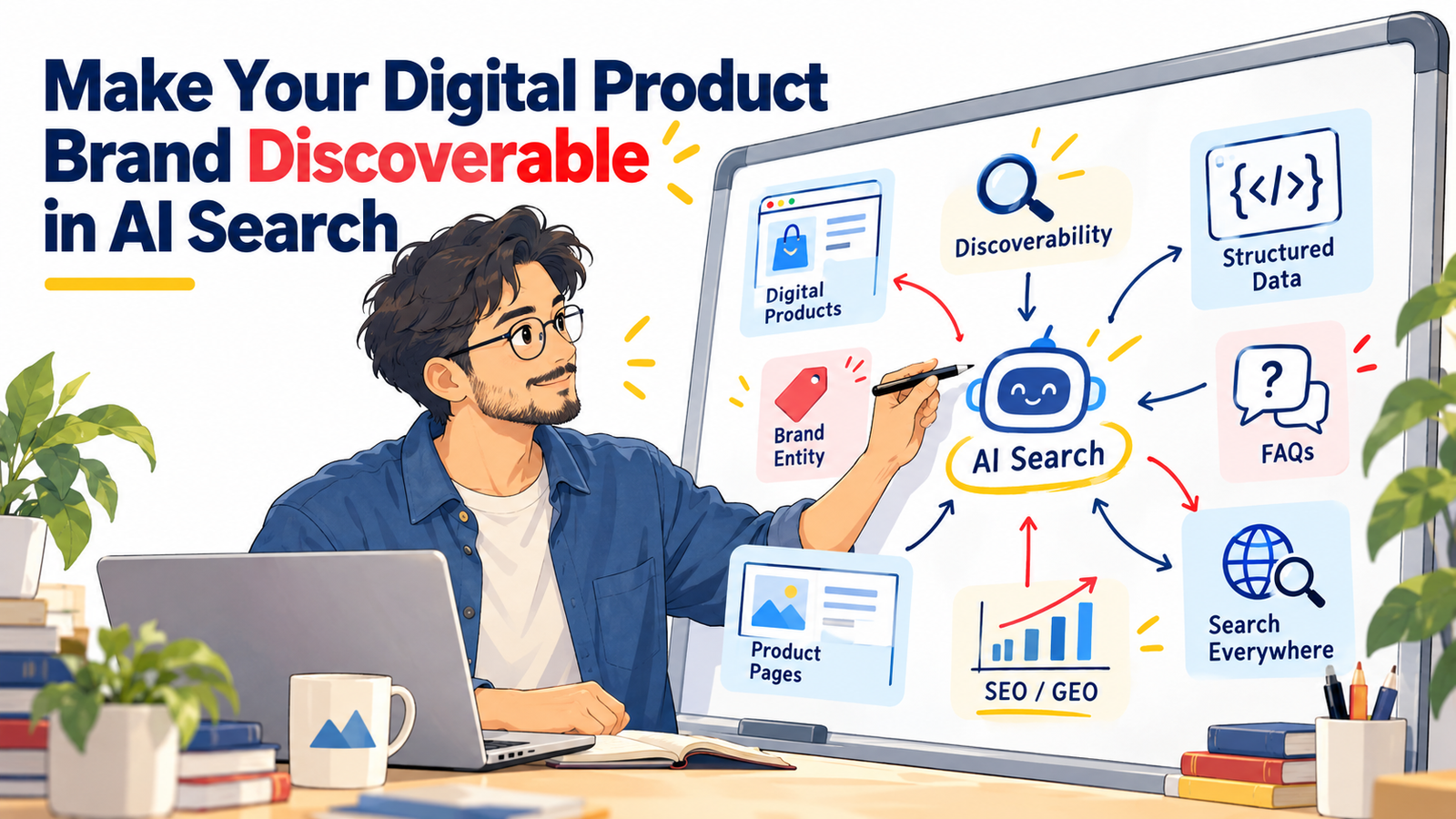
Search is no longer limited to ten blue links.
A potential customer looking for a digital planner, business template, PLR resource, spreadsheet, online course, design asset, prompt collection, or downloadable business tool may now begin the buying journey in Google Search, Google AI Mode, an AI Overview, ChatGPT, Gemini, Perplexity, YouTube, Reddit, TikTok, or another discovery platform.
That changes an important question for digital product sellers.
Instead of asking only, “How do I rank this page?”, brands increasingly need to ask:
“Can search engines and AI systems clearly understand who we are, what we sell, who our products are for, and why our information should be considered useful?”
That is the foundation of AI search optimization, GEO ecommerce, digital product AI SEO, and modern “search everywhere” visibility.
Google’s current guidance reinforces an important point: traditional SEO has not become irrelevant because generative AI search has arrived. Google says its generative search experiences continue to rely on its core Search ranking and quality systems, while techniques such as retrieval-augmented generation and query fan-out can surface information from multiple relevant pages. Google also advises businesses to focus on original, non-commodity, people-first content rather than trying to manufacture pages for every possible AI query.
For digital product businesses, the opportunity is significant. A store that communicates its identity, expertise, product information, use cases, FAQs, pricing, categories and supporting knowledge clearly gives both people and machines more useful information to work with.
What Does AI Search Optimization Mean for a Digital Product Store?
AI search optimization is the process of making your brand, products and expertise understandable and discoverable across search engines and AI-assisted discovery experiences.
You may also see terms such as GEO, or generative engine optimization, and AEO, or answer engine optimization.
The labels are useful for describing the changing search landscape, but they should not distract you from the fundamentals.
Google explicitly states that, from its perspective, optimizing for generative AI Search remains part of SEO rather than a completely separate discipline.
For an ecommerce brand selling digital products, that means successful optimization should connect several areas at once:
Brand clarity + strong product information + useful expertise + technical SEO + structured product data + credible external mentions + consistent information + excellent customer experience.
Think about AI visibility as a trust and understanding problem.
If your website calls a product a “Business Growth Kit,” your marketplace listing calls it a “Business Mega Bundle,” your Pinterest page calls it a “5000 Template Pack,” and another page describes it as a “Marketing Resource Library,” machines have to determine whether those references describe the same product.
The clearer and more consistent your information becomes, the easier it is for users and systems to understand your commercial offering.
1. Make Your Brand a Clear Entity
Before an AI system can confidently associate your products with your business, it needs enough consistent information to understand the brand itself.
Your website should answer basic questions without making visitors search for them.
What is the brand called?
What does it sell?
What type of customer does it serve?
What categories does it specialize in?
Where is the official website?
What makes its products different?
Who operates or publishes the content?
Your homepage, About page, product pages, contact information, social profiles, author pages and marketplace profiles should reinforce the same basic identity.
For example, compare these two brand descriptions.
A weak description might say:
“Welcome to our store. We sell amazing digital downloads for everyone.”
A stronger description would say:
“Digital Growth Market provides downloadable business templates, PLR and MRR resources, spreadsheets, content tools and digital business kits for creators, online sellers, freelancers and small businesses.”
The second version gives both the customer and a machine a meaningful description of the business.
Entity clarity does not require endlessly repeating the company name. It requires consistency.
Your brand description should naturally connect your business with the topics and product categories that genuinely define it.
2. Build Topical Authority Around What You Actually Sell
A store with hundreds or thousands of products should not rely exclusively on product pages.
Create an information ecosystem around those products.
If you sell business spreadsheets, publish practical content about cash-flow tracking, pricing calculators, inventory management, business budgeting and spreadsheet workflows.
If you sell Canva templates, publish guides about visual branding, social media design, template customization, lead magnets and digital marketing assets.
If you sell PLR products, create useful resources explaining PLR licenses, content customization, responsible resale, product positioning, niche selection and digital storefront development.
This is where digital product AI SEO becomes more powerful than simply adding keywords to a product description.
AI systems often need enough contextual information to determine relationships between concepts.
A detailed knowledge base can establish those relationships naturally.
Google’s 2026 generative-search guidance specifically emphasizes useful, original and non-commodity content. It cautions against publishing large numbers of shallow pages simply to capture variations of possible AI queries.
The goal should therefore be depth, not artificial volume.
One excellent guide explaining how to use a product category can be more strategically valuable than twenty nearly identical articles targeting slightly different keyword phrases.
3. Turn Every Important Product Page Into a Complete Information Source
A digital product page should do more than display a title, price and Buy button.
A customer deciding whether to purchase a digital download usually wants practical details.
AI systems may also need those details to accurately characterize the product.
Consider a page selling a business template collection.
Instead of writing:
“5000 templates. Download now.”
Explain what customers actually receive.
Describe the file types, major categories, intended users, software requirements, editing possibilities, license conditions, delivery method, important limitations and realistic use cases.
A strong digital product page should naturally answer questions such as:
What is this product?
Who is it designed for?
What problem can it help solve?
What is included?
What file formats are provided?
Does the buyer need special software?
Is the content editable?
What rights are included?
How is the download delivered?
Are updates included?
What should buyers understand before purchasing?
This information improves conversion because customers can make a more informed decision.
It also reduces ambiguity.
Google’s merchant structured-data documentation shows how product information such as product name, description, brand, offer, price, currency and availability can be represented in machine-readable form. Product markup can make eligible products available for various Search shopping experiences, although Google does not guarantee that a rich result will appear.
The important principle is simple:
Your visible product information and your machine-readable product information should tell the same story.
4. Keep Product Information Consistent Everywhere
Consistency may become one of the most underestimated aspects of AI commerce visibility.
Imagine your website says a bundle contains 10,000 resources.
Your marketplace listing says 12,000.
An older blog article says 8,000.
A social media post says 15,000.
An affiliate page lists a different license.
Which version should an AI system trust?
Ahrefs’ current AI-search guidance emphasizes keeping important information current and consistent, particularly changing details such as pricing, features, product limits and setup information.
For digital product stores, create a single source of truth for important product facts.
Whenever you change a product name, price, file count, compatibility requirement, license condition or major feature, review the places where that information appears.
Consistency matters across your product page, product schema, category page, marketplace listing, help documentation, promotional pages, comparison pages and important partner listings.
Perfect synchronization across the entire internet may be impossible.
Your own properties, however, should not contradict one another.
5. Use Structured Data Without Treating It Like an AI Ranking Trick
Structured data helps search engines interpret page information and can make pages eligible for richer Search experiences.
For ecommerce websites, Product and Offer structured data can communicate information such as product name, brand, category, price, currency and availability.
Google added further merchant-listing guidance around product categories in 2026, reinforcing the value of maintaining accurate product information.
But there is an important distinction.
Structured data is useful for SEO and ecommerce understanding, but Google says there is no special schema markup required specifically for its generative AI search features. It also advises site owners not to overfocus on structured data as though adding markup alone creates AI visibility.
Your schema should describe reality.
It should not attempt to create a version of the product that is more impressive than the visible page.
A useful rule is:
Visible content first. Structured representation second.
If your product page clearly explains what you sell, structured data can reinforce that information for machines.
6. Create Useful FAQs Around Real Buying Questions
FAQs are valuable because digital products often create questions that standard product descriptions do not fully address.
For example:
“Can I edit this template in Canva?”
“Does this PLR license allow resale?”
“Will this spreadsheet work in Google Sheets?”
“Is this purchase a physical shipment?”
“Can I use the files for client projects?”
Questions like these reflect real commercial intent.
Writing clear answers can help visitors evaluate products without contacting support.
There is one important 2026 SEO update to understand.
Google discontinued the FAQ rich-result feature in Search in May 2026. Therefore, brands should not create FAQ sections simply because they expect the old FAQ rich-result display in Google. FAQs can still be useful because they improve clarity, satisfy customers and create useful contextual information on the page.
Write FAQs for people first.
If they also help machines understand your products, that is an additional benefit.
7. Earn Brand Mentions Where Your Audience Already Searches
Your website should not be the only place where your brand exists.
People discover products across creator platforms, communities, marketplaces, video sites, blogs, review sites and social networks.
This is why “search everywhere optimization” has become increasingly relevant.
Ahrefs describes modern AI visibility partly through brand mentions and citations across AI-generated answers. Its Brand Radar product, for example, monitors sampled responses across platforms including ChatGPT, Gemini, Perplexity and Google AI experiences. Ahrefs also notes that AI discovery is not equivalent to traditional rank tracking because generated answers can vary rather than maintaining a fixed numbered ranking.
For brands, the strategic lesson is broader than any one monitoring tool.
Be present where meaningful conversations about your product category happen.
That might include educational YouTube videos, expert guest articles, legitimate reviews, helpful Reddit discussions, creator collaborations, niche newsletters, marketplace profiles or industry directories.
Do not manufacture fake mentions.
Google’s AI optimization guidance specifically cautions against chasing inauthentic mentions as an AI-search tactic.
A genuine recommendation from a credible creator who has actually used your product is far more useful than dozens of artificial references created only for SEO.
8. Think Beyond Keywords Toward Questions, Problems and Use Cases
Keywords remain useful.
But AI-assisted discovery encourages businesses to think beyond exact keyword phrases.
A shopper might traditionally search:
“social media templates”
An AI-assisted query could look more like:
“I run a small handmade jewelry business. What digital tools could help me create a consistent month of Instagram content without hiring a designer?”
The second query describes a customer situation rather than simply naming a product.
Your website needs enough context to connect your offering with that situation.
This is why product use cases matter.
Instead of merely saying:
“Includes 500 social templates.”
Explain:
“A small ecommerce seller could use these templates to create product announcements, customer testimonials, promotional posts, educational posts and seasonal campaign graphics without designing every post from scratch.”
The richer explanation connects the product with intent.
Google says its generative Search systems can use query fan-out to explore related searches around a user’s original question. This means site owners should focus on genuinely comprehensive information rather than obsessively repeating exact-match keywords.
9. Build Commercial Content and Educational Content Together
One of the strongest structures for a digital store is an ecosystem where informational content naturally leads to commercial content.
Imagine that you sell an ecommerce inventory spreadsheet.
Your informational architecture might include an article explaining inventory management for online sellers, another showing common inventory mistakes, a guide to spreadsheet-based stock tracking, a product comparison page and finally the detailed product page.
The articles educate.
The category page organizes.
The product page converts.
Internal links connect the journey.
This structure can also help search engines understand relationships between topics, categories and products.
Do not force links simply to manipulate SEO.
Link when the destination genuinely helps the reader continue the task.
A helpful call to action might say:
Need a ready-to-use system instead of building your own spreadsheet? Explore our inventory and ecommerce business templates.
That CTA serves a logical next step rather than interrupting the article with an unrelated sales message.
10. Make Your Product Images Part of Search Discovery
AI search is becoming increasingly visual.
In September 2026, Google introduced Search Console reporting for web multimodal searches, including discovery through experiences such as Lens, Circle to Search and image-based Search interactions.
That makes strong product imagery more than a design consideration.
For digital products, consider using clean previews showing what the customer is actually buying.
A spreadsheet product can show dashboards.
A template bundle can show representative layouts.
A digital planner can show important page types.
A business toolkit can show the major resource categories.
Image filenames, surrounding text, captions when useful, accessibility alt text and page context should accurately describe the visual rather than being filled with repeated keywords.
Images should create confidence rather than mystery.
11. Prepare Articles for Google Discover Without Chasing Clickbait
Google Discover can create another source of visibility for a digital product brand’s educational content.
Discover does not require special structured data merely to become eligible. Google says indexed pages that meet its policies can be eligible, although eligibility does not guarantee distribution.
Google recommends headlines that accurately represent the content and specifically warns against misleading clickbait and sensationalism.
That fits well with trustworthy digital product marketing.
Instead of:
“This Secret AI Trick Will Make You Rich Overnight!”
write something like:
“How AI Search Is Changing Digital Product Discovery in 2026”
The second title creates curiosity while accurately explaining the article.
Visual quality matters as well.
For Discover, Google currently recommends relevant high-resolution images that are at least 1,200 pixels wide, generally suited to a 16:9 presentation, with max-image-preview:large enabled where appropriate. Google also says schema.org image markup and og:image can help identify the preferred representative image.
Timely topics can help, but trend chasing should not replace expertise.
Google continues to emphasize helpful, reliable, people-first content and warns against publishing material purely to attract search visits.
The better approach is to connect current developments with your established area of expertise.
12. Improve Page Experience Before Sending More Traffic
Visibility means little when the landing experience creates friction.
A user arriving from an AI answer may know almost nothing about your business.
The page needs to quickly establish relevance.
Use a clear product name.
Explain the benefit.
Show meaningful previews.
Make pricing obvious.
Explain the license.
Identify file formats.
Show compatibility.
Make purchase buttons easy to find.
Keep mobile navigation simple.
Avoid intrusive popups that hide the product.
Google’s current page-experience guidance continues to emphasize mobile usability, Core Web Vitals, secure delivery, unobstructed main content and avoiding excessive intrusive elements.
For ecommerce, this is not simply an SEO concern.
It directly affects confidence and conversion.
13. Build Information Worth Citing
One of the best ways to become more visible in AI-assisted discovery is to publish information that deserves to be referenced.
That does not mean trying to “write for citations.”
It means producing something meaningfully better than generic internet summaries.
For a digital product business, original information could include observations from customer questions, a comparison based on your own testing, template benchmarks, original workflow examples, case studies, product usage data, industry surveys, downloadable calculators, practical experiments or lessons from supporting customers.
Google’s current guidance specifically encourages unique viewpoints, firsthand experience and content that goes beyond information that could easily be reproduced from existing material.
Generic content competes with thousands of generic pages.
Original expertise creates a reason to mention your brand.
14. Make Your About, Author and Trust Pages Stronger
AI visibility and buyer confidence both benefit when responsibility is clear.
Do not hide the identity behind your store.
An About page can explain your business purpose, subject expertise, product-development process and who your resources are intended to help.
Article pages should identify authors where appropriate.
Important policy information should be accessible.
For a digital product store, clearly explain issues such as delivery, refund policies, licensing, commercial usage, customer support and intellectual-property expectations.
Trust is not created by inserting the word “trusted” into marketing copy.
It grows when important questions are answered transparently.
15. Do Not Build Your Strategy Around AI SEO Myths
AI search has created a new generation of shortcuts and supposed ranking hacks.
Be cautious.
Google’s 2026 generative-search guidance says there is no need to create special AI text files or special AI-only markup to appear in its generative Search features. It specifically states that llms.txt does not positively or negatively affect visibility or rankings in Google Search, although other services may choose to use such files.
Google also says there is no requirement to artificially “chunk” every page into tiny blocks for its AI systems.
That does not mean page structure is unimportant.
Good headings, concise sections, logical organization and direct explanations help human readers enormously.
Just do not turn readability techniques into imaginary ranking formulas.
16. Measure AI Visibility Differently From Traditional Rankings
Traditional SEO often revolves around positions.
AI discovery is less predictable.
One customer may ask ChatGPT one question and receive one set of brands.
Another may phrase the request differently and receive another answer.
Ahrefs describes AI visibility measurement through metrics such as mentions, citations and share of voice rather than treating AI answers like fixed traditional rankings.
Google has also expanded Search Console during 2026 with dedicated generative AI performance reporting, including views related to generative features in Search and Discover. Google stated that the reporting rollout reached all websites worldwide by August 31, 2026.
For a digital product business, measurement should therefore look beyond a single ranking position.
Track brand searches, non-brand organic traffic, important product-page impressions, conversions, external mentions, referring domains, AI citations where measurable, product discovery traffic, category visibility and changes in branded demand.
You are trying to understand whether more qualified people are discovering and recognizing your business.
17. Use AI Search Optimization to Improve the Business, Not Just Traffic
The strongest GEO strategy often looks surprisingly similar to building a better store.
Clearer product names help AI systems, but they also help customers.
Detailed descriptions help search engines, but they also reduce purchase uncertainty.
Consistent pricing prevents machine confusion, but it also prevents customer frustration.
Helpful FAQs may improve contextual understanding, but they also reduce support tickets.
Original educational content establishes topical authority, but it also builds trust before a sale.
External brand mentions can increase discoverability, but they also introduce your products to new audiences.
Good technical SEO improves crawling, but it also encourages faster, easier pages.
That is what makes sustainable AI search optimization different from a temporary SEO trick.
You are improving the information architecture of the entire digital product business.
A Practical 2026 AI Search Visibility Checklist
Before investing in more content, review these essentials:
- Keep your brand name, description, product names, pricing, licenses and important specifications consistent across your primary online properties; build substantial category and product pages; publish original educational content related directly to what you sell; use appropriate
ProductandOfferstructured data where relevant; create FAQs around genuine customer questions; earn authentic mentions from relevant third-party sources; use strong internal links between guides, categories and products; publish useful product previews and high-quality images; ensure important pages are crawlable and indexable; improve mobile experience and page speed; use accurate, compelling headlines instead of clickbait; create large representative images for Discover-oriented editorial content; keep old articles and product information updated; and measure AI mentions, organic discovery, branded demand, product visibility and conversions rather than focusing on one ranking metric.
Five Questions About AI Search Optimization for Digital Product Brands
1. What is GEO ecommerce?
GEO ecommerce, or generative engine optimization for ecommerce, refers to practices intended to improve how products and brands are understood and discovered in AI-assisted search experiences.
For a digital product store, that can include stronger product descriptions, clear brand information, topical expertise, consistent product data, useful supporting articles, structured data and credible external mentions.
For Google specifically, GEO should not be viewed as a replacement for SEO. Google says traditional SEO best practices remain foundational to visibility in its generative Search experiences.
2. How can I make my products easier for ChatGPT and other AI assistants to discover?
Start by making your brand and products easy to understand across the open web.
Use consistent names and descriptions, maintain accurate product pages, publish genuinely useful information around your niche, earn authentic references from credible websites and communities, and keep important product facts current.
Do not think of ChatGPT product discovery as a traditional ranking system with a permanent number-one position. AI-generated responses can vary by question and context, which is why modern AI visibility tools increasingly measure mentions and citations across samples of queries rather than fixed rankings.
3. Do I need special schema for AI search?
For Google Search, no special AI-specific schema is required.
Continue using relevant structured data because it can help Google understand page information and make pages eligible for supported rich Search experiences, but do not treat structured data as an AI ranking shortcut.
For ecommerce pages, accurate Product and Offer information remains useful.
4. Are FAQs still useful for SEO in 2026?
Yes, when the questions are genuinely useful to customers.
However, Google’s FAQ rich-result feature was discontinued in May 2026, so FAQ sections should not be created merely to obtain the old expanded FAQ display in Search.
Use FAQs to clarify purchases, answer commercial questions, explain compatibility, licensing, delivery and usage, and strengthen the overall usefulness of the page.
5. Can optimizing for AI search also help Google Discover?
There is considerable overlap.
Both benefit from strong content quality, trustworthy information, good page experience and useful original material.
For Discover specifically, Google recommends accurate non-clickbait headlines, timely or uniquely insightful content and compelling relevant imagery. Large Discover images should generally be at least 1,200 pixels wide, and Google recommends enabling large image previews and using suitable image metadata.
Build a Digital Product Brand That Can Be Understood Everywhere
Digital product discovery in 2026 is becoming broader than traditional Google rankings.
A buyer may move from an AI recommendation to a blog post, from a Google Discover article to a category page, from YouTube to a product landing page, or from a community discussion to a branded search.
Your job is to make those paths reinforce one another.
Be clear about who you are.
Publish products with complete information.
Build genuine expertise around your categories.
Keep important facts consistent.
Answer real customer questions.
Earn legitimate brand mentions.
Create useful content that contributes something original.
Use structured data accurately.
Make your site technically accessible.
And give people a reason to trust what they find when AI search, Google Search, Google Discover or another discovery platform introduces them to your brand.
AI search optimization is not simply about getting mentioned by a machine.
It is about building a digital presence that is easy to discover, understand, verify, trust and choose.
Ready to strengthen your digital product visibility? Start with your ten most commercially important products. Improve their descriptions, standardize their information, answer the questions customers actually ask, connect them with useful educational content, and ensure every page clearly communicates what the product is and who it is designed to help.
That foundation can support traditional SEO, GEO ecommerce, AI-assisted discovery and long-term brand growth at the same time.
Stay ahead with exclusive updates
Join our community. Get curated industry trends, actionable guides, and fresh resources delivered straight to your inbox.