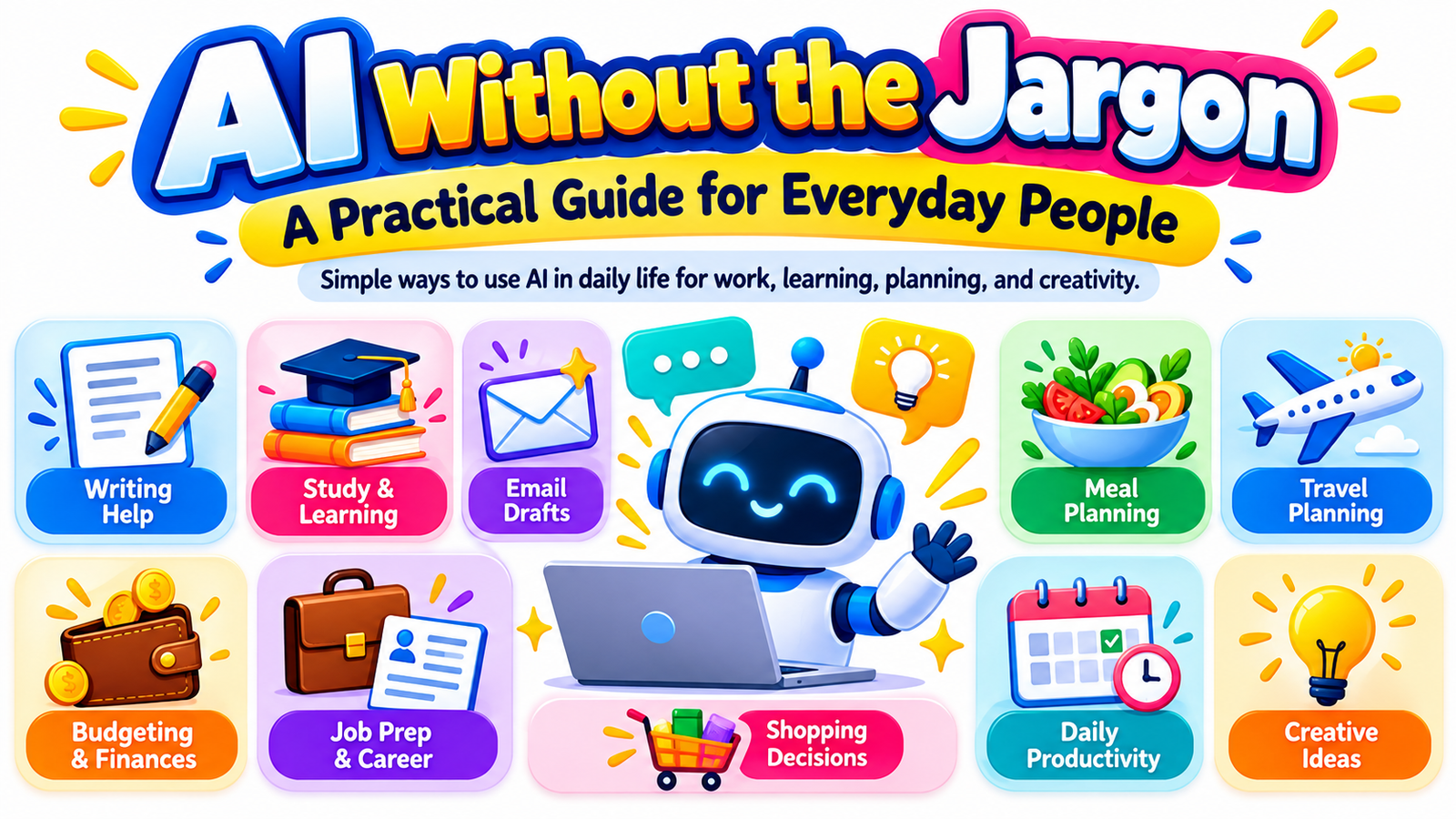
A Practical Guide for Everyday People
Artificial intelligence used to sound like something that belonged in research laboratories, science-fiction movies, or the offices of large technology companies.
That has changed.
Today, AI can help ordinary people write an email, understand a difficult topic, organize a holiday, improve a résumé, create a meal plan, summarize a document, brainstorm a business idea, learn a language, compare options, or simply turn a messy collection of thoughts into something useful.
You do not need to be a programmer.
You do not need to understand algorithms.
And you certainly do not need to become an AI expert before you can benefit from it.
For most people, learning to use AI is becoming less about understanding the technology behind it and more about knowing what to ask, when to trust the answer, and when to double-check it.
AI adoption is already moving well beyond technical audiences. In a 2026 Pew Research Center survey, 36% of U.S. adults said they interact with AI at least several times a day, while another 30% said they interact with it about once a day or several times a week.
That makes understanding AI increasingly similar to understanding search engines, smartphones or online banking: you may never need to know exactly how the technology works internally, but knowing how to use it responsibly can make everyday life easier.
This AI for beginners guide explains artificial intelligence without technical jargon and focuses on something far more important: practical AI use in everyday life.
What Is Artificial Intelligence in Simple Language?
Artificial intelligence is software designed to perform tasks that normally require some form of human intelligence.
Depending on the system, AI may recognize patterns, understand written questions, generate text, interpret images, organize information, make predictions, translate languages or help people make sense of large amounts of data.
One of the most familiar forms today is generative AI.
Generative AI can create new content based on instructions from a user. That content might be text, images, summaries, ideas, plans, computer code, audio or other material.
Think of it less as a digital brain that “knows everything” and more as an extremely fast assistant that has learned patterns from large amounts of information.
That distinction matters.
AI can produce impressive answers, but impressive does not always mean correct.
You Are Probably Already Using AI
Many people imagine AI only as a chatbot.
In reality, artificial intelligence has already been appearing quietly in everyday technology for years.
When an email service filters spam, a navigation app predicts traffic, a streaming platform recommends a movie, a smartphone improves a photograph, an online store suggests products or a translation service converts one language into another, AI-related technologies may be working behind the scenes.
Generative AI simply makes the interaction more visible.
Instead of software quietly making recommendations, you can now have a conversation with it.
You can say:
“Explain this letter in simple language.”
“Help me plan meals for the next five days.”
“Turn these notes into a professional email.”
“Teach me this topic as if I were a complete beginner.”
That conversational ability is one reason AI is becoming useful to people who have no technical background at all.
The Most Important AI Skill Is Asking Clearly
You do not need a library of complicated “secret prompts” to use AI well.
Clear communication is usually more valuable.
Compare these two requests.
“Help me exercise.”
versus:
“I am a beginner who can exercise at home for 20 minutes each morning. Create a simple seven-day routine using only bodyweight exercises. Keep the instructions short and include rest days.”
The second request gives AI more useful information.
A strong everyday AI request usually contains four things: what you want to accomplish, relevant background information, any important restrictions, and the format you would like the answer in.
For example:
“I am preparing for a job interview for a customer-support position. I have three years of retail experience but no formal customer-service qualification. Give me 10 likely interview questions and show me how I could structure strong answers without exaggerating my experience.”
That is not programming.
It is simply explaining what you need.
How AI Can Help With Everyday Writing
Writing is one of the easiest places for beginners to experience the practical value of AI.
You might know exactly what you want to say but struggle to phrase it.
AI can help transform rough ideas into clearer communication.
Imagine writing:
“Tell landlord kitchen tap broken water coming constantly need repair quickly but polite.”
An AI assistant can turn those notes into a respectful maintenance request.
It can also change the tone.
You can ask for something to sound more professional, friendlier, shorter, warmer, more persuasive or easier to understand.
This can help with workplace messages, customer replies, complaint letters, invitations, product descriptions, social-media captions, announcements and personal correspondence.
The important principle is to treat AI-generated writing as a draft rather than automatically sending everything it produces.
Read it.
Correct it.
Make sure it still sounds like you.
AI as a Learning Assistant
One of the most powerful everyday uses of artificial intelligence is personalized explanation.
Traditional search often gives you pages to read.
AI can help explain the information at the level you currently understand.
Suppose you are learning compound interest.
You could ask:
“Explain compound interest to me without using financial jargon.”
Then:
“Give me a simple example using ₹10,000.”
Then:
“Now give me a small quiz.”
Then:
“Explain question three again because I got it wrong.”
This creates something closer to an interactive tutor than a traditional search result.
The same approach can be useful for history, mathematics, science, grammar, business concepts, software, language learning and professional skills.
AI should not replace qualified teachers or authoritative sources where accuracy matters, but it can make difficult subjects less intimidating.
Turn Long Information Into Something Manageable
Modern life produces more information than most people have time to process.
Reports, meeting notes, policies, articles and documents can quickly become overwhelming.
AI can help reduce that information into a usable format.
For example, you might provide a document you are allowed to share and ask:
“Summarize this in plain English. Tell me the five points I need to understand and identify anything that requires action.”
Or:
“Compare these two documents and explain the main differences.”
The value is not simply making text shorter.
The real benefit is turning information into decisions and actions.
However, when dealing with contracts, regulations, financial documents, medical information or other high-stakes material, check the original source rather than relying solely on an AI summary.
Plan Your Day Without Building a Complicated Productivity System
AI can also act as a practical planning assistant.
Suppose you have ten things to do and no idea where to begin.
You might say:
“I have three hours available today. I need to reply to six emails, prepare tomorrow’s presentation, buy groceries, make two phone calls and exercise. Help me prioritize everything realistically.”
AI can organize the tasks, estimate a logical sequence and suggest what can be postponed.
That does not mean you must follow its schedule.
The benefit is giving yourself a starting point.
For busy people, overcoming the “Where do I begin?” problem can sometimes be more valuable than the plan itself.
Use AI for Meal and Household Planning
Everyday AI does not need to involve business or complicated research.
It can help with very ordinary problems.
Imagine opening your refrigerator and finding rice, eggs, tomatoes, potatoes and a few vegetables.
Instead of searching through dozens of recipes, you could ask:
“I have rice, eggs, potatoes, tomatoes, onions and spinach. Suggest three simple dinner ideas using mostly these ingredients.”
You could then add:
“One person does not eat eggs.”
Or:
“Make the second recipe suitable for four people.”
AI can also help create shopping lists, organize household chores, build cleaning routines, suggest ways to use leftovers or develop basic weekly meal plans.
For dietary restrictions, allergies and medical nutrition requirements, however, professional guidance remains important.
AI Can Make Travel Planning Easier
Travel planning often requires juggling destinations, transport, accommodation, timing, budgets, food and attractions.
AI can help organize those pieces.
For example:
“I have four days in Jaipur and prefer history, local food and relaxed sightseeing. I do not want an overloaded itinerary. Suggest a practical four-day plan with one main area each day.”
You could then ask it to reorganize the itinerary for children, older travelers or rainy weather.
For current opening hours, ticket prices, transport schedules, visa requirements and safety information, always verify the latest information with reliable sources because these details can change.
Think of AI as the planning assistant—not the official authority.
Use AI Before You Buy Something
Shopping becomes difficult when dozens of products appear to offer nearly identical features.
AI can help you think more clearly about what actually matters.
Instead of asking:
“What is the best laptop?”
Try:
“I need a laptop mainly for writing, web browsing, video meetings and light photo editing. I care more about battery life and reliability than gaming performance. Help me understand which specifications matter and which ones I can ignore.”
Now AI is helping you define your requirements.
That can be more useful than simply naming a product.
You can use the same method for appliances, phones, software subscriptions, cameras and many other purchases.
Because prices, product specifications and availability change, verify current details before buying.
AI for Work Without Becoming an “AI Expert”
Many everyday workplace tasks involve organizing information rather than highly technical work.
That makes them well suited to AI assistance.
AI can help create meeting agendas, summarize notes, brainstorm presentation structures, improve reports, draft standard operating procedures, organize research, generate customer-service response ideas or convert rough notes into polished documents.
Imagine returning from a meeting with scattered notes.
You might ask:
“Turn these meeting notes into three sections: decisions made, actions required and unresolved questions.”
A task that previously required 20 minutes of reorganizing could become much easier to begin.
The goal is not necessarily to remove people from the process.
Often the greatest value comes from removing repetitive preparation so people can spend more time reviewing, deciding and communicating.
AI Can Help You Think Through a Problem
AI is also useful before you know the answer you need.
Suppose you want to start a small side business but cannot decide what to sell.
Instead of asking AI to choose your business for you, ask it to help you think.
For example:
“I enjoy photography, basic graphic design and teaching beginners. I can spend about five hours each week building a side business. Give me 10 realistic business models and compare them by startup cost, difficulty and time required.”
Now you have possibilities to evaluate.
AI becomes a brainstorming partner rather than an oracle.
You remain the decision-maker.
Use AI to Practice Conversations
Artificial intelligence can be surprisingly useful for rehearsal.
You can ask it to simulate a job interviewer, customer, client, language partner or skeptical buyer.
For example:
“Act as an interviewer hiring for an administrative assistant position. Ask me one question at a time. After every answer, tell me one thing I did well and one thing I could improve.”
You can practice without worrying about embarrassment.
This is useful for interviews, presentations, sales conversations, language learning and difficult workplace discussions.
It does not recreate every nuance of speaking with a real person, but it can dramatically improve preparation.
AI Can Support Creativity Without Replacing Your Ideas
Writers, bloggers, teachers, designers, small-business owners and creators can use AI to explore possibilities.
You might ask for 20 headline ideas, alternative story openings, product concepts, lesson activities or ways to explain the same topic to different audiences.
The strongest approach is usually not:
“Create everything for me.”
It is:
“Help me explore more possibilities.”
Your experience, taste and judgment are what transform generic AI output into something distinctive.
What AI Is Not Good At
Using artificial intelligence effectively also means understanding its weaknesses.
AI can sometimes generate information that sounds completely believable but is incorrect.
It may misunderstand context.
It may provide outdated information.
It can miss important exceptions.
It may confidently describe a source, statistic, product, rule or event incorrectly.
The polished language can make these errors difficult to notice.
This is why AI should not automatically become your sole source of truth.
For casual brainstorming, an occasional mistake may be inconvenient.
For health, legal matters, finance, safety, employment regulations, major purchases or important business decisions, errors can have serious consequences.
The higher the stakes, the stronger your verification should be.
A Simple Rule: Create With AI, Verify With Evidence
A useful beginner habit is to separate creation from verification.
Use AI freely for brainstorming, reorganizing information, drafting, explaining, generating questions and exploring possibilities.
But when an answer depends on facts, check those facts.
If AI gives you a statistic, ask for the source and then verify the source.
If it explains a government rule, visit the relevant official website.
If it mentions today’s price, current schedule or recent news, check current information.
If the topic involves professional medical, legal or financial advice, consult an appropriate professional or authoritative resource where needed.
AI becomes far more useful when you stop asking, “Can I trust AI?”
A better question is:
“How much verification does this particular task require?”
Protect Your Privacy
Convenience can make people forget that AI systems are digital services.
Think carefully before entering sensitive information.
Avoid casually pasting passwords, banking credentials, confidential business information, private customer records, identity documents or other sensitive data into a service unless you clearly understand how that service handles your information and your organization permits it.
You can often remove identifying details.
Instead of entering a real customer’s personal information, replace the name with “Customer A.”
Instead of uploading an entire confidential document, provide only the non-sensitive section required for the task when appropriate.
Good AI habits include good privacy habits.
Do Not Let AI Replace Your Judgment
AI can recommend.
It can compare.
It can summarize.
It can suggest.
But responsibility still belongs to the person using the information.
Consider a simple example.
You ask AI which of two job opportunities you should accept.
It can help you compare salary, travel time, career growth, working hours and other factors.
What it cannot fully understand is how much you value stability, family time, workplace culture, personal ambition or a particular life goal.
Those decisions contain human values.
AI can organize the decision.
You still have to make it.
The Beginner’s Four-Step AI Method
If you remember only one technique from this artificial intelligence guide, use this sequence: Goal → Context → Format → Check.
Goal: Explain what you want.
“Help me prepare for a job interview.”
Context: Give useful background.
“I am applying for my first supervisory position after working four years in retail.”
Format: Say how you want the answer.
“Give me eight questions with short guidance under each.”
Check: Review important information.
Verify facts, rewrite anything that does not sound like you and question anything that appears uncertain.
This small habit can improve AI results dramatically.
Ten Practical AI Requests You Can Try Today
Here are simple ways to start using AI without learning technical terminology:
- “Explain this topic to me like I am a beginner, then give me three examples.”
- “Turn these rough notes into a clear professional email without changing the meaning.”
- “Create a realistic schedule for these tasks based on the four hours I have available.”
- “Compare these two options by cost, convenience, risks and long-term value.”
- “Ask me questions that will help me clarify this business idea before I spend money on it.”
- “Teach me five useful phrases in Spanish and then test me.”
- “Summarize this document and highlight anything that requires action.”
- “I have these ingredients available. Suggest three simple meal ideas.”
- “Act as a job interviewer. Ask one question at a time and critique my answers.”
- “Explain the strengths and weaknesses of this idea rather than simply agreeing with me.”
You do not need to memorize them.
Notice the pattern: each request gives AI a clear role and a clear outcome.
The Best Follow-Up Question Is Often “Why?”
One of the biggest mistakes beginners make is treating the first AI answer as the end of the conversation.
AI becomes much more useful when you continue.
Ask:
“Why do you recommend that?”
“What assumptions are you making?”
“What could go wrong?”
“Give me a cheaper alternative.”
“Explain that more simply.”
“What would someone who disagrees say?”
“Which part of your answer should I verify?”
“Can you give me an example?”
These follow-up questions can turn a generic response into a useful conversation.
Ask AI to Challenge You, Not Just Agree With You
AI assistants can sometimes be overly agreeable.
That is not always helpful.
If you are considering an important idea, ask AI to challenge it.
For example:
“I am thinking about opening an online store selling printable planners. Do not simply encourage me. Identify the five biggest reasons this idea could fail and what evidence I should gather before investing.”
That question is considerably more valuable than:
“Is my business idea good?”
Good AI use involves seeking better thinking, not constant validation.
AI Literacy May Matter More Than AI Expertise
Most people do not need to become artificial-intelligence specialists.
But an increasing number of people will benefit from becoming AI-literate.
AI literacy means understanding enough to use the technology intentionally.
It means knowing that AI can be useful without being infallible.
It means knowing what information is safe to share.
It means understanding when an answer should be verified.
It means recognizing the difference between assistance and authority.
And it means knowing how to describe a problem clearly enough for AI to help.
These skills are useful whether you are a student, employee, parent, freelancer, entrepreneur, retiree, creator or lifelong learner.
Start With One Real Problem
There is an endless stream of AI news, tools, demonstrations and predictions.
Trying to understand everything at once can make artificial intelligence feel more complicated than it actually needs to be.
A better approach is to begin with a real problem in your own life.
Maybe you spend too long writing emails.
Maybe you struggle to organize weekly meals.
Maybe you want help understanding difficult documents.
Maybe you are learning English.
Maybe you need ideas for your small business.
Maybe you want to prepare for a job interview.
Choose one problem.
Use AI to make that problem slightly easier.
Then learn from the experience.
Practical confidence grows faster from actually using AI than from reading endless lists of AI terminology.
Five Frequently Asked Questions About AI
1. Do I need technical knowledge to use AI?
No. Most modern consumer AI tools are designed to accept ordinary written or spoken instructions. You can use everyday language. Being specific about your goal, situation and preferred output is generally more important than understanding programming.
2. Is everything AI tells me accurate?
No. AI can provide incorrect, incomplete or outdated information while sounding confident. Treat important factual claims as information to verify rather than guaranteed truth. The more important the decision, the more carefully you should check reliable sources.
3. What is the easiest way for a beginner to start using AI?
Choose one ordinary task you already do, such as writing an email, explaining a topic, planning meals or organizing notes. Ask AI for help with that task and continue with follow-up questions until the answer becomes useful.
4. Will AI replace normal internet search?
AI is changing how people find information, but different tools remain useful for different purposes. AI is particularly effective for explanation, synthesis and conversation, while direct sources remain essential when you need authoritative, current or highly specific information. Even Google’s current guidance describes traditional SEO foundations as continuing to matter alongside generative AI search experiences.
5. What should I never forget when using AI?
Keep three principles in mind: protect sensitive information, verify important facts and keep human judgment in the decision-making process. AI is most valuable when it improves your abilities rather than replacing your responsibility.
Start Small, Use AI With Purpose
Artificial intelligence does not need to feel mysterious.
For everyday users, its value is often surprisingly practical.
It can help you begin when a blank page feels intimidating.
It can explain something that seems confusing.
It can organize information that feels overwhelming.
It can give you options when you feel stuck.
It can help you prepare before an important conversation.
And it can reduce some of the repetitive work that consumes your attention.
But the goal should not be to hand your entire life over to an algorithm.
The better goal is to learn where AI genuinely saves time, improves understanding or helps you think more clearly—and where human experience, judgment and professional expertise still matter more.
Start with one useful task.
Give clear instructions.
Ask follow-up questions.
Check important information.
Keep your judgment switched on.
That is enough to begin.
Ready to try AI today? Pick one task you normally spend 15 or 20 minutes doing and ask an AI assistant to help you complete the first draft, organize the information or explore your options. Judge the result by one simple standard: Did this make the task genuinely easier or better?
If the answer is yes, you have already started building practical AI skills.
Stay ahead with exclusive updates
Join our community. Get curated industry trends, actionable guides, and fresh resources delivered straight to your inbox.