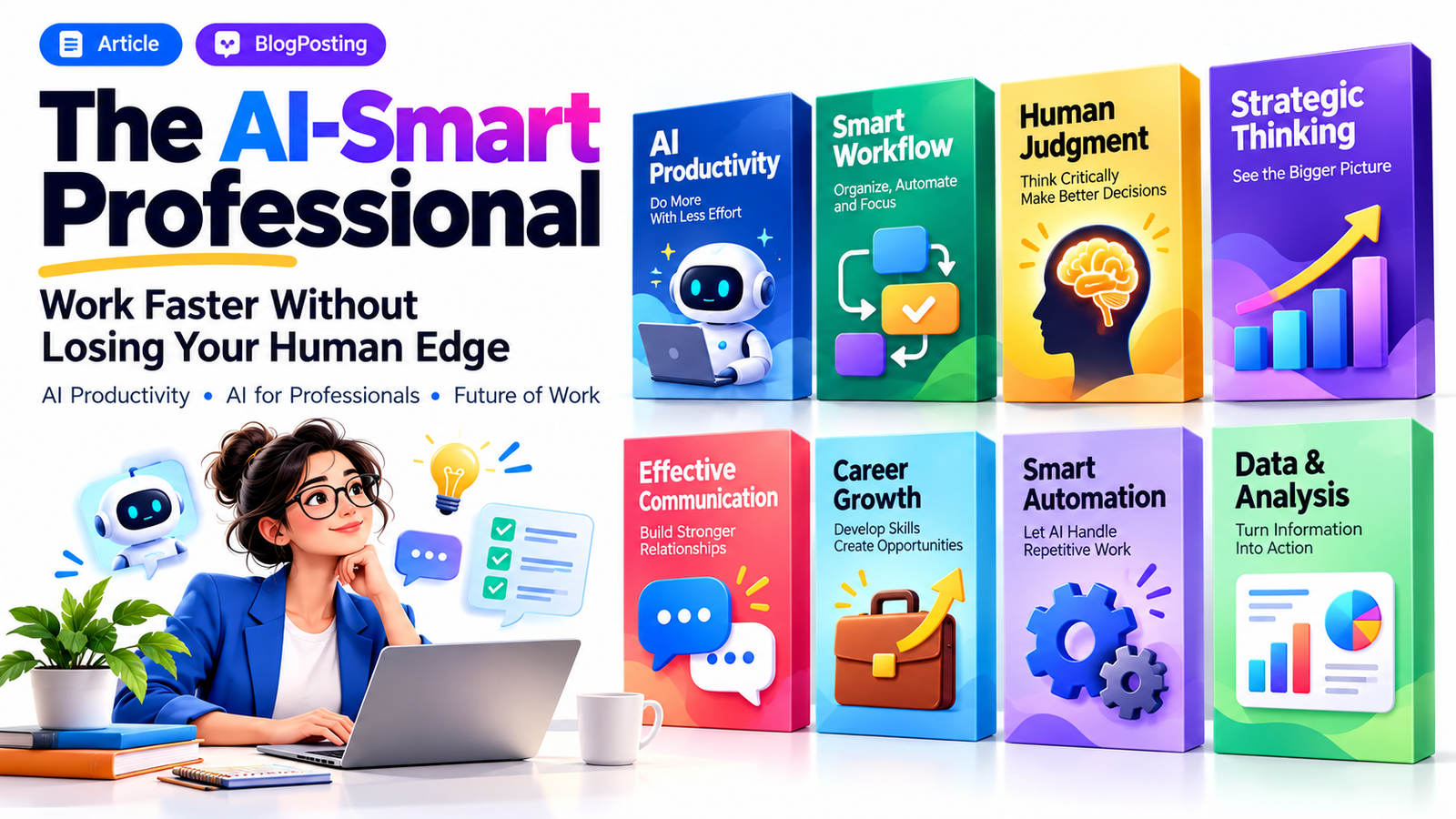
The Professionals Who Win With AI Will Not Be the Ones Who Use It for Everything
Artificial intelligence is rapidly changing what it means to be productive at work.
A task that once required an hour of research can sometimes begin with a useful AI-assisted summary in minutes. A blank presentation can become a structured first draft. A long meeting transcript can be turned into action points. Hundreds of customer comments can be grouped into themes. A difficult email can be rewritten before you hit Send.
That creates an obvious temptation: use AI everywhere.
But becoming an AI-smart professional requires something more sophisticated.
The goal is not to hand your thinking over to artificial intelligence. It is to use AI to remove unnecessary friction so that more of your time can go toward judgment, creativity, communication, problem-solving and decisions that actually require you.
That distinction may become one of the defining career skills of the next decade.
PwC’s 2026 Global AI Jobs Barometer found that productivity growth was 40% higher at companies most exposed to AI than at the least-exposed companies. At the same time, PwC reported growing importance for traditionally senior skills such as judgment and leadership in AI-exposed roles.
The message is not simply “learn AI.”
It is:
Learn how to combine AI capability with human capability.
That is where professional leverage begins.
What Is an AI-Smart Professional?
An AI-smart professional is someone who knows how to use artificial intelligence to increase the speed, quality and scope of their work without surrendering responsibility for the outcome.
They know when AI can help.
They know when it cannot be trusted without verification.
They know what should remain human-led.
And most importantly, they understand that AI productivity is not the same as AI dependency.
The strongest professionals are moving from simply asking AI for answers toward directing, evaluating, refining and integrating AI-generated work.
Microsoft’s 2026 Work Trend Index found that 86% of surveyed AI users said they treat AI output as a starting point rather than a final answer. Quality control and critical thinking were also among the human skills respondents considered increasingly important as AI takes on more work.
That is a useful model for anyone thinking about AI and career development.
AI can increase your capacity.
Your judgment determines what happens with that capacity.
AI Productivity Is Really About Redesigning Work
Many professionals approach AI like a faster search engine.
They type a question.
They receive an answer.
They copy something from the response.
That may save a few minutes, but it captures only a small portion of the potential value.
The bigger opportunity is to examine your workflow and ask:
Where am I spending human attention on work that does not require much human judgment?
Consider a marketing manager preparing a campaign.
Without AI, the manager might spend hours reviewing previous campaigns, organizing customer feedback, generating headline variations, preparing a content outline and formatting briefing documents.
With AI, some of that preparation can be accelerated.
But the manager should still decide which customer insight matters, what positioning fits the brand, whether a claim is appropriate, which creative direction is worth pursuing and what should actually be published.
AI performs parts of the process.
The professional owns the outcome.
That is human-AI collaboration at its most useful.
The New Productivity Equation
Traditional workplace productivity often meant doing more work in less time.
AI introduces a better equation:
Less repetitive effort + better information processing + stronger human judgment = higher-value output.
Imagine saving 40 minutes by using AI to create the first draft of a report.
You have two choices.
You can simply produce more reports.
Or you can spend those 40 minutes examining the evidence, challenging assumptions, improving the recommendation and discussing the implications with the people affected by it.
The second option creates significantly more professional value.
AI productivity should therefore not be measured only by how much time you save.
Ask instead:
What did I do with the time AI gave back to me?
That question separates automation from professional growth.
Where AI Can Make Professionals Faster
AI is particularly useful when the work involves large amounts of information, repeated patterns, initial drafts, structured transformation or idea generation.
A professional might use AI to summarize a long document before reading the critical sections in depth, turn rough notes into an organized meeting brief, compare several strategic options, generate questions before a client meeting, classify customer feedback, simplify technical language, prepare alternative presentation structures, create spreadsheet formulas, brainstorm objections to an idea, or develop a first version of a standard operating procedure.
These applications share something important.
AI is reducing the mechanical burden surrounding the work.
It is not necessarily making the important decision.
That boundary matters.
The AI Productivity Ladder
Professionals can think about workplace AI in five levels.
Level 1: Ask
You use AI to answer questions, explain concepts or generate ideas.
Level 2: Draft
You use AI to create first versions of emails, reports, presentations, summaries and plans.
Level 3: Analyze
You use AI to identify patterns, compare alternatives, organize information and challenge assumptions.
Level 4: Systemize
You integrate AI into repeatable workflows such as meeting preparation, reporting, research, content development or customer-feedback analysis.
Level 5: Direct
You decide which work AI should perform, establish standards, evaluate its outputs and coordinate AI-assisted processes around business outcomes.
Career advantage increasingly appears near the top of this ladder.
Knowing a clever prompt is useful.
Knowing how to redesign a workflow is more valuable.
Knowing how to judge whether the resulting work is correct, useful, ethical and strategically sound is more valuable still.
Your Human Edge Becomes More Important as AI Gets Better
There is a paradox at the center of the future of work.
The better AI becomes at producing information, the more valuable it becomes to know what information deserves attention.
The easier AI makes content creation, the more valuable taste becomes.
The faster AI produces options, the more valuable judgment becomes.
The more routine execution can be automated, the more important ownership becomes.
The World Economic Forum’s Future of Jobs research identifies AI and big data among the fastest-growing skill areas while also highlighting creative thinking, resilience, flexibility, curiosity, lifelong learning, leadership and analytical thinking as increasingly important capabilities.
This suggests that the future professional is neither purely technical nor purely human-centered.
The strongest combination is likely to be:
AI fluency + domain expertise + human judgment.
Judgment Is Becoming a Career Superpower
Suppose AI gives you five business recommendations.
The difficult part is no longer producing five ideas.
The difficult questions are:
Which recommendation fits the situation?
What assumptions is it making?
What information is missing?
Which risks has it ignored?
Does the recommendation conflict with company policy?
Could the data be outdated?
Would a customer consider the action fair?
What happens if the recommendation is wrong?
AI may help you investigate those questions.
It cannot take professional responsibility away from you.
In finance, law, healthcare, management, education, hiring, customer relations and other consequential areas, that distinction becomes especially important.
The professional who can challenge AI intelligently may ultimately be more valuable than the professional who simply knows how to operate it.
AI Should Give You More Time to Be Human
One of the best uses of workplace AI may be surprisingly simple:
Remove administrative friction from work that depends on relationships.
Imagine a sales professional.
AI can help prepare background research before a meeting.
It can summarize previous conversations.
It can organize follow-up points.
It can draft the first version of an email.
But the salesperson still needs to listen carefully, understand hesitation, establish trust, negotiate thoughtfully and recognize what a customer really needs.
Or consider a manager.
AI can summarize status reports and identify recurring project risks.
But it cannot replace the manager’s responsibility to handle conflict fairly, motivate an exhausted employee, recognize untapped talent or make a difficult call when the data is incomplete.
When technology handles more routine preparation, professionals can invest more attention in the human parts of work.
That is a far better ambition than simply becoming faster at everything.
Stop Asking AI to Replace Expertise
A dangerous productivity habit is asking AI to perform tasks you are not equipped to evaluate.
If you cannot recognize a serious mistake in the output, you may not be saving time at all.
You may simply be producing risk faster.
AI works best when paired with enough knowledge to question it.
A financial analyst should understand finance.
A marketer should understand customers and positioning.
A programmer should understand software systems.
A manager should understand people and operations.
A writer should understand audience, clarity and evidence.
AI can extend expertise.
It should not become a substitute for building expertise.
This is especially important for professionals early in their careers. If AI performs every difficult part of the learning process, efficiency today can potentially create a capability gap tomorrow.
Sometimes the slower task is the training.
Protect Your Ability to Think Without AI
There is nothing wrong with using a calculator.
But you still need number sense.
There is nothing wrong with GPS.
But understanding where you are remains useful.
AI creates a similar challenge for knowledge work.
If every blank page immediately becomes an AI prompt, professionals may gradually lose confidence in generating their own first ideas.
A healthier practice is intentional separation.
For important problems, think independently before asking AI.
Write your initial interpretation.
Identify what you believe the problem actually is.
Generate one or two possible solutions.
Then bring AI into the process.
Now you can compare.
Instead of asking AI to think for you, you are asking it to think with you.
Microsoft’s 2026 research found that more advanced AI users were more likely than other professionals to intentionally complete some work without AI to keep their skills sharp.
That is a valuable habit.
Use AI as a Challenger, Not Only an Assistant
Most people ask AI to agree with what they are already trying to do.
That leaves considerable value unused.
Try asking:
“What is weak about this proposal?”
“What assumptions am I making?”
“What would a skeptical customer object to?”
“Give me three reasons this strategy could fail.”
“What information would change this recommendation?”
“What is the strongest argument against my conclusion?”
“What risks have I overlooked?”
AI becomes more useful when it creates productive friction.
The purpose is not to let AI make the decision.
It is to make your decision stronger.
Verification Is Part of AI Literacy
AI systems can produce information that sounds confident even when details are incorrect, incomplete or misleading.
That means verification is not an optional extra.
It is part of professional AI use.
For important work, check names, statistics, quotations, dates, regulations, calculations and source claims against reliable primary or authoritative sources.
Be particularly careful with rapidly changing information.
Also distinguish between three different tasks:
Generating ideas can tolerate more uncertainty.
Producing factual information requires verification.
Making consequential decisions requires both verification and human accountability.
Using the same standard for all three is a mistake.
Do Not Put Confidential Information Into AI Tools Without Knowing the Rules
Productivity should never come at the expense of security, privacy or professional obligations.
Before entering workplace information into an AI system, understand your organization’s policies and the tool’s data-handling arrangements.
Sensitive customer information, internal financial data, credentials, unpublished intellectual property, employee information, confidential contracts and proprietary strategies may require special protection.
Professionals should know not only how to use AI, but where AI use is appropriate.
Responsible AI behavior will increasingly become part of professional trust.
Your AI Career Strategy Should Be Bigger Than Prompt Engineering
Prompting matters, but prompts will evolve.
Interfaces will change.
Models will improve.
Some skills that seem advanced today will become ordinary product features.
Building an entire career advantage around knowing special prompt formulas is therefore fragile.
Instead, invest in capabilities that remain valuable as tools improve.
Learn how to define problems.
Learn how to communicate goals clearly.
Learn how to evaluate evidence.
Learn your industry deeply.
Learn how organizations actually create value.
Learn how to design workflows.
Learn how to communicate with people.
Learn how to make decisions under uncertainty.
Then add AI.
The World Economic Forum estimates that 39% of workers’ existing skill sets could be transformed or become outdated between 2025 and 2030, reinforcing the importance of continuous learning rather than one-time technical training.
Build a T-Shaped AI Skill Set
Think of your professional development as a T.
The horizontal bar represents broad AI fluency.
You understand what generative AI can do, how to communicate with AI systems, how to verify outputs, how automation works, how AI agents may support workflows, and where privacy or reliability problems can appear.
The vertical bar represents deep expertise.
That might be accounting, design, marketing, engineering, sales, operations, education, law, HR, logistics or another profession.
The combination matters.
AI knowledge without domain expertise can produce shallow work.
Domain expertise without AI fluency may leave useful productivity gains unexplored.
Together they create leverage.
Become Known for Outcomes, Not AI Usage
Imagine two employees.
The first tells their manager:
“I use AI every day.”
The second says:
“I redesigned our weekly reporting process. Preparation now takes less time, the team receives the information earlier, and I added a verification step to reduce errors.”
Who sounds more valuable?
The second employee is describing an outcome.
That should shape how you present AI skills professionally.
Instead of filling your résumé with vague statements such as “experienced with generative AI,” show how AI contributed to measurable work.
You might explain that you reduced research preparation time, accelerated proposal development, improved customer-response workflows, created a repeatable knowledge system or increased the number of alternatives a team could evaluate before making decisions.
Tools matter.
Results matter more.
AI Can Expand Your Role Before It Changes Your Job Title
Career growth has traditionally depended partly on gaining access to resources.
Analysts depended on research teams.
Entrepreneurs needed designers.
Managers needed administrative support.
Creators needed production expertise.
Small teams had limited capacity.
AI changes parts of this equation by making certain forms of knowledge work easier to access.
A professional may now be able to conduct preliminary market research, explore datasets, prepare visual concepts, draft documentation, prototype ideas and create presentations with significantly less assistance than before.
That does not make everyone an expert in everything.
It does allow individuals to explore beyond the traditional boundaries of their roles.
The opportunity is significant:
Do not use AI only to perform your current responsibilities faster.
Use it to increase the range of problems you are capable of helping solve.
That is how productivity can become career development.
The Future of Work Is Moving Toward Human-AI Teams
The workplace conversation is increasingly moving beyond individual AI assistants toward AI agents and workflows capable of completing multiple steps.
Microsoft’s 2026 Work Trend Index describes a workplace in which AI takes on more execution while humans increasingly direct work, exercise judgment and remain responsible for outcomes.
This means an increasingly important professional skill may be delegation to AI.
Good delegation requires clarity.
You need to communicate:
What is the goal?
What context matters?
What constraints must be followed?
What information can be used?
What should the output contain?
What requires human approval?
How will quality be evaluated?
Those are not merely prompting skills.
They are management skills.
Professionals in India Are Already Showing How the Balance Can Work
Microsoft’s September 2026 India Work Trend Index reported that 32% of India’s surveyed AI users qualified as “Frontier Professionals,” compared with a 16% global average across the markets studied.
More importantly for the human-edge argument, 63% of Indian respondents prioritized quality control of AI output and 59% ranked critical thinking among the important human skills in an AI-supported workplace.
The lesson applies well beyond India.
Greater AI adoption does not automatically reduce the importance of human capability.
Used well, it can raise the standard expected from humans.
A Practical AI-Smart Workday
You do not need to automate your entire professional life.
Start with one recurring workflow.
Imagine beginning the morning by reviewing your priorities yourself.
Next, use AI to summarize non-sensitive background material and identify unanswered questions.
Before an important meeting, ask AI to help organize your notes and challenge your assumptions.
During creative work, generate several possibilities rather than requesting one finished answer.
When drafting, use AI for structure or refinement while preserving your own point of view.
Before delivering the work, verify important facts and apply your professional standards.
At the end of the week, ask a simple question:
Where did AI remove friction, and where did human judgment create the real value?
Repeat this process and your AI system gradually becomes more useful without making you less capable.
The 70/20/10 AI Career Development Approach
A useful professional learning model is to divide your attention across three areas.
Spend roughly 70% of your development effort strengthening the expertise that makes you valuable in your profession.
Spend around 20% learning how AI can improve workflows within that profession.
Spend the remaining 10% exploring emerging tools, agents, experiments and capabilities that could change how your work is performed.
These percentages are not rules.
They are a reminder that AI capability should sit on top of professional capability rather than replacing it.
What Employers May Value More in an AI-Powered Workplace
As access to AI becomes common, simply producing a polished draft will become less impressive.
The differentiators shift.
Can you define an ambiguous problem?
Can you recognize a bad AI answer?
Can you explain why one option is stronger than another?
Can you communicate complicated information clearly?
Can people trust your judgment?
Can you work effectively with specialists?
Can you understand customers?
Can you lead change?
Can you take responsibility when something goes wrong?
Can you keep learning?
PwC’s 2026 research offers an important signal: AI-exposed junior roles were substantially more likely to demand skills traditionally associated with seniority, including leadership.
AI may therefore compress not only task time but expectations.
Professionals may be expected to operate with greater judgment earlier in their careers.
Do Not Compete With AI on What AI Does Best
Trying to beat AI at rapidly generating generic summaries, routine first drafts or endless variations is unlikely to be the strongest career strategy.
Move up the value chain.
If AI produces twenty ideas, become excellent at selecting the right one.
If AI summarizes the information, become excellent at determining what the information means.
If AI generates the report, become excellent at deciding what action should follow.
If AI creates the presentation, become excellent at communicating the idea convincingly.
If AI automates the routine, become excellent at handling the exception.
Your goal is not to become the fastest human machine.
Your goal is to become the human who knows what the machine should do, what its work means and what should happen next.
A Simple Rule: Automate Tasks, Not Accountability
This may be the most useful principle for professional AI adoption.
Automate repetitive preparation.
Accelerate information processing.
Delegate low-risk transformations.
Use AI to explore possibilities.
Use it to challenge your thinking.
But keep accountability attached to a person.
Someone should understand the work.
Someone should verify what matters.
Someone should make the consequential decision.
Someone should own the result.
That is how organizations gain the productivity benefits of AI without creating a culture where nobody is sure who is responsible.
The Career Opportunity Hidden Inside AI Productivity
The conversation around workplace AI often begins with fear:
“Will AI take my job?”
A more productive career question is:
“Which parts of my work are becoming easier, and what higher-value capability should I build next?”
If AI reduces the time required to prepare reports, strengthen analysis.
If it accelerates coding, strengthen system design.
If it accelerates content creation, strengthen strategy and audience insight.
If it accelerates research, strengthen synthesis.
If it accelerates presentations, strengthen persuasion.
If it accelerates administration, strengthen leadership and relationships.
Every productivity gain creates a decision about where your attention goes next.
That decision may determine whether AI merely makes you faster or actually makes your career stronger.
The Professional Advantage Is Human + AI
The future of work does not require choosing between artificial intelligence and human intelligence.
The more promising model combines them.
AI offers speed, scale, pattern recognition, drafting capacity and increasingly capable automation.
Humans bring context, accountability, lived experience, empathy, ethics, taste, relationships, purpose and judgment.
Professionals who understand both sides of that equation can become extraordinarily capable.
So use AI to clear the repetitive work from your desk.
Use it to explore more ideas.
Use it to understand complex information faster.
Use it to challenge your assumptions.
Use it to expand what you can attempt.
But keep doing the things that make your contribution unmistakably yours:
Think. Question. Verify. Decide. Communicate. Create. Care. Take responsibility.
The AI-smart professional does not become valuable by using artificial intelligence everywhere.
They become valuable by knowing precisely where AI belongs—and where a human still needs to lead.
Start today: Choose one recurring task that consumes unnecessary time. Use AI to improve the process, measure what you save, verify the output and deliberately reinvest the recovered time into higher-value work. That small experiment can teach you more about AI productivity than another week of collecting prompts.
Frequently Asked Questions
1. What does AI productivity mean for professionals?
AI productivity means using artificial intelligence to reduce repetitive work, accelerate research, organize information, create first drafts, analyze possibilities and support decision-making. Effective AI productivity does not mean allowing AI to make every decision. Professionals remain responsible for verification, context, judgment and outcomes.
2. Will AI replace professional jobs?
AI is likely to automate or reshape parts of many jobs rather than affect every occupation in the same way. Current workforce research points toward substantial skill change alongside growing demand for AI capability, analytical thinking, creativity, adaptability and leadership. The safer career strategy is therefore continuous learning and developing skills that complement AI rather than trying to predict one universal outcome.
3. What are the most important AI skills for professionals?
Important skills include understanding AI capabilities and limitations, writing clear instructions, verifying outputs, protecting confidential information, redesigning workflows and using AI for research and analysis. These should be combined with domain expertise, critical thinking, communication, creativity and professional judgment.
4. How can I use AI at work without becoming dependent on it?
Think independently before using AI for important decisions, use AI primarily to accelerate rather than replace learning, occasionally complete work without AI, verify significant outputs and continue developing your core professional skills. Treat AI as a collaborator and starting point rather than an unquestioned authority.
5. How can AI help with career development?
AI can help professionals learn concepts, prepare for meetings, practice interviews, analyze job requirements, improve communication, explore new areas of expertise and automate low-value tasks. The greatest career benefit comes when the time and capacity created by AI are reinvested into deeper expertise, stronger relationships, strategic thinking and higher-value responsibilities.
Stay ahead with exclusive updates
Join our community. Get curated industry trends, actionable guides, and fresh resources delivered straight to your inbox.