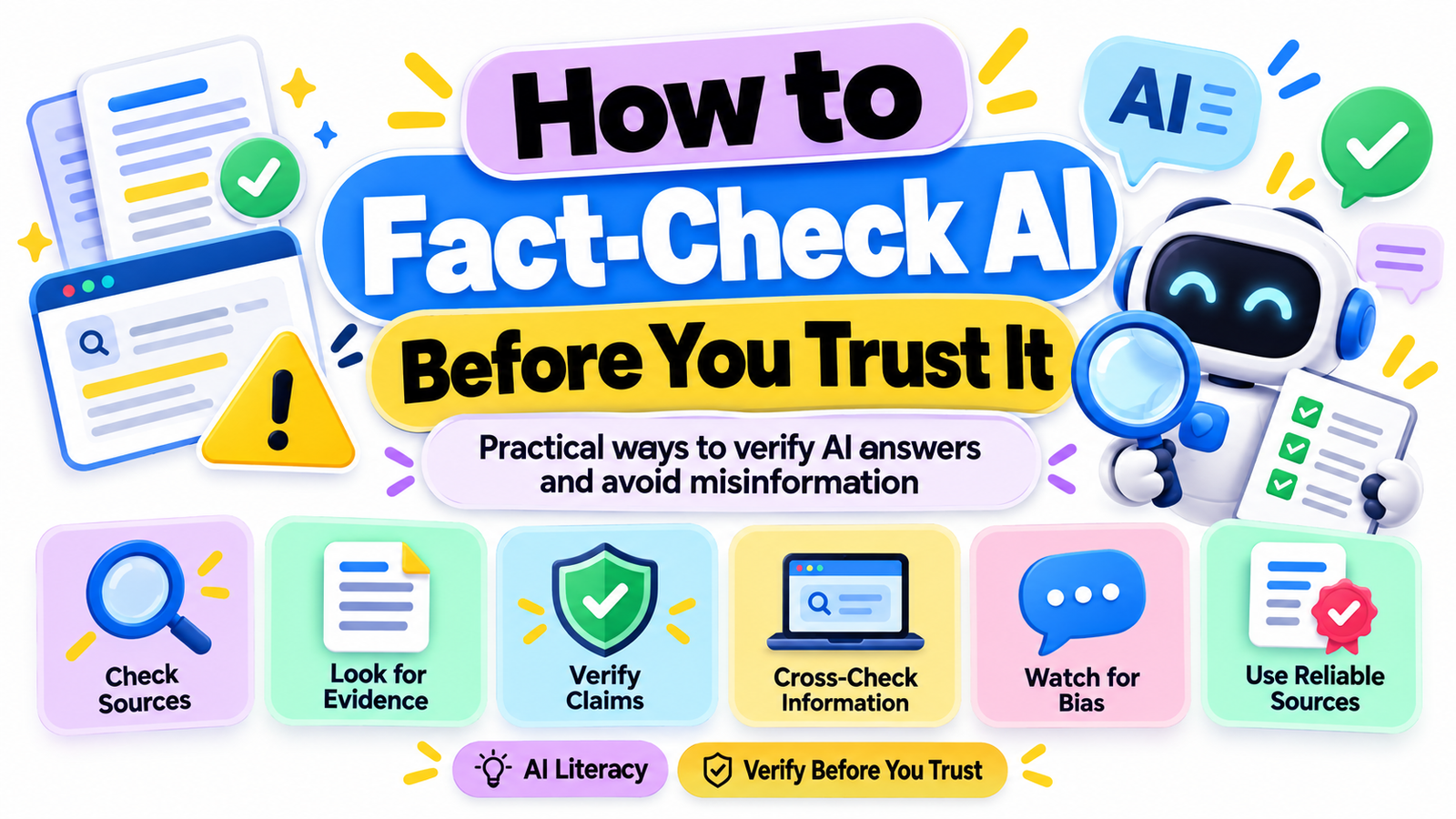
How to Fact-Check AI Before You Trust It: A Practical Guide to Verifying AI Answers
Artificial intelligence can explain a difficult concept in seconds, summarize a long document, suggest a business strategy, help plan a trip, draft an email, analyze data, or answer questions that once required hours of research.
That convenience creates a new problem.
An AI answer can sound confident, detailed, logical, and professional while still containing information that is incomplete, outdated, misleading, or simply wrong.
The most important AI skill, therefore, is no longer just knowing how to ask a good question.
It is knowing how to fact-check AI before you trust it.
As AI becomes part of search, education, business, healthcare, finance, content creation, customer service, and everyday decision-making, practical AI literacy is becoming an essential digital skill.
You do not need to become a professional fact-checker. You need a repeatable method for separating useful AI assistance from information that deserves verification.
Why AI Answers Can Sound Right Even When They Are Wrong
Generative AI systems are extremely good at producing fluent language. Fluency, however, is not the same thing as factual accuracy.
An AI system may produce an incorrect answer because it misunderstands the question, lacks current information, combines unrelated facts, makes an incorrect inference, or generates details that appear plausible based on patterns in its training.
This phenomenon is often called an AI hallucination or confabulation.
The dangerous part is not always that the mistake looks ridiculous. Many errors are convincing.
An AI might give you the right company but the wrong CEO, the correct court case with an invented quotation, a legitimate research paper with the wrong conclusion, or a believable statistic that cannot be traced to any real source.
That means confidence is not evidence.
A polished answer should be treated as a starting point for investigation when accuracy matters.
AI Fact Checking Starts With One Question: Does This Claim Matter?
Not every AI response needs the same level of verification.
If you ask AI for ten birthday party themes, you probably do not need to independently verify every suggestion.
If you ask which medication interacts with another drug, how much tax you owe, whether an investment is safe, what a law requires, or whether a breaking-news report is true, the verification standard should be dramatically higher.
A useful habit is to ask:
What would happen if this answer were wrong?
If the consequences are small, a quick check may be enough.
If the consequences involve health, money, legal rights, employment, safety, reputation, academic work, or an important business decision, verify the information using authoritative sources before acting.
This simple risk-based approach makes AI fact checking practical instead of exhausting.
The 7-Step Method to Verify AI Answers
Use this process whenever an AI-generated answer contains factual claims you intend to rely on.
- Identify the actual claims. Separate opinions, suggestions, and factual statements. Statements involving names, dates, statistics, studies, prices, regulations, technical specifications, historical events, quotations, medical guidance, or current events deserve particular attention.
- Ask where the information comes from. Request the original source, author, organization, publication date, report title, dataset, regulation, or research paper. But never assume a citation is genuine merely because AI produced one.
- Open the original source yourself. Do not rely only on an AI-generated summary of a source. Confirm that the page, study, document, or report actually exists and says what the AI claims it says.
- Check the date. Information can be accurate and still be outdated. This matters especially for laws, software, prices, company leadership, government policies, travel rules, scientific research, product specifications, and breaking news.
- Cross-check important claims. Look for independent confirmation from another reliable source. Two websites repeating the same unsourced claim are not necessarily two independent confirmations.
- Check the context. Statistics, quotations, and research findings can become misleading when removed from their original context. Read enough of the original material to understand what was actually measured, said, or concluded.
- Increase verification as risk increases. For high-stakes decisions, AI should support your research—not replace qualified professional advice or primary authoritative information.
CTA: Bookmark this seven-step process. The next time an AI answer influences a purchase, business decision, article, assignment, investment, or important personal choice, run through it before taking action.
Never Trust a Citation Just Because It Looks Academic
One of the easiest AI mistakes to overlook is a fabricated citation.
An AI-generated reference can contain everything that makes an academic source look legitimate: author names, a sophisticated title, journal name, volume number, publication year, and even a convincing-looking identifier.
That still does not prove the source exists.
When AI provides research citations, search for the actual paper using the title, author, journal, DOI, academic database, publisher website, or institutional repository.
Then verify something even more important:
Does the research actually support the claim?
A real paper can still be misrepresented.
For example, a study might report an association while the AI describes it as proof of cause and effect. Research conducted on a small group might be generalized to an entire population. Preliminary findings might be presented as established scientific consensus.
Finding the source is only half of fact-checking.
Understanding what the source actually says is the other half.
Primary Sources Should Beat AI Summaries
When reliable primary information is available, go to it.
If you are checking a law, look for the legislation, government publication, regulator, court document, or official guidance.
If you are verifying company information, look at the company’s official disclosures, regulatory filings, investor relations materials, or verified announcement.
For scientific claims, look for the research paper, recognized scientific organization, academic institution, systematic review, or reputable medical authority.
For product specifications, use the manufacturer’s official documentation.
For statistics, find the original dataset or organization that collected the data.
For current events, compare reputable reporting with official statements and direct evidence when available.
AI can help you understand these sources, but it should not automatically outrank them.
Watch for the “Citation Loop”
A modern misinformation problem occurs when low-quality information gets repeated until it appears authoritative.
Imagine that one website publishes an incorrect claim. Other websites repeat it. Social posts quote those websites. AI systems then encounter variations of the same claim and may reproduce it.
A user asks AI for confirmation and receives the claim again.
Now the user sees repetition and assumes there must be strong evidence behind it.
But ten repetitions of one unsupported claim do not create ten independent pieces of evidence.
When verifying AI-generated information, trace important claims as close as possible to their original source.
Ask:
Where did this information begin?
Who collected the evidence?
Can the original document be found?
Are multiple independent organizations confirming it, or is everyone repeating the same source?
This habit protects you from both traditional misinformation and AI-amplified misinformation.
Verify Numbers Separately From the Explanation
Numbers deserve special attention because they make an answer feel precise.
AI may correctly explain an overall topic while producing an incorrect percentage, date, financial figure, population estimate, survey result, conversion, ranking, or probability.
Treat numerical claims as individual facts.
If an AI says, for example, that a market grew by 38%, do not verify only that the market is growing. Find the original dataset and verify the 38% figure, the measurement period, the geography, the currency if relevant, and what exactly was being measured.
A statistic without context may technically be correct while creating a false impression.
Good AI fact checking asks not only:
Is this number real?
It also asks:
What does this number actually represent?
Check Quotations Word for Word
AI-generated quotations deserve extremely careful verification.
Never publish a quotation attributed to a real person solely because an AI tool supplied it.
Search for the original speech, interview, transcript, book, article, video, court record, research paper, or official statement.
If you cannot locate the original quotation, convert it into a clearly labeled paraphrase only if the underlying idea itself can be verified.
Otherwise, remove it.
Publishing an invented quote can damage credibility far more quickly than an ordinary factual mistake.
Be Especially Careful With Breaking News
Breaking news creates ideal conditions for AI misinformation.
Facts may be incomplete. Early reports can conflict. Images may circulate without context. Old videos can be reposted as new events. Fake screenshots can spread rapidly. AI-generated images, audio, and video can make verification even harder.
When something major appears to be happening, avoid depending on a single screenshot, social account, AI answer, or viral video.
Check the publication time, location, original uploader, established news organizations, official authorities, and whether credible independent sources are reporting the same event.
Also distinguish between three very different statements:
“This has been reported.”
“This has been confirmed.”
“We currently do not know.”
Responsible information sometimes includes uncertainty.
Images and Videos Require Their Own Verification Process
AI misinformation is not limited to text.
Synthetic photographs, manipulated videos, cloned voices, altered screenshots, and deepfakes can be highly convincing.
Do not assume unusual lighting, strange fingers, blurry text, or facial imperfections will always expose AI-generated media. Generation technology improves quickly, and authentic photographs can also contain visual anomalies.
Instead, investigate provenance.
Search for earlier versions of the image. Look for the original uploader. Compare it with reporting from the claimed event. Examine whether the location, weather, clothing, signage, shadows, time of day, and surrounding details are consistent with the story attached to the image.
For a video, search for longer or earlier versions rather than relying on a short viral clip.
Context can reveal manipulation even when the pixels cannot.
Do Not Treat AI Detectors as Lie Detectors
AI-content detectors can sometimes provide useful signals, but they should not be treated as definitive proof that text, an image, or another piece of content was generated by artificial intelligence.
Detection is an evolving technical challenge.
A detector can produce false positives and false negatives. Human-edited AI text may be difficult to identify, while unusual human writing can sometimes be incorrectly flagged.
The safer question is not simply:
“Was this generated by AI?”
Ask:
“Can the factual claims be independently verified?”
Authenticity and accuracy are related issues, but they are not the same issue.
A human can write misinformation.
AI can generate an accurate sentence.
Evidence matters more than guessing who—or what—wrote it.
Ask AI to Challenge Its Own Answer
AI can occasionally help you identify weaknesses in an answer if you prompt it critically.
After receiving an important response, try asking questions such as:
“What parts of this answer are most uncertain?”
“Which claims require independent verification?”
“What assumptions did you make?”
“What information could be outdated?”
“What credible evidence would contradict this conclusion?”
“Separate confirmed facts from estimates and interpretations.”
These prompts can improve your research workflow.
But remember the central rule: an AI checking another AI-generated statement is not independent verification.
Use the model to identify what needs checking. Use external evidence to perform the check.
Separate Facts From Predictions
AI frequently mixes established facts with predictions without making the difference obvious.
Consider these statements:
“Artificial intelligence is being adopted by businesses.”
“Artificial intelligence will eliminate 40% of jobs in this industry.”
The first may be supported by observed data.
The second is a forecast requiring assumptions.
Predictions about careers, technology adoption, markets, elections, business growth, consumer behavior, investment performance, and future product releases should be clearly identified as forecasts rather than facts.
Whenever AI tells you what “will” happen, ask:
Who made this prediction?
What data was used?
What assumptions drive it?
Is there a confidence range?
Do credible experts disagree?
Forecasts can be useful. They should not be disguised as certainty.
Beware of Answers That Agree Too Easily
AI often tries to respond helpfully to the framing of a user’s question.
That can create a subtle verification problem.
If you ask, “Why is Product X the best investment?” the AI may accept the assumption that it is the best investment and produce supporting reasons.
A better prompt would be:
“Evaluate the evidence for and against investing in Product X. Identify risks, uncertain assumptions, and information I should independently verify.”
The same principle applies to health, politics, business, education, technology, and personal decisions.
Do not ask only for evidence supporting what you already believe.
Ask AI to find reasons you may be wrong.
Use the Two-Source Rule for Important Claims
For ordinary research, a useful minimum is to confirm an important factual claim through at least two credible, independent sources.
Independence matters.
A news article quoting a government report and a blog quoting that news article may ultimately represent only one source.
Whenever possible, combine different types of evidence.
You might compare an official document with reputable journalism, a research paper with a systematic review, or company filings with independent industry analysis.
The higher the stakes, the stronger the evidence should become.
Recognize the Red Flags of an Unreliable AI Answer
Certain patterns should trigger additional verification.
Be cautious when an answer provides extremely precise statistics without clear sourcing, confidently describes very recent events, cites obscure studies that are difficult to locate, attributes dramatic quotations to famous people, gives legal or medical conclusions without qualification, claims something is “guaranteed,” presents disputed issues as universally settled, or provides links and citations that you have not opened yourself.
Another warning sign is unnecessary certainty.
Real knowledge often contains boundaries.
A trustworthy explanation may acknowledge missing data, conflicting evidence, changing conditions, or limitations in what can currently be known.
Confidence without evidence is not expertise.
AI Misinformation Can Be Accidental or Deliberate
Not every inaccurate AI output is intentionally deceptive.
Sometimes a model simply generates an incorrect answer.
But AI can also be used deliberately to produce fake reviews, fraudulent documents, impersonation messages, misleading political content, manipulated photographs, fake celebrity endorsements, fabricated news stories, phishing messages, cloned voices, or deepfake videos.
This makes AI misinformation awareness a cybersecurity and media-literacy issue as well as an information-quality issue.
If a message creates urgency, demands payment, asks for passwords or verification codes, impersonates someone you know, or pressures you to act before checking independently, stop and verify through another communication channel.
Never use contact information supplied inside a suspicious message to perform that verification.
Find the organization’s legitimate contact details independently.
A 60-Second AI Verification Routine
When you do not have time for deep research, use this quick test.
Ask yourself:
Source: Can I identify where this claim came from?
Date: Could the information have changed?
Evidence: Is there a real document, dataset, study, or authoritative record behind it?
Confirmation: Can another independent, credible source verify it?
Context: Is anything important being omitted?
Risk: What happens if this information is wrong?
If several of those questions cannot be answered, treat the claim as unverified.
That does not automatically mean it is false.
It means you do not yet have enough evidence to trust it.
How Writers and Content Creators Should Fact-Check AI
AI can dramatically accelerate research and drafting, but publishers have an additional responsibility because mistakes may be amplified to hundreds or thousands of readers.
Before publishing AI-assisted content, verify names, dates, quotations, numerical claims, studies, laws, product specifications, statistics, historical details, current officeholders, company information, and any factual statement central to the article’s argument.
Whenever possible, link readers to original authoritative material.
Also distinguish clearly between evidence, interpretation, and opinion.
This approach does more than reduce mistakes.
It builds trust.
Readers are increasingly surrounded by inexpensive, rapidly produced content. Reliable research and transparent sourcing can become a meaningful competitive advantage.
CTA: If you create AI-assisted articles, add a “verification pass” to your publishing workflow before proofreading. Grammar checks whether your sentence sounds correct. Verification checks whether the sentence is true.
How Businesses Should Verify AI-Generated Work
The same principles apply inside organizations.
An employee might use AI to prepare a market analysis, summarize a regulation, evaluate a supplier, draft a proposal, research a competitor, or generate a client presentation.
If nobody verifies the underlying facts, AI can make a business produce incorrect information faster.
Organizations should therefore define which AI outputs require human review.
Routine brainstorming may require little oversight.
Financial projections, compliance information, contracts, customer-facing claims, safety procedures, research reports, and executive decisions should require stronger verification.
The goal is not to eliminate AI.
It is to create a system where AI speed and human judgment work together.
AI Literacy Is Becoming a Core Digital Skill
For years, digital literacy meant knowing how to search the internet and judge whether a website looked trustworthy.
That standard is no longer enough.
Modern AI literacy includes knowing how generative systems work at a basic level, recognizing that fluent language does not guarantee truth, tracing claims back to evidence, distinguishing fact from interpretation, identifying manipulated media, understanding uncertainty, and knowing when expert review is required.
The people who benefit most from AI will not necessarily be those who believe it most.
They may be the people who know when to use it, when to question it, and when to verify it.
Trust AI as an Assistant, Not as Evidence
AI can be extraordinarily useful.
It can help you discover questions you had not considered, translate technical information, compare viewpoints, organize research, summarize documents, generate hypotheses, and explain unfamiliar subjects.
But usefulness and authority are different things.
An AI response is not automatically evidence simply because it is detailed.
The healthiest relationship with AI is neither blind trust nor automatic distrust.
It is calibrated trust.
Use AI quickly when the stakes are low.
Verify carefully when the stakes rise.
Ask for sources.
Open those sources.
Check dates.
Trace statistics.
Confirm quotations.
Compare independent evidence.
And when the consequences matter, consult the appropriate primary source or qualified professional.
That is how AI becomes more valuable—not by trusting everything it says, but by learning exactly when trust has been earned.
Frequently Asked Questions
1. How can I fact-check an AI answer?
Start by identifying the factual claims in the answer. Ask for sources, locate the original material yourself, check publication dates, verify quotations and statistics, and compare important claims with independent authoritative sources. For high-stakes topics such as health, finance, law, or safety, obtain appropriate professional or official guidance before acting.
2. Can AI give false information confidently?
Yes. Generative AI can produce incorrect or fabricated information in fluent and convincing language. A confident tone should never be treated as proof of accuracy. The reliability of an answer depends on the evidence supporting it, not how professionally it is written.
3. Can I trust sources and citations provided by AI?
You should verify them. AI systems can provide real citations, misdescribe legitimate sources, or generate references that do not exist. Search for the original source and confirm that it genuinely supports the claim being made.
4. Are AI detection tools reliable enough to identify misinformation?
AI detectors can provide signals, but they should not be treated as definitive evidence. Determining whether something was AI-generated is different from determining whether it is true. The stronger method is to verify factual claims using original documents, credible sources, context, and independent confirmation.
5. What kinds of AI answers should always be checked?
Verify AI output especially carefully when it affects health, medicine, money, investments, taxes, legal rights, safety, employment, academic work, major purchases, business decisions, breaking news, or someone’s reputation. The greater the potential harm from an incorrect answer, the higher your verification standard should be.
Make Verification Your Default AI Habit
AI has lowered the cost of creating information.
It has not lowered the cost of being wrong.
As synthetic text, images, audio, and video become increasingly convincing, the ability to verify information may become more valuable than the ability to consume it quickly.
Before accepting an AI-generated claim, develop one simple reflex:
Where is the evidence?
That question can prevent misinformation from becoming a decision, a purchase, a published article, a financial loss, or a belief you later discover was built on something that never happened.
Use AI to accelerate your thinking.
Use evidence to decide what deserves your trust.
Stay ahead with exclusive updates
Join our community. Get curated industry trends, actionable guides, and fresh resources delivered straight to your inbox.