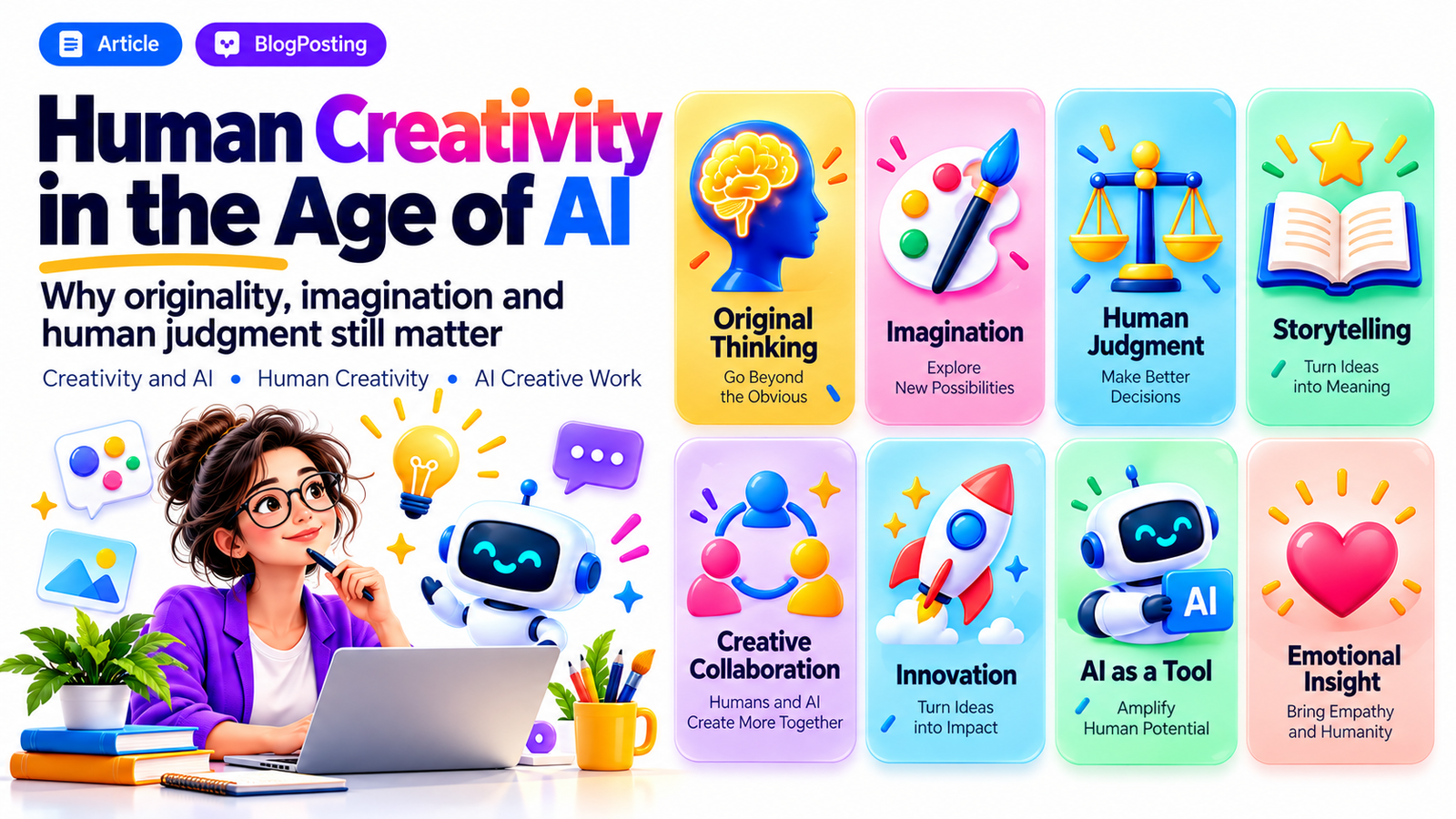
Human Creativity in the Age of AI: Why Original Thinking Matters More Than Ever
Artificial intelligence can write a headline in seconds, generate an illustration from a sentence, compose music, create videos, brainstorm business ideas and transform rough notes into polished presentations.
That extraordinary speed has created an uncomfortable question for writers, designers, marketers, musicians, entrepreneurs and almost anyone whose work depends on ideas:
If AI can create, what happens to human creativity?
The answer is more encouraging than it first appears.
AI is becoming remarkably capable at generating creative material, but creativity has never been only about producing words, pictures or ideas quickly. Human creativity involves curiosity, taste, emotion, lived experience, judgment, risk, cultural understanding and the ability to decide that something is worth saying in the first place.
The future of creativity and AI therefore may not become a competition between humans and machines. It is more likely to become a test of how effectively humans can use powerful technology without allowing convenience to replace imagination.
And that distinction matters.
As AI-generated content becomes easier to produce, genuinely thoughtful work may become more valuable, not less.
What Does Human Creativity Mean in an AI-Driven World?
Human creativity is the ability to combine knowledge, experience, imagination and emotion in ways that produce something meaningful, useful or original.
A person does not create from an empty database.
We create from memories.
From disappointment.
From conversations.
From childhood experiences.
From places we have visited.
From mistakes we have made.
From people we have loved.
From questions that refuse to leave us alone.
Two writers can receive exactly the same assignment and produce completely different stories because each person brings a different life to the page.
That difference is difficult to reduce to a prompt.
Artificial intelligence can analyze enormous amounts of existing information and generate sophisticated combinations of patterns. Humans add another dimension: personal meaning.
This is why the conversation about AI creative work should not focus only on whether AI can produce something attractive.
The more important question is whether the work has a reason to exist.
AI Is Changing the Economics of Creativity
For most of history, producing professional-looking creative work required substantial time, technical skill or money.
AI is dramatically lowering those barriers.
A small business owner can now create marketing concepts without a large agency.
A teacher can generate visual learning materials.
A writer can explore dozens of headlines before breakfast.
A startup founder can prototype branding ideas without hiring an entire creative department.
A video creator can turn a script into multiple content formats.
This democratization of creative capability is significant.
But when everyone gains access to similar tools, access itself stops being a competitive advantage.
Knowing how to generate an image will become less distinctive when millions of people can generate images.
Knowing how to ask AI for a blog post becomes less valuable when every competitor can do the same thing.
The scarce resource shifts.
Instead of production capability, the advantage increasingly becomes judgment.
Which idea is worth developing?
Which one should be rejected?
What perspective has not been explored?
What does the audience actually care about?
What feels emotionally true?
What is appropriate for this moment?
What should never be automated?
Those questions move creativity back toward the human being.
The Great Creative Paradox of AI
AI gives people more creative possibilities while simultaneously creating the risk of greater sameness.
Imagine thousands of marketers asking similar AI systems:
“Give me 20 social media ideas.”
“Write an engaging introduction.”
“Create a professional logo concept.”
“Generate viral video hooks.”
“Write an inspirational LinkedIn post.”
The output may be technically competent.
But competence is not automatically originality.
When creators accept the first reasonable AI output, the internet can begin filling with similar phrases, similar structures, similar designs and similar ideas.
Everything becomes polished.
Everything also starts feeling strangely familiar.
This creates one of the most important opportunities in the age of generative AI:
Originality becomes easier to notice when generic content becomes abundant.
A distinctive voice stands out.
A genuine experience stands out.
Unexpected research stands out.
A strong opinion supported by evidence stands out.
A personal illustration stands out.
A surprising observation stands out.
AI may increase the quantity of creative material. Humans still determine whether that material deserves attention.
AI Can Generate Options. Humans Provide Direction.
One useful way to understand the relationship between human creativity and artificial intelligence is to separate generation from direction.
AI is extremely useful for generating possibilities.
A novelist might ask for alternative settings.
A designer might explore visual directions.
A marketer might generate campaign angles.
A filmmaker might brainstorm scenes.
An entrepreneur might test product positioning.
But somebody still has to decide what the project is trying to achieve.
Consider a photographer creating a campaign about loneliness in modern cities.
An AI system might suggest locations, compositions, color palettes and captions.
But why loneliness?
Why this city?
Why now?
Whose experience is being represented?
What emotion should the viewer feel?
Which photograph communicates the idea without exploiting the subject?
Those questions involve intention and judgment.
Technology can participate in the creative process without owning the creative purpose.
The Most Valuable Creative Skill May Become Taste
For decades, creative education concentrated heavily on production skills.
Writers learned grammar and storytelling.
Designers learned typography and composition.
Filmmakers learned cameras and editing.
Musicians learned instruments and production.
Those skills remain valuable.
But generative AI introduces another increasingly important capability: creative taste.
Taste is the ability to recognize quality.
It is knowing when a paragraph technically works but feels lifeless.
It is recognizing when a design is beautiful but inappropriate.
It is understanding when a campaign is clever but inconsistent with the brand.
It is knowing when an AI-generated idea resembles everything else in the market.
AI can produce twenty versions.
Taste helps you identify version twenty-one—the version that does not exist yet.
People with strong taste can use AI as an amplifier rather than allowing the technology to become the creative director.
Human Experience Is Becoming Creative Currency
One of the simplest ways to create work that cannot easily be commoditized is to use what genuinely belongs to you.
Your experience.
Suppose two entrepreneurs write articles about launching their first businesses.
One article contains generalized advice:
“Know your audience.”
“Build a strong brand.”
“Use social media.”
“Provide good customer service.”
All sensible advice.
The second entrepreneur explains how the company’s first product failed, why customers rejected it, what three interviews revealed and how changing one assumption eventually produced the first profitable version.
Which article would you remember?
Probably the second.
AI can summarize entrepreneurship.
It did not experience that particular failure.
This principle applies across creative industries.
A travel writer can include firsthand observations.
A teacher can share classroom lessons.
A designer can document how a project evolved.
A creator can reveal why an experiment failed.
A business owner can explain what customers actually asked.
A photographer can describe the moment behind an image.
These details turn information into experience.
And experience gives creative work identity.
AI Should Expand the Creative Process, Not Replace It
The most productive relationship between AI and creativity is not:
Human gives prompt → AI creates finished product → human publishes it.
A stronger process looks different.
The human identifies a meaningful problem.
AI helps explore possibilities.
The human evaluates those possibilities.
AI helps develop selected directions.
The human adds expertise, experience and original material.
AI helps edit, organize or transform the work.
The human verifies accuracy, tone and purpose.
The human decides what deserves publication.
In this model, AI becomes part of the creative studio rather than the owner of it.
The difference may sound subtle, but it changes the quality of the work dramatically.
Use AI for Breadth and Humans for Depth
AI is particularly powerful when you need breadth.
It can quickly generate alternative approaches, titles, questions, frameworks, examples or formats.
Humans are especially valuable when depth is required.
Instead of asking AI to write everything, creators can divide responsibilities intelligently.
One practical framework is:
- Discover — Use human curiosity to define the interesting problem.
- Explore — Use AI to expand the range of possibilities.
- Select — Apply human judgment to choose the strongest direction.
- Develop — Combine AI assistance with research and expertise.
- Humanize — Add experience, stories, observations and personality.
- Verify — Check claims, sources, context and accuracy.
- Refine — Remove anything generic, unnecessary or predictable.
- Publish — Take responsibility for the finished work.
The objective is not to prove that humans can work without AI.
It is to ensure that AI does not remove the thinking that makes creative work valuable.
Why Prompting Alone Will Not Be a Lasting Competitive Advantage
Prompt engineering is useful.
Knowing how to describe an outcome clearly can dramatically improve AI-generated results.
But prompts themselves are becoming easier.
AI systems can already help users write better prompts. Interfaces are becoming more conversational. Tools increasingly understand images, documents, audio and context without highly technical instructions.
That means the durable advantage is unlikely to be knowing a collection of secret prompt formulas.
The deeper advantage will come from knowing what to ask, why to ask it and what to do with the answer.
A brilliant prompt cannot rescue an uninteresting idea.
A sophisticated AI workflow cannot replace weak judgment.
And generating more content does not guarantee that anyone wants to consume it.
Creative professionals should therefore develop prompting alongside research, storytelling, critical thinking, audience understanding, communication and domain expertise.
Creativity Is Also the Courage to Reject
People often imagine creativity as generating ideas.
But creative professionals spend enormous amounts of time rejecting ideas.
A novelist deletes scenes.
A designer discards concepts.
A photographer rejects hundreds of photographs.
A songwriter removes lyrics.
An entrepreneur abandons product features.
An editor cuts paragraphs that took hours to write.
AI makes generation cheap.
That makes rejection even more important.
The creator who keeps everything AI produces will usually create weaker work than the creator who knows what to remove.
In the AI era, creative excellence may increasingly depend on disciplined subtraction.
Ask:
Does this sentence say something meaningful?
Does this image strengthen the idea?
Is this example genuinely useful?
Would I still publish this if competitors were not publishing similar content?
Does this sound like me—or like generic internet language?
These questions protect originality.
The Difference Between Personalization and Personality
AI makes personalization easier.
A company can create different messages for different customer segments. A learning platform can adapt explanations. A marketing system can create hundreds of content variations.
But personalization should not be confused with personality.
Personalization means adapting something for an individual.
Personality means having a recognizable point of view.
The strongest brands, writers and creators often possess recognizable characteristics.
You know what they care about.
You understand how they communicate.
You recognize their visual language.
You can predict some of their principles without predicting every sentence.
That consistency creates trust.
AI can help maintain a style guide, but humans must determine what the style stands for.
AI Can Make Beginners More Capable
There is another side of the creativity debate that deserves attention.
AI is not only challenging professional creators.
It is helping millions of people become creative who previously felt excluded from creative work.
Someone who struggles with drawing can visualize an idea.
Someone writing in a second language can communicate more confidently.
A small nonprofit can produce better educational materials.
A teenager can prototype an app concept.
An independent author can brainstorm cover directions.
A local business can create marketing materials previously beyond its budget.
This expansion of participation is valuable.
Creativity should not belong only to people who can afford expensive software, professional agencies or years of specialized training.
The important distinction is between using AI to unlock expression and using AI to avoid thinking.
The first can expand human creativity.
The second can slowly weaken it.
The Danger of Creative Dependence
Convenience changes behavior.
When calculators became widespread, people used less mental arithmetic.
When GPS became normal, many people stopped memorizing routes.
Generative AI could produce a similar effect on creative thinking if it is used automatically.
If every difficult paragraph immediately goes to AI, writers may spend less time learning how to solve difficult paragraphs.
If every blank page triggers a chatbot request, creators may become uncomfortable with uncertainty.
But uncertainty is often where creativity begins.
The mind searches.
It connects unexpected memories.
It explores strange possibilities.
It makes mistakes.
Some of the best ideas arrive after the obvious ideas have been exhausted.
Creators therefore need moments where AI is deliberately absent.
Sketch before prompting.
Write ten headlines yourself.
Brainstorm alone for fifteen minutes.
Read outside your field.
Observe customers directly.
Walk without headphones.
Keep an idea notebook.
Allow boredom.
Creativity needs inputs that are not generated by the same systems everyone else is using.
Human Creativity Will Matter More in Business
The commercial implications are significant.
As businesses gain access to increasingly similar AI capabilities, technology alone cannot permanently differentiate them.
Imagine ten competing companies using comparable AI platforms for advertising, research, customer communication and content creation.
Where does competitive advantage come from?
It comes from choices.
Brand positioning.
Customer understanding.
Product insight.
Storytelling.
Design decisions.
Company culture.
Risk tolerance.
Leadership.
Ideas competitors did not recognize.
In other words, many sources of differentiation remain deeply connected to human creativity.
Companies that treat AI purely as a tool for producing more content may create greater volume.
Companies that combine AI with original thinking may create greater value.
Creativity Is Moving Up the Value Chain
When technology automates part of a creative job, the value of the job often moves toward higher-level decisions.
A graphic designer may spend less time creating routine variations and more time developing visual systems.
A marketer may spend less time producing first drafts and more time understanding customers.
A filmmaker may prototype scenes quickly and dedicate more energy to narrative decisions.
A writer may automate transcription and research organization while spending additional time developing arguments.
A product designer may test more concepts before committing resources.
This does not mean disruption will be painless.
Some tasks will become less valuable.
Some roles will change.
Some workflows will require fewer people.
But creative workers can respond by moving beyond execution toward strategy, interpretation, direction and ownership.
The New Creative Professional Is Part Maker, Part Editor
In traditional creative workflows, making was often the expensive stage.
AI changes that equation.
Generating material becomes cheaper.
Evaluating material becomes more valuable.
Tomorrow’s successful creative professional may therefore operate partly as a maker and partly as an editor.
They will ask better questions.
Recognize stronger ideas.
Combine unexpected concepts.
Verify information.
Protect brand identity.
Understand context.
Notice ethical concerns.
Improve weak outputs.
And know when the machine’s suggestion should simply be ignored.
Editing is not a secondary creative act.
Choosing what survives is itself creativity.
Authenticity Will Become More Important, Not Less
As synthetic media becomes increasingly common, audiences may pay greater attention to signs of authenticity.
That does not necessarily mean rejecting AI.
It means understanding where the human contribution exists.
A creator might openly explain that AI helped organize research while the analysis comes from personal expertise.
A designer might use generative tools during ideation while building the finished identity manually.
A filmmaker might use AI for previsualization while relying on human actors and direction for the emotional core.
A business might automate routine content while reserving major brand stories for deeper human involvement.
Trust grows when technology supports the message rather than pretending to be the source of experiences it never had.
How Creators Can Stay Original While Using AI
The goal is not to make every piece of work completely untouched by technology.
That standard would be increasingly unrealistic.
Instead, protect the elements that make your work difficult to substitute.
Develop a point of view.
Collect your own observations.
Interview real people.
Create original examples.
Build expertise in a specific subject.
Experiment before searching for answers.
Study work outside your industry.
Keep unfinished ideas.
Develop visual and verbal preferences.
Question fashionable assumptions.
And most importantly, stop asking AI only to provide answers.
Use it to help you discover better questions.
Instead of:
“Write an article about creativity.”
Try exploring:
“What assumptions about creativity are changing because creative production is becoming nearly free?”
Instead of:
“Give me marketing ideas.”
Investigate:
“What frustrations do customers repeatedly experience that competitors continue to ignore?”
The quality of creative work improves when the starting question improves.
What Employers Should Look for in the AI Era
Organizations may also need to reconsider how they evaluate creative talent.
Speed alone becomes less informative when AI accelerates everyone.
Future-ready creative teams need people who can think across disciplines, understand customers, challenge assumptions and recognize quality.
A candidate who can produce fifty ideas is useful.
A candidate who can recognize the three worth pursuing may be more valuable.
Businesses should therefore evaluate more than AI proficiency.
They should examine reasoning.
Why did someone choose this concept?
What alternatives were rejected?
What customer insight supports the decision?
How was AI used?
What did the person change after receiving AI output?
Those questions reveal the human contribution behind the finished result.
Creativity and AI Are Not Opposites
The debate is sometimes framed incorrectly.
Either you support human creativity or you support artificial intelligence.
Reality is far more interesting.
A photographer can use autofocus without losing artistic judgment.
A writer can use spell-check without surrendering authorship.
A musician can use digital production tools without abandoning musicianship.
AI is more powerful than these examples, but the underlying principle remains useful.
Tools change what humans can do.
They do not automatically decide what humans should do.
The challenge is maintaining agency.
When people remain responsible for the goals, values, choices and consequences of creative work, AI can become a remarkable creative partner.
When people surrender those responsibilities, automation can produce enormous quantities of material with very little meaning.
Five Questions About Human Creativity and AI
1. Will AI replace human creativity?
AI is likely to automate many creative tasks, but that is different from eliminating human creativity. Generative AI can produce text, images, audio, video and ideas quickly, while humans continue to contribute intention, lived experience, judgment, cultural understanding, emotional context and responsibility. The strongest future workflows are likely to combine AI capability with human direction.
2. How can humans stay creative when using AI?
Use AI after developing some of your own thinking rather than automatically making it the starting point. Add firsthand experiences, original research, personal observations, customer conversations and distinctive opinions. Treat AI output as material to evaluate and transform rather than something that must be accepted.
3. What creative skills will become more valuable because of AI?
Creative judgment, storytelling, critical thinking, research, audience understanding, strategic thinking, taste, communication and domain expertise are likely to become increasingly important. As generating content becomes easier, knowing which ideas deserve development becomes more valuable.
4. Can AI-generated creative work be original?
AI can generate novel combinations and unexpected outputs, but meaningful originality involves more than statistical novelty. Creators can increase originality by combining AI-assisted exploration with unique experiences, proprietary information, firsthand observations, strong artistic direction and thoughtful human editing.
5. Is AI good or bad for creative professionals?
It can be either, depending on how it is used. AI can accelerate repetitive tasks, expand experimentation and make sophisticated creative tools accessible to more people. However, excessive dependence can encourage generic output and reduce opportunities to practice creative problem-solving. The strongest approach is to use AI where it increases capability while protecting the human thinking that creates differentiation.
Protect What Makes Your Work Human
Artificial intelligence will continue getting faster.
Creative software will become easier.
Content production will become cheaper.
And astonishing capabilities that seem advanced today may soon feel ordinary.
Human creators should not respond by trying to beat machines at speed.
That is probably the wrong competition.
Compete through insight.
Compete through curiosity.
Compete through expertise.
Compete through emotional intelligence.
Compete through storytelling.
Compete through observation.
Compete through taste.
Compete through the willingness to create something that does not resemble the average of everything that came before it.
AI can help generate possibilities.
Humans still choose what deserves to become real.
That may be the most important creative advantage of all.
Take the Next Step
The next time you use an AI creative tool, do not simply ask, “What can AI create for me?”
Ask:
“What can I create with AI that still carries something unmistakably human?”
That small change in perspective can turn artificial intelligence from a shortcut into a creative multiplier.
The future does not have to be AI versus human creativity.
The more powerful possibility is human creativity amplified by AI—without surrendering originality, judgment or purpose.
Stay ahead with exclusive updates
Join our community. Get curated industry trends, actionable guides, and fresh resources delivered straight to your inbox.