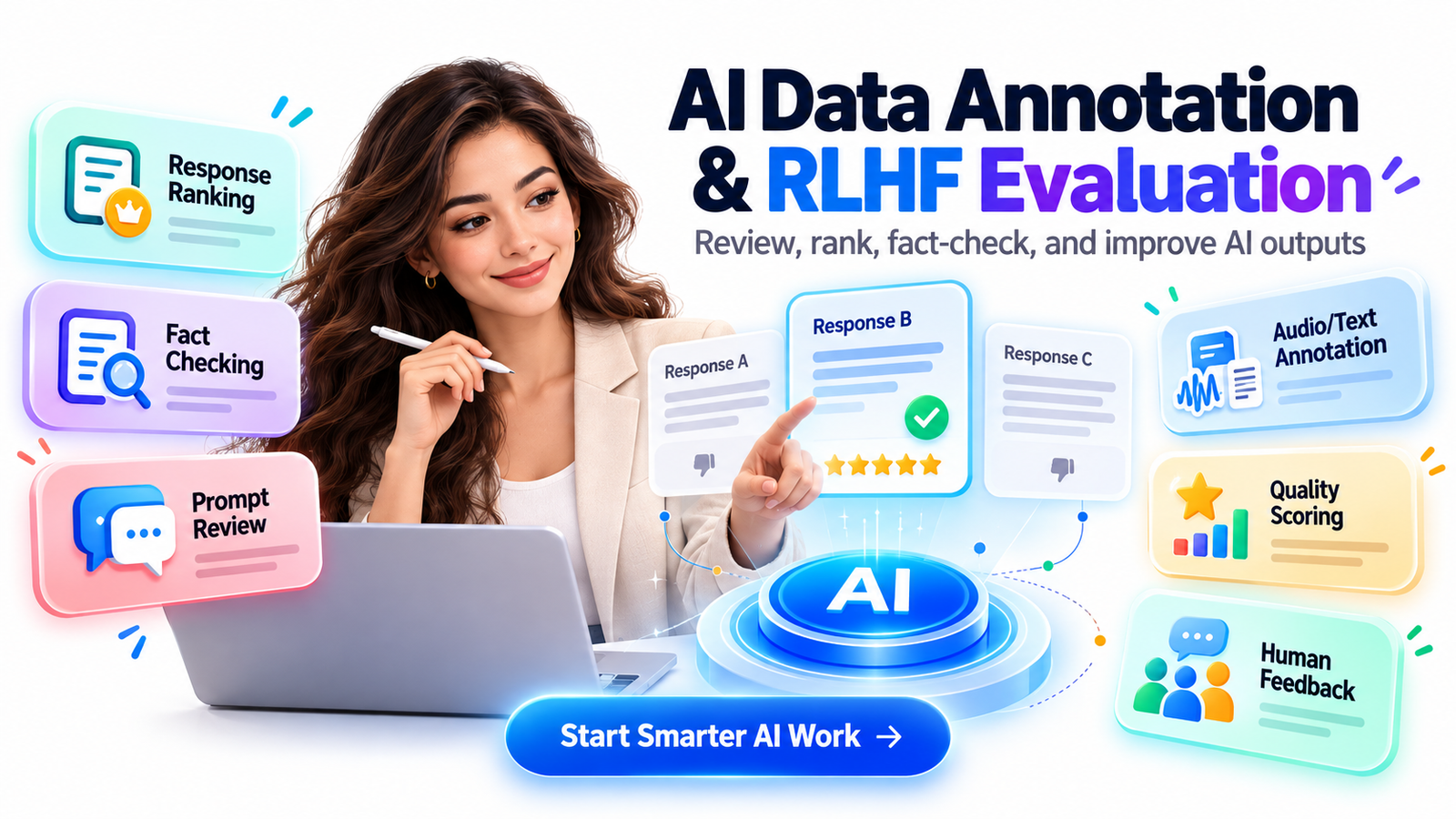
How to Get Paid to Help Train AI in 2026
AI is becoming better at writing, coding, reasoning, translation, research, image understanding, and conversation. But behind many of those improvements is something surprisingly human: people reviewing what AI produces and deciding whether it is accurate, useful, safe, relevant, and well written.
That has created a growing category of flexible online work commonly described as AI data annotation, AI training, RLHF evaluation, human feedback, AI response evaluation, fact-checking, prompt evaluation, and data labeling.
Instead of building an AI model yourself, you may be asked to compare two chatbot responses, identify factual errors, judge whether instructions were followed, label text or audio, create difficult prompts, score model answers against a rubric, or explain why one response is better than another.
Platforms such as DataAnnotation.tech, Outlier.ai, and Remotasks connect eligible contributors with this type of work.
The attraction is obvious: remote access, flexible schedules, relatively low startup costs, and opportunities for people with strong language, reasoning, research, coding, mathematics, science, or specialist professional knowledge.
But there is an important distinction between a legitimate opportunity and an exaggerated side-hustle promise.
Passing an assessment does not guarantee permanent work, immediate project access, or a universal $20–$40 hourly rate. Compensation and task availability can vary substantially according to your country, language, skills, assessment performance, project type, and current client demand.
For people who understand that reality, however, remote AI evaluation work can be an interesting way to earn money while developing hands-on experience with modern AI systems.
What Is AI Data Annotation?
Data annotation traditionally meant adding labels to raw information so machine-learning systems could understand it.
A worker might identify objects in images, transcribe speech, categorize documents, label sentiment, or mark relevant sections of text.
Generative AI has expanded the job considerably.
Modern AI data annotation jobs can require sophisticated judgment rather than simple labeling. Workers may need to determine whether an answer is logically sound, whether its sources support its claims, whether it follows a complicated instruction, or whether it contains subtle factual mistakes.
A typical task could show you two answers generated by an AI system and ask:
Which response answers the user’s question more completely?
Which contains fewer factual errors?
Which follows the required format?
Which is clearer and more natural?
Which response should an AI system learn to prefer?
Your decision becomes part of the feedback used to evaluate or improve AI performance.
That is why terms such as AI evaluator, AI trainer, human feedback specialist, model evaluator, prompt evaluator, LLM evaluator, and RLHF contributor increasingly overlap.
What Is RLHF Evaluation?
RLHF stands for Reinforcement Learning from Human Feedback.
In simplified terms, AI systems can generate multiple possible responses to the same prompt. Human reviewers then evaluate those responses according to criteria such as accuracy, relevance, clarity, safety, reasoning quality, usefulness, and instruction following.
Those human preferences can become signals used during model development.
The evaluator therefore is not simply checking spelling.
You might be helping answer questions such as:
Did the model understand the request?
Did it invent information?
Did it overlook an important constraint?
Was its reasoning internally consistent?
Was one response substantially better than another?
Could the answer mislead a user?
Would a knowledgeable person consider the response useful?
Modern AI evaluation may also involve creating grading rubrics, writing ideal answers, designing challenging prompts, correcting model mistakes, evaluating code, checking mathematics, assessing translations, or reviewing domain-specific answers.
Outlier, for example, currently describes common contributor activities including writing challenging prompts, creating grading rubrics, and rating or ranking AI answers.
Why Human Review Still Matters in the AI Era
One might assume increasingly capable AI models would eliminate the need for human evaluators.
In practice, more sophisticated models can make human judgment more valuable.
An obviously incorrect answer is easy to identify. A polished answer containing one subtle factual error is much harder.
AI systems can produce confident language even when an underlying statement is wrong. They can miss nuances in instructions, misunderstand cultural context, create unsupported citations, choose an inappropriate tone, or provide reasoning that sounds persuasive but does not actually support the conclusion.
Human reviewers provide something automated evaluation does not always capture reliably: contextual judgment.
That is particularly important in areas including mathematics, programming, science, finance, law, medicine, multilingual content, creative writing, research, and culturally sensitive communication.
DataAnnotation says its projects can involve reviewing AI-generated text, ranking responses, checking facts, labeling data, refining prompts, and evaluating specialist subject matter.
What Does an AI Data Annotator Actually Do?
The work differs dramatically from one project to another.
A general language evaluator might receive a customer question followed by two AI-generated answers. The evaluator reads both, checks important claims, and determines which response better satisfies the instructions.
A fact-checking project could require researching statements and marking them accurate, inaccurate, unsupported, outdated, or unverifiable.
An AI writing project might ask you to rewrite a poor response so that it becomes clearer and more useful.
An RLHF evaluation task might require ranking several answers from strongest to weakest and writing a short justification.
An audio annotation assignment could involve reviewing speech recognition, labeling pronunciation, identifying speakers, checking transcription quality, or evaluating synthetic voice responses.
A programmer might inspect AI-generated code, locate a bug, test the solution, and explain how the code should be corrected.
A mathematics specialist might verify a multistep solution and identify the exact point at which the model’s reasoning becomes invalid.
The common denominator is judgment.
The better you are at reading instructions carefully, reasoning objectively, researching efficiently, and explaining decisions clearly, the stronger your fit may be.
Current AI Evaluation Platforms to Explore
Platform conditions change frequently, so always check the current role page before applying.
| Platform | Typical Work | Current Application/Work Notes |
|---|---|---|
| DataAnnotation.tech | AI response evaluation, fact-checking, writing, multilingual work, coding and specialist evaluation | Its FAQ says the Starter Assessment commonly takes around an hour and applicants who qualify are notified after review. General project rates are currently advertised from roughly $25–$30+ per hour on its FAQ, while newer role pages show some generalist opportunities in a broader $25–$50 range and substantially higher specialist ranges. |
| Outlier.ai | Prompt creation, ranking AI responses, factual evaluation, rubric creation, coding and language evaluation | Applicants typically create a profile, verify identity, validate skills, and then become eligible for projects. Rates vary significantly by location and project. Current India listings demonstrate why a universal $20–$40 claim is misleading: some Hindi-related work is advertised at up to $7.50/hour, while coding and specialist opportunities may differ considerably. |
| Remotasks | Data work and selected generative-AI training projects, including coding evaluation | A current India coding-expert page describes tasks such as ranking AI-generated code, writing solutions, and fixing AI-produced code, with advertised earnings of up to $33/hour depending on location and skill. |
The lesson is simple: apply based on the actual role, not a viral social-media income screenshot.
Can You Really Earn $20–$40 an Hour?
Sometimes.
But it should never be presented as an automatic beginner rate across every platform.
Current DataAnnotation materials advertise general work beginning around the mid-$20-per-hour range, with substantially higher potential rates for specialized coding, STEM, finance, legal, medical, and other expert work.
Outlier demonstrates a different compensation structure. Its opportunities state that rates vary based on expertise, location, assessment results, and individual project requirements. Some current India language opportunities advertise rates below $10/hour, while specialist opportunities can be different.
Remotasks currently advertises up to $33/hour for its India coding-expert opportunity.
Therefore, someone searching for AI data annotation jobs paying $20 an hour, RLHF jobs from home, or high-paying AI trainer jobs should understand that the strongest earning opportunities usually correlate with one or more valuable skills:
Strong written communication.
Reliable research and fact-checking.
Programming.
Mathematics or science.
Professional expertise.
Multilingual fluency.
Exceptional instruction-following.
Detailed reasoning.
The goal should not be to chase a particular headline rate.
The better strategy is to become qualified for more valuable task categories.
The Assessment Is More Important Than Your Résumé
Many traditional jobs begin with a résumé.
AI evaluation platforms frequently begin by testing whether you can actually perform the work.
DataAnnotation describes its entry assessment as performance based and says its Starter Assessment generally takes about an hour, although specialized assessments can take longer.
Outlier’s current application flow includes building a profile, confirming identity, validating skills, and becoming eligible for projects.
The biggest mistake is therefore treating the qualification assessment like a quick survey.
It is better viewed as your first work sample.
How to Approach an AI Annotation Assessment
Read the instructions twice before answering.
AI evaluation projects frequently contain detailed rubrics. Missing a small condition can turn an otherwise intelligent answer into an incorrect one.
Suppose a task asks you to select the better response based specifically on factual accuracy.
Response A may be beautifully written but contain a factual error.
Response B may sound less impressive but be factually correct.
If the rubric prioritizes factual accuracy, choosing Response A because it sounds better demonstrates poor instruction following.
The evaluator must judge according to the stated criteria rather than personal preference.
Show Your Reasoning Clearly
When a task asks why one response is better, avoid vague explanations such as:
“Response A is better because it is more accurate.”
Explain what makes it more accurate.
For example:
“Response A directly answers the question and correctly distinguishes correlation from causation. Response B incorrectly claims that the study proves causation, which is not supported by the information provided.”
The second explanation demonstrates that you identified the specific problem.
That is much more useful training data.
Fact-Check Before You Guess
If verification is allowed and you encounter an unfamiliar factual claim, research it.
Do not assume the more polished AI answer is correct.
AI evaluation rewards accuracy more than confidence.
Useful fact-checking habits include checking primary sources, identifying the date of the information, comparing multiple trustworthy references when necessary, distinguishing evidence from opinion, and watching for fabricated citations.
Fast research is useful.
Accurate research is more useful.
Grammar Matters More Than Many Applicants Expect
You do not need to write like a novelist.
You do need to communicate clearly.
Strong evaluators usually write concise explanations with logical sentence structure, correct grammar, appropriate punctuation, and enough detail to justify their decision.
If English is not your first language, this does not automatically disqualify you. Multilingual AI evaluation itself is a major category of work.
DataAnnotation currently advertises numerous language-specialist roles, including Hindi and Bengali among many others.
What matters is whether you meet the requirements of the role you select.
Think Like an Evaluator, Not a Chatbot User
Most people use AI by asking:
“Did I like the answer?”
An evaluator asks:
“Did this answer satisfy the rubric?”
Those are different questions.
Your preferences should not override project guidelines.
A response can disagree with your personal opinion and still deserve the highest rating if it is accurate, relevant, well-supported, and compliant with the instructions.
Consistency is one of the most valuable evaluator skills.
What Skills Give You the Best Chance of Getting More Work?
General AI annotation is accessible to a relatively broad group of applicants.
Specialist evaluation is naturally more selective.
For general work, useful abilities include reading comprehension, writing, research, analytical reasoning, attention to detail, fact-checking, editing, and instruction following.
For higher-value technical projects, useful skills can include Python, JavaScript, SQL, mathematics, physics, chemistry, biology, statistics, finance, legal reasoning, medical knowledge, engineering, or other professional expertise.
DataAnnotation currently advertises considerably higher ranges for many specialist categories than for its generalist category.
This leads to an important long-term strategy:
Do not remain a generic annotator if you possess a specialist skill.
A bilingual accountant, programmer, engineer, researcher, lawyer, nurse, mathematics graduate, or experienced technical writer should investigate roles matching that expertise.
Your domain knowledge may be more valuable than your ability to perform basic labeling.
AI Data Annotation for Writers and Editors
Writers have an interesting advantage in this field.
They already spend significant time evaluating clarity, logic, tone, structure, wording, and factual consistency.
AI writing evaluation may involve examining whether responses are repetitive, unclear, overly verbose, insufficiently supported, awkwardly phrased, or inconsistent with a requested style.
Editors may find this familiar.
The difference is that instead of editing a human writer’s article, you are evaluating an AI model’s output.
Professional writing experience can therefore translate surprisingly well into remote AI training work.
AI Data Annotation for Programmers
Coding projects can be more demanding but may also command higher advertised rates.
Tasks could involve asking an AI system to solve a programming problem, reviewing the output, running or mentally evaluating the code, finding bugs, improving an answer, or comparing two competing solutions.
Remotasks’ current India coding project, for example, lists activities including ranking generated code responses, writing code and reasoning, and correcting model-generated code.
Outlier also recruits coding experts for AI-training work in India, with compensation varying according to expertise and project requirements.
For developers looking for an alternative to traditional freelance client hunting, AI evaluation can therefore represent another category worth testing.
Audio and Voice AI Evaluation
Generative AI is no longer just text.
Voice assistants, transcription systems, synthetic speech, multimodal models, and real-time visual assistants are increasing the need for human evaluation of audio and spoken-language outputs.
Possible assignments may involve transcription checking, pronunciation judgment, audio categorization, voice-response accuracy, language fluency, or contextual evaluation.
Outlier currently advertises language and voice-related opportunities in several markets. Its current Hindi voice-related India listing, for example, illustrates both the existence of such work and the reality that compensation depends strongly on the particular role.
This can create opportunities for people whose strongest asset is not coding but native-language knowledge and cultural fluency.
A Practical Beginner Strategy
Avoid registering for ten platforms and completing every assessment in one exhausted weekend.
Choose one or two legitimate platforms.
Read their official requirements.
Select the role that most closely matches your strongest ability.
Prepare when you are alert and distraction-free.
Take the qualification seriously.
If accepted, complete your first tasks slowly enough to understand the grading system.
Your first objective should be accuracy and consistency rather than maximum hourly earnings.
Once you understand the workflow, efficiency will improve naturally.
How to Increase Your Effective Hourly Earnings
Advertised hourly rates do not always equal your real effective hourly rate.
Imagine a project advertises $25 per hour.
If you spend unpaid time repeatedly rereading instructions, researching inefficiently, correcting avoidable mistakes, or switching constantly between tasks, your practical earnings may feel lower.
Experienced evaluators build systems.
Keep research tabs organized.
Use keyboard shortcuts.
Maintain notes about recurring task rules where permitted.
Read the rubric before opening external sources.
Know when additional research is necessary and when it is not.
Work in focused blocks.
Accuracy still comes first, but organized accuracy is faster.
Never Sacrifice Quality for Speed
Trying to maximize earnings by rushing can backfire.
Platforms can use quality signals to determine what projects you remain eligible to access.
DataAnnotation explicitly states that project availability can depend on expertise and performance.
That creates a simple equation:
Better work can create access to better work.
Your reputation on a task platform is an asset.
Protect it.
Why Project Availability Can Suddenly Change
One week may be busy.
Another may be quiet.
A project may disappear because its dataset has been completed, a client changes direction, your skills no longer match the active queue, or the platform changes contributor allocation.
Outlier’s FAQ notes that available projects vary and may not always match a contributor’s specific field.
That is why AI annotation is generally safer to treat as variable freelance or contract income rather than guaranteed employment income.
Do not build essential financial commitments around an assumption that today’s task queue will remain unchanged indefinitely.
Should You Use AI to Complete AI Evaluation Tasks?
This depends entirely on the project’s rules.
Some projects may explicitly allow particular tools.
Others may prohibit external AI assistance.
Never assume.
If a platform asks for your independent reasoning and you secretly outsource the work to another chatbot, you may violate project requirements and undermine the purpose of the evaluation.
Read every project’s instructions.
The irony of working in AI is that one of the most valuable skills is knowing when not to use AI.
Watch for AI Job Scams
The popularity of remote AI work has also created opportunities for scammers.
Be suspicious when someone claims you must pay an activation fee, purchase a training package, transfer cryptocurrency, or send money before receiving work.
DataAnnotation explicitly states that it does not charge workers signup fees and warns applicants to use its verified application process rather than unverified recruiters or alternative application routes.
A legitimate work platform pays you.
You should not have to pay a stranger to “unlock” a task dashboard.
Also verify domains carefully before providing identity documents.
Is AI Annotation a Job, Side Hustle, or Freelance Career?
It can function as any of the three, but the safest description is usually flexible contract work.
Someone might contribute a few hours during evenings.
Another person might combine several AI training projects with freelance writing or programming.
A specialist may use AI evaluation as one component of a broader consulting or remote-work portfolio.
The strongest long-term opportunity may not simply be the money earned from individual tasks.
You are also learning how modern AI systems are evaluated.
That experience can become relevant to careers involving AI quality assurance, prompt engineering, model evaluation, AI safety, content operations, human-in-the-loop systems, trust and safety, data quality, localization, and AI product testing.
How to Turn Annotation Experience Into a More Valuable Skill Stack
Do not describe months of experience simply as “I labeled data.”
Document the higher-level skills you are developing.
You may be gaining experience in model response evaluation, factual verification, rubric-based quality assessment, prompt design, error analysis, content classification, safety evaluation, multilingual localization, technical validation, or preference ranking.
Those phrases communicate considerably more value.
Imagine two résumé descriptions.
The first says:
“Completed online microtasks.”
The second says:
“Evaluated generative AI outputs for factual accuracy, instruction compliance, reasoning quality, and response preference using structured evaluation rubrics.”
They may describe similar underlying work, but the second communicates transferable professional skills.
Who Is This Opportunity Best For?
AI evaluation can be particularly attractive to people who enjoy analytical work more than sales.
Traditional freelancing often requires finding prospects, sending proposals, attending calls, negotiating contracts, and chasing invoices.
Task-based AI platforms can reduce some of that client acquisition burden.
That does not make the work effortless.
You exchange client hunting for qualification tests, detailed rubrics, variable queues, and strict quality expectations.
People who tend to perform well are often patient readers who notice small inconsistencies and enjoy asking:
“Is this actually correct?”
If that question naturally interests you, AI evaluation may suit you better than many conventional online side hustles.
The 2026 Opportunity: Human Judgment Becomes the Product
For years, internet side hustles often revolved around producing more content.
AI can now produce enormous amounts of content almost instantly.
That changes where human value can appear.
One increasingly valuable role is deciding which output deserves to be trusted.
Someone must distinguish the accurate answer from the hallucination.
Someone must catch the subtle coding error.
Someone must recognize unnatural translation.
Someone must decide whether a voice response sounds appropriate.
Someone must recognize when an AI follows the words of an instruction but misses its actual purpose.
That person is increasingly the evaluator.
The work may look like clicking buttons on a task interface, but the underlying product is human judgment.
Your Action Plan
Start by deciding what type of AI evaluator you could realistically become.
If your strongest skill is English writing, investigate general response-evaluation and fact-checking roles.
If you speak multiple languages fluently, search for multilingual AI trainer and localization projects.
If you code, prioritize programming evaluation.
If you have professional expertise in mathematics, science, engineering, finance, medicine, law, or another specialist field, search for domain-specific AI training opportunities instead of limiting yourself to generic annotation.
Then visit the official platform websites, confirm that your country and expertise are currently supported, review the compensation shown for the exact project, and complete the application when you have enough uninterrupted time to do it properly.
Do not pay anyone for access.
Do not rush the assessment.
Do not exaggerate your credentials.
And do not assume acceptance or continuous task availability.
Treat the assessment as your first demonstration of professional judgment.
If AI-assisted remote work interests you, bookmark this guide and return when you are ready to compare new AI evaluator roles. Platform rates, languages, specializations, and project availability can change, so checking current official listings before every new application is worth the few extra minutes.
Is AI Data Annotation Worth Trying in 2026?
For the right person, yes.
The startup cost can be low. The work can be remote. Scheduling may be flexible. Strong writers and critical thinkers can find general opportunities, while programmers and subject-matter specialists may qualify for more advanced assignments.
But approach it as skilled freelance work rather than a guaranteed-income shortcut.
There is no universal “30-minute test → instant $40/hour” formula.
Current platform listings demonstrate enormous variation in compensation, project availability, geography, and qualification requirements.
What remains consistent is the underlying demand for something AI still needs from people:
careful human judgment.
If you can read closely, think critically, verify facts, explain decisions, follow complex instructions, and develop specialist knowledge, you are building exactly the kind of capability these human-in-the-loop workflows are designed to use.
And unlike many online gigs, those same abilities can remain valuable far beyond one annotation platform.
Frequently Asked Questions
1. What is AI data annotation and RLHF evaluation?
AI data annotation involves creating, labeling, reviewing, or correcting information used to train or evaluate artificial-intelligence systems. RLHF evaluation is a related process in which humans assess or rank AI-generated responses so developers can learn which outputs people judge to be more accurate, useful, safe, relevant, or instruction-compliant.
Modern projects can include fact-checking AI answers, comparing chatbot responses, evaluating reasoning, creating prompts, reviewing code, checking translations, annotating audio, and writing ideal responses.
2. Can beginners get AI data annotation jobs without coding experience?
Yes, some roles do not require programming.
General evaluation projects may focus on writing, reasoning, research, fact-checking, and communication. DataAnnotation currently states that coding is not required for its general project category.
Coding, STEM, and professional expertise can, however, open access to more specialized projects.
3. Do AI annotation jobs really pay $20–$40 per hour?
Some do, but the range should not be treated as universal.
DataAnnotation currently advertises general opportunities in and above this range depending on the role, while certain specialist categories can advertise considerably higher rates. Outlier rates vary by country, expertise, assessment, and project, and some current India language opportunities are below $20/hour. Remotasks currently advertises up to $33/hour for an India coding project.
Always verify the rate attached to the exact opportunity before applying.
4. How do I pass an AI data annotation assessment?
Focus on instruction following rather than speed.
Read the complete rubric, answer exactly what is requested, verify factual claims when appropriate, explain your reasoning clearly, check grammar and spelling, and review your response before submission.
Do not use outside AI tools unless the assessment explicitly permits them.
5. Which websites offer AI training and RLHF evaluation work?
Well-known platforms in this category include DataAnnotation.tech, Outlier.ai, and Remotasks. Each has different eligibility rules, countries, projects, assessment procedures, and compensation structures.
Outlier is operated by Scale AI and describes its platform as connecting experts with AI companies that need human feedback.
The best platform is therefore not necessarily the one advertising the highest headline rate. It is the platform currently offering legitimate projects that match your location and strongest skills.
Stay ahead with exclusive updates
Join our community. Get curated industry trends, actionable guides, and fresh resources delivered straight to your inbox.