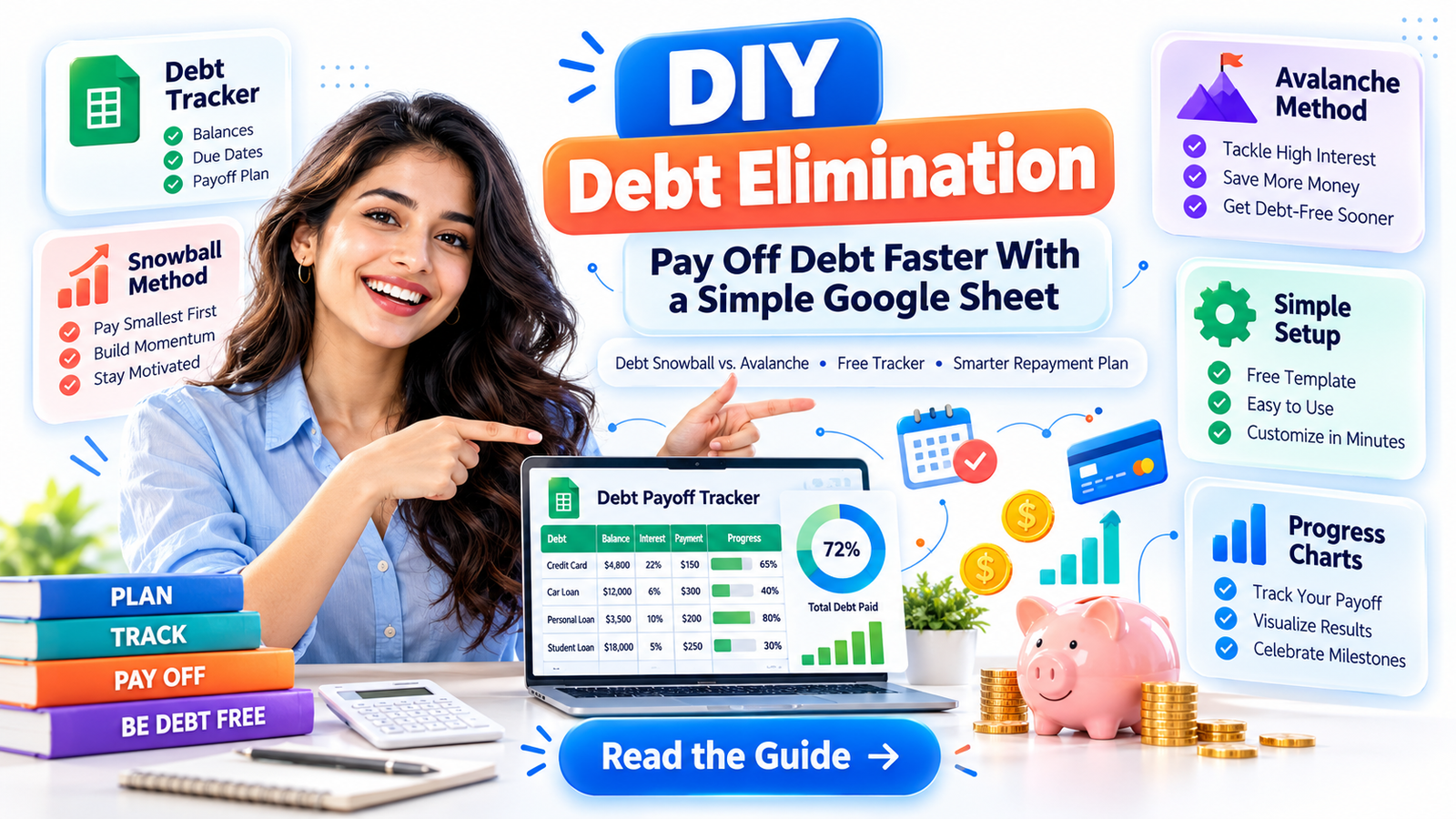
The One-Sheet System to Pay Off Debt Faster
Paying off debt does not necessarily require another budgeting subscription, a complicated finance dashboard, or an app sending you seventeen notifications about the coffee you bought yesterday.
Sometimes the most useful debt-management system is surprisingly simple: one spreadsheet, one repayment strategy, one monthly target, and the discipline to keep updating it.
For someone carrying credit card balances, personal loans, student debt, medical bills, buy-now-pay-later balances, or several smaller debts at once, the hardest part is often not understanding that the debt needs to disappear. The real challenge is knowing which debt to attack first, how much extra to pay, and whether the plan is actually working.
That is where a simple DIY debt elimination tracker can become powerful.
Instead of paying every month for software you may barely use, you can build a Google Sheets debt payoff tracker that shows your balances, minimum payments, interest rates, extra payments, estimated progress, and repayment priority on a single screen.
And once that sheet is built correctly, it can answer one of the biggest questions borrowers face:
Should I use the debt snowball or debt avalanche method?
The answer matters because the strategy that is mathematically cheapest is not always the strategy a real person will stick with.
Why a Simple Google Sheet Can Beat a Paid Budgeting App for Debt Payoff
Budgeting apps can be useful.
They may automatically import transactions, categorize purchases, send spending alerts, calculate net worth, connect investment accounts, and visualize dozens of financial metrics.
But someone whose immediate goal is simply getting out of debt may not need all of that.
The more features you add to a financial system, the easier it becomes to spend time managing the system instead of solving the problem.
A debt payoff sheet focuses attention on a few numbers that actually affect the outcome:
Your current balance.
Your interest rate.
Your minimum monthly payment.
Your extra monthly payment.
Your payoff priority.
Your remaining balance.
Your estimated debt-free date.
That is usually enough to create a meaningful debt elimination plan.
A spreadsheet also gives you something many subscription apps cannot easily provide: complete customization.
You decide what gets tracked.
You decide how debts are ranked.
You decide whether the sheet follows the snowball method, avalanche method, or a hybrid strategy.
You can also duplicate the file, modify formulas, add charts, create milestone rewards, or share the sheet with a spouse or financial accountability partner without rebuilding your entire financial system.
The point is not that every budgeting app is unnecessary.
It is that you should not confuse sophisticated software with financial progress.
The best debt payoff tool is the one you consistently use.
Start With the Number Most People Avoid: Total Debt
Open a blank Google Sheet.
Before calculating anything sophisticated, list every debt.
Include the creditor or account name, current balance, APR or interest rate, minimum payment, payment due date, and account status.
Your table might look something like this:
| Debt | Balance | APR | Minimum Payment |
|---|---|---|---|
| Credit Card A | $1,400 | 24.99% | $55 |
| Medical Balance | $650 | 0% | $50 |
| Personal Loan | $4,800 | 12.5% | $180 |
| Credit Card B | $3,100 | 20.99% | $95 |
| Student Loan | $7,500 | 6.2% | $110 |
Total debt: $17,450
Seeing that number can be uncomfortable.
That is precisely why it is useful.
Debt becomes easier to manage when it stops being a collection of vague bills and becomes a measurable project.
The Consumer Financial Protection Bureau similarly recommends understanding what you owe before choosing a repayment strategy and recognizes both the smallest-balance snowball approach and highest-interest-rate approach as common debt reduction strategies.
Debt Snowball vs. Debt Avalanche: What Is the Difference?
Both systems share one important rule.
You continue making the required minimum payments on your debts while directing your available extra repayment money toward one priority balance.
After that debt is eliminated, the money that was going toward it is redirected toward the next debt.
Where the two methods differ is which account becomes the priority.
The Debt Snowball Method
With the debt snowball method, you arrange debts from the smallest balance to the largest balance.
Interest rates are not the primary consideration.
Using the previous example, your order might be:
$650 medical balance
$1,400 Credit Card A
$3,100 Credit Card B
$4,800 personal loan
$7,500 student loan
Suppose your minimum payments total $490 a month and you can find another $200 for debt reduction.
Instead of distributing that additional $200 across five accounts, you direct it toward the $650 balance.
You continue paying the minimums everywhere else.
Once the $650 account disappears, its previous payment plus the additional money becomes available for the next debt.
That is where the “snowball” begins.
Your repayment power becomes larger every time another account reaches zero.
Why the Snowball Works for Many People
Its advantage is psychological.
Checking off an entire balance can create a stronger sense of progress than watching several accounts slowly decline at the same time.
For someone who has previously started and abandoned several debt payoff plans, those quick victories may be valuable.
The CFPB notes that the snowball approach can create visible progress relatively quickly, although it can result in paying more overall because higher-cost debt may remain outstanding longer.
The Debt Avalanche Method
The debt avalanche takes the opposite approach.
Instead of asking:
Which balance is smallest?
You ask:
Which debt is costing me the most?
You arrange your debts from the highest interest rate to the lowest interest rate.
Using our example, the priority becomes:
Credit Card A — 24.99%
Credit Card B — 20.99%
Personal Loan — 12.5%
Student Loan — 6.2%
Medical Balance — 0%
Mathematically, this usually makes more sense.
High-interest debt grows faster.
Eliminating the most expensive debt first generally reduces the amount of interest that continues accumulating.
The CFPB describes the highest-interest-rate strategy as one that can save money over the long run because you eliminate the costliest debt first.
Snowball or Avalanche: Which One Should You Choose?
There is no universally perfect answer.
The avalanche is usually stronger mathematically.
The snowball can be stronger behaviorally.
If you are highly disciplined and seeing balances decline slowly will not discourage you, the debt avalanche may be the logical choice.
If your biggest difficulty has been staying motivated, the snowball method may be more effective simply because you are more likely to continue.
A theoretically perfect financial plan that you quit after six weeks is not better than a slightly less efficient plan you successfully follow for three years.
There is also nothing wrong with using a hybrid.
For example, imagine you have a tiny $250 balance along with several much larger high-interest debts.
You might eliminate the $250 account first for an immediate psychological win and then switch to an avalanche strategy.
Your spreadsheet belongs to you.
Build the strategy around human behavior, not just mathematics.
Build Your One-Sheet Debt Payoff Tracker
Your Google Sheets debt calculator does not need twenty tabs.
Start with columns for:
Debt name
Starting balance
Current balance
Interest rate
Minimum payment
Extra payment
Total monthly payment
Priority
Percentage paid
Target payoff date
You can add additional columns later if they genuinely help you make decisions.
For percentage paid, the basic calculation is:
(Starting Balance − Current Balance) ÷ Starting Balance
If a debt started at $5,000 and the remaining balance is $3,000:
($5,000 − $3,000) ÷ $5,000 = 40%
That one number can become surprisingly motivating.
Instead of thinking:
“I still owe $3,000.”
You can see:
“I have already eliminated 40%.”
Both statements are true.
Only one encourages momentum.
Add a Debt Freedom Progress Bar
Humans respond well to visible progress.
Create one cell for total original debt and another for total remaining debt.
Then calculate:
Total Debt Paid = Original Debt − Remaining Debt
And:
Debt Freedom Percentage = Total Debt Paid ÷ Original Debt
Imagine you started with $25,000 and now owe $18,500.
You have eliminated $6,500.
Your progress is:
$6,500 ÷ $25,000 = 26%
Seeing “26% complete” can feel dramatically different from looking at “$18,500 remaining.”
That is one reason a simple debt payoff spreadsheet can become more than a calculator.
It becomes a feedback system.
Create a Monthly Extra-Payment Target
Minimum payments keep accounts current.
Extra payments create acceleration.
After paying essential expenses and maintaining an appropriate cash cushion for your circumstances, determine what amount can realistically be directed toward debt.
Maybe it is $75.
Maybe it is $300.
Maybe it changes every month.
Do not dismiss a small amount.
An extra $100 directed consistently toward principal is fundamentally different from $100 disappearing through scattered purchases without intention.
Also be careful about draining every dollar of emergency savings simply to produce a more impressive debt payoff chart.
Research discussed by the CFPB found that people often prefer paying down debt while retaining some savings cushion rather than emptying savings entirely.
Your debt plan has to survive real life.
A broken phone, medical bill, car repair, or temporary income interruption should not immediately force you to borrow again.
Why Interest Rate Deserves More Attention Than Most People Give It
If you carry revolving credit card debt, interest can work against you continuously.
Many credit card issuers calculate interest using daily balances. In those situations, reducing a balance earlier can reduce the amount on which future interest is calculated.
This is why high-APR balances deserve serious attention.
Imagine two $5,000 debts.
One costs 6%.
The other costs 27%.
They may look identical inside the “Balance” column.
They are not financially identical.
The second debt is significantly more expensive to carry.
That is the core logic behind the avalanche strategy.
The “$100 More” Debt Experiment
One useful feature for your spreadsheet is an additional-payment scenario.
Create three versions of your monthly debt payment:
Current payment
Current payment + $100
Current payment + $250
Then compare the projected repayment timelines.
This exercise can turn an abstract lifestyle decision into something measurable.
Instead of asking:
“Should I spend this extra money?”
You can ask:
“Would I rather buy this today or move my debt-free date forward?”
That is a very different financial question.
Give Every Windfall a Rule Before It Arrives
Tax refunds.
Bonuses.
Freelance income.
Cash gifts.
Marketplace sales.
Overtime income.
Commission checks.
Unexpected refunds.
Without a rule, windfalls disappear remarkably quickly.
Create the rule in advance.
For example:
50% of unexpected income goes toward debt, 30% toward savings, and 20% can be spent freely.
Your percentages may be completely different.
The value comes from deciding before emotion enters the transaction.
When an unexpected $1,000 appears, you already know what happens to it.
What About Debt Consolidation?
Debt consolidation can sometimes simplify repayment or reduce borrowing costs, but it is not automatically a debt solution.
Moving several balances into one new loan does not eliminate the underlying debt.
It changes the structure.
Before consolidating, compare the effective interest rate, fees, repayment term, monthly payment, total projected repayment cost, and whether you are likely to accumulate new balances afterward.
The CFPB warns borrowers to examine why the debt accumulated in the first place. If spending continues to exceed income, consolidation alone may not solve the problem.
Your spreadsheet can help here too.
Create two scenarios:
Current repayment plan
versus
Proposed consolidation plan
Compare the estimated total interest, monthly payment, repayment timeline, and fees.
Numbers are usually more useful than marketing language.
Why Your “Payoff Balance” May Not Equal the Number on Your Spreadsheet
A spreadsheet is a planning tool.
It is not your lender’s official payoff statement.
Interest, fees, transaction timing, penalties, or other account-specific terms can change the exact amount required to close an obligation.
For some loans, the official payoff amount can differ from the balance shown on a statement because additional interest or fees may apply through the payoff date.
Before making what you believe will be the last payment on a significant loan, confirm the actual payoff amount with the lender.
That prevents the frustrating situation where you believe an account is finished but a small residual balance remains.
Stop Tracking Every Penny If It Makes You Quit
Personal finance advice sometimes assumes that successful budgeting requires recording every transaction forever.
That works for some people.
For others it creates financial fatigue.
If your objective is debt elimination, try simplifying your monthly financial picture into four buckets:
Essential living costs.
Required debt payments.
Savings and financial protection.
Available extra debt payment.
The question becomes:
How much money can safely be sent toward the current target debt this month?
That may be more useful than categorizing whether a $4 purchase belongs under “coffee,” “restaurants,” or “miscellaneous food.”
Use as much detail as helps you make better decisions.
No more.
Turn Debt Repayment Into a Weekly Five-Minute Habit
The spreadsheet should not become another project you avoid.
Pick one day each week.
Open the sheet.
Update balances.
Check upcoming due dates.
Record any extra payment.
Review your current target.
Close the sheet.
Five minutes.
Consistency matters more than dashboard perfection.
This also creates a reason to return to your financial plan regularly instead of checking it only when anxiety appears.
A useful financial system should reduce uncertainty, not create more of it.
The Returning-Visitor Habit That Keeps a Debt Plan Alive
If you are using an online debt calculator or downloadable debt payoff spreadsheet, bookmark it.
Return on the same day every week.
Each visit should answer one question:
What changed since last week?
Maybe your debt dropped by $42.
Maybe you made a $500 extra payment.
Maybe an interest charge was higher than expected.
Maybe your monthly surplus increased.
Maybe you discovered that your plan needs adjusting.
Small updates keep the system alive.
Debt elimination usually happens through accumulated decisions rather than one dramatic financial event.
How a Free Debt Calculator Can Become an Ethical Affiliate Business
There is another side to the debt-calculator model that matters to publishers, bloggers, personal-finance creators, and digital-product entrepreneurs.
A genuinely useful free calculator can attract readers with strong financial intent.
Someone searching for:
“how long will it take to pay off my credit card?”
“debt avalanche calculator”
“debt snowball spreadsheet”
“best way to consolidate credit card debt”
“how much interest am I paying?”
“is a balance transfer worth it?”
is not casually browsing.
They are actively trying to make a financial decision.
That makes a debt calculator commercially valuable.
The correct approach, however, is utility first, affiliate offer second.
A calculator could show a user’s repayment scenario and then, where relevant, provide educational links explaining options such as high-yield savings accounts, balance-transfer offers, credit monitoring, budgeting services, nonprofit credit counseling resources, or debt-consolidation products.
But the affiliate product should never be presented as the automatic solution.
A user whose spreadsheet already shows that they can eliminate a balance efficiently may not need another financial product at all.
That trust is valuable.
It is better to lose one commission than lose the reader.
How the Affiliate Revenue Model Actually Works
Imagine you publish a free debt snowball and avalanche calculator.
A visitor enters:
$18,000 total debt.
$650 monthly payment.
Several APRs.
$200 of additional monthly repayment capacity.
The calculator helps compare strategies.
Below the results, the page may explain:
“If high-interest balances are driving most of your repayment cost, you may want to compare whether a lower-rate option could reduce that cost. Compare fees, eligibility, repayment terms, and total cost carefully before applying.”
A relevant comparison tool or financial-service partner can then be offered.
If an eligible visitor completes the required action through an affiliate relationship, the publisher may earn compensation.
That does not mean a free calculator automatically produces passive banking commissions every month.
Traffic, visitor eligibility, affiliate-program rules, conversion rates, geography, consumer trust, and regulatory requirements all affect results.
Any material affiliate relationship should also be disclosed clearly and conspicuously. FTC guidance specifically emphasizes disclosure when publishers receive commissions from recommendations or affiliate links.
Trust converts better over the long term than disguised advertising.
The Better Conversion Funnel
The strongest debt calculator funnel is not:
Calculator → Apply Now
It is:
Problem → Calculation → Understanding → Options → Decision
For example:
A visitor searches for a credit card payoff calculator.
They calculate their debt-free date.
They discover that their APR is slowing progress.
They read a short explanation of the avalanche method.
They compare what an additional $100 payment would accomplish.
They receive a downloadable debt tracker.
They bookmark the page.
They return next month.
Only then, if appropriate, do they explore related financial products or services.
That sequence creates something much more valuable than one click.
It creates a returning visitor.
Give Readers a Reason to Come Back Every Month
A static article may be read once.
A debt tracker can become a monthly ritual.
Encourage readers to update their balance on the first weekend of each month.
Ask them to record:
Starting balance.
Current balance.
Amount eliminated.
Extra amount paid.
Interest charged.
Next target milestone.
Then introduce milestones such as:
First $500 eliminated.
10% debt reduction.
First account paid off.
25% eliminated.
Halfway point.
Highest-interest balance eliminated.
Final $1,000.
Debt-free.
The product becomes useful repeatedly.
That is how content can move from attracting search traffic to building an audience.
Do Not Turn Debt Repayment Into Financial Punishment
Debt reduction requires discipline.
It does not require making life miserable.
Plans built around extreme deprivation often collapse because they assume motivation will remain permanently high.
Instead, create a repayment amount you can repeat.
If necessary, maintain a small guilt-free spending allowance.
A slower plan that continues for twenty-four months can outperform an aggressive plan that collapses after eight weeks.
Your spreadsheet should help you build a system you can live with.
The Most Important Cell in Your Debt Spreadsheet
It is not your APR.
It is not your total balance.
It is not even your debt-free date.
Create one large cell at the top that says:
NEXT TARGET: ______
Only one debt goes there.
When extra money appears, you do not need another debate.
That account receives it.
When the account reaches zero, replace the name.
That small design choice removes repeated decision-making from the process.
Your DIY Debt Elimination Plan
Start by gathering accurate balances, rates, minimum payments, and due dates.
Build the spreadsheet.
Calculate total debt.
Choose snowball, avalanche, or a deliberate hybrid.
Set a sustainable extra-payment target.
Maintain an emergency cushion appropriate to your situation.
Automate required payments where appropriate.
Direct extra money toward one target at a time.
Update the tracker weekly or monthly.
Celebrate measurable milestones.
Review the strategy when interest rates, income, expenses, or account terms change.
And remember that debt repayment is not a competition.
Someone eliminating $8,000 with a $50 monthly surplus is solving a very different problem from someone paying off the same balance with $2,000 of disposable income.
Measure progress against your own starting point.
The Real Goal Is Not a Perfect Budget
A beautiful dashboard is not financial freedom.
A 40-tab spreadsheet is not financial freedom.
Downloading another budgeting app is not financial freedom.
The objective is much simpler:
Owe less next month than you owe today.
Repeat that process often enough and eventually one balance reaches zero.
Then another.
Then another.
Whether the snowball keeps you motivated or the avalanche minimizes your interest cost, the best debt payoff strategy is the one that moves your balances downward without creating another financial crisis elsewhere.
Start with one sheet.
Enter every balance.
Choose the first target.
Make the first extra payment.
Then return next month and make the number smaller again.
Frequently Asked Questions About DIY Debt Elimination
1. Is the debt snowball or debt avalanche method better?
The avalanche method generally prioritizes financial efficiency because it targets the highest-interest debt first and can reduce total interest costs. The snowball targets the smallest balance first, which can create faster psychological wins. The better strategy is the one you can follow consistently.
2. Can I really use Google Sheets instead of a budgeting app to pay off debt?
Yes. For a straightforward debt payoff plan, a spreadsheet can track balances, APRs, minimum payments, extra payments, repayment priority, progress, and estimated payoff goals. People who need automatic transaction syncing or broader financial management may still prefer dedicated budgeting software.
3. How much extra should I pay toward debt each month?
There is no universal amount. Calculate what remains after essential expenses, minimum obligations, and an appropriate savings cushion. Even relatively small extra payments can accelerate repayment when made consistently. Avoid creating a payment target so aggressive that an ordinary emergency forces you back into expensive debt.
4. Should I use savings to pay off credit card debt?
It depends on your interest costs, income stability, available emergency reserves, upcoming obligations, and personal circumstances. Paying down expensive debt can reduce interest, but exhausting your entire cash reserve may leave you financially vulnerable. CFPB research indicates many consumers prefer balancing debt reduction with retaining some savings cushion.
5. Can a free debt calculator website really earn affiliate income?
It can, but income is never guaranteed. A useful debt calculator can attract people with strong financial intent, and publishers may earn commissions by referring eligible users to relevant financial products or services. Recommendations should be genuinely relevant, risks and costs should be explained, and affiliate relationships should be clearly disclosed.
Debt elimination becomes easier when the problem is visible, measurable, and repeatable. Build the tracker, choose the strategy, protect yourself from avoidable emergencies, and concentrate your extra money where it can make the greatest difference.
The spreadsheet itself will not eliminate the debt.
But it can make the next decision unmistakably clear.
Stay ahead with exclusive updates
Join our community. Get curated industry trends, actionable guides, and fresh resources delivered straight to your inbox.