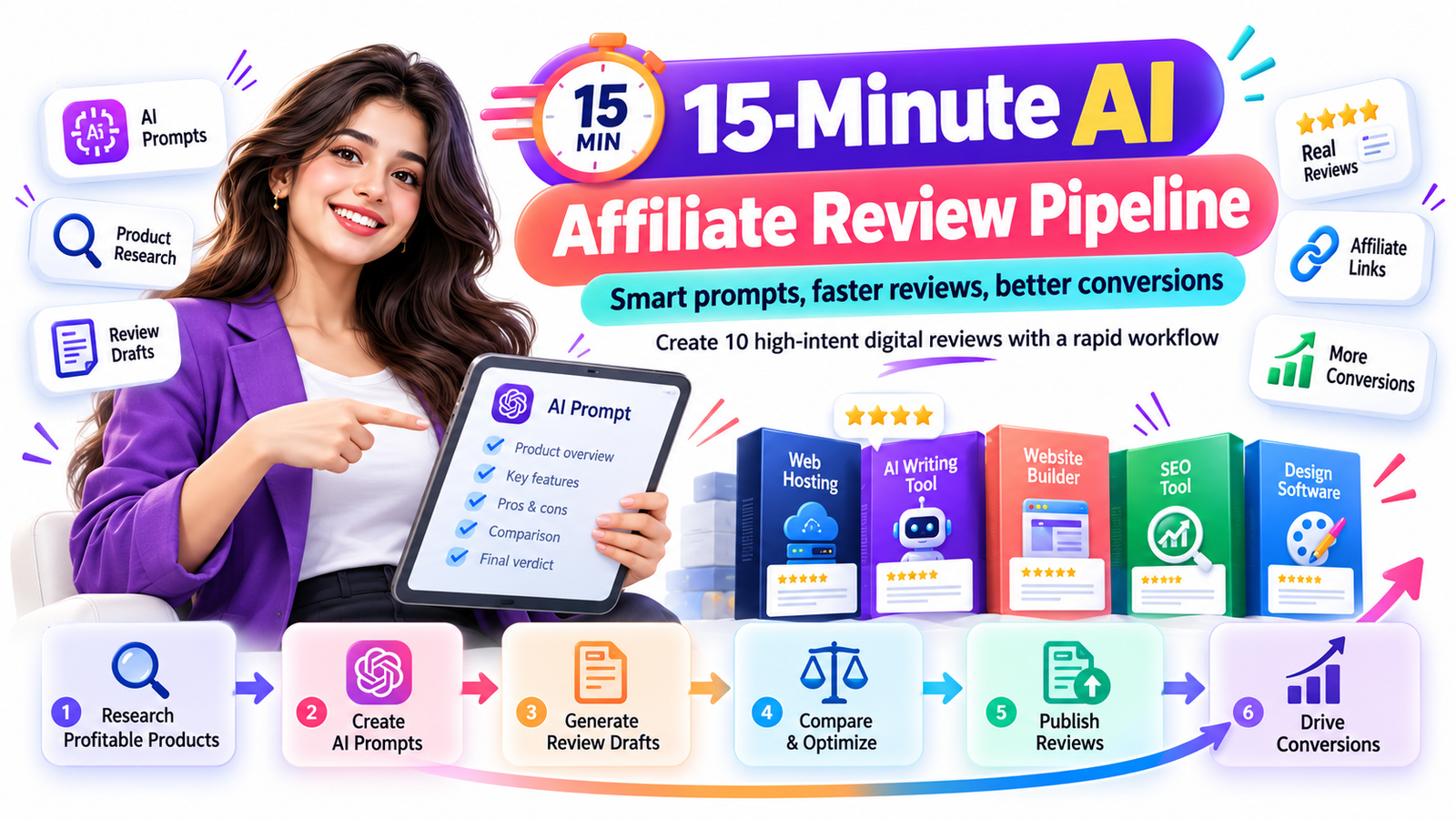
How to Build an Affiliate Review Pipeline in 15 Minutes Using Smart AI Prompts
Writing affiliate reviews every day sounds simple until you actually try to do it.
You find a product. You research the features. You compare pricing. You read documentation. You check competitors. You identify the ideal buyer. You outline the article. You write several thousand words. You edit the draft, add affiliate links, create images, optimize the page for search, and finally hit publish.
Then tomorrow, you are expected to do it again.
For many affiliate marketers, bloggers, niche-site owners, and digital creators, the problem is not a lack of product ideas. The problem is content production capacity.
A single detailed affiliate review can easily consume several hours when every part of the process is handled manually. That makes publishing consistently difficult, particularly if you are trying to compete for high-intent searches such as “best email marketing software for creators,” “Tool A vs Tool B,” “is this software worth it,” or “best alternative to [product].”
AI can dramatically reduce that workload, but only when it is used as part of a structured affiliate review pipeline.
The goal is not to ask an AI tool, “Write me a 2,000-word review.”
The better approach is to create a repeatable system in which AI helps organize research, identify buying questions, build comparison frameworks, create first drafts, discover content gaps, and accelerate editing while you remain responsible for accuracy, judgment, product experience, disclosures, recommendations, and the final published page.
That distinction matters.
Google says its ranking systems are designed to prioritize helpful, reliable, people-first content and specifically encourages original information, substantial analysis, clear sourcing, demonstrated expertise, and meaningful value beyond simply rewriting other sources. Google also notes that explaining how AI or automation contributed to content can help readers understand the process when automation plays a substantial role.
So the real opportunity is not AI content at scale.
It is better affiliate publishing at scale.
The Affiliate Content Bottleneck Is Usually the Workflow
Most people assume writing is the slowest part of producing an affiliate review.
Frequently, it is not.
The real time drain comes from repeatedly making the same small decisions.
What problem does the product solve?
Who is the product actually for?
Which features deserve attention?
Which features are mostly marketing language?
What are the strongest alternatives?
Which buying objections should be addressed?
What keywords indicate commercial intent?
Where should the CTA appear?
What evidence supports the recommendation?
What should be updated later?
Without a system, you answer these questions from scratch for every review.
With an affiliate review pipeline, the answers are collected in a predictable order.
That means your brain stops switching constantly between researcher, SEO analyst, reviewer, copywriter, editor, conversion strategist, and publisher.
AI becomes useful because it can handle much of that organizational workload quickly.
What a 15-Minute Affiliate Review Pipeline Actually Means
A “15-minute pipeline” should not be interpreted as producing a trustworthy, fully researched review in fifteen minutes.
It means building the production framework for a review in roughly fifteen minutes once you have access to the necessary product information.
The pipeline gives you the search intent, audience profile, question set, evidence requirements, comparison structure, outline, conversion path, and drafting instructions before serious writing begins.
Once that foundation exists, producing the article becomes significantly faster.
A practical pipeline can look like this:
- Identify one product and one primary buyer problem.
- Collect the product’s official features, pricing, limitations, policies, documentation, and relevant firsthand notes.
- Use AI to classify the dominant search intent and related buyer questions.
- Generate a decision-oriented review outline instead of a generic feature outline.
- Build an evidence sheet separating verified facts, personal observations, assumptions, and items still requiring verification.
- Draft individual sections with tightly scoped AI prompts instead of generating the entire article in one request.
- Add your own verdict, examples, comparisons, disclosures, screenshots, testing observations, and conversion CTAs.
- Perform an accuracy, originality, SEO, readability, and commercial-intent review before publication.
The important word is pipeline.
Every review travels through the same stages.
That repeatability is what creates scale.
Stop Writing Reviews Around Features
One of the biggest mistakes in affiliate content is organizing an article entirely around what the product offers.
Imagine reviewing an email marketing platform.
A conventional article might contain sections about templates, automation, analytics, landing pages, integrations, and pricing.
Those sections may be technically correct, but they do not automatically help someone make a purchasing decision.
A buyer thinks differently.
A solo creator may be wondering whether the platform is easy enough to use without hiring someone.
A Shopify owner may care about abandoned-cart automation.
A consultant may want to know whether the entry-level plan becomes expensive as the subscriber list grows.
A small agency may need multiple accounts and client reporting.
The review should therefore move from:
What does this product have?
to:
What decision is the reader trying to make?
That simple shift dramatically improves affiliate content.
Smart Prompt #1: Find the Real Buyer Intent
Instead of asking AI for keywords immediately, ask it to understand the purchase situation first.
A useful prompt is:
“Act as a buyer-intent research assistant. I am reviewing [PRODUCT] for [AUDIENCE]. Identify the most important problems a person is trying to solve before purchasing this type of product. Separate informational questions from commercial-investigation and purchase-ready questions. Prioritize questions that would materially influence whether someone buys, rejects, upgrades, or chooses an alternative. Do not invent product facts.”
The output gives you something far more useful than a random keyword list.
It gives you the decision map behind the search.
For example, someone searching for “email automation software” may still be researching.
Someone searching for “ConvertKit vs MailerLite for 5,000 subscribers” is much closer to a purchase decision.
Someone searching “ConvertKit pricing after 10,000 subscribers” may already understand the product and simply needs one last objection resolved.
Those queries require different articles, different CTAs, and different levels of explanation.
Search Intent Should Control the Review Structure
Affiliate SEO becomes much easier when the format matches the query.
A search containing “review” usually requires evaluation.
A search containing “vs” requires direct comparison.
A search containing “alternative” requires multiple options and an explanation of why someone might leave or avoid the original product.
A search containing “pricing” requires clear cost analysis.
A search containing “worth it” requires a verdict.
A search containing “for beginners,” “for agencies,” “for photographers,” or another audience qualifier requires segmentation.
Instead of forcing every affiliate keyword into one massive article, build content around these different decision stages and connect the pages internally.
That creates a stronger topical ecosystem while giving readers logical next steps.
Smart Prompt #2: Build an Evidence-First Review Brief
AI-generated affiliate content becomes dangerous when the model fills information gaps with confident-sounding guesses.
Prevent that at the prompt level.
Use:
“Create an evidence-first review brief for [PRODUCT]. Use only the source material I provide. Create sections for verified facts, pricing, key use cases, limitations, ideal users, poor-fit users, competitors, questions requiring additional verification, and claims that should not be made without firsthand testing. If information is unavailable, write ‘verification required’ rather than guessing.”
This single rule can eliminate a large amount of unreliable copy.
If you do not know whether a product provides unlimited exports, do not let AI decide that it probably does.
If a pricing page has changed, verify it.
If you have never personally tested customer support, do not write as though you have.
Trust is a conversion tool.
A buyer who detects one obvious false claim may distrust every affiliate recommendation on the site.
Build Reviews Around “Best For” and “Not For”
Many weak affiliate reviews attempt to convince everyone that the product is excellent.
Strong reviews help the wrong buyer leave.
That sounds counterproductive until you understand affiliate conversion psychology.
Suppose a product is excellent for freelancers but unnecessarily complex for a solo beginner.
Saying so makes your recommendation more believable.
The page can explicitly explain:
Best for: Freelancers managing several recurring clients who need automation and reporting.
Probably unnecessary for: Beginners who only need a simple invoicing tool.
The second statement may sacrifice a few inappropriate clicks, but it improves reader trust and directs those visitors toward a better alternative.
Now your affiliate site is behaving like an adviser rather than an advertisement.
Smart Prompt #3: Create the Decision-First Outline
Once research is complete, generate the outline.
Try:
“Using the verified research below, create a high-intent affiliate review outline for someone deciding whether to purchase [PRODUCT]. Lead with the decision, not company history. Include a quick verdict, who it is best for, who should skip it, major benefits, meaningful limitations, pricing context, key alternatives, buying objections, use-case examples, frequently asked buyer questions, and natural CTA opportunities. Avoid repetitive sections and generic filler.”
Notice what is missing.
There is no request for an arbitrary word count.
The objective is not to reach 3,000 words.
The objective is to answer the buying decision completely.
Sometimes that requires 1,500 words.
Sometimes it requires 4,000.
Usefulness should determine length.
The Rapid Daily Affiliate Content Workflow
Once the pipeline exists, daily publishing becomes considerably less chaotic.
Start by keeping a review queue rather than choosing products each morning.
Your queue might contain topics such as:
“Best AI writing tool for ecommerce product descriptions”
“Tool X vs Tool Y for bloggers”
“Is Tool Z worth the upgrade?”
“Tool X pricing explained”
“Best Tool X alternative for small teams”
“Tool X review after 30 days”
Each topic should have a clear reader, decision, intent, and product.
When it reaches production, you already know why the article exists.
That eliminates the blank-page problem before writing begins.
Use a Product Research Packet
Every product should have a reusable research packet.
Store official pricing information, product documentation, screenshots, release notes, affiliate conditions, feature notes, competing products, frequently asked questions, user objections, personal test results, and update dates in one place.
Then multiple pieces of content can use the same verified foundation.
A detailed product review can become a pricing guide.
The pricing guide can support a comparison article.
The comparison can lead into an alternatives article.
The alternatives article can link back to your full reviews.
One research investment produces an entire commercial content cluster.
Smart Prompt #4: Draft One Section at a Time
Large one-shot prompts tend to produce repetitive articles.
Instead, isolate each writing job.
For example:
“Write the ‘Who Is This Product Best For?’ section using the research provided. Give three realistic customer situations, explain why the product fits each one, and mention one situation where a competing solution may be better. Use a confident but non-promotional tone. Do not introduce facts that are not contained in the research.”
Then draft the pricing section separately.
Then the limitations.
Then the alternatives.
Then the verdict.
This gives you much more control over tone, repetition, facts, and conversion flow.
Smart Prompt #5: Run a Skeptical Buyer Audit
Before publishing, switch the AI from writer to critic.
Use:
“Pretend you are a skeptical buyer who arrived from Google and is considering spending your own money on this product. Read the article and identify unanswered questions, unsupported claims, vague statements, excessive praise, missing limitations, confusing pricing explanations, weak comparisons, and places where the CTA appears before sufficient trust has been established. Do not rewrite the article yet. Give specific improvement recommendations.”
This is one of the highest-value uses of AI in affiliate marketing.
Your first draft tries to sell.
Your audit should try to disprove the sale.
The tension between the two usually produces a stronger page.
Your CTA Should Match the Reader’s Confidence Level
A CTA placed after every few paragraphs does not automatically improve conversions.
Good affiliate CTAs appear when the reader has received enough information to take the next logical action.
Near the beginning of a review, the CTA may be low pressure:
Check current plans and features
After the pricing discussion, it may become:
Compare the current plans for your list size
After a positive verdict:
See whether the current plan fits your workflow
After explaining an alternative:
Compare both options before choosing
This is more persuasive than repeatedly shouting “BUY NOW.”
The CTA continues the decision instead of interrupting it.
Create Conversion Hooks Inside the Content
Conversion hooks are small pieces of information that reconnect the article to the reader’s buying problem.
Imagine the user is reading a project-management software review.
A weak sentence says:
“The Professional plan includes advanced reporting.”
A conversion-oriented sentence says:
“If you manage several client projects and spend Friday afternoon manually creating progress reports, the advanced reporting feature is one of the strongest reasons to consider the Professional tier.”
Same feature.
Completely different commercial value.
The second version translates functionality into an outcome.
That is the core skill behind high-converting affiliate review writing.
The 24-Hour Content Sprint: Producing 10 High-Intent Reviews
Producing ten useful affiliate articles in one day is ambitious, and the workflow only makes sense when you already understand the niche and have reliable product information.
Do not interpret the sprint as permission to mass-publish unverified AI output.
Instead, batch similar tasks.
Begin with ten tightly defined buyer-intent topics.
Research them together.
Build the ten briefs together.
Create the outlines together.
Draft similar sections together.
Run fact checks together.
Complete SEO and internal linking together.
Publishing in batches reduces context switching.
For example, researching ten products independently from beginning to end forces you to move repeatedly between research, writing, editing, publishing, and optimization.
Batching keeps your brain in one operating mode for longer.
This is where AI can create a substantial productivity advantage.
A Better 10-Article Sprint Mix
Do not publish ten versions of “[Product] Review.”
Create different search-intent assets.
One article can be the definitive product review.
Another can answer whether the product is worth its price.
Another can compare it with its closest competitor.
Another can address beginners.
Another can target agencies.
Another can explain alternatives.
Another can focus on a specific feature.
Another can address pricing.
Another can answer a common migration concern.
Another can cover a practical use case.
Now your ten articles are capable of capturing buyers at multiple stages.
That is more valuable than producing ten nearly identical reviews.
The Content Cluster Becomes the Real Affiliate Asset
Affiliate publishers often evaluate pages individually.
A stronger strategy is to think in clusters.
Suppose your main topic is email marketing tools.
Your flagship review can link to:
the pricing breakdown,
the competitor comparison,
the beginner guide,
the automation tutorial,
the alternatives article,
and the migration guide.
Those articles can link back to the flagship review.
Readers get more relevant information.
Search engines receive clearer topical relationships.
Your affiliate offers appear naturally throughout the decision journey.
And someone who visits through an informational query can return later through a commercial one.
How to Turn New Visitors Into Returning Visitors
Search traffic is useful.
Audience ownership is better.
A visitor who discovers one affiliate review and disappears forever gives you one opportunity.
A returning reader may eventually use multiple recommendations.
Give people a reason to come back.
Add a visible “last reviewed” date where appropriate.
Update pricing sections when vendors change plans.
Maintain “best for” recommendations as products evolve.
Publish monthly comparison updates.
Create useful tool directories.
Offer a buyer’s checklist or comparison template.
Invite readers to subscribe to updates relevant to the niche rather than sending generic promotional emails.
You can also create continuity inside articles.
For example:
“We update this comparison when either platform changes pricing or introduces a major automation feature.”
That sentence creates an expectation of future value.
The article becomes a resource rather than a one-time post.
Google introduced broader Preferred Sources functionality in 2026, allowing eligible publishers to encourage readers to select their site as a preferred source in Google Search. For publishers building a genuine repeat audience, that is another reason to think beyond the first click.
Why Original Experience Matters More as AI Publishing Gets Easier
When everybody has access to similar AI models, generic information becomes inexpensive.
Anyone can generate:
product summaries,
feature descriptions,
pros and cons,
comparison tables,
basic FAQs,
and generic conclusions.
Those elements therefore become less defensible.
Your competitive advantage increasingly comes from information that cannot be generated reliably without actual work.
Examples include firsthand screenshots, real workflow examples, test results, migration experiences, pricing calculations, support interactions, original comparisons, unexpected limitations, product-update observations, and clearly explained personal judgment.
AI should help package that knowledge.
It should not replace the knowledge.
Google explicitly encourages original information, research and analysis, and asks whether content provides substantial value compared with other results. Its guidance for reviews also emphasizes helping readers understand how testing or evaluation was performed when applicable.
Optimize for SEO Without Turning the Review Into an SEO Article
Good affiliate SEO is mostly about satisfying the intent behind the query.
If the primary topic is an AI affiliate review workflow, related language will naturally include phrases such as affiliate marketing, affiliate review writing, AI content workflow, affiliate content creation, buyer-intent keywords, digital product reviews, SEO content strategy, conversion optimization, affiliate comparison articles, product research, content automation, review templates, commercial search intent, and high-converting affiliate content.
You do not need to repeat the same keyword twenty times.
Use terminology where it adds clarity.
Use descriptive headings.
Answer related questions.
Explain entities and products clearly.
Connect related articles through internal links.
Use descriptive anchor text.
Keep URLs understandable.
Make the title accurately describe the page.
And make the introduction confirm quickly that the visitor has reached the right resource.
Google’s current people-first guidance explicitly recommends descriptive, helpful titles rather than exaggerated or shocking headlines.
GEO and AEO Begin With Clear Answers
Search behavior is increasingly spread across classic search results, AI-powered search experiences, answer engines, assistants, and recommendation systems.
That makes clear information architecture particularly useful.
Instead of burying an answer beneath 700 words of setup, answer important questions directly and then expand.
For example:
Can AI write affiliate reviews?
AI can accelerate affiliate review research, outlining, drafting and editing, but factual claims, product experience, recommendations, disclosures and the final evaluation should be verified by a human publisher.
That paragraph is easy for a reader to understand.
It also has enough context to stand independently.
That is the basic philosophy behind answer-engine-friendly content.
Do not write for machines.
Write information that machines can understand because humans can understand it.
Make the Page Worth Citing
One useful GEO mindset is to ask:
“What information on this page would another writer actually want to reference?”
Generic statements are rarely citation-worthy.
Original frameworks are.
Testing methodologies are.
Detailed calculations are.
Useful statistics with sources are.
Comparison methodologies are.
Decision trees are.
Original research is.
If every paragraph in your affiliate article could appear on another site with only the product name changed, the page probably needs more original value.
Build for Google Discover Without Chasing Discover
No publisher can guarantee that an article will rank or appear in Google Discover.
Discover is personalized, and visibility can fluctuate.
However, Google’s current guidance recommends content that reflects current interests, tells stories well, provides unique insights, avoids sensationalism, and uses compelling relevant imagery. Its February 2026 Discover core update also emphasized deeper, original, timely content and reduced sensational or clickbait material.
That creates a useful editorial direction for affiliate publishers.
Instead of publishing:
This NEW AI Tool Will Make You Rich Overnight!
publish:
I Tested an AI Affiliate Review Workflow: Where It Saves Time and Where Human Editing Still Matters
The second title still creates curiosity.
But the curiosity comes from useful information rather than exaggeration.
Your Featured Image Matters
For content intended to have a strong chance of being represented attractively in Discover, Google currently recommends relevant, high-quality images that are at least 1,200 pixels wide, high resolution, and preferably suitable for a 16:9 presentation. Google also recommends enabling large image previews and says publishers can identify representative images through schema.org markup or og:image.
For an article about an AI affiliate review pipeline, a strong featured image could visualize the workflow itself: product research moving into AI-assisted analysis, review creation, publication, search visibility, and affiliate conversions.
The image should support the topic rather than merely decorate the page.
Mobile Experience Is Part of the Conversion Strategy
Most affiliate publishers think of mobile optimization as a technical SEO task.
It is also a sales issue.
If the article loads slowly, the comparison table is impossible to read, ads interrupt every few paragraphs, buttons are difficult to tap, or a popup blocks the content, readers may leave before reaching your recommendation.
Google’s page-experience guidance encourages strong Core Web Vitals, secure delivery, mobile-friendly presentation, non-intrusive experiences, and a clear distinction between main content and distracting elements.
A commercially optimized page should therefore feel calm.
Make the headline clear.
Keep paragraphs readable.
Give tables enough mobile space.
Avoid excessive floating elements.
Make CTAs visible but not intrusive.
Allow the content to do the selling.
Use Structured Data Carefully
Structured data can help search engines understand what a page represents, but markup should describe content that genuinely exists on the page.
For normal editorial content, appropriate Article or BlogPosting markup can describe the article.
For legitimate editorial product-review pages, Product and Review markup may be relevant when the page and data satisfy Google’s requirements.
Do not manufacture ratings.
Do not copy aggregate ratings from unrelated websites.
Do not create fake reviews merely to generate stars.
Google’s documentation states that structured review information should correspond to review content visible to users and specifically prohibits fake or undisclosed incentivized reviews.
Rich-result markup is an enhancement, not a substitute for a trustworthy review.
Your AI Pipeline Needs a Human Verification Gate
Before publication, every affiliate review should pass one final question:
Would I be comfortable if the product company, a competitor, and one of my readers fact-checked every sentence?
If the answer is no, the article is not ready.
Check current pricing.
Check the product name.
Check free-trial conditions.
Check feature availability.
Check limitations.
Check screenshots.
Check affiliate links.
Check disclosure language.
Check dates.
Check comparisons.
Remove unsupported superlatives.
Replace vague claims with evidence.
The human verification gate is what separates AI-assisted publishing from automated content dumping.
The Most Profitable Prompt Is Often “What Am I Missing?”
Affiliate marketers naturally focus on what makes a product attractive.
Buyers frequently focus on what could go wrong.
So after completing a review, ask AI:
“Based on the concerns of a cautious buyer, identify the five questions this article has still failed to answer that could stop someone from purchasing.”
That prompt often finds opportunities hidden beneath the original keyword research.
Maybe your review describes the software beautifully but never explains cancellation.
Maybe pricing is clear but migration is not.
Maybe you discuss automation but ignore learning curve.
Maybe you compare features but never explain which competitor is easier for beginners.
Answering those questions can improve usefulness and conversions simultaneously.
Speed Comes From Systems, Not Lower Standards
There is nothing wrong with wanting to produce affiliate content faster.
The mistake is assuming speed requires lower quality.
The better equation is:
Reusable research + structured prompts + specialized AI tasks + human judgment + verification + consistent publishing = scalable affiliate content.
Once you build that system, writing does not begin with an empty screen.
It begins with a buyer.
A problem.
A verified research packet.
A clear search intent.
A decision framework.
A useful outline.
And a defined conversion path.
That is why the same workflow that improves productivity can also improve quality.
Start With One Review Before Trying to Produce Ten
Do not begin by attempting the 24-hour ten-review sprint.
Build one excellent workflow first.
Choose one digital product you understand well.
Create the research packet.
Identify the buying questions.
Build the evidence-first brief.
Create the decision-oriented outline.
Draft the review section by section.
Run the skeptical-buyer audit.
Verify every commercial claim.
Publish.
Then document what took too long.
Improve the prompts.
Create reusable templates.
Repeat the process.
Only after the workflow produces consistently useful articles should you increase volume.
Scale a good system.
Do not automate a weak one.
The Competitive Advantage Is the Pipeline
AI has made writing faster for everyone.
That means simply producing more words is not much of an advantage.
The advantage belongs to publishers who build better systems for discovering buyer intent, collecting trustworthy information, producing original analysis, answering objections, structuring decisions, improving conversions, updating old content, and creating reasons for readers to return.
A smart affiliate review pipeline does exactly that.
You are not trying to replace ten hours of thoughtful work with fifteen minutes of automated writing.
You are trying to eliminate ten hours of unnecessary friction.
Build the framework in minutes.
Use AI for the repetitive thinking.
Keep humans responsible for evidence and judgment.
Turn one verified research packet into multiple high-intent assets.
Connect those assets into a useful commercial content cluster.
Then update them often enough that readers know your recommendations are worth returning to.
That is a far more durable affiliate strategy than simply asking AI to write another review.
Frequently Asked Questions
Can I use AI to write affiliate reviews?
Yes. AI can be useful for analyzing research, identifying buyer questions, organizing product information, creating outlines, producing early drafts, editing copy, and finding missing objections. The final review should still be checked by a human for factual accuracy, firsthand-experience claims, pricing, recommendations, disclosures, and product limitations. AI should accelerate the review process rather than invent the reviewer’s experience.
How long should an affiliate product review be?
There is no universal ideal word count. A review should be long enough to resolve the searcher’s buying decision without unnecessary filler. A straightforward digital tool may require a relatively concise review, while complex software with several pricing plans, competing alternatives, and technical workflows may require much more explanation. Completeness and usefulness matter more than hitting a predetermined number of words.
How can I create ten affiliate reviews in 24 hours without publishing low-quality AI content?
Use batching. Prepare verified research first, define ten narrow buyer-intent topics, create evidence-based briefs, build outlines together, draft sections using scoped prompts, and then apply a human fact-checking and editing stage. Reusing verified research across reviews, pricing guides, comparisons, alternatives, and audience-specific articles can accelerate production without requiring AI to invent missing information.
What affiliate keywords have the highest buyer intent?
Commercial-investigation and transactional searches often show stronger buying intent than broad informational searches. Typical patterns include “[product] review,” “[product A] vs [product B],” “[product] pricing,” “is [product] worth it,” “best [product category] for [specific audience],” “[product] alternatives,” and “[product] discount.” However, the strongest keyword is the one where your content can genuinely provide the best answer to the buyer’s specific decision.
Can AI-generated affiliate content rank on Google or appear in Google Discover?
Using AI does not automatically make content useful or unhelpful. What matters is the quality and purpose of the resulting page. Google’s published guidance emphasizes helpful, reliable, people-first information, original analysis, trustworthy sourcing, and meaningful value. For Discover specifically, Google also recommends timely or interesting content, non-sensational titles, unique insights, relevant high-quality imagery, and strong page presentation. No workflow can guarantee Search rankings or Discover distribution.
Stay ahead with exclusive updates
Join our community. Get curated industry trends, actionable guides, and fresh resources delivered straight to your inbox.