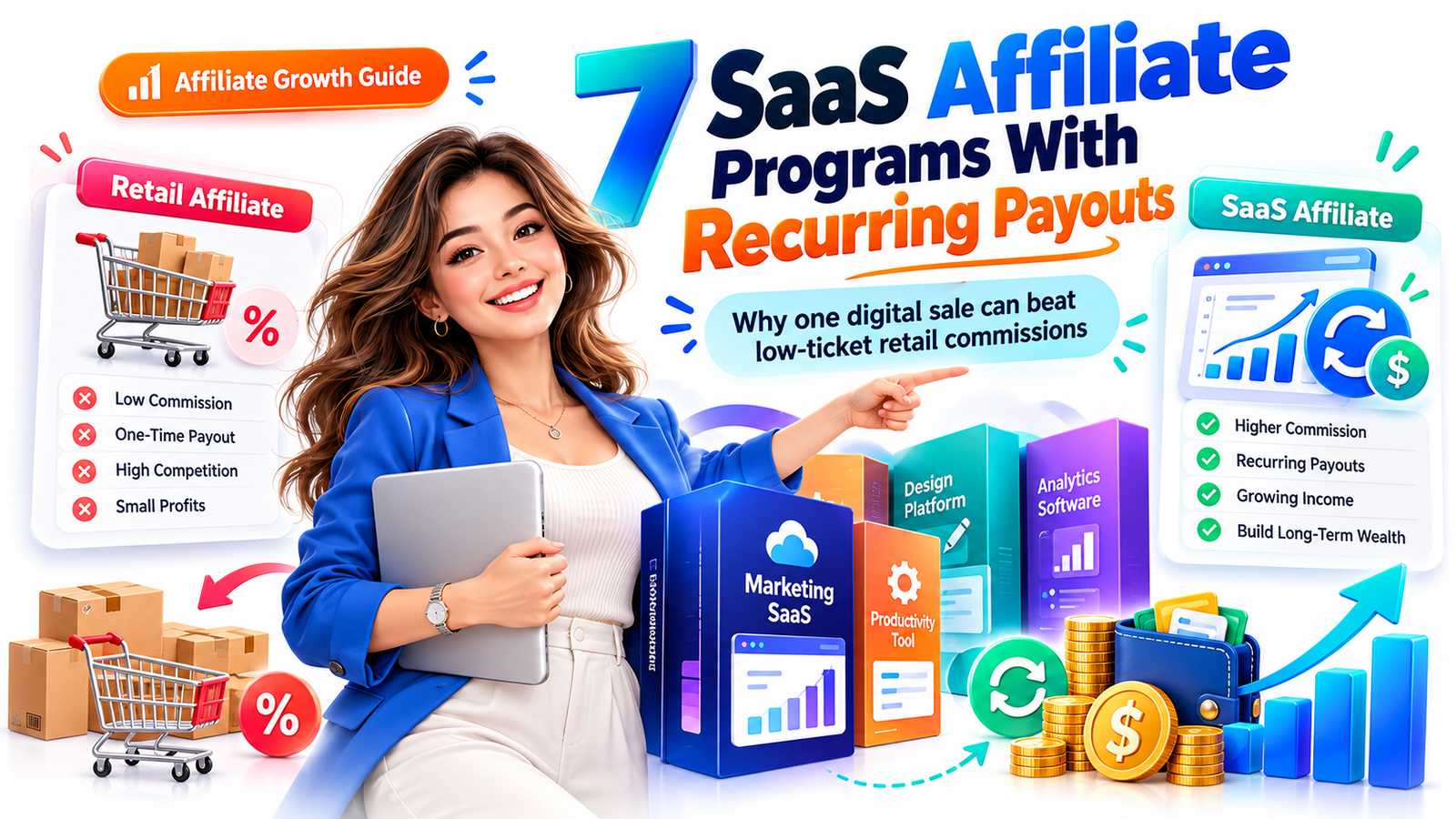
Stop Chasing 3% Amazon Payouts: Why Digital SaaS Affiliates Can Earn Far More Per Sale
If you are publishing affiliate content every week but still need dozens of orders to generate meaningful income, the problem may not be your traffic.
It may be the economics of the products you are promoting.
Imagine sending 1,000 highly targeted visitors to two different offers.
The first is a physical product marketplace where a buyer might spend $30, $50, or $80 and you receive a small percentage of the transaction.
The second is a digital SaaS platform charging $100 per month and paying a recurring commission of 40%.
One successful SaaS referral could generate $40 from the first payment alone. If the customer remains subscribed for 12 months under an eligible recurring structure, the same referral could theoretically produce $480 before considering upgrades, downgrades, refunds, commission limits, or program changes.
That is fundamentally different from chasing another one-time retail order.
This is why some bloggers, YouTubers, newsletter publishers, SEO professionals, AI creators, software reviewers, consultants, and niche-site owners are increasingly building content around recurring commission affiliate programs, digital products and SaaS affiliate programs rather than relying entirely on low-ticket physical products.
There is one important clarification before going further: Amazon does not have one universal 3% commission rate. Current U.S. Amazon Associates standard rates differ by product category. Several popular categories currently pay 3%, while others pay 1%, 2%, 4%, 4.5%, 5%, 10%, or another applicable rate. Amazon also generally uses a 24-hour shopping session for standard affiliate attribution.
So the real question is not:
“Is Amazon affiliate marketing bad?”
It is:
“How much affiliate revenue can each qualified visitor and each converted customer realistically produce?”
That is where the mathematics becomes eye-opening.
The Affiliate Metric Most Beginners Ignore: Revenue Per Converted Customer
Affiliate marketers frequently obsess over traffic.
“How do I get 100,000 monthly visitors?”
“How can I increase Pinterest clicks?”
“How do I rank another product review?”
“How do I get more Amazon clicks?”
Traffic matters, but traffic by itself does not pay you.
A more useful question is:
What is one converted customer worth to your affiliate business?
Consider a simplified example.
Suppose an Amazon-category product sells for $40 and qualifies for a hypothetical 3% commission.
Your commission would be:
$40 × 3% = $1.20
Now suppose you recommend a $100-per-month SaaS platform paying a 40% recurring commission.
Your first-month commission could be:
$100 × 40% = $40
That means one such SaaS conversion would equal roughly 33 commissions of $1.20 before considering future recurring payments.
If that SaaS customer remained eligible and subscribed for an entire year:
$40 × 12 months = $480
You would need 400 commissions of $1.20 to produce the same $480.
This does not mean SaaS automatically converts better. It often requires more trust, stronger purchase intent, better product education, and a more sophisticated sales journey.
But it explains why smart affiliate strategy is not simply a traffic game.
It is an economics game.
The Math Behind “One $100 Digital Sale Beats 50 Amazon Orders”
This headline requires context because the answer depends on average order value, commission rate and the digital program involved.
Assume 50 physical-product orders average $20 each and earn 3%.
Total referred sales:
50 × $20 = $1,000
Affiliate earnings:
$1,000 × 3% = $30
Now compare that with one $100 SaaS subscription paying 40%.
First payment:
$100 × 40% = $40
In that example, one digital subscription has already generated more commission than 50 $20 retail orders.
But suppose those 50 retail orders averaged $50 instead.
50 × $50 × 3% = $75
Now the physical-product commissions beat the SaaS referral during month one.
However, if the SaaS referral continues paying $40 per month, month two takes cumulative commission to $80, month three to $120, and month twelve could take it to $480 where the affiliate program allows recurring commission for that full period.
That recurring component changes the business model.
Instead of starting from zero every morning, part of your previous work may continue producing revenue.
That is the attraction of recurring affiliate income.
It is not magic passive income. Customers cancel. Programs modify terms. Refunds happen. Attribution fails. Commission percentages differ by tier.
But the underlying economics can be dramatically more attractive.
Why SaaS Companies Can Sometimes Pay 40%, 50% or Even 60%
A retailer selling physical goods has costs that a software company may not carry in exactly the same way.
Physical commerce can involve manufacturing, packaging, freight, warehousing, fulfilment, returns, damaged goods and inventory management.
Software economics are different.
A SaaS company still has serious expenses—software development, cloud infrastructure, customer support, cybersecurity, payment processing, sales, marketing and employee costs—but once a software product exists, providing another customer access does not require shipping another physical object.
More importantly, subscription companies think in terms of customer lifetime value.
If a company acquires a customer paying $100 every month and that customer remains for a long period, sharing a substantial percentage of early revenue with the affiliate who acquired that customer can make economic sense.
That is why recurring affiliate programs can afford commissions that initially look unusually generous when compared with physical retail programs.
7 Digital Affiliate Programs That Can Reach 40%+ Recurring Commissions
Affiliate terms change frequently, so percentages should always be verified directly before publishing promotional claims. The programs below were checked against official information available in October 2026.
Not every program starts every new affiliate at 40%. Several use performance tiers. What matters is that each currently advertises a pathway to 40% or more recurring commission.
1. systeme.io — 60% Lifetime Recurring Commission
For creators whose audiences want sales funnels, email marketing, online courses, websites, automation or digital-business infrastructure, systeme.io immediately stands out.
Its current affiliate information states that affiliates can earn 60% on systeme.io sales, with recurring commission continuing while the referred subscriber remains an eligible paying customer. The company describes the attribution as lifetime rather than a conventional short cookie window.
That combination makes it particularly interesting for content such as:
“Best all-in-one marketing platform for beginners”
“systeme.io vs ClickFunnels”
“How to create a sales funnel without expensive software”
“Best online course platform for new creators”
“How to launch a digital product business”
The conversion advantage comes from matching the offer with a specific problem rather than simply inserting an affiliate link into a generic article.
Someone searching “What is a sales funnel?” has educational intent.
Someone searching “systeme.io pricing vs ClickFunnels pricing” is much closer to a purchase.
That second visitor is considerably more valuable.
2. Kit — 50% Monthly Commission for the First 12 Months
Kit, formerly ConvertKit, is built primarily for creators using email to build audiences and businesses.
Kit currently says its affiliate program pays 50% monthly commission for up to 12 months on referred customers. It also states that qualifying affiliates at certain status levels may earn an additional 10%–20% recurring commission after those first 12 months.
That makes Kit highly relevant to bloggers, authors, newsletter publishers, coaches, YouTubers and digital-product sellers.
Instead of publishing another vague “best email marketing tools” article, a higher-intent content cluster could include:
“Kit vs MailerLite for paid newsletter creators”
“Kit pricing explained for a 5,000-subscriber newsletter”
“Best email platform for selling ebooks”
“How creators can automate a welcome sequence in Kit”
“Is Kit worth paying for after the free plan?”
These queries attract visitors who are already evaluating a purchase rather than merely learning what email marketing means.
3. beehiiv — Up to 60% of Referral Payments for 12 Months
Newsletter businesses have become their own software category, and beehiiv has developed a partner program around that audience.
Its current partner page says eligible partners can collect up to 60% of referral payments for 12 months. The program uses conversion-based tiers, so publishers should check their exact current tier rather than assuming every new participant automatically receives the maximum rate.
beehiiv can fit naturally into content aimed at:
Newsletter creators
Media startups
Bloggers building owned audiences
Course creators
Community operators
Creators moving away from social-platform dependency
A high-converting article does not need to shout “BUY BEEHIIV.”
It can answer a buying question such as:
“beehiiv vs Substack: Which one makes more sense when you want to turn a newsletter into a business?”
That is both useful to the reader and commercially aligned.
4. AWeber — 30% to 50% Recurring for the Lifetime of Paid Accounts
AWeber remains interesting because its Advocate Program is structured around long-term recurring referrals.
AWeber currently states that advocates can earn 30% to 50% recurring commission, depending on the applicable commission tier, for the lifetime of eligible paid accounts. Its documentation also lists a 90-day cookie duration.
The important phrase here is up to 50%.
A new affiliate should not advertise “I earn 50%” unless that is genuinely the tier applicable to their account.
A better article would explain the product first, identify who it suits, show where it may not be ideal, compare alternatives and then give readers a clear next action.
Trust converts better than aggressive promotion.
5. GetResponse — 40% for 12 Months at the Starting Tier
GetResponse made a significant affiliate-program change in 2026.
Its updated PartnerStack-based program lists a starting Bronze tier of 40% commission for 12 months. Affiliates hitting specified referral thresholds can move to 50% and eventually 60% for 12 months on qualifying referrals. GetResponse also lists a 90-day referral cookie in its current affiliate information.
That makes the program particularly relevant for content around:
Email marketing automation
Lead generation
Landing pages
Small-business marketing
Creator funnels
AI-assisted email campaigns
Webinars
List building
A commercially useful article might compare the cost of assembling five separate marketing tools against using one integrated platform.
The affiliate recommendation then becomes part of the solution rather than an interruption.
6. Moosend — Up to 40% Lifetime Recurring Commission
Moosend currently uses a tiered affiliate structure starting at 30% recurring commission and increasing as affiliates generate more paid accounts.
Its published tiers rise through 33%, 35% and 37%, reaching 40% recurring commission at the Diamond level, currently associated with 36 or more paid referred accounts. The company states that recurring commissions can continue while the referred customer remains a paying customer.
That makes Moosend a useful example of an important affiliate principle:
Your commission structure can improve as your distribution improves.
An established affiliate with an email list, ranking comparison pages, YouTube tutorials and evergreen software reviews may therefore have very different unit economics from a beginner promoting the same tool.
This is why serious affiliates should track the commission tier they are actually earning rather than relying on the headline rate on a partner page.
7. Kartra — Up to 40% Recurring for 12 Months
Kartra targets businesses needing funnels, email marketing, memberships, automation and other digital-sales functions.
Its current affiliate material advertises up to 40% recurring commission for the first 12 months of qualifying referrals. Kartra also states that the program does not currently offer lifetime recurring commissions under this structure.
That last detail matters.
“Recurring” does not automatically mean “lifetime.”
Affiliate marketers should distinguish between:
Recurring for 12 months
Recurring for 24 months
Lifetime recurring
Tier-limited recurring
Recurring while the subscription remains active
Using precise language is good for compliance, reader trust and long-term search visibility.
What the Seven Programs Reveal About Affiliate Marketing in 2026
The most important insight is not that everyone should immediately abandon Amazon Associates.
Amazon has extraordinary consumer trust, enormous product selection and strong purchase intent. For product-focused sites, it can still be an effective monetization channel.
The smarter approach is often diversification.
A technology blogger might recommend physical equipment through Amazon while monetizing software tutorials through recurring SaaS programs.
A photography publisher might promote cameras and lenses alongside editing software, cloud storage, portfolio platforms and email tools.
A business site could monetize books and office equipment while also covering CRMs, website builders, AI platforms and marketing automation tools.
The winning model is not necessarily Amazon versus SaaS.
It can be Amazon plus higher-value digital offers.
The 24-Hour Affiliate Profit Test
Before publishing your next affiliate article, ask:
If this page converts one customer today, what is that customer potentially worth?
Consider three fictional offers.
Offer A produces a $2 commission.
Offer B produces a $40 one-time commission.
Offer C produces $40 per month for up to 12 months if the customer remains subscribed and all program conditions continue to be met.
You might need:
20 Offer A sales to earn $40.
One Offer B sale to earn $40.
One Offer C sale to earn $40 this month—and potentially additional commissions later.
Suddenly, keyword selection changes.
Content strategy changes.
Your CTA changes.
The quality of visitor you want changes.
You stop asking:
“How do I get the maximum possible clicks?”
And start asking:
“How do I attract people who genuinely need this solution?”
That is a far healthier affiliate business model.
Buyer Intent Beats Traffic Volume
A page receiving 20,000 informational visits can earn less than a page receiving 800 purchase-ready visits.
Search queries reveal different levels of intent.
A person searching:
“what is email automation”
is learning.
Someone searching:
“best email automation software”
is comparing.
Someone searching:
“GetResponse vs Kit”
is evaluating specific options.
Someone searching:
“GetResponse pricing for 10,000 subscribers”
is potentially much closer to buying.
This is why profitable SaaS affiliate marketing is often built around commercial investigation and transactional search intent.
Strong topics include comparisons, alternatives, pricing breakdowns, tutorials, migrations, use-case reviews, implementation guides and problem-specific software recommendations.
A visitor should finish your article knowing three things:
What problem the software solves.
Who should and should not buy it.
What they should do next.
The Content Funnel That Turns New Visitors Into Returning Visitors
The first visit should answer the immediate question.
The second visit should help the reader make a better decision.
The third may produce the conversion.
Instead of treating each article as a dead-end review, build connected resources.
A visitor reading “Best Email Marketing Software for Creators” should naturally discover your comparison between Kit, GetResponse, AWeber and Moosend.
Someone reading the comparison may later want a pricing breakdown.
The pricing reader might return for a setup guide.
The setup guide may lead to a free trial.
This is how a search visitor becomes a returning visitor and eventually a buyer.
Give readers a reason to bookmark your page as well. Affiliate programs change pricing, feature sets, eligibility requirements and commission structures. A comparison page that is visibly maintained and periodically rechecked can become more useful than a one-time “Top 10” post abandoned after publication.
If you are returning to this guide after reading it previously, check the program sections again before choosing your next campaign. Commission terms are one of the fastest-changing variables in affiliate marketing.
Do Not Promote the Program With the Highest Commission Just Because It Pays More
A 60% affiliate commission attached to the wrong product can earn less than a 20% program attached to a product your audience genuinely wants.
Imagine two offers.
Software A pays 60% but is poorly matched to your readers.
Software B pays 30% but solves the exact problem that brought them to your article.
If 1,000 visitors produce one Software A customer but ten Software B customers, the smaller percentage can easily become the more profitable offer.
So when evaluating the best SaaS affiliate programs, score them on more than commission percentage.
Think about product-market fit, pricing, customer reputation, refund risk, conversion friction, subscription retention, attribution rules, cookie duration, recurring period, brand demand and how naturally the product fits your existing content.
The best affiliate program is not necessarily the one displaying the largest number.
It is the program with the strongest combination of audience fit × conversion rate × commission × retention.
A Better Formula for Affiliate Revenue
A useful simplified model is:
Affiliate Revenue = Qualified Traffic × Conversion Rate × Commission per Customer × Retention
Suppose Website A receives 10,000 monthly visitors.
One percent convert.
Average affiliate commission is $2.
Approximate revenue:
10,000 × 1% × $2 = $200
Now imagine Website B receives only 2,000 highly targeted visitors.
Two percent convert.
Average initial commission is $40.
Approximate first-payment revenue:
2,000 × 2% × $40 = $1,600
The second site has one-fifth the traffic yet produces eight times the illustrative affiliate revenue.
Those numbers are examples, not income guarantees, but they reveal why affiliate publishers should optimize for economic value rather than vanity traffic.
How to Build a 24-Hour High-Intent SaaS Affiliate Campaign
You do not need 50 articles before testing a digital affiliate offer.
Start with one problem.
Choose one software category.
Identify one audience.
Then create one high-intent piece of content that solves the buying question completely.
For example:
Audience: freelance designers.
Problem: managing leads manually.
Software category: CRM.
Content angle: “Best Simple CRM for Freelance Designers Who Hate Complicated Sales Software.”
Inside the article, explain the workflow, compare relevant alternatives, discuss cost, identify limitations, show who each tool is suitable for, answer objections and provide a natural trial or signup CTA.
Then support that article with a tutorial, comparison article and FAQ page.
A small cluster of highly relevant content can have more commercial power than dozens of disconnected affiliate posts.
Use CTAs That Help the Reader Decide
Weak CTA:
Buy now.
Better CTA:
See current plans and check whether the features you need are included.
Weak CTA:
Get this amazing software today!
Better CTA:
Compare the available plans before moving your existing email list.
Weak CTA:
Don’t miss out!
Better CTA:
Start with the free plan or trial and test the workflow before committing to a paid subscription.
Buyer-intent content performs best when the CTA feels like the logical next step in the decision process.
The purpose of your article is not to pressure the reader.
It is to reduce uncertainty.
Trust Is a Conversion Strategy
There is another mistake that destroys affiliate sites: pretending every product is perfect.
Readers know better.
A trustworthy SaaS review should explain disadvantages.
Maybe a platform is expensive for large contact lists.
Maybe advanced features require a higher plan.
Maybe the interface has a learning curve.
Maybe the affiliate program itself has tier requirements.
Maybe a competing product is genuinely better for a particular user.
Saying so can increase credibility.
And when affiliate relationships are involved, disclosure matters. FTC guidance says affiliate relationships should be disclosed clearly and conspicuously so readers understand that the publisher may receive compensation from purchases or referrals. The disclosure should be easy to notice and placed close enough to the endorsement or affiliate relationship to be meaningful.
A transparent recommendation can outperform an exaggerated one because readers feel they are making an informed decision rather than being pushed into a sale.
Why Recurring Commission Changes the Way You Value Content
A physical-product affiliate article may create a sale once.
A recurring SaaS referral has the potential to create a stream of commissions from the same acquisition.
That means an article published today may have two layers of value:
New visitors generating new referrals.
Existing referred customers potentially generating eligible recurring commissions.
This is closer to building an affiliate revenue portfolio than simply collecting individual transactions.
Consider ten hypothetical customers each paying $100 per month under a 40% recurring structure.
Monthly gross commission while all ten remain active and eligible:
10 × $100 × 40% = $400
Twenty active referrals:
$800 per month
Fifty:
$2,000 per month
One hundred:
$4,000 per month
These are mathematical illustrations, not expected-income claims. Real customers cancel, pricing changes, programs impose restrictions and not every commission is approved.
But the model explains why affiliates care so much about recurring revenue.
The Hidden Multiplier: Customer Retention
Affiliate beginners focus on conversion.
Experienced SaaS affiliates also pay attention to retention.
Suppose Offer A pays 50% but customers stay an average of two months.
Offer B pays 30% but customers remain subscribers for three years.
Depending on the programs’ commission-duration rules, Offer B may ultimately have far better affiliate economics.
That means product quality matters financially.
Recommend software people continue using, and recurring commissions have a chance to compound.
Recommend products because the commission banner looks attractive, and cancellations can destroy the economics.
Should You Stop Promoting Amazon?
Not necessarily.
Amazon works especially well where readers naturally want physical products.
Think:
Kitchen equipment
Home improvement tools
Books
Pet supplies
Photography gear
Office equipment
Beauty products
Hobby equipment
Consumer electronics
For these searches, sending someone to a trusted retail marketplace can make perfect sense.
The mistake is assuming that all of your affiliate content must use the same monetization model.
A business-content publisher can promote books through Amazon and business software through SaaS partner programs.
A creator site can recommend cameras through retail programs and email, website, newsletter and automation tools through recurring affiliate partnerships.
The goal is not ideological loyalty to one affiliate network.
The goal is matching each reader with the most relevant solution.
Five Questions Readers Ask About High-Commission SaaS Affiliate Programs
1. Are 40% recurring affiliate programs legitimate?
Yes, some established SaaS businesses currently advertise recurring commission structures at 40% or higher, although eligibility, duration and tiers vary. For example, GetResponse currently starts its newer affiliate structure at 40% for 12 months, systeme.io advertises 60% lifetime recurring commission, and Kit advertises 50% monthly commission for up to 12 months. Always confirm the current official terms before publishing a commission claim.
2. Is recurring affiliate marketing better than Amazon Associates?
Neither is automatically better. Amazon can convert strongly for physical-product searches because customers already trust the marketplace. Recurring SaaS affiliate programs can offer greater customer value when your audience is searching for software or business solutions. The best option depends on audience intent, conversion rate, order value, commission structure and retention.
3. How much can one $100 SaaS customer generate at 40% commission?
A $100 eligible payment at 40% produces a $40 commission. If the same $100 payment repeats for 12 months and all 12 payments remain commissionable at 40%, the mathematical total would be $480. This is only an illustration; real programs have their own terms, refund policies, eligibility rules and commission periods.
4. What type of affiliate content converts best for SaaS?
High-intent content generally includes product comparisons, alternatives, pricing articles, use-case guides, setup tutorials, migration guides and reviews answering specific buyer questions. “Kit vs GetResponse for creators” is typically closer to a purchase decision than a broad article explaining what email marketing is.
5. Can beginners succeed with recurring affiliate programs?
Yes, but beginners should focus on audience relevance rather than chasing the highest advertised commission. One useful article that solves a specific buying problem can be more valuable than publishing dozens of generic AI-generated “best software” lists. Use the product when practical, understand its limitations, create original screenshots or demonstrations where permitted, answer real objections and disclose your commercial relationship clearly.
Stop Measuring Affiliate Success by Order Count
Fifty orders sounds impressive.
One order sounds small.
But order count without revenue context is a vanity metric.
One customer producing a $40 commission may be more valuable than dozens of small transactions.
One customer producing eligible recurring commissions may be worth considerably more over time.
And one piece of high-intent content attracting serious software buyers can outperform a large library of generic product-roundup articles.
The opportunity for affiliate marketers in 2026 is not simply to chase higher percentages.
It is to build content around higher-value problems.
Find the reader who is already comparing solutions.
Answer the questions blocking the purchase.
Show the mathematics.
Explain the drawbacks.
Recommend the right product, not merely the most profitable one.
Give the visitor a sensible next step.
And build enough useful related content that the first-time visitor has a reason to return before making a decision.
Amazon Associates can still belong in that strategy. Physical-product affiliate marketing can still work. But if your audience buys software, marketing platforms, creator tools, email services, automation products or other subscriptions, ignoring high-quality recurring SaaS affiliate programs can mean ignoring one of the most attractive economic models available to an affiliate publisher.
Before producing another ten low-value product reviews, calculate the potential value of one qualified customer.
That number may change what you publish next.
Stay ahead with exclusive updates
Join our community. Get curated industry trends, actionable guides, and fresh resources delivered straight to your inbox.