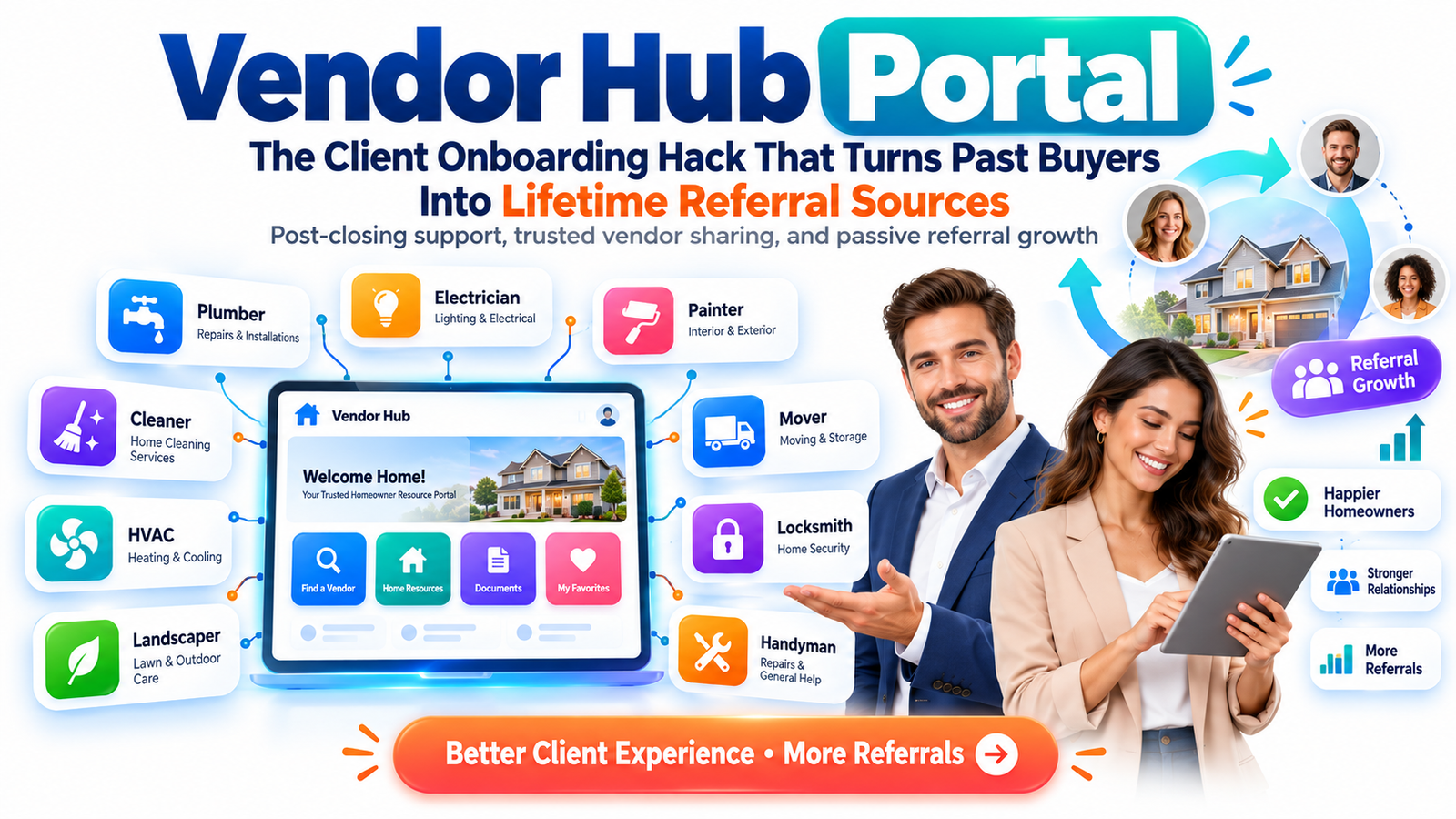
Vendor Hub Portal: The Client Onboarding Hack That Turns Past Buyers Into Lifetime Referral Sources
Closing day feels like the finish line.
For the client, however, it is often the beginning of a completely different journey.
The keys are handed over. The photos are taken. Everyone celebrates. Then, within days, the new homeowner starts asking questions nobody discussed at the closing table.
Who should I call for plumbing?
Do you know a reliable electrician?
Who handles lawn care in this neighborhood?
Can you recommend a painter?
What about HVAC service?
Do you know someone who can install security cameras?
Who should I contact if I want to remodel the kitchen next year?
For many real estate professionals, these questions become random text messages scattered across months or years.
For a well-organized agent, they become one of the most powerful client-retention and referral opportunities in the business.
That is where a Vendor Hub Portal changes the post-closing experience.
Instead of giving clients a few business cards or sending contractor names one at a time, you can create a centralized homeowner resource containing trusted service providers, useful property information, maintenance resources and future real estate support.
The result is simple: your usefulness does not disappear when the transaction closes.
You remain connected to the client long after the commission check clears.
And when someone in their family, neighborhood or workplace needs a real estate professional, your name is much easier to remember.
What Is a Vendor Hub Portal?
A Vendor Hub Portal is a digital resource center created for buyers, homeowners and past clients.
It can be built using a simple website, private webpage, Notion workspace, client portal, CRM resource page, PDF-linked directory or another easy-to-access platform.
Its purpose is to organize the homeowner resources clients repeatedly need after purchasing a property.
Instead of sending a generic “Congratulations on your new home” email and disappearing, the agent gives the buyer an ongoing support system.
A well-designed real estate vendor portal might include categories such as:
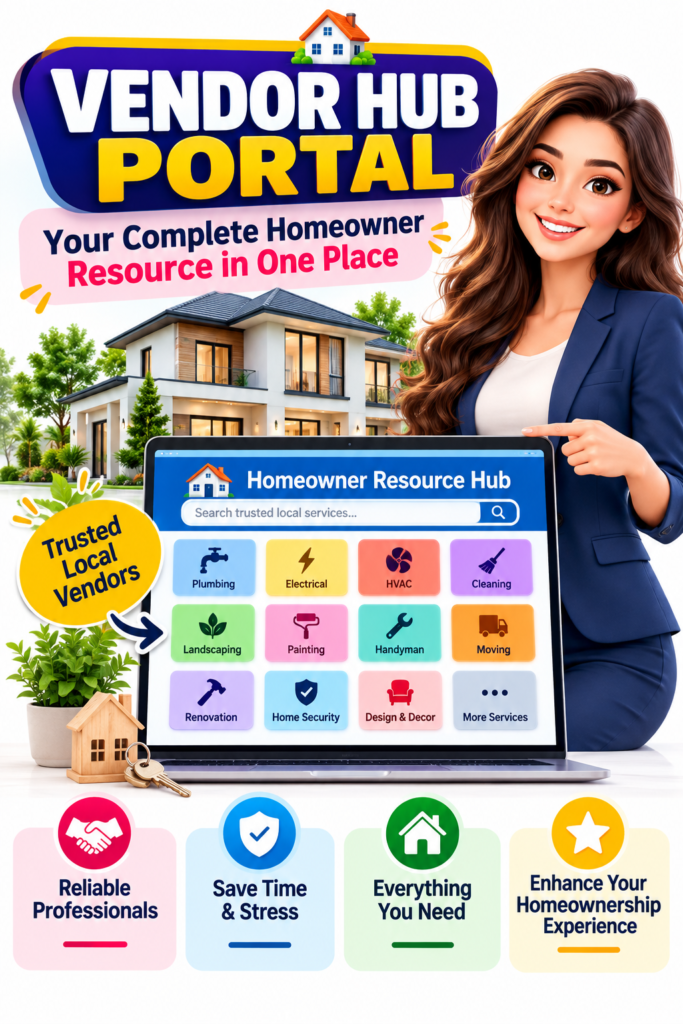
Plumbers, electricians, HVAC technicians, painters, roofers, landscapers, cleaners, movers, locksmiths, pest-control providers, handymen, appliance repair companies, home-security installers, pool services, interior designers, organizers, contractors and property-maintenance professionals.
The portal can also contain utility information, local service contacts, seasonal maintenance checklists, neighborhood resources, home-improvement planning tools and guidance about contacting the agent when future real estate questions arise.
The real value is not simply the vendor list.
The value is convenience.
A homeowner suddenly has one place they can return to whenever something around the property needs attention.
Your brand becomes associated with that convenience.
Why Post-Closing Experience Matters More Than Many Agents Realize
Real estate marketing often focuses heavily on finding the next lead.
Agents run advertisements.
They purchase leads.
They post on social media.
They host open houses.
They send prospecting emails.
They create listing content.
All of those activities can be valuable.
But one of the most underused opportunities is sitting inside the agent’s existing database.
Past buyers already know who you are.
They have already experienced your communication style.
They have already trusted you during a major financial transaction.
Instead of treating the closing as the end of the relationship, agents can turn it into the beginning of a long-term homeowner service relationship.
A useful Vendor Hub Portal helps make that possible without requiring constant manual communication.
Every time the client returns to the portal, your business receives another subtle brand impression.
That matters.
People do not always refer the professional who completed a transaction years ago.
They are more likely to refer the professional who continues to feel relevant.
The Real Client Onboarding Hack: Extend Onboarding Beyond Closing Day
Most agents think onboarding happens before the transaction.
Collect client information.
Explain the process.
Set expectations.
Schedule showings.
Introduce lenders.
Prepare documents.
Guide inspections.
Coordinate the closing.
But homeowner onboarding should continue after the buyer receives the keys.
The first weeks of homeownership often create new questions.
Clients may need help setting up utilities, choosing contractors, understanding local services or deciding which improvements deserve immediate attention.
A post-closing onboarding system can answer many of those questions before the client has to ask.
Imagine sending this message shortly after closing:
“Welcome home. I created a homeowner resource hub for you with local service professionals, maintenance resources and useful contacts. Save the link because I’ll continue improving the resource over time.”
That message changes your positioning.
You are no longer just the person who helped them buy the property.
You become part of their homeowner support network.
What Should Be Inside a High-Value Vendor Hub?
The strongest portals are not giant directories containing hundreds of random businesses.
They are curated.
Clients should be able to find useful information quickly, especially on a phone.
Start with the services homeowners need most often.
Emergency and Essential Home Services
Put urgent services near the top.
A homeowner with a leaking pipe at 9:00 p.m. does not want to search through 70 categories.
Consider including quick-access sections for plumbers, electricians, HVAC services, locksmiths, roof repair, water-damage restoration and other appropriate emergency services.
Make phone numbers easy to locate on mobile devices.
When possible, include business hours and service areas.
Moving and New-Home Setup
Recent buyers may still need movers, cleaners, storage providers, internet providers, security services, furniture delivery support or professional organizers.
These resources make the portal useful immediately after closing rather than months later.
Home Maintenance Professionals
Create separate categories for routine property care.
This may include landscaping, lawn maintenance, pest control, gutter cleaning, pool maintenance, window cleaning, pressure washing, appliance repair, handyman services and seasonal maintenance.
The easier you make homeownership, the more useful your brand becomes.
Renovation and Improvement Resources
Clients frequently begin planning improvements after living in the property for a while.
Useful categories may include painters, flooring professionals, kitchen remodelers, bathroom contractors, carpenters, interior designers, cabinet specialists and general contractors.
This section creates a natural reason for clients to revisit your portal months or years after their purchase.
Property and Transaction Professionals
Depending on local rules and your brokerage policies, the resource center may also include appropriately presented contacts for relevant professional services.
These might include inspectors, surveyors, attorneys, insurance professionals, tax professionals or other specialists.
Avoid presenting specialized legal, tax, insurance or financial guidance as your own professional advice unless you are properly licensed to provide it.
Homeowner Education
The Vendor Hub becomes significantly more valuable when it contains helpful information rather than only contact details.
Consider adding content such as:
“Your First 30 Days After Closing”
“Seasonal Home Maintenance Checklist”
“How to Prepare Your Home Before a Storm”
“Questions to Ask Before Hiring a Contractor”
“Home Improvement Records Every Owner Should Keep”
“When to Contact Your Real Estate Agent Again”
These resources can also support your organic content strategy.
Each useful topic can become a blog post, downloadable checklist, email newsletter, social post or searchable FAQ.
Do Not Build a Vendor List. Build a Homeowner Experience.
There is an important difference.
A spreadsheet containing business names is a vendor list.
A carefully structured resource that helps clients solve homeownership problems is an experience.
Presentation matters.
Instead of:
Plumber: ABC Plumbing — 555-0000
Consider presenting information in a structured format:
Plumbing
Services: Repairs, leak detection, fixture installation
Coverage area: Local service area
Contact options: Phone, website or booking information
Notes: Contact provider directly for pricing, scheduling, licensing and availability
You can also allow clients to report their experience.
That feedback helps maintain the quality of the directory.
If multiple clients consistently report poor service from a company, you can review whether that provider should remain in the portal.
The Trust Rule: Never Treat Recommendations Casually
A vendor referral affects your reputation.
If the contractor performs poorly, clients may associate the negative experience with the person who recommended the provider.
That is why agents should avoid filling a portal with companies they know nothing about simply to make the directory look impressive.
Instead, establish a vendor-review process.
You might examine professional licensing requirements where applicable, insurance documentation, public reputation, client feedback, service coverage, responsiveness and business history.
The exact verification process will depend on the service and jurisdiction.
You should also periodically review your directory.
Companies change ownership.
Phone numbers change.
Service areas change.
Businesses close.
Quality can change.
A Vendor Hub Portal should be treated as a living client resource rather than a one-time marketing project.
Add More Than One Provider When Appropriate
Providing one company for every service can create unnecessary problems.
Clients may assume the business is the agent’s official preferred provider or may think there is a formal commercial relationship.
Where practical, provide multiple options.
For example:
Need a painter? Here are three local providers clients may wish to research. Please independently confirm pricing, licensing, insurance, availability and suitability before hiring any service provider.
This gives the homeowner choice while reducing the perception that the agent is guaranteeing the quality of a particular company.
Transparency is especially important if there is any referral fee, marketing partnership, sponsorship or other financial relationship involving a listed provider.
The Referral Psychology Behind a Useful Client Portal
Referrals often happen because someone remembers the right person at exactly the right moment.
Imagine this conversation:
“My sister is moving to the area. Do you know a good agent?”
If your past buyer has not heard from you for four years, they may struggle to remember your full name.
But imagine that the same buyer used your homeowner portal last month to find a landscaper.
Your name is fresh.
Your brand is familiar.
Your usefulness was recently reinforced.
That is the power of ongoing utility.
You are creating multiple small reasons to remain memorable.
Not through constant selling.
Through relevance.
Add a Quiet Referral CTA Inside the Portal
Your portal should not look like one giant advertisement.
The primary job is to help the client.
However, strategic calls to action can transform the resource into a long-term referral system.
For example:
Know someone planning to buy or sell?
I would be happy to give them the same organized guidance and support you received. Introduce us here.
A second CTA might say:
Thinking about your next move?
Whether you are considering upgrading, downsizing, investing or simply curious about the current market value of your home, you can contact me anytime.
These CTAs work because they appear inside a resource the homeowner already values.
There is no aggressive sales pressure.
The invitation is simply available when the need arises.
Create a “Recommend Someone” Button
Your clients often know excellent local professionals you have never encountered.
Allow them to submit recommendations.
A simple form can ask for:
Business name
Service category
Contact information
Client experience
Website
Why they recommend the provider
This creates community participation while helping you discover potential vendors.
Do not automatically publish submissions.
Review them first.
The portal should remain curated.
Turn Vendor Relationships Into a Local Networking Engine
A strong Vendor Hub does not only strengthen relationships with buyers.
It may also improve your local professional network.
Imagine having trusted relationships with dozens of home-service companies.
Those providers interact with homeowners every day.
They hear questions such as:
“We’re thinking about selling.”
“My parents might be downsizing.”
“We just inherited a house.”
“We need a bigger home.”
“We might buy a rental property.”
A genuine professional relationship can create reciprocal awareness.
However, the objective should never be to build questionable referral arrangements.
The strongest network is based on shared customer service, transparency and local reputation.
When the vendor helps your client well, everybody benefits.
Create Local Versions for Better GEO and Search Visibility
A generic vendor page may help clients.
A well-designed local homeowner resource can also support geographic search visibility.
Instead of publishing only a page called:
Recommended Vendors
consider creating useful local resources such as:
Homeowner Resource Guide for [City]
Trusted Home Services in [Neighborhood]
Moving to [City]: Local Homeowner Services and Resources
New Homeowner Checklist for [City] Buyers
Best Types of Home Services to Set Up After Buying in [City]
These pages naturally answer location-specific questions that buyers and homeowners may search online.
Local relevance can also strengthen your broader content ecosystem.
A person searching for a contractor resource today may become a seller, investor or repeat buyer later.
Make the Portal AEO-Friendly
Search behavior is changing.
People increasingly ask full questions instead of typing short keyword phrases.
Your content should answer those questions directly.
For example:
What services do new homeowners usually need after closing?
Most buyers initially need utilities, locksmith services, cleaning, internet setup, moving help, basic repairs and routine property maintenance. Over time, they may also need landscaping, HVAC servicing, plumbing, electrical work, painting or renovation contractors.
That structure is useful for both readers and answer-oriented search experiences.
Use clear headings followed immediately by concise answers.
Then expand with useful details.
This improves usability while helping search systems understand the purpose of the page.
Make the Portal Easy for AI Search Systems to Understand
Modern search discovery is increasingly influenced by structured, clearly organized information.
That does not mean writing robotic content.
It means making your expertise easy to interpret.
Use descriptive section headings.
Explain locations clearly.
Identify service categories.
Answer common homeowner questions.
Keep business information current.
Provide context around each recommendation.
Link supporting articles together.
Maintain consistent naming.
When helpful, use appropriate structured data on public resource pages.
For example, your site architecture might connect:
Buyer guide → closing checklist → homeowner portal → maintenance guide → neighborhood resources → seller preparation guide.
That creates a useful information network rather than isolated blog posts.
The Smart Follow-Up System That Keeps Clients Returning
A Vendor Hub becomes significantly more powerful when clients have reasons to revisit it.
Try a simple seasonal follow-up system.
Spring
Send a homeowner spring maintenance checklist.
Link to landscaping, HVAC, pest-control and cleaning resources.
Summer
Share cooling-system maintenance, exterior care, pool services or renovation planning resources.
Fall
Send a seasonal preparation guide.
Link gutter, roofing, heating and exterior maintenance providers where appropriate.
Winter
Share cold-weather property tips relevant to your market.
Link to emergency plumbing, heating, electrical or weather-related services as appropriate.
You are not sending “Do you know anyone who wants to buy a house?” four times a year.
You are sending something useful.
The referral opportunities happen naturally because your relationship stays active.
Add a Home Anniversary Touchpoint
One of the easiest referral opportunities is the client’s home purchase anniversary.
Instead of sending only:
“Happy home anniversary!”
send something useful.
“Happy one-year home anniversary. I hope you’re still enjoying the property. I also updated the homeowner resource hub with several additional local service categories. Here is the link in case you ever need it.”
Then add a light invitation:
“If anyone you know is planning a move this year, I’m always happy to help.”
Useful first.
Referral CTA second.
That order matters.
Create a Home Value Return Path
Past buyers eventually become future sellers.
Some become investors.
Some relocate.
Some purchase vacation properties.
Some help children buy homes.
Your Vendor Hub should include a natural pathway back into your real estate services.
You might add:
Curious What Your Home Is Worth Today?
Request a personalized property value review.
Or:
Planning Your Next Move?
Book a homeowner strategy conversation.
This transforms the portal from a post-closing service into a long-term client lifecycle platform.
Connect the Portal to Your CRM
One of the biggest advantages of creating a digital post-closing system is that it can connect with your broader real estate CRM workflow.
Your database could organize clients by:
Closing date
Property location
Home anniversary
Neighborhood
Buyer type
Investor status
Likely future real estate needs
Engagement with homeowner resources
You do not need to overwhelm clients with automation.
The goal is thoughtful communication.
A simple system may include:
Closing-day welcome
Seven-day homeowner resource message
Thirty-day check-in
Seasonal maintenance email
Quarterly market update
Home anniversary message
Annual property review invitation
Occasional referral reminder
This creates consistency without forcing the agent to manually remember every touchpoint.
Turn One Vendor Hub Into Dozens of Content Assets
Another advantage of a portal is content efficiency.
Suppose you have a section about landscaping.
That topic can become:
A local landscaping resource page
A spring homeowner email
A social media post
A short video
A downloadable checklist
A neighborhood maintenance article
A homeowner FAQ
A newsletter feature
A Google Business Profile post where appropriate
A seasonal client update
The same principle applies to HVAC servicing, plumbing, renovations, pest control, moving, storage and dozens of other homeowner topics.
Your Vendor Hub therefore becomes more than a referral tool.
It becomes an ongoing content engine.
Use the Portal to Build Returning Website Visitors
Most real estate websites are designed almost entirely around people who are currently buying or selling.
That creates a problem.
Past clients often have little reason to return.
A useful homeowner resource library changes that.
Instead of visiting your website only during a transaction, clients can return whenever they need help with homeownership.
This supports a much healthier audience relationship.
New visitors may discover your site through a homeowner question.
Returning visitors may come back for local vendors, maintenance advice or real estate updates.
Future sellers may request a property valuation.
Past buyers may send referrals.
Investors may return when evaluating another purchase.
One useful digital resource can serve every stage of the client lifecycle.
A Simple Vendor Hub Structure You Can Build
You do not need complicated software to launch the idea.
A clean structure might include:
Welcome Home
A short introduction explaining what the resource is and how clients should use it.
Emergency Home Services
Easy access to frequently needed contacts.
Cleaning and Moving
Useful during the first weeks after closing.
Repairs and Maintenance
Everyday homeowner support.
Renovation and Improvement
Resources for future projects.
Outdoor Property Care
Landscaping, lawn care and related services.
Local Services
Relevant community and neighborhood resources.
Homeowner Guides
Checklists, articles and practical educational material.
Real Estate Help
Home value requests, future buying, selling or investing support.
Recommend a Vendor
A submission form for clients.
Refer a Friend
A simple introduction form or contact button.
That is enough to create a highly useful first version.
Improve the portal based on actual client questions.
The Biggest Mistake: Making It Look Like a Sales Funnel
Clients should feel that the Vendor Hub exists primarily to help them.
Do not cover every page with popups.
Do not require visitors to enter their email address every time they want a plumber’s contact information.
Do not bury useful information behind aggressive lead forms.
Do not turn every recommendation into a promotional pitch.
The portal works because it builds goodwill.
Protect that goodwill.
A strong conversion system can still exist.
Use relevant CTAs where they naturally fit.
For example:
Looking for a contractor → show contractor resources.
Wondering about home value → offer property review.
Thinking about moving → offer consultation.
Know someone relocating → offer referral introduction.
Good conversion design responds to intent instead of interrupting it.
How a Vendor Hub Can Support Seller Leads Too
The strategy is not limited to buyers.
Homeowners preparing to sell often need exactly the same service providers.
They may need:
Painters
Cleaners
Landscapers
Handymen
Staging professionals
Movers
Storage providers
Repair contractors
Decluttering professionals
You can create a dedicated section:
Preparing Your Home for Sale
Then connect that resource to an appropriate consultation CTA.
“Not sure which improvements are worth doing before you list? Ask for a pre-sale property walkthrough before spending money.”
That is a high-intent conversion opportunity because the homeowner already has a real estate-related problem.
What Makes a Vendor Hub Worth Saving?
The strongest test is simple:
Would your client bookmark it?
If the answer is no, the portal probably needs improvement.
A bookmark-worthy resource is:
Easy to navigate.
Mobile friendly.
Local.
Updated.
Useful.
Clear.
Fast.
Well organized.
Transparent.
Not overloaded with advertising.
The goal is to create something your client would genuinely share with a neighbor.
Once that happens, the resource itself starts creating brand awareness.
From One Closing to an Entire Referral Ecosystem
The traditional real estate transaction has a clear ending.
The modern client relationship does not have to.
A thoughtful Vendor Hub Portal gives agents a practical way to remain helpful after closing without constantly asking past clients for business.
That distinction matters.
People usually do not want to feel like they are trapped inside an endless sales sequence.
They do appreciate professionals who continue making their lives easier.
A homeowner resource hub can create exactly that experience.
The buyer gets convenient access to useful resources.
Local service providers gain relevant visibility.
The agent stays connected to the homeowner.
Your website gains useful evergreen content.
Your CRM gains natural reasons for follow-up.
And referrals become part of an ongoing relationship rather than an occasional request.
If you already have a database of past clients, you may not need another complicated lead-generation strategy before improving what happens after the sale.
Start by identifying the 10 homeowner questions clients ask you most often.
Build those answers into one simple resource.
Add trusted service categories.
Add your homeowner guides.
Include an easy way to contact you.
Then send the portal to every new client and gradually introduce it to previous buyers.
Your next referral may not come from another advertisement.
It may come from the homeowner who needed a plumber, opened the resource you gave them two years ago and was reminded exactly why they enjoyed working with you.
Frequently Asked Questions
1. What is a real estate Vendor Hub Portal?
A real estate Vendor Hub Portal is a centralized digital resource containing useful home-service providers, homeowner guides, local resources and contact options for past clients. Agents can use it to improve the post-closing experience and remain connected with buyers after the transaction.
2. How can real estate agents get more referrals from past clients?
Real estate agents can increase referral opportunities by remaining useful after closing. Helpful homeowner resources, seasonal maintenance information, home-anniversary follow-ups, local market updates and easy referral options can keep the agent relevant without relying on aggressive referral requests.
3. What vendors should a Realtor include in a homeowner resource portal?
Depending on local needs and brokerage rules, useful categories may include plumbers, electricians, HVAC professionals, cleaners, landscapers, movers, locksmiths, painters, roofers, pest-control providers, handymen and renovation professionals. Clients should still independently evaluate any vendor before hiring them.
4. Can a Vendor Hub help generate real estate leads?
Yes, indirectly. A useful homeowner portal can encourage returning website visits and keep an agent visible to past clients. It can also include natural conversion paths for property valuations, future purchases, seller consultations and client referrals. Results will depend on audience, execution, follow-up and market conditions.
5. How often should a real estate Vendor Hub be updated?
Review the portal regularly and whenever you learn that a provider’s business information, service area or quality has changed. At minimum, agents should periodically verify important contact information and remove outdated or inappropriate listings so clients are not relying on stale resources.
Build the Relationship Clients Remember
Real estate professionals spend enormous amounts of time trying to become memorable before a transaction.
The larger opportunity may be becoming indispensable afterward.
A Vendor Hub Portal turns the post-closing period into an ongoing client experience.
It gives homeowners another reason to trust you.
Another reason to return to your website.
Another reason to save your contact information.
Another reason to mention your name when somebody they know needs an agent.
The goal is not to turn people into “referral machines.”
The goal is to create such a consistently useful client experience that referrals become a natural by-product of the relationship.
Build the resource once.
Keep improving it.
Connect it to thoughtful follow-up.
Then let usefulness do what constant self-promotion often cannot: keep your real estate brand relevant long after closing day.
Compliance Note: This article is provided for general educational and marketing information only and does not constitute legal, financial, tax, insurance, brokerage or professional licensing advice. Real estate advertising rules, referral-fee restrictions, disclosure requirements, vendor relationships, settlement-service regulations and brokerage policies vary by jurisdiction. Real estate professionals should follow applicable federal, state and local laws, fair housing requirements, RESPA where applicable, brokerage-approved procedures and relevant professional standards. Agents should not guarantee the work, pricing, licensing, insurance, availability or suitability of third-party vendors unless legally authorized to do so. Any financial relationship, referral arrangement, sponsorship or compensation involving a vendor should be reviewed for applicable disclosure and regulatory requirements. Consumers should independently evaluate service providers before entering into contracts or making purchasing decisions.
Stay ahead with exclusive updates
Join our community. Get curated industry trends, actionable guides, and fresh resources delivered straight to your inbox.