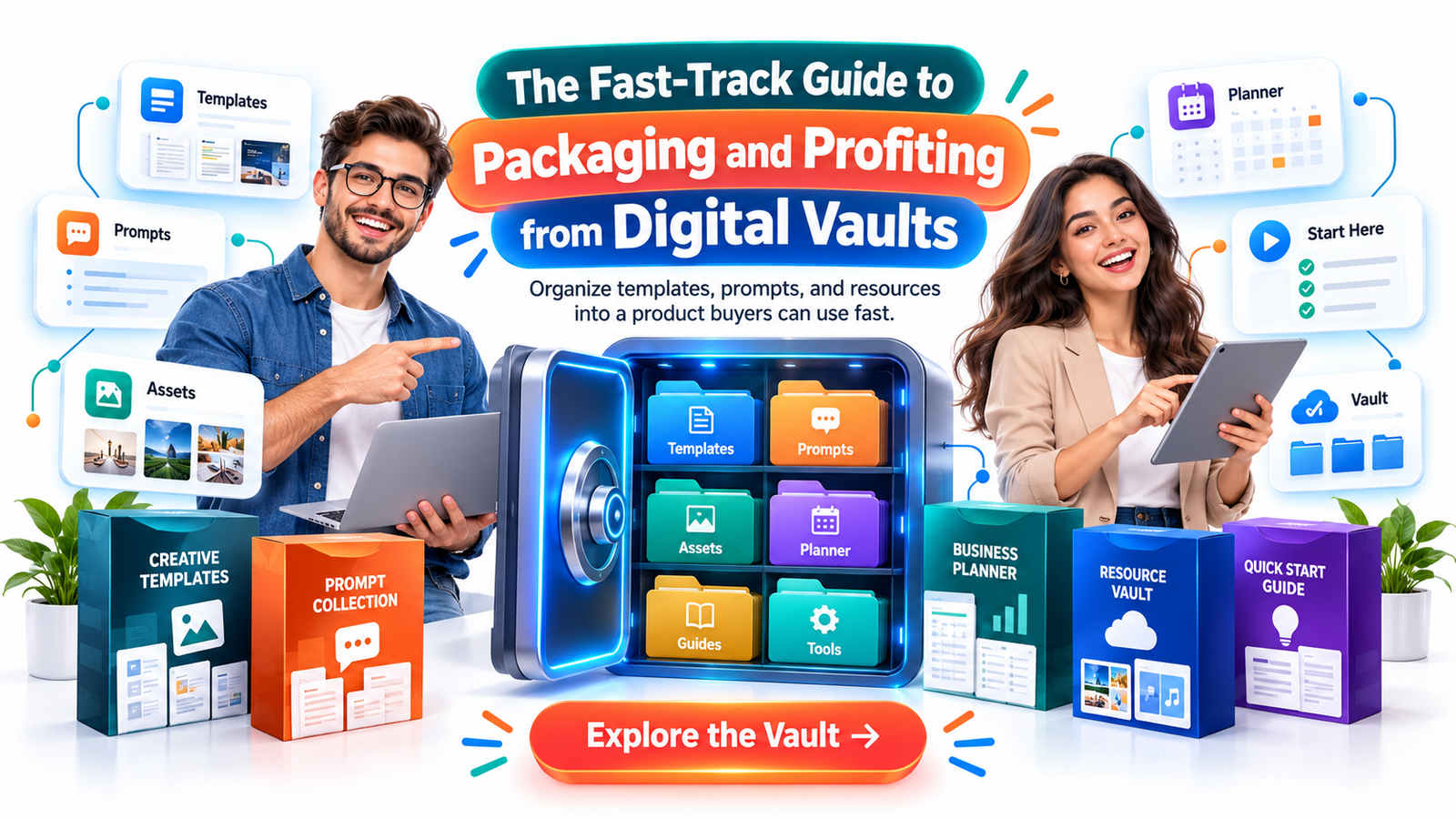
The Fast-Track Guide to Packaging and Profiting from Digital Vaults
How to Turn Ready-Made Digital Assets Into an Organized, High-Value Product That Buyers Can Understand, Access, and Start Using Immediately
Imagine opening a folder containing 500 social media templates, 200 AI prompts, 50 business spreadsheets, and dozens of ready-made marketing resources.
Everything looks valuable. But there is one problem: nobody knows where to start.
The files have confusing names. Important templates are hidden inside random subfolders. Some resources are outdated, while others require hours of customization.
Now imagine taking those exact resources, reviewing them, removing unnecessary files, organizing everything by purpose, and transforming the collection into a beautifully structured digital vault.
Suddenly, buyers can find what they need in seconds instead of spending hours searching.
That transformation—from scattered digital files into a ready-to-use resource library—is where a powerful digital product business opportunity begins.
You don’t necessarily need to create hundreds of original templates, write a 300-page eBook, or develop complicated software to sell digital products.
Sometimes, the most valuable thing you can offer is organization.
For freelancers, content creators, small business owners, online sellers, and aspiring entrepreneurs, time is often more valuable than another collection of information.
They want shortcuts to useful resources. They want clear instructions. Most importantly, they want tools that help them accomplish something without unnecessary complications.
A well-packaged digital asset vault can provide exactly that.
In this guide, you’ll discover how to package digital assets for maximum perceived value, choose a profitable micro-niche, organize a professional digital resource library, price your product, create a checkout page, and launch a focused 24-hour sales experiment.
You’ll also learn why a carefully curated collection of 50 useful assets can sometimes be more attractive than a disorganized bundle containing 5,000 files.
Why Digital Vaults Are Becoming an Attractive Digital Product Business Model
The internet has no shortage of digital resources.
There are countless templates, downloadable worksheets, AI prompts, Canva designs, business checklists, and productivity tools available online.
Yet people still pay for curated digital products.
Why?
Because having access to information is not the same as having a practical system for using it.
Consider a small business owner who needs social media content for the next 30 days.
They could spend several evenings researching post ideas, searching template libraries, adjusting designs, organizing captions, and developing a posting schedule.
Alternatively, they could purchase a ready-to-use content vault containing:
- 30 editable social media templates
- 30 customizable caption examples
- 15 promotional content ideas
- 20 practical AI prompts
- A weekly content calendar
- A simple getting-started guide
The second option offers something more useful than a pile of files: a structured starting point.
The buyer isn’t necessarily purchasing the individual templates. They’re purchasing convenience, clarity, and the possibility of finishing their work faster.
That is the commercial appeal of digital vaults.
What Is a Digital Asset Vault?
A digital asset vault is an organized collection of downloadable resources designed to help a specific audience complete recurring tasks, solve practical problems, or achieve a defined goal.
Unlike a random digital bundle, a professionally packaged vault typically includes categorized resources, descriptive file names, simple navigation, usage instructions, and a clear explanation of what each asset helps accomplish.
For example, a Small Business Marketing Vault might include promotional graphics, email templates, marketing calendars, AI writing prompts, customer follow-up scripts, and campaign checklists.
A Freelancer Business Vault might contain client onboarding documents, proposal templates, invoice trackers, project planners, and communication scripts.
The strongest vaults share one characteristic: their contents are organized around a recognizable buyer need.
The Hidden Value of Curation: Why Organization Can Be More Valuable Than Quantity
Many digital product beginners believe they must offer enormous collections to justify a purchase.
They assume that a bundle with 10,000 files automatically has more value than one containing 100 files.
But file count alone tells buyers very little about usefulness.
A customer who needs ten excellent email templates may not appreciate searching through hundreds of irrelevant documents.
In fact, excessive choice can make a product feel difficult to use.
A curated digital vault reduces that friction.
1. Curation Reduces Research Time
Buyers often spend considerable time searching for the right templates, prompts, or resources.
A carefully selected vault puts relevant materials in one place.
Instead of opening dozens of websites, the buyer can begin with a collection built for their particular task.
2. Organization Makes Resources Easier to Use
Clear categories, meaningful file names, and a simple navigation system help customers locate the resources they need.
A buyer shouldn’t have to open 40 unrelated documents just to find a basic client proposal.
3. Instructions Increase Practical Value
A resource becomes more useful when customers understand how to apply it.
Short tutorials, examples, and customization notes can turn an ordinary template into a practical business tool.
4. Convenience Strengthens Perceived Value
Perceived value is influenced by how effectively a product addresses the customer’s needs, not just its contents.
A vault that helps someone complete an unpleasant two-hour task more efficiently may feel more valuable than a much larger collection of resources they never use.
5. Reliable Curation Builds Trust
Reviewing assets for relevance, compatibility, accuracy, usability, and licensing quality makes the collection more dependable.
That reliability can become a competitive advantage, particularly when buyers are comparing similar digital products.
The principle is simple: Don’t sell more files. Sell a clearer path from problem to solution.
Step 1: Choose a Micro-Niche With an Immediate Problem
Before collecting digital assets, decide exactly who will buy your vault.
A common beginner mistake is creating a product for everyone.
A generic collection called “Ultimate Digital Business Bundle” may sound impressive, but it doesn’t communicate a specific benefit.
A product called 30-Day Instagram Content Vault for Home Bakers immediately identifies the audience, the subject, and the practical outcome.
That specificity makes the offer easier to explain.
Five Digital Vault Niches Worth Exploring
| Digital vault idea | Target buyer | Core problem solved |
|---|---|---|
| Instagram Content Vault | Small business owners | Planning and creating recurring social posts |
| Freelancer Starter Vault | New freelancers | Organizing proposals, onboarding, and client work |
| AI Productivity Prompt Vault | Busy professionals | Getting started with repeatable AI-assisted workflows |
| Etsy Seller Resource Vault | Digital product sellers | Preparing listings, planning promotions, and tracking products |
| Local Business Marketing Vault | Service providers | Creating consistent marketing materials |
These ideas are starting points for market research, not verified sales opportunities.
Before committing, investigate whether your target customers already spend money solving the problem.
Look at marketplace listings, audience discussions, frequently asked questions, and customer reviews.
Pay particular attention to recurring complaints.
If people repeatedly say they struggle to organize content, write proposals, or plan promotions, those problems may indicate demand for a relevant resource collection.
The Three-Question Niche Test
Ask yourself:
- Who needs these resources regularly?
- What frustrating task will the collection make easier?
- Why would someone purchase this collection instead of collecting the resources independently?
If you can answer all three questions clearly, you have a promising foundation.
Quick action: Write one sentence that describes your ideal customer’s problem and the result your vault is designed to support.
Step 2: Collect the Right Digital Assets Without Creating Everything From Scratch
One of the attractions of digital vault selling is the ability to package suitable existing assets.
You may already have useful templates, spreadsheets, checklists, prompt libraries, and business resources.
You can also create additional materials to fill gaps.
However, there is an important distinction between having access to digital assets and having permission to redistribute them.
Understand Digital Asset Licensing Before Packaging
Not every downloadable file can legally be resold, repackaged, or distributed.
Check the applicable license for each resource.
Common categories include:
Original assets: Resources you created yourself. These are generally the simplest to package, provided they do not incorporate unlicensed third-party material.
Private Label Rights (PLR): Some PLR products permit modification, branding, and resale. However, individual licenses vary considerably.
Master Resell Rights (MRR): Certain products permit resale under defined conditions, but often restrict modifications, sublicensing, or redistribution.
Commercial-use licenses: These may allow assets to be used in client or commercial projects without permitting redistribution as standalone templates.
Personal-use resources: These are generally unsuitable for resale unless separate permission is granted.
Free downloads do not automatically come with redistribution rights.
For example, the ability to edit a template in Canva does not necessarily mean you can resell that template as a standalone product.
Read platform terms, creator licenses, and any restrictions on embedded fonts, stock imagery, icons, or other third-party elements.
Maintain a simple licensing record showing the asset name, source, permitted uses, restrictions, and proof of permission.
When permissions are unclear, exclude the asset until they can be verified.
A smaller, properly licensed vault is more sustainable than a large collection with unresolved intellectual-property risks.
Step 3: Build a Professional Vault Structure That Buyers Can Navigate
Imagine purchasing a premium digital toolkit and receiving a ZIP file containing hundreds of randomly named documents.
Even if the content is good, the experience feels unfinished.
Professional packaging begins with navigation.
Your buyer should immediately understand where the files are, what they do, and how to start.
Example: The 30-Day Content Creator Vault
A practical folder structure could look like this:
START HERE
Welcome guide, resource index, usage instructions, licensing information, and support details.
01 — Social Media Templates
Editable Instagram posts, carousel layouts, story templates, and promotional graphics.
02 — AI Content Prompts
Prompts for captions, headlines, content ideas, promotional messages, and audience engagement.
03 — Content Planning
Monthly calendars, weekly schedules, campaign planners, and content tracking sheets.
04 — Marketing Copy
Email drafts, product description frameworks, promotional captions, and call-to-action examples.
05 — Tutorials and Examples
Customization instructions, completed examples, and simple workflow demonstrations.
06 — Bonuses
Supplementary checklists, planning worksheets, or other relevant resources.
This structure turns a folder collection into a navigable product.
Add a Master Resource Index
A master index can make your vault significantly easier to explore.
You can create it using a spreadsheet, PDF, Notion page, or another accessible document.
Include the asset name, category, purpose, file format, and location.
For a larger vault, a searchable index is particularly helpful.
Consider adding a “Best Place to Start” section for beginners who may feel overwhelmed by the collection.
The ideal customer experience is simple: Open the vault, find the right category, choose a useful resource, and begin working.
Step 4: Increase Perceived Value Through Better Packaging
Two vaults may contain similar underlying resources yet create very different buying experiences.
The difference often lies in how clearly their benefits are presented.
Give Your Vault a Specific Product Name
Avoid relying entirely on phrases such as “Massive Bundle” or “Ultimate Collection.”
Choose a name that explains who the product serves and what it contains.
For example:
The Home Baker’s 30-Day Instagram Content Vault
Supporting description:
Editable post templates, customizable captions, and practical content prompts designed to simplify social media planning for home baking businesses.
This communicates the product’s purpose without making unrealistic promises.
Create a Professional Product Cover
Your product cover should feel polished and relevant to the target audience.
A clean mockup showing a digital dashboard, sample templates, and organized resource categories can help buyers visualize the product.
Use consistent typography, recognizable icons, and enough white space to keep the design readable.
For online storefronts and blog features, provide high-resolution images that remain clear on mobile devices.
Show What’s Inside
Buyers should never have to guess what they’re purchasing.
Use product previews, sample screenshots, short walkthroughs, or a downloadable sample to demonstrate the vault’s contents.
Show actual resources, not just decorative mockups.
Add a Quick-Start Guide
A two-page guide can make a surprisingly useful difference.
Explain what the vault includes, how to access it, which resources to begin with, and what software is required.
This helps customers use their purchase with less confusion.
Include Relevant Bonuses
Bonuses work best when they complement the main product.
For example, a social media template vault could include a seven-day content planner or a checklist for customizing branded posts.
Avoid padding the offer with unrelated files merely to increase the advertised count.
Improve the Product Before Increasing the Price
Perceived value can rise when the product becomes easier to use, more dependable, or better tailored to the customer’s needs.
More files are not always the best improvement.
Sometimes, a clearer tutorial or searchable dashboard creates more value than another hundred templates.
Step 5: Price Your Digital Vault for an Easy Purchase Decision
Digital vault pricing should reflect buyer needs, product quality, market alternatives, support commitments, licensing rights, and the value of the solution.
There is no universal price that guarantees sales.
However, a simple pricing framework can help you test your first offer.
Example Pricing Framework
| Offer | Illustrative test price | Potential contents |
|---|---|---|
| Starter Vault | $9 | Small, focused template collection |
| Essential Vault | $19 | Templates, prompts, and planning resources |
| Professional Vault | $39 | Broader collection, guides, and advanced workflows |
| Premium Vault | $79 | Specialized resources, tutorials, and additional support |
These are hypothetical starting prices, not market averages or validated demand estimates.
For a first launch, an accessible entry-level offer may reduce purchasing hesitation.
But pricing too low can create problems if customers expect extensive assistance or ongoing updates.
Account for payment processing charges, platform fees, refunds, taxes, time spent preparing the assets, and customer support.
The Founding-Member Offer
A temporary founding-member promotion can help you test demand with early customers.
Suppose your standard price is $19.
A genuine 50% introductory discount would make the initial price $9.50.
Explain exactly who qualifies, when the offer expires, and whether future updates are included.
Do not invent a previous selling price or imply an established discount if the product has never been offered at that price.
A transparent introductory offer is more credible than artificial urgency.
Step 6: Create a Simple Sales Page That Converts Interest Into Action
Your checkout page does not need complicated graphics or lengthy sales copy.
It needs to answer the buyer’s most important questions.
What is this? Who is it for? What do I receive? How will it help me? What does it cost? How do I access it?
A Practical Sales Page Structure
Headline: 30-Day Instagram Content Vault for Home Bakers
Supporting message: Spend less time planning your next month of social content with editable designs, customizable captions, and simple planning tools.
What’s included: Present accurate asset counts and clearly describe each category.
Product preview: Show screenshots of actual templates, folders, and the resource index.
Who it’s for: Explain the intended customer and the level of experience needed.
How it works: Describe the purchase, download, and customization process.
Important details: State software requirements, file formats, license terms, update policy, support availability, and refund conditions.
Primary call to action: Explore the Vault and Get Instant Access.
Use action-oriented button text that explains what happens next.
Other suitable purchase calls to action include View the Templates, See Everything Included, and Get the Starter Vault.
Keep the checkout experience straightforward, secure, and mobile-friendly.
Avoid requiring unnecessary customer information or adding unexpected charges at the final step.
Add a Free Preview for Hesitant Buyers
Not everyone will purchase immediately.
A free sample can give potential customers an opportunity to evaluate the product.
For example, offer three editable templates and five practical AI prompts.
If visitors choose to subscribe for additional resources, clearly explain what emails they will receive and provide a straightforward unsubscribe option.
This creates an opportunity to build a relationship beyond a single website visit.
Step 7: The 24-Hour Digital Vault Launch Plan
Can you make your first digital product sale within 24 hours?
It’s possible, especially when you already have a suitable audience, a relevant offer, and properly licensed assets ready to package.
But no honest launch strategy can guarantee a first sale within 24 hours.
Purchases depend on product-market fit, customer trust, price, timing, and the buyer’s willingness to spend.
A better goal is to launch a complete offer and collect real market feedback within one day.
The following plan is designed for that purpose.
Hours 1–3: Identify One Buyer Problem
Choose a narrow audience and a recurring task they struggle with.
For example, home bakers who need consistent social media content.
Define one straightforward promise:
An organized collection of templates and content ideas that helps home bakers plan their next month of posts.
Avoid building a general-purpose vault at this stage.
Hours 4–7: Assemble a Focused Collection
Gather suitable resources you own or have permission to distribute.
Review every file.
Remove duplicates, broken templates, outdated examples, and irrelevant materials.
Aim for a useful, manageable collection rather than an impressive file count.
For instance, your initial version might include 20 editable posts, 20 captions, 10 prompts, and one content planner.
Hours 8–10: Organize and Test the Vault
Create categories, clear file names, a master index, and a quick-start guide.
Download the finished collection into a test folder.
Open the assets and check whether they work as described.
If possible, ask someone unfamiliar with the product to locate and use one resource.
Their feedback may reveal navigation problems you overlooked.
Hours 11–13: Prepare the Sales Page
Create a clear product description, a representative cover image, and several real previews.
Set an initial test price.
Upload the files to a suitable selling platform and configure delivery.
Complete a test checkout if the platform permits it.
Confirm that customers can receive and access the product.
Hours 14–17: Contact 10 Relevant Warm Connections
Identify up to ten people you already know who may genuinely benefit from the product.
They might be freelancers, small business owners, content creators, or acquaintances starting side projects.
Send personalized messages rather than unsolicited mass promotions.
Mention the practical problem your product addresses.
If appropriate, offer a legitimate founding-member discount and share the checkout link.
Do not automatically add contacts to a marketing list, repeatedly message unresponsive people, or imply personal familiarity that doesn’t exist.
A Natural Founding-Member Direct Message
“Hey! I saw you’ve been working on your business content recently. I’ve put together a small digital vault with editable templates, caption ideas, and planning resources designed to make content creation easier.
I’m offering an introductory 50% discount to a few early customers while I gather feedback. If this sounds useful, I can send you the preview and checkout link. No pressure at all!”
The goal is to start a relevant conversation, not force a purchase.
Hours 18–21: Publish Helpful Content
Share a useful demonstration on a platform where your audience is active.
For example, show how one template can be customized for three different business promotions.
You could publish a short tutorial, a Pinterest pin, an Instagram carousel, or a practical blog post.
Give viewers something useful before asking for the sale.
A simple educational post may attract better-qualified visitors than a generic promotional message.
Hours 22–24: Review Your Results
Track the number of messages sent, replies received, product-page visits, checkout starts, completed purchases, and customer questions.
If nobody purchases, examine the evidence rather than immediately assuming your product is bad.
Perhaps the offer was unclear, the audience wasn’t relevant, the price was too high for the perceived value, or the buyer needed more proof.
Use the feedback to improve your next launch.
The real benefit of the 24-hour method is speed of learning—not a guaranteed payout.
Step 8: Turn a Single Vault Into a Sustainable Digital Product Business
One successful vault can become the foundation of a broader product collection.
Start by understanding how customers use your first product.
Which templates do they download most frequently? Which questions do they ask? Where do they get stuck?
Customer feedback can reveal opportunities for new products.
For example, a home baker content vault might lead to a holiday promotion pack, a product photography planning kit, or a customer-order tracking spreadsheet.
These related products serve the same audience without forcing you to reinvent your entire marketing strategy.
Create a Clear Product Ladder
A free sample can introduce customers to your content.
An affordable starter vault can help them solve one immediate problem.
A larger specialized vault can support more advanced requirements.
A premium package might provide additional tutorials, customization guidance, or genuinely useful extended resources.
Each level should offer a distinct benefit.
Avoid splitting essential product functionality across multiple purchases simply to create upselling opportunities.
Use Customer Questions to Develop Future Products
Suppose buyers frequently ask how to create promotional captions for seasonal sales.
That may reveal demand for a specialized seasonal marketing pack.
If buyers struggle with editing templates, a short tutorial or simplified edition may be more helpful than creating another large vault.
Product development becomes more efficient when you use real customer behavior instead of guessing.
Step 9: Build Organic Traffic With Search-Focused Content
Selling digital vaults becomes easier when potential buyers can discover your products through helpful articles and educational resources.
Instead of publishing only advertisements, create content around the practical problems your vault addresses.
For example, a content creator vault could support blog articles such as:
- How to Plan 30 Days of Social Media Content for a Small Business
- The Best Way to Organize Canva Templates for Faster Content Creation
- How to Build a Reusable AI Prompt Library for Marketing Tasks
- Simple Content Planning Systems for Busy Entrepreneurs
- How to Choose Ready-Made Templates Without Wasting Money
Each article can answer a genuine reader question and introduce a relevant resource where it naturally helps.
Write for Search Intent, Not Keyword Density
A reader searching for “how to organize digital templates” is usually looking for instructions.
Someone searching for “editable Instagram content vault for small business” may be closer to evaluating a purchase.
Both audiences matter, but they need different content.
Use descriptive headings, practical examples, relevant terminology, and straightforward explanations.
Phrases such as digital asset vault, ready-made digital products, sell digital templates online, digital product bundling, and profitable digital downloads should appear only where they fit naturally.
Helpful content should remain the priority.
Make Your Content Useful for AI-Assisted Search
Search experiences increasingly present summarized answers and comparisons.
Clear explanations make your content easier for readers and automated systems to interpret.
Define important terms, answer specific questions directly, explain processes in logical steps, and distinguish factual information from estimates or personal recommendations.
When discussing profitability, disclose assumptions and avoid presenting hypothetical earnings as verified outcomes.
Include meaningful firsthand examples where available.
For original product demonstrations, show actual templates and explain how they are used.
Improve Article Presentation for Search and Discovery
Create a descriptive title and a high-resolution featured image that genuinely represents your article.
An original landscape image showing an organized digital dashboard, categorized templates, and accessible resource folders would fit this subject.
Make the page easy to read on mobile, with fast-loading assets, appropriately sized text, and clear navigation.
Implement accurate article metadata and applicable Article or BlogPosting structured data through your publishing system.
These practices can improve content clarity and technical accessibility, but they do not guarantee rankings, Google Discover placement, AI-generated citations, or search traffic.
Turn First-Time Visitors Into Returning Readers
A single informative article can attract a visitor.
A connected series of useful resources gives that visitor a reason to return.
For example, you could publish an ongoing Digital Vault Builder Series covering niche research, licensing, packaging, pricing, launch strategies, and product updates.
At the end of an article, invite readers to explore the next lesson or receive a practical checklist.
A useful returning-reader invitation might be:
Building your first digital product? Explore our next guide on creating a professional digital vault index that customers can navigate in minutes.
This keeps the reader journey relevant to the original topic.
Step 10: Understand the Real Profit Potential of Digital Vaults
Digital vaults are attractive because digital files can usually be delivered repeatedly without physically manufacturing each copy.
However, that does not make every sale pure profit.
You still have costs associated with development, licensing, hosting, payment processing, marketing, taxes, refunds, and support.
Consider a simplified example.
Suppose you sell a digital vault for $19.
If 20 customers purchase at the full price, gross revenue would be $380.
If 50 customers purchase at the full price, gross revenue would be $950.
If 100 customers purchase at the full price, gross revenue would be $1,900.
These figures represent illustrative revenue scenarios, not sales forecasts.
Actual profit depends on expenses and whether enough customers want the product at your chosen price.
A Basic Profit Calculation
Net profit = Sales revenue − refunds − platform and payment fees − licensing and production costs − marketing and other business expenses.
For more accurate reporting, also account for applicable taxes and distinguish one-time development expenses from ongoing operating expenses.
Rather than focusing exclusively on total sales, measure customer acquisition cost, refund rates, conversion rates, and customer satisfaction.
A smaller vault that buyers appreciate and recommend may provide a stronger foundation than a large collection that creates frequent refund requests.
Seven Common Mistakes That Reduce Digital Vault Sales
Even an attractive digital collection can struggle when the buying experience is unclear.
Mistake 1: Selling Random Files Without a Specific Purpose
A large assortment of unrelated resources makes it difficult for customers to understand the product.
Better approach: Organize the vault around one customer, problem, or workflow.
Mistake 2: Advertising File Counts Instead of Benefits
“5,000 files included” may sound impressive, but it doesn’t explain why the buyer needs them.
Better approach: Highlight the specific tasks your collection supports.
Mistake 3: Ignoring License Restrictions
Improperly redistributed assets can create legal disputes, marketplace penalties, and customer dissatisfaction.
Better approach: Verify and document commercial distribution rights before selling.
Mistake 4: Hiding Important Product Information
Unclear file formats, software requirements, or restrictions can lead to disappointed customers.
Better approach: Publish accurate descriptions, previews, license terms, and compatibility information.
Mistake 5: Creating Artificial Scarcity
False countdown timers, invented customer testimonials, and misleading price comparisons can damage trust.
Better approach: Use truthful introductory offers and authentic customer feedback.
Mistake 6: Overcomplicating the First Product
Beginners sometimes spend months building elaborate resource libraries without testing demand.
Better approach: Start with a smaller collection that solves one meaningful problem.
Mistake 7: Disappearing After the Sale
Customers may need access instructions, compatibility clarification, or help locating files.
Better approach: Provide reasonable support, clear documentation, and a transparent update policy.
A Practical Digital Vault Quality Checklist
Before publishing, make sure your collection meets these essential standards:
- The vault solves a clearly defined customer problem.
- Every included asset has appropriate distribution rights.
- Files are organized into understandable categories.
- The resource index is accurate and easy to navigate.
- Downloads and editable templates have been tested.
- The product description accurately reflects the contents.
- File formats and required software are clearly disclosed.
- Customers receive a simple quick-start guide.
- Screenshots show real included resources.
- Pricing, discounts, license terms, and refund policies are transparent.
- The checkout and product delivery process work correctly.
- Customers know where to request assistance.
Completing this checklist does not guarantee commercial success, but it can help you deliver a more professional product.
Five Frequently Asked Questions About Selling Digital Asset Vaults
1. Can I start selling digital vaults without creating all the assets myself?
Yes, provided you have the appropriate rights to use and redistribute every included asset.
You can combine your original materials with legitimately licensed resources that explicitly permit the intended packaging and resale.
Always review individual licensing conditions. A file that permits commercial use does not necessarily permit resale or redistribution as part of a downloadable library.
2. How many files should a beginner digital vault contain?
There is no universal minimum.
A focused collection of 20–50 useful resources may be enough for a simple starter product, while a professional library may require substantially more.
The right number depends on the audience, the problem being solved, the quality of the assets, and how comprehensively the collection supports the buyer’s workflow.
Start with usefulness rather than quantity.
3. Can I realistically make my first digital product sale within 24 hours?
A first-day sale is possible, particularly if you already know potential buyers and can launch a relevant product quickly.
However, it cannot be guaranteed.
A more reliable objective is to complete a working offer, contact appropriate prospective customers, and collect feedback within 24 hours.
Even without a purchase, the process can provide useful evidence for improving the product.
4. Where can I sell digital vaults online?
Digital vaults can be sold through a personal website or suitable digital product platforms such as Gumroad, Payhip, Etsy, or Shopify, subject to each platform’s current policies and supported product types.
Compare payment fees, digital delivery options, licensing rules, customer management features, tax handling, and marketplace restrictions before choosing a platform.
The best option depends on your audience, technical preferences, and business requirements.
5. How do I make my digital vault different from competing products?
Focus on a narrower audience, better resource selection, clearer organization, helpful instructions, real product previews, and dependable customer support.
Instead of copying competitors’ file counts or product descriptions, identify a practical frustration that existing products do not address well.
Your strongest differentiator may be how quickly and confidently customers can start using the resources they purchase.
Your Next Digital Product Might Already Be in Your Files
You may already have useful resources scattered across folders, cloud storage, project archives, or previous business experiments.
Some might be editable templates. Others could be spreadsheets, checklists, content planners, or prompts you created for recurring tasks.
Individually, those assets may seem ordinary.
Organized around a specific problem, reviewed for quality, and packaged with clear instructions, they can become a useful product.
That doesn’t mean every folder can become a profitable digital vault.
A sustainable offer still requires genuine customer demand, appropriate licensing, accurate descriptions, and a buying experience that delivers what was promised.
But it does mean you can approach digital product creation differently.
Instead of asking, “What entirely new product can I create?”
Start by asking:
“What useful resources can I organize into a system that makes someone’s work easier?”
Choose one audience. Identify one frustrating task. Build one focused vault. Show potential customers exactly what it contains and why it might help them.
Then test your offer, listen carefully, and improve it.
You don’t need to launch the biggest digital library on the internet.
You need to build a collection that the right buyer can understand, trust, and actually use.
Ready to create your first digital vault? Start with one practical problem, assemble a focused resource collection, and turn it into a product that offers genuine convenience from the first download.
For more practical strategies, explore our guides on selling digital templates, creating AI prompt collections, launching digital downloads, and building an organized online resource business.
Compliance Note
Educational and Business Information Disclaimer: This article provides general educational information about digital product creation, packaging, licensing, marketing, and online selling. It does not constitute legal, financial, tax, or professional business advice. Examples of prices, revenue, launch schedules, and customer outreach are hypothetical illustrations, not guaranteed or typical results. Sales, profits, website traffic, search rankings, and conversion rates depend on market demand, product quality, audience fit, competition, pricing, platform policies, and individual circumstances.
Copyright and Licensing: Sellers must verify ownership, intellectual-property rights, redistribution permissions, and relevant third-party license restrictions before including assets in any commercial vault. PLR, MRR, commercial-use, and marketplace licenses are not interchangeable. Respect the applicable terms of platforms, templates, AI tools, and stock asset providers.
Marketing and Consumer Protection: All promotional claims, discounts, testimonials, product counts, availability statements, and deadlines should be truthful, substantiated, and compliant with applicable consumer protection and advertising laws. Respect privacy, consent, anti-spam rules, and direct-marketing regulations. Disclose material affiliate or sponsored relationships, and clearly communicate access conditions, refund policies, limitations, and any additional charges.
Platform and Search Visibility: Selling platform rules, payment processing requirements, tax obligations, and search-engine policies may change. Review current official guidance and seek qualified professional advice when necessary. No marketing method, including a 24-hour launch or founding-member discount, guarantees a sale, a particular income, or placement in Google Search or Google Discover.
Stay ahead with exclusive updates
Join our community. Get curated industry trends, actionable guides, and fresh resources delivered straight to your inbox.