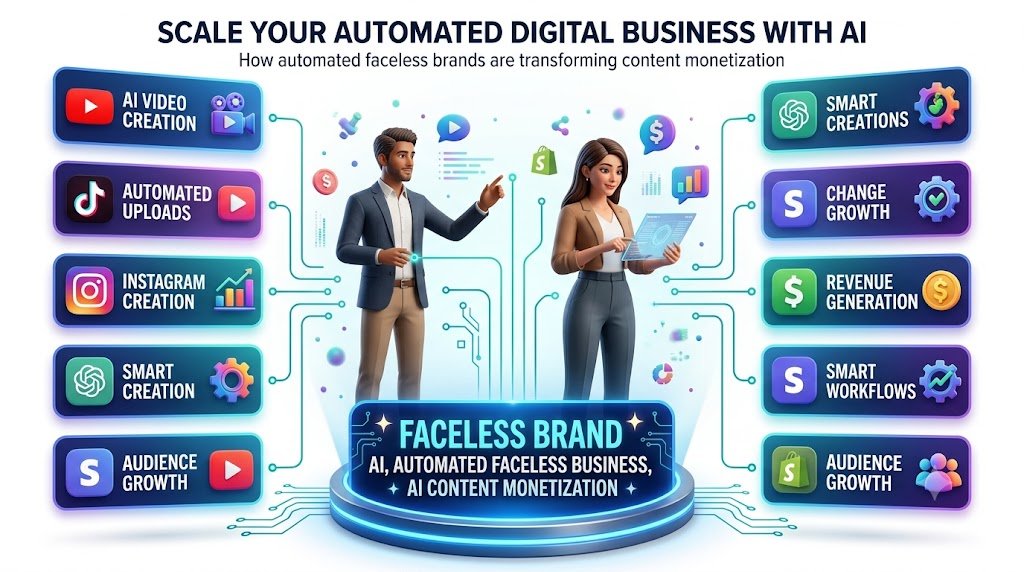
How to build an AI-powered faceless business, attract the right audience, create valuable content, and turn digital attention into sustainable income without becoming an influencer.
Imagine building an online business where you never have to appear on camera, record yourself speaking, or become a recognizable social media personality.
Your content reaches potential customers while you work on other projects. Your digital products remain available around the clock. Automated systems help you publish, communicate with subscribers, and deliver purchases.
It sounds like the perfect business model.
And with artificial intelligence making content creation faster and more accessible, the idea of building a profitable faceless brand has attracted growing interest among creators, freelancers, entrepreneurs, and digital product sellers.
But there is an important question hiding behind the excitement.
Can an AI-powered faceless brand genuinely make money, or is it another internet business trend that looks easier than it actually is?
The answer is yes, a faceless brand can become profitable. However, success rarely comes from generating hundreds of AI videos, posting automatically, and hoping an algorithm turns views into revenue.
The businesses with a more credible path to profitability combine useful content, a clearly defined audience, trustworthy recommendations, products people actually need, and carefully managed automation.
This guide explains how the faceless brand AI business model works, which monetization strategies make commercial sense, what mistakes to avoid, and how to build a brand that people return to even when they never see the person behind it.
What Is a Faceless Brand, and Why Does AI Make It Different?
A faceless brand is an online business or content identity that delivers information, entertainment, education, or products without relying on the owner’s physical appearance.
Rather than making a personality the center of attention, the brand builds recognition through its expertise, visual identity, storytelling, and value to a specific audience.
A faceless business might operate through:
- A YouTube channel featuring narrated tutorials and original visuals.
- An Instagram page publishing educational carousels.
- A niche website generating search traffic.
- A Pinterest account promoting helpful articles and digital products.
- An email newsletter offering practical industry insights.
- An online store selling downloadable resources, templates, or guides.
Artificial intelligence changes how efficiently these businesses can operate.
Previously, running several content channels might have required writers, graphic designers, video editors, researchers, and marketing assistants.
Today, AI tools can support much of the production workflow.
For example, a creator can use AI to research audience questions, organize a video script, generate initial visual concepts, produce captions, and transform a detailed tutorial into shorter promotional content.
However, automation doesn’t eliminate the need for judgment.
AI can help create a product description. It cannot independently establish that customers want the product.
AI can propose useful content ideas. It cannot guarantee that those ideas will attract qualified buyers.
The strongest approach is to use artificial intelligence as a production assistant while keeping audience understanding, quality control, and business decisions under human supervision.
Can You Really Make Money with a Faceless AI Brand?
Yes. A faceless AI brand can generate revenue through digital product sales, affiliate commissions, paid newsletters, advertising, sponsorships, subscriptions, and specialized services.
The more important question is whether revenue can consistently exceed the cost of operating the business.
Profitability depends on factors such as audience demand, conversion rates, product margins, acquisition costs, platform fees, and the time needed to maintain content quality.
Consider two hypothetical faceless businesses.
The first publishes 100 generic motivational videos every week. Some receive thousands of views, but the channel has no clear customer problem to solve, no email list, and no relevant product.
The second publishes three detailed tutorials each week about digital budgeting, financial organization, and spreadsheet productivity. Its content directs interested readers toward a useful budgeting template.
The first business might generate more impressions.
The second has a clearer connection between audience attention and purchasing intent.
That difference is fundamental.
A profitable faceless brand is not built around how much content AI can produce. It is built around how effectively that content solves a problem people are willing to pay to solve.
The Five Faceless AI Business Models Worth Exploring
Not every faceless business model is equally suited to a beginner. Some need substantial traffic before generating meaningful revenue. Others can begin testing paid offers with relatively small audiences.
1. AI-Powered Digital Product Brands


10
Selling digital products is one of the more accessible ways to monetize specialized knowledge and original creative work.
Digital products can include:
- Canva marketing templates and social media design packs.
- Notion productivity systems.
- Printable planners, journals, and educational worksheets.
- Excel budgeting and business tracking spreadsheets.
- Specialized eBooks and instructional guides.
- Original AI prompt collections with tested examples.
- Content calendars and business workflow kits.
Imagine creating a faceless brand focused on helping small online sellers organize their business operations.
You could publish tutorials explaining inventory management, pricing decisions, monthly expense tracking, and customer follow-up systems.
Instead of simply collecting views, those tutorials could lead readers toward a $15 digital seller toolkit.
The content attracts people who have a specific problem. The product helps them solve that problem faster.
AI can assist with planning, documentation, formatting suggestions, descriptions, and promotional copy.
The product itself must still be tested for usability, accuracy, originality, and practical value.
What works: Highly specific products built for clearly identifiable customer problems.
What struggles: Large bundles of generic AI-generated files with unclear benefits, inadequate quality checks, or questionable resale rights.
2. Faceless YouTube Channels with Original Educational Content


12
Faceless YouTube channels can operate in areas such as software education, business tools, history, productivity, visual explainers, and technical tutorials.
A creator does not necessarily need to appear on camera to communicate expertise.
Screen recordings, diagrams, original animations, licensed footage, and narrated walkthroughs can make excellent teaching materials.
For example, a channel about spreadsheet automation might publish videos explaining how to create inventory trackers, organize customer data, and understand business dashboards.
Relevant revenue sources could include advertising after eligibility, affiliate partnerships, digital templates, or paid training resources.
There is one important limitation.
YouTube’s monetization policies distinguish original, authentic content from repetitive or mass-produced material. Its July 2025 clarification specifically addressed inauthentic content, including videos that appear interchangeable or lack meaningful original value.
YouTube Help
+1
Simply combining generic AI narration with recycled stock clips is therefore not a dependable long-term monetization strategy.
What works: Original demonstrations, researched explanations, distinctive storytelling, and useful instruction.
What struggles: Automatically generated videos that repeat identical structures without adding meaningful insight.
3. Niche Blogging and Affiliate Marketing
A faceless website can become an information resource that attracts visitors through search engines, social referrals, and email recommendations.
Consider a website dedicated to AI productivity for independent professionals.
Potential articles include:
- How to automate repetitive business administration.
- Which AI tools are useful for freelancers.
- How to organize client projects with Notion.
- How to create a content calendar using spreadsheets.
- How to evaluate AI writing assistants before subscribing.
Relevant articles could recommend suitable software through disclosed affiliate relationships.
The business earns commissions when qualifying readers make purchases.
However, affiliate content must provide genuine value beyond promotional links.
Useful product reviews should explain pricing, limitations, intended users, alternatives, and the basis for any recommendation.
Google’s guidance explains that generative AI can assist research and content structure, but producing large amounts of low-value material may violate its scaled-content abuse policies.
Google for Developers
+1
A smaller collection of carefully researched, original articles may offer a stronger foundation than hundreds of nearly identical AI-generated posts.
4. Faceless Social Media Brands
Instagram, Pinterest, TikTok, and other discovery platforms can help a faceless brand reach an audience through visual information and storytelling.
Effective formats include educational carousels, short demonstrations, animated explainers, checklists, infographics, and screen-recorded tutorials.
A brand specializing in small-business marketing could publish a weekly series about improving product listings.
One post might explain the difference between product features and benefits.
Another could demonstrate how to create a persuasive product headline.
A third could offer a free product-description checklist.
These posts build a connection between valuable education and a relevant downloadable product.
AI can accelerate production, but the recognizable element should be the brand’s consistent quality rather than simply a repeated visual template.
A useful social media strategy gives people a reason to save the content today and return for the next lesson tomorrow.
5. Paid Newsletters and Resource Memberships
A newsletter is particularly valuable for faceless businesses because it creates a more direct relationship with subscribers.
Instead of depending entirely on changing social media algorithms, the brand can communicate with readers who have chosen to receive its content.
For example, a newsletter about practical AI tools for small businesses could share:
- One tested workflow each week.
- An explanation of an emerging tool.
- A reusable template.
- A comparison of two approaches.
- A practical implementation checklist.
Eventually, the business could offer paid resource libraries, specialized tutorials, or premium membership content.
The challenge is retention.
Subscribers will not continue paying simply because the information was generated using AI. They need reliable usefulness, careful curation, originality, or meaningful time savings.
The Faceless Brand Profitability Equation
Before choosing tools or producing content, understand how your business will make money.
A simple operating formula is:
Profit = Revenue − Operating Expenses
Revenue might come from digital sales, commissions, sponsorships, or subscription payments.
Operating expenses can include AI subscriptions, hosting, design tools, advertising, payment processing fees, refunds, contractors, and other business costs.
Consider a hypothetical brand selling a $19 productivity toolkit.
Interactive digital product profit estimatorMonthly visitors
2,000
Purchase rate
2%
Price ($)Fees (%)Other costs ($)
Estimated monthly sales
40
Gross revenue
$760
Estimated monthly operating profit
$542
Illustrative scenario, not an income forecast. Excludes taxes, refunds, variable support costs, and the value of your time unless included above.
This example demonstrates why traffic alone is insufficient.
A website may have thousands of visitors but struggle commercially when few are interested in its offer.
A more focused website could earn revenue from fewer visitors if those people arrive with a clear purchasing need.
The goal is not necessarily to maximize audience size. It is to attract the right visitors, solve a meaningful problem, and maintain healthy margins.
How to Build a Profitable Faceless Brand with AI: A Practical Seven-Step System
Step 1: Choose a Niche with Real Customer Demand
One of the most common mistakes is selecting a niche solely because it attracts millions of social media views.
Entertainment can generate significant attention, but attention does not always translate into purchasing behavior.
A stronger approach begins with customer problems.
Ask yourself:
What does this audience struggle to accomplish?
What tasks consume too much of their time?
What digital products or services do they already pay for?
Can I offer a useful solution without requiring personal appearances?
Examples of promising areas to investigate include small-business productivity, freelance operations, job application organization, creator workflows, home budgeting, study systems, and digital marketing.
Do not assume these niches are automatically profitable. Validate demand through relevant search queries, product marketplace reviews, audience discussions, and competitor analysis.
Look for repeated problems rather than isolated complaints.
A niche becomes commercially interesting when a clearly defined group repeatedly expresses a need and there is evidence of willingness to pay for a solution.
Step 2: Develop a Brand Identity People Recognize
Being faceless does not mean being anonymous in every aspect of the customer relationship.
A recognizable brand needs a clear promise.
For example:
We help independent creators organize their businesses with practical AI workflows and simple digital tools.
This statement immediately establishes the intended audience and the brand’s value.
Next, create a consistent identity using a distinctive name, readable typography, a limited color palette, and recognizable visual formats.
More importantly, maintain a consistent editorial personality.
A professional business resource should communicate with clarity and evidence.
An educational brand might prioritize simple explanations and supportive examples.
The best faceless brands develop a recognizable point of view without needing a recognizable face.
Step 3: Use AI to Build a High-Quality Content Workflow
A productive faceless brand separates content production into stages instead of asking an AI tool to generate everything in one instruction.
An AI-assisted publishing workflow
1
Audience research
Find real questions and unmet needs
2
Content planning
Select one problem and a useful angle
3
AI-assisted drafting
Develop structure, scripts, and visual concepts
4
Human verification
Check facts, originality, examples, and rights
5
Production and publishing
Create accessible visuals and distribute
6
Performance review
Improve based on saves, signups, and sales
Useful tools may include ChatGPT for outlining and writing assistance, Canva for visual design, video editing software for production, and publishing tools for scheduling content.
The specific tool matters less than the reliability of the overall process.
Avoid automating factual statements or product recommendations without verification.
Step 4: Create Content That Leads Naturally to a Product
Every piece of commercial content should ideally connect with a customer problem.
Suppose your faceless brand sells freelancer productivity templates.
Instead of posting generic motivational quotes, create an educational article titled:
How Freelancers Can Organize Multiple Clients Without Missing Deadlines
Explain the underlying problem, demonstrate a useful organization method, and show a simple workflow.
Then introduce a relevant template for readers who want a ready-made system.
For example:
Want to organize your next client project without building a system from scratch? Explore the Freelancer Project Tracker, designed to help you manage deadlines, deliverables, and follow-ups in one place.
The product feels relevant because it addresses the same challenge described in the article.
This is more persuasive than placing unrelated promotional banners throughout the page.
Step 5: Build an Email List Before Relying on Viral Growth
A social platform can expose your content to new people, but it does not guarantee that those people will see your next post.
An email list helps turn occasional visitors into an audience that can return.
Offer a useful free resource related to the brand’s central topic.
For example, a faceless productivity brand might offer a free weekly work planner.
A visitor downloads the planner, signs up for helpful emails, and receives a short welcome sequence.
The sequence could introduce the brand, explain how to use the resource, provide another useful lesson, and eventually present a relevant paid product.
Every message should create value rather than simply pressure readers to purchase.
Use clear opt-in language, respect unsubscribe requests, and comply with applicable email marketing laws.
Step 6: Automate Repetitive Work Without Automating Trust
Automation is especially useful for operational tasks.
An automated faceless business might use connected systems to schedule approved posts, deliver purchased files, send welcome emails, organize customer inquiries, and generate draft performance reports.
However, important activities should remain supervised.
These include verifying claims, responding to unusual customer issues, resolving refunds, reviewing copyright permissions, and correcting published errors.
A useful principle is:
Automate repeatable processes. Keep responsibility for quality and customer trust.
The goal is to reduce unnecessary work, not eliminate human accountability.
Step 7: Measure What Produces Revenue
It is easy to become distracted by follower counts, impressions, and video views.
Those metrics can help explain audience growth, but they are incomplete measures of commercial success.
Monitor content engagement alongside email subscriptions, qualified product-page visits, sales conversion rates, average order value, customer acquisition costs, refunds, and repeat purchases.
Consider a post that attracts 50,000 views but produces no meaningful website visits.
Now consider another that receives 2,000 views and leads to several relevant email signups or purchases.
The second post may contribute more directly to the commercial objectives of the brand.
Build your decisions around evidence rather than vanity metrics.
A Realistic 30-Day Faceless AI Brand Launch Plan
Launching a faceless business doesn’t require an enormous content library.
It requires a focused offer, enough useful content to demonstrate expertise, and a repeatable way to reach potential customers.
30-day launch checklist
Track your preparation
0 of 12 completed
0%
Week 1 — Research and positioningChoose a narrowly defined audience and problemStudy audience questions, competitors, and existing offersDefine a simple brand promise and visual identity
Week 2 — Content and productBuild one minimum viable paid productCreate a useful free sample or lead magnetDraft and verify five evergreen content pieces
Week 3 — Publication and promotionPublish your website or product landing pageSet up permission-based email signup and deliveryShare helpful content across one or two selected platforms
Week 4 — Test and improveCollect feedback and test the product checkoutReview qualified traffic and purchasing behaviorImprove the offer and plan next month’s content
Copy launch checklist
At the end of 30 days, the most useful outcome is not necessarily a specific revenue figure.
It is a functioning business foundation with a clearly identified customer, a tested offer, a small body of useful content, and real-world feedback.
Even if the initial campaign produces no sales, the information gathered can guide improvements to the product, audience targeting, or pricing.
How Much Does It Cost to Start a Faceless AI Business?
A faceless business can often begin with relatively modest expenses, especially when the owner creates and reviews the content personally.
Many tools offer free entry-level options or limited trials, although commercial rights and feature limits vary.
A hypothetical lean monthly operating budget might look like this:
| Expense | Illustrative monthly budget |
|---|---|
| AI writing and research tools | $0–$25 |
| Graphic design tools | $0–$15 |
| Website and hosting | $5–$25 |
| Email marketing | $0–$20 |
| Video editing and scheduling | $0–$25 |
| Estimated total | $5–$135 |
These figures are planning assumptions, not verified current subscription quotations. Costs vary by location, usage, tool selection, taxes, and billing terms.
You do not need every tool at the beginning.
A focused combination of one AI assistant, one visual editor, a publishing platform, and an online storefront can be enough to test an idea.
A common mistake is spending money on automation subscriptions before validating that anyone wants to buy the product.
Start with the smallest practical workflow. Expand when actual business needs justify the expense.
Seven Mistakes That Keep Faceless AI Brands from Becoming Profitable
Mistake 1: Confusing Content Volume with Business Growth
Publishing more content can create additional opportunities for discovery, but only when the content has meaningful value.
Producing 50 repetitive AI videos will not necessarily outperform five carefully researched tutorials.
Quality, usefulness, audience relevance, and differentiation matter.
Mistake 2: Copying Existing Brands
It may be tempting to reproduce the appearance, topics, or exact structure of successful accounts.
But imitation makes a new brand difficult to distinguish.
Study competitors to identify unmet needs, then create original demonstrations, practical tools, different explanations, or more specialized solutions.
Mistake 3: Depending Entirely on Advertising Revenue
Advertising-based models often require considerable qualified traffic before earnings become meaningful.
Digital products, affiliate partnerships, or services may create additional monetization opportunities.
Diversification should follow audience demand rather than becoming a reason to promote unrelated offers.
Mistake 4: Selecting a Niche Without Purchase Intent
An audience may enthusiastically consume free entertainment while showing limited interest in paid resources.
Understand what people are willing to purchase before building an extensive content library.
Mistake 5: Using Unverified AI-Generated Information
AI can produce convincing explanations containing factual errors, invented examples, or outdated recommendations.
Inaccurate content can damage customer trust, particularly when discussing financial, legal, health, or technical subjects.
Verify material claims against reliable sources and include appropriate qualifications.
Mistake 6: Ignoring Product Quality and Customer Support
Digital products can be delivered automatically, but customers still expect working files, clear instructions, accurate descriptions, and responsive support.
An attractive landing page cannot compensate for a poorly functioning product.
Mistake 7: Expecting Passive Income Immediately
The term passive income often obscures the work involved in establishing a business.
Research, product development, content creation, customer acquisition, maintenance, and customer service require effort.
Automation can reduce repetitive tasks after effective systems exist.
It does not guarantee that revenue will continue without attention.
What Actually Converts Visitors into Buyers?
One of the most overlooked aspects of AI content monetization is the journey between discovering content and making a purchase.
A typical journey might look like this:
DiscoverHelpful article, video, or social post
Build trustClear advice, examples, and useful results
Stay connectedRelevant free resource and optional email updates
PurchaseWell-matched product with transparent value
Illustrative customer journey, not measured conversion data.
Make the Value Immediately Clear
Visitors should quickly understand who a resource is designed for and what problem it solves.
Instead of a generic headline such as Ultimate AI Business Toolkit, consider:
Organize Your Freelance Clients, Deadlines, and Invoices with One Simple Workspace.
The second message communicates a concrete benefit.
Show the Product Before Asking for a Purchase
Useful previews can reduce uncertainty.
For a spreadsheet, show the relevant worksheets and explain how calculations work.
For a template pack, display actual designs.
For an eBook, offer a meaningful sample.
Avoid presenting mockups as though they represent features the product does not contain.
Address Buyer Questions Clearly
A product page should answer practical questions about file formats, compatibility, required software, included resources, licensing, and customer support.
Where relevant, explain refund terms and any product limitations.
Offer a Relevant Next Step
A new reader may not be ready to purchase.
A free checklist, tutorial, or sample can help them explore the topic without pressure.
Returning visitors may be more interested in a product comparison, advanced guide, or bundle.
Match the next step to the audience’s level of familiarity rather than overwhelming everyone with the same sales message.
How to Turn One-Time Visitors into a Returning Audience
New visitors can arrive through search results, social shares, email recommendations, and video discovery.
A sustainable brand gives those visitors a reason to return.
The most useful strategy is to create an ongoing learning experience.
For example, instead of publishing unrelated articles about dozens of AI tools, a faceless business could build a structured series titled 30 Practical AI Workflows for Small Businesses.
Each article would solve one specific challenge while pointing interested readers toward the next lesson.
A returning visitor knows what to expect.
The same principle works with newsletters.
A weekly email might include one verified workflow, one useful resource, and one practical improvement readers can implement.
This creates familiarity without depending on personal celebrity.
You can also build topic clusters that connect foundational tutorials with advanced resources.
For a brand about digital product selling, the cluster might include product research, product creation, pricing, sales pages, marketing, delivery systems, and customer retention.
Every article should stand on its own while making the next relevant resource easy to discover.
The most durable audience relationship comes from consistent usefulness, not constant promotional pressure.
Can Faceless AI Brands Rank on Google and Appear in Google Discover?
A faceless brand can publish content eligible for Google Search and Discover, but neither indexing nor Discover distribution guarantees visibility.
Google’s published guidance emphasizes quality, accuracy, relevance, and content that adds genuine value.
For AI-assisted publishing, that means avoiding low-value, large-scale content generation and ensuring that articles provide meaningful benefits to readers.
A brand can strengthen its editorial approach by creating comprehensive explanations, testing products before recommending them, citing trustworthy sources, adding original examples, and updating articles when information changes.
Clear headings and concise question-based explanations also make content easier for readers and search systems to interpret.
For AI-powered search experiences, provide direct answers to real questions, support claims with evidence, and make your product or business identity transparent.
Google Discover has additional presentation considerations. Google recommends relevant, high-quality images at least 1,200 pixels wide, along with suitable large-image preview settings. Representative imagery can also be specified using structured data or og:image.
These measures can improve eligibility and presentation, but cannot guarantee placement.
Avoid exaggerated headlines, misleading imagery, manufactured urgency, or claims of financial success that lack evidence.
A title should create curiosity while accurately reflecting the article.
For example, Can You Really Build a Profitable Faceless Brand with AI? makes a clear promise to investigate a business question without declaring that everyone will succeed.
Where AI Automation Helps Most—and Where It Should Stop
The next stage of faceless business development is not necessarily producing content faster.
It is using automation to create more consistent customer experiences.
AI can help identify recurring support questions, prepare email drafts, organize product documentation, analyze content performance, and turn lengthy educational resources into shorter approved formats.
It can also support translations, accessibility descriptions, and content updates when all outputs receive appropriate review.
More advanced workflows may connect storefronts, mailing systems, spreadsheets, and customer-support tools.
However, fully autonomous publication introduces risks.
An AI system could accidentally publish outdated information, misrepresent product capabilities, mishandle personal data, or send an inappropriate customer message.
For that reason, establish approval checkpoints.
Financial decisions, legally significant claims, sensitive customer issues, public-facing factual assertions, and important product changes should receive human review.
A reliable automated business is one where the owner understands how the system operates and can correct it when necessary.
Five Frequently Asked Questions About AI Faceless Brands
1. Can a beginner start a profitable faceless AI brand with no experience?
Yes, a beginner can start, but profitability is not guaranteed. Begin with a narrow topic you can learn and verify, one audience problem, and one manageable content format. Focus on building a useful resource before paying for advanced automation.
2. How long does it take to make money from a faceless AI business?
There is no reliable universal timeline. Some businesses may achieve early sales through direct customer outreach, while others may spend months developing an audience without becoming profitable. Results depend on customer demand, product quality, distribution, pricing, and execution.
3. What is the best faceless AI business model for beginners?
A focused digital product supported by educational content can be a practical starting point because it creates a direct connection between the audience’s problem and a paid solution. However, the best option depends on your skills, available time, budget, and ability to reach potential buyers.
4. Can AI-generated faceless videos be monetized on YouTube?
Yes, AI-assisted videos may be eligible for monetization when they meet the platform’s requirements. However, repetitive, mass-produced, or reused content without meaningful originality can be ineligible. YouTube also requires disclosure for certain realistic AI-generated or meaningfully altered content.
5. Is a faceless AI business genuinely passive income?
It can become more automated over time, particularly when selling reusable digital products through automated delivery systems. However, content updates, marketing, customer support, product improvements, and compliance usually require ongoing work. It is more accurate to view it as a potentially scalable business than a guaranteed source of effortless income.
The Real Opportunity: Build a Brand That Offers Value Without Needing a Face
The commercial opportunity behind faceless branding is not simply the ability to hide your identity.
It is the ability to create a useful business that doesn’t depend on personal visibility.
AI makes the production process more accessible. It can reduce repetitive tasks, help organize research, accelerate initial drafts, and support content repurposing.
But the factors that determine long-term profitability remain familiar.
People need to trust the information.
Products need to solve real problems.
Marketing needs to reach interested customers.
Revenue needs to exceed expenses.
And the business needs to adapt when audience behavior or platform requirements change.
The most effective approach is to begin with a single defined audience, identify an important problem, create a genuinely useful solution, and use AI to make the surrounding business more efficient.
You do not need thousands of posts or millions of followers to start testing that approach.
You need a reason for the right customer to pay attention—and a product or service worth paying for.
If you’re considering your first faceless brand, start by identifying one audience problem you can solve with a useful digital resource. Build that solution, demonstrate its value, and let genuine customer response guide what you create next.
Compliance Note
This article is provided for general educational and informational purposes and does not constitute financial, legal, tax, or professional business advice.
Building a faceless AI brand involves commercial uncertainty. Revenue, profit, website traffic, platform eligibility, and audience growth depend on individual circumstances. No sales volume, return on investment, search ranking, or income outcome is guaranteed. Financial figures and business scenarios presented in this article are illustrative, not verified earnings results.
Creators and businesses are responsible for complying with applicable laws, platform policies, copyright and intellectual property requirements, privacy regulations, advertising standards, and consumer protection obligations.
AI-generated text, images, audio, and video should be reviewed for accuracy, originality, commercial usage permissions, and misleading representations. Do not use another person’s likeness or voice without appropriate authorization, fabricate customer testimonials, or present synthetic experiences as genuine.
Disclose sponsorships, affiliate relationships, and other material commercial connections clearly. The U.S. Federal Trade Commission advises that relevant relationships should be disclosed in ways audiences can readily notice and understand. Other jurisdictions may impose additional obligations.
Federal Trade Commission
For videos, websites, marketplaces, and social platforms, consult the latest applicable rules before publishing or monetizing. AI disclosure and monetization requirements may change, and compliance with one platform’s guidelines does not establish compliance with every other platform.
Email collection and automated customer communication should use appropriate consent, privacy safeguards, secure handling of personal information, and legally required unsubscribe mechanisms.
Before launching paid campaigns, selling licensed digital materials, or making business income claims, independently verify relevant requirements and seek qualified professional advice where appropriate.
Stay ahead with exclusive updates
Join our community. Get curated industry trends, actionable guides, and fresh resources delivered straight to your inbox.