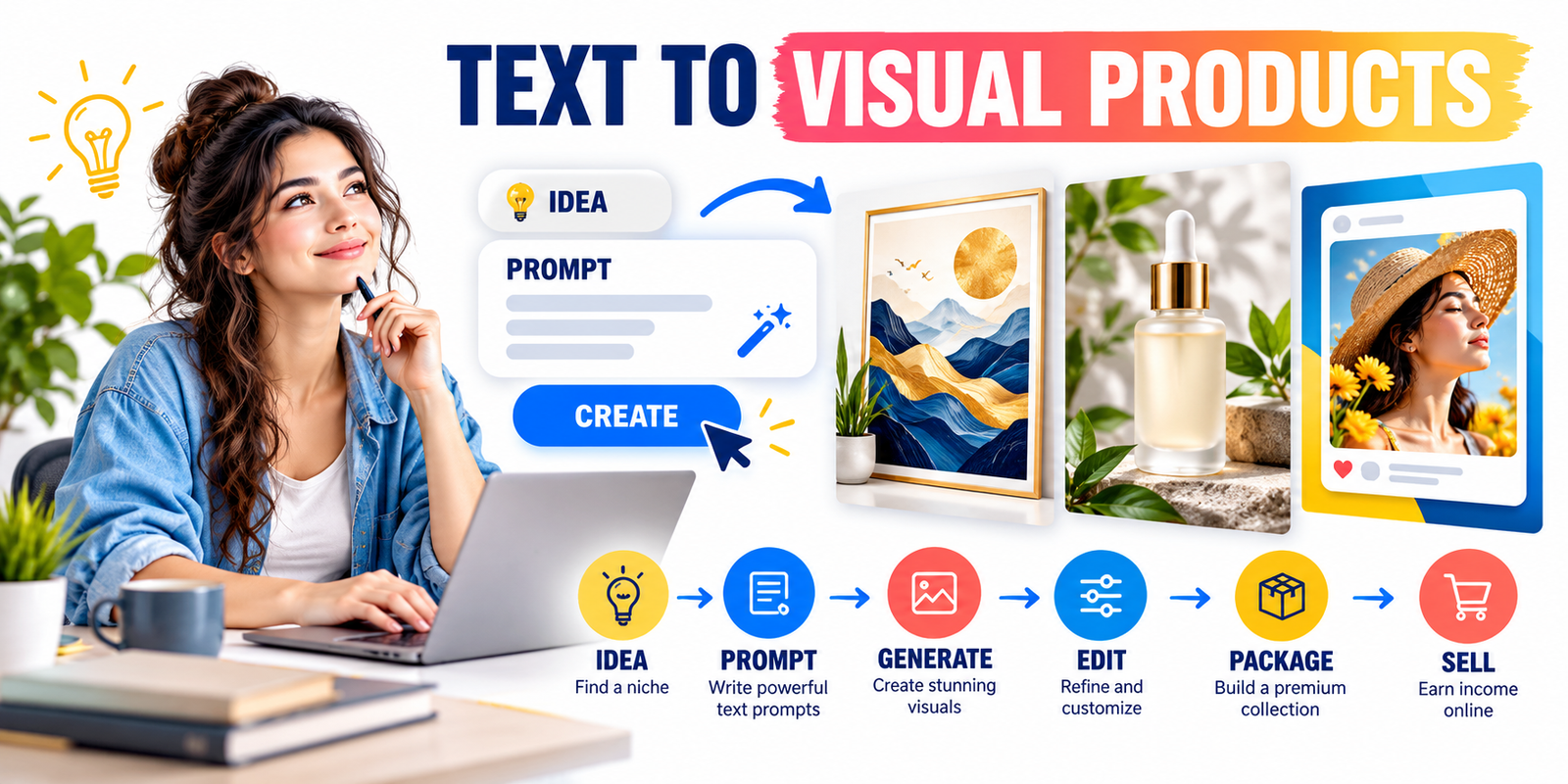
What if a carefully written paragraph could become the starting point for a digital product that people genuinely want to buy?
A few years ago, creating professional visual products usually required advanced design skills, expensive software, and considerable production time. Today, generative AI has made visual creation more accessible. A well-structured text prompt can help produce compelling illustrations, product photography concepts, digital artwork, marketing graphics, printable designs, and branded visual collections.
But there is an important difference between generating an attractive image and building something customers will pay for.
The real business opportunity is not simply writing AI prompts. It is transforming creative instructions into reliable, useful, professionally packaged visual products.
This prompt engineering masterclass explains how to develop that skill, create an original digital prompt collection, identify profitable niches, and build a sustainable business around AI-assisted visual design.
Whether you are a blogger, freelancer, graphic designer, content creator, digital product seller, or entrepreneur exploring AI-powered income opportunities, this guide will help you move from experimentation to a structured commercial workflow.
What Is Prompt Engineering for Visual Products?
Prompt engineering is the practice of writing, testing, and improving instructions that guide artificial intelligence systems toward a desired output.
In visual creation, these instructions typically describe the image subject, artistic direction, composition, lighting, color palette, environment, visual details, and intended purpose.
A basic prompt might say:
Create a beautiful coffee shop illustration.
This leaves almost every creative decision to the AI model.
A more intentional prompt would say:
Create a premium editorial illustration of a small European-style coffee shop on a quiet street. Use warm morning sunlight, soft terracotta walls, elegant architectural details, muted cream and sage-green tones, balanced composition, and subtle watercolor textures. Keep the storefront clearly visible, avoid readable signage, and produce a refined image suitable for a boutique café’s promotional materials.
The second prompt gives the model stronger creative direction. It also provides a basis for controlled testing and revision.
However, detailed prompts are not automatically better. The best instructions are the ones that produce the required result consistently without unnecessary complexity.
For commercial work, effective prompt engineering combines three capabilities: creative judgment, technical experimentation, and a clear understanding of customer needs.
Why AI Visual Products Can Become a Valuable Digital Business
Digital products are attractive because they can be created once and delivered to multiple customers without conventional inventory or physical shipping.
AI-assisted production can make certain parts of this process faster, particularly concept development, visual experimentation, and creation of multiple design variations.
Potential products include:
Printable Wall Art Collections
Coordinated botanical illustrations, abstract prints, nursery artwork, and interior decoration sets.
Commercial Visual Assets
Product backgrounds, lifestyle compositions, social media imagery, and advertising concepts.
Digital Prompt Collections
Tested prompt libraries, creative recipes, editable variables, and example outputs for specific professional uses.
Publishing and Educational Graphics
Worksheets, illustrations, teaching resources, book graphics, and visual storytelling materials.
Brand-Specific Design Kits
Cohesive creative assets for restaurants, beauty businesses, real estate professionals, and independent retailers.
The strongest business models usually focus on a specific customer problem.
A collection of 100 unrelated AI images might attract attention, but a coordinated set of 30 editable promotional graphics for independent bakeries offers a much clearer reason to purchase.
Customers are not necessarily buying the technology behind the product. They are buying convenience, relevant design choices, usable files, and saved production effort.
The Seven Essential Elements of a Premium AI Image Prompt
A strong visual prompt can be built using seven components.
THE VISUAL PROMPT FORMULA
From Creative Idea to Controlled Output
Subject
What appears
Style
Visual language
Composition
Framing and space
Lighting
Mood and shadows
Color
Palette and contrast
Technical
Format and ratio
Quality constraints
Unwanted elements, readability, accuracy, and intended use
1. Subject: Describe What You Want to Create
Start with a clearly defined subject.
Instead of requesting a generic product image, specify the object and its most important characteristics.
For example:
A transparent amber skincare bottle with a matte cream label, minimal typography, and a natural wooden cap.
Precise subject descriptions reduce unnecessary variations and make the output easier to evaluate.
2. Style: Establish a Recognizable Visual Identity
Artistic style communicates personality and positioning.
Possible directions include minimalist product photography, editorial illustration, geometric vector art, vintage-inspired graphics, 3D illustration, watercolor, or architectural visualization.
Avoid relying on another living artist’s name as the primary style instruction. Describe the desired visual characteristics directly.
3. Composition: Control How Elements Are Arranged
Composition has a significant influence on commercial usability.
A social media advertisement may need generous negative space for a headline. A printable art product may require a centered subject and balanced margins. A website banner might need the main visual on one side.
Specify the location of important elements, framing, focal point, and breathing room.
4. Lighting: Shape the Emotional Experience
Lighting helps establish mood and perceived quality.
Soft daylight might suit a wellness product, while dramatic studio lighting could support a luxury accessories campaign.
Experiment with directional light, diffused shadows, rim lighting, and natural reflections.
5. Color: Create Brand Consistency
A defined palette helps a collection feel professionally designed.
For example, a premium stationery brand might use ivory, midnight blue, and muted gold throughout its visual assets.
You can specify colors descriptively or provide hexadecimal values, although not every image model interprets color codes reliably.
6. Technical Format: Prepare for the Actual Product
The intended delivery format affects composition and generation choices.
A 16:9 image may work well for blog banners, while a square composition might suit social media graphics.
Remember that an AI-generated image’s original resolution is not always sufficient for professional printing. Check actual pixel dimensions, resizing quality, and export settings.
7. Quality Constraints: Reduce Common Problems
Constraints can help avoid clutter, unwanted text, distorted product proportions, inappropriate backgrounds, and other errors.
Instead of adding dozens of negative instructions, identify the most important problems to prevent.
A useful rule: Define what success looks like before listing everything you want the model to avoid.
Build Your First Premium Prompt with a Reusable Framework
The following structure works as a starting point for many image-generation projects.
Reusable visual prompt template Copy
Create a [visual product type] featuring [main subject] for [target audience and use case]. Use [visual style] with [color palette], [lighting direction], and [composition]. Position [important elements] to create [desired visual hierarchy]. The result should communicate [brand personality or emotion]. Use [aspect ratio and output requirements]. Avoid [specific unwanted features]. Prioritize [quality criteria].
This framework is valuable because individual variables can be changed without rebuilding the entire instruction.
For instance, a creator could use the same underlying prompt to develop variations for coffee shops, bakeries, florists, and boutique hotels.
That repeatability is one of the foundations of a commercial digital prompt collection.
Five High-Value Prompt Examples You Can Adapt Into Visual Products
Below are original prompt concepts designed around real commercial applications. They are starting points, not guarantees of a particular model’s output.

1. Luxury Product Photography Kit
Ideal customer: skincare brands and small online retailers
Create a premium commercial photograph of a minimalist amber skincare serum bottle resting on a pale travertine pedestal. Use soft directional daylight, natural shadows, refined beige and ivory tones, and an uncluttered background. Keep the product centered with room for advertising text.

2. Botanical Printable Wall Art
Ideal customer: home decorators and printable art shoppers
Create an elegant botanical illustration featuring eucalyptus branches and delicate foliage. Use muted sage green, warm ivory, and subtle watercolor shading. Maintain a spacious composition suitable for contemporary home decor.

3. Bakery Social Media Campaign
Ideal customer: local bakeries and food marketers
Create an appetizing editorial photograph of a premium chocolate cake on a ceramic stand. Use warm café lighting, realistic cake texture, a neutral background, and thoughtful empty space for promotional copy. Emphasize food appeal and a refined bakery aesthetic.

4. Real Estate Marketing Visuals
Ideal customer: real estate marketers and interior designers
Create a high-end architectural visualization of a contemporary apartment living room, featuring natural oak flooring, comfortable neutral furniture, large windows, and realistic daylight. Maintain accurate perspective, proportional objects, and a welcoming atmosphere.

5. Children’s Educational Illustration Kit
Ideal customer: educators and children’s publishers
Create a friendly storybook illustration featuring a curious fox, a small rabbit, and a wise owl in a peaceful forest. Use soft watercolor-inspired textures, gentle expressions, pastel colors, and clear character silhouettes appropriate for young children.Illustrative visual references. These images are not included in a commercial product license; create or license your own final assets before distributing them.
Each example can become the foundation for a more complete visual package.
A bakery campaign, for instance, might include a hero banner, ten social media images, seasonal promotion layouts, square product graphics, and editable text overlays.
When those components follow a coherent visual direction, customers receive much more practical value than they would from a folder of unrelated AI outputs.
How to Turn Individual Prompts Into a Sellable Digital Prompt Collection
A successful prompt collection should be designed like a professional toolkit.
It needs organization, reliable instructions, clear use cases, and enough guidance to help purchasers achieve useful results.
Step 1: Choose One Specific Customer
Avoid starting with an excessively broad target audience.
Instead of making an AI art prompt bundle for everyone, create something more focused, such as:
- Product photography prompts for handmade soap brands.
- Printable artwork prompts for nursery decorators.
- Social media visual prompts for independent restaurants.
- Editorial photography prompts for lifestyle bloggers.
- Seasonal marketing prompts for small e-commerce stores.
Niche specificity makes the product easier to position and explain.
Step 2: Research Problems Before Creating Prompts
Look at the questions prospective customers already ask.
Product reviews, creator communities, social media discussions, and customer feedback can reveal where people struggle with visual production.
For example, small business owners may need consistent marketing graphics but lack the budget for frequent custom photography.
That problem suggests a more useful product than a generic list of visual styles.
Step 3: Develop a Consistent Visual System
Decide which elements should remain consistent across the collection.
These might include a limited color palette, similar lighting, a recognizable photographic treatment, recurring composition patterns, and compatible image dimensions.
A visual system makes your collection easier for customers to use across a campaign.
Step 4: Create and Test Prompt Variations
Write several versions of each prompt, then generate sample outputs.
Evaluate how consistently the model follows important instructions.
A useful testing process involves changing one major variable at a time, such as the lighting or camera angle.
This makes it easier to understand which instructions actually improve results.
Step 5: Document the Best Results
For every approved prompt, record the model used, test date, settings where applicable, successful output examples, known limitations, and recommended adjustments.
AI models change over time, so preserving this information makes future product maintenance easier.
Step 6: Package the Collection Professionally
Organize your prompts into categories and include practical documentation.
For a 50-prompt collection, you might provide five groups of ten prompts, with example imagery and a short customization guide for each group.
A premium edition could also contain compatible layout files, export checklists, and a troubleshooting reference.
Step 7: Test the Buyer Experience
Before selling, imagine you are purchasing the product for the first time.
Can you find the right prompt quickly? Do the examples look like the described output? Are the files clearly labeled? Do the instructions work with the tools listed?
The buyer should not need to spend an hour understanding how the product is organized.
What Makes a Prompt Collection Feel Premium?
The number of prompts is rarely the strongest indicator of value.
A large collection of vague, repetitive instructions may be less useful than a smaller library of carefully tested prompts.
Consider the difference between these two offers.
Basic offer: 500 AI image prompts in a plain text file.
Premium offer: 60 tested product-photography prompts, organized into six commercial themes, including sample results, editable variables, lighting recipes, background variations, troubleshooting notes, and a product-mockup guide.
The second offer communicates a much clearer professional purpose.
Buyers can understand what they are receiving, why the collection exists, and how they might put it to work.
Premium positioning also depends on accurate descriptions. Avoid presenting uncertain outcomes as guaranteed, and never claim that every prompt will generate identical results across different tools.
Seven Digital Products You Can Build Around Prompt Engineering
| Digital product | Customer benefit | Illustrative price range |
|---|---|---|
| Niche AI prompt library | Saves experimentation time | $7–$19 |
| AI wall art collection | Ready-to-use decorative assets | $9–$29 |
| Business social media visual kit | Simplifies campaign design | $15–$49 |
| Product photography prompt system | Helps plan consistent product visuals | $19–$59 |
| Brand visual identity toolkit | Supports cohesive design direction | $29–$99 |
| Educational illustration bundle | Provides classroom or publishing graphics | $12–$39 |
| Custom AI visual design package | Offers tailored commercial deliverables | $75–$300+ |
These are hypothetical starting-price ranges for planning, not verified market averages or earnings forecasts. Actual pricing should reflect production quality, licensing rights, customer demand, competitor positioning, and support costs.
A smaller, highly specialized product can be an effective entry point.
As customer feedback grows, the product can evolve into a coordinated series of related resources.
Where Can You Sell AI Art Prompts and Visual Products?
Choosing the right selling platform matters because not every marketplace permits the same types of AI-generated products.
Your Own Digital Product Website
A self-hosted store or compatible e-commerce platform provides more control over product presentation, customer relationships, marketing, and packaging.
You can offer digital prompt collections, visual downloads, tutorials, and customized design services, subject to the platform’s terms.
A dedicated website also makes it easier to develop long-term content that attracts visitors through search.
Digital Product Platforms
Platforms such as Gumroad and Payhip can be considered for distributing downloads, provided your specific product satisfies their current policies.
Check supported product categories, fees, payment methods, content restrictions, and customer-delivery features before publishing.
Etsy: An Important Restriction
Etsy permits certain seller-prompted AI creations when the required disclosures are made. However, its Creativity Standards explicitly list AI prompt bundles as an example of products that do not qualify under its designed-by-a-seller category.
That distinction is essential.
Selling an eligible, personally designed AI-assisted digital artwork is different from listing a standalone collection of prompts.
Always verify a platform’s latest policies instead of assuming that every type of digital download is permitted.
How to Price Premium Visual Products Without Guessing
Pricing should reflect customer value, production costs, support requirements, and market positioning.
A simple calculation can help establish a baseline.
Suppose creating a digital visual kit requires six hours of work valued internally at $15 per hour, plus $20 in software and testing costs.
The initial creation cost would be $110.
That does not mean every copy must sell for $110. Digital products can distribute the original production cost across multiple sales.
However, you still need to account for transaction fees, promotion, customer support, revisions, taxes, and future updates.
Consider building three product levels.
Starter
$9
10 tested prompts, simple guide
Creator
$29
50 prompts, sample visuals, customization guide
Studio
$79
Full creative system, reusable layouts, extended documentation
Illustrative pricing architecture; the actual package must deliver all advertised assets and rights.
This approach gives customers different purchase options without requiring them to pay for features they do not need.
Make the differences between packages meaningful. Adding hundreds of low-quality prompts to justify a higher price rarely creates lasting customer satisfaction.
How to Market AI Prompt Products Without a Large Audience
A profitable digital product business does not necessarily begin with thousands of followers.
It begins with visibility among the right people.
Publish Problem-Solving Articles
Build educational content around the issues your products address.
A visual prompt collection for product photography could be supported by articles such as:
How to Create Consistent Product Images for a Small Online Store
How to Design Premium Skincare Advertising Visuals with AI
Seven Common AI Product Photography Mistakes and How to Fix Them
Each article can teach something useful while introducing a relevant product as an optional next step.
This creates a natural path from information to purchase.
Show Before-and-After Improvements
Visual demonstrations make the benefits of prompt engineering easier to understand.
Compare the result of a basic instruction with a more carefully structured prompt.
Explain what changed and why.
A good demonstration should focus on clarity, relevance, and quality rather than making exaggerated claims about instant professional results.
Offer a Useful Free Sample
A free starter collection of five carefully tested prompts can help potential customers evaluate your approach.
Include a short guide, examples, and one practical customization exercise.
An interested visitor can then decide whether the expanded collection offers enough additional value to purchase.
Build Trust Through Transparent Demonstrations
Publish examples created with the actual tools and prompts you sell.
When outputs have been edited, explain the editing process.
Authentic demonstrations are more persuasive than pretending an untouched AI generation is a finished professional design.
How to Turn First-Time Visitors Into Returning Readers and Customers
A one-time website visit is valuable, but a returning visitor can become part of a longer relationship with your brand.
To encourage that relationship, build an interconnected learning experience.
For example, a visitor reading this prompt engineering masterclass may also want to learn how to improve AI image consistency, create product mockups, or develop niche-specific digital products.
Each article should answer a distinct question and guide the reader toward a logical next topic.
A practical content journey might look like this:
Discover
Reader finds an educational tutorial through search or social sharing
Learn
Reader uses a free prompt and sees a practical demonstration
Return
Reader subscribes voluntarily for new tutorials and resources
Purchase
Reader chooses a relevant visual toolkit when ready
A newsletter can play an important role here.
You could publish a weekly edition featuring one original visual prompt, a practical improvement technique, and a real-world commercial use case.
Readers then have a reason to return beyond a single article.
The key is to provide continuing value rather than using repeated promotional messages to push every visitor toward an immediate sale.
Use AI to Create More Than Images: Build Complete Visual Systems
One particularly valuable opportunity is to combine prompt engineering with conventional design skills.
AI might generate a suitable visual background, but a finished marketing asset may still require typography, brand identity, layout design, accessible contrast, and manual corrections.
For example, a restaurant’s complete promotional package could include menu-background imagery, food campaign visuals, coordinated banners, story graphics, and seasonal promotional layouts.
AI can accelerate the development of visual concepts, while human editing ensures that prices, product names, logos, and other important details are accurate.
The combined workflow often delivers more useful results than relying on AI generation alone.
Think of prompts as one component of a design production system rather than the entire product.
How to Improve Prompt Reliability and Reduce Wasted Generations
Image-generation systems are probabilistic. The same prompt may produce variations across runs, and different models may interpret identical instructions differently.
To improve consistency, develop a repeatable evaluation method.
Review every output for subject accuracy, composition, visual quality, usability, brand consistency, and potential intellectual-property concerns.
Use a simple scorecard, with each category rated from one to five.
Keep the prompts that consistently meet your requirements and refine or discard those that do not.
Where supported, use reference images, seed values, fixed settings, and version documentation. These controls can improve repeatability, although none guarantees identical output across all tools.
For critical commercial details, manual retouching or traditional design software may be necessary.
The goal is not to eliminate experimentation. It is to make experimentation more deliberate and less expensive.
A Practical 30-Day Plan to Launch Your First AI Visual Product
| Period | Focus | Practical outcome |
|---|---|---|
| Days 1–5 | Audience and niche research | Defined customer and problem |
| Days 6–10 | Prompt development | Initial library of 30–50 candidate prompts |
| Days 11–15 | Testing and refinement | Smaller validated collection |
| Days 16–20 | Design and packaging | Organized assets, previews, and instructions |
| Days 21–25 | Store setup and content marketing | Product listing, samples, and supporting tutorials |
| Days 26–30 | Launch and feedback | Early customer insights and improvement plan |
This schedule is a planning framework, not a promise of sales within 30 days.
A small, well-organized launch is often more manageable than attempting to release a huge collection immediately.
Your First Product Launch Checklist
Launch readiness
0 of 10 completedChoose a specific customer nicheResearch actual customer needsDevelop and test original promptsInspect and edit sample outputsConfirm tool and asset licensesPackage and label files clearlyPrepare accurate product previewsCreate a free sample and sales pagePublish supporting educational contentCollect feedback and improve the product
Mistakes That Can Make AI Prompt Products Difficult to Sell
Selling Quantity Instead of Quality
A product marketed around an enormous prompt count may disappoint customers if the instructions are repetitive, outdated, or poorly tested.
Focus on useful results rather than impressive numbers.
Ignoring the Target Customer
A visual prompt may be aesthetically interesting while having little commercial value.
Understand the customer’s intended application before deciding what to create.
Using Unverified Commercial Rights
Not every generated output, font, template, icon, or reference image comes with the same reuse permissions.
Check all applicable terms before including assets in a paid product.
Overpromising Results
Avoid claims that a prompt will always produce a masterpiece, guarantee sales, or automatically replace professional creative services.
Your marketing should describe genuine capabilities and limitations.
Neglecting Product Updates
Image-generation platforms evolve.
A prompt that worked well with one model version may require adjustment after an update.
A small maintenance process can help preserve product quality and customer satisfaction.
Compliance Note: Copyright, Licensing, Transparency, and Responsible AI Use
Anyone planning to sell AI art prompts or AI-generated visual products should address copyright, licensing, commercial permissions, and platform rules before launching.
Copyright and human authorship: The U.S. Copyright Office has explained that generative AI outputs may receive copyright protection where sufficient human-authored expressive elements exist, but entering prompts alone does not automatically establish copyright in the resulting image. Human selection, modification, and creative arrangement may matter, depending on the work and applicable law.
Commercial-use rights: Some image-generation services permit commercial use of qualifying outputs. For example, Adobe describes commercial use of its own Firefly-model outputs as permitted, while distinguishing outputs generated through partner models, which may have different considerations. Always examine the terms for the specific service, model, plan, and intended activity.
Third-party artwork and branding: Do not assume that AI-generated content is automatically free from trademark, copyright, publicity, or privacy concerns. Avoid unauthorized logos, copyrighted characters, recognizable likenesses used without appropriate permission, and misleading brand associations.
Images and icons: For commercial products, use artwork you created with appropriate commercial permissions, properly licensed stock assets, or verified public-domain material. Open-license icons may also be useful, but attribution, redistribution, and sublicensing conditions must be respected. A free download is not necessarily a copyright-free asset.
Transparency: Explain when promotional examples are AI-generated or significantly edited, particularly when customers could otherwise mistake them for actual product photographs or real-world results.
Originality and resale: Do not copy and repackage another creator’s protected prompt collection or design files without authorization. Describe the scope of the license you provide to your own customers, including whether redistribution and resale are permitted.
Marketplace rules: Platform acceptance of AI-generated artwork does not imply acceptance of standalone AI prompt bundles. Check the exact category and current seller requirements.
Data privacy: Avoid entering confidential business information, customer photographs, personal data, or proprietary material into AI systems unless you have suitable permission and understand the service’s data-handling terms.
Accuracy: Educational illustrations, commercial product visuals, real estate imagery, and promotional content may require manual verification. AI can invent product features, alter room layouts, or depict unrealistic details. Do not use misleading generated images as evidence of real product characteristics.
This guidance is general educational information, not legal advice. Copyright and consumer-protection requirements vary by jurisdiction.
Five Frequently Asked Questions About Selling AI Art Prompts
1. Can beginners make money selling AI art prompts?
Yes, beginners can attempt to monetize original AI prompt collections or finished visual assets, provided their products comply with applicable platform policies and licenses.
Success depends on product usefulness, market demand, presentation, distribution, and customer trust.
Learning to generate attractive imagery is only the beginning. Building a product people genuinely need is the more important commercial skill.
2. What is the best AI image generator for commercial visual products?
There is no universally best generator.
Different tools offer different strengths in image quality, editing controls, style flexibility, consistency, resolution, pricing, and commercial terms.
Evaluate tools by testing the same task across multiple models. Compare output quality, licensing suitability, production costs, and how much manual correction is required.
For commercial work, licensing clarity and repeatability are often as important as visual appeal.
3. How many prompts should a beginner include in a paid digital prompt collection?
A collection of 20–50 genuinely useful, tested prompts can provide a manageable starting point.
The ideal number depends on the product.
A specialized photography toolkit might require fewer prompts supplemented by detailed examples and customization guidance. A broader creative resource may justify more.
Choose the number that allows you to maintain consistent quality.
4. Can I sell AI-generated artwork without advanced graphic design skills?
You can create and offer some AI-assisted artwork without advanced design training, but commercial quality still requires judgment.
You need to evaluate composition, readability, proportions, export quality, and licensing.
Basic knowledge of design principles, image editing, and customer requirements can substantially improve the finished product.
A visually attractive generation is not automatically a production-ready deliverable.
5. Is selling AI prompt collections a passive income business?
It can become a relatively low-maintenance digital-product business, but it is rarely completely passive.
After initial creation, a seller may still need to attract visitors, maintain listings, answer customer questions, update prompts, manage refunds, and monitor platform policy changes.
Automation can reduce repetitive work, but sustained product quality and customer service remain important.
The Bigger Opportunity: Build a Creative Business Around Outcomes
Prompt engineering is becoming an increasingly useful creative skill because it helps people communicate more precisely with generative systems.
But the strongest commercial opportunity is not simply knowing how to write long or elaborate prompts.
It is understanding what people need, producing dependable creative assets, and delivering those assets in a convenient professional format.
A beginner might start with ten carefully tested product photography prompts. Over time, that small collection could develop into a coordinated photography toolkit, a visual-branding resource, or a specialized design service.
A creator focused on children’s education might begin with a modest illustration library and gradually build original worksheets, printable activities, and storytelling resources.
A freelance designer might use AI image generation to explore concepts faster while preserving the human judgment that makes the work distinct.
All three approaches begin with the same principle: solve a specific problem before trying to scale production.
If you want to turn text prompts into premium visual products, choose one audience, build one useful collection, test it carefully, and make the buying experience clear.
Start by creating a small visual system that you would confidently use in your own business. Then improve it through real feedback.
The most sustainable advantage will not come from possessing a secret prompt formula. It will come from your creative direction, your understanding of customers, your attention to detail, and your ability to turn AI-assisted ideas into products that deliver genuine value.
Your next step: Choose one of the five prompt examples in this masterclass, create three controlled variations, and develop a sample visual collection around a specific customer’s needs. That small experiment can provide the foundation for your first serious digital product.
And as your skills improve, return to this guide to refine your prompt architecture, expand your product library, and build a more consistent AI-powered creative workflow.
Stay ahead with exclusive updates
Join our community. Get curated industry trends, actionable guides, and fresh resources delivered straight to your inbox.